
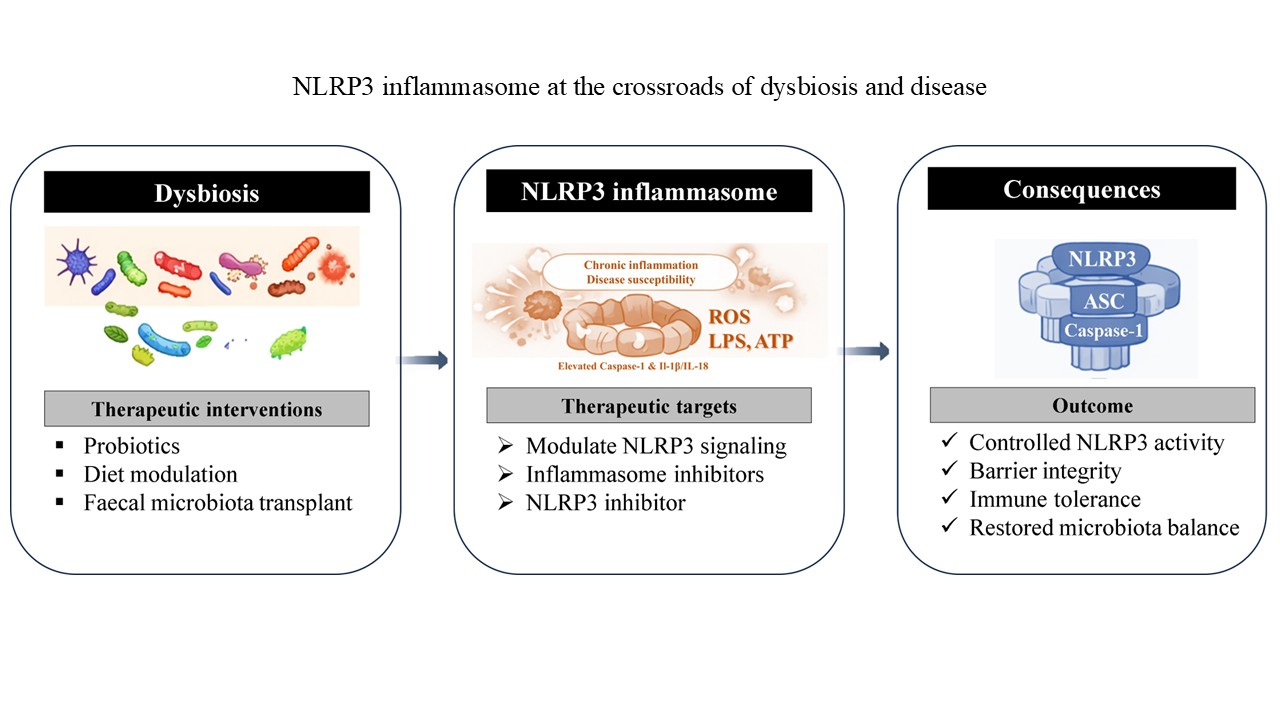
NLRP3 (NOD-, LRR-, and pyrin domain-containing protein 3) inflammasome at the crossroads of dysbiosis and disease: A target for microbiome-modulated inflammation

The NOD-, LRR- and pyrin domain-containing protein 3 (NLRP3) inflammasome is a critical regulator of inflammation and innate immunity, linking microbial and environmental signals to inflammatory responses. Dysbiosis, an imbalance in the composition of the microbiota, is increasingly recognized as a key trigger for aberrant NLRP3 activation. Under healthy conditions, NLRP3 protects against pathogens and maintains homeostasis; however, chronic activation driven by dysbiosis promotes low-grade inflammation and contributes to various diseases. In the gut, dysbiosis-induced NLRP3 activation is implicated in inflammatory bowel disease, colorectal cancer, obesity, and metabolic disorders. Beyond the gut, dysbiosis in the vaginal microbiome, oral cavity, and skin can activate the NLRP3 inflammasome, driving conditions, such as bacterial vaginosis, periodontitis, and chronic inflammatory skin diseases. Emerging evidence also links dysbiosis-associated NLRP3 activation to neurodegenerative disorders and autoimmune diseases, where systemic inflammation and microbiome disturbances accelerate disease progression. Understanding the mechanisms by which dysbiosis activates the NLRP3 inflammasome is critical for developing targeted therapeutic strategies. Interventions aimed at restoring microbial balance—such as dietary modification, probiotics, and inflammasome inhibitors—may offer promising approaches to mitigate NLRP3-driven inflammation and improve human health outcomes. This perspective highlights the complex interplay between dysbiosis and NLRP3 activation, with a focus on its role in health and disease and on emerging therapeutic strategies to restore homeostasis.
- Yang Y, Wang H, Kouadir M, Song H, Shi F. Recent advances in the mechanisms of NLRP3 inflammasome activation and its inhibitors. Cell Death Dis. 2019;10(2):128. doi: 10.1038/s41419-019-1413-8
- Paik S, Kim JK, Silwal P, Sasakawa C, Jo EK. An update on the regulatory mechanisms of NLRP3 inflammasome activation. Cell Mol Immunol. 2021;18(5):1141-1160. doi: 10.1038/s41423-021-00670-3
- Vande Walle L, Lamkanfi M. Drugging the NLRP3 inflammasome: From signalling mechanisms to therapeutic targets. Nat Rev Drug Discov. 2024;23(1):43-66. doi: 10.1038/s41573-023-00822-2
- Liao L, Schneider KM, Galvez EJC, et al. Intestinal dysbiosis augments liver disease progression via NLRP3 in a murine model of primary sclerosing cholangitis. Gut. 2019;68(8):1477-1492. doi: 10.1136/gutjnl-2018-316670
- Zhang H, Zhao T, Gu J, Tang F, Zhu L. Gut microbiota and inflammasome-mediated pyroptosis: A bibliometric analysis from 2014 to 2023. Front Microbiol. 2025;15:1413490. doi: 10.3389/fmicb.2024.1413490
- Heneka MT, Kummer MP, Stutz A, et al. NLRP3 is activated in Alzheimer’s disease and contributes to pathology in APP/ PS1 mice. Nature. 2013;493(7434):674-678. doi: 10.1038/nature11729
- Sokolova M, Yang K, Hansen SH, et al. NLRP3 inflammasome deficiency attenuates metabolic disturbances involving alterations in the gut microbial profile in mice exposed to high fat diet. Sci Rep. 2020;10(1):21006. doi: 10.1038/s41598-020-76497-1
- Xiao N, He W, Chen S, et al. Protective effect of egg yolk lipids against dextran sulfate sodium‐induced colitis: The key role of gut microbiota and short‐chain fatty acids. Mol Nutr Food Res. 2024;68(9):e2400048. doi: 10.1002/mnfr.202400048
- Seo SU, Kamada N, Muñoz-Planillo R, et al. Distinct commensals induce interleukin-1β via NLRP3 inflammasome in inflammatory monocytes to promote intestinal inflammation in response to injury. Immunity. 2015;42(4):744-755. doi: 10.1016/j.immuni.2015.03.004
- Zhou Y, Chen S, Gu W, Sun X, Wang L, Tang L. Sinomenine hydrochloride ameliorates dextran sulfate sodiuminduced colitis in mice by modulating the gut microbiota composition whilst suppressing the activation of the NLRP3 inflammasome. Exp Ther Med. 2021;22(5):1287. doi: 10.3892/etm.2021.10722
- Shukla PK, Delotterie DF, Xiao J, et al. Alterations in the Gut-microbial-inflammasome-brain axis in a mouse model of alzheimer’s disease. Cells. 2021;10(4):779. doi: 10.3390/cells10040779
- Zhao N, Chen X, Chen QG, et al. NLRP3-mediated autophagy dysfunction links gut microbiota dysbiosis to tau pathology in chronic sleep deprivation. Zool Res. 2024;45(4):857-874. doi: 10.24272/j.issn.2095-8137.2024.085
- Ding PH, Yang MX, Wang NN, et al. Porphyromonas gingivalis-induced NLRP3 inflammasome activation and its downstream interleukin-1β release depend on caspase-4. Front Microbiol. 2020;11:01881. doi: 10.3389/fmicb.2020.01881
- Wang B, Yang C, Jin X, et al. Regulation of antibody-mediated complement-dependent cytotoxicity by modulating the intrinsic affinity and binding valency of IgG for target antigen. mAbs. 2020;12(1):1690959. doi: 10.1080/19420862.2019.1690959
- Chen K, Shanmugam NKN, Pazos MA, Hurley BP, Cherayil BJ. Commensal bacteria-induced inflammasome activation in mouse and human macrophages is dependent on potassium efflux but does not require phagocytosis or bacterial viability. PLoS One. 2016;11(8):e0160937. doi: 10.1371/journal.pone.0160937
- Feng D, Guo L, Liu J, et al. DDX3X deficiency alleviates LPSinduced H9c2 cardiomyocytes pyroptosis by suppressing activation of NLRP3 inflammasome. Exp Ther Med. 2021;22(6):1389. doi: 10.3892/etm.2021.10825
- Hao H, Cao L, Jiang C, et al. Farnesoid X receptor regulation of the NLRP3 inflammasome underlies cholestasis-associated sepsis. Cell Metab. 2017;25(4):856-867.e5. doi: 10.1016/j.cmet.2017.03.007
- D’Espessailles A, Mora YA, Fuentes C, Cifuentes M. Calcium‐sensing receptor activates the NLRP3 inflammasome in LS14 preadipocytes mediated by ERK1/2 signaling. J Cell Physiol. 2018;233(8):6232-6240. doi: 10.1002/jcp.26490
- Rossol M, Pierer M, Raulien N, et al. Extracellular Ca2+ is a danger signal activating the NLRP3 inflammasome through G protein-coupled calcium sensing receptors. Nat Commun. 2012;3(1):1329. doi: 10.1038/ncomms2339
- Dufies O, Doye A, Courjon J, et al. Escherichia coli Rho GTPase-activating toxin CNF1 mediates NLRP3 inflammasome activation via p21-activated kinases-1/2 during bacteraemia in mice. Nat Microbiol. 2021;6(3):401-412. doi: 10.1038/s41564-020-00832-5
- Wang W, Li G, De Wu, et al. Zika virus infection induces host inflammatory responses by facilitating NLRP3 inflammasome assembly and interleukin-1β secretion. Nat Commun. 2018;9(1):106. doi: 10.1038/s41467-017-02645-3
- Hou K, Wu ZX, Chen XY, et al. Microbiota in health and diseases. Signal Transduct Target Ther. 2022;7(1):135. doi: 10.1038/s41392-022-00974-4
- Zaki MH, Lamkanfi M, Kanneganti TD. The Nlrp3 inflammasome: Contributions to intestinal homeostasis. Trends Immunol. 2011;32(4):171-179. doi: 10.1016/j.it.2011.02.002
- Zaki MH, Boyd KL, Vogel P, Kastan MB, Lamkanfi M, Kanneganti TD. The NLRP3 Inflammasome protects against loss of epithelial integrity and mortality during experimental colitis. Immunity. 2010;32(3):379-391. doi: 10.1016/j.immuni.2010.03.003
- Hirota SA, Ng J, Lueng A, et al. NLRP3 inflammasome plays a key role in the regulation of intestinal homeostasis. Inflamm Bowel Dis. 2011;17(6):1359-1372. doi: 10.1002/ibd.21478
- Chung IC, OuYang CN, Yuan SN, et al. Pretreatment with a heat-killed probiotic modulates the NLRP3 inflammasome and attenuates colitis-associated colorectal cancer in mice. Nutrients. 2019;11(3):516. doi: 10.3390/nu11030516
- Shimada K, Crother TR, Karlin J, et al. Oxidized mitochondrial DNA activates the NLRP3 inflammasome during apoptosis. Immunity. 2012;36(3):401-414. doi: 10.1016/j.immuni.2012.01.009
- Hung SC, Huang PR, Almeida-da-Silva CLC, Atanasova KR, Yilmaz O, Ojcius DM. NLRX1 modulates differentially NLRP3 inflammasome activation and NF-κB signaling during Fusobacterium nucleatum infection. Microbes Infect. 2018;20(9-10):615-625. doi: 10.1016/j.micinf.2017.09.014
- McGettrick AF, O’Neill LAJ. NLRP3 and IL-1β in macrophages as critical regulators of metabolic diseases. Diabetes Obes Metab. 2013;15 Suppl 3:19-25. doi: 10.1111/dom.12169
- Feng Y, Wang Y, Wang P, Huang Y, Wang F. Short-chain fatty acids manifest stimulative and protective effects on intestinal barrier function through the inhibition of NLRP3 inflammasome and autophagy. Cell Physiol Biochem Int J Exp Cell Physiol Biochem Pharmacol. 2018;49(1):190-205. doi: 10.1159/000492853
- Yue Y, Chen Y, Liu H, et al. Shugan Hewei decoction alleviates cecum mucosal injury and improves depressive- and anxiety-like behaviors in chronic stress model rats by regulating cecal microbiota and inhibiting NLRP3 inflammasome. Front Pharmacol. 2021;12:766474. doi: 10.3389/fphar.2021.766474
- Feng Y, Huang Y, Wang Y, Wang P, Song H, Wang F. Antibiotics induced intestinal tight junction barrier dysfunction is associated with microbiota dysbiosis, activated NLRP3 inflammasome and autophagy. PLOS One. 2019;14(6):e0218384. doi: 10.1371/journal.pone.0218384
- Wong ML, Inserra A, Lewis MD, et al. Inflammasome signaling affects anxiety- and depressive-like behavior and gut microbiome composition. Mol Psychiatry. 2016;21(6):797-805. doi: 10.1038/mp.2016.46
- Franchi L, Muñoz-Planillo R, Núñez G. Sensing and reactingto microbes through the inflammasomes. Nat Immunol. 2012;13(4):325-332. doi: 10.1038/ni.2231
- Lin Y, Li Z, Wang Y, et al. CCDC50 suppresses NLRP3 inflammasome activity by mediating autophagic degradation of NLRP3. EMBO Rep. 2022;23(5):e54453. doi: 10.15252/embr.202154453
- Muñoz-Planillo R, Kuffa P, Martínez-Colón G, Smith BL, Rajendiran TM, Núñez G. K+ efflux is the common trigger of NLRP3 inflammasome activation by bacterial toxins and particulate matter. Immunity. 2013;38(6):1142-1153. doi: 10.1016/j.immuni.2013.05.016
- Zhen Y, Zhang H. NLRP3 Inflammasome and inflammatory bowel disease. Front Immunol. 2019;10:276. doi: 10.3389/fimmu.2019.00276
- Shen C, Luo Z, Ma S, et al. Microbe-derived antioxidants protect IPEC-1 cells from H2O2-induced oxidative stress, inflammation and tight junction protein disruption via activating the Nrf2 pathway to inhibit the ROS/NLRP3/IL-1β signaling pathway. Antioxid Basel Switz. 2024;13(5):533. doi: 10.3390/antiox13050533
- Machado D, Castro J, Palmeira-de-Oliveira A, Martinez-de- Oliveira J, Cerca N. Bacterial vaginosis biofilms: Challenges to current therapies and emerging solutions. Front Microbiol. 2015;6:1528. doi: 10.3389/fmicb.2015.01528
- Vodstrcil LA, Muzny CA, Plummer EL, Sobel JD, Bradshaw CS. Bacterial vaginosis: Drivers of recurrence and challenges and opportunities in partner treatment. BMC Med. 2021;19(1):194. doi: 10.1186/s12916-021-02077-3
- Saleem F, Malik M, Shahid MS, Tayyab M. Bacterial vaginosis: Comparison between metronidazole vaginal gel and clindamycin vaginal cream for treatment of bacterial vaginosis. Prof Med J. 2017;24(2):252-257. doi: 10.29309/TPMJ/2017.24.02.520
- Swanson KV, Deng M, Ting JPY. The NLRP3 inflammasome: Molecular activation and regulation to therapeutics. Nat Rev Immunol. 2019;19(8):477-489. doi: 10.1038/s41577-019-0165-0
- Zito G, Buscetta M, Cimino M, Dino P, Bucchieri F, Cipollina C. Cellular models and assays to study NLRP3 inflammasome biology. Int J Mol Sci. 2020;21(12):4294. doi: 10.3390/ijms21124294
- Pirzada RH, Javaid N, Choi S. The roles of the NLRP3 inflammasome in neurodegenerative and metabolic diseases and in relevant advanced therapeutic interventions. Genes. 2020;11(2):131. doi: 10.3390/genes11020131
- Xu J, Zhang L, Duan Y, et al. NEK7 phosphorylation amplifies NLRP3 inflammasome activation downstream of potassium efflux and gasdermin D. Sci Immunol. 2025;10(103):eadl2993. doi: 10.1126/sciimmunol.adl2993
- Kobayashi T, Imanishi I. Epithelial-immune crosstalk with the skin microbiota in homeostasis and atopic dermatitis - a mini review. Vet Dermatol. 2021;32(6):533-e147. doi: 10.1111/vde.13007
- Sand J, Haertel E, Biedermann T, et al. Expression of inflammasome proteins and inflammasome activation occurs in human, but not in murine keratinocytes. Cell Death Dis. 2018;9(2):24. doi: 10.1038/s41419-017-0009-4
- Di Domenico EG, Cavallo I, Capitanio B, et al. Staphylococcus aureus and the cutaneous microbiota biofilms in the pathogenesis of atopic dermatitis. Microorganisms. 2019;7(9):301. doi: 10.3390/microorganisms7090301
- Kim J, Kim BE, Leung DYM. Pathophysiology of atopic dermatitis: Clinical implications. Allergy Asthma Proc. 2019;40(2):84-92. doi: 10.2500/aap.2019.40.4202
- Su F, Xia Y, Huang M, Zhang L, Chen L. Expression of NLPR3 in psoriasis is associated with enhancement of interleukin-1β and caspase-1. Med Sci Monit Int Med J Exp Clin Res. 2018;24:7909-7913. doi: 10.12659/MSM.911347
- Castillo-González R, Fernández-Delgado I, Comberiati P. Bacteriotherapy with human skin commensals in atopic dermatitis. Allergy. 2022;77(4):1331-1333. doi: 10.1111/all.15162
- Alipour M, Lou Y, Zimmerman D, et al. A balanced IL-1β activity is required for host response to Citrobacter rodentium infection. PloS One. 2013;8(12):e80656. doi: 10.1371/journal.pone.0080656
- Kostadinova E, Chaput C, Gutbier B, et al. NLRP3 protects alveolar barrier integrity by an inflammasome-independent increase of epithelial cell adherence. Sci Rep. 2016;6(1):30943. doi: 10.1038/srep30943
- Arbore G, West EE, Spolski R, et al. T helper 1 immunity requires complement-driven NLRP3 inflammasome activity in CD4+ T cells. Science. 2016;352(6292):aad1210. doi: 10.1126/science.aad1210