
Genetic analysis of GJA3 and GJA8 mutations in cataract patients from the Jammu region, North India

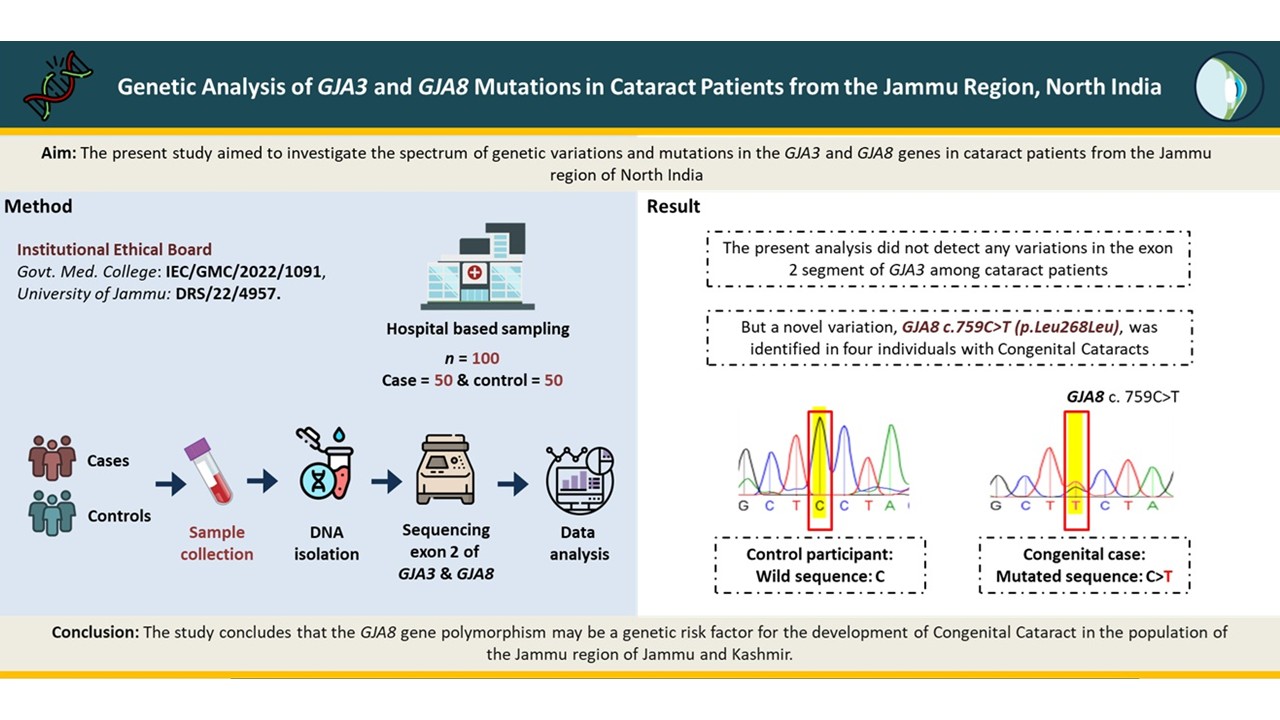
Cataracts are a clinically and genetically heterogeneous cause of visual impairment and have multifactorial causes, in which genetic factors play a significant role. Numerous studies suggest that mutations in genes involved in maintaining lens transparency contribute to the development of cataracts. Therefore, the present study aimed to investigate the spectrum of genetic variations and mutations in the GJA3 and GJA8 genes in cataract patients from the Jammu region of North India. A total of 100 individuals were enrolled, consisting of 50 cataract patients (senile [n = 35 and congenital cataracts (CCs) [n = 15), diagnosed by an ophthalmologist, and 50 healthy controls. DNA was extracted, followed by amplification of the targeted regions of the GJA8 and GJA3 genes using polymerase chain reaction. The amplified DNA was then sequenced using the Sanger sequencing method. A novel heterozygous C>T transition at nucleotide position 759 in exon 2 of the GJA8 gene (connexin 50) was identified in four CC patients. This silent variation caused a leucine-to-leucine substitution at amino acid position 268. Importantly, this mutation was not found in any of the 50 healthy controls or the other 46 cataract patients. No mutations were detected in the GJA3 gene. The study concludes that this GJA8 gene polymorphism may be a genetic risk factor for the development of CCs in the Jammu region of North India.
- Cicinelli MV, Buchan JC, Nicholson M, Varadaraj V, Khanna RC. Cataracts. Lancet. 2023;401(10374):377-389. doi: 10.1016/S0140-6736(22)01839-6
- Churchill A, Graw J. Clinical and experimental advances in congenital and paediatric cataracts. Philos Trans R Soc B Biol Sci. 2011;366(1562):1234-1249. doi: 10.1098/rstb.2010.0227
- Deng H, Yuan L. Molecular genetics of congenital nuclear cataract. Eur J Med Genet. 2014;57(2-3):113-122. doi: 10.1016/j.ejmg.2013.12.006
- Li Y, Liu Y, Liu Y, Guo H, Hu ZK, Jin X. Identification of a GJA3 mutation in a large family with bilateral congenital cataract. DNA Cell Biol. 2016;35(3):135-139. doi: 10.1089/dna.2015.3125
- Hilal LN, Nandrot E, Belmekki M, et al. Evidence of clinical and genetic heterogeneity in autosomal dominant congenital cerulean cataracts. Ophthalmic Genet. 2002;23(4):199-208. doi: 10.1076/opge.23.4.199.13881
- Shiels A, Hejtmancik JF. Genetics of human cataract. Clin Genet. 2013;84(2):120-127. doi: 10.1111/cge.12182
- Hejtmancik JF, Kantorow M. Molecular genetics of age-related cataract. Exp Eye Res. 2004;79(1):3-9. doi: 10.1016/j.exer.2004.03.014
- Shiels A, Hejtmancik JF. Inherited cataracts: Genetic mechanisms and pathways new and old. Exp Eye Res. 2021;209:108662. doi: 10.1016/j.exer.2021.108662
- Beyer EC, Ebihara L, Berthoud VM. Connexin mutants and cataracts. Front Pharmacol. 2013;4:43. doi: 10.3389/fphar.2013.00043
- Sudershan A, Mahajan K, Panjaliya RK, Dhar MK, Kumar P. Algorithm for sample availability prediction in a hospital-based epidemiological study spreadsheet-based sample availability calculator. Sci Rep. 2022;12(1):1860. doi: 10.1038/s41598-021-03399-1
- Sambrook J, Russell DW. Molecular Cloning: A Laboratory Manual. 3rd ed. Cold Spring Harbor, NY: Cold Spring Harbor Laboratory Press; 2001.
- Wang W, Yan W, Fotis K, et al. Cataract surgical rate and socioeconomics: A global study. Invest Ophthalmol Vis Sci. 2016;57(14):5872-5881. doi: 10.1167/iovs.16-19894
- Addison PKF, Berry V, Holden KR, et al. A novel mutation in the connexin 46 gene (GJA3) causes autosomal dominant zonular pulverulent cataract in a Hispanic family. Mol Vis. 2006;12:791-795.
- Hansen L, Yao W, Eiberg H, et al. Genetic heterogeneity in microcornea-cataract: Five novel mutations in CRYAA, CRYGD, and GJA8. Invest Ophthalmol Vis Sci. 2007;48:3937-3945. doi: 10.1167/iovs.07-0013
- Devi RR, Reena C, Vijayalakshmi P. Novel mutations in GJA3 associated with autosomal dominant congenital cataract in the Indian population. Mol Vis. 2005;11:846-852.
- Ma ZW, Ma Z, Zheng JQ, et al. Two novel mutations of connexin genes in Chinese families with autosomal dominant congenital nuclear cataract. Br J Ophthalmol. 2005;89:1535-1537. doi: 10.1136/bjo.2005.075184
- Zhou Z, Hu S, Wang B, et al. Mutation analysis of congenital cataract identified a novel missense mutation in connexin 46. Mol Vis. 2010;16:713-719.
- Bennett TM, Mackay DS, Knopf HLS, Shiels A. A novel missense mutation in GJA3 associated with autosomal dominant nuclear punctate cataracts. Hum Mol Genet. 2004;10:376-382.
- Yang G, Xing B, Liu G, et al. A novel mutation in GJA3 associated with autosomal dominant congenital nuclear cataract. Mol Vis. 2011;17:1070-1073.
- Guo S, Liu Y, Qiao C, et al. Mutant connexin 50 inhibits channel and hemichannel functions inducing cataract. J Genet. 2013;94(2):221-229.
- Rees MI, Watts P, Fenton I, et al. Autosomal dominant congenital zonular cataracts linked to 13q11 and a novel GJA3 mutation. Hum Genet. 2000;106:206-209. doi: 10.1007/s004390051029
- Ding X, Wang B, Luo Y, et al. A novel mutation in connexin 46 associated with congenital cataract. Mol Vis. 2011;17:1343-1349.
- Li Y, Wang J, Dong B, Man H. A connexin 46 mutation in autosomal dominant congenital nuclear pulverulent cataract. Mol Vis. 2004;10:668-671.
- Zhang X, Wang L, Wang J, Dong B, Li Y. Coralliform cataract caused by a novel connexin 46 mutation. Mol Vis. 2012;18:203-210.
- Guleria K, Sperling K, Singh D, Varon R, Singh JR. A novel GJA3 mutation in an Indian family with congenital cataract. Mol Vis. 2007;13:1657-1665.
- Santhiya ST, Kumar GS, Sudhakar P, et al. Molecular analysis of cataract families in India. Mol Vis. 2010;16:1837-1847.
- Jiang H, Jin Y, Bu L, et al. A novel GJA3 mutation for autosomal dominant congenital cataract. Mol Vis. 2003;9:579-583.
- Yao K, Jin C. A nonsense mutation in CRYGC associated with congenital nuclear cataract. Mol Vis. 2011;14:1272-1276.
- Burdon KP, Wirth MG, Mackey DA, et al. A novel GJA3 mutation causing congenital cataract with incomplete penetrance. J Med Genet. 2004;41:e106.
- White TW, Bruzzone R, Goodenough DA, Paul DL. Mouse Cx50 is the lens fiber protein MP70. Mol Biol Cell. 1992;3(6):711-720. doi: 10.1091/mbc.3.7.711
- Rong P, Wang X, Niesman I, et al. Disruption of GJA8 (α8 connexin) in mice leads to microphthalmia associated with retardation of lens growth and fiber maturation. Development. 2002;129(1):167-174. doi: 10.1242/dev.129.1.167
- Mathias RT, Riquelme G, Rae JL. Cell-to-cell communication and pH in the frog lens. J Gen Physiol. 1991;98(6):1085-1103. doi: 10.1085/jgp.98.6.1085
- Mathias RT, Rae JL, Baldo GJ. Physiological properties of the normal lens. Physiol Rev. 1997;77(1):21-50. doi: 10.1152/physrev.1997.77.1.21
- White TW, Goodenough DA, Paul DL. Targeted ablation of connexin50 in mice results in microphthalmia and zonular pulverulent cataracts. J Cell Biol. 1998;143(3):815-825. doi: 10.1083/jcb.143.3.815
- Willoughby CE, Arab S, Gandhi R, et al. A novel GJA8 mutation in an Iranian family with progressive autosomal dominant congenital nuclear cataract. J Med Genet. 2003;40:e124.
- Devi RR, Vijayalakshmi P. Novel mutations in GJA8 associated with autosomal dominant congenital cataract and microcornea. Mol Vis. 2006;12:190-195.
- Vanita V, Hennies HC, Singh D, et al. A novel GJA8 mutation associated with autosomal dominant congenital cataract in an Indian family. Mol Vis. 2006;12:1217-1222.
- Vanita V, Singh JR, Singh D, Varon R, Sperling K. A GJA8 mutation associated with balloon-like cataract with Y-sutural opacities. Mol Vis. 2008;14:1171-1175.
- Kumar M, Agarwal T, Khokhar S, et al. Mutation screening and genotype–phenotype correlation of crystallin and GJA8 genes in congenital cataract. Mol Vis. 2011;17:693-707.
- Poonam D, Sinha BP, Bhaskar G. Outcome of cataract surgery in diabetic and non-diabetic patients: A comparative study. Eur J Mol Clin Med. 2013;7(11):5424-5430.
- Polyakov A, Shagina I, Khlebnikova O, Evgrafov O. Mutation in connexin 50 (GJA8) in a Russian family with zonular pulverulent cataract. Clin Genet. 2001;60:476-478. doi: 10.1034/j.1399-0004.2001.600614.x
- Schmidt W, Klopp N, Illig T, Graw J. A novel GJA8 mutation causing a recessive triangular cataract. Mol Vis. 2008;14:851-856.
- Yan M, Xiong C, Ye SQ, et al. A novel connexin 50 mutation in a Chinese family with dominant congenital pulverulent nuclear cataract. Mol Vis. 2008;14:418-424.
- Berry V, Francis P, Reddy MA, et al. Alpha-B crystallin gene mutation causes dominant congenital posterior polar cataract. Am J Hum Genet. 1998;69(5):1141-1145. doi: 10.1086/324158
- Shiels A, MacKay D, Ionides A, et al. A missense mutation in connexin50 underlies autosomal dominant zonular pulverulent cataract. Am J Hum Genet. 1998;62:526-532. doi: 10.1086/301762
- Reddy MA, Francis PJ, Berry V, Bhattacharya SS, Moore AT. Molecular genetic basis of inherited cataract and associated phenotypes. Surv Ophthalmol. 2004;49(3):300-315. doi: 10.1016/j.survophthal.2004.02.013
- Hejtmancik JF. Congenital cataracts and their molecular genetics. Semin Cell Dev Biol. 2008;19(2):134-149. doi: 10.1016/j.semcdb.2007.10.003
- Solebo AL, Teoh L, Rahi J. Epidemiology of blindness in children. Arch Dis Child. 2017;102(9):853-857. doi: 10.1136/archdischild-2016-310532
- Li J, Chen X, Yan Y, Yao K. Molecular genetics of congenital cataracts. Exp Eye Res. 2020;191:107872. doi: 10.1016/j.exer.2019.107872
- Messina-Baas O, Cuevas-Covarrubias SA. Inherited congenital cataract: A guide to suspect genetic etiology. Mol Syndromol. 2017;8(2):58-78. doi: 10.1159/000455752
- Ma AS, Grigg JR, Ho G, et al. Sporadic and familial congenital cataracts: Mutational spectrum using next-generation sequencing. Hum Mutat. 2016;37(4):371-384. doi: 10.1002/humu.22948
- Vanita V, Singh JR, Singh D. Genetic and segregation analysis of congenital cataract in the Indian population. Clin Genet. 1999;56(5):389-393. doi: 10.1034/j.1399-0004.1999.560507.x
- Ionides A, Francis P, Berry V, et al. Clinical and genetic heterogeneity in autosomal dominant cataract. Br J Ophthalmol. 1999;83(7):802-808. doi: 10.1136/bjo.83.7.802
- Wu X, Long E, Lin H, Liu Y. Prevalence and epidemiological characteristics of congenital cataract: A meta-analysis. Sci Rep. 2016;6:28564. doi: 10.1038/srep28564
- Zhou Y, Zhai Y, Huang L, et al. A novel CRYBB2 stopgain mutation causing autosomal dominant cataract. J Ophthalmol. 2016;2016:4353957. doi: 10.1155/2016/4353957
- Graw J. Mouse models of cataract. J Genet. 2009;88(4):469-486. doi: 10.1007/s12041-009-0066-2
- Shiels A, Bennett TM, Hejtmancik JF. Cat-Map: Putting cataract on the map. Mol Vis. 2010;16:2007-2015.
- Pichi F, Lembo A, Serafino M, Nucci P. Genetics of congenital cataract. Dev Ophthalmol. 2016;57:1-14. doi: 10.1159/000442495
- Shiels A, Hejtmancik JF. Mutations and mechanisms in congenital and age-related cataracts. Exp Eye Res. 2017;156:95-102. doi: 10.1016/j.exer.2016.06.011
- Uwineza A, Kalligeraki AA, Hamada N, et al. Cataractogenic load and ionizing radiation-induced accelerated aging of the eye lens. Mutat Res Rev Mutat Res. 2019;779:68-81. doi: 10.1016/j.mrrev.2019.02.004