
Beyond defense: Immunity as an evolutionary network for preserving biological organization from microbes to complex life

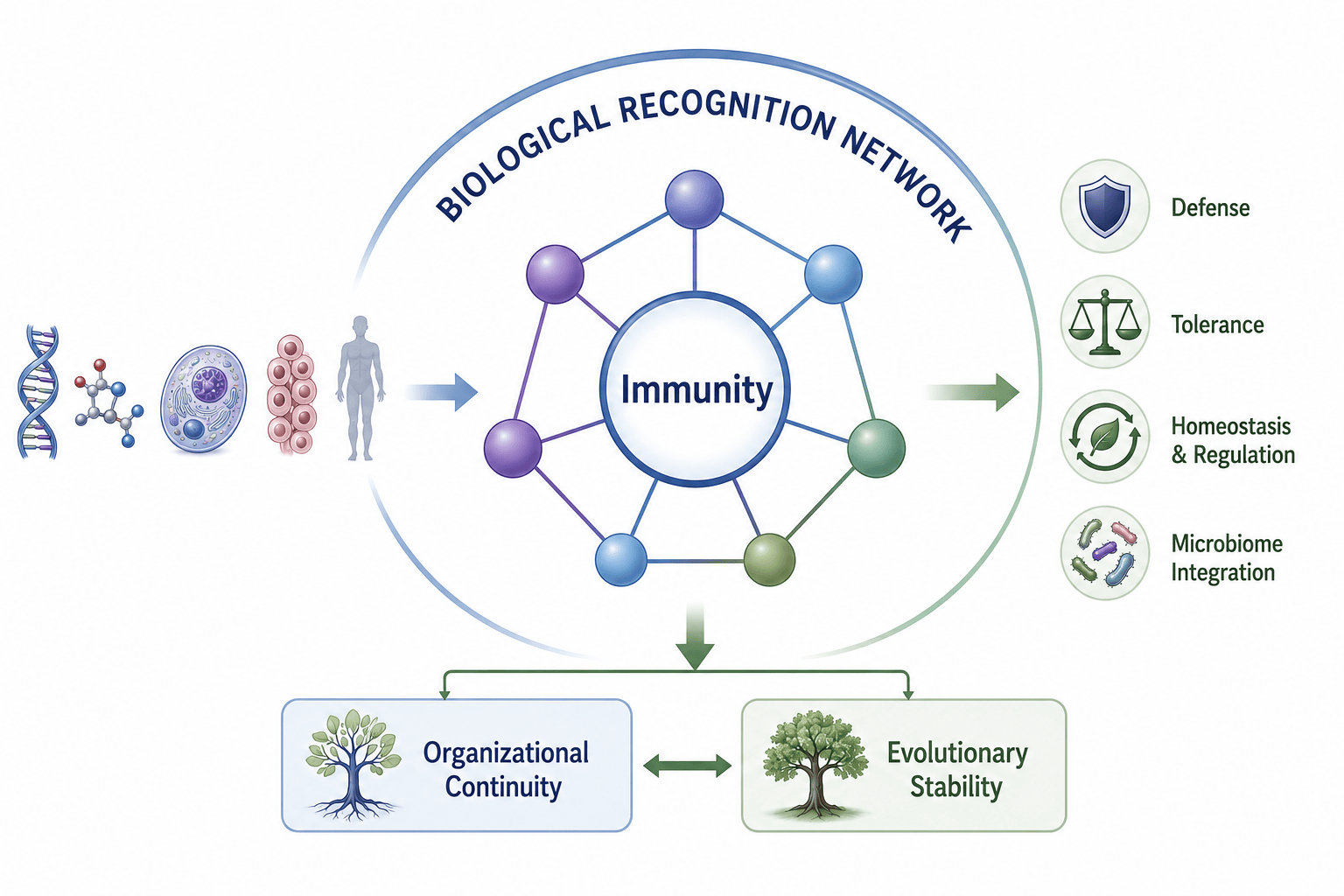
Biological evolution has produced increasing organizational complexity, from molecular systems to integrated multicellular organisms. Natural selection explains why advantageous variation persists, but sustaining increasingly complex living systems also requires mechanisms that preserve functional organization while allowing continual adaptive change. We propose that immunity is one of the principal networks providing this continuity: rather than serving solely as pathogen defense, it functions as an evolved recognition-and-regulation system that shapes compatible relationships across linked cellular, tissue, organismal, and host-associated ecological levels. Here, a compatible relationship is one that, within a defined biological context and timescale, sustains or can be regulated to restore system-level function; compatibility does not imply permanence, harmony, or the absence of conflict. Drawing on immunology, microbiology, evolutionary biology, developmental biology, and host–microbiome research, we argue that the progressive refinement of biological recognition has let increasingly complex organisms maintain functional coherence amid genetic variation, microbial interactions, developmental remodeling, and environmental change. Host defense, immune tolerance, tissue homeostasis, inflammatory regulation, and host–microbiome interactions are complementary expressions of this broader organizational function, which preserves biological integrity while accommodating innovation. Compatible biological relationships thus supply the organizational context in which complexity can accumulate, integrate new functions, and persist over evolutionary time. This is not a new mechanism of evolution, but an organizational principle unifying established findings across disciplines, positioning immunity as an important contributor to the preservation of biological organization during the continued evolution of complex life.
- Stefano GB. Immunity as an evolutionary stabilizer: Microbial competition, biological complexity, and thermodynamic organization. Microbes Immun. 2026. doi: 10.36922/MI026240066
- Müller GB, Newman SA, editors. Origination of Organismal Form: Beyond the Gene in Developmental and Evolutionary Biology. Cambridge, MA: MIT Press; 2003.doi: 10.7551/mitpress/5182.001.0001
- Maynard Smith J, Szathmáry E. The Major Transitions in Evolution. Oxford: Oxford University Press; 1995. Accessed July 8, 2026. https://academic.oup.com/book/40636
- Janeway CA Jr, Medzhitov R. Innate immune recognition. Annu Rev Immunol. 2002;20:197-216.doi: 10.1146/annurev.immunol.20.083001.084359
- Zheng D, Liwinski T, Elinav E. Interaction between microbiota and immunity in health and disease. Cell Res. 2020;30(6):492-506. doi: 10.1038/s41422-020-0332-7
- Pradeu T, Thomma BPHJ, Girardin SE, Lemaitre B. The conceptual foundations of innate immunity: Taking stock 30 years later. Immunity. 2024;57(4):613-631. doi: 10.1016/j.immuni.2024.03.007
- Stefano GB. Energy evolution to matter to cognition: Thermodynamic dependency, conformational matching, and the emergence of intelligent systems. J Surg. 2026;11:11600. doi: 10.29011/2575-9760.011600
- Stefano GB. Life as a thermodynamic continuum: Genetic sharing and the unified architecture of biological systems. Biomed J Sci Tech Res. 2026;65(4):57865-57870. doi: 10.26717/BJSTR.2026.65.010221
- Akira S, Uematsu S, Takeuchi O. Pathogen recognition and innate immunity. Cell. 2006;124(4):783-801. doi: 10.1016/j.cell.2006.02.015
- Stefano GB. Adaptability beyond Darwin: Microbial evolution, mitochondria, and the thermodynamic frontiers of survival. Front Biosci. 2025;30(10):45962. doi: 10.31083/FBL45962
- Koonin EV, Wolf YI. Evolution of microbes and viruses: A paradigm shift in evolutionary biology? Front Cell Infect Microbiol. 2012;2:119. doi: 10.3389/fcimb.2012.00119
- Daubin V, Szöllősi GJ. Horizontal gene transfer and the history of life. Cold Spring Harb Perspect Biol. 2016;8(4):a018036. doi: 10.1101/cshperspect.a018036
- Hug LA, Baker BJ, Anantharaman K, et al. A new view of the tree of life. Nat Microbiol. 2016;1(5):16048. doi: 10.1038/nmicrobiol.2016.48
- Barrangou R, Fremaux C, Deveau H, et al. CRISPR provides acquired resistance against viruses in prokaryotes. Science. 2007;315(5819):1709-1712. doi: 10.1126/science.1138140
- Bernheim A, Sorek R. The pan-immune system of bacteria: Antiviral defence as a community resource. Nat Rev Microbiol. 2020;18(2):113-119. doi: 10.1038/s41579-019-0278-2
- Margulis L. Origin of Eukaryotic Cells: Evidence and Research Implications for a Theory of the Origin and Evolution of Microbial, Plant, and Animal Cells on the Precambrian Earth. New Haven, CT: Yale University Press; 1970. Accessed June 3, 2026. https://openlibrary.org/books/OL5700102M/Origin_of_eukaryotic_cells
- McFall-Ngai M, Hadfield MG, Bosch TCG, et al. Animals in a bacterial world, a new imperative for the life sciences. Proc Natl Acad Sci USA. 2013;110(9):3229-3236. doi: 10.1073/pnas.1218525110
- Keeling PJ, McCutcheon JP. Endosymbiosis: The feeling is not mutual. J Theor Biol. 2017;434:75-79.doi: 10.1016/j.jtbi.2017.06.008
- Medzhitov R. Recognition of microorganisms and activation of the immune response. Nature. 2007;449(7164):819-826. doi: 10.1038/nature06246
- Flajnik MF. A cold-blooded view of adaptive immunity. Nat Rev Immunol. 2018;18(7):438-453. doi: 10.1038/s41577-018-0003-9
- Chaplin DD. Overview of the immune response. J Allergy Clin Immunol. 2010;125(2):S3-S23. doi: 10.1016/j.jaci.2009.12.980
- Murphy K, Weaver C, Berg LJ. Janeway’s Immunobiology. 10th ed. New York: W.W. Norton & Company; 2022. Accessed July 8, 2026. https://wwnorton.com/books/9780393884890
- Matzinger P. The danger model: A renewed sense of self. Science. 2002;296(5566):301-305.doi: 10.1126/science.1071059
- Pradeu T. The Limits of the Self: Immunology and Biological Identity. Vitanza E, translator. New York: Oxford University Press; 2012. doi: 10.1093/acprof:oso/9780199775286.001.0001
- Medzhitov R. Origin and physiological roles of inflammation. Nature. 2008;454(7203):428-435. doi: 10.1038/nature07201
- Belkaid Y, Hand TW. Role of the microbiota in immunity and inflammation. Cell. 2014;157(1):121-141. doi: 10.1016/j.cell.2014.03.011
- Foster KR, Schluter J, Coyte KZ, Rakoff-Nahoum S. The evolution of the host microbiome as an ecosystem on a leash. Nature. 2017;548(7665):43-51. doi: 10.1038/nature23292
- Finlay BB, McFadden G. Anti-immunology: Evasion of the host immune system by bacterial and viral pathogens. Cell. 2006;124(4):767-782. doi: 10.1016/j.cell.2006.01.034
- West-Eberhard MJ. Developmental Plasticity and Evolution. New York: Oxford University Press; 2003. doi: 10.1093/oso/9780195122343.001.0001
- Müller GB. Why an extended evolutionary synthesis is necessary. Interface Focus. 2017;7(5):20170015. doi: 10.1098/rsfs.2017.0015
- Wagner A. Arrival of the Fittest. New York: Current; 2014. Accessed June 14, 2026. https://www.penguinrandomhouse.com/books/314334/arrival-of-the-fittest-by-andreas-wagner/
- Alberts B, Heald R, Johnson A, et al. Molecular Biology of the Cell. 7th ed. New York: W.W. Norton & Company; 2022. Accessed July 2, 2026. https://wwnorton.com/books/9780393884821
- Gilbert SF, Sapp J, Tauber AI. A symbiotic view of life: We have never been individuals. Q Rev Biol. 2012;87(4):325-341. doi: 10.1086/668166
- Kitano H. Biological robustness. Nat Rev Genet. 2004;5(11):826-837. doi: 10.1038/nrg1471
- Levin M. Life, death, and self: Fundamental questions of primitive cognition viewed through the lens of body plasticity and synthetic organisms. Biochem Biophys Res Commun. 2021;564:114-133. doi: 10.1016/j.bbrc.2020.10.077
- Stefano GB. Beyond amyloid: Evolutionary and immune-metabolic perspectives on Alzheimer’s disease. Front Biosci. 2026;31(6):53859. doi: 10.31083/FBL53859
- Gaut NJ, Deich C, Cash B, Hoog T, Engelhart AE, Adamala KP. A chemically defined synthetic cell capable of growth and replication. bioRxiv. Preprint posted online July 2, 2026. doi: 10.64898/2026.07.01.735724
- Ozturk SF, Sasselov DD. Life’s homochirality: Across a prebiotic network. Proc Natl Acad Sci USA. 2025;122(34):e2505126122. doi: 10.1073/pnas.2505126122
- Adamala KP, Agashe D, Belkaid Y, et al. Confronting risks of mirror life. Science. 2024;386(6728):1351-1353. doi: 10.1126/science.ads9158