
Pharmacokinetic scaling and pharmacokinetics/pharmacody-namics for rational prediction of antibacterial dosage regimens in animals to mitigate antimicrobial resistance

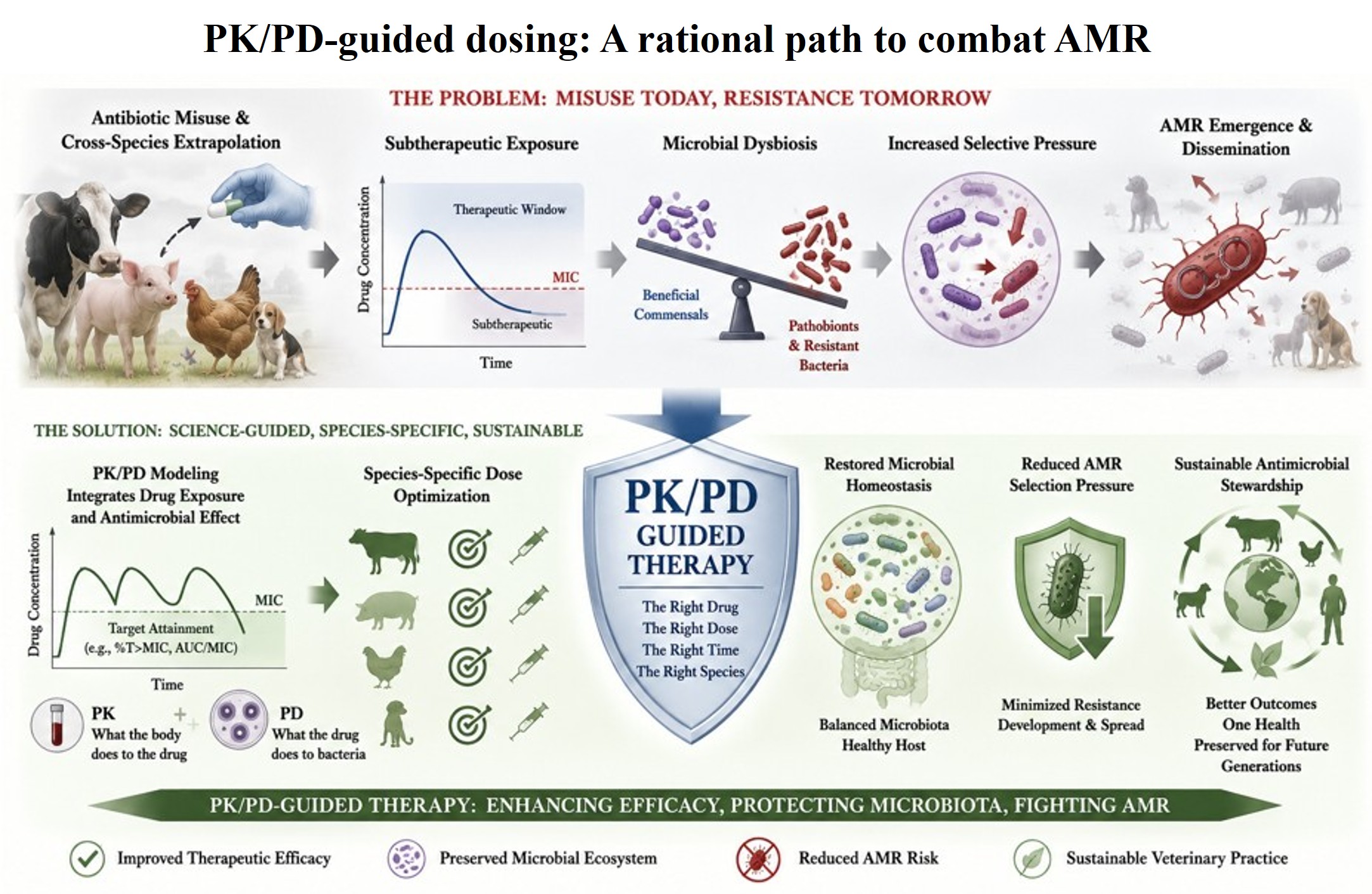
The rapid emergence of antimicrobial resistance (AMR) has become a significant challenge in both human and veterinary medicine, largely driven by the misuse and overuse of antibiotics, including inappropriate cross-species dosage extrapolation. Empirical antimicrobial dosing can result in subtherapeutic exposure, disruption of the microbial ecosystem, and increased selective pressure, thereby accelerating the emergence and dissemination of resistant bacteria. Maintaining microecological homeostasis, particularly the stability of the commensal microbiota, is increasingly recognized as essential for limiting the development of resistance and preserving host health. Although interspecies scaling, Monte Carlo simulations, population pharmacokinetics (PK), and physiologically based PK models have been used to predict dosage regimens, their complexity and extensive data requirements restrict routine application in veterinary practice. In this context, PK/pharmacodynamic (PD) modeling provides a practical and scientifically robust framework for rational antimicrobial therapy. By integrating drug concentration–time profiles with antimicrobial effects, PK/PD-guided approaches enable species-specific dose optimization that improves therapeutic efficacy, minimizes ecological disruption, and reduces AMR selection pressure. This review highlights the application of modern PK/PD strategies in veterinary medicine as an essential tool for sustainable antimicrobial stewardship, AMR mitigation, and preservation of microbial ecosystem stability.
- Van Boeckel TP, Brower C, Gilbert M, et al. Global trends in antimicrobial use in food animals. Proc Natl Acad Sci USA. 2015;112(18):5649-5654. doi: 10.1073/pnas.1503141112
- Cromwell GL. Why and how antibiotics are used in swine production. Anim Biotechnol. 2002;13(1):7-27. doi: 10.1081/ABIO-120005767
- Lei Z, Liu Q, Xiong J, et al. Pharmacokinetic and Pharmacodynamic Evaluation of Marbofloxacin and PK/PD Modeling against Escherichia coli in Pigs. Front Pharmacol. 2017;8:542. doi: 10.3389/fphar.2017.00542
- Van Boeckel TP, Glennon EE, Chen D, et al. Reducing antimicrobial use in food animals. Science. 2017;357(6358):1350-1352. doi: 10.1126/science.aao1495
- Tiseo K, Huber L, Gilbert M, Robinson TP, Van Boeckel TP. Global Trends in Antimicrobial Use in Food Animals from 2017 to 2030. Antibiotics. 2020;9(12):918. doi: 10.3390/antibiotics9120918
- Sartorius B, Gray AP, Davis Weaver N, et al. The burden of bacterial antimicrobial resistance in the WHO African region in 2019: a cross-country systematic analysis. Lancet Global Health. 2024;12(2):e201-e216. doi: 10.1016/s2214-109x(23)00539-9
- Ferdinand AS, McEwan C, Lin C, et al. Development of a cross-sectoral antimicrobial resistance capability assessment framework. BMJ Glob Health. 2024;9(1):e013280. doi: 10.1136/bmjgh-2023-013280
- Caneschi A, Bardhi A, Barbarossa A, Zaghini A. The Use of Antibiotics and Antimicrobial Resistance in Veterinary Medicine, a Complex Phenomenon: A Narrative Review. Antibiotics. 2023;12(3):487. doi: 10.3390/antibiotics12030487
- MacGowan A, Macnaughton E. Antibiotic resistance. Medicine. 2017;45(10):622-628. doi: 10.1016/j.mpmed.2017.07.006
- Shehab N, Patel PR, Srinivasan A, Budnitz DS. Emergency department visits for antibiotic-associated adverse events. Clin Infect Dis. 2008;47(6):735-743. doi: 10.1086/591126
- Cameron A, McAllister TA. Antimicrobial usage and resistance in beef production. J Anim Sci Biotechnol. 2016;7:68. doi: 10.1186/s40104-016-0127-3
- Mithuna R, Tharanyalakshmi R, Jain I, et al. Emergence of antibiotic resistance due to the excessive use of antibiotics in medicines and feed additives: A global scenario with emphasis on the Indian perspective. Emerg Contam. 2024;10(4):100389. doi: 10.1016/j.emcon.2024.100389
- Barman TK, Arora P, Rao M, Bhadauriya T, Upadhyay DJ. Utilization of Bombyx mori larvae as a surrogate animal model for evaluation of the anti-infective potential of oxazolidinones. J Infect Chemother. 2008;14(2):166-169. doi: 10.1007/s10156-008-0586-3
- Boffito M, Back D, Stainsby-Tron M, et al. Pharmacokinetics of saquinavir hard gel/ritonavir (1000/100 mg twice daily) when administered with tenofovir diproxil fumarate in HIV- 1-infected subjects. Br J Clin Pharmacol. 2005;59(1):38-42. doi: 10.1111/j.1365-2125.2004.02240.x
- Lees P, Shojaee Aliabadi F. Rational dosing of antimicrobial drugs: animals versus humans. Int J Antimicrob Agents. 2002;19(4):269-284. doi: 10.1016/s0924-8579(02)00025-0
- Prescott JF. Antimicrobial use in food and companion animals. Anim Health Res Rev. 2008;9(2):127-133. doi: 10.1017/S1466252308001473
- Toutain PL, Ferran A, Bousquet-Melou A. Species differences in pharmacokinetics and pharmacodynamics. In: Cunningham F, Elliott J, Lees P, eds. Comparative and Veterinary Pharmacology. Handbook of Experimental Pharmacology, vol 199. Berlin, Heidelberg: Springer; 2010:19-48. doi: 10.1007/978-3-642-10324-7_2
- Marshall BM, Levy SB. Food animals and antimicrobials: impacts on human health. Clin Microbiol Rev. 2011;24(4):718-733. doi: 10.1128/CMR.00002-11
- Allen HK, Donato J, Wang HH, Cloud-Hansen KA, Davies J, Handelsman J. Call of the wild: antibiotic resistance genes in natural environments. Nat Rev Microbiol. 2010;8(4):251-259. doi: 10.1038/nrmicro2312
- Meier H, Spinner K, Crump L, Kuenzli E, Schuepbach G, Zinsstag J. State of Knowledge on the Acquisition, Diversity, Interspecies Attribution and Spread of Antimicrobial Resistance between Humans, Animals and the Environment: A Systematic Review. Antibiotics. 2022;12(1):73. doi: 10.3390/antibiotics12010073
- Soh HY, Tan PXY, Ng TTM, Chng HT, Xie S. A Critical Review of the Pharmacokinetics, Pharmacodynamics, and Safety Data of Antibiotics in Avian Species. Antibiotics. 2022;11(6):741. doi: 10.3390/antibiotics11060741
- Ahmed H, Bohmdorfer M, Eberl S, Jager W, Zeitlinger M. Interspecies variability in protein binding of antibiotics basis for translational PK/PD studies-a case study using cefazolin. Antimicrob Agents Chemother. 2024;68(4):e0164723. doi: 10.1128/aac.01647-23
- Zhou SF, Liu JP, Chowbay B. Polymorphism of human cytochrome P450 enzymes and its clinical impact. Drug Metab Rev. 2009;41(2):89-295. doi: 10.1080/03602530902843483
- Chaira T, Subramani C, Barman TK. ADME, Pharmacokinetic Scaling, Pharmacodynamic and Prediction of Human Dose and Regimen of Novel Antiviral Drugs. Pharmaceutics. 2023;15(4):1212. doi: 10.3390/pharmaceutics15041212
- Prueksaritanont T, Tang C. ADME of biologics-what have we learned from small molecules? AAPS J. 2012;14(3):410- 419. doi: 10.1208/s12248-012-9353-6
- Avery LB, Zarr MA, Bakshi RP, Siliciano RF, Hendrix CW. Increasing extracellular protein concentration reduces intracellular antiretroviral drug concentration and antiviral effect. AIDS Res Hum Retroviruses. 2013;29(11):1434-1442. doi: 10.1089/AID.2013.0031
- Fischl MA, Richman DD, Flexner C, et al. Phase I/II study of the toxicity, pharmacokinetics, and activity of the HIV protease inhibitor SC-52151. J Acquir Immune Defic Syndr Hum Retrovirol. 1997;15(1):28-34. doi: 10.1097/00042560-199705010-00005
- Antonovic L, Martinez M. Role of the cytochrome P450 enzyme system in veterinary pharmacokinetics: where are we now? Where are we going? Future Med Chem. 2011;3(7):855-879. doi: 10.4155/fmc.11.37
- Court MH. Canine cytochrome P-450 pharmacogenetics. Vet Clin North Am Small Anim Pract. 2013;43(5):1027-1038. doi: 10.1016/j.cvsm.2013.05.001
- Hammer H, Schmidt F, Marx-Stoelting P, Potz O, Braeuning A. Cross-species analysis of hepatic cytochrome P450 and transport protein expression. Arch Toxicol. 2021;95(1):117-133. doi: 10.1007/s00204-020-02939-4
- Martignoni M, Groothuis GM, de Kanter R. Species differences between mouse, rat, dog, monkey and human CYP-mediated drug metabolism, inhibition and induction. Expert Opin Drug Metab Toxicol. 2006;2(6):875-894. doi: 10.1517/17425255.2.6.875
- Trepanier LA. Cytochrome P450 and its role in veterinary drug interactions. Vet Clin North Am Small Anim Pract. 2006;36(5):975-985. doi: 10.1016/j.cvsm.2006.05.003
- Watanabe KP, Kawai YK, Ikenaka Y, et al. Avian cytochrome P450 (CYP) 1-3 family genes: isoforms, evolutionary relationships, and mRNA expression in chicken liver. PLoS ONE. 2013;8(9):e75689. doi: 10.1371/journal.pone.0075689
- Nigam SK, Granados JC. OAT, OATP, and MRP Drug Transporters and the Remote Sensing and Signaling Theory. Annu Rev Pharmacol Toxicol. 2023;63:637-660. doi: 10.1146/annurev-pharmtox-030322-084058
- International Transporter C, Giacomini KM, Huang SM, et al. Membrane transporters in drug development. Nat Rev Drug Discov. 2010;9(3):215-236. doi: 10.1038/nrd3028
- Chu X, Bleasby K, Evers R. Species differences in drug transporters and implications for translating preclinical findings to humans. Expert Opin Drug Metab Toxicol. 2013;9(3):237-252. doi: 10.1517/17425255.2013.741589
- Virkel G, Ballent M, Lanusse C, Lifschitz A. Role of ABC Transporters in Veterinary Medicine: Pharmaco- Toxicological Implications. Curr Med Chem. 2019;26(7):1251-1269. doi: 10.2174/0929867325666180201094730
- Hann E, Malagu K, Stott A, Vater H. Chapter Three - The importance of plasma protein and tissue binding in a drug discovery program to successfully deliver a preclinical candidate. In: Witty DR, Cox B, eds. Progress in Medicinal Chemistry. Amsterdam: Elsevier; 2022:163-214. doi: 10.1016/bs.pmch.2022.04.002
- Bohnert T, Gan LS. Plasma protein binding: from discovery to development. J Pharm Sci. 2013;102(9):2953-2994. doi: 10.1002/jps.23614
- Li P, Fan Y, Wang Y, Lu Y, Yin Z. Characterization of plasma protein binding dissociation with online SPE-HPLC. Sci Rep. 2015;5:14866. doi: 10.1038/srep14866
- Rosa B. Equine Drug Transporters: A Mini-Review and Veterinary Perspective. Pharmaceutics. 2020;12(11):1064. doi: 10.3390/pharmaceutics12111064
- GollaBala A, Ahad H, Chintaginjala H, Chapidi SR, Kodi K. A technical view on transporters-the drug pharmacokinetics dictators. MOJ Bioequiv Bioavailab. 2019;6(4):47-53. Accessed February 1, 2026. https://medcraveonline.com/ MOJBB/MOJBB-06-00134.pdf
- Liu H, Sahi J. Role of Hepatic Drug Transporters in Drug Development. J Clin Pharmacol. 2016;56(Suppl 7):S11-S22. doi: 10.1002/jcph.703
- Mahmood I. Application of allometric principles for the prediction of pharmacokinetics in human and veterinary drug development. Adv Drug Deliv Rev. 2007;59(11):1177-1192. doi: 10.1016/j.addr.2007.05.015
- Huang Q, Riviere JE. The application of allometric scaling principles to predict pharmacokinetic parameters across species. Expert Opin Drug Metab Toxicol. 2014;10(9):1241-1253. doi: 10.1517/17425255.2014.934671
- Jairam RK, Mallurwar SR, Sulochana SP, et al. Prediction of Human Pharmacokinetics of Fomepizole from Preclinical Species Pharmacokinetics Based on Normalizing Time Course Profiles. AAPS PharmSciTech. 2019;20(6):221. doi: 10.1208/s12249-019-1434-8
- Mahmood I, Balian JD. Interspecies scaling: predicting clearance of drugs in humans. Three different approaches. Xenobiotica. 1996;26(9):887-895. doi: 10.3109/00498259609052491
- Tang H, Mayersohn M. A novel model for prediction of human drug clearance by allometric scaling. Drug Metab Dispos. 2005;33(9):1297-1303. doi: 10.1124/dmd.105.004143
- Martinez M, Mahmood I, Hunter RP. Interspecies allometric scaling: prediction of clearance in large animal species: part II: mathematical considerations. J Vet Pharmacol Ther. 2006;29(5):425-432. doi: 10.1111/j.1365-2885.2006.00787.x
- Sawada Y, Hanano M, Sugiyama Y, Iga T. Prediction of the disposition of beta-lactam antibiotics in humans from pharmacokinetic parameters in animals. J Pharmacokinet Biopharm. 1984;12(3):241-261. doi: 10.1007/BF01061720
- Gong Y, Haque S, Chowdhury P, et al. Pharmacokinetics and pharmacodynamics of cytochrome P450 inhibitors for HIV treatment. Expert Opin Drug Metab Toxicol. 2019;15(5):417-427. doi: 10.1080/17425255.2019.1604685
- Oitate M, Nakayama S, Ito T, Kurihara A, Okudaira N, Izumi T. Prediction of human plasma concentration-time profiles of monoclonal antibodies from monkey data by a species-invariant time method. Drug Metab Pharmacokinet. 2012;27(3):354-359. doi: 10.2133/dmpk.dmpk-11-sh-059
- Boxenbaum H, Ronfeld R. Interspecies pharmacokinetic scaling and the Dedrick plots. Am J Physiol. 1983;245(6):R768-R775. doi: 10.1152/ajpregu.1983.245.6.R768
- Yagura H, Watanabe D, Kushida H, et al. Impact of UGT1A1 gene polymorphisms on plasma dolutegravir trough concentrations and neuropsychiatric adverse events in Japanese individuals infected with HIV-1. BMC Infect Dis. 2017;17(1):622. doi: 10.1186/s12879-017-2717-x
- Mahmood I. Role of fixed coefficients and exponents in the prediction of human drug clearance: how accurate are the predictions from one or two species? J Pharm Sci. 2009;98(7):2472-2493. doi: 10.1002/jps.21597
- Chaira T, Barman T, Samuel Raj V. In Vitro ADME, Preclinical Pharmacokinetics and Prediction of Human Pharmacokinetics of RBx14255, a Novel Ketolide with Pharmacodynamics Against Multidrug-Resistant Bacterial Pathogens. J Pharm Pharm Sci. 2020;23:206-219. doi: 10.18433/jpps30942
- Mordenti J. Man versus beast: pharmacokinetic scaling in mammals. J Pharm Sci. 1986;75(11):1028-1040. doi: 10.1002/jps.2600751104
- Mahmood I, Yuan R. A comparative study of allometric scaling with plasma concentrations predicted by species-invariant time methods. Biopharm Drug Dispos. 1999;20(3):137-144. doi: 10.1002/(sici)1099-081x(199904)20:3<137::aid-bdd165>3.0.co;2-i
- Tuntland T, Ethell B, Kosaka T, et al. Implementation of pharmacokinetic and pharmacodynamic strategies in early research phases of drug discovery and development at Novartis Institute of Biomedical Research. Front Pharmacol. 2014;5:174. doi: 10.3389/fphar.2014.00174
- Ambrose PG, Bhavnani SM, Rubino CM, et al. Pharmacokinetics-pharmacodynamics of antimicrobial therapy: it’s not just for mice anymore. Clin Infect Dis. 2007;44(1):79-86. doi: 10.1086/510079
- Nair AB, Jacob S. A simple practice guide for dose conversion between animals and human. J Basic Clin Pharm. 2016;7(2):27-31. doi: 10.4103/0976-0105.177703
- Barman TK, Kumar M, Mathur T, et al. In Vitro and In Vivo Activities of DS-2969b, a Novel GyrB Inhibitor, and Its Water-Soluble Prodrug, DS11960558, against Methicillin- Resistant Staphylococcus aureus. Antimicrob Agents Chemother. 2018;62(6). doi: 10.1128/AAC.02556-17
- Kukanich B. Clinical interpretation of pharmacokinetic and pharmacodynamic data in zoologic companion animal species. Vet Clin North Am Exot Anim Pract. 2011;14(1):1-20. doi: 10.1016/j.cvex.2010.09.006
- Pandya M, Chakrabarti A, Rathy S, et al. Activity of a novel series of acylides active against community-acquired respiratory pathogens. Int J Antimicrob Agents. 2010;36(2):169-174. doi: 10.1016/j.ijantimicag.2010.03.026
- Zhang H, He Y, Davies Forsman L, et al. Population pharmacokinetics and dose evaluations of linezolid in the treatment of multidrug-resistant tuberculosis. Front Pharmacol. 2023;13:1032674. doi: 10.3389/fphar.2022.1032674
- Asin-Prieto E, Rodriguez-Gascon A, Isla A. Applications of the pharmacokinetic/pharmacodynamic (PK/PD) analysis of antimicrobial agents. J Infect Chemother. 2015;21(5):319- 329. doi: 10.1016/j.jiac.2015.02.001
- Ahmad I, Huang L, Hao H, Sanders P, Yuan Z. Application of PK/PD Modeling in Veterinary Field: Dose Optimization and Drug Resistance Prediction. Biomed Res Int. 2016;2016:5465678. doi: 10.1155/2016/5465678
- Craig WA. Pharmacokinetic/pharmacodynamic parameters: rationale for antibacterial dosing of mice and men. Clin Infect Dis. 1998;26(1):1-10;quiz 11-2. doi: 10.1086/516284
- Craig W. Pharmacodynamics of antimicrobial agents as a basis for determining dosage regimens. Eur J Clin Microbiol Infect Dis. 1993;12(Suppl 1):S6-S8. doi: 10.1007/BF02389870
- Andersson DI, Hughes D. Microbiological effects of sublethal levels of antibiotics. Nat Rev Microbiol. 2014;12(7):465-478. doi: 10.1038/nrmicro3270
- Lin JH. Species similarities and differences in pharmacokinetics. Drug Metab Dispos. 1995;23(10):1008- 1021. doi: 10.1016/S0090-9556(25)06742-X
- Caffrey AR, Borrelli EP. The art and science of drug titration. Ther Adv Drug Saf. 2020;11:2042098620958910. doi: 10.1177/2042098620958910
- Onita T, Ishihara N, Yano T. PK/PD-Guided Strategies for Appropriate Antibiotic Use in the Era of Antimicrobial Resistance. Antibiotics. 2025;14(1):92. doi: 10.3390/antibiotics14010092
- Toutain PL, Pelligand L, Lees P, Bousquet-Melou A, Ferran AA, Turnidge JD. The pharmacokinetic/pharmacodynamic paradigm for antimicrobial drugs in veterinary medicine: Recent advances and critical appraisal. J Vet Pharmacol Ther. 2021;44(2):172-200. doi: 10.1111/jvp.12917