

Beyond the pathogen: Tracing healthcare worker-mediated cross-transmission through real-time infection prevention surveillance and quality improvement

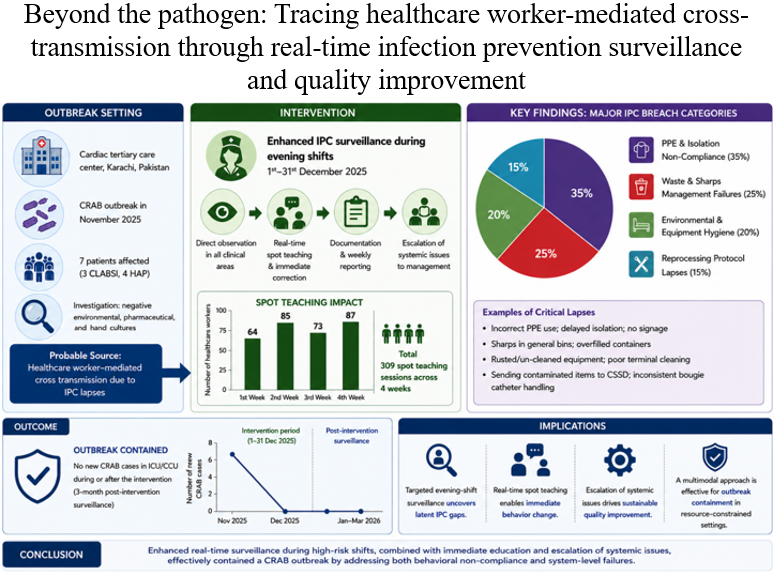
Transmission of carbapenem-resistant Acinetobacter baumannii (CRAB) can be facilitated by lapses in infection prevention and control practices among healthcare workers, underscoring the need for proactive, real-time surveillance. In November 2025, a CRAB outbreak occurred at a cardiac tertiary care center in Karachi, Pakistan, involving seven patients who developed central line-associated bloodstream infections and hospital-acquired pneumonia. Following an Infection Control Committee meeting, a one-month intensive surveillance program was implemented from December 1–31, 2025, deploying a senior infection control nurse exclusively during evening shifts to observe, document, and provide immediate corrective teaching across all clinical areas, including intensive care, coronary care, operating rooms, and dialysis units. Over four weeks, 309 spot teaching sessions were conducted with 64, 85, 73, and 87 healthcare workers, respectively. Persistent systemic non-compliance was identified across multiple domains, including incorrect use of personal protective equipment, particularly in operating rooms and during isolation precautions; improper disposal of sharps and biomedical waste; delayed initiation of isolation; critical reprocessing failures involving bougie catheters and oxygen bottles; and environmental hygiene deficits, including rusted equipment. The surveillance uncovered a critical lack of standardization in bougie catheter classification across units and hazardous pre-transport practices, including sending contaminated items to central sterile processing. Following real-time corrective interventions and escalation of systemic issues to management, the outbreak was successfully contained with no new CRAB cases reported during or after the surveillance period. This experience demonstrates that targeted, proactive infection-prevention surveillance during high-risk evening shifts, combined with immediate educational reinforcement, can effectively identify and address latent systemic failures and behavioral non-compliance that might be overlooked during routine daytime audits, thereby providing a practical framework for outbreak mitigation in resource-constrained settings.
- Li P, Li Y, Zhang Y, et al. Economic burden attributable to healthcare-associated infections in tertiary public hospitals of Central China: a multi-centre case-control study. Epidemiol Infect. 2022;150:e155. doi: 10.1017/S0950268822001340
- Naylor NR, Hasso-Agopsowicz M, Kim C, et al. The global economic burden of antibiotic-resistant infections and the potential impact of bacterial vaccines: a modelling study. BMJ Glob Health. 2025;10(6):e016249. doi: 10.1136/bmjgh-2024-016249
- Aldali JA. Acinetobacter baumannii: A multidrug-resistant pathogen, has emerged in Saudi Arabia. Saudi Med J. 2023;44(8):732–744. doi: 10.15537/smj.2023.44.8.20230194
- Eckardt P, Canavan K, Guran R, et al. Containment of a carbapenem-resistant Acinetobacter baumannii complex outbreak in a COVID-19 intensive care unit. Am J Infect Control. 2022;50(5):477–481. doi: 10.1016/j.ajic.2022.02.022
- Medioli F, Franceschini E, Mussini C, Meschiari M. Update on infection prevention in the ICU. Curr Opin Crit Care. 2025;31(5):529–538. doi: 10.1097/MCC.0000000000001313
- Lee MH, Lee GA, Lee SH, Park Y-H. A systematic review on the causes of the transmission and control measures of outbreaks in long-term care facilities: Back to basics of infection control. PLoS ONE. 2020;15(3):e0229911. doi: 10.1371/journal.pone.0229911
- Barker AK, Cowley ES, McKinley L, Wright M-O, Safdar N. An in-room observation study of hand hygiene and contact precaution compliance for Clostridioides difficile patients. Am J Infect Control. 2019;47(10):1273–1276. doi: 10.1016/j.ajic.2019.03.031
- Randle J, Arthur A, Vaughan N. Twenty-four-hour observational study of hospital hand hygiene compliance. J Hosp Infect. 2010;76(3):252–255. doi: 10.1016/j.jhin.2010.06.027
- Centers for Disease Control and Prevention. CDC’s Core Infection Prevention and Control Practices for Safe Healthcare Delivery in all settings; 2024. Accessed on Jan 31, 2026. https://www.cdc.gov/infection-control/hcp/core-practices/index.html.
- Drews FA, Visnovsky LC, Mayer J. Human factors engineering contributions to infection prevention and control. Hum Factors. 2019;61(5):693–701. doi: 10.1177/0018720819833214
- Parker SH, Jesso MN, Wolf LD, et al. Human factors contributing to infection prevention in outpatient hemodialysis centers: A mixed methods study. Am J Kidney Dis. 2024;84(1):18–27. doi: 10.1053/j.ajkd.2023.12.024
- Gupta P, Biswal M, Kaur R, et al. Quantification of diurnal variation in “glove hygiene” compliance in COVID ICUs: An exploratory study. Am J Infect Control. 2023;51(4):372–375. doi: 10.1016/j.ajic.2022.07.018
- Loef B, Dollé MET, Proper KI, van Baarle D, Initiative LCR, van Kerkhof LW. Night-shift work is associated with increased susceptibility to SARS-CoV-2 infection. Chronobiol Int. 2022;39(8):1100–1109. doi: 10.1080/07420528.2022.2069031
- Baleivanualala SC, Matanitobua S, Samisoni Y, et al. Environmental contamination with carbapenem resistant Acinetobacter baumannii in healthcare settings in Fiji: a potential source of infection. Front Cell Infect Microbiol. 2024;14:1429443. doi: 10.3389/fcimb.2024.1429443
- Chang N-CN, Schweizer ML, Reisinger HS, et al. The impact of workload on hand hygiene compliance: Is 100% compliance achievable? Infect Control Hosp Epidemiol. 2022;43(9):1259–1261. doi: 10.1017/ice.2021.179
- Zheng S, Yang Q, Wang X, Zhang X, Zhou Q. Capability, opportunity, motivation, and hand hygiene behavior in healthcare workers: A structural equation modeling. Psychol Res Behav Manag. 2022;15:2219–2228. doi: 10.2147/PRBM.S373287
- Greene C, Wilson J. The use of behaviour change theory for infection prevention and control practices in healthcare settings: A scoping review. J Infect Prev. 2022;23(3):108–117. doi: 10.1177/17571774211066779
- Sickbert-Bennett EE, DiBiase LM, Teal LJ, Summerlin-Long SK, Weber DJ. The holy grail of hand hygiene compliance: Just-in-time peer coaching that leads to behavior change. Infect Control Hosp Epidemiol. 2020;41(2):229–232. doi: 10.1017/ice.2019.340
- Owen NS, Johnson CT, Hader C, Monia K, Hessels AJ. Low resource, high impact: Just-in-time training toolkit in response to a public health crisis. Clin Simul Nurs. 2024;97:101629. doi: 10.1016/j.ecns.2024.101629
- National Healthcare Safety Network (NHSN). Bloodstream Infection Event (Central Line-Associated Bloodstream Infection and Non-central Line Associated Bloodstream Infection). Centers for Disease Control and Prevention; 2026. https://www.cdc.gov/nhsn/pdfs/pscmanual/4psc_clabscurrent.pdf.
- National Healthcare Safety Network (NHSN). Pneumonia (Ventilator-Associated [VAP] and Non-Ventilator Associated Pneumonia [PNEU]) Event. Centers for Disease Control and Prevention; 2026. Accessed on July 10, 2026. https://www.cdc.gov/nhsn/pdfs/pscmanual/6pscvapcurrent.pdf.
- Clinical and Laboratory Standards Institute. Performance Standards for Antimicrobial Susceptibility Testing. CLSI Supplement M100. 35th ed. Clinical and Laboratory Standards Institute; 2025. Accessed on July 10, 2026. https://clsi.org/shop/standards/m100/.
- World Health Organization. Outbreak Toolkit: Stages of an Outbreak Investigation. Geneva: WHO; 2024. Accessed on July 10, 2026. https://www.who.int/emergencies/outbreak-toolkit/standardized-data-collection-tools/investigating-outbreak-of-unknown-disease.
- Centers for Disease Control and Prevention. Field Epidemiology Manual: Healthcare Settings. Atlanta (GA): CDC; 2024. Accessed on July 10, 2026. https://www.cdc.gov/field-epi-manual/php/chapters/healthcare-settings.html.
- Yagupsky P, Loeffelholz M, Bell K, Menegus MA. Use of multiple markers for investigation of an epidemic of Shigella sonnei infections in Monroe County, New York. J Clin Microbiol. 1991;29(12):2850–2855. doi: 10.1128/jcm.29.12.2850-2855.1991
- Blanc DS, Petignat C, Moreillon P, Wenger A, Bille J, Francioli P. Quantitative antibiogram as a typing method for the prospective epidemiological surveillance and control of MRSA: comparison with molecular typing. Infect Control Hosp Epidemiol. 1996;17(10):654–659. doi: 10.1086/647198
- Sabat AJ, Budimir A, Nashev D, Sá-Leão R, van Dijl J m., Laurent F, et al. Overview of molecular typing methods for outbreak detection and epidemiological surveillance. Euro Surveill. 2013;18(4):20380. doi: 10.2807/ese.18.04.20380-en
- World Health Organization. Minimum requirements for infection prevention and control programmes. World Health Organization; 2019. Accessed on July 10, 2026. https://www.who.int/publications/i/item/9789241516945.
- World Health Organization. Hand Hygiene Technical reference Manual: To Be Used by Health-Care Workers, Trainers and Observers of Hand Hygiene Practices. Geneva: WHO; 2009. Accessed on July 10, 2026. https://www.who.int/publications/i/item/9789241598606.
- World Health Organization. Infection Prevention and Control Assessment Framework at the Facility Level. Geneva: WHO; 2018. Accessed on July 10, 2026. https://iris.who.int/handle/10665/330072.
- Lenglet A, van Deursen B, Viana R, et al. Inclusion of real-time Hand Hygiene observation and feedback in a multimodal Hand Hygiene improvement strategy in low-resource settings. JAMA Netw Open. 2019;2(8):e199118. doi: 10.1001/jamanetworkopen.2019.9118
- Asif S, Khan MA, Basheer V, Palous M, Sheraz N. Longitudinal evaluation of a multimodal hand hygiene intervention in improving healthcare worker compliance: a three-year quasi-experimental study at a cardiac specialty hospital in Karachi, Pakistan. Antimicrob Resist Infect Control. 2026;15(1):20. doi: 10.1186/s13756-025-01689-1
- Obenhuber T, Scheier TC, Stutz T, et al. An outbreak of multi-drug-resistant Acinetobacter baumannii on a burns ICU and its control with multi-faceted containment measures. J Hosp Infect. 2024;146:102–108. doi: 10.1016/j.jhin.2024.01.002
- Armstrong-Novak J, Juan HY, Cooper K, Bailey P. Healthcare personnel hand hygiene compliance: Are we there yet? Curr Infect Dis Rep. 2023;25(7):123-129. doi: 10.1007/s11908-023-00806-8
- Zhang M, Wu S, Ibrahim MI, Noor SSM, Mohammad WMZW. Significance of ongoing training and professional development in optimizing healthcare-associated infection prevention and control. J Med Signals Sens. 2024;14(5):13. doi: 10.4103/jmss.jmss_37_23
- Zhu Y, Ni M, Fang X, et al. Monitoring multidrug-resistant Acinetobacter baumannii infections in the neurosurgery ICU using a Real-time Surveillance System. Pol J Microbiol. 2022;71(1):107–114. doi: 10.33073/pjm-2022-013