
Oral microbiome and oral mucositis in pediatric acute lymphoblastic leukemia

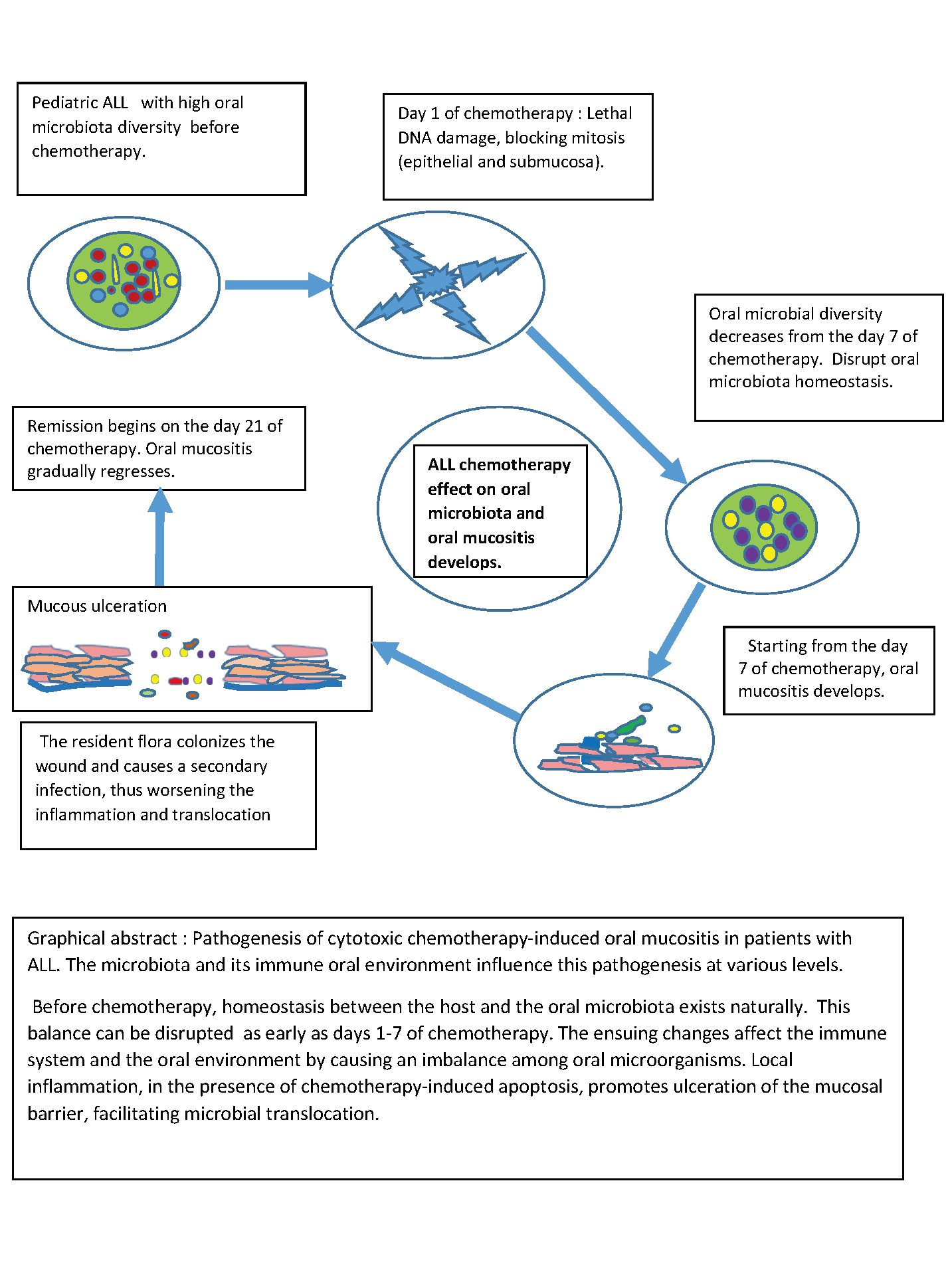
Oral mucositis (OM) is a common, dose-limiting toxicity in pediatric acute lymphoblastic leukemia (ALL) and is associated with increased risk of infection, nutritional deficiency, and potential interruption of chemotherapy. Growing interest in the role of the oral microbiota has focused on its close association with inflammation and infection. The oral ecosystem undergoes changes throughout cancer treatment, with commensal and pathogenic microorganisms interacting within a diverse microbial ecosystem before and during therapy. This narrative review synthesizes recent clinical, translational, and omics-based studies on OM in pediatric ALL, focusing on the underlying pathophysiological mechanisms, oral microbiome dynamics, inflammatory pathways, and emerging predictive biomarkers. A comprehensive search of PubMed and Web of Science was performed through May 1, 2026. Studies were screened for eligibility based on title, abstract, and full text. OM pathogenesis is driven by a multifactorial interplay between chemotherapy-induced epithelial injury, dysregulated inflammatory responses, and oral microbiome dysbiosis. Dysbiosis is characterized by an expansion of opportunistic taxa (e.g., Prevotella, Porphyromonas) and depletion of protective commensals (e.g., Streptococcus), alongside elevated pro-inflammatory cytokine levels. These findings highlight the clinical importance of developing better strategies for personalized preventive management of OM. Integrating microbiome and inflammatory biomarkers into clinical practice may enable early risk stratification and support individualized preventive strategies, thereby improving supportive care and treatment outcomes.
- Bustamante JC, Hernandez A, Galvan C, et al. Childhood leukemias in Mexico: Towards implementing CAR-T cell therapy programs. Front Oncol. 2024;14:1304805. doi: 10.3389/fonc.2023.1304805
- Schwartz LF, Wesevich A, Englum BR, et al. Advances and disparities in survival of childhood and adolescent cancers. J Natl Cancer Inst. 2026;djag155. doi: 10.1093/jnci/djag155
- Bhojwani D, Yang JJ, Pui CH. Biology of childhood acute lymphoblastic leukemia. Pediatr Clin North Am. 2015;62(1):47–60. doi: 10.1016/j.pcl.2014.09.004
- Arber DA, Hasserjian RP, Orazi A, et al. Classification of myeloid neoplasms/acute leukemia: Global perspectives and the international consensus classification approach. Am J Hematol. 2022;97(5):514–518. doi: 10.1002/ajh.26503
- Shah B, Mattison RJ, Abboud R, et al. Acute lymphoblastic leukemia, version 2.2024, NCCN Clinical Practice Guidelines in Oncology. J Natl Compr Canc Netw. 2024;22(8):563-576. doi: 10.6004/jnccn.2024.0051
- Malczewska M, Kośmider K, Bednarz K, Ostapińska K, Lejman M, Zawitkowska J. Recent advances in treatment options for childhood acute lymphoblastic leukemia. Cancers. 2022;14(8):2021. doi: 10.3390/cancers14082021
- Pui CH, Yang JJ, Hunger SP, et al. Childhood acute lymphoblastic leukemia: progress through collaboration. J Clin Oncol. 2015;33(27):2938–2948. doi: 10.1200/JCO.2014.59.1636
- Campbell M, Kiss C, Zimmermann M, et al. Chi l d ho o d Acute Lymphoblastic Leukemia: Results of the Randomized Acute Lymphoblastic Leukemia Intercontinental- Berlin-Frankfurt-Münster 2009 Trial. J Clin Oncol. 2023;41(19):3499–3511. doi: 10.1200/JCO.22.01760
- Gallardo-Pérez MM, Gale RP, Reyes-Cisneros OA, et al. Therapy of childhood acute lymphoblastic leukemia in resource-poor geospaces. Front Oncol. 2023;13:1187268. doi: 10.3389/fonc.2023.1187268
- Pui CH, Pei D, Sandlund JT, et al. Long-term results of St Jude Total Therapy studies 11–14 for childhood acute lymphoblastic leukemia. Leukemia. 2010;24(2):371–382. doi: 10.1038/leu.2009.252
- Lee JM, Shim YJ, Kim DH, Jung N, Ha JS. The effect of NUDT15, TPMT, APEX1, and ITPA genetic variations on mercaptopurine treatment of pediatric acute lymphoblastic leukemia. Children. 2021;8(3):224. doi: 10.3390/children8030224
- Yildirim UM, Tekkesin F, Koc BS, Aydogdu S, Asarcikli F, Kilic SC. Acute complications observed during intensive chemotherapy in pediatric patients with acute lymphoblastic leukemia: single-center experience. North Clin Istanb. 2023;10:458–469. doi: 10.14744/nci.2022.47600
- He X, Rong X, Wang W, et al. Prevalence and risk factors of chemotherapy-induced oral mucositis in 470 children with acute lymphoblastic leukemia. Int J Paediatr Dent. 2025;35(5):888–897. doi: 10.1111/ipd.13303
- World Health Organization (1979) WHO handbook for reporting results of cancer treatment. Accessed 22 July, 2023. https://iris.who.int/items/8496c91f-e82a-44c2-88c3-2b468958d991
- Kiyomi A, Yoshida K, Arai C, et al. Salivary inflammatory mediators as biomarkers for oral mucositis and oral mucosal dryness in cancer patients: a pilot study. PLoS ONE. 2022;17(4):e0267092. doi: 10.1371/journal.pone.0267092
- Hong BY, Sobue T, Choquette L, et al. Chemotherapy-induced oral mucositis is associated with detrimental bacterial dysbiosis. Microbiome. 2019;7(1):66. doi: 10.1186/s40168-019-0679-5
- Hakim H, Dallas R, Wolf J, et al. Gut microbiome composition predicts infection risk during chemotherapy in children with acute lymphoblastic leukemia. Clin Infect Dis. 2018;67(4):541–548. doi: 10.1093/cid/ciy153
- Sonis ST. New thoughts on the initiation of mucositis. Oral Dis. 2010;16(7):597–600. doi: 10.1111/j.1601-0825.2010.01681.x
- Fukata M, Chen A, Klepper A, et al. Cox-2 is regulated by Toll-like receptor-4 (TLR4) signaling: role in proliferation and apoptosis in the intestine. Gastroenterology. 2006;130(3):862–877. doi: 10.1053/j.gastro.2006.06.017
- Burdelya LG, Krivokrysenko VI, Tallant TC, et al. An agonist of toll-like receptor 5 has radioprotective activity in mouse and primate models. Science. 2008;320(5873):226-230. doi: 10.1126/science.1154986
- Sánchez-Becerra AE, Peña-Rodríguez M, Vega-Magaña AN, et al. Oral microbiome dynamics in patients with acute lymphoblastic leukemia and oral mucositis. Microorganisms. 2026;14(1):185. doi: 10.3390/microorganisms14010185
- Ye Y, Carlsson G, Agholme MB, et al. Oral bacterial community dynamics in paediatric patients with malignancies in relation to chemotherapy-related oral mucositis: a prospective study. Clin Microbiol Infect. 2013;19(12):E559–E567. doi: 10.1111/1469-0691.12287
- Vincent JL. The immune response in critical illness: excessive, inadequate or dysregulated. In: Marshall JC, Cohen J, editors. Immune Response in the Critically Ill. Berlin, Heidelberg: Springer; 2002. doi: 10.1007/978-3-642-57210-4_2
- Morales-Rojas T, Viera N, Morón-Medina A, Alvarez CJ, Alvarez A. Proinflammatory cytokines during the initial phase of oral mucositis in patients with acute lymphoblastic leukemia. Int J Paediatr Dent. 2012;22(3):191–196. doi: 10.1111/j.1365-263X.2011.01175.x
- Karpel E. The place of systemic inflammatory response mediators in intensive care. Anestezjol Intens Terap. 2001;3:181–190.
- Krzaczek PM, Mitura-Lesiuk M, Zawitkowska J, Petkowicz B, Wilczyńska B, Drabko K. Salivary and serum concentrations of selected pro- and anti-inflammatory cytokines in relation to oral lesions among children undergoing maintenance therapy of acute lymphoblastic leukemia. Contemp Oncol. 2019;23(2):81–86. doi: 10.5114/wo.2019.85878
- Filetici P, Gallottini SG, Corvaglia A, et al. The role of oral microbiota in the development of oral mucositis in pediatric oncology patients treated with antineoplastic drugs: a systematic review. BMC Oral Health. 2024;24(1):183. doi: 10.1186/s12903-024-03938-y
- Crielaard W, Zaura E, Schuller AA, Huse SM, Montijn RC, Keijser BJ. Exploring the oral microbiota of children at various developmental stages of their dentition in relation to their oral health. BMC Med Genom. 2011;4(1):22. doi: 10.1186/1755-8794-4-22
- Lif Holgerson P, Öhman C, Rönnlund A, Johansson I. Maturation of oral microbiota in children with or without dental caries. PLoS ONE. 2015;10(5):e0128534. doi: 10.1371/journal.pone.0128534
- Wang X, Ye L, Liu Y, Li H, Shi H, Zheng L. Metagenomic analysis reveals severity-dependent microbial succession and correlation with host inflammatory response in oral and maxillofacial space infections. Front Cell Infect Microbiol. 2026;15:1695928. doi: 10.3389/fcimb.2025.1695928
- Pels E. Comparison of saliva interleukin-2 concentration to the condition of gums in children with acute lymphoblastic leukemia during anti-tumour treatment. Cancer Chemother Pharmacol. 2015;76(1):205–210. doi: 10.1007/s00280-015-2750-7
- Wang Y, Xue J, Zhou X, et al. Oral microbiota distinguishes acute lymphoblastic leukemia pediatric hosts from healthy populations. PLoS ONE. 2014;9(7):e102116. doi: 10.1371/journal.pone.0102116
- Tlaskalova-Hogenova H, Štěpánková R, Hudcovic T, et al. Commensal bacteria (normal microflora), mucosal immunity and chronic inflammatory and autoimmune diseases. Immunol Lett. 2004;93(2-3):97-108. doi: 10.1016/j.imlet.2004.02.005
- Kitchingman GR, Rovigatti U, Mauer AM, et al. Rearrangement of immunoglobulin heavy chain genes in T cell acute lymphoblastic leukemia. Blood. 1985;65(3):725–729. doi: 10.1182/blood.V65.3.725.bloodjournal653725
- Zhang XL, Komada Y, Chipeta J, et al. Intracellular cytokine profile of T cells from children with acute lymphoblastic leukemia. Cancer Immunol Immunother. 2000;49(3):165–172. doi: 10.1007/s002620050616
- Tjwa E, Mattijssen V. Gingival hypertrophy and leukemia. N Engl J Med. 2008;359(16):e21. doi: 10.1056/NEJMicm064633
- Hegde AM, Joshi S, Rai K, Shetty S. Evaluation of oral hygiene status, salivary characteristics and dental caries experience in acute lymphoblastic leukemic children. J Clin Pediatr Dent. 2011;35(3):319–323. doi: 10.17796/jcpd.35.3.u5kx28q33m760834
- Souza AV, Barbosa LV, Castro AAC, et al. Oral microbiota dysbiosis in pediatric patients undergoing treatment for acute lymphoid leukemia: a preliminary study. Genet Mol Biol. 2025;48(2):e20230359. doi: 10.1590/1678-4685-GMB-2023-0359
- Wang Y, Zeng X, Yang X, et al. Oral health, caries risk profiles, and oral microbiome of pediatric patients with leukemia submitted to chemotherapy. Biomed Res Int. 2021;2021(1):6637503. doi: 10.1155/2021/6637503
- Cheng KK, Goggins WB, Lee V, Thompson DR. Risk factors for oral mucositis in children undergoing chemotherapy: a matched case-control study. Oral Oncol. 2008;44(11):1019–1025. doi: 10.1016/j.oraloncology.2008.01.003
- de Mendonça RM, de Araújo M, Levy CE, et al. Prospective evaluation of HSV, Candida spp., and oral bacteria on the severity of oral mucositis in pediatric acute lymphoblastic leukemia. Support Care Cancer. 2012;20(5):1101-1107. doi: 10.1007/s00520-011-1190-0
- Costa RC, Bezerra PM, Damascena LC, et al. Impact of saliva and cariogenic microbiota on the chemotherapy-induced oral mucositis in oncopediatric patients: a preliminary longitudinal study. Int J Dent. 2020;2020:1243953. doi: 10.1155/2020/1243953
- Ciernikova S, Sevcikova A, Stevurkova V, Mego M. Tumor microbiome—an integral part of the tumor microenvironment. Front Oncol. 2022;12:1063100. doi: 10.3389/fonc.2022.1063100
- Kyriazi AA, Karaglani M, Agelaki S, Baritaki S. Intratumoral microbiome: foe or friend in reshaping the tumor microenvironment landscape? Cells. 2024;13(15):1279. doi: 10.3390/cells13151279
- Betancur D, Jara EL, Lima CA, Victoriano M. Diet type and the oral microbiome. Front Nutr. 2026;12:1691952. doi: 10.3389/fnut.2025.1691952
- Dame-Teixeira N, Do T, Deng D. The Oral Microbiome and Us. In: Advances in Experimental Medicine and Biology. Switzerland: Springer Nature; 2025;1472:3-9. doi: 10.1007/978-3-031-79146-8_1
- Zhu XX, Yang XJ, Chao YL, et al. The potential effect of oral microbiota in the prediction of mucositis during radiotherapy for nasopharyngeal carcinoma. eBioMedicine. 2017;18:23-31. doi: 10.1016/j.ebiom.2017.02.002
- Bruno JS, Al-Qadami GH, Laheij AMGA, Bossi P, Fregnani ER, Wardill HR. From pathogenesis to intervention: the importance of the microbiome in oral mucositis. Int J Mol Sci. 2023;24(9):8274. doi: 10.3390/ijms24098274
- Ambati P, Galhotra V, Jondhale SN, Dolker T, Ravi M, Rathod P. Evaluation of oral complications in children undergoing chemotherapy: an observational study. J Indian Soc Pedod Prev Dent. 2024;42(3):184–189. doi: 10.4103/jisppd.jisppd_219_24
- Zhang Y, Lv D, Zhang J, et al. Microbial-triggered integrated stress response in sulcular and junctional keratinocytes exacerbates immunopathology in periodontitis. Int Immunopharmacol. 2026;169:115965. doi: 10.1016/j.intimp.2025.115965
- Dholam KP, Gurav S, Dugad J, Banavli S. Correlation of oral health of children with acute leukemia during the induction phase. Indian J Med Paediatr Oncol. 2014; 35(01):36-39. doi: 10.4103/0971-5851.133717
- Valéra MC, Noirrit-Esclassan E, Pasquet M, Vaysse F. Oral complications and dental care in children with acute lymphoblastic leukaemia. J Oral Pathol Med. 2015; 44(7):483-489. doi: 10.1111/jop.12266
- Pels EJ. Oral mucositis and saliva IgA, IgG and IgM concentration during anti-tumor treatment in children suffering from acute lymphoblastic leukemia. Adv Clin Exp Med. 2017;26(9):1351-1358. doi: 10.17219/acem/64940
- Sung L, Robinson P, Treister N, et al. Guideline for the prevention of oral and oropharyngeal mucositis in children receiving treatment for cancer or undergoing haematopoietic stem cell transplantation. BMJ Support Palliat Care. 2017;7(1):7–16. doi: 10.1136/bmjspcare-2014-000804
- Coppini M, Caponio VCA, Mauceri R, et al. Efficacy of topical agents in oral mucositis prevention: systematic review and network meta-analysis. Oral Dis. 2024;30(7):4126–4144. doi: 10.1111/odi.15046
- Sankaran SS, Dewan P, Malhotra RK, et al. Glutamine mouthwash for preventing methotrexate-induced mucositis in children with acute lymphoblastic leukemia: a randomized cross-over trial. Indian Pediatr. 2025;62(4):269–275. doi: 10.1007/s13312-025-00042-4
- Liu YC, Wu CR, Huang TW. Preventive effect of probiotics on oral mucositis induced by cancer treatment: a systematic review and meta-analysis. Int J Mol Sci. 2022;23(21):13268. doi: 10.3390/ijms232113268
- Sharma A, Tilak T, Bakhshi S, et al. Lactobacillus brevis CD2 lozenges prevent oral mucositis in patients undergoing high dose chemotherapy followed by haematopoietic stem cell transplantation. ESMO Open. 2016;1(6):e000138. doi: 10.1136/esmoopen-2016-000138
- Pui CH, Mullighan CG, Evans WE, Relling MV. Pediatric acute lymphoblastic leukemia: where are we going and how do we get there? Blood. 2012;120(6):1165–1174. doi: 10.1182/blood-2012-05-378943
- Colella G, Boschetti CE, Vitagliano R, et al. Interventions for the prevention of oral mucositis in patients receiving cancer treatment: evidence from randomized controlled trials. Curr Oncol. 2023;30(1):967–980. doi: 10.3390/curroncol30010074
- Khera S, Muhammed MKS, Kumar R, Kapoor R. Outcomes of childhood acute lymphoblastic leukemia treated with modified BFM-2009 protocol using measurable residual disease-based risk stratification: a single-center study. Indian Pediatr. 2026;1-6. doi: 10.1007/s13312-026-00277-9
- Freifeld AG, Bow EJ, Sepkowitz KA, et al. Clinical practice guideline for the use of antimicrobial agents in neutropenic patients with cancer: 2010 update by the Infectious Diseases Society of America. Clin Infect Dis. 2011;52(4):427–431. doi: 10.1093/cid/ciq147
- Ferrandez-Pujante A, Perez-Silva A, Serna-Munoz C, et al. Prevention and treatment of oral complications in hematologic childhood cancer patients: an update. Children. 2022;9(4):566. doi: 10.3390/children9040566
- Zhang L, Yin Y, Simons A, Francisco NM, Wen F, Patil S. Use of honey in the management of chemotherapy-associated oral mucositis in paediatric patients. Cancer Manag Res. 2022;14:2773-2783. doi: 10.2147/CMAR.S367472
- Yavuz B, Bal Yılmaz H. Investigation of the effects of planned mouth care education on the degree of oral mucositis in pediatric oncology patients. J Pediatr Oncol Nurs. 2015;32(1):47-56. doi: 10.1177/1043454214554011
- Miranda-Silva W, Gomes-Silva W, Zadik Y, et al. MASCC/ ISOO clinical practice guidelines for the management of mucositis: sub-analysis of current interventions for the management of oral mucositis in pediatric cancer patients. Support Care Cancer. 2021;29(7):3539-3562. doi: 10.1007/s00520-020-05803-4