

Comparison of immune evasion mechanisms of multidrug-resistant Mycobacterium tuberculosis versus nontuberculous mycobacteria

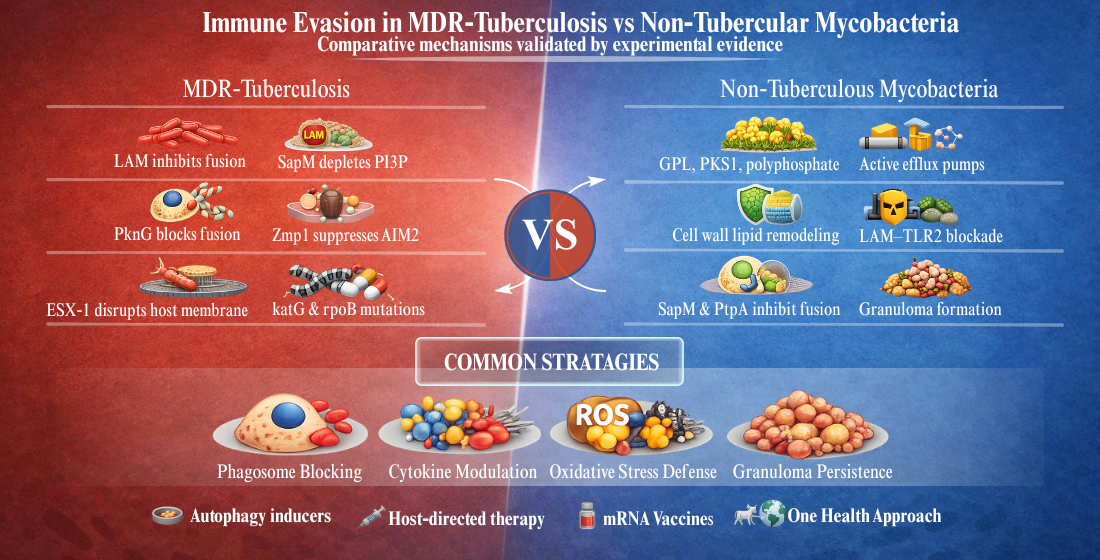
Mycobacterium tuberculosis (MTB) and nontuberculous mycobacteria (NTM) are important worldwide health problems because they may challenge human immunity and cause chronic infections. This study presents a comparative overview of immune evasion mechanisms in multidrug-resistant MTB (MDR-MTB) and NTM, focusing on mechanisms supported by direct experimental evidence and those inferred from drug-susceptible MTB. Supported findings in MDR-MTB include LAM-mediated block of phagolysosomal fusion, depletion of PI3P by SapM, and Zmp1-mediated suppression of AIM2 inflammasome activation. Mutations in katG and rpoB confer resistance to isoniazid and rifampicin. However, these primarily affect drug susceptibility rather than immune modulation. Other processes, such as ESX-1–mediated membrane disruption, PPE protein interference with oxidative stress, and ubiquitination pathway evasion, are well described in drug-susceptible MTB and are inferred to contribute to MDR-MTB persistence. For NTM, experimental evidence demonstrates immune evasion through biofilm formation (glycopeptidolipids, PKS1, polyphosphate accumulation), active efflux pumps, and cytokine modulation via LAM and Toll-like receptor 2 (TLR2) blockade. NTM also inhibits phagolysosomal fusion using SapM and PtpA, while granuloma formation sustains long-term infection. Both bacteria use overlapping mechanisms, including inhibition of phagosome-lysosome fusion, modulation of cytokine responses, and granuloma formation, but differ in their ecological niches, transmission, and clinical presentations. These immune-evasive features complicate therapy, prolong treatment, and hamper vaccine development. Emerging therapeutics include autophagy inducers (e.g., rapamycin) and host-directed therapies (e.g., interferon-gamma). Future prospects include personalized medicine, innovative vaccination platforms such as messenger RNA-based techniques, and a One Health approach to address the interconnected issues of MDR-MTB and NTM. Thus, this review explicitly distinguishes experimentally validated immune evasion mechanisms underlying MDR-MTB from those extrapolated from drug-susceptible strains, while integrating evidence-based findings for NTM.
- Orgeur M, Sous C, Madacki J, Brosch R. Evolution and emergence of Mycobacterium tuberculosis. FEMS Microbiol Rev. 2024;48(2):fuae006. doi: 10.1093/femsre/fuae006
- Barberis I, Bragazzi NL, Galluzzo L, Martini M. The history of tuberculosis: from the first historical records to the isolation of Koch’s bacillus. J Prev Med Hyg. 2017;58(1):E9-E12. PMID:28515626
- Frieden TR, Sterling TR, Munsiff SS, Watt CJ, Dye C. Tuberculosis. Lancet. 2003;362(9387):887-899. doi: 10.1016/S0140-6736(03)14333-4
- Pawlowski A, Jansson M, Sköld M, Rottenberg ME, Källenius G. Tuberculosis and HIV co-infection. PLoS Pathog. 2012;8(2):e1002464. doi: 10.1371/journal.ppat.1002464
- Cole ST, Brosch R, Parkhill J, et al. Deciphering the biology of Mycobacterium tuberculosis from the complete genome sequence. Nature. 1998;393(6685):537-544. doi: 10.1038/31159
- Fleischmann RD, Alland D, Eisen JA, et al. Whole genome comparison of Mycobacterium tuberculosis clinical and laboratory strains. J Bacteriol. 2002;184(19):5479-5490. doi: 10.1128/JB.184.19.5479-5490.2002
- Gandhi NR, Nunn P, Dheda K, et al. Multidrug-resistant and extensively drug-resistant tuberculosis: a threat to global control of tuberculosis. Lancet. 2010;375(9728):1830-1843. doi: 10.1016/S0140-6736(10)60410-2
- McLaughlin AM, O’Donnell RA, Gibbons N, Scully M, O’Flangan D, Keane J. Extensively drug-resistant tuberculosis (XDR-TB) — a potential threat in Ireland. Open Respir Med J. 2007;1:7-9. doi: 10.2174/1874306400701010007
- Stout JE, Koh WJ, Yew WW. Update on pulmonary disease due to nontuberculous mycobacteria. Int J Infect Dis. 2016;45:123-134. doi: 10.1016/j.ijid.2016.03.006
- Griffith DE, Aksamit T, Brown-Elliott BA, et al. An official ATS/IDSA statement: diagnosis, treatment, and prevention of nontuberculous mycobacterial diseases. Am J Respir Crit Care Med. 2007;175(4):367-416. doi: 10.1164/rccm.200604-571ST
- Falkinham JO. Environmental sources of nontuberculous mycobacteria. Clin Chest Med. 2015;36(1):35-41. doi: 10.1016/j.ccm.2014.10.003
- Adjemian J, Olivier KN, Seitz AE, et al. Prevalence of nontuberculous mycobacterial lung disease in U.S. Medicare beneficiaries. Am J Respir Crit Care Med. 2012;185(8):881-886. doi: 10.1164/rccm.201111-2016OC
- Abbew ET, Laryea R, Kwakye AO, et al. Treatment outcomes of multidrug-resistant and rifampicin-resistant tuberculosis with and without isolation of nontuberculous mycobacteria between 2018–2021: a retrospective cohort study in Ghana. PLoS Negl Trop Dis. 2025;19(7):e0013204. doi: 10.1371/journal.pntd.0013204
- Kahkouee S, Esmi E, Moghadam A, et al. Multidrug-resistant tuberculosis versus nontuberculous mycobacterial infections: a CT scan challenge. Braz J Infect Dis. 2013;17(2):137-142. doi: 10.1016/j.bjid.2012.10.011
- Dartois V, Dick T. Therapeutic developments for tuberculosis and nontuberculous mycobacterial lung disease. Nat Rev Drug Discov. 2024;23(5):381-403. doi: 10.1038/s41573-024-00897-5
- Mehra A, Zahra A, Thompson V, et al. Mycobacterium tuberculosis type VII secreted effector EsxH targets host ESCRT to impair trafficking. PLoS Pathog. 2013;9(10):e1003734. doi: 10.1371/journal.ppat.1003734
- Watson RO, Bell SL, MacDuff DA, et al. Cyclic GMP-AMP synthase is an innate immune DNA sensor for Mycobacterium tuberculosis. Cell Host Microbe. 2015;17(6):820-828. doi: 10.1016/j.chom.2015.05.005
- Ehlers S, Schaible UE. The granuloma in tuberculosis: dynamics of a host-pathogen collusion. Front Immunol. 2013;3:411. doi: 10.3389/fimmu.2012.00411
- Sieling PA, Modlin RL. Cytokine patterns at the site of mycobacterial infection. Immunobiology. 1994;191(4- 5):378-387. doi: 10.1016/S0171-2985(11)80443-2
- Gutierrez MG, Master SS, Singh SB, et al. Autophagy is a defense mechanism inhibiting BCG and Mycobacterium tuberculosis survival in infected macrophages. Cell. 2004;119(6):753-766. doi: 10.1016/j.cell.2004.11.038
- Cooper AM. Cell-mediated immune responses in tuberculosis. Annu Rev Immunol. 2009;27:393-422. doi: 10.1146/annurev.immunol.021908.132703
- Lange C, Chesov D, Heyckendorf J, Leung CC, Udwadia Z, Dheda K. Drug-resistant tuberculosis: An update on disease burden, diagnosis and treatment. Respirology. 2018;23(7):656-673. doi: 10.1111/resp.13304
- Seung KJ, Keshavjee S, Rich ML. Multidrug-resistant tuberculosis and extensively drug-resistant tuberculosis. Cold Spring Harb Perspect Med. 2015;5(9):a017863. doi: 10.1101/cshperspect.a017863
- Shah NS, Auld SC, Brust JCM, et al. Transmission of extensively drug-resistant tuberculosis in South Africa. N Engl J Med. 2017;376(3):243-253. doi: 10.1056/NEJMoa1604544
- Dheda K, Gumbo T, Maartens G, et al. The epidemiology, pathogenesis, transmission, diagnosis, and management of multidrug-resistant, extensively drug-resistant, and incurable tuberculosis. Lancet Respir Med. 2017;5(4):291- 360. doi: 10.1016/S2213-2600(17)30079-6
- Gul M, Ali S, Rehman A, et al. Genetic characterization of first-line drug-resistance mutations in multidrug-resistant Mycobacterium tuberculosis. Pathogens. 2024;15(5):455. doi: 10.3390/pathogens15050455
- Gygli SM, Loiseau C, Jugheli L, et al. Antimicrobial resistance in Mycobacterium tuberculosis: mechanistic and evolutionary perspectives. FEMS Microbiol Rev. 2017;41(3):354-373. doi: 10.1093/femsre/fux011
- Jarlier V, Nikaido H. Mycobacterial cell wall: structure and role in natural resistance to antibiotics. FEMS Microbiol Lett. 1994;123(1-2):11-18. doi: 10.1111/j.1574-6968.1994.tb07194.x
- Jackson M. The mycobacterial cell envelope—lipids. Cold Spring Harb Perspect Med. 2014;4(10):a021105. doi: 10.1101/cshperspect.a021105
- Pathak SK, Basu S, Basu KK, et al. Direct extracellular interaction between the early secreted antigen ESAT-6 of Mycobacterium tuberculosis and TLR2 inhibits TLR signaling in macrophages. Nat Immunol. 2007;8(6):610-618. doi: 10.1038/ni1468
- Smith I. Mycobacterium tuberculosis pathogenesis and molecular determinants of virulence. Clin Microbiol Rev. 2003;16(3):463-496. doi: 10.1128/CMR.16.3.463-496.2003
- Cole ST, Telenti A. Drug resistance in Mycobacterium tuberculosis. Eur Respir J Suppl. 1995;20:701s-713s. PMID:8590570
- Tortoli E. Microbiological features and clinical relevance of new species of the genus Mycobacterium. Clin Microbiol Rev. 2014;27(4):727-752. doi: 10.1128/CMR.00035-14
- Johnson MM, Odell JA. Nontuberculous mycobacterial pulmonary infections. J Thorac Dis. 2014;6(3):210-220. doi: 10.3978/j.issn.2072-1439.2013.12.24
- Daley CL, Iaccarino JM, Lange C, et al. Treatment of nontuberculous mycobacterial pulmonary disease: an official ATS/ERS/ESCMID/IDSA clinical practice guideline. Eur Respir J. 2020;56(1):2000535. doi: 10.1183/13993003.00535-2020
- Runyon EH. Anonymous mycobacteria in pulmonary disease. Med Clin North Am. 1959;43(1):273-290. doi: 10.1016/S0025-7125(16)34193-1
- Prevots DR, Marras TK. Epidemiology of human pulmonary infection with nontuberculous mycobacteria: a review. Clin Chest Med. 2015;36(1):13-34. doi: 10.1016/j.ccm.2014.10.002
- Vaerewijck MJ, Huys G, Palomino JC, Swings J, Portaels F. Mycobacteria in drinking water distribution systems: ecology and significance for human health. FEMS Microbiol Rev. 2005;29(5):911-934. doi: 10.1016/j.femsre.2005.02.001
- Howard ST, Rhoades E, Recht J, et al. Spontaneous reversion of Mycobacterium abscessus from a smooth to a rough morphotype is associated with reduced expression of glycopeptidolipid and reacquisition of an invasive phenotype. Microbiology. 2006;152(6):1581-1590. doi: 10.1099/mic.0.28625-0
- Qvist T, Gilljam M, Jönsson B, et al; Scandinavian Cystic Fibrosis Study Consortium (SCFSC). Epidemiology of nontuberculous mycobacteria among patients with cystic fibrosis in Scandinavia. J Cyst Fibros. 2015;14(1):46-52. doi: 10.1016/j.jcf.2014.08.002
- Nessar R, Cambau E, Reyrat JM, Murray A, Gicquel B. Mycobacterium abscessus: a new antibiotic nightmare. J Antimicrob Chemother. 2012;67(4):810-818. doi: 10.1093/jac/dkr578
- Nikaido H. Molecular basis of bacterial outer membrane permeability revisited. Microbiol Mol Biol Rev. 2003;67(4):593-656. doi: 10.1128/MMBR.67.4.593-656.2003
- Ratnatunga CN, Lutzky VP, Kupz A, et al. The rise of nontuberculosis mycobacterial lung disease. Front Immunol. 2020;11:303. doi: 10.3389/fimmu.2020.00303
- Xander C, Rajagopalan S, Jacobs WR Jr, Braunstein M. The SapM phosphatase can arrest phagosome maturation in an ESX-1 independent manner in Mycobacterium tuberculosis and BCG. Infect Immun. 2024;92(7):e00217-224. doi: 10.1128/iai.00217-24
- Bhat KH, Srivastava S, Kotturu SK, Ghosh S, Mukhopadhyay S. The PPE2 protein of Mycobacterium tuberculosis translocates to host nucleus and inhibits nitric oxide production. Sci Rep. 2017;7:39706. doi: 10.1038/srep39706
- Hornung V, Bauernfeind F, Halle A, et al. Silica crystals and aluminum salts activate the NALP3 inflammasome through phagosomal destabilization. Nat Immunol. 2008;9(8):847-856. doi: 10.1038/ni.1631
- Yamazaki Y, Danelishvili L, Wu M, et al. The ability to form biofilm influences Mycobacterium avium invasion and translocation of bronchial epithelial cells. Cell Microbiol. 2006;8(5):806-814. doi: 10.1111/j.1462-5822.2005.00667.x
- Schorey JS, Sweet L. The mycobacterial glycopeptidolipids: structure, function, and their role in pathogenesis. Glycobiology. 2008;18(11):832-841. doi: 10.1093/glycob/cwn076
- Wong D, Bach H, Sun J, Hmama Z, Av-Gay Y. Mycobacterium tuberculosis protein tyrosine phosphatase (PtpA) excludes host vacuolar-H+-ATPase to inhibit phagosome acidification. Proc Natl Acad Sci USA. 2011;108(48):19371-19376. doi: 10.1073/pnas.1109201108
- Briken V, Porcelli SA, Besra GS, Kremer L. Mycobacterial lipoarabinomannan and related lipoglycans: from biogenesis to modulation of the immune response. Mol Microbiol. 2004;53(2):391-403. doi: 10.1111/j.1365-2958.2004.04183.x
- Redford PS, Mayer-Barber KD, McNab FW, et al. Influenza A virus impairs control of Mycobacterium tuberculosis coinfection through a type I interferon receptor-dependent pathway. J Infect Dis. 2014;209(2):270-274. doi: 10.1093/infdis/jit424
- Ng VH, Cox JS, Sousa AO, MacMicking JD, McKinney JD. Role of KatG catalase-peroxidase in mycobacterial pathogenesis: countering the phagocyte oxidative burst. Mol Microbiol. 2004;52(5):1291-1302. doi: 10.1111/j.1365-2958.2004.04078.x
- Wang J, Li BX, Ge PP, et al. Mycobacterium tuberculosis suppresses innate immunity by coopting the host ubiquitin system. Nat Immunol. 2015;16(3):237-245. doi: 10.1038/ni.3096
- Shah S, Bohsali A, Ahlbrand SE, et al. Cutting edge: Mycobacterium tuberculosis but not nonvirulent mycobacteria inhibits IFN-β and AIM2 inflammasome-dependent IL-1β production via its ESX-1 secretion system. J Immunol. 2013;191(7):3514-3518. doi: 10.4049/jimmunol.1301331
- Fratti RA, Backer JM, Gruenberg J, Corvera S, Deretic V. Role of phosphatidylinositol 3-kinase and Rab5 effectors in phagosomal biogenesis and mycobacterial phagosome maturation arrest. J Cell Biol. 2001;154(3):631-644. doi: 10.1083/jcb.200106049
- Vieira OV, Bucci C, Harrison RE, et al. Modulation of Rab5 and Rab7 recruitment to phagosomes by phosphatidylinositol 3-kinase. Mol Cell Biol. 2003;23(7):2501-2514. doi: 10.1128/MCB.23.7.2501-2514.2003
- Vergne I, Chua J, Lee HH, Lucas M, Deretic V. Mechanism of phagolysosome biogenesis block by viable Mycobacterium tuberculosis. Proc Natl Acad Sci USA. 2005;102(11):4033-4038. doi: 10.1073/pnas.0409716102
- Chan J, Tanaka K, Carroll D, Flynn J, Bloom BR. Effects of nitric oxide synthase inhibitors on murine infection with Mycobacterium tuberculosis. Infect Immun. 1995;63(2):736-740. doi: 10.1128/iai.63.2.736-740.1995
- Watson RO, Manzanillo PS, Cox JS. Extracellular Mycobacterium tuberculosis DNA targets bacteria for autophagy by activating the host DNA-sensing pathway. Cell. 2012;150(4):803-815. doi: 10.1016/j.cell.2012.06.040
- Houben D, Demangel C, van Ingen J, et al. ESX-1– mediated translocation to the cytosol controls virulence of mycobacteria. Cell Microbiol. 2012;14(8):1287-1298. doi: 10.1111/j.1462-5822.2012.01799.x
- Pilli M, Arko-Mensah J, Ponpuak M, et al. TBK-1 promotes autophagy-mediated antimicrobial defense by controlling autophagosome maturation. Immunity. 2012;37(2):223-234. doi: 10.1016/j.immuni.2012.04.015
- Manzanillo PS, Ayres JS, Watson RO, et al. The ubiquitin ligase Parkin mediates resistance to intracellular pathogens. Nature. 2013;501(7468):512-516. doi: 10.1038/nature12566
- Shariq M, Quadir N, Alam A, et al. The exploitation of host autophagy and ubiquitin machinery by Mycobacterium tuberculosis in shaping immune responses and host defense during infection. Autophagy. 2023;19(1):3-23. doi: 10.1080/15548627.2021.2021495
- Mevissen TET, Komander D. Mechanisms of deubiquitinase specificity and regulation. Annu Rev Biochem. 2017;86:159-192. doi: 10.1146/annurev-biochem-061516-044916
- van der Wel N, Hava D, Houben D, et al. Mycobacterium tuberculosis and Mycobacterium leprae translocate from the phagolysosome to the cytosol in myeloid cells. Cell. 2007;129(7):1287-1298. doi: 10.1016/j.cell.2007.05.059
- Saini NK, Baena A, Ng TW, et al. Suppression of autophagy and antigen presentation by Mycobacterium tuberculosis PE_PGRS47. Nat Microbiol. 2016;1(9):16133. doi: 10.1038/nmicrobiol.2016.133
- Philips JA, Ernst JD. Tuberculosis pathogenesis and immunity. Annu Rev Pathol. 2012;7:353-384. doi: 10.1146/annurev-pathol-011811-132458
- Master SS, Rampini SK, Davis AS, Keller C, Ehlers S, Springer B, Timmins GS, Sander P, Deretic V. Mycobacterium tuberculosis prevents inflammasome activation. Cell Host Microbe. 2008;3(4):224-232. doi: 10.1016/j.chom.2008.03.003
- Saiga H, Kitada S, Shimada Y, et al. Critical role of AIM2 in Mycobacterium tuberculosis infection. Int Immunol. 2012;24(10):637-644. doi: 10.1093/intimm/dxs062
- Johansen MD, Herrmann JL, Kremer L. Non-tuberculous mycobacteria and the rise of Mycobacterium abscessus. Nat Rev Microbiol. 2020;18(7):392-407. doi: 10.1038/s41579-020-0331-1
- Medzhitov R, Janeway CA Jr. Innate immunity: the virtues of a nonclonal system of recognition. Cell. 1997;91(3):295-298. doi: 10.1016/S0092-8674(00)80412-2
- Flannagan RS, Cosío G, Grinstein S. Antimicrobial mechanisms of phagocytes and bacterial evasion strategies. Nat Rev Microbiol. 2009;7(5):355-366. doi: 10.1038/nrmicro2128
- Blum JS, Wearsch PA, Cresswell P. Pathways of antigen processing. Annu Rev Immunol. 2013;31:443-473. doi: 10.1146/annurev-immunol-032712-095910
- Via LE, Deretic D, Ulmer RJ, Hibler NS, Huber LA, Deretic V. Arrest of mycobacterial phagosome maturation is caused by a block in vesicle fusion between stages controlled by Rab5 and Rab7. J Biol Chem. 1997;272(20):13326-13331. doi: 10.1074/jbc.272.20.13326
- Soverina S, Gilliland HN, Olive AJ. Pathogenicity and virulence of Mycobacterium abscessus. Virulence. 2025;16(1):2508813. doi: 10.1080/21505594.2025.2508813
- Saunders BM, Britton WJ. Life and death in the granuloma: immunopathology of tuberculosis. Immunol Cell Biol. 2007;85(2):103-111. doi: 10.1038/sj.icb.7100027
- Russell DG. Who puts the tubercle in tuberculosis? Nat Rev Microbiol. 2007;5(1):39-47. doi: 10.1038/nrmicro1538
- Flynn JL, Chan J. Immunology of tuberculosis. Annu Rev Immunol. 2001;19:93-129. doi: 10.1146/annurev.immunol.19.1.93
- Gramegna A, Lombardi A, Lorè NI, Amati F, Barone I, Azzarà C, Cirillo D, Aliberti S, Gori A, Blasi F. Innate and adaptive lymphocytes in non-tuberculous mycobacteria lung disease: a review. Front Immunol. 2022;13:927049. doi: 10.3389/fimmu.2022.927049
- Rose SJ, Bermudez LE. Mycobacterium avium biofilm attenuates mononuclear phagocyte function by triggering hyperstimulation and apoptosis during early infection. Infect Immun. 2014;82(2):405-412. doi: 10.1128/IAI.00820-13
- Meliefste HM, van der Werf TS, van Ingen J, et al. A laboratory perspective on Mycobacterium abscessus biofilm culture, characterization and drug activity testing. Front Microbiol. 2024;15:1392606. doi: 10.3389/fmicb.2024.1392606
- Hurst-Hess K, Rudra P, Ghosh P. Mycobacterium abscessus WhiB7 regulates a species-specific repertoire of genes to confer extreme antibiotic resistance. Antimicrob Agents Chemother. 2017;61(11):e01347-17. doi: 10.1128/AAC.01347-17
- Prasla Z, Sutliff RL, Sadikot RT. Macrophage signaling pathways in pulmonary nontuberculous mycobacteria infections. Am J Respir Cell Mol Biol. 2020;63(2):144-151. doi: 10.1165/rcmb.2019-0241TR
- Shamaei M, Mirsaeidi M. Nontuberculous mycobacteria, macrophages, and host innate immune response. Infect Immun. 2021;89(8):e00812-20. doi: 10.1128/IAI.00812-20
- Hsu N, Young LS, Bermudez LE. Response to stimulation with recombinant cytokines and synthesis of cytokines by murine intestinal macrophages infected with the Mycobacterium avium complex. Infect Immun. 1995;63(2):528-533. doi: 10.1128/iai.63.2.528-533.1995
- Chandra P, Ghanwat S, Matta SK, Yadav SS. Mycobacterium tuberculosis inhibits RAB7 recruitment to selectively modulate autophagy flux in macrophages. Sci Rep. 2015;5(1):16320. doi: 10.1038/srep16320
- Strohmeier GR, Fenton MJ. Roles of lipoarabinomannan in the pathogenesis of tuberculosis. Microbes Infect. 1999;1(9):709-717. doi: 10.1016/S1286-4579(99)80072-0
- Kim SY, Goodman JR, Petrofsky M, Bermudez LE. Mycobacterium avium infection of gut mucosa in mice associated with late inflammatory response and intestinal cell necrosis. J Med Microbiol. 1998;47(8):725-731. doi: 10.1099/00222615-47-8-725
- Kim JJ, Lee HM, Shin DM, et al. Host cell autophagy activated by antibiotics is required for their effective antimycobacterial drug action. Cell Host Microbe. 2012;11(5):457-468. doi: 10.1016/j.chom.2012.03.008
- Yang Y, Xu J, Hu Y, et al. Mycobacterial ESAT-6 triggers cGAS-STING pathway via the GSDMD-NT dependent mitochondria dysfunction. Virulence. 2025;16(1):2570001. doi: 10.1080/21505594.2025.2570001
- Gideon HP, Flynn JL. Latent tuberculosis: what the host “sees”? Clin Immunol. 2011;50(2-3):202-212. doi: 10.1007/s12026-011-8229-7
- Rindi L. Efflux pump inhibitors against nontuberculous mycobacteria. Int J Mol Sci. 2020;21(12):4191. doi: 10.3390/ijms21124191
- Pereira AC, Ramos B, Reis AC, Cunha MV. Non-tuberculous mycobacteria: molecular and physiological bases of virulence and adaptation to ecological niches. Microorganisms. 2020;8(9):1380. doi: 10.3390/microorganisms8091380
- Volkman HE, Pozos TC, Zheng J, Davis JM, Rawls JF, Ramakrishnan L. Tuberculous granuloma induction via interaction of a bacterial secreted protein with host epithelium. Science. 2010;327(5964):466-469. doi: 10.1126/science.1179663
- Ottenhoff THM, Kaufmann SHE. Vaccines against tuberculosis: where are we and where do we need to go? PLoS Pathog. 2012;8(5):e1002607. doi: 10.1371/journal.ppat.1002607
- Möller M, Hoal EG. Current findings, challenges and novel approaches in human genetic susceptibility to tuberculosis. Tuberculosis. 2010;90(2):71-83. doi: 10.1016/j.tube.2010.02.002
- Caminero JA, Sotgiu G, Zumla A, Migliori GB. Best drug treatment for multidrug-resistant and extensively drug-resistant tuberculosis. Lancet Infect Dis. 2010;10(9):621-629. doi: 10.1016/S1473-3099(10)70139-0
- Lawn SD, Nicol MP. Xpert MTB/RIF assay: development, evaluation and implementation of a new rapid molecular diagnostic for tuberculosis and rifampicin resistance. Future Microbiol. 2011;6(9):1067-1082. doi: 10.2217/fmb.11.84
- Modongo C, Pasipanodya JG, Zetola NM, Williams SM, Sirugo G, Gumbo T. Amikacin concentrations predictive of ototoxicity in multidrug-resistant tuberculosis patients. Antimicrob Agents Chemother. 2015;59(10):6337-6343. doi: 10.1128/AAC.01050-15
- Pai M, Schito M. Tuberculosis diagnostics in 2015: landscape, priorities, needs, and prospects. J Infect Dis. 2015;211(Suppl 2):S21-S28. doi: 10.1093/infdis/jiu803
- Sampson SL. Mycobacterial PE/PPE proteins at the host– pathogen interface. Clin Dev Immunol. 2011;2011:497203. doi: 10.1155/2011/497203
- Redford PS, Murray PJ, O’Garra A. The role of IL-10 in immune regulation during Mycobacterium tuberculosis infection. Mucosal Immunol. 2011;4(3):261-270. doi: 10.1038/mi.2011.7
- Vasiliu A, Martinez L, Gupta RK, et al. Tuberculosis prevention: current strategies and future directions. Clin Microbiol Infect. 2024;30(9):1123-1130. doi: 10.1016/j.cmi.2023.10.023
- Tait DR, Hatherill M, Van Der Meeren O, et al. Final analysis of a trial of M72/AS01E vaccine to prevent tuberculosis. N Engl J Med. 2019;381(25):2429-2439. doi: 10.1056/NEJMoa1909953
- Hoft DF, Worku S, Kampmann B, et al. Investigation of the relationships between immune-mediated inhibition of mycobacterial growth and other potential surrogate markers of protective Mycobacterium tuberculosis immunity. J Infect Dis. 2002;186(10):1448-1457. doi: 10.1086/344359
- Bryk R, Gold B, Venugopal A, et al. Selective killing of nonreplicating mycobacteria. Cell Host Microbe. 2008;3(3):137-145. doi: 10.1016/j.chom.2008.02.003
- Gatfield J, Pieters J. Essential role for cholesterol in entry of Mycobacterium tuberculosis into macrophages. Science. 2000;288(5471):1647-1650. doi: 10.1126/science.288.5471.1647
- Singhal A, Jie L, Kumar P, et al. Metformin as adjunct therapy for tuberculosis treatment. Sci Transl Med. 2014;6(263):263ra159. doi: 10.1126/scitranslmed.3009885
- Zumla A, Rao M, Wallis RS, et al; Host-Directed Therapies Network consortium. Host-directed therapies for infectious diseases: current status, recent progress, and future prospects. Lancet Infect Dis. 2016;16(4):e47-e63. doi: 10.1016/S1473-3099(16)00078-5
- Wallis RS, Hafner R. Advancing host-directed therapy for tuberculosis. Nat Rev Immunol. 2015;15(4):255-263. doi: 10.1038/nri3813
- Verma Puri R, Reddy PV, Tyagi AK. Secreted acid phosphatase (SapM) of Mycobacterium tuberculosis is indispensable for arresting phagosomal maturation and growth of the pathogen in guinea pig tissues. PLoS ONE. 2013;8(7):e70514. doi: 10.1371/journal.pone.0070514
- Pardi N, Hogan MJ, Porter FW, Weissman D. mRNA vaccines—a new era in vaccinology. Nat Rev Drug Discov. 2018;17(4):261-279. doi: 10.1038/nrd.2017.243
- Stokes JM, Yang K, Swanson K, et al. A deep learning approach to antibiotic discovery. Cell. 2020;180(4):688-702. e13. doi: 10.1016/j.cell.2020.01.021