

Physics-informed hybrid deep learning for modeling immunomodulatory antitumor response in prostate cancer tumor microenvironment

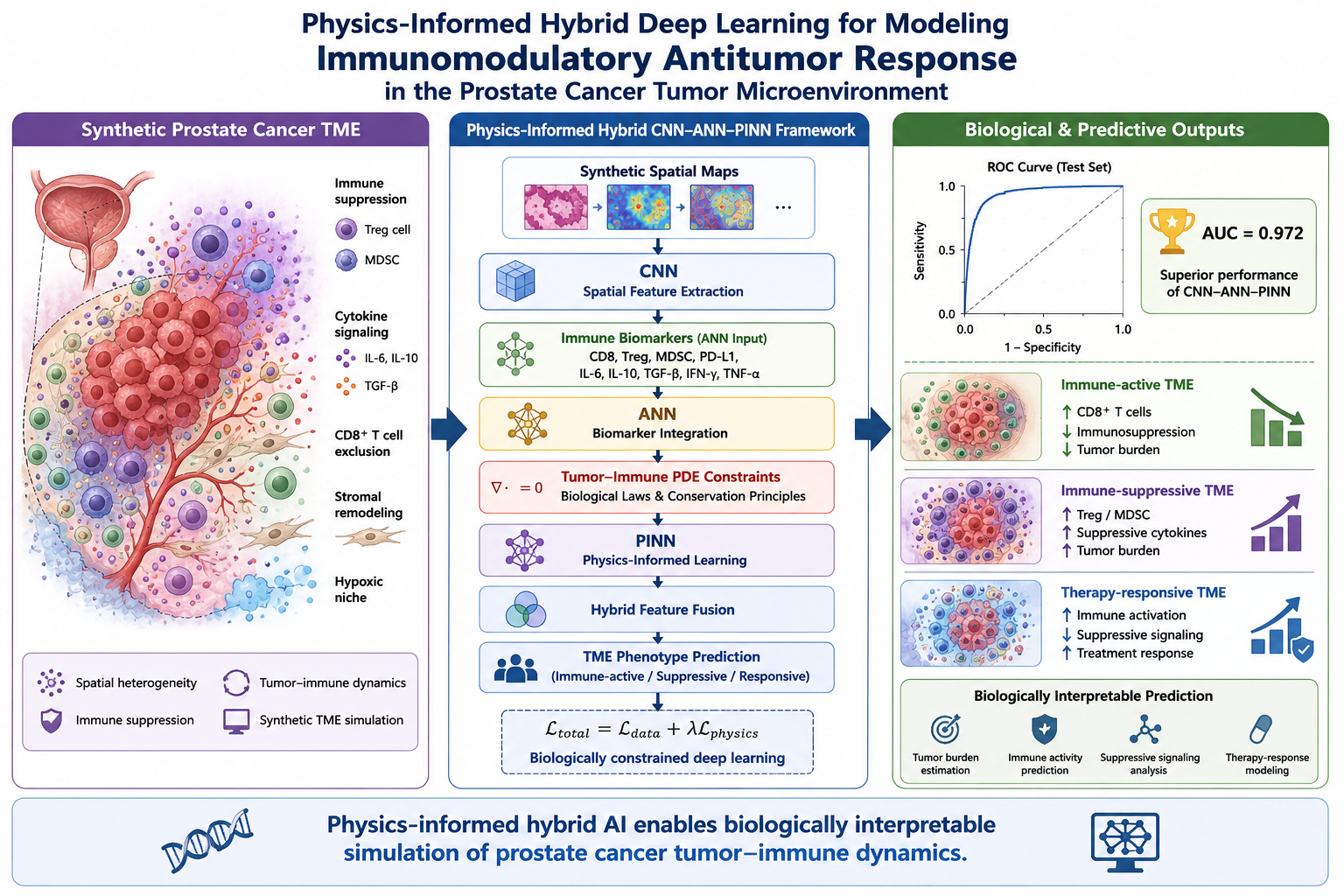
The prostate cancer tumor microenvironment (TME) is frequently characterized by immune suppression, stromal remodeling, limited cytotoxic immune infiltration, and heterogeneous response to immunomodulatory therapy. This study proposes a simulation-based proof-of-concept CNN–ANN–PINN framework for modeling immunomodulatory antitumor response in the prostate cancer TME. A synthetic cohort of 1,080 prostate cancer TME cases was generated using biologically constrained tumor–immune interaction equations. The framework integrates a convolutional neural network (CNN) branch for spatial TME-like features, an artificial neural network (ANN) branch for immune and cytokine-related biomarkers, and a physics-informed neural network (PINN) branch for enforcing tumor–immune dynamic consistency. The model was evaluated against CNN-only, ANN-only, CNN–ANN, and PINN-only baselines. The proposed CNN–ANN–PINN model achieved the strongest simulated performance, with accuracy of 0.952, F1-score of 0.938, and AUC of 0.972, while also reducing biological residual error compared with the ANN dynamic model. Ablation analysis showed that immune-cell markers, biomarker features, spatial features, and physics-informed constraints each contributed to model performance. The learned parameters provided mechanistic interpretability related to tumor proliferation, immune killing, immune suppression, suppressive signaling, and therapy response. Because this study used synthetic data only, the findings should be interpreted as feasibility evidence within a simulation-based benchmark rather than clinical validation. Future work should validate the framework using real prostate cancer histopathology, spatial transcriptomics, immune profiling, liquid biopsy biomarkers, treatment data, and clinical outcomes.
- Hanahan D. Hallmarks of cancer: new dimensions. Cancer Discov. 2022;12(1):31-46. doi: 10.1158/2159-8290.CD-21-1059
- Binnewies M, Roberts EW, Kersten K, et al. Understanding the tumor immune microenvironment (TIME) for effective therapy. Nat Med. 2018;24(5):541-550. doi: 10.1038/s41591-018-0014-x
- Anderson NM, Simon MC. The tumor microenvironment. Curr Biol. 2020;30(16):R921-R925. doi: 10.1016/j.cub.2020.06.081
- Joyce JA, Fearon DT. T cell exclusion, immune privilege, and the tumor microenvironment. Science. 2015;348(6230):74- 80. doi: 10.1126/science.aaa6204
- Sung H, Ferlay J, Siegel RL, et al. Global cancer statistics 2020: GLOBOCAN estimates of incidence and mortality worldwide for 36 cancers in 185 countries. CA Cancer J Clin. 2021;71(3):209-249. doi: 10.3322/caac.21660
- Kwon JTW, Bryant RJ, Parkes EE. The tumor microenvironment and immune responses in prostate cancer patients. Endocr Relat Cancer. 2021;28(8):T95-T107. doi: 10.1530/ERC-21-0149
- Zhang Y, Campbell BK, Stylli SS, Corcoran NM, Hovens CM. The prostate cancer immune microenvironment, biomarkers and therapeutic intervention. Uro. 2022;2(2):74- 92. doi: 10.3390/uro2020010
- Siemińska I, Baran J. Myeloid-derived suppressor cells as key players and promising therapy targets in prostate cancer. Front Oncol. 2022;12:862416. doi: 10.3389/fonc.2022.862416
- Lin M, Sun X, Lv L. New insights and options into the mechanisms and effects of combined targeted therapy and immunotherapy in prostate cancer. Mol Ther Oncolytics. 2023;29:91-106. doi: 10.1016/j.omto.2023.04.007
- Liu D, Wang L, Guo Y. Advances in and prospects of immunotherapy for prostate cancer. Cancer Lett. 2024;601:217155. doi: 10.1016/j.canlet.2024.217155
- Hirz T, Mei S, Sarkar H, et al. Dissecting the immune-suppressive human prostate tumor microenvironment via integrated single-cell and spatial transcriptomic analyses. Nat Commun. 2023;14(1):663. doi: 10.1038/s41467-023-36325-2
- Shiao SL, Chu GCY, Chung LWK. Regulation of prostate cancer progression by the tumor microenvironment. Cancer Lett. 2016;380(1):340-348. doi: 10.1016/j.canlet.2015.12.022
- Agrawal S, Vagha S. A comprehensive review of artificial intelligence in prostate cancer care: state-of-the-art diagnostic tools and future outlook. Cureus. 2024;16(8):e66225. doi: 10.7759/cureus.66225
- Cimadamore A, Cheng L, Scarpelli M, Lopez-Beltran A, Montironi R. Digital diagnostics and artificial intelligence in prostate cancer treatment in 5 years from now. Transl Androl Urol. 2021;10(3):1499-1505. doi: 10.21037/tau-2021-01
- Marra A, Morganti S, Pareja F, et al. Artificial intelligence entering the pathology arena in oncology: current applications and future perspectives. Ann Oncol. 2025;36(7):712-725. doi: 10.1016/j.annonc.2025.03.006
- Tiwari A, Ghose A, Hasanova M, et al. The current landscape of artificial intelligence in computational histopathology for cancer diagnosis. Discov Oncol. 2025;16(1):438. doi: 10.1007/s12672-025-02212-z
- Kather JN, Calderaro J. Development of AI-based pathology biomarkers in gastrointestinal and liver cancer. Nat Rev Gastroenterol Hepatol. 2020;17(10):591-592. doi: 10.1038/s41575-020-0343-3
- Amann, J., Blasimme, A., Vayena, E. et al. Explainability for artificial intelligence in healthcare: a multidisciplinary perspective. BMC Med Inform Decis Mak. 2020;20(1):310. doi: 10.1186/s12911-020-01332-6
- Raissi M, Perdikaris P, Karniadakis GE. Physics-informed neural networks: a deep learning framework for solving forward and inverse problems involving nonlinear partial differential equations. J Comput Phys. 2019;378:686-707. doi: 10.1016/j.jcp.2018.10.045
- Karniadakis GE, Kevrekidis IG, Lu L, Perdikaris P, Wang S, Yang L. Physics-informed machine learning. Nat Rev Phys. 2021;3(6):422-440. doi: 10.1038/s42254-021-00314-5
- Altrock PM, Liu LL, Michor F. The mathematics of cancer: integrating quantitative models. Nat Rev Cancer. 2015;15(12):730-745. doi: 10.1038/nrc4029
- Eftimie R, Bramson JL, Earn DJD. Interactions between the immune system and cancer: a brief review of non-spatial mathematical models. Bull Math Biol. 2011;73(1):2-32. doi: 10.1007/s11538-010-9526-3
- Mahlbacher GE, Reihmer KC, Frieboes HB. Mathematical modeling of tumor-immune cell interactions. J Theor Biol. 2019;469:47-60. doi: 10.1016/j.jtbi.2019.03.002
- Novysedlak R, Guney M, Al Khouri M, et al. The immune microenvironment in prostate cancer: a comprehensive review. Oncology. 2025;103(6):521-545. doi: 10.1159/000541881
- Stultz J, Fong L. How to turn up the heat on the cold immune microenvironment of metastatic prostate cancer. Prostate Cancer Prostatic Dis. 2021;24(3):697-717. doi: 10.1038/s41391-021-00340-5
- Wang I, Song L, Wang BY, Rezazadeh Kalebasty A, Uchio E, Zi X. Prostate cancer immunotherapy: a review of recent advancements with novel treatment methods and efficacy. Am J Clin Exp Urol. 2022;10(4):210-233. Available from: https://pubmed.ncbi.nlm.nih.gov/36051616/ [Last accessed on May 27, 2026].
- Anton A, Hutchinson R, Hovens CM, et al. An immune suppressive tumor microenvironment in primary prostate cancer promotes tumor immune escape. PLoS ONE. 2024;19(11):e0301943. doi: 10.1371/journal.pone.0301943
- Chen L, Xu YX, Wang YS, et al. Prostate cancer microenvironment: multidimensional regulation of immune cells, vascular system, stromal cells, and microbiota. Mol Cancer. 2024;23(1):229. doi: 10.1186/s12943-024-02137-1
- Thomas R, Jerome JM, Krieger KL, Ashraf N, Rowley DR. The reactive stroma response regulates the immune landscape in prostate cancer. J Transl Genet Genom. 2024;8:249-277. doi: 10.20517/jtgg.2024.15
- Salachan PV, Rasmussen M, Ulhøi BP, Jensen JB, Borre M, Sørensen KD. Spatial whole transcriptome profiling of primary tumor from patients with metastatic prostate cancer. Int J Cancer. 2023;153(12):2055-2067. doi: 10.1002/ijc.34708
- Krossa S, Andersen MK, Sandholm EM, et al. Spatial multi-omics identifies aggressive prostate cancer signatures highlighting pro-inflammatory chemokine activity in the tumor microenvironment. Nat Commun. 2025;16(1):10160. doi: 10.1038/s41467-025-65161-9
- Graham MK, Wang R, Chikarmane R, et al. Convergent alterations in the tumor microenvironment of MYC-driven human and murine prostate cancer. Nat Commun. 2024;15(1):7414. doi: 10.1038/s41467-024-51450-2
- Jin Y, Bai Z, Wang G, Zhang Y, Chen J. Applications and prospects of spatial transcriptomics in prostate cancer research: a narrative review. Curr Urol. 2025;19(5):303-308. doi: 10.1097/CU9.0000000000000288
- Ionescu F, Zhang J, Wang L. Clinical applications of liquid biopsy in prostate cancer: from screening to predictive biomarker. Cancers. 2022;14(7):1728. doi: 10.3390/cancers14071728
- Dathathri E, Isebia KT, Abali F, et al. Liquid biopsy based circulating biomarkers in metastatic prostate cancer. Front Oncol. 2022;12:863472. doi: 10.3389/fonc.2022.863472
- Alahdal M, Perera RA, Moschovas MC, Patel V, Perera RJ. Current advances of liquid biopsies in prostate cancer: molecular biomarkers. Mol Ther Oncolytics. 2023;30:27-38. doi: 10.1016/j.omto.2023.07.004
- Hamid Y, Rabbani RD, Afsara R, et al. Exosomal liquid biopsy in prostate cancer: a systematic review of biomarkers for diagnosis, prognosis, and treatment response. Int J Mol Sci. 2025;26(2):802. doi: 10.3390/ijms26020802
- Crocetto F, Musone M, Chianese S, et al. Blood and urine-based biomarkers in prostate cancer: current advances, clinical applications, and future directions. J Liq Biopsy. 2025;9:100305. doi: 10.1016/j.jlb.2025.100305
- Wang Y, Chen Y, Wang J. Role of tumor microenvironment in prostate cancer immunometabolism. Biomolecules. 2025;15(6):826. doi: 10.3390/biom15060826
- Matuszczak M, Schalken JA, Salagierski M. Prostate cancer liquid biopsy biomarkers’ clinical utility in diagnosis and prognosis. Cancers. 2021;13(13):3373. doi: 10.3390/cancers13133373