

An in silico approach to design a multi-epitope vaccine against small ruminant lentiviruses causing Maedi-Visna and caprine arthritis encephalitis in sheep and goats

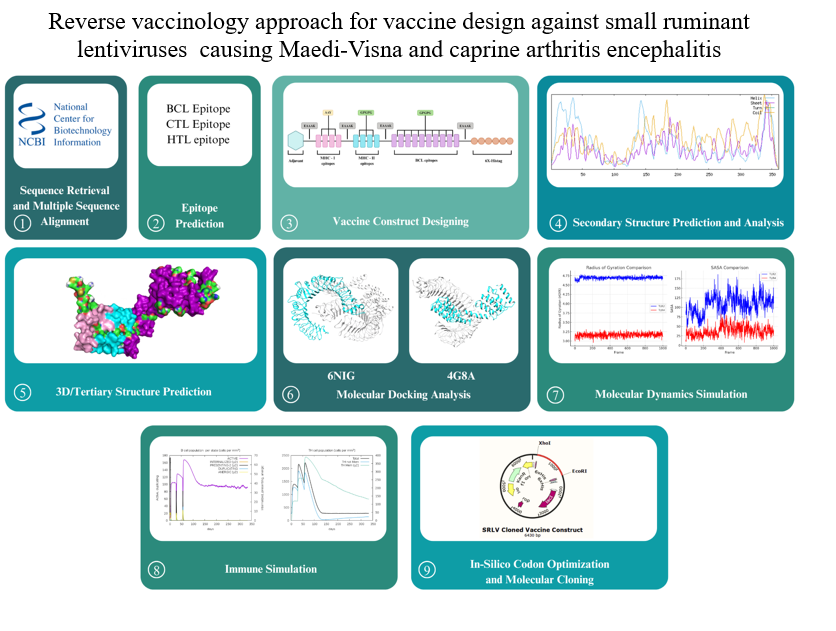
Small ruminant lentiviruses are common viral pathogens affecting livestock, primarily sheep and goats, and are responsible for chronic and fatal diseases such as Maedi-Visna and caprine arthritis encephalitis. These infections compromise livestock productivity. Developing a safe and effective vaccine that provides broad protection across host species remains a major challenge. Consequently, we employed different bioinformatics tools to design a novel multi-epitope vaccine construct based on the envelope gene of the causative lentiviruses. The secondary and tertiary structures of the construct were predicted and subsequently refined. The stability and binding affinity of the vaccine construct were evaluated using advanced computational approaches, including molecular docking and molecular dynamics simulation. Also, the immunogenic potential was assessed through immune simulation studies, followed by codon optimization and in silico cloning. However, in vivo studies are required in the near future to confirm the vaccine construct’s efficacy and immunogenicity.
- Mosa AH, Zenad MM. Serological and histopathological detection of Maedi-Visna virus in middle Iraq regions. Plant Arch. 2020;20(2):6339–6343.
- Blacklaws BA. Small ruminant lentiviruses: immunopathogenesis of visna-maedi and caprine arthritis and encephalitis virus. Comp Immunol Microbiol Infect Dis. 2012;35(3):259-269. doi:10.1016/j.cimid.2011.12.003
- Moroz A, Czopowicz M, Sobczak-Filipiak M, et al. The prevalence of histopathological features of pneumonia in goats with symptomatic caprine arthritis-encephalitis. Pathogens. 2022;11(6):629. doi:10.3390/pathogens11060629
- Enache DA, Baraitareanu S, Dan M, et al. Preliminary results of MVV and CAEV seroprevalence in Romanian sheep and goats. Sci Works Series C Vet Med. 2017;63(1):95-100.
- Rahman MH, Ahmed E, Haque MN, Hassan MZ, Ali MZ. Major respiratory diseases of goat and their epidemiology, prevention and control. Bangladesh J Livest Res. 2022;29(1- 2):1-20. doi:10.3329/bjlr.v29i1.72031
- Blacklaws BA, Berriatua E, Torsteinsdottir S, et al. Transmission of small ruminant lentiviruses. Vet Microbiol. 2004;101(3):199-208. doi:10.1016/j.vetmic.2004.04.006
- Minardi da Cruz JC, Singh DK, Lamara A, Chebloune Y. Small ruminant lentiviruses (SRLVs) break the species barrier to acquire new host range. Viruses. 2013;5(7):1867- 1884. doi:10.3390/v5071867
- Arcangeli C, Torricelli M, Sebastiani C, et al. Genetic characterization of small ruminant lentiviruses (SRLVs) circulating in naturally infected sheep in Central Italy. Viruses. 2022;14(4):686. doi:10.3390/v14040686
- Santry LA, de Jong J, Gold AC, Walsh SR, Menzies PI, Wootton SK. Genetic characterization of small ruminant lentiviruses circulating in naturally infected sheep and goats in Ontario, Canada. Virus Res. 2013;175(1):30-44. doi:10.1016/j.virusres.2013.03.019
- Gomez-Lucia E, Barquero N, Domenech A. Maedi-Visna virus: current perspectives. Vet Med. 2018;9:11-21. doi:10.2147/VMRR.S136705
- Olech M, Valas S, Kuźmak J. Epidemiological survey in single-species flocks from Poland reveals expanded genetic and antigenic diversity of small ruminant lentiviruses. PLoS ONE. 2018;13(3):e0193892. doi:10.1371/journal.pone.0193892
- Pépin M, Vitu C, Russo P, Mornex JF, Peterhans E. Maedi-visna virus infection in sheep: a review. Vet Res. 1998;29(3- 4):341-367.
- Querat G, Audoly G, Sonigo P, Vigne R. Nucleotide sequence analysis of SA-OMVV, a visna-related ovine lentivirus: phylogenetic history of lentiviruses. Virology. 1990;175(2):434-447. doi:10.1016/0042-6822(90)90428-T
- Molaee V, Bazzucchi M, De Mia GM, et al. Phylogenetic analysis of small ruminant lentiviruses in Germany and Iran suggests their expansion with domestic sheep. Sci Rep. 2020;10(1):2243. doi:10.1038/s41598-020-58990-9
- Michiels R, Van Mael E, Quinet C, Adjadj NR, Cay AB, De Regge N. Comparative analysis of different serological and molecular tests for the detection of small ruminant lentiviruses (SRLVs) in Belgian sheep and goats. Viruses. 2018;10(12):696. doi:10.3390/v10120696
- Pétursson G, Matthíasdóttir S, Svansson V, et al. Mucosal vaccination with an attenuated maedi–visna virus clone. Vaccine. 2005;23(24):3223-3228. doi:10.1016/j.vaccine.2004.11.074
- González B, Reina R, García I, et al. Mucosal immunization of sheep with a Maedi-Visna virus (MVV) env DNA vaccine protects against early MVV productive infection. Vaccine. 2005;23(34):4342-4352. doi:10.1016/j.vaccine.2005.03.032
- Torsteinsdóttir S, Carlsdóttir HM, Svansson V, Matthíasdóttir S, Martin AH, Pétursson G. Vaccination of sheep with Maedi-visna virus gag gene and protein, beneficial or harmful? Vaccine. 2007;25(37-38):6713-6720. doi:10.1016/j.vaccine.2007.07.004
- De Andres X, Reina R, Ciriza J, et al. Use of B7 costimulatory molecules as adjuvants in a prime-boost vaccination against Visna–Maedi ovine lentivirus. Vaccine. 2009;27(34):4591- 4600. doi:10.1016/j.vaccine.2009.05.080
- Koçkaya ES, Can H, Yaman Y, Ün C. In silico discovery of epitopes of gag and env proteins for the development of a multi-epitope vaccine candidate against Maedi Visna virus using reverse vaccinology approach. Biologicals. 2023;84:101715. doi:10.1016/j.biologicals.2023.101715
- Cheevers WP, Knowles DP, McGuire TC, Baszler TV, Hullinger GA. Caprine arthritis-encephalitis lentivirus (CAEV) challenge of goats immunized with recombinant vaccinia virus expressing CAEV surface and transmembrane envelope glycoproteins. Vet Immunol Immunopathol. 1994;42(3-4):237-251. doi:10.1016/0165-2427(94)90070-1
- Sievers F, Higgins DG. Clustal Omega for making accurate alignments of many protein sequences. Protein Sci. 2018;27(1):135-145. doi:10.1002/pro.3290
- Troshin PV, Procter JB, Barton GJ. Java bioinformatics analysis web services for multiple sequence alignment— JABAWS: MSA. Bioinformatics. 2011;27(14):2001-2002. doi:10.1093/bioinformatics/btr304
- Hall T. BioEdit: an important software for molecular biology. GERF Bull Biosci. 2011;2(1):60-61.
- Saha S, Raghava GPS. Prediction of continuous B‐cell epitopes in an antigen using recurrent neural network. Proteins. 2006;65(1):40-48. doi:10.1002/prot.21078
- Saha S, Raghava GPS. BcePred: prediction of continuous B-cell epitopes in antigenic sequences using physico-chemical properties. In: Flower DR, Dimitrov I, eds. Immunoinformatics: Predicting Immunogenicity in Silico. Berlin, Heidelberg: Springer; 2004:197-204.
- Jespersen MC, Peters B, Nielsen M, Marcatili P. BepiPred-2.0: improving sequence-based B-cell epitope prediction using conformational epitopes. Nucleic Acids Res. 2017;45(W1):W24-W29. doi:10.1093/nar/gkx346
- Doytchinova IA, Flower DR. VaxiJen: a server for prediction of protective antigens, tumour antigens and subunit vaccines. BMC Bioinform. 2007;8(1):4. doi:10.1186/1471-2105-8-4
- Dimitrov I, Bangov I, Flower DR, Doytchinova I. AllerTOP v. 2—a server for in silico prediction of allergens. J Mol Model. 2014;20(6):2278. doi:10.1007/s00894-014-2278-5
- Sharma N, Naorem LD, Jain S, Raghava GP. ToxinPred2: an improved method for predicting toxicity of proteins. Brief Bioinform. 2022;23(5):bbac174. doi:10.1093/bib/bbac174
- Singh H, Raghava GPS. ProPred: prediction of HLA-DR binding sites. Bioinformatics. 2001;17(12):1236-1237. doi:10.1093/bioinformatics/17.12.1236
- Doytchinova IA, Guan P, Flower DR. EpiJen: a server for multistep T cell epitope prediction. BMC Bioinformatics. 2006;7(1):131. doi:10.1186/1471-2105-7-131
- Trolle T, Metushi IG, Greenbaum JA, et al. Automated benchmarking of peptide-MHC class I binding predictions. Bioinformatics. 2015;31(13):2174-2181. doi:10.1093/bioinformatics/btv123
- Lybeck K, Tollefsen S, Mikkelsen H, et al. Selection of vaccine-candidate peptides from Mycobacterium avium subsp. paratuberculosis by in silico prediction, in vitro T-cell line proliferation, and in vivo immunogenicity. Front Immunol. 2024;15:1297955. doi:10.3389/fimmu.2024.1297955
- Gaafar BB, Ali SA, Abd-Elrahman KA, Almofti YA. Immunoinformatics approach for multiepitope vaccine prediction from H, M, F, and N proteins of Peste des petits ruminants virus. J Immunol Res. 2019;2019:6124030. doi:10.1155/2019/6124030
- Oladipo EK, Taiwo OR, Teniola FO, et al. Immunoinformatics approach to Rift Valley fever virus vaccine design in ruminants. Biomed Res Ther. 2024;11(2):6233-6247. doi:10.15419/bmrat.v11i2.869
- Yang Y, Wei Z, Cia G, et al. MHCII-peptide presentation: an assessment of the state-of-the-art prediction methods. Front Immunol. 2024;15:1293706. doi:10.3389/fimmu.2024.1293706
- Ponomarenko J, Bui HH, Li W, et al. ElliPro: a new structure-based tool for the prediction of antibody epitopes. BMC Bioinform. 2008;9(1):514. doi:10.1186/1471-2105-9-514
- Crowe J, Masone BS, Ribbe J. One-step purification of recombinant proteins with the 6xHis tag and Ni-NTA resin. Mol Biotechnol. 1995;4(3):247-258. doi:10.1007/bf02779018
- Gasteiger E, Hoogland C, Gattiker A, et al. Protein identification and analysis tools on the ExPASy server. In: Walker JM, eds. The Proteomics Protocols Handbook. Totowa, NJ: Humana Press; 2005:571-607.
- Magnan CN, Randall A, Baldi P. SOLpro: accurate sequence-based prediction of protein solubility. Bioinformatics. 2009;25(17):2200-2207. doi:10.1093/bioinformatics/btp386
- Geourjon C, Deleage G. SOPMA: significant improvements in protein secondary structure prediction by consensus prediction from multiple alignments. Bioinformatics. 1995;11(6):681-684. doi:10.1093/bioinformatics/11.6.681
- McGuffin LJ, Bryson K, Jones DT. The PSIPRED protein structure prediction server. Bioinformatics. 2000;16(4):404- 405. doi:10.1093/bioinformatics/16.4.404
- Zhang Y. I-TASSER server for protein 3D structure prediction. BMC Bioinform. 2008;9(1):40. doi:10.1186/1471-2105-9-40
- Laskowski RA, MacArthur MW, Moss DS, Thornton JM. PROCHECK: a program to check the stereochemical quality of protein structures. J Appl Crystallogr. 1993;26:283-291. doi:10.1107/S0021889892009944
- Heo L, Park H, Seok C. GalaxyRefine: Protein structure refinement driven by side-chain repacking. Nucleic Acids Res. 2013;41(W1):W384-W388. doi:10.1093/nar/gkt458
- Wiederstein M, Sippl MJ. ProSA-web: interactive web service for the recognition of errors in three-dimensional structures of proteins. Nucleic Acids Res. 2007;35(Suppl 2):W407-W410. doi:10.1093/nar/gkm290
- Kozakov D, Hall DR, Xia B, et al. The ClusPro web server for protein–protein docking. Nat Protoc. 2017;12(2):255-278. doi:10.1038/nprot.2016.169
- Xue LC, Rodrigues JP, Kastritis PL, Bonvin AM, Vangone A. PRODIGY: a web server for predicting the binding affinity of protein–protein complexes. Bioinformatics. 2016;32(23):3676-3678. doi:10.1093/bioinformatics/btw514
- Krissinel E, Henrick K. Inference of macromolecular assemblies from crystalline state. J Mol Biol. 2007;372(3):774- 797. doi:10.1016/j.jmb.2007.05.022
- Pettersen EF, Goddard TD, Huang CC, et al. UCSF Chimera—a visualization system for exploratory research and analysis. J Comput Chem. 2004;25(13):1605-1612. doi:10.1002/jcc.20084
- Seeliger D, de Groot BL. Ligand docking and binding site analysis with PyMOL and Autodock/Vina. J Comput Aided Mol Des. 2010;24(5):417-422. doi:10.1007/s10822-010-9352-6
- Laskowski RA, Jabłońska J, Pravda L, Vařeková RS, Thornton JM. PDBsum: Structural summaries of PDB entries. Protein Sci. 2018;27(1):129-134. doi:10.1002/pro.3289
- Kosloff D, Kosloff R. A Fourier method solution for the time dependent Schrödinger equation as a tool in molecular dynamics. J Comput Phys. 1983;52(1):35-53. doi:10.1016/0021-9991(83)90015-3
- Rapin N, Lund O, Castiglione F. Immune system simulation online. Bioinformatics. 2011;27(14):2013-2014. doi:10.1093/bioinformatics/btr335
- Grote A, Hiller K, Scheer M, et al. JCat: a novel tool to adapt codon usage of a target gene to its potential expression host. Nucleic Acids Res. 2005;33(Suppl 2):W526-W531. doi:10.1093/nar/gki376