
Reconstructing hair follicle pigmentary unit using organoids and bioprinting

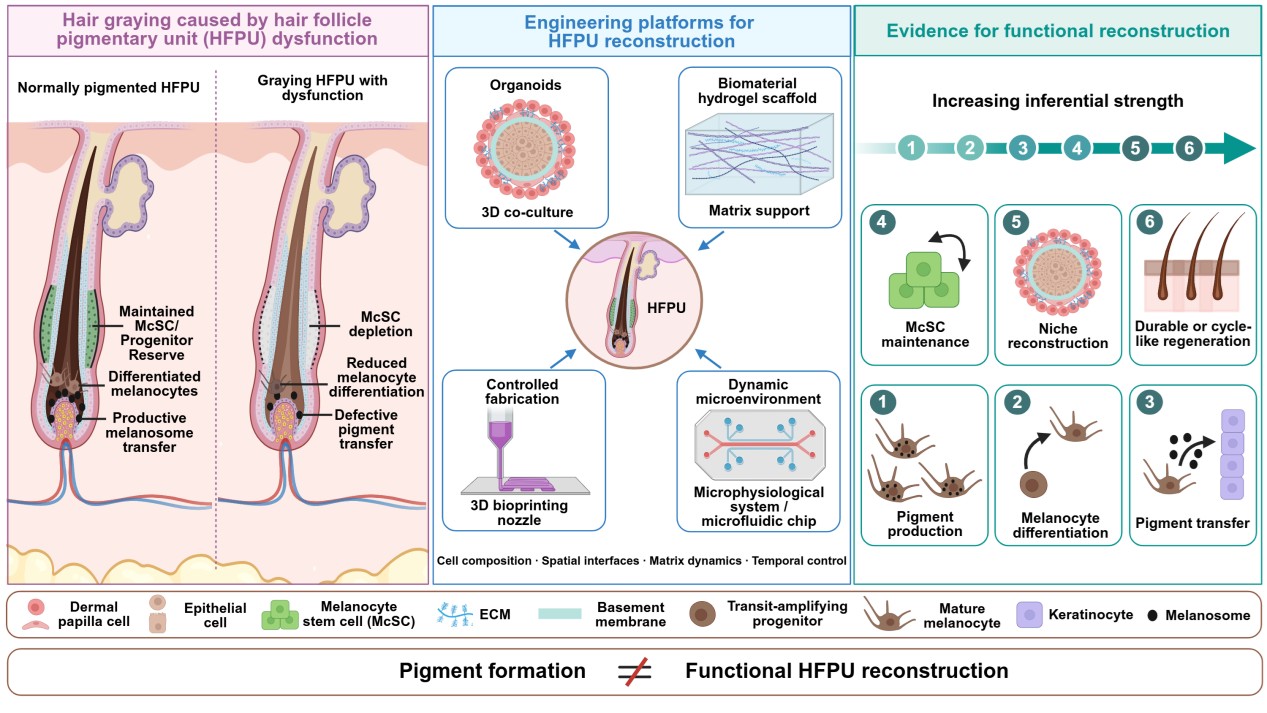
Hair graying is a common feature of physiological aging and is typically evaluated by hair color, melanin content, or melanogenesis-related enzyme activity. However, growing evidence suggests that hair graying results from functional defects at multiple levels of the hair follicle pigmentary unit (HFPU). The HFPU comprises both the intrinsic melanocyte lineage and the extrinsic microenvironment that supports melanocyte function. Here, we review the application of emerging technologies, including organoids, biomaterials, bioprinting, and microphysiological systems, to HFPU reconstruction. Based on the biological functions directly demonstrated by different models, we define six ascending levels of evidence: pigment production, melanocyte differentiation, pigment transfer, progenitor cell maintenance, niche reconstruction, and durable or cycle-like regenerative capacity. Current three-dimensional models reproduce selected structural or cellular components of the HFPU, but remain limited in their ability to sustain melanocyte-lineage renewal, support coordinated pigment transfer, and restore pigmentary function after perturbation. Distinguishing transient hair darkening or short-term melanogenic activation from functional HFPU reconstruction gives a more rigorous evaluation of hair repigmentation models and the interventions tested using these models.
- Tobin DJ, Paus R. Graying: Gerontobiology of the hair follicle pigmentary unit. Exp Gerontol. 2001;36(1):29-54. doi: 10.1016/S0531-5565(00)00210-2
- Slominski A, Wortsman J, Plonka PM, Schallreuter KU, Paus R, Tobin DJ. Hair follicle pigmentation. J Invest Dermatol. 2005;124(1):13-21. doi: 10.1111/j.0022-202X.2004.23528.x
- O'Sullivan JDB, Nicu C, Picard M, et al. The biology of human hair greying. Biol Rev Camb Philos Soc. 2021;96(1):107-128. doi: 10.1111/brv.12648
- Qiu W, Chuong CM, Lei M. Regulation of melanocyte stem cells in the pigmentation of skin and its appendages: Biological patterning and therapeutic potentials. Exp Dermatol. 2019;28(4):395-405. doi: 10.1111/exd.13856
- Tobin DJ. The cell biology of human hair follicle pigmentation. Pigment Cell Melanoma Res. 2011;24(1):75-88. doi: 10.1111/j.1755-148X.2010.00803.x
- Rabbani P, Takeo M, Chou W, et al. Coordinated activation of Wnt in epithelial and melanocyte stem cells initiates pigmented hair regeneration. Cell. 2011;145(6):941-955. doi: 10.1016/j.cell.2011.05.004
- Nishimura EK, Granter SR, Fisher DE. Mechanisms of hair graying: Incomplete melanocyte stem cell maintenance in the niche. Science. 2005;307(5710):720-724. doi: 10.1126/science.1099593
- Inomata K, Aoto T, Binh NT, et al. Genotoxic stress abrogates renewal of melanocyte stem cells by triggering their differentiation. Cell. 2009;137(6):1088-1099. doi: 10.1016/j.cell.2009.03.037
- Rosenberg AM, Rausser S, Ren J, et al. Quantitative mapping of human hair greying and reversal in relation to life stress. Elife. 2021;10:e67437. doi: 10.7554/eLife.67437
- Lei M, Schumacher LJ, Lai YC, et al. Self-organization process in newborn skin organoid formation inspires strategy to restore hair regeneration of adult cells. Proc Natl Acad Sci USA. 2017;114(34):E7101-E7110. doi: 10.1073/pnas.1700475114
- Lee J, Rabbani CC, Gao H, et al. Hair-bearing human skin generated entirely from pluripotent stem cells. Nature. 2020;582(7812):399-404. doi: 10.1038/s41586-020-2352-3
- Nanmo A, Yan L, Asaba T, et al. Bioprinting of hair follicle germs for hair regenerative medicine. Acta Biomater. 2023;165:50-59. doi: 10.1016/j.actbio.2022.06.021
- Lee J, van der Valk WH, Serdy SA, et al. Generation and characterization of hair-bearing skin organoids from human pluripotent stem cells. Nat Protoc. 2022;17(5):1266-1305. doi: 10.1038/s41596-022-00681-y
- Li T, Li X, Xiang X, et al. Regenerative hair pigmentation via skin organoids: Adaptive patterning mediated by collagen VI and semaphorin 3C. Adv Sci (Weinh). 2025;12(36):e02436. doi: 10.1002/advs.202502436
- Qiu W, Gu PR, Chuong CM, Lei M. Skin cyst: A pathological dead-end with a new twist of morphogenetic potentials in organoid cultures. Front Cell Dev Biol. 2021;8:628114. doi: 10.3389/fcell.2020.628114
- Zou Y, Tang F, Li P, Qiu W, Lei M. Wnt10b regulation of hair follicle development, regeneration, and skin diseases. Stem Cell Rev Rep. 2025;21(6):1728-1737. doi: 10.1007/s12015-025-10898-5
- Tu S, Kageyama T, Seo J, Zhou Y, Fukuda J. Development of an in vitro hair pigmentation model using hair follicle organoids. J Biosci Bioeng. 2025;139(2):141-146. doi: 10.1016/j.jbiosc.2024.11.003
- Jeong S, Na Y, Nam HM, Sung GY. Skin-on-a-chip strategies for human hair follicle regeneration. Exp Dermatol. 2023;32(1):13-23. doi: 10.1111/exd.14699
- Commo S, Gaillard O, Bernard BA. Human hair greying is linked to a specific depletion of hair follicle melanocytes affecting both the bulb and the outer root sheath. Br J Dermatol. 2004;150(3):435-443. doi: 10.1046/j.1365-2133.2004.05787.x
- Paus R, Sevilla A, Grichnik JM. Human hair graying revisited: Principles, misconceptions, and key research frontiers. J Invest Dermatol. 2024;144(3):474-491. doi: 10.1016/j.jid.2023.09.276
- Sun Q, Lee W, Hu H, et al. Dedifferentiation maintains melanocyte stem cells in a dynamic niche. Nature. 2023;616(7958):774-782. doi: 10.1038/s41586-023-05960-6
- Nishimura EK, Suzuki M, Igras V, et al. Key roles for transforming growth factor beta in melanocyte stem cell maintenance. Cell Stem Cell. 2010;6(2):130-140. doi: 10.1016/j.stem.2009.12.010
- Wood JM, Decker H, Hartmann H, et al. Senile hair graying: H2O2-mediated oxidative stress affects human hair color by blunting methionine sulfoxide repair. FASEB J. 2009;23(7):2065-2075. doi: 10.1096/fj.08-125435
- Zhang B, Ma S, Rachmin I, et al. Hyperactivation of sympathetic nerves drives depletion of melanocyte stem cells. Nature. 2020;577(7792):676-681. doi: 10.1038/s41586-020-1935-3
- Nishimura EK, Jordan SA, Oshima H, et al. Dominant role of the niche in melanocyte stem-cell fate determination. Nature. 2002;416(6883):854-860. doi: 10.1038/416854a
- Higgins CA, Chen JC, Cerise JE, Jahoda CA, Christiano AM. Microenvironmental reprogramming by three-dimensional culture enables dermal papilla cells to induce de novo human hair-follicle growth. Proc Natl Acad Sci USA. 2013;110(49):19679-19688. doi: 10.1073/pnas.1309970110
- Nishimura EK. Melanocyte stem cells: A melanocyte reservoir in hair follicles for hair and skin pigmentation. Pigment Cell Melanoma Res. 2011;24(3):401-410. doi: 10.1111/j.1755-148X.2011.00855.x
- Wu X, Hammer JA. Melanosome transfer: It is best to give and receive. Curr Opin Cell Biol. 2014;29:1-7. doi: 10.1016/j.ceb.2014.02.003
- Abaci HE, Coffman A, Doucet Y, et al. Tissue engineering of human hair follicles using a biomimetic developmental approach. Nat Commun. 2018;9(1):5301. doi: 10.1038/s41467-018-07579-y
- Toyoshima KE, Asakawa K, Ishibashi N, et al. Fully functional hair follicle regeneration through the rearrangement of stem cells and their niches. Nat Commun. 2012;3:784. doi: 10.1038/ncomms1784
- Ando H, Niki Y, Yoshida M, et al. Involvement of pigment globules containing multiple melanosomes in the transfer of melanosomes from melanocytes to keratinocytes. Cell Logist. 2011;1(1):12-20. doi: 10.4161/cl.1.1.13638
- Wu XS, Masedunskas A, Weigert R, Copeland NG, Jenkins NA, Hammer JA. Melanoregulin regulates a shedding mechanism that drives melanosome transfer from melanocytes to keratinocytes. Proc Natl Acad Sci USA. 2012;109(31):E2101-E2109. doi: 10.1073/pnas.1209397109
- Chaudhuri O, Gu L, Darnell M, et al. Hydrogels with tunable stress relaxation regulate stem cell fate and activity. Nat Mater. 2016;15(3):326-334. doi: 10.1038/nmat4489
- Wang M, Zhou X, Zhou S, et al. Mechanical force drives the initial mesenchymal-epithelial interaction during skin organoid development. Theranostics. 2023;13(9):2930-2945. doi: 10.7150/thno.83217
- Lei M, Harn HI, Li Q, et al. The mechano-chemical circuit drives skin organoid self-organization. Proc Natl Acad Sci USA. 2023;120(36):e2221982120. doi: 10.1073/pnas.2221982120
- Ouyang L. Pushing the rheological and mechanical boundaries of extrusion-based 3D bioprinting. Trends Biotechnol. 2022;40(7):891-902. doi: 10.1016/j.tibtech.2022.01.001
- Blaeser A, Duarte Campos DF, Puster U, Richtering W, Stevens MM, Fischer H. Controlling shear stress in 3D bioprinting is a key factor to balance printing resolution and stem cell integrity. Adv Healthc Mater. 2016;5(3):326-333. doi: 10.1002/adhm.201500677
- Botchkareva NV, Khlgatian M, Longley BJ, Botchkarev VA, Gilchrest BA. SCF/c-kit signaling is required for cyclic regeneration of the hair pigmentation unit. FASEB J. 2001;15(3):645-658. doi: 10.1096/fj.00-0368com
- Ando H, Niki Y, Ito M, et al. Melanosomes are transferred from melanocytes to keratinocytes through the processes of packaging, release, uptake, and dispersion. J Invest Dermatol. 2012;132(4):1222-1229. doi: 10.1038/jid.2011.413
- Li H, Fan L, Zhu S, et al. Epilation induces hair and skin pigmentation through an EDN3/EDNRB-dependent regenerative response of melanocyte stem cells. Sci Rep. 2017;7(1):7272. doi: 10.1038/s41598-017-07683-x
- Liu H, Gan Z, Qin X, Wang Y, Qin J. Advances in microfluidic technologies in organoid research. Adv Healthc Mater. 2024;13(21):e2302686. doi: 10.1002/adhm.202302686
- Cao X, Xu D, Lu M, Zhao Y. Hair follicle seedling cryomicroneedles from hierarchical microfluidic organoid on a chip. Adv Sci (Weinh). Published online June 4, 2026. doi: 10.1002/advs.75961
- Ataç B, Kiss FM, Lam T, et al. The microfollicle: A model of the human hair follicle for in vitro studies. In Vitro Cell Dev Biol Anim. 2020;56(10):847-858. doi: 10.1007/s11626-020-00513-x
- Baltazar T, Jiang B, Moncayo A, et al. 3D bioprinting of an implantable xeno-free vascularized human skin graft. Bioeng Transl Med. 2023;8(1):e10324. doi: 10.1002/btm2.10324
- Zhao W, Chen H, Zhang Y, et al. Adaptive multi-degree-of-freedom in situ bioprinting robot for hair-follicle-inclusive skin repair: A preliminary study conducted in mice. Bioeng Transl Med. 2022;7(3):e10303. doi: 10.1002/btm2.10303
- Lei M, Jiang J, Wang M, et al. Epidermal-dermal coupled spheroids are important for tissue pattern regeneration in reconstituted skin explant cultures. NPJ Regen Med. 2023;8(1):65. doi: 10.1038/s41536-023-00340-0
- Lee V, Singh G, Trasatti JP, et al. Design and fabrication of human skin by three-dimensional bioprinting. Tissue Eng Part C Methods. 2014;20(6):473-484. doi: 10.1089/ten.TEC.2013.0335
- Catarino CM, Schuck DC, Dechiario L, Karande P. Incorporation of hair follicles in 3D bioprinted models of human skin. Sci Adv. 2023;9(41):eadg0297. doi: 10.1126/sciadv.adg0297
- Nasehi R, Aveic S, Fischer H. Wall shear stress during impingement at the building platform can exceed nozzle wall shear stress in microvalve-based bioprinting. Int J Bioprint. 2023;9(4):743. doi: 10.18063/ijb.743
- Kang MS, Kwon M, Lee SH, et al. 3D printing of skin equivalents with hair follicle structures and epidermal-papillary-dermal layers using gelatin/hyaluronic acid hydrogels. Chem Asian J. 2022;17(18):e202200620. doi: 10.1002/asia.202200620
- Kang D, Liu Z, Qian C, et al. 3D bioprinting of a gelatin-alginate hydrogel for tissue-engineered hair follicle regeneration. Acta Biomater. 2023;165:19-30. doi: 10.1016/j.actbio.2022.03.011
- Min D, Lee W, Bae IH, Lee TR, Croce P, Yoo SS. Bioprinting of biomimetic skin containing melanocytes. Exp Dermatol. 2018;27(5):453-459. doi: 10.1111/exd.13376
- Baltazar T, Merola J, Catarino C, et al. Three dimensional bioprinting of a vascularized and perfusable skin graft using human keratinocytes, fibroblasts, pericytes, and endothelial cells. Tissue Eng Part A. 2020;26(5-6):227-238. doi: 10.1089/ten.TEA.2019.0201
- Chen H, Zhang Y, Zhou D, Ma X, Yang S, Xu T. Mechanical engineering of hair follicle regeneration by in situ bioprinting. Biomater Adv. 2022;142:213127. doi: 10.1016/j.bioadv.2022.213127
- Chen H, Ma X, Gao T, Zhao W, Xu T, Liu Z. Robot-assisted in situ bioprinting of gelatin methacrylate hydrogels with stem cells induces hair follicle-inclusive skin regeneration. Biomed Pharmacother. 2023;157:114140. doi: 10.1016/j.biopha.2022.114140
- Ataç B, Wagner I, Horland R, et al. Skin and hair on-a-chip: In vitro skin models versus ex vivo tissue maintenance with dynamic perfusion. Lab Chip. 2013;13(18):3555-3561. doi: 10.1039/c3lc50227a
- Sugiyama E, Nanmo A, Nie X, et al. Large-scale preparation of hair follicle germs using a microfluidic device. ACS Biomater Sci Eng. 2024;10(2):998-1005. doi: 10.1021/acsbiomaterials.3c01346
- Osawa M, Egawa G, Mak SS, et al. Molecular characterization of melanocyte stem cells in their niche. Development. 2005;132(24):5589-5599. doi: 10.1242/dev.02161
- Singh SK, Nizard C, Kurfurst R, Bonte F, Schnebert S, Tobin DJ. The silver locus product (Silv/gp100/Pmel17) as a new tool for the analysis of melanosome transfer in human melanocyte-keratinocyte co-culture. Exp Dermatol. 2008;17(5):418-426. doi: 10.1111/j.1600-0625.2008.00702.x
- Chen CL, Huang WY, Wang EHC, Tai KY, Lin SJ. Functional complexity of hair follicle stem cell niche and therapeutic targeting of niche dysfunction for hair regeneration. J Biomed Sci. 2020;27(1):43. doi: 10.1186/s12929-020-0624-8
- Wu W, Zhou W, Jiang J, et al. Mechanical stimuli-induced CCL2 restores adult mouse cells to regenerate hair follicles. Mol Ther Nucleic Acids. 2023;32:94-110. doi: 10.1016/j.omtn.2023.03.002
- Zhou S, Li Z, Li X, et al. Crosstalk between endothelial cells and dermal papilla entails hair regeneration and angiogenesis during aging. J Adv Res. 2025;70:339-353. doi: 10.1016/j.jare.2024.05.006
- Nicu C, O'Sullivan JDB, Ramos R, et al. Dermal adipose tissue secretes HGF to promote human hair growth and pigmentation. J Invest Dermatol. 2021;141(7):1633-1645.e13. doi: 10.1016/j.jid.2020.12.019
- Yue Z, Lei M, Paus R, Chuong CM. The global regulatory logic of organ regeneration: Circuitry lessons from skin and its appendages. Biol Rev Camb Philos Soc. 2021;96(6):2573-2583. doi: 10.1111/brv.12767
- Ma X, Zhu X, Lv S, et al. 3D bioprinting of prefabricated artificial skin with multicomponent hydrogel for skin and hair follicle regeneration. Theranostics. 2025;15(7):2933-2950. doi: 10.7150/thno.104854
- Wu K, Wei J, Meng Z, Xu K, Lin JT. Harnessing the mechanical properties of gelatin methacryloyl hydrogels through cooling-induced entanglement. Theor Appl Mech Lett. 2025;15(6):100622. doi: 10.1016/j.taml.2025.100622
- Li ME, Jin C, Zhou J. Finite element implementation of poroelasticity theory for swelling dynamics of hydrogels. Theor Appl Mech Lett. 2013;3(5):054009. doi: 10.1063/2.1305409
- Sandoval AGW, Gim KY, Huang JT, Koehler KR. Applications of human pluripotent stem cell-derived skin organoids in dermatology. J Invest Dermatol. 2023;143(10):1872-1876. doi: 10.1016/j.jid.2023.07.017
- Dal Prà I, Chiarini A, De Santis D, Nocini R, Chang S, Armato U. The quest for the perfect healing of human skin wounds: Promising models. Regenesis Repair Rehabil. 2025;1(2):66-79. doi: 10.1016/j.rerere.2025.03.003
- Lin Z, Chen L, Qi C, Wang G. Skin microecology and skin barrier repair, wound healing and appendage regeneration. Regenesis Repair Rehabil. 2025;1(1):1-5. doi: 10.1016/j.rerere.2024.07.001