
Sustainable ALMA from seaweed for DLP printing

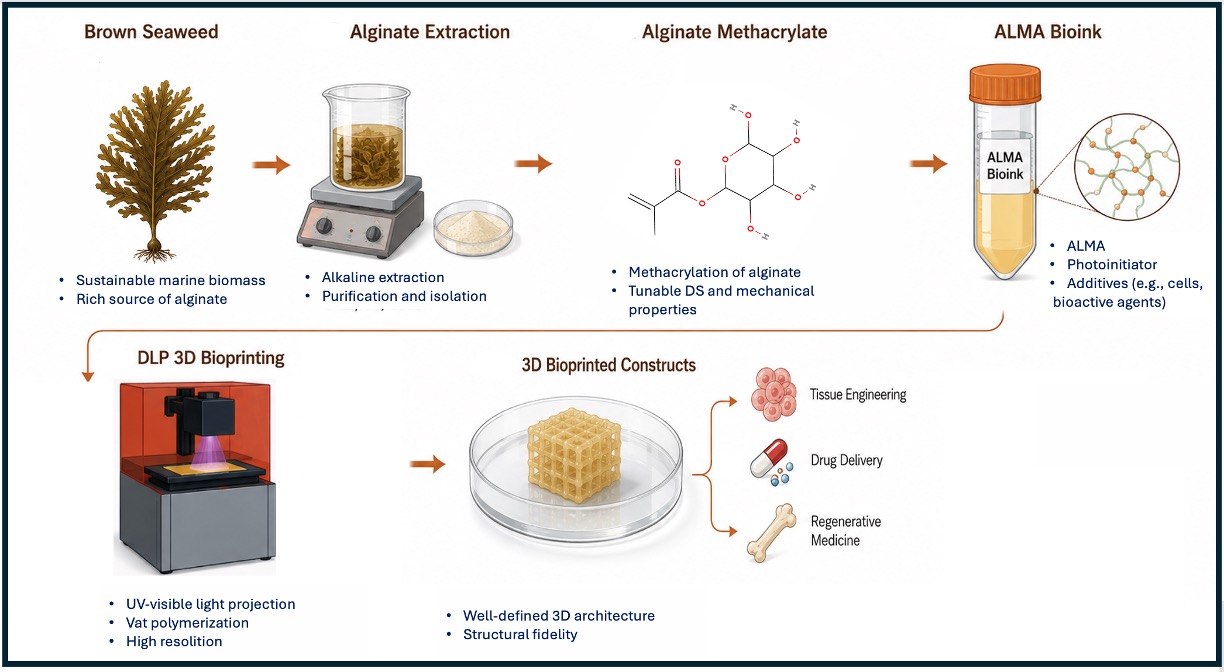
Alginate, which can be extracted from various brown seaweed species, is a sustainable biomaterial with several potential biomedical applications because of its biocompatibility and biodegradability. While alginate hydrogels are traditionally ionically crosslinked with divalent cations, this approach often produces hydrogels with low mechanical strength and poorly controlled degradation kinetics, limiting their suitability for biomedical applications. The chemical modification of alginate via methacrylation to produce alginate methacrylate (ALMA) allows the fabrication of photocrosslinkable hydrogels under ultraviolet (UV) light irradiation. This approach enables the fabrication of alginate-based hydrogels with superior physicochemical properties that can be tailored for specific biomedical areas. However, there is a relative lack of research related to the performance of ALMA bioinks in 3D printing using digital light processing (DLP). The research conducted to date indicates a connection between the choice of alginate source, methacrylation chemistry, and printing outcomes. This review directly addresses this topic by considering alginate extraction from brown seaweed, ALMA synthesis methods, and the biomedical applications of ALMA as a 3D hydrogel using DLP. For this purpose, the focus has been on how each step in the process affects the performance of the materials used in final biomedical applications. The goal of this review is to provide researchers with a framework for optimizing ALMA-based bioinks for DLP-based biomedical fabrication.
- Bi D, Yang X, Yao L, et al. Potential Food and Nutraceutical Applications of Alginate: A Review. Marine Drugs. 2022;20(9):564. doi: 10.3390/md20090564
- Wang Y, Lu Y. Sodium Alginate-Based Functional Materials toward Sustainable Applications: Water Treatment and Energy Storage. Ind Eng Chem Res. 2023;62(29):11279-11304. doi: 10.1021/acs.iecr.3c01082
- Jain D, Bar-Shalom D. Alginate drug delivery systems: Application in context of pharmaceutical and biomedical research. Drug Dev Ind Pharm. 2014;40(12):1576-1584. doi: 10.3109/03639045.2014.917657
- Farshidfar N, Iravani S, Varma RS. Alginate-Based Biomaterials in Tissue Engineering and Regenerative Medicine. Marine Drugs. 2023;21(3):189. doi: 10.3390/md21030189
- Li Y, Liao J, Li S, et al. Marine materials: New hope for biomedical applications. Cell Biomaterials. 2026;2(8):100370. doi: 10.1016/j.celbio.2026.100370
- Fernando IPS, Lee WW, Han EJ, Ahn G. Alginate-based nanomaterials: Fabrication techniques, properties, and applications. Chemical Engineering Journal. 2020;391(4472):123823. doi: 10.1016/j.cej.2019.123823
- Peteiro C. Alginate Production from Marine Macroalgae, with Emphasis on Kelp Farming. In: Springer Series in Biomaterials Science and Engineering. Singapore: Springer; 2017:27-66. doi: 10.1007/978-981-10-6910-9_2
- Saji S, Hebden A, Goswami P, Du C. A Brief Review on the Development of Alginate Extraction Process and Its Sustainability. Sustainability. 2022;14(9):5181. doi: 10.3390/su14095181
- Bojorges H, López-Rubio A, Martínez-Abad A, Fabra J. Overview of alginate extraction processes: Impact on alginate molecular structure and techno-functional properties. Trends Food Sci Technol. 2023;140:104142. doi: 10.1016/j.tifs.2023.104142
- Fawzy MA, Gomaa M, Hifney AF, Abdel-Gawad KM. Optimization of alginate alkaline extraction technology from Sargassum latifolium and its potential antioxidant and emulsifying properties. Carbohydr Polym. 2017;157:1903-1912. doi: 10.1016/J.CARBPOL.2016.11.077
- Stagnaro P, Schizzi I, Utzeri R, Marsano E, Castellano M. Alginate-polymethacrylate hybrid hydrogels for potential osteochondral tissue regeneration. Carbohydr Polym. 2018;185:56-62. doi: 10.1016/j.carbpol.2018.01.012
- Chou AI, Nicoll SB. Characterization of photocrosslinked alginate hydrogels for nucleus pulposus cell encapsulation. J Biomed Mater Res A. 2009;91A(1):187-194. doi: 10.1002/jbm.a.32191
- Wang X, Hao T, Qu J, Wang C, Chen H. Synthesis of Thermal Polymerizable Alginate‐GMA Hydrogel for Cell Encapsulation. J Nanomater. 2015;2015(1): 970619. doi: 10.1155/2015/970619
- Araiza-Verduzco F, Rodríguez-Velázquez E, Cruz H, et al. Photocrosslinked Alginate-Methacrylate Hydrogels with Modulable Mechanical Properties: Effect of the Molecular Conformation and Electron Density of the Methacrylate Reactive Group. Materials. 2020;13(3):534. doi: 10.3390/ma13030534
- Mishbak HH, Cooper G, Bartolo PJ. Development and characterization of a photocurable alginate bioink for three-dimensional bioprinting. Int J Bioprint. 2019;5(2):189. doi: 10.18063/ijb.v5i2.189
- Flórez-Fernández N, Domínguez H, Torres MD. A green approach for alginate extraction from Sargassum muticum brown seaweed using ultrasound-assisted technique. Int J Biol Macromol. 2019;124:451-459. doi: 10.1016/j.ijbiomac.2018.11.232
- Makoure D, Arhaliass A, Echchelh A, Baron R, Legrand J. Procédé d’extrusion réactive et/ou enzymatique pour l’extraction de phycocolloïdes: application aux produits de la mer [Reactive and/or enzymatic extrusion process for phycocolloids extraction: application to sea products]. STA. 2019;2(1). [In French] doi: 10.21494/iste.op.2021.0675
- Nesic A, De Bonis MV, Dal Poggetto G, Ruocco G, Santagata G. Microwave Assisted Extraction of Raw Alginate as a Sustainable and Cost-Effective Method to Treat Beach-Accumulated Sargassum Algae. Polymers. 2023;15(14). doi: 10.3390/polym15142979
- Ummat V, Zhao M, Sivagnanam SP, et al. Ultrasound-Assisted Extraction of Alginate from Fucus vesiculosus Seaweed By-Product Post-Fucoidan Extraction. Marine Drugs. 2024;22(11). doi: 10.3390/md22110516
- Ye S, Xie C, Agar OT, Barrow CJ, Dunshea FR, Suleria HAR. Alginates from Brown Seaweeds as a Promising Natural Source: A Review of Its Properties and Health Benefits. Food Reviews International. 2024;40(9):2682-2710. doi: 10.1080/87559129.2023.2279583
- Trica B, Delattre C, Gros F, et al. Extraction and Characterization of Alginate from an Edible Brown Seaweed (Cystoseira barbata) Harvested in the Romanian Black Sea. Marine Drugs. 2019;17(7). doi: 10.3390/md17070405
- Nøkling-Eide K, Langeng AM, Åslund A, Aachmann FL, Sletta H, Arlov Ø. An assessment of physical and chemical conditions in alginate extraction from two cultivated brown algal species in Norway: Alaria esculenta and Saccharina latissima. Algal Res. 2023;69(1-2):102951. doi: 10.1016/j.algal.2022.102951
- Wedlock DJ, Fasihuddin BA. Effect of formaldehyde pre-treatment on the intrinsic viscosity of alginate from various brown seaweeds. Food Hydrocoll. 1990;4(1):41-47. doi: 10.1016/S0268-005X(09)80326-3
- Shi Y, Dong M, Lei X, et al. Comparison of Flocculation Methods for Sodium Alginate and Characterization of Its Structure and Properties. Published online 2025. doi: 10.3390/foods14172970
- Qin Y. The Extraction of Alginate from Brown Seaweeds. In: Alginate Fibers and Wound Dressings. Hoboken, NJ: Wiley; 2023. doi: 10.1002/9783527845200.ch1
- Mohammed A, Bissoon R, Bajnath E, et al. Multistage extraction and purification of waste Sargassum natans to produce sodium alginate: An optimization approach. Carbohydr Polym. 2018;198:109-118. doi: 10.1016/J.CARBPOL.2018.06.067
- Vauchel P, Kaas R, Arhaliass A, Baron R, Legrand J. A New Process for Extracting Alginates from Laminaria digitata: Reactive Extrusion. Food Bioprocess Technol. 2008;1(3):297-300. doi: 10.1007/s11947-008-0082-x
- Baron R, Vauchel P, Kaas R, Arhaliass A, Legrand J. Dynamical modelling of a reactive extrusion process: Focus on residence time distribution in a fully intermeshing co-rotating twin-screw extruder and application to an alginate extraction process. Chem Eng Sci. 2010;65(10):3313-3321. doi: 10.1016/j.ces.2010.02.019
- Baron R, Vauchel P, Arhaliass A. Modeling of twin-screw reactive extrusion: application to alginate extraction. IFAC Proceedings Volumes. 2010;43(6):341-346. doi: 10.3182/20100707-3-BE-2012.0094
- Felicia WXL, Rovina K, Zuldin WH, Suriati L, Huda N, Nurdiani R. Sustainable Valorization of Alginate, a Review of Green Extraction, Structure–Function Relationships, and Next-Generation Food Applications. Food and Bioprocess Technology. 2026;19(2):97. doi: 10.1007/S11947-025-04096-X
- Savić Gajić IM, Savić IM, Ivanovska AM, Vunduk JD, Mihalj IS, Svirčev ZB. Improvement of Alginate Extraction from Brown Seaweed (Laminaria digitata L.) and Valorization of Its Remaining Ethanolic Fraction. Marine Drugs. 2024;22(6). doi: 10.3390/MD22060280
- Youssouf L, Lallemand L, Giraud P, et al. Ultrasound-assisted extraction and structural characterization by NMR of alginates and carrageenans from seaweeds. Carbohydr Polym. 2017;166:55-63. doi: 10.1016/J.CARBPOL.2017.01.041
- Dodero A, Vicini S, Castellano M. Depolymerization of sodium alginate in saline solutions via ultrasonic treatments: A rheological characterization. Food Hydrocoll. 2020;109:106128. doi: 10.1016/J.FOODHYD.2020.106128
- Yuan Y, Macquarrie D. Microwave assisted extraction of sulfated polysaccharides (fucoidan) from Ascophyllum nodosum and its antioxidant activity. Carbohydr Polym. 2015;129(10):101-107. doi: 10.1016/j.carbpol.2015.04.057
- Abdul Khalil HPS, Lai TK, Tye YY, et al. A review of extractions of seaweed hydrocolloids: Properties and applications. Express Polym Lett. 2018;12(4):296-317. doi: 10.3144/expresspolymlett.2018.27
- Nam H Bin, Lee KH, Yoo HY, Park C, Lim JM, Lee JH. Rapid and High-Yield Recovery of Sodium Alginate from Undaria pinnatifida via Microwave-Assisted Extraction. Processes. 2024;12(1). doi: 10.3390/pr12010208
- Sugiono S, Hidayat MT, Alrosyidi F, et al. Microwave-Assisted Extraction in A Sequential Biorefinery of Alginate and Fucoidan From Brown Alga Sargassum Cristaefolium. Food Sci Technol. Published online December 1, 2022:96-105. doi: 10.25139/fst.vi.4976
- Andriamanantoanina H, Rinaudo M. Characterization of the alginates from five madagascan brown algae. Carbohydr Polym. 2010;82(3):555-560. doi: 10.1016/j.carbpol.2010.05.002
- Sari-Chmayssem N, Taha S, Mawlawi H, Guégan JP, Jeftić J, Benvegnu T. Extracted and depolymerized alginates from brown algae Sargassum vulgare of Lebanese origin: chemical, rheological, and antioxidant properties. J Appl Phycol. 2016;28(3):1915-1929. doi: 10.1007/s10811-015-0676-4
- Khajouei RA, Keramat J, Hamdami N, et al. Extraction and characterization of an alginate from the Iranian brown seaweed Nizimuddinia zanardini. Int J Biol Macromol. 2018;118:1073-1081. doi: 10.1016/j.ijbiomac.2018.06.154
- Sugiono S, Masruri M, Estiasih T, Widjanarko SB. Optimization of extrusion-assisted extraction parameters and characterization of alginate from brown algae (Sargassum cristaefolium). J Food Sci Technol. 2019;56(8):3687-3696. doi: 10.1007/S13197-019-03829-Z
- Mohammed A, Rivers A, Stuckey DC, Ward K. Alginate extraction from Sargassum seaweed in the Caribbean region: Optimization using response surface methodology. Carbohydr Polym. 2020;245:116419. doi: 10.1016/J.CARBPOL.2020.116419
- Chica LR, Yamashita C, Nunes NSS, et al. Optimizing alginate extraction using Box-Behnken design: Improving yield and antioxidant properties through ultrasound-assisted citric acid extraction. Food Chem Adv. 2024;5:100813. doi: 10.1016/J.FOCHA.2024.100813
- Smith HA, Cabling LPB, Leonard NA, Dubrawski KL, Buckley HL. Green Alginate Extraction from Macrocystis pyrifera for Bioplastic Applications: Physicochemical, Environmental Impact, and Chemical Hazard Analyses. ACS Sustain Resour Manag. 2024;1(5):958-969. doi: 10.1021/acssusresmgt.4c00019
- Alboofetileh M, Jeddi S, Abdollahi M. Sequential recovery of alginate from fucoidan extraction by-products of Nizamuddinia zanardinii seaweed using green extraction methods. Ultrason Sonochem. 2025;117:107343. doi: 10.1016/J.ULTSONCH.2025.107343
- Varaprasad K, Jayaramudu T, Kanikireddy V, Toro C, Sadiku ER. Alginate-based composite materials for wound dressing application:A mini review. Carbohydr Polym. 2020;236:116025. doi: 10.1016/j.carbpol.2020.116025
- Jiao W, Chen W, Mei Y, et al. Effects of Molecular Weight and Guluronic Acid/Mannuronic Acid Ratio on the Rheological Behavior and Stabilizing Property of Sodium Alginate. Molecules. 2019;24(23). doi: 10.3390/molecules24234374
- Hernández-González AC, Téllez-Jurado L, Rodríguez-Lorenzo LM. Alginate hydrogels for bone tissue engineering, from injectables to bioprinting: A review. Carbohydr Polym. 2020;229:115514. doi: 10.1016/J.CARBPOL.2019.115514
- Axpe E, Oyen M. Applications of Alginate-Based Bioinks in 3D Bioprinting. Int J Mol Sci. 2016;17(12):1976. doi: 10.3390/ijms17121976
- Ching SH, Bansal N, Bhandari B. Alginate gel particles–A review of production techniques and physical properties. Crit Rev Food Sci Nutr. 2017;57(6):1133-1152. doi: 10.1080/10408398.2014.965773
- Liu J, Yang S, Li X, Yan Q, Reaney MJT, Jiang Z. Alginate Oligosaccharides: Production, Biological Activities, and Potential Applications. Compr Rev Food Sci Food Saf. 2019;18(6):1859-1881. doi: 10.1111/1541-4337.12494
- Hariyadi DM, Islam N. Current Status of Alginate in Drug Delivery. Adv Pharmacol Pharm Sci. 2020;2020:1-16. doi: 10.1155/2020/8886095
- Cardoso M, Costa R, Mano J. Marine Origin Polysaccharides in Drug Delivery Systems. Mar Drugs. 2016;14(2):34. doi: 10.3390/md14020034
- Deng Y, Shavandi A, Okoro OV, Nie L. Alginate modification via click chemistry for biomedical applications. Carbohydr Polym. 2021;270:118360. doi: 10.1016/j.carbpol.2021.118360
- Kumar B, Singh N, Kumar P. A review on sources, modification techniques, properties and potential applications of alginate-based modified polymers. Eur Polym J. 2024;213:113078. doi: 10.1016/J.EURPOLYMJ.2024.113078
- Jeon O, Bouhadir KH, Mansour JM, Alsberg E. Photocrosslinked alginate hydrogels with tunable biodegradation rates and mechanical properties. Biomaterials. 2009;30(14):2724-2734. doi: 10.1016/J.BIOMATERIALS.2009.01.034
- Wang H, Bu X, Huang Z, Yang J, Qiu T. Synthesis of Methacrylic Anhydride by Batch Reactive Distillation: Reaction Kinetics and Process. Ind Eng Chem Res. 2014;53(44):17317-17324. doi: 10.1021/IE501607V
- Habib M, Berthalon S, Leclercq L, Tourrette A, Sharkawi T, Blanquer S. Dual Cross-Linked Stimuli-Responsive Alginate-Based Hydrogels. Biomacromolecules. 2024;25(3):1660-1670. doi: 10.1021/ACS.BIOMAC.3C01201
- Hasany M, Talebian S, Sadat S, et al. Synthesis, properties, and biomedical applications of alginate methacrylate (ALMA)-based hydrogels: Current advances and challenges. Appl Mater Today. 2021;24:101150. doi: 10.1016/j.apmt.2021.101150
- Somo SI, Langert K, Yang CY, et al. Synthesis and evaluation of dual crosslinked alginate microbeads. Acta Biomater. 2018;65:53-65. doi: 10.1016/J.ACTBIO.2017.10.046
- Liang X, Chen S, Liang Y, et al. Alginate-Based Hydrogels: Recent Progress in Preparation, Property Tuning, and Multifunctional Applications. Gels. 2026;12(2):182. doi: 10.3390/gels12020182
- Ren Y, Wang Q, Xu W, et al. Alginate-based hydrogels mediated biomedical applications: A review. Int J Biol Macromol. 2024;279:135019. doi: 10.1016/J.IJBIOMAC.2024.135019
- Tansik G, Stowers R. Viscoelastic and phototunable GelMA-alginate hydrogels for 3D cell culture. MRS Advances. 2024;9(8):505-511. doi: 10.1557/S43580-024-00815-2
- Tavafoghi M, Sheikhi A, Tutar R, et al. Engineering tough, injectable, naturally-derived, bioadhesive composite hydrogels. Adv Healthc Mater. 2020;9(10):e1901722. doi: 10.1002/ADHM.201901722
- Yue H, Wang Y, Fernandes S, Vyas C, Bartolo P. Bioprinting of GelMA/PEGDA Hybrid Bioinks for SH-SY5Y Cell Encapsulation: Role of Molecular Weight and Concentration. Macromol Biosci. 2025;25(6). doi: 10.1002/MABI.202400587
- Yang W, Liu R, Qian K, et al. 3D-printed cell-free bioactive scaffolds from methacrylated hyaluronic acid and silk fibroin incorporating platelet-rich plasma for adipose tissue regeneration. Int J Biol Macromol. 2026;365:152341. doi: 10.1016/j.ijbiomac.2026.152341
- Gao Y, Jin X. Dual Crosslinked Methacrylated Alginate Hydrogel Micron Fibers and Tissue Constructs for Cell Biology. Mar Drugs. 2019;17(10):557. doi: 10.3390/MD17100557
- García-García A, Silván U, Pérez-Álvarez L, Lanceros S. Comparing the Printability, Biological and Physicochemical Properties of Bio-Based Photo-Crosslinkable Hydrogels. Polymers. 2025;17(21):2867. doi: 10.3390/POLYM17212867
- Augst AD, Kong HJ, Mooney DJ. Alginate hydrogels as biomaterials. Macromol Biosci. 2006;6(8):623-633. doi: 10.1002/MABI.200600069
- Masoumi Shahrbabak S, Jalali SM, Fathabadi MF, et al. Modified alginates for precision drug delivery: Advances in controlled-release and targeting systems. Int J Pharm X. 2025;10:100381. doi: 10.1016/J.IJPX.2025.100381
- Zoco de la Fuente A, García-García A, Pérez-Álvarez L, et al. Evaluation of Various Types of Alginate Inks for Light-Mediated Extrusion 3D Printing. Polymers. 2024;16(7):986. doi: 10.3390/POLYM16070986
- Chou AI, Akintoye SO, Nicoll SB. Photo-crosslinked alginate hydrogels support enhanced matrix accumulation by nucleus pulposus cells in vivo. Osteoarthritis Cartilage. 2009;17(10):1377-1384. doi: 10.1016/j.joca.2009.04.012
- Batool SR, Nazeer MA, Ekinci D, Sahin A, Kizilel S. Multifunctional alginate-based hydrogel with reversible crosslinking for controlled therapeutics delivery. Int J Biol Macromol. 2020;150:315-325. doi: 10.1016/J.IJBIOMAC.2020.02.042
- Tahir I, Floreani R. Dual-Crosslinked Alginate-Based Hydrogels with Tunable Mechanical Properties for Cultured Meat. Foods. 2022;11(18). doi: 10.3390/foods11182829
- Jalali Kandeloos A, Bastani S, Mashayekhan S. Architecting oxidized alginate methacrylate hydrogels with tunable characteristics by altering the sequence of the cross-linking steps, methacrylation reaction time, and polymer concentration. J Biomater Appl. 2023;38(1):25-38. doi: 10.1177/08853282231184294
- Mignon A, Zimmer J, Gutierrez Cisneros C, et al. Electron-Beam-Initiated Crosslinking of Methacrylated Alginate and Diacrylated Poly(ethylene glycol) Hydrogels. Polymers (Basel). 2023;15(24):4685. doi: 10.3390/POLYM15244685
- Lipari S, Sacco P, Marsich E, Donati I. Silk Fibroin-Enriched Bioink Promotes Cell Proliferation in 3D-Bioprinted Constructs. Published online 2024. doi: 10.3390/gels10070469
- Poshina D, Sokolova N, Nono-Tagne S, et al. Electrospinning of methacrylated alginate for tissue engineering applications. RSC Adv. 2024;14(52):38746-38756. doi: 10.1039/D4RA07559E
- Gutierrez Cisneros C, Agten H, Derveaux E, Adriaensens P, Bloemen V, Mignon A. Development of a biocompatible, low-cost reinforcement of methacrylated alginate hydrogels using synthetic crosslinking agents. React Funct Polym. 2025;214:106330. doi: 10.1016/J.REACTFUNCTPOLYM.2025.106330
- International Organization for Standardization. Additive manufacturing — General principles — Fundamentals and vocabulary. ISO/ASTM 52900:2021. Accessed July 26, 2026. https://www.iso.org/standard/74514.html
- Ng WL, An J, Chua CK. Process, Material, and Regulatory Considerations for 3D Printed Medical Devices and Tissue Constructs. Engineering. 2024;36:146-166. doi: 10.1016/J.ENG.2024.01.028
- Ng WL, Paula CTB, Serra AC, Coelho JFJ, Bartolo P. Vat photopolymerization-based bioprinting: Shaping next-generation tissues with light. Interdisciplinary Medicine. 2026;4(1):e70078. doi: 10.1002/INMD.70078
- Li Y, Zhang X, Zhang X, Zhang Y, Hou D. Recent Progress of the Vat Photopolymerization Technique in Tissue Engineering: A Brief Review of Mechanisms, Methods, Materials, and Applications. Polymers. 2023;15(19):3940. doi: 10.3390/POLYM15193940
- Islam A, Rahman MZ. Recent advances in additive manufacturing techniques: An in-depth review. Comprehensive Materials Processing: Volume 1-13, Second edition. 2024;13:352-378. doi: 10.1016/B978-0-323-96020-5.00187-4
- Li H, Dai J, Wang Z, et al. Digital light processing (DLP)‐based (bio)printing strategies for tissue modeling and regeneration. Aggregate. 2023;4(2). doi: 10.1002/agt2.270
- Zhao T, Liu Y, Wu Y, Zhao M, Zhao Y. Controllable and biocompatible 3D bioprinting technology for microorganisms: Fundamental, environmental applications and challenges. Biotechnol Adv. 2023;69:108243. doi: 10.1016/j.biotechadv.2023.108243
- Kowsari K, Zhang B, Panjwani S, et al. Photopolymer formulation to minimize feature size, surface roughness, and stair-stepping in digital light processing-based three-dimensional printing. Addit Manuf. 2018;24:627-638. doi: 10.1016/j.addma.2018.10.037
- Bhusal A, Dogan E, Nguyen HA, et al. Multi-material digital light processing bioprinting of hydrogel-based microfluidic chips. Biofabrication. 2022;14(1):014103. doi: 10.1088/1758-5090/ac2d78
- Goodarzi Hosseinabadi H, Nieto D, Yousefinejad A, Fattel H, Ionov L, Miri AK. Ink material selection and optical design considerations in DLP 3D printing. Appl Mater Today. 2023;30:101721. doi: 10.1016/j.apmt.2022.101721
- Grigoryan B, Paulsen SJ, Corbett DC, et al. Multivascular networks and functional intravascular topologies within biocompatible hydrogels. Science. 2019;364(6439):458-464. doi: 10.1126/science.aav9750
- He Y, Wang F, Wang X, Zhang J, Wang D, Huang X. A photocurable hybrid chitosan/acrylamide bioink for DLP based 3D bioprinting. Mater Des. 2021;202:109588. doi: 10.1016/j.matdes.2021.109588
- Na K, Shin S, Lee H, et al. Effect of solution viscosity on retardation of cell sedimentation in DLP 3D printing of gelatin methacrylate/silk fibroin bioink. J Ind Eng Chem. 2018;61:340-347. doi: 10.1016/j.jiec.2017.12.032
- Piras CC, Smith DK. Multicomponent polysaccharide alginate-based bioinks. J Mater Chem B. 2020;8(36):8171-8188. doi: 10.1039/D0TB01005G
- Ren X, Wang J, Wu Y, et al. One-pot synthesis of hydroxyapatite hybrid bioinks for digital light processing 3D printing in bone regeneration. J Mater Sci Technol. 2024;188:84-97. doi: 10.1016/J.JMST.2024.01.001
- Wan J, Xu Y, Qi T, et al. AG73-GelMA/AlgMA hydrogels provide a stable microenvironment for the generation of pancreatic progenitor organoids. J Nanobiotechnol. 2025;23(1):149. doi: 10.1186/S12951-025-03266-5
- Li Y, Mao Q, Yin J, Wang Y, Fu J, Huang Y. Theoretical prediction and experimental validation of the digital light processing (DLP) working curve for photocurable materials. Addit Manuf. 2021;37:101716. doi: 10.1016/j.addma.2020.101716
- Allen NS. Photoinitiators for UV and visible curing of coatings: Mechanisms and properties. J Photochem Photobiol A Chem. 1996;100(1-3):101-107. doi: 10.1016/S1010-6030(96)04426-7
- Tomal W, Ortyl J. Water-Soluble Photoinitiators in Biomedical Applications. Polymers. 2020;12(5):1073. doi: 10.3390/POLYM12051073
- Wang Y, Zhang S, Wang J. Photo-crosslinkable hydrogel and its biological applications. Chin Chem Lett. 2021;32(5):1603-1614. doi: 10.1016/j.cclet.2020.11.073
- Yagci Y, Jockusch S, Turro NJ. Photoinitiated Polymerization: Advances, Challenges, and Opportunities. Macromolecules. 2010;43(15):6245-6260. doi: 10.1021/MA1007545
- Dzwonkowska-Zarzycka M, Sionkowska A. Photoinitiators for Medical Applications—The Latest Advances. Molecules. 2024;29(16):3898. doi: 10.3390/MOLECULES29163898
- Elkhoury K, Zuazola J, Vijayavenkataraman S. Bioprinting the future using light: A review on photocrosslinking reactions, photoreactive groups, and photoinitiators. SLAS Technol. 2023;28(3):142-151. doi: 10.1016/J.SLAST.2023.02.003
- Kim M, Kang D, Han H, Jang J. Light-activated decellularized extracellular matrix-based bioinks for enhanced mechanical integrity. Mater Today Bio. 2025;32:101859. doi: 10.1016/J.MTBIO.2025.101859
- Enayati-Gerdroodbar A, Khayati A, Ahmadi M, Pourabbas B, Ali Aboudzadeh M, Salami-Kalajahi M. An overview on potential of novel photoinitiators for vat photopolymerization-based 3D/4D printing formulations. Eur Polym J. 2024;221:113552. doi: 10.1016/J.EURPOLYMJ.2024.113552
- Deng H, Yin J, Sun Y, et al. Application of new photoinitiating systems based on BODIPY derivatives in long-wavelength photo-induced free radical polymerization. Eur Polym J. 2025;228:113833. doi: 10.1016/J.EURPOLYMJ.2025.113833
- Rayat Pisheh H, Hoseinian MS, Dezfoulian D, et al. Digital light processing bioprinting: bioink innovations and applications in tissue and organ regeneration. J Biol Eng. Published online July 11, 2026. doi: 10.1186/s13036-026-00718-w
- Jacobs PF, Reid DT. Rapid Prototyping & Manufacturing: Fundamentals of Stereolithography. Society of Manufacturing Engineers in cooperation with the Computer and Automated Systems Association of SME; 1992.
- Zhu H, Yang H, Ma Y, et al. Spatiotemporally Controlled Photoresponsive Hydrogels: Design and Predictive Modeling from Processing through Application. Adv Funct Mater. 2020;30(32). doi: 10.1002/ADFM.202000639
- Danis K, Ilgar S, Saraj S, Topuzogullari M, Gunduz O, Ustundag CB. Influence of Light Exposure Time on the Vat Photopolymerization of Methacrylated PVA Microneedles. ACS Omega. 2026;11(29):44284-44293. doi: 10.1021/acsomega.6c04499
- Pagnotta G, Becconi M, Malferrari M, et al. Development of a tissue construct with spatially controllable stiffnessviaa one-step 3D bioprinting and dual-crosslinking process. Mater Adv. 2024;4(16):3491-3505. doi: 10.1039/D3MA00319A
- Sharifi S, Sharifi H, Akbari A, Chodosh J. Systematic optimization of visible light-induced crosslinking conditions of gelatin methacryloyl (GelMA). Scientific Reports. 2021;11(1):23276. doi: 10.1038/s41598-021-02830-x
- González G, Baruffaldi D, Martinengo C, et al. Materials Testing for the Development of Biocompatible Devices through Vat-Polymerization 3D Printing. Nanomaterials. 2020;10(9):1788. doi: 10.3390/NANO10091788
- Luo Z, Zhang H, Chen R, et al. Digital light processing 3D printing for microfluidic chips with enhanced resolution via dosing- and zoning-controlled vat photopolymerization. Microsyst and nanoeng. 2023;9(1):103. doi: 10.1038/s41378-023-00542-y
- Kashi PA, Bachlechner C, Huc-Mathis D, Jäger H, Shahbazi M. A porous 3D biofilm-inspired alginate/gellan hydrogel fabricated via dual-wavelength UV-crosslinking printer: Structural and rheological properties. Carbohydr Polym. 2025;370:124246. doi: 10.1016/J.CARBPOL.2025.124246
- Coser C, Ghaemmaghami AM, Yang J. Soft tissue-mimicking hydrogel stiffness modulates polarisation of human monocyte-derived macrophages. Biomater Sci. 2025;13(23):6637-6651. doi: 10.1039/d5bm01187f
- Mazzoli A, Greco S, Luzi F, et al. 3D-Printed Alginate-Based Hydrogels with Appropriate Rheological Properties and Efficient Development of Cell Spheroids. Polymers 2025, Vol 17, Page 1730. 2025;17(13):1730. doi: 10.3390/POLYM17131730
- Kim J, Choi YJ, Gal CW, Sung A, Park H, Yun HS. Development of an alginate-gelatin bioink enhancing osteogenic differentiation by gelatin release. Int J Bioprint. 2023;9(2):660. doi: 10.18063/IJB.V9I2.660
- Hazur J, Röder J, Czwalinna J, Schubert DW, Boccaccini AR. Pre-Crosslinking with Hydrogel Microparticles Enhances the Printability of Alginate-Based Inks. Macromol Mater Eng. 2023;308(12):2200675. doi: 10.1002/MAME.202200675
- Feng H, Song Y, Lian X, et al. Study on Printability Evaluation of Alginate/Silk Fibroin/Collagen Double-Cross-Linked Inks and the Properties of 3D Printed Constructs. ACS Biomater Sci Eng. 2024;10(10):6581-6593. doi: 10.1021/ACSBIOMATERIALS.4C01522
- Das S, Jegadeesan JT, Basu B. Gelatin Methacryloyl (GelMA)-Based Biomaterial Inks: Process Science for 3D/4D Printing and Current Status. Biomacromolecules. 2024;25(4):2156-2221. doi: 10.1021/ACS.BIOMAC.3C01271
- Zhu W, Ma X, Gou M, Mei D, Zhang K, Chen S. 3D printing of functional biomaterials for tissue engineering. Curr Opin Biotechnol. 2016;40:103-112. doi: 10.1016/J.COPBIO.2016.03.014
- Mao Q, Wang Y, Li Y, et al. Fabrication of liver microtissue with liver decellularized extracellular matrix (dECM) bioink by digital light processing (DLP) bioprinting. Mat Sci Eng C-mater. 2020;109:110625. doi: 10.1016/j.msec.2020.110625
- Jeon O, Alt DS, Ahmed SM, Alsberg E. The effect of oxidation on the degradation of photocrosslinkable alginate hydrogels. Biomaterials. 2012;33(13):3503-3514. doi: 10.1016/J.BIOMATERIALS.2012.01.041
- Liu W, Madry H, Cucchiarini M. Application of Alginate Hydrogels for Next-Generation Articular Cartilage Regeneration. Int J Mol Sci. 2022;23(3):1147. doi: 10.3390/IJMS23031147
- Fenn SL, Miao T, Scherrer RM, Oldinski RA. Dual-Crosslinked Methacrylated Alginate Sub-Microspheres for Intracellular Chemotherapeutic Delivery. ACS Appl Mater Interfaces. 2016;8(28):17775. doi: 10.1021/ACSAMI.6B03245
- Román-Guerrero A, Cortés-Camargo S, Alpizar-Reyes E, et al. Chemically Modified Alginate-Based Hydrogel-Matrices in Drug Delivery. Macromol 2025, Vol 5, Page 36. 2025;5(3):36. doi: 10.3390/MACROMOL5030036
- da Silva CM, Reis RL, Correlo VM, Jahno VD. The efficient role of sodium alginate-based biodegradable dressings for skin wound healing application: a systematic review. J Biomater Sci Polym Ed. 2024;35(3):397-414. doi: 10.1080/09205063.2023.2289247
- Boddupalli A, Bratlie KM. Second harmonic generation microscopy of collagen organization in tunable, environmentally responsive alginate hydrogels. Biomater Sci. 2019;7(3):1188-1199. doi: 10.1039/C8BM01535J
- Vashishtha G, Chauhan S, Zimroz R, Yadav N, Kumar R, Gupta MK. Current Applications of Machine Learning in Additive Manufacturing: A Review on Challenges and Future Trends. Arch. Comput. Methods Eng. 2024;32(4):2635-2668. doi: 10.1007/S11831-024-10215-2
- Ma Y, Tian Z, Wang B, et al. Enhancing the 3D printing fidelity of vat photopolymerization with machine learning-driven boundary prediction. Mater Des. 2024;241:112978. doi: 10.1016/J.MATDES.2024.112978
- Standard Guide for Bioinks Used in Bioprinting. Published online March 15, 2024. doi: 10.1520/F3659-24
- Afshar AK, Mirshafiei M, Saberi A, et al. From light to life: Photocrosslinkable bioinks and their role in 3D bioprinting for shaping future regenerative medicine. Bioprinting. 2026;57:e00487. doi: 10.1016/j.bprint.2026.e00487
- U.S. Food and Drug Administration. Process of 3D Printing Medical Devices. Accessed July 28, 2026. https://www.fda.gov/medical-devices/3d-printing-medical-devices/process-3d-printing-medical-devices