

Development of 3D-printable concrete with coarse biochar as a natural aggregate supplement

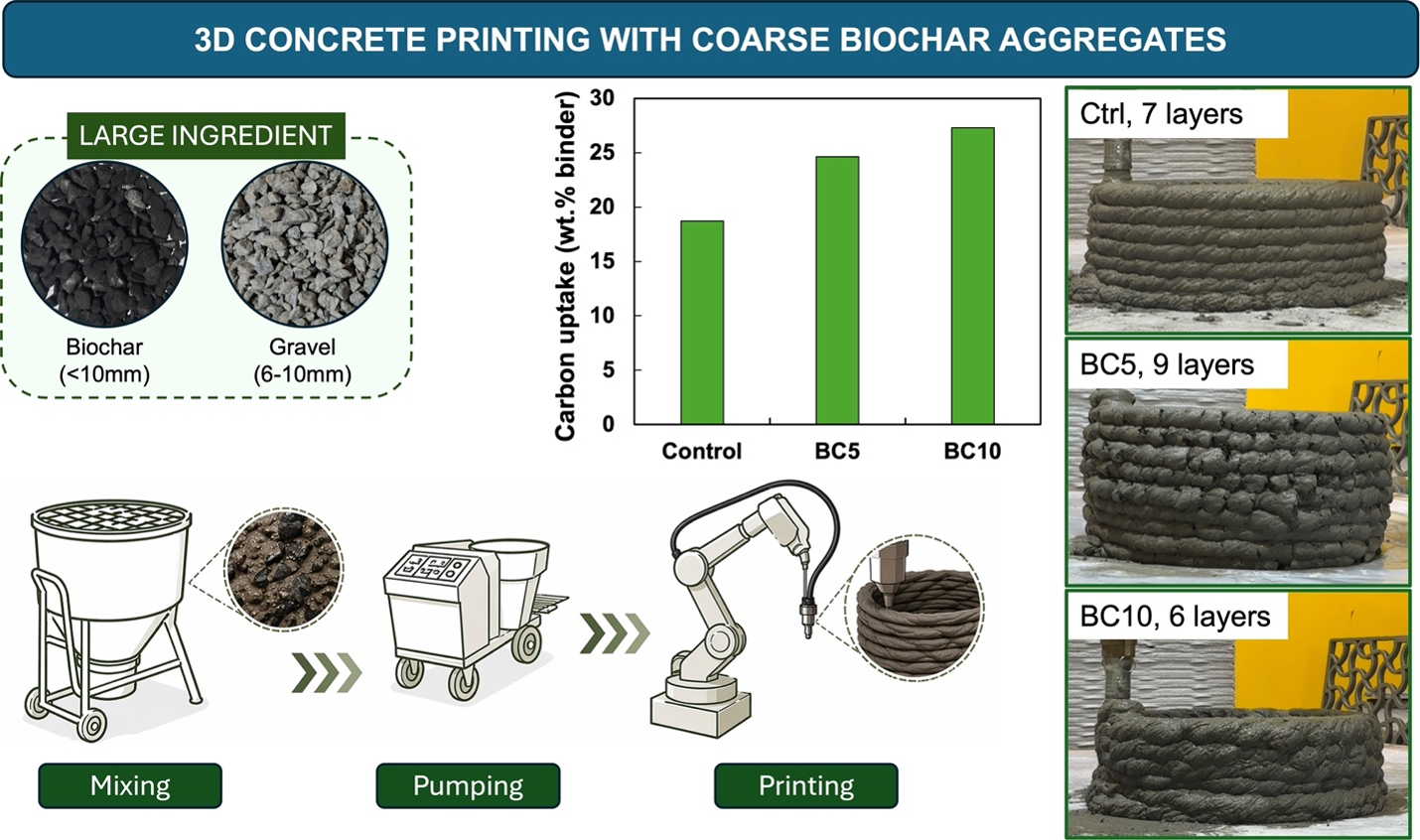
This research investigates the use of biochar as a supplement to natural aggregates in the development of 3D-printable concrete. Most studies on 3D concrete printing (3DCP) have focused on fine aggregates due to limitations in the printing system, particularly regarding the material delivery process. Pumping 3D-printable concrete with large aggregates poses challenges, as it requires larger nozzles and higher print speeds to accommodate the flow from the larger pumps, which typically have a higher flow rate than those used for fine aggregate materials. In this study, coarse biochar with a maximum size of approximately 10 mm was incorporated alongside natural coarse aggregates at volumes of 0%, 5%, and 10%. Various tests were conducted, including assessments of buildability, rheology, mechanical strength, and thermogravimetric analysis for carbon capture of the 3D-printable biochar materials, which were compared to reference materials without biochar. The findings showed that coarse biochar can effectively enhance early-age carbon sequestration while preserving printability. Although the addition of biochar reduced mechanical strength, a 5% biochar replacement achieved higher buildability. While biochar has traditionally been explored as a cement replacement or filler, its use as coarse aggregate in 3DCP is relatively new and has not been previously studied. Optimizing biochar derived from agricultural waste in concrete can further enhance the sustainability of current 3DCP technology. This approach provides a scalable strategy for integrating carbon capture functionality into digital construction materials.
- Gibson I, Rosen D, Stucker B, Khorasani M. Development of Additive Manufacturing Technology. In: Additive Manufacturing Technologies. Cham, Switzerland: Springer; 2021. doi: 10.1007/978-3-030-56127-7_2
- Karkun MS, Dharmalingam S. 3D printing technology in aerospace industry–a review. IJAAA. 2022;9(2):4. doi: 10.15394/ijaaa.2022.1708
- Lai J, Wang C, Wang M. 3D printing in biomedical engineering: Processes, materials, and applications. Appl Phys Rev. 2021;8(2). doi: 10.1063/5.0024177
- Shaukat U, Rossegger E, Schlögl S. A review of multi-material 3D printing of functional materials via vat photopolymerization. Polymers. 2022;14(12):2449. doi: 10.3390/polym14122449
- Nachal N, Moses JA, Karthik P, Anandharamakrishnan C. Applications of 3D printing in food processing. Food Eng Rev. 2019;11(3):123-141. doi: 10.1007/s12393-019-09199-8
- Pan Y, Zhang Y, Zhang D, Song Y. 3D printing in construction: state of the art and applications. Int J Adv Manuf Technol. 2021;115(5):1329-1348. doi: 10.1007/s00170-021-07213-0
- Žujović M, Obradović R, Rakonjac I, Milošević J. 3D printing technologies in architectural design and construction: A systematic literature review. Buildings. 2022;12(9):1319. doi: 10.3390/buildings12091319
- Paritala S, Singaram KK, Bathina I, Khan MA, Jyosyula SKR. Rheology and pumpability of mix suitable for extrusion-based concrete 3D printing–A review. Constr Build Mater. 2023;402:132962. doi: 10.1016/j.conbuildmat.2023.132962
- Sun Y, Zhang X, Zhou J, et al. Extrudability analysis of 3D printable concrete as a two-phase discrete flow. J Build Eng. 2024;98:111252. doi: 10.1016/j.jobe.2024.111252
- Xia Z, Geng J, Zhou Z, Liu G. Comparative analysis of polypropylene, basalt, and steel fibers in 3D printed concrete: Effects on flowability, printability, rheology, and mechanical performance. Constr Build Mater. 2025;465:140098. doi: 10.1016/j.conbuildmat.2025.140098
- Ivanova I, Ivaniuk E, Bisetti S, Nerella VN, Mechtcherine V. Comparison between methods for indirect assessment of buildability in fresh 3D printed mortar and concrete. Cem Concr Res. 2022;156:106764. doi: 10.1016/j.cemconres.2022.106764
- He Z, Zhu X, Wang J, Mu M, Wang Y. Comparison of CO2 emissions from OPC and recycled cement production. Constr Build Mater. 2019;211:965-973. doi: 10.1016/j.conbuildmat.2019.03.289
- Ige OE, Von Kallon DV, Desai D. Carbon emissions mitigation methods for cement industry using a systems dynamics model. Clean Technol Environ Policy. 2024;26(3):579-597. doi: 10.1007/s10098-023-02683-0
- Lehmann J, Cowie A, Masiello CA, et al. Biochar in climate change mitigation. Nat Geosci. 2021;14(12):883-892. doi: 10.1038/s41561-021-00852-8
- Suarez-Riera D, Restuccia L, Ferro GA. The use of Biochar to reduce the carbon footprint of cement-based materials. Procedia Struct Integr. 2020;26:199-210. doi: 10.1016/j.prostr.2020.06.023
- Gupta S, Kua HW, Dai Pang S. Effect of biochar on mechanical and permeability properties of concrete exposed to elevated temperature. Constr Build Mater. 2020;234:117338. doi: 10.1016/j.conbuildmat.2019.117338
- Gupta S, Kua HW. Effect of water entrainment by pre-soaked biochar particles on strength and permeability of cement mortar. Constr Build Mater. 2018;159:107-125. doi: 10.1016/j.conbuildmat.2017.10.095
- Sirico A, Belletti B, Bernardi P, et al. Effects of biochar addition on long-term behavior of concrete. Theor Appl Fract Mech. 2022;122:103626. doi: 10.1016/j.tafmec.2022.103626
- Chen L, Zhu X, Zheng Y, Wang L, Poon CS, Tsang DC. Development of high-strength lightweight concrete by utilizing food waste digestate based biochar aggregate. Constr Build Mater. 2024;411:134142. doi: 10.1016/j.conbuildmat.2023.134142
- Song S, Liu Z, Liu G, Cui X, Sun J. Application of biochar cement-based materials for carbon sequestration. Constr Build Mater. 2023;405:133373. doi: 10.1016/j.conbuildmat.2023.133373
- Wyrzykowski M, Toropovs N, Winnefeld F, Lura P. Cold-bonded biochar-rich lightweight aggregates for net-zero concrete. J Clean Prod. 2024;434:140008. doi: 10.1016/j.jclepro.2023.140008
- Park JH, Lim KM, Ryu GS, Koh KT, Kim KC. An experimental study on the thermal insulation properties of concrete containing wood-based biochar. Appl Sci. 2025;15(19):10560. doi: 10.3390/app151910560
- Revathi S, Alice Elizabeth Tania D, Ancy Shadin S, Keerthana J. Effect of zeolite and bamboo biochar as CO2 absorbant in concrete. Carbon Res. 2024;3(1):43. doi: 10.1007/s44246-024-00116-1
- Zhou Y, Wang S, Chen L. Progress and prospects of biochar as concrete filler: A review. Alex Eng J. 2025;128:306-323. doi: 10.1016/j.aej.2025.05.077
- Zhang C, Zhang J, Su Y, et al. Low-carbon 3D-printed concrete by using biochar as a carbon sequestrator. In: Biochar-Based Cement and Concrete for Sustainable Construction. Cambridge, UK: Woodhead Publishing; 2026:67-88. doi: 10.1016/B978-0-443-22037-1.00009-4
- Vergara LA, Perez JF, Colorado HA. 3D printing of ordinary Portland cement with waste wood derived biochar obtained from gasification. Case Stud Constr Mater. 2023;18:e02117. doi: 10.1016/j.cscm.2023.e02117
- Jhun J, Lee J, Paul SC, et al. Potential of rice husk biochar in 3D concrete printing: an analysis of fresh-state rheology, strength retention, and carbon sequestration. Virtual Phys Prototyp. 2026;21(1):e2619391. doi: 10.1080/17452759.2026.2619391
- Praneeth S, Guo R, Wang T, Dubey BK, Sarmah AK. Accelerated carbonation of biochar reinforced cement-fly ash composites: enhancing and sequestering CO2 in building materials. Constr Build Mater. 2020;244:118363. doi: 10.1016/j.conbuildmat.2020.118363
- Chen Y, Zhan B, Guo B, et al. Biochar-enhanced cement composites as carbon sink under accelerated carbonation curing: Carbon sequestration potential stimulated by biochar porosity. Constr Build Mater. 2025;492:143005. doi: 10.1016/j.conbuildmat.2025.143005
- Dixit A, Gupta S, Dai Pang S, Kua HW. Waste Valorisation using biochar for cement replacement and internal curing in ultra-high performance concrete. J Clean Prod. 2019;238:117876. doi: 10.1016/j.jclepro.2019.117876
- De Guzman AIR, Mateo WC, Denson MD, Villota EM, Perez MG. Synthesis and evaluation of rice straw-derived biochar as cement replacement for concrete. J Build Eng. 2025:113617. doi: 10.1016/j.jobe.2025.113617
- Harbouz I, Roziere E, Yahia A, Loukili A. Printability assessment of cement-based materials based on rheology, hydration kinetics, and viscoelastic properties. Constr Build Mater. 2022;325:126810. doi: 10.1016/j.conbuildmat.2022.126810
- Wang H, Zentar R, Wang D. Rheological characterization of fine-grained sediments under steady and dynamic conditions. Int J Geomech. 2022;22(1):04021260. doi: 10.1061/(ASCE)GM.1943-5622.0002243
- Bhatty JI. Hydration versus strength in a Portland cement developed from domestic mineral wastes—a comparative study. Thermochim Acta. 1986;106:93-103. doi: 10.1016/0040-6031(86)85120-6
- Dixit A, Du H, Dai Pang S. Carbon capture in ultra-high performance concrete using pressurized CO2 curing. Constr Build Mater. 2021;288:123076. doi: 10.1016/j.conbuildmat.2021.123076
- Lim SG, Tay YWD, Paul SC, et al. Carbon capture and sequestration with in-situ CO2 and steam integrated 3D concrete printing. Carbon Capture Sci Technol. 2024;13:100306. doi: 10.1016/j.ccst.2024.100306
- Panda B, Paul SC, Mohamed NAN, Tay YWD, Tan MJ. Measurement of tensile bond strength of 3D printed geopolymer mortar. Measurement. 2018;113:108-116. doi: 10.1016/j.measurement.2017.08.051
- Scrivener KL, Crumbie AK, Laugesen P. The interfacial transition zone (ITZ) between cement paste and aggregate in concrete. Interface Sci. 2004;12(4):411-421. doi: 10.1023/B:INTS.0000042339.92990.4c
- Patel R, Stobbs J, Acharya B. Study of biochar in cementitious materials for developing green concrete composites. Sci Rep. 2025;15(1):22192. doi: 10.1038/s41598-025-07210-3
- Ali D, Agarwal R, Hanifa M, et al. Thermo-physical properties and microstructural behaviour of biochar-incorporated cementitious material. J Build Eng. 2023;64:105695. doi: 10.1016/j.jobe.2022.105695
- Xu W, Li M, Liang J, et al. Microstructural regulation of interfacial transition zone by biochar: A novel strategy for enhancing fire resistance. Cem Concr Compos. 2026;169:106517. doi: 10.1016/j.cemconcomp.2026.106517
- Zhu X, Zhang Y, Chen L, et al. Bonding mechanisms and micro-mechanical properties of the interfacial transition zone (ITZ) between biochar and paste in carbon-sink cement-based composites. Cem Concr Compos. 2023;139:105004. doi: 10.1016/j.cemconcomp.2023.105004