
Effect of lattice interlocking geometry on curing distribution and tensile performance in metal–polymer hybrid structures fabricated by powder bed fusion and vat photopolymerization

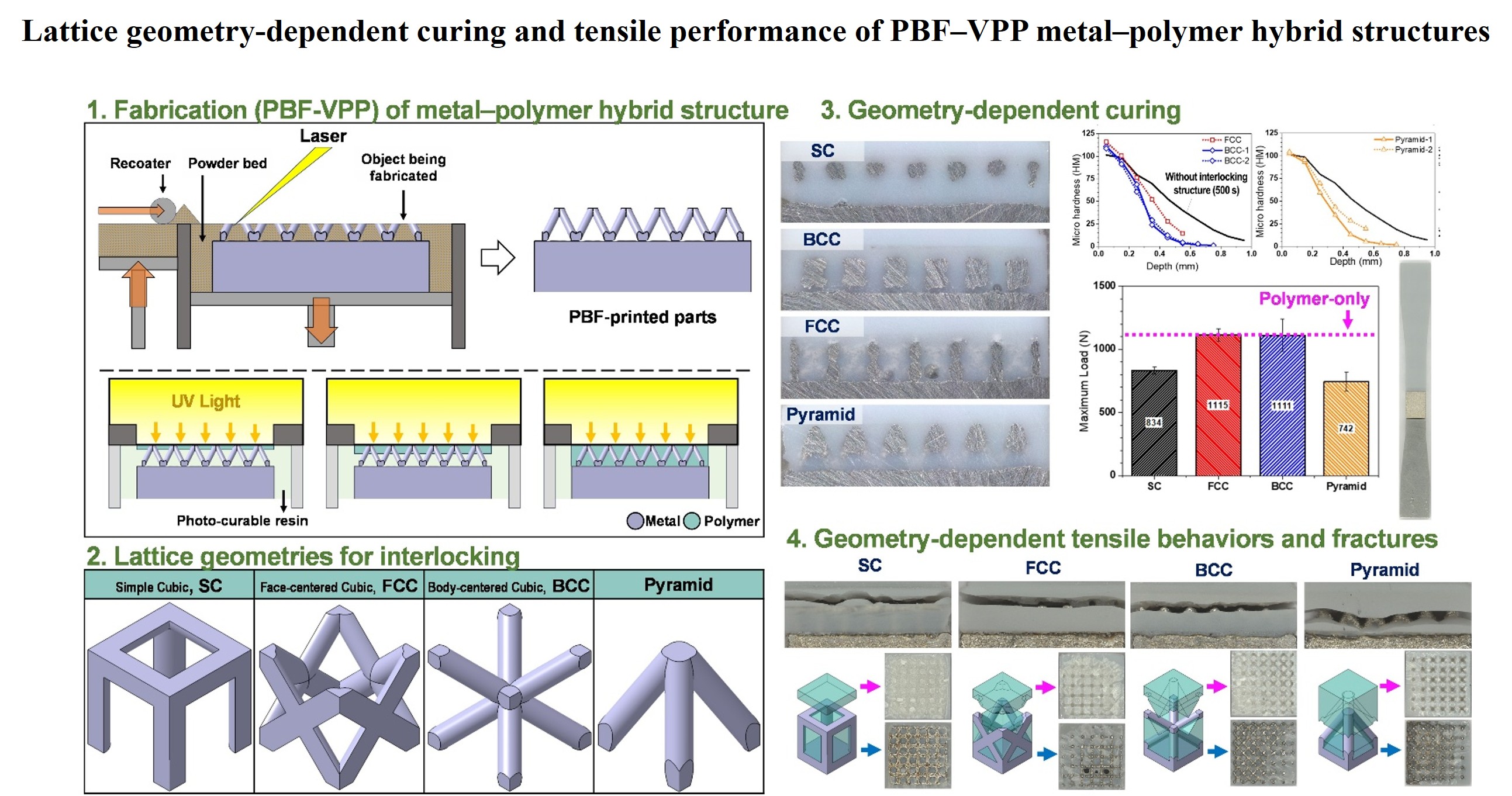
Metal–polymer hybrid structures can be fabricated by integrating powder bed fusion (PBF) and vat photopolymerization (VPP) additive manufacturing, in which a photopolymer is infiltrated and cured within metal lattice structures through extended UV exposure. This study examines how the lattice interlocking geometry influences local curing behavior and the tensile performance of hybrid structures. Four lattice geometries, simple cubic (SC), face-centered cubic (FCC), body-centered cubic (BCC), and pyramid, were comparatively investigated. Indirect curing enabled polymer solidification within optically shielded lattice regions, but the curing level decreased with increasing distance from the incident surface, resulting in geometry-dependent microhardness distributions. Tensile behavior also depended strongly on lattice geometry: FCC and BCC showed the highest maximum loads of 1,115 and 1,111 N, respectively, whereas SC and pyramid exhibited lower values of 834 and 742 N, respectively. Fracture observations indicated that FCC and BCC promoted more tortuous crack paths through inclined or diagonal struts, while SC and pyramid provided less favorable fracture routes and lower resistance. These results show that lattice geometry governs the tensile performance of PBF–VPP metal–polymer hybrid structures by influencing both curing distribution and fracture path.
- Delzendehrooy F, Akhavan-Safar A, Barbosa AQ, et al. A comprehensive review on structural joining techniques in the marine industry. Compos Struct. 2022;289. doi: 10.1016/j.compstruct.2022.115490
- Huang Y, Gao X, Zhang Y, Ma B. Laser joining technology of polymer-metal hybrid structures - A review. J Manuf Process. 2022;79:934-961. doi: 10.1016/j.jmapro.2022.05.026
- Lambiase F, Scipioni SI, Lee CJ, Ko DC, Liu F. A state-of-the-art review on advanced joining processes for metal-composite and metal-polymer hybrid structures. Materials. 2021;14(8). doi: 10.3390/ma14081890
- Lambiase F, Liu F. Recent advances in metal-polymer joining processes. In: Joining Processes for Dissimilar and Advanced Materials. Amsterdam, Netherlands: Elsevier; 2022:123-151. doi: 10.1016/B978-0-323-85399-6.00007-2
- Borges CSP, Akhavan-Safar A, Tsokanas P, Carbas RJC, Marques EAS, da Silva LFM. From fundamental concepts to recent developments in the adhesive bonding technology: a general view. Discov Mech Eng. 2023;2(1). doi: 10.1007/s44245-023-00014-7
- Wei Y, Jin X, Luo Q, Li Q, Sun G. Adhesively bonded joints – A review on design, manufacturing, experiments, modeling and challenges. Compos Part B Eng. 2024;276. doi: 10.1016/j.compositesb.2024.111225
- Bu H, Li X, Wang J, Li B, Xiao L, Zhan X. Porosity characteristics and interfacial structure evolution of laser joining CFRTP and 6061-T6 with prefabricated interfacial grooves. Compos Part B Eng. 2025;294. doi: 10.1016/j.compositesb.2025.112173
- Du M, Dong W, Li X, Wang L, Wang B, Tang B. Effect of surface topography on injection joining Ti alloy for improved bonding strength of metal-polymer. Surf Coat Technol. 2022;433. doi: 10.1016/j.surfcoat.2022.128132
- Vasconcelos RL, Oliveira GHM, Amancio-Filho ST, Canto LB. Injection overmolding of polymer-metal hybrid structures: A review. Polym Eng Sci. 2023;63(3):691-722. doi: 10.1002/pen.26244
- Kimura F, Kadoya S, Kajihara Y. Effects of molding conditions on injection molded direct joining using a metal with nano-structured surface. Precis Eng. 2016;45:203-208. doi: 10.1016/j.precisioneng.2016.02.013
- Chueh YH, Wei C, Zhang X, Li L. Integrated laser-based powder bed fusion and fused filament fabrication for three-dimensional printing of hybrid metal/polymer objects. Addit Manuf. 2020;31:100928. doi: 10.1016/j.addma.2019.100928
- Chueh YH, Zhang X, Ke JCR, Li Q, Wei C, Li L. Additive manufacturing of hybrid metal/polymer objects via multiple-material laser powder bed fusion. Addit Manuf. 2020;36. doi: 10.1016/j.addma.2020.101465
- Abreu T, Leal RM, Leitão C, Galvão I. Metal-Polymer Joining by Additive Manufacturing: Effect of Printing Parameters and Interlocking Design. J Manuf Mater Process. 2024;8(5):228. doi: 10.3390/jmmp8050228
- Englert L, Heuer A, Engelskirchen MK, et al. Hybrid material additive manufacturing: interlocking interfaces for fused filament fabrication on laser powder bed fusion substrates. Virtual Phys Prototyp. 2022;17(3):508-527. doi: 10.1080/17452759.2022.2048228
- Hertle S, Kleffel T, Wörz A, Drummer D. Production of polymer-metal hybrids using extrusion-based additive manufacturing and electrochemically treated aluminum. Addit Manuf. 2020;33:101135. doi: 10.1016/j.addma.2020.101135
- Guerra Silva R, Torres MJ, Zahr Viñuela J. A comparison of miniature lattice structures produced by material extrusion and vat photopolymerization additive manufacturing. Polymers. 2021;13(13):2163. doi: 10.3390/polym13132163
- Pagac M, Hajnys J, Ma QP, et al. A review of vat photopolymerization technology: Materials, applications, challenges, and future trends of 3D printing. Polymers. 2021;13(4):598. doi: 10.3390/polym13040598
- Zhang F, Zhu L, Li Z, et al. The recent development of vat photopolymerization: A review. Addit Manuf. 2021;48:102423. doi: 10.1016/j.addma.2021.102423
- Li L, Huang Z. Vat photopolymerization 3D printing of ceramics. In: Vat Photopolymerization Additive Manufacturing: 3D Printing Processes, Materials, and Applications. Amsterdam, Netherlands: Elsevier; 2024:195-241. doi: 10.1016/B978-0-443-15487-4.00007-8
- Wang X, Liu J, Kho ASK, Hong W, Gilchrist MD, Zhang N. Elucidating the mechanism of overcuring in microchannels fabricated via vat photopolymerization (VPP) for precise microfluidic chip printing. Addit Manuf. 2024;92:104350. doi: 10.1016/j.addma.2024.104350
- Jacobs PF. Rapid Prototyping and Manufacturing: Fundamentals of Stereolithography. Southfield, MI: Society of Manufacturing Engineers; 1992.
- Li Y, Mao Q, Yin J, Wang Y, Fu J, Huang Y. Theoretical prediction and experimental validation of the digital light processing (DLP) working curve for photocurable materials. Addit Manuf. 2021;37:101716. doi: 10.1016/j.addma.2020.101716
- Guven E, Karpat Y, Cakmakci M. Improving the dimensional accuracy of micro parts 3D printed with projection-based continuous vat photopolymerization using a model-based grayscale optimization method. Addit Manuf. 2022;57:102954. doi: 10.1016/j.addma.2022.102954
- Qian C, Hu K, Li J, Li P, Lu Z. The effect of light scattering in stereolithography ceramic manufacturing. J Eur Ceram Soc. 2021;41(14):7141-7154. doi: 10.1016/j.jeurceramsoc.2021.07.017
- Rehbein T, Johlitz M, Lion A, Sekmen K, Constantinescu A. Temperature- and degree of cure-dependent viscoelastic properties of photopolymer resins used in digital light processing. Prog Addit Manuf. 2021;6(4):743-756. doi: 10.1007/s40964-021-00194-2
- Yang Y, Li L, Zhao J. Mechanical property modeling of photosensitive liquid resin in stereolithography additive manufacturing: Bridging degree of cure with tensile strength and hardness. Mater Des. 2019;162:418-428. doi: 10.1016/j.matdes.2018.12.009
- Vallabh CKP, Zhang Y, Zhao X. In-situ ultrasonic monitoring for Vat Photopolymerization. Addit Manuf. 2022;55:102801. doi: 10.1016/j.addma.2022.102801
- Lim JH, Shin SH, Jung YE, An H, Kim JE. Influence of heat-assisted vat photopolymerization on the physical and mechanical characteristics of dental 3D printing resins. Sci Rep. 2025;15(1). doi: 10.1038/s41598-025-85529-7
- Zhang H, Zhang Y, Zhao X. Vat photopolymerization additive manufacturing process modeling: a thermal-chemical coupling approach informed by in-situ and ex-situ characterization data. Addit Manuf Lett. 2024;9:100193. doi: 10.1016/j.addlet.2024.100193
- Verma S, Yang CK, Lin CH, Jeng JY. Additive manufacturing of lattice structures for high strength mechanical interlocking of metal and resin during injection molding. Addit Manuf. 2022;49:102463. doi: 10.1016/j.addma.2021.102463
- Graziosi S, Cannazza F, Vedani M, Ratti A, Tamburrino F, Bordegoni M. Design and testing of an innovative 3D-printed metal-composite junction. Addit Manuf. 2020;36:101311. doi: 10.1016/j.addma.2020.101311
- Lin E, Li Y, Ortiz C, Boyce MC. 3D printed, bio-inspired prototypes and analytical models for structured suture interfaces with geometrically-tuned deformation and failure behavior. J Mech Phys Solids. 2014;73:166-182. doi: 10.1016/j.jmps.2014.08.011