
Uncovering the role of heterogeneous microstructure in the mechanical anisotropy of ultra-high-strength steel fabricated by directed energy deposition–arc

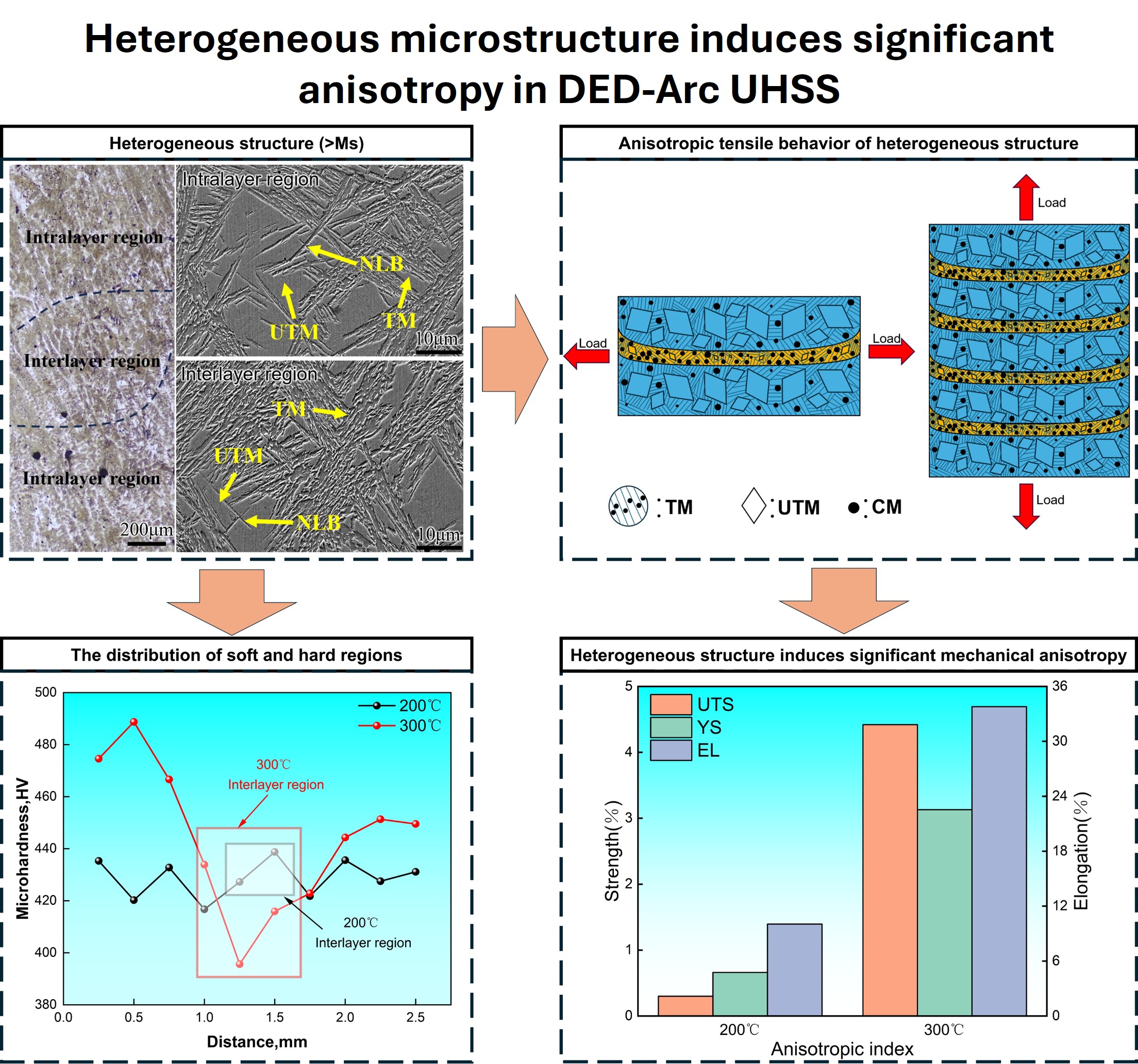
The anisotropic properties of components produced by directed energy deposition–arc (DED-Arc) markedly limit their use in engineering. Thus, it is crucial to elucidate the mechanism that regulates this anisotropic phenomenon in DED-Arc components to ensure the reliable application of this technology in high-performance components. In this study, 300M steel was fabricated by DED-Arc with controlled interlayer temperature, and a critical phenomenon was observed. At an interlayer temperature of 200 °C, the strength was isotropic, while the ductility exhibited a certain degree of anisotropy. When the interlayer temperature increased above the martensite start temperature to 300 °C, a unique anisotropy in mechanical properties emerged. The vertical specimens exhibited higher ultimate tensile strength and elongation but lower yield strength than the horizontal specimens. At an interlayer temperature of 200 °C, the microstructure was relatively uniform and consisted entirely of tempered martensite. The plastic anisotropy mainly originated from directional grain growth. At an interlayer temperature of 300 °C, the microstructure evolved into a heterogeneous structure consisting of alternating soft and hard zones, caused by the uneven distribution of soft phases (tempered martensite and needle‑like bainite) and hard phases (untempered martensite). In this case, the spatial arrangement of the heterogeneous structure governed the anisotropy. Under horizontal tension, the soft and hard zones are alternately stacked perpendicular to the tensile direction, and the deformation compatibility was constrained by the hard zones, resulting in higher yield strength but lower ductility. Under vertical tension, the soft and hard zones are stacked parallel to the tensile direction, offering better deformation compatibility. Moreover, the Orowan strengthening effect induced by the interlayer regions was more pronounced, leading to a higher ultimate tensile strength than that of the horizontal specimens. This study elucidates the microscale mechanism of heterogeneous structure formation upon exceeding the martensite start temperature, thereby producing this unique anisotropy.
- Bai Y, Zhang S, Yan Q, Zhao C, Zhan J. Enhanced strength of A131 steel via heterostructures induced by laser-directed energy deposition. Mater Sci Add Manuf. 2025;4(3):025220038. doi: 10.36922/MSAM025220038
- Zhao M, Jiang L, Li C, et al. Flow characteristics and hot workability of a typical low-alloy high-strength steel during multi-pass deformation. Int J Miner Metall Mater. 2024;31(2):323-336. doi: 10.1007/s12613-023-2736-0
- Zhao M, Li C, Jiang L, et al. Hot workability of a typical ultrahigh strength steel during the isothermal forging process. Met Mater Int. 2023;30(4):1055-1071. doi: 10.1007/s12540-023-01560-1
- Li K, Yang TB, Gong N, et al. Additive manufacturing of ultra-high strength steels: A review. J Alloys Compd. 2023;965:171390. doi: 10.1016/j.jallcom.2023.171390
- Sandua X, Arbizu E, Rodríguez A, Veiga F, Martín MÁ, Rivero PJ. Influence of laser power and hatch spacing on the mechanical properties of AlSi10Mg processed by selective laser melting. Mater Sci Add Manuf. 2026;5(2):026040008. doi: 10.36922/MSAM026040008
- Gain S, Veeman D. A review on advances and challenges in wire arc additive manufacturing: Process parameters, microstructural evolution and material performance across alloys. J Alloys Compd. 2025;1029:180735. doi: 10.1016/j.jallcom.2025.180735
- Yang L, Yi H, Jia L, Zhang W, Cao H. Achieving collaborative improvement of strength and plasticity of wire arc additive manufactured Ti-6Al-4V titanium alloy via ultrasonic vibration and heat treatment. Appl Mater Today. 2026;48:103040. doi: 10.1016/j.apmt.2025.103040
- Zhang H, Li R, Liu J, et al. State‑of‑art review on the process‑structure‑properties‑performance linkage in wire arc additive manufacturing. Virtual Phys Prototyp. 2024;19(1). doi: 10.1080/17452759.2024.2390495
- Wang X, Deng J, Zhao R, Shen L, Wang Z. Compressive response and energy absorption of 3D-printed cellular structures: advances and challenges. Virtual Phys Prototyp. 2026;21(1). doi: 10.1080/17452759.2026.2638085
- Guo Z, Lu A, Zhao M, Jiang L, Wang G. Effects of bainite transformation on mechanical properties of 300 M ultra-high strength steel fabricated by power plasma arc additive manufacturing. Materialia. 2025;44:102586. doi: 10.1016/j.mtla.2025.102586
- Zhang J, Fan J, Xu J, ang D, Peng Y, Wang K. The effect of heat input on the microstructure and mechanical properties of 18Ni 300 maraging steel fabricated by arc directed energy deposition. Mater Sci Eng A. 2023;884:145545. doi: 10.1016/j.msea.2023.145545
- Lyu Z, Sato YS, Xu W, et al. Simultaneous enhancements of strength and ductility of wire arc additive manufactured 17‑4PH steel via intrinsic heat treatment. J Mater Process Technol. 2023;321:118149. doi: 10.1016/j.jmatprotec.2023.118149
- Xiong Y, Wen D, Zheng Z, Sun C, Xie J, Li J. Effect of heat treatment on microstructure and mechanical properties of directed energy deposition-Arc 300M steel. Mater Charact. 2023;198:112756. doi: 10.1016/j.matchar.2023.112756
- Li Y, Xiong Y, Zhao M, et al. Synergistic enhancement of strength and ductility for plasma arc additive manufactured ultrahigh strength steel by a novel heat treatment. Arch Civ Mech Eng. 2026;26(3). doi: 10.1007/s43452-026-01501-w
- Dekis M, Tawfik M, Egiza M, Dewidar M. Challenges and developments in wire arc additive manufacturing of steel: a review. Results Eng. 2025;26:104657. doi: 10.1016/j.rineng.2025.104657
- Wang C, Lou D, Duan Z, Rong J, Xu B. Structural topology optimization considering multi‑source anisotropic failure strength from printing space and material locality. Comput Methods Appl Mech Eng. 2025;446:118309. doi: 10.1016/j.cma.2025.118309
- Shi Q, Wang J, Xu X, Liu Y, Wen Z, Yue Z. Temperature‑dependent tensile anisotropic behavior of WAAM‑TC4 dual‑phase titanium alloy: Microstructural evolution, deformation mechanisms, and fracture characteristics. Mater Sci Eng A. 2025;943:148748. doi: 10.1016/j.msea.2025.148748
- Blinn B, Hassel T, Viebranz VF, Beck T, Maier HJ. Influence of the grain orientation and δ‑ferrite on the cyclic deformation behavior of an austenitic CrNi steel manufactured by wire and arc additive manufacturing. Mater Sci Eng A. 2023;870:144612. doi: 10.1016/j.msea.2023.144612
- Akbarzadeh Chiniforoush E, Zargari HH, Jandaghi MR, Moverare J, Warsi R, Gür CH. A sustainable strategy for wire arc additive manufacturing of high‑performance duplex stainless steel: Microstructural refinement and mechanical anisotropy reduction. Mater Sci Eng A. 2025;943:148785. doi: 10.1016/j.msea.2025.148785
- Palmeira Belotti L, van Dommelen JAW, Geers MGD, Ya W, Hoefnagels JPM. Influence of the printing strategy on the microstructure and mechanical properties of thick-walled wire arc additive manufactured stainless steels. J Mater Process Tech. 2024;324:118275. doi: 10.1016/j.jmatprotec.2023.118275
- Sun L, Jiang F, Huang R, Yuan D, Guo C, Wang J. Anisotropic mechanical properties and deformation behavior of low‑carbon high‑strength steel component fabricated by wire and arc additive manufacturing. Mater Sci Eng A. 2020;787:139514. doi: 10.1016/j.msea.2020.139514
- Chen W, Cao H, Zhu L. Heterogeneous microstructure and anisotropic mechanical properties of reduced activation ferritic/martensitic steel fabricated by wire arc additive manufacturing. Nucl Mater Energy. 2022;33:101261. doi: 10.1016/j.nme.2022.101261
- Tu Y, Zheng D, Li Z, Zhang C, Gong X. Microstructure and mechanical properties of Mg‑12Gd‑3Y‑4Zr magnesium alloy with layered heterogeneous microstructure fabricated by wire arc additive manufacturing. J Alloys Compd. 2025;1037:182210. doi: 10.1016/j.jallcom.2025.182210
- Lyu Z, Sato YS, Tokita S, Zhao Y, Jia J, Wu A. Microstructural distribution and anisotropic tensile behavior in a 2Cr13 martensitic stainless steel thin wall fabricated by wire arc additive manufacturing. Mater Today Commun. 2021;29:102870. doi: 10.1016/j.mtcomm.2021.102870
- Zhai W, Wu N, Zhou W. Effect of interpass temperature on wire arc additive manufacturing using high-strength metal-cored wire. Metals. 2022;12(2):212. doi: 10.3390/met12020212
- Xiong Y, Wen D, Zheng Z, Li J. Effect of interlayer temperature on microstructure evolution and mechanical performance of wire arc additive manufactured 300M steel. Mater Sci Eng A. 2022;831:142351. doi: 10.1016/j.msea.2021.142351
- Wei S, Wang P, Zhang L, Ramamurty U. Grain morphologies in additively manufactured alloys: From solidification fundamentals to advanced microstructure control. J Mater Sci Technol. 2025;235:133-145. doi: 10.1016/j.jmst.2025.02.033
- Gao P, Fan J, Cai B, et al. Effect of interlayer temperature on the microstructure and mechanical properties of new Co-Free maraging steel fabricated by arc-based directed energy deposition. Mater Charact. 2025;222:114851. doi: 10.1016/j.matchar.2025.114851
- Salahi S, Nemani AV, Ghaffari M, Lunde J, Nasiri A. On microstructure, crystallographic orientation, and corrosion properties of wire arc additive manufactured 420 martensitic stainless steel: Effect of the inter-layer temperature. Addit Manuf. 2021;46:102157. doi: 10.1016/j.addma.2021.102157
- Liu F, Lin X, Song M, et al. Effect of tempering temperature on microstructure and mechanical properties of laser solid formed 300M steel. J Alloys Compd. 2016;689:225-232. doi: 10.1016/j.jallcom.2016.07.276
- Chen R, Zheng Z, Li N, Li J, Feng F. In-situ investigation of phase transformation behaviors of 300M steel in continuous cooling process. Mater Charact. 2018;144:400-410. doi: 10.1016/j.matchar.2018.07.034
- Franceschi M, Morales‑Rivas L, Cordova‑Tapia E, Jimenez JA, Dabalà M, Garcia-Mateo C. Study of bainite and martensite tempering in a medium C high Si steel. microstructural disparities and equilibrium convergence. J Mater Res Technol. 2024;32:2931-2944. doi: 10.1016/j.jmrt.2024.08.141
- Hu Z, Hua L, Ni M, Ji F, Qin X. Microstructure and mechanical properties of directed energy deposition-arc/wire bimetallic hierarchical structures of hot-working tool steel and martensitic stainless steel. Addit Manuf. 2023;67:103495. doi: 10.1016/j.addma.2023.103495
- Li M, Zhang W, Zhou Z, et al. Effect of the interlayer temperature on microstructure and mechanical behavior of the high-strength low-alloy steel manufactured by the wire arc additive manufacturing. Mater Today Commun. 2025;46:112845. doi: 10.1016/j.mtcomm.2025.112845
- Wang X, Li J, Huang S, et al. Elimination mechanism of the anisotropy of additively manufactured alloys in high temperature mechanical properties by HG-S2A treatment. J Alloys Compd. 2025;1044:184377. doi: 10.1016/j.jallcom.2025.184377
- Sun J, Ma N, Deng D, Dilger K. Generation mechanism and distribution characteristics of residual stresses in wire-arc additively manufactured ultra-high strength steel components. J Mater Res Technol. 2025;38:6244-6259. doi: 10.1016/j.jmrt.2025.09.059
- Turnali A, Kibaroglu D, Evers N, et al. Segregation-guided alloy design via tailored solidification behavior. Mater Today Adv. 2025;25:100549. doi: 10.1016/j.mtadv.2024.100549
- Feng L, Gao J, Liu F, Huang C, Zheng Y. Effect of grain orientation on microstructure and mechanical properties of laser welded joint of additive manufactured 300M steel. Mater Today Commun. 2023;35:105497. doi: 10.1016/j.mtcomm.2023.105497
- Jing G, Huang W, Yang H, Wang Z. Microstructural evolution and mechanical properties of 300M steel produced by low and high power selective laser melting. J Mater Sci Technol. 2020;48:44-56. doi: 10.1016/j.jmst.2019.12.020
- Mishra NK, Ajay V, Nakrani J, Shrivastava A. Influence of dwell time on mechanical and microstructural anisotropy of additively manufactured SS 316 L: Experimental and numerical investigation. J Manuf Process. 2025;145:600-615. doi: 10.1016/j.jmapro.2025.04.072
- Liu X, Liu ZT, Zhang SY, et al. Isotropic high strength Al-Mg-Si-Zn-Cu alloy fabricated by wire-arc additive manufacturing via Ti nanoparticles addition. Mater Charact. 2026;233:116148. doi: 10.1016/j.matchar.2026.116148
- Palmeira Belotti LP, van Dommelen JAW, Geers MGD, Goulas C, Ya W, Hoefnagels JPM. Microstructural characterisation of thick‑walled wire arc additively manufactured stainless steel. J Mater Process Technol. 2022;299:117373. doi: 10.1016/j.jmatprotec.2021.117373
- Tian C, Ponge D, Christiansen L, Kirchlechner C. On the mechanical heterogeneity in dual phase steel grades: Activation of slip systems and deformation of martensite in DP800. Acta Mater. 2020;183:274-284. doi: 10.1016/j.actamat.2019.11.002
- Isavand S, Rao PS, Bondarev A, et al. Integrating micropillar compression testing and crystal plasticity modelling to unravel slip system activity and deformation mechanisms in P91 steel. Mater Sci Eng A. 2025;942:148659. doi: 10.1016/j.msea.2025.148659
- Ng KS, Ngan AHW. Breakdown of Schmid’s law in micropillars. Scr Mater. 2008;59(7):796-799. doi: 10.1016/j.scriptamat.2008.06.019
- Shen JH, Li YL, Wei Q. Statistic derivation of taylor factors for polycrystalline metals with application to pure magnesium. Mater Sci Eng A. 2013;582:270-275. doi: 10.1016/j.msea.2013.06.025
- Sarkar A, Sanyal S, Bandyopadhyay TK, Mandal S. Implications of microstructure, taylor factor distribution and texture on tensile properties in a Ti-added Fe-Mn-Al-Si-C steel. Mater Sci Eng A. 2019;767:138402. doi: 10.1016/j.msea.2019.138402
- Jia N, Cong ZH, Sun X, et al. An in situ high-energy X-ray diffraction study of micromechanical behavior of multiple phases in advanced high-strength steels. Acta Mater. 2009;57(13):3965-3977. doi: 10.1016/j.actamat.2009.05.002
- Wronski S, Wierzbanowski K, Jędrychowski M, et al. Microstructure evolution of titanium after tensile test. Mater Sci Eng A. 2016;656:1-11. doi: 10.1016/j.msea.2015.12.041
- Gao P, Jing G, Lan X, et al. Effect of heat treatment on microstructure and mechanical properties of Fe–Cr–Ni–Co–Mo maraging stainless steel produced by selective laser melting. Mater Sci Eng A. 2021;814:141149. doi: 10.1016/j.msea.2021.141149
- Yin S, Chen C, Yan X, et al. The influence of aging temperature and aging time on the mechanical and tribological properties of selective laser melted maraging 18Ni-300 steel. Addit Manuf. 2018;22:592-600. doi: 10.1016/j.addma.2018.06.005
- Otani Y, Takata N, Suzuki A, Kobashi M, Kato M. Microstructural origin of anisotropic tensile ductility of Al-Si alloy manufactured by laser powder bed fusion. Scr Mater. 2023;226:115259. doi: 10.1016/j.scriptamat.2022.115259
- Jing G, Wang Z. Influence of molten pool mode on microstructure and mechanical properties of heterogeneously tempered 300M steel by selective laser melting. J Mater Process Technol. 2021;296:117188. doi: 10.1016/j.jmatprotec.2021.117188
- Wang H, Zhang J, Liu Y, et al. Achieving high strength and low modulus titanium alloy with non-uniform multiscale heterogeneous microstructures. J Mater Sci Technol. 2026;264:151-162. doi: 10.1016/j.jmst.2025.11.026
- Jing G, Wang Z. Defects, densification mechanism and mechanical properties of 300M steel deposited by high power selective laser melting. Addit Manuf. 2021;38:101831. doi: 10.1016/j.addma.2020.101831
- Ma K, Wen H, Hu T, et al. Mechanical behavior and strengthening mechanisms in ultrafine grain precipitation-strengthened aluminum alloy. Acta Mater. 2014;62:141-155. doi: 10.1016/j.actamat.2013.09.042
- Yu Q, Zhang Y, Jia Z, Huang L, Geng L. Synergistic effect of aluminum distribution and in-situ annealing on layered microstructure formation: Microstructural evolution and mechanical anisotropy mechanisms in EBM-fabricated Ti-48Al-2Cr-2Nb. Mater Sci Eng A. 2026;949:149383. doi: 10.1016/j.msea.2025.149383