

Blast resistance of polyurethane-filled 316L stainless steel honeycomb sandwich structures fabricated by selective laser melting

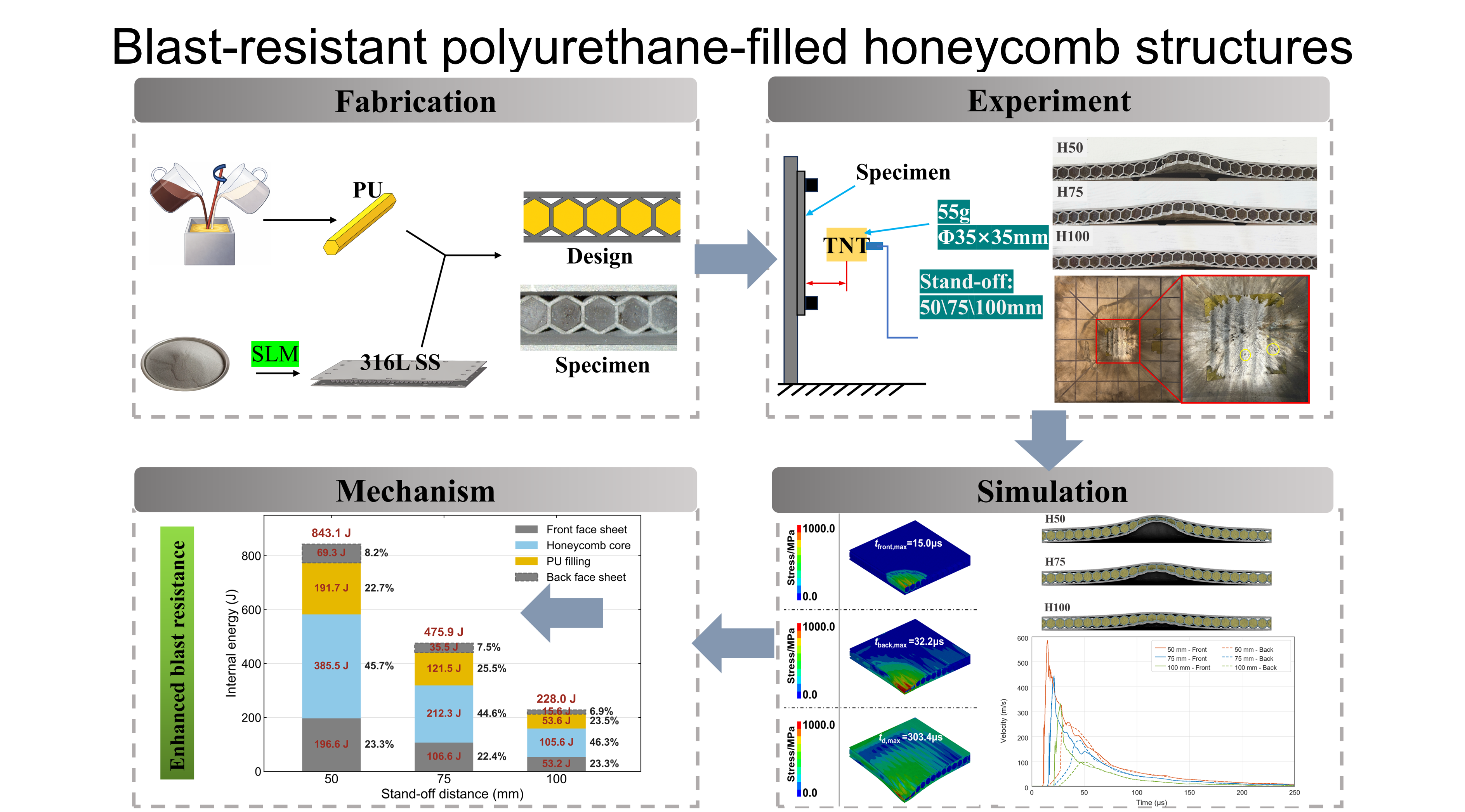
Honeycomb sandwich structures (HSS) have attracted increasing attention for blast protection because of their lightweight characteristics, high specific strength, and excellent energy absorption capacity; however, the near-field blast response and component-level energy absorption mechanisms of integrated metal–polymer honeycomb structures remain insufficiently understood. In this study, a blast-resistant HSS fabricated by selective laser melting (SLM) using 316L stainless steel and filled with polyurethane (PU) was designed and experimentally investigated under near-field explosion loading. Three scaled distances of Z = 0.1315, 0.1972, and 0.2630 m·kg−1/3 were tested to evaluate the blast resistance and energy absorption characteristics of the PU-filled SLM HSS compared with an equivalent areal-density solid plate. The mechanical tests were conducted on SLM-fabricated 316L stainless steel, and the Johnson–Cook constitutive parameters were calibrated from the measured stress–strain responses. A coupled fluid–structure interaction numerical model based on the S-ALE algorithm in LS-DYNA was established and validated against experiments. Results show that the PU-filled HSS exhibits markedly smaller back-face deflection and improved blast resistance compared to the solid plate. At the closest stand-off distance, the back-face residual deflection of the HSS decreased by 20.4%, indicating that the honeycomb core and PU filling effectively attenuate transmitted impact energy. Across the tested stand-off distances, the honeycomb core and PU filling contributed 44.6–46.3% and 22.7–25.5% of the total absorbed energy, respectively. The combined mechanisms of plastic buckling, viscoelastic dissipation, and micropore compression endow the composite core with superior energy absorption efficiency and structural integrity under extreme loading. This study provides an effective design strategy for lightweight, high-performance blast-resistant sandwich structures.
- Marshall A. Sandwich construction. In: Lubin G, ed. Handbook of Composites. 2nd ed. New York, NY: Van Nostrand Reinhold; 1982:557-601. doi: 10.1007/978-1-4615-7139-1_21
- Wadley HNG. Multifunctional periodic cellular metals. Philos Trans R Soc A Math Phys Eng Sci. 2006;364:31-68. doi: 10.1098/rsta.2005.1697
- Yungwirth CJ, O'Connor J, Zakraysek A, Deshpande VS, Wadley HNG. Explorations of hybrid sandwich panel concepts for projectile impact mitigation. J Am Ceram Soc. 2011;94(suppl 1):S62-S75. doi: 10.1111/j.1551-2916.2011.04501.x
- Yu B, Han B, Ni CY, Zhang QC, Chen CQ, Lu TJ. Dynamic crushing of all-metallic corrugated panels filled with closed-cell aluminum foams. J Appl Mech. 2015;82(1):011006. doi: 10.1115/1.4028995
- Wang Y, Xu F, Gao H, Li X. Elastically isotropic truss-plate-hybrid hierarchical microlattices with enhanced modulus and strength. Small. 2023;19(18):e2206024. doi: 10.1002/smll.202206024
- Bohara RP, Linforth S, Nguyen T, Ghazlan A, Ngo T. Anti-blast and -impact performances of auxetic structures: a review of structures, materials, methods, and fabrications. Eng Struct. 2023;276:115377. doi: 10.1016/j.engstruct.2022.115377
- Han B, Song H, Wang Y, Zhang Q. Superior compressive behaviour of alveolar biomimetic interlaced hollow lattice metastructures. Virtual Phys Prototyp. 2025;20(1):e2512166. doi: 10.1080/17452759.2025.2512166
- Dharmasena KP, Wadley HNG, Xue Z, Hutchinson JW. Mechanical response of metallic honeycomb sandwich panel structures to high-intensity dynamic loading. Int J Impact Eng. 2008;35(9):1063-1074. doi: 10.1016/j.ijimpeng.2007.06.008
- Yungwirth CJ, Wadley HNG, O'Connor JH, Zakraysek AJ, Deshpande VS. Impact response of sandwich plates with a pyramidal lattice core. Int J Impact Eng. 2008;35(8):920-936. doi: 10.1016/j.ijimpeng.2007.07.001
- Bohara RP, Linforth S, Nguyen T, Ghazlan A, Ngo T. Dual-mechanism auxetic-core protective sandwich structure under blast loading. Compos Struct. 2022;299:116088. doi: 10.1016/j.compstruct.2022.116088
- Yazici M, Wright J, Bertin D, Shukla A. Experimental and numerical study of foam-filled corrugated core steel sandwich structures subjected to blast loading. Compos Struct. 2014;110:98-109. doi: 10.1016/j.compstruct.2013.11.016
- Alavi Nia A, Sadeghi MZ. An experimental investigation on the effect of strain rate on the behaviour of bare and foam-filled aluminium honeycombs. Mater Des. 2013;52:748-756. doi: 10.1016/j.matdes.2013.06.006
- Li L, Zhang F, Li J, Jia F, Han B. Computational analysis of sandwich panels with graded foam cores subjected to combined blast and fragment impact loading. Materials (Basel). 2023;16(12):4371. doi: 10.3390/ma16124371
- Pan T, Bian XB, Yuan MZ, et al. Baozha chongjibo zuoyong xia ju'an zhi-banqiu jiaxin jiegou de dongtai xiangying [Dynamic response of polyurethane-hemispherical sandwich structures under blast loading]. Acta Armamentarii. 2023;44(12):3580-3589. [In Chinese] doi: 10.12382/bgxb.2023.0645
- Zhang P, Cheng YS, Liu J, et al. Experimental study on the dynamic response of foam-filled corrugated core sandwich panels subjected to air blast loading. Compos Part B Eng. 2016;105:67-81. doi: 10.1016/j.compositesb.2016.08.038
- Cheng YS, Liu MX, Zhang P, et al. The effects of foam filling on the dynamic response of metallic corrugated core sandwich panel under air blast loading: experimental investigations. Int J Mech Sci. 2018;145:378-388. doi: 10.1016/j.ijmecsci.2018.07.030
- Vaziri A, Xue Z, Hutchinson JW. Metal sandwich plates with polymer foam-filled cores. J Mech Mater Struct. 2006;1(1):97-127. doi: 10.2140/jomms.2006.1.97
- Li XS, Huang JB, Xie J, Li JF, Xu ZJ, Chen PW. Lianjie fangshi dui fengwo jiaxin jiegou kangbao xingneng de yingxiang guilü yanjiu [Influence of connection mode on blast resistance of honeycomb sandwich structures]. Packaging Engineering. 2024;45(19):29-40. [In Chinese] doi: 10.19554/j.cnki.1001-3563.2024.19.002
- Casati R, Lemke J, Vedani M. Microstructure and fracture behavior of 316L austenitic stainless steel produced by selective laser melting. J Mater Sci Technol. 2016;32(8):738-744. doi: 10.1016/j.jmst.2016.06.016
- Mertens A, Reginster S, Contrepois Q, Dormal T, Lemaire O, Lecomte-Beckers J. Microstructures and mechanical properties of stainless steel AISI 316L processed by selective laser melting. Mater Sci Forum. 2014;783-786:898-903. doi: 10.4028/www.scientific.net/MSF.783-786.898
- Leicht A, Klement U, Hryha E. Effect of build geometry on the microstructural development of 316L parts produced by additive manufacturing. Mater Charact. 2018;143:137-143. doi: 10.1016/j.matchar.2018.04.040
- Niendorf T, Leuders S, Riemer A, Richard HA, Tröster T, Schwarze D. Highly anisotropic steel processed by selective laser melting. Metall Mater Trans B. 2013;44(4):794-796. doi: 10.1007/s11663-013-9875-z
- Kurzynowski T, Gruber K, Stopyra W, Kuźnicka B, Chlebus E. Correlation between process parameters, microstructure and properties of 316L stainless steel processed by selective laser melting. Mater Sci Eng A. 2018;718:64-73. doi: 10.1016/j.msea.2018.01.103
- Güden M, Yavaş H, Tanrıkulu AA, et al. Orientation dependent tensile properties of a selective-laser-melted 316L stainless steel. Mater Sci Eng A. 2021;824:141808. doi: 10.1016/j.msea.2021.141808
- Suryawanshi J, Prashanth KG, Scudino S, Eckert J, Prakash O, Ramamurty U. Simultaneous enhancements of strength and toughness in an Al–12Si alloy synthesized using selective laser melting. Acta Mater. 2016;115:285-294. doi: 10.1016/j.actamat.2016.06.009
- Smith LC. On the Dynamic Response of Additively Manufactured 316L Stainless Steel and the Development of an Orthotropic Johnson–Cook Viscoplastic Strength Model. PhD thesis. Oxford, UK: University of Oxford; 2023.
- Liu H, Huang RY, Jiang D, Qin J, Wen YB, Zhang YZ. Yingzhi ju'an zhi paomo suliao de yingbianlü xiaoying yanjiu [Strain rate effect of rigid polyurethane foam]. J Mech Eng. 2023;59(16):192-203. [In Chinese] doi: 10.3901/JME.2023.16.192
- Koohbor B, Kidane A, Lu WY, Sutton MA. Investigation of the dynamic stress–strain response of compressible polymeric foam using a non-parametric analysis. Int J Impact Eng. 2016;91:170-182. doi: 10.1016/j.ijimpeng.2016.01.007
- Whisler D, Kim H. Experimental and simulated high strain dynamic loading of polyurethane foam. Polym Test. 2015;41:219-230. doi: 10.1016/j.polymertesting.2014.12.004
- Li X, Roth CC, Tancogne-Dejean T, Mohr D. Rate- and temperature-dependent plasticity of additively manufactured stainless steel 316L: characterization, modeling and application to crushing of shell-lattices. Int J Impact Eng. 2020;145:103671. doi: 10.1016/j.ijimpeng.2020.103671
- Zhao ZY, Jiang H, Li XD, Zhang XD, Su X, Zou MS. Research on the dynamic compressibility of polyurethane microcellular elastomer and its application for impact resistance. Chin J Polym Sci. 2024;42(8):1185-1197. doi: 10.1007/s10118-024-3134-4
- Si D, Pan Z, Zhang H. Determination method of mesh size for numerical simulation of blast load in near-ground detonation. Defence Technol. 2024;38:111-125. doi: 10.1016/j.dt.2023.08.004
- Henrych J. The Dynamics of Explosion and Its Use. Amsterdam, Netherlands: Elsevier Scientific Publishing Company; 1979.
- Brode HL. Blast wave from a spherical charge. Phys Fluids. 1959;2(2):217-229.
- Gan L, Chen L, Zong ZH, Qian HM. Jin juli baozha bili baoju de jieding biaozhun ji zaihe moxing [Definition criteria and load model of scaled distance in near-field explosion]. Explosion Shock Waves. 2021;41(6):064902. [In Chinese] doi: 10.11883/bzycj-2020-0194
- Ma RL, Wang XJ, Sun ZM, You S, Huang FL. Qiu xing he zhu xing zhuangyao jinchang baozha chongjibo zaihe texing [Characteristics of blast wave loads of spherical and cylindrical charges in near-field explosions]. Acta Armamentarii. 2025;46(1):24-38. [In Chinese] doi: 10.12382/bgxb.2023.1105
- Shin J, Whittaker AS, Cormie D. Incident and normally reflected overpressure and impulse for detonations of spherical high explosives in free air. J Struct Eng. 2015;141(12):04015057. doi: 10.1061/(ASCE)ST.1943-541X.0001305
- Karlos V, Solomos G, Larcher M. Analysis of Blast Parameters in the Near-Field for Spherical Free-Air Explosions. Luxembourg: Publications Office of the European Union; 2016. EUR 27823 EN. doi: 10.2788/778898
- Xiao W, Andrae M, Gebbeken N. Effect of charge shape and initiation configuration of explosive cylinders detonating in free air on blast-resistant design. J Struct Eng. 2020;146(8):04020146. doi: 10.1061/(ASCE)ST.1943-541X.0002694
- Pan W, Xia YY, Zhang C, Fang HY, Wang FM. Xinxing ju'an zhi tanxingti zhujiang cailiao de yasuo chicun xiaoying ji yingbianlü xiaoying [Size and strain rate effects on the compression of novel polyurethane elastomer grouting materials]. Mater Rep. 2023;37(15):273-279. [In Chinese]
- Qiu C, Al Kindi M, Aladawi AS, Al Hatmi I. A comprehensive study on microstructure and tensile behaviour of a selectively laser melted stainless steel. Sci Rep. 2018;8(1):7785. doi: 10.1038/s41598-018-26136-7
- Suryawanshi J, Prashanth KG, Ramamurty U. Mechanical behavior of selective laser melted 316L stainless steel. Mater Sci Eng A. 2017;696:113-121. doi: 10.1016/j.msea.2017.04.058
- Jacob N, Nurick GN, Langdon GS. The effect of stand-off distance on the failure of fully clamped circular mild steel plates subjected to blast loads. Eng Struct. 2007;29(10):2723-2736. doi: 10.1016/j.engstruct.2007.01.021
- Jiang HZ, Li ZY, Feng T, et al. Effect of process parameters on defects, melt pool shape, microstructure, and tensile behavior of 316L stainless steel produced by selective laser melting. Acta Metall Sin Engl Lett. 2021;34(4):495-510. doi: 10.1007/s40195-020-01143-8