

Positive and negative effects of MCA1 deletion on stress sensitivity and virulence

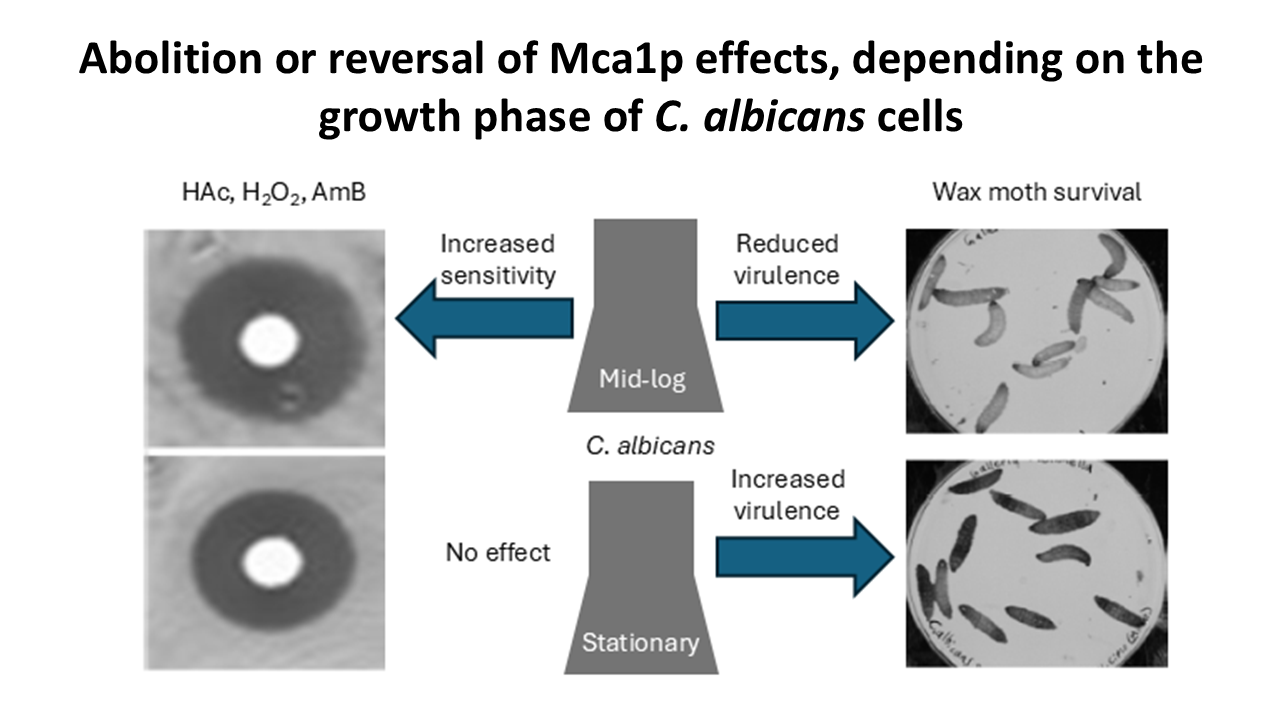
Metacaspases are cysteine proteases, found in every group of organisms except metazoa. They are structural orthologs of caspases, which orchestrate apoptosis in metazoa. Like caspases (cysteine-dependent aspartate-directed proteases), paracaspases, and orthocaspases, metacaspases are class C14 proteases, with a hemoglobinase fold and a catalytic cysteine residue. However, metacaspases cleave after arginine or lysine rather than aspartate, prompting calls to rename them. Furthermore, most metacaspases are activated by calcium; they do not target the same range of proteins as caspases, and they tend to cut target proteins multiple times rather than at a single, canonical site. The Candida albicans metacaspase Mca1p mediates cell death in response to various stresses but also has pro-life functions, such as clearing protein aggregates and extending lifespan. Many plant and protist metacaspases lack cell-death roles and instead mediate development, differentiation, and immunity. This article highlights the phase-dependent reversal of Mca1p’s effects on susceptibility to acetic acid, hydrogen peroxide, and amphotericin B, as well as on C. albicans virulence in Galleria mellonella larvae. This reversal of metacaspase function indicates the protein’s dual nature and the conditions that drive the switch from its pro-survival to its pro-death role.
- Dho SH, Cho M, Woo W, Jeong S, Kim LK. Caspases as master regulators of programmed cell death: apoptosis, pyroptosis and beyond. Exp Mol Med. 2025;57(6):1121-1132. doi: 10.1038/s12276-025-01470-9
- Eisele-Bürger AM, Eisele F, Hill SM, et al. Calmodulin regulates protease versus co-chaperone activity of a metacaspase. Cell Rep. 2023;42(11):113372. doi: 10.1016/j.celrep.2023.113372
- Uren AG, O’Rourke K, Aravind LA, et al. Identification of paracaspases and metacaspases: two ancient families of caspase-like proteins, one of which plays a key role in MALT lymphoma. Mol Cell. 2000;6(4):961-967. doi: 10.1016/s1097-2765(00)00094-0
- Klemenčič M, Funk C. Structural and functional diversity of caspase homologues in non-metazoan organisms. Protoplasma. 2017;255(1):387-397. doi: 10.1007/s00709-017-1145-5
- Wilkinson D. Regulated Cell Death in Fungi, the Role of Metacaspases and Assay Techniques. Methods Protoc. 2026;9(3):83. doi: 10.3390/mps9030083
- La SR, Ndhlovu A, Durand PM. The ancient origins of death domains support the ‘original sin’hypothesis for the evolution of programmed cell death. J Mol Evol. 2022;90(1):95-113. doi: 10.1007/s00239-021-10044-y
- Salas-Gómez M, Ruiz-Solaní N, Armengot L, Coll NS. The role of plant metacaspases in cell death and survival. Cell Death Differ. 2025;33(2):259-266. doi: 10.1038/s41418-025-01555-y
- Hill SM, Nyström T. The dual role of a yeast metacaspase: What doesn’t kill you makes you stronger. BioEssays. 2015;37(5):525-531. doi: 10.1002/bies.201400208
- Madeo F, Herker E, Maldener C, et al. A Caspase-Related Protease Regulates Apoptosis in Yeast. Mol Cell. 2002;9(4):911-917. doi: 10.1016/s1097-2765(02)00501-4
- Duarte AC, Trujilho MN, Valdivia KS, et al. The structural, functional, and therapeutic potential of metacaspases in fungi and protozoa. FEBS J. 2025;293(4):948-958. doi: 10.1111/febs.70327
- Phillips AJ, Sudbery I, Ramsdale M. Apoptosis induced by environmental stresses and amphotericin B in Candida albicans. Proc Natl Acad Sci USA. 2003;100(24):14327-14332. doi: 10.1073/pnas.2332326100
- Cao Y, Huang S, Dai B, et al. Candida albicans cells lacking CaMCA1-encoded metacaspase show resistance to oxidative stress-induced death and change in energy metabolism. Fungal Genet Biol. 2009;46(2):183-189. doi: 10.1016/j.fgb.2008.11.001
- Denning DW. Global incidence and mortality of severe fungal disease. Lancet Infect Dis. 2024;24(7):e428-e438. doi: 10.1016/s1473-3099(23)00692-8
- Salmanton-García J, Cornely OA, Stemler J, et al. Attributable mortality of candidemia–results from the ECMM Candida III multinational European observational cohort study. J Infect. 2024;89(3):106229. doi: 10.1016/j.jinf.2024.106229
- Herculano RD, Dos Reis CE, de Souza SMB, et al. Amphotericin B-loaded natural latex dressing for treating Candida albicans wound infections using Galleria mellonella model. J Control Release. 2024;365:744-758. doi: 10.1016/j.jconrel.2023.12.010
- Garcia N, Kalicharan RE, Kinch L, Fernandez J. Regulating death and disease: exploring the roles of metacaspases in plants and fungi. Int J Mol Sci. 2022;24(1):312. doi: 10.3390/ijms24010312
- Noble SM, Johnson AD. Strains and strategies for large-scale gene deletion studies of the diploid human fungal pathogen Candida albicans. Eukaryot Cell. 2005;4(2):298-309. doi: 10.1128/ec.4.2.298-309.2005
- Hanahan D, Jessee J, Bloom FR. [4] Plasmid transformation of Escherichia coli and other bacteria. In: Methods in Enzymology. Elsevier; 1991:63-113. doi: 10.1016/0076-6879(91)04006-a
- Murad AMA, Lee PR, Broadbent ID, Barelle CJ, Brown AJ. CIp10, an efficient and convenient integrating vector for Candida albicans. Yeast. 2000:16(4);325–327. doi: 10.1002/1097-0061(20000315)16:4<325::AID-YEA538>3.0.CO;2-#
- Dennison PM, Ramsdale M, Manson CL, Brown AJ. Gene disruption in Candida albicans using a synthetic, codon-optimised Cre-loxP system. Fungal Genet Biol. 2005;42(9):737-748. doi: 10.1016/j.fgb.2005.05.006
- Gietz RD, Woods RA. Transformation of yeast by lithium acetate/single-stranded carrier DNA/polyethylene glycol method. In: Methods in Enzymology. Elsevier; 2002:87-96. doi: 10.1016/s0076-6879(02)50957-5
- Loerts H, Poarch G. JASP for (web-based) statistics. In: Research Methods in Applied Linguistics. John Benjamins Publishing Company; 2026:386-411. doi: 10.1075/rmal.15.18loe
- R Core Team. R: A language and environment for statistical computing. R Foundation for Statistical Computing; 2024. https://www.R-project.org/
- Therneau T. A package for survival analysis in R. Published 2026. https://ftp2.uib.no/cran/web/packages/survival/vignettes/survival.pdf
- Gao Y. Visually exploring Kaplan-Meier curves using SAS GTL and R survminer. In: Proceedings of the PharmaSUG 2025 Conference. Paper DV-018. Pfizer Inc; 2025. https://pharmasug.org/proceedings/2025/DV/PharmaSUG-2025-DV-018.pdf
- Grunsky E. R: A data analysis and statistical programming environment–an emerging tool for the geosciences. Comput Geosci. 2002;28(10):1219-1222. doi: 10.1016/s0098-3004(02)00034-1
- Sonnberger J, Kasper L, Lange T, Brunke S, Hube B. “We’ve got to get out”—Strategies of human pathogenic fungi to escape from phagocytes. Mol Microbiol. 2023;121(3):341-358. doi: 10.1111/mmi.15149
- Wakade RS, Wellington M, Krysan DJ. The role of the C. albicans transcriptional repressor NRG1 during filamentation and disseminated candidiasis is strain dependent. mSphere. 2024;9: e00785–00723. doi: 10.1101/2023.12.15.571891
- Kramara J, Kim M-J, Ollinger TL, et al. Systematic analysis of the Candida albicans kinome reveals environmentally contingent protein kinase-mediated regulation of filamentation and biofilm formation in vitro and in vivo. mBio. 2024;15(8). doi: 10.1128/mbio.01249-24
- Cui X, Wang Y, Zhao X, et al. A Novel Fungal Metabolite 1-Methyl-1,2,3,4-tetrahydro-β-carboline-3-carboxylic Acid Enhances Apple Resistance to Glomerella cingulatathrough Activation of the Phenylpropanoid Pathway and Lignin Biosynthesis. J Agric Food Chem. 2026;74(29):22648-22659. doi: 10.1021/acs.jafc.6c03964
- Richie DL, Miley MD, Bhabhra R, Robson GD, Rhodes JC, Askew DS. The Aspergillus fumigatus metacaspases CasA and CasB facilitate growth under conditions of endoplasmic reticulum stress. Mol Microbiol. 2006;63(2):591-604. doi: 10.1111/j.1365-2958.2006.05534.x
- Gonzalez-Jimenez I, Perlin DS, Shor E. Reactive oxidant species induced by antifungal drugs: identity, origins, functions, and connection to stress-induced cell death. Front Cell Infect Microbiol. 2023;13. doi: 10.3389/fcimb.2023.1276406
- Chaves SR, Rego A, Santos-Pereira C, Sousa MJ, Côrte-Real M. Current and novel approaches in yeast cell death research. Cell Death Differ. 2024;32(2):207-218. doi: 10.1038/s41418-024-01298-2
- Wilkinson D, Ramsdale M. Proteases and caspase-like activity in the yeast Saccharomyces cerevisiae. Biochem Soc Trans. 2011;39(5):1502-1508. doi: 10.1042/bst0391502
- Murphy JP, Stepanova E, Everley RA, Paulo JA, Gygi SP. Comprehensive temporal protein dynamics during the diauxic shift in Saccharomyces cerevisiae. Mol Cell Proteom. 2015;14(9):2454-2465. doi: 10.1074/mcp.m114.045849
- Eleftherianos I, Heryanto C, Bassal T, Zhang W, Tettamanti G, Mohamed A. Haemocyte‐mediated immunity in insects: Cells, processes and associated components in the fight against pathogens and parasites. Immunology. 2021;164(3):401-432. doi: 10.1111/imm.13390
- Lam DK, Sherlock G. Yca1 metacaspase: diverse functions determine how yeast live and let die. FEMS Yeast Res. 2023;23. doi: 10.1093/femsyr/foad022
- Laprade DJ, Brown MS, McCarthy ML, Ritch JJ, Austriaco N. Filamentation protects Candida albicans from amphotericin B-induced programmed cell death via a mechanism involving the yeast metacaspase, MCA1. Microbial Cell. 2016;3(7):285-292. doi: 10.15698/mic2016.07.512
- Giannattasio S, Guaragnella N, Corte-Real M, Passarella S, Marra E. Acid stress adaptation protects Saccharomyces cerevisiae from acetic acid-induced programmed cell death. Gene. 2005;354:93-98. doi: 10.1016/j.gene.2005.03.030
- Pérez B, Bouvier LA, Cazzulo JJ, Agüero F, Salas-Sarduy E, Alvarez VE. Screening and identification of metacaspase inhibitors: Evaluation of inhibition mechanism and trypanocidal activity. Antimicrob Agents Chemother. 2021;65(3). doi: 10.1128/aac.01330-20
- Ambit A, Fasel N, Coombs G, Mottram J. An essential role for the Leishmania major metacaspase in cell cycle progression. Cell Death Differ. 2007;15(1):113-122. doi: 10.1038/sj.cdd.4402232
- Deng Y-j, Chen Z, Chen Y-p, et al. Lipopeptide C17 fengycin B exhibits a novel antifungal mechanism by triggering metacaspase-dependent apoptosis in Fusarium oxysporum. J Agric Food Chem. 2024;72(14):7943-7953. doi: 10.1021/acs.jafc.4c00126