
Intracellular Fusobacterium nucleatum attenuates poly(ADP-ribose) polymerase inhibitor-induced cGAS–STING signaling in head and neck squamous cell carcinoma cells

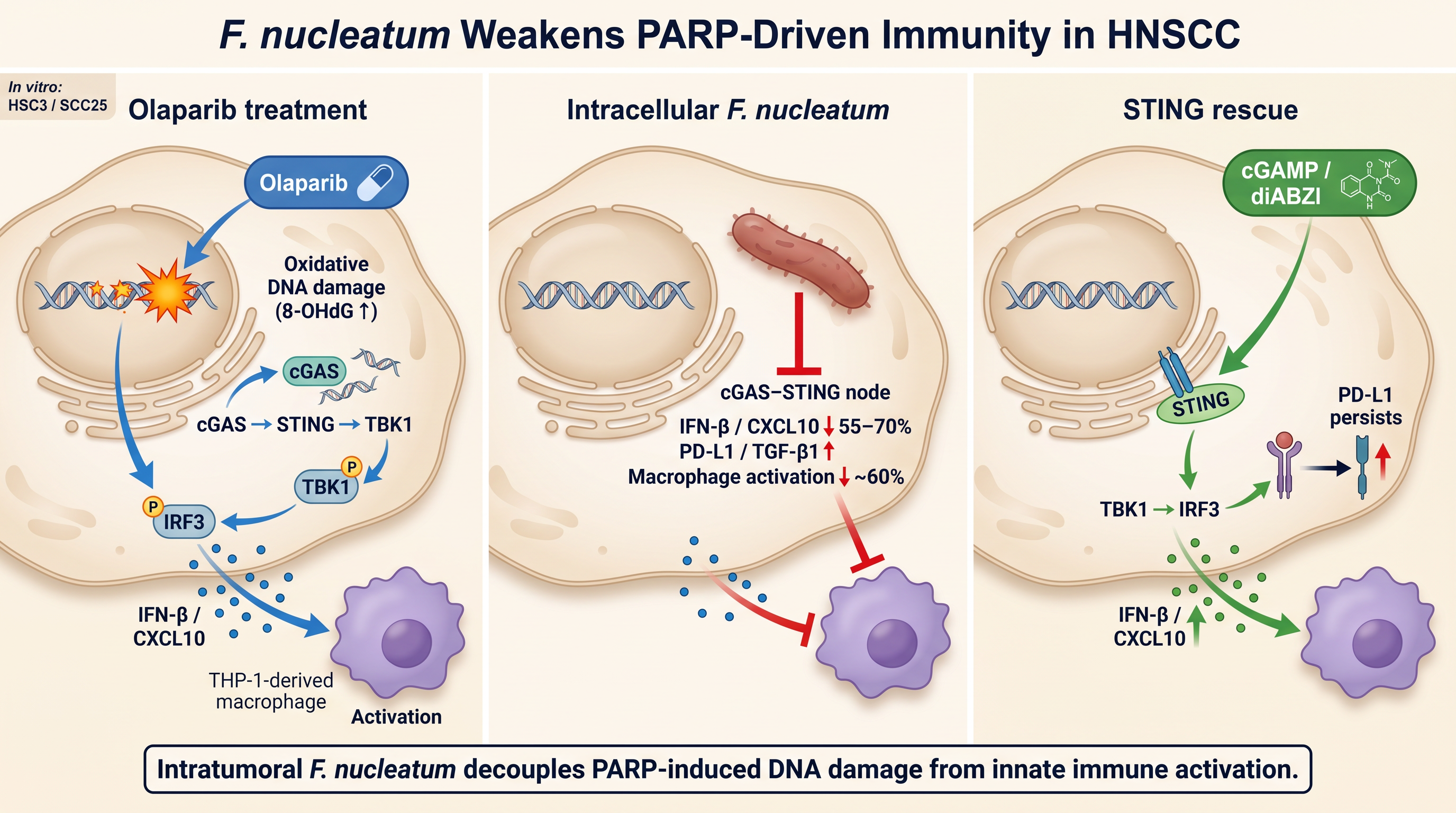
Head and neck squamous cell carcinoma (HNSCC) harbors one of the densest intratumoral microbiomes of any solid tumor, yet it is unknown whether resident oral bacteria interfere with the innate immune signaling underlying poly(ADP-ribose) polymerase inhibitor (PARPi) efficacy. This study examined the effect of Fusobacterium nucleatum colonization on olaparib-induced DNA damage signaling, cyclic GMP–AMP synthase (cGAS)–stimulator of interferon genes (STING)–type I interferon (IFN) activation, and innate immune crosstalk in HSC3 and SCC25 HNSCC cell lines. Oxidative DNA damage was measured by 8-hydroxy-2’-deoxyguanosine competitive enzyme-linked immunosorbent assay (ELISA); cGAS–STING, checkpoint (CD274), and tolerogenic (TGFB1) transcripts by quantitative reverse transcription polymerase chain reaction; and cytokine secretion, including macrophage activation in conditioned-media transfer assays, by sandwich ELISA. Olaparib induced dose-dependent oxidative DNA damage, cytotoxicity (IC50 ≈ 5.6 µM in HSC3 and 7.9 µM in SCC25), and robust cGAS–STING activation, increasing IFNB1 expression 8–11-fold and IFN-β secretion 6–9-fold. Co-culture with live F. nucleatum did not acutely compromise tumor cell fitness but attenuated olaparib-induced IFN-β and C-X-C motif chemokine ligand 10 secretion by 55%–70% and upregulated CD274 and TGFB1. Macrophage tumor necrosis factor alpha release provoked by conditioned media from bacteria-free, olaparib-treated cells (3.4-fold) was reduced by more than 60% when tumor cells carried intracellular bacteria, and direct STING agonism partially restored interferon output. F. nucleatum thus dampens PARPi-elicited cGAS–STING innate immune signaling and skews the tumor secretome toward immune evasion, providing a rationale for combining PARPi with STING agonists or microbiome-directed interventions in HNSCC.
- Warnakulasuriya S. Global epidemiology of oral and oropharyngeal cancer. Oral Oncol. 2009;45(4-5);309–316. doi: 10.1016/j.oraloncology.2008.06.002
- Chen JW, Wu JH, Chiang WF, Chen YL, Wu WS, Wu LW. Taxonomic and Functional Dysregulation in Salivary Microbiomes During Oral Carcinogenesis. Front Cell Infect Microbiol. 2021;11:663068. doi: 10.3389/fcimb.2021.663068
- Banerjee S, Tian T, Wei Z, et al. Microbial signatures associated with oropharyngeal and oral squamous cell carcinomas. Sci Rep. 2017;7(1):4036. doi: 10.1038/s41598-017-03466-6.
- Wang S, Tan X, Cheng J, et al. Oral microbiome and its relationship with oral cancer. J Cancer Res Ther. 2024;20(4):1141-1149. doi: 10.4103/jcrt.jcrt_44_24.
- Golusińska-Kardach E, Yadav H, Jain S, Masternak MM, Golusiński W. The Oral Microbiome and Head and Neck Cancer: A Narrative Review. Cancers. 2025;17(17):2736. doi: 10.3390/cancers17172736
- Hayes RB, Ahn J, Fan X, et al. Association of oral microbiome with risk for incident head and neck squamous cell cancer. JAMA Oncol. 2018;4(3):358-365. doi: 10.1001/jamaoncol.2017.4777.
- Brennan CA, Garrett WS. Fusobacterium nucleatum—symbiont, opportunist and oncobacterium. Nat Rev Microbiol. 2019;17(3):156-166. doi: 10.1038/s41579-018-0129-6
- Feres M, Teles F, Teles R, Figueiredo LC, Faveri M. The subgingival periodontal microbiota of the aging mouth. Periodontol 2000. 2016;72(1):30-53. doi: 10.1111/prd.12136
- Kostic AD, Chun E, Robertson L, et al. Fusobacterium nucleatum potentiates intestinal tumorigenesis and modulates the tumor-immune microenvironment. Cell Host Microbe. 2013;14(2):207-215. doi: 10.1016/j.chom.2013.07.007
- McIlvanna E, Linden GJ, Craig SG, Lundy FT, James JA. Fusobacterium nucleatum and oral cancer: a critical review. BMC Cancer. 2021;21(1):1212. doi: 10.1186/s12885-021-08903-4.
- Gur C, Ibrahim Y, Isaacson B, et al. Binding of the Fap2 protein of Fusobacterium nucleatum to human inhibitory receptor TIGIT protects tumors from immune cell attack. Immunity. 2015;42(2):344-355. doi: 10.1016/j.immuni.2015.01.010
- Pignatelli P, Nuccio F, Piattelli A, Curia MC. The Role of Fusobacterium nucleatum in Oral and Colorectal Carcinogenesis. Microorganisms. 2023;11(9):2358. doi: 10.3390/microorganisms11092358
- Fu A, Yao B, Dong T, et al. Tumor-resident intracellular microbiota promotes metastatic colonization in breast cancer. Cell. 2022;185(8):1356-1372.e26. doi: 10.1016/j.cell.2022.02.027
- Zang X, Li X, Sun R, et al. Intratumoral microbiota drive immune evasion and disease progression in oral squamous cell carcinoma. BDJ Open. 2025;11(1):89. doi: 10.1038/s41405-025-00385-x
- Silver NL, Dai J, Kerr TD, et al. Intratumoral bacteria are immunosuppressive and promote immunotherapy resistance in head and neck squamous cell carcinoma. Nat Cancer. 2026;7:80-97. doi: 10.1038/s43018-025-01067-1
- Moutafi M, Economopoulou P, Rimm D, Psyrri A. PARP inhibitors in head and neck cancer: molecular mechanisms, preclinical and clinical data. Oral Oncol. 2021;117:105292. doi: 10.1016/j.oraloncology.2021.105292
- Moutafi M, Koliou GA, Papaxoinis G, et al. Phase II window study of olaparib alone or with cisplatin or durvalumab in operable head and neck cancer. Cancer Res Commun. 2023;3(8):1514-1523. doi: 10.1158/2767-9764.CRC-23-0051
- Murai J, Huang SY, Das BB, et al. Trapping of PARP1 and PARP2 by clinical PARP inhibitors. Cancer Res. 2012;72(21):5588-5599. doi: 10.1158/0008-5472.CAN-12-2753
- Pantelidou C, Sonzogni O, De Oliveria Taveira M, et al. PARP inhibitor efficacy depends on CD8+ T-cell recruitment via intratumoral STING pathway activation in BRCA-deficient models of triple-negative breast cancer. Cancer Discov. 2019;9(6):722-737. doi: 10.1158/2159-8290.CD-18-1218
- Shen J, Zhao W, Ju Z, et al. PARPi triggers the STING-dependent immune response and enhances the therapeutic efficacy of immune checkpoint blockade independent of BRCAness. Cancer Res. 2019;79(2):311-319. doi: 10.1158/0008-5472.CAN-18-1003
- Ding L, Kim HJ, Wang Q, et al. PARP inhibition elicits STING-dependent antitumor immunity in Brca1-deficient ovarian cancer. Cell Rep. 2018;25(11):2972-2980.e5. doi: 10.1016/j.celrep.2018.11.054
- Adkins D, Ley JC, Liu J, Oppelt P. Olaparib, pembrolizumab, and carboplatin as first-line treatment of recurrent or metastatic head and neck squamous cell carcinoma: a phase II trial. JCO Oncol Adv. 2025;2(1). doi: 10.1200/OA-25-00049
- Yao Y, Zhu Y, Chen K, et al. Microbiota in cancer: current understandings and future perspectives. Signal Transduct Target Ther. 2026;11(1):39. doi: 10.1038/s41392-025-02335-3
- Decout A, Katz JD, Venkatraman S, Ablasser A. The cGAS-STING pathway as a therapeutic target in inflammatory diseases. Nat Rev Immunol. 2021;21(9):548-569. doi: 10.1038/s41577-021-00524-z
- Chauvin SD, Stinson WA, Platt DJ, Poddar S, Miner JJ. Regulation of cGAS and STING signaling during inflammation and infection. J Biol Chem. 2023;299(7):104866. doi: 10.1016/j.jbc.2023.104866
- Taghavi Pourianazar N. ROS-induced DNA damage enhances sensitivity to PARP inhibition in HSC3 and SCC25 head and neck squamous cell carcinoma cell lines. Curr Issues Mol Biol. 2026;48(7):692. doi: 10.3390/cimb48070692
- Baraniya D, Chitrala KN, Al-Hebshi NN. Global transcriptional response of oral squamous cell carcinoma cell lines to health-associated oral bacteria: an in vitro study. J Oral Microbiol. 2022;14(1):2073866. doi: 10.1080/20002297.2022.2073866
- Lee EK, Konstantinopoulos PA. PARP inhibition and immune modulation: scientific rationale and perspectives for the treatment of gynecologic cancers. Ther Adv Med Oncol. 2020;12:1-16. doi: 10.1177/1758835920944116
- Zitvogel L, Galluzzi L, Kepp O, Smyth MJ, Kroemer G. Type I interferons in anticancer immunity. Nat Rev Immunol. 2015;15(7):405-414. doi: 10.1038/nri3845
- Stashenko P, Yost S, Choi Y, et al. The oral mouse microbiome promotes tumorigenesis in oral squamous cell carcinoma. mSystems. 2019;4(4). doi: 10.1128/mSystems.00323-19
- Udayasuryan B, Zhou Z, Ahmad RN, et al. Fusobacterium nucleatum infection modulates the transcriptome and epigenome of HCT116 colorectal cancer cells in an oxygen-dependent manner. Commun Biol. 2024;7(1):551. doi: 10.1038/s42003-024-06201-w
- Dohlman AB, Arguijo Mendoza D, Ding S, et al. The cancer microbiome atlas: a pan-cancer comparative analysis to distinguish tissue-resident microbiota from contaminants. Cell Host Microbe. 2021;29(2):281-298.e5. doi: 10.1016/j.chom.2020.12.001
- Zhao K, Cui S, Wang N, et al. The cGAS-STING pathway and mitochondrial metabolism: from mechanistic insights to therapeutic potential in tumor. J Transl Med. 2026;24(1):294. doi: 10.1186/s12967-026-07748-4
- Okazawa-Sakai M, Sakai SA, Hyodo I, et al. Gut microbiome associated with PARP inhibitor efficacy in patients with ovarian cancer. J Gynecol Oncol. 2025;36(3). doi: 10.3802/jgo.2025.36.e38
- Yang X, Zhang S, Ning T, Wu J. Fusobacterium nucleatum in health and disease. MedComm. 2025;6(11). doi: 10.1002/mco2.70465
- Yano M, Kamiya T, Yamamoto Y, et al. Functional heterogeneity of Fusobacterium nucleatum subspecies in the immune microenvironment of oral squamous cell carcinoma. Microorganisms. 2026;14(9):2067. doi: 10.3390/microorganisms14092067
- Wei L, He Q, Gao H, Li W, Sun T, Feng Q. Fusobacterium nucleatum-stimulated OSCC cell-derived exosomes induce a pro-adhesive phenotype in lymphatic endothelial cells via the ROS/NF-κB/ICAM1 axis. Microorganisms. 2026;14(9):1965. doi: 10.3390/microorganisms14091965
- Qiao H, Li H, Wen X, Tan X, Yang C, Liu N. Multi-omics integration reveals the crucial role of Fusobacterium in the inflammatory immune microenvironment in head and neck squamous cell carcinoma. Microbiol Spectr. 2022;10(4):e01068-22. doi: 10.1128/spectrum.01068-22
- Routy B, Le Chatelier E, Derosa L, et al. Gut microbiome influences efficacy of PD-1-based immunotherapy against epithelial tumors. Science. 2018;359(6371):91-97. doi: 10.1126/science.aan3706
- Harrington KJ, Ferris RL, Blumenschein G, et al. Nivolumab versus standard, single-agent therapy of investigator’s choice in recurrent or metastatic squamous cell carcinoma of the head and neck (CheckMate 141): health-related quality-of-life results from a randomised, phase 3 trial. Lancet Oncol. 2017;18(8):1104-1115. doi: 10.1016/S1470-2045(17)30421-7
- Corrales L, McWhirter SM, Dubensky TW Jr, Gajewski TF. The host STING pathway at the interface of cancer and immunity. J Clin Invest. 2016;126(7):2404-2411. doi: 10.1172/JCI86892
- Kerr TD, Silver NL, Duggal R, et al. HPV status impacts oncobacteria abundance and prognostic relevance in head and neck squamous cell carcinoma. Oncogene. 2025;44(26):2217-2223. doi: 10.1038/s41388-025-03463-4