
Synthesis and in vitro assessment of triazole-based compounds as potential inhibitors of herpes simplex virus type 1

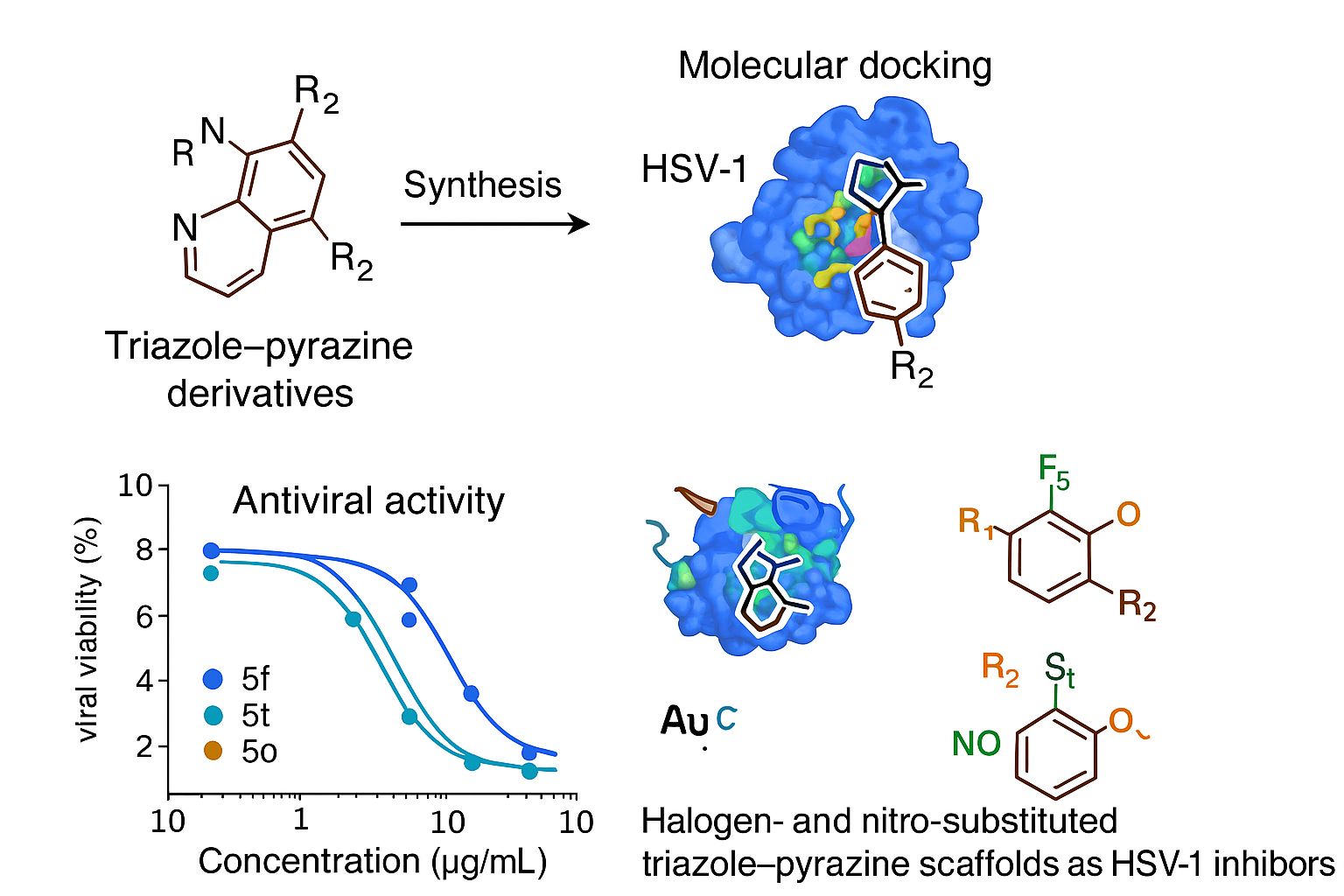
Herpes simplex virus type 1 (HSV-1) remains a widespread human pathogen responsible for recurrent infections and significant health burdens. The emergence of drug resistance and limitations of existing antiviral therapies highlight the need for the development of novel antiviral agents with improved efficacy and safety profiles In this study, a library of novel 1,2,4-triazole derivatives fused with a pyrazine moiety (5a–5t) was successfully synthesized and evaluated for their therapeutic potential against HSV-1 and oxidative stress. These compounds were assessed for anti-inflammatory, antioxidant, and anti-HSV–1 activities, demonstrating encouraging biological profiles. In particular, compounds 5f and 5t exhibited markedly improved antiviral efficacy compared to the reference drug, acyclovir. The antioxidant capacity was also notable, with compound 5b showing exceptional radical scavenging potential. Docking studies were conducted to better understand their molecular interactions with the target protein. The findings demonstrated that these molecules could potentially inhibit HSV-1, targeting a key enzyme involved in viral replication. Additionally, in silico analyses were performed to assess drug-likeness, absorption, distribution, metabolism, and excretion characteristics, and metabolic stability, which may aid in the optimization of future lead compounds. Although the experimental methods were accurately implemented, minor variations associated with human error, such as differences in timing during compound administration, measurements, and other experimental procedures, may have occurred. These possible variations, however, are unlikely to significantly affect the observed trends. Ultimately, the study emphasizes these new triazole–pyrazine hybrids as potential lead compounds for the development of potent anti-HSV–1 and possibly antibacterial agents, warranting further pharmacological and clinical investigation.
- Nicola AV, Hou J, Major EO, et al. Herpes simplex virus type 1 enters human epidermal keratinocytes, but not neurons, via a pH-dependent endocytic pathway. J Virol. 2005;79(12):7609-7616. doi: 10.1128/JVI.79.12.7609-7616.2005
- Milne RSB, Nicola AV, Whitbeck JC, et al. Glycoprotein D receptor-dependent, low-pH-independent endocytic entry of herpes simplex virus type 1. J Virol. 2005;79(11):6655- 6663. doi: 10.1128/JVI.79.11.6655-6663.2005
- Montgomery RI, Warner MS, Lum BJ, et al. Herpes simplex virus-1 entry into cells mediated by a novel member of the TNF/NGF receptor family. Cell. 1996;87(3):427-436. doi: 10.1016/S0092-8674(00)81363-X
- Roizman B, Knipe DM, Whitley RJ. Herpes simplex viruses. In: Knipe DM, Howley PM, eds. Fields Virology. 5th ed. Philadelphia, PA: Lippincott Williams & Wilkins; 2007:2501-2601.
- Piret J, Boivin G. Antiviral resistance in herpes simplex virus and varicella-zoster virus infections: diagnosis and management. Curr Opin Infect Dis. 2016;29(6):654-662. doi: 10.1097/QCO.0000000000000288
- Anighoro A, Bajorath J, Rastelli G. Polypharmacology: challenges and opportunities in drug discovery. J Med Chem. 2014;57(19):7874-7887. doi: 10.1021/jm5006463
- Saag MS, Benson CA, Gandhi RT, et al. Antiretroviral drugs for treatment and prevention of HIV infection in adults: 2018 recommendations of the International Antiviral Society–USA Panel. JAMA. 2018;320(4):379. doi: 10.1001/jama.2018.8431.
- Campadelli-Fiume G, Cocchi F, Menotti L, Lopez M. The novel receptors that mediate the entry of herpes simplex viruses and animal alphaviruses into cells. Rev Med Virol. 2000;10(5):305-319. doi: 10.1002/1099-1654(200009/10)10:5<305::AID-RMV286>3.0.CO;2-T
- Baranowski E, Ruiz-Jarabo CM, Pariente N, et al. Evolution of Cell Recognition by Viruses: A Source of Biological Novelty with Medical Implications. In: Advances in Virus Research. Amsterdam: Elsevier; 2003:19-111. doi: 10.1016/s0065-3527(03)62002-6
- James C, Harfouche M, Welton NJ, et al. Herpes simplex virus: global infection prevalence and incidence estimates, 2016. Bull World Health Organ. 2020;98(5):315-329. doi: 10.2471/BLT.19.237149
- Shukla D, Liu J, Blaiklock P, et al. A novel role for 3-O-sulfated heparan sulfate in herpes simplex virus 1 entry. Cell. 1999;99(1):13-22. doi: 10.1016/S0092-8674(00)80058-6
- Trottier B, Lake JE, Logue K, et al. Dolutegravir/abacavir/ lamivudine versus current ART in virally suppressed patients (STRIIVING): a 48- week, randomized, non-inferiority, open-label, Phase IIIb study. Antivir Ther. 2016;22(4):295- 305. doi: 10.3851/IMP3166
- Spear PG, Eisenberg RJ, Cohen GH. Three classes of cell surface receptors for alphavirus entry. Virology. 2000;275(1):1-8. doi: 10.1006/viro.2000.0529
- Gain C, Song S, Angtuaco T, et al. The role of oxidative stress in the pathogenesis of infections with coronaviruses. Front Microbiol. 2023;13. doi: 10.3389/fmicb.2022.1111930
- Hannah BP, Heldwein EE, Bender FC, et al. Mutational evidence of internal fusion loops in herpes simplex virus glycoprotein B. J Virol. 2007;81(9):4858-4865. doi: 10.1128/JVI.02755-06
- Chavan H, Shirodkar P, Mogal R, et al. Synthesis and evaluation of 1,2,4-triazole derivatives as antimicrobial, antifungal and anthelmintic agents. Indian J Chem. 2022;61(9):994-998. doi: 10.56042/ijc.v61i9.66354
- Heldwein EE, Lou H, Bender FC, et al. Crystal structure of glycoprotein B from herpes simplex virus 1. Science. 2006;313(5784):217-220. doi: 10.1126/science.1126548
- Connolly SA, Jackson JO, Jardetzky TS, et al. Fusing structure and function: a structural view of the herpesvirus entry machinery. Nat Rev Microbiol. 2011;9(5):369-381. doi: 10.1038/nrmicro2548
- Döhner K, Wolfstein A, Prank U, et al. Function of dynein and dynactin in herpes simplex virus capsid transport. MBoC. 2002;13(8):2795-2809. doi: 10.1091/mbc.01-07-0348
- Zoete V, Daina A, Bovigny C, et al. SwissSimilarity: a web tool for low to ultra high throughput ligand-based virtual screening. J Chem Inf Model. 2016;56(8):1399-1404. doi: 10.1021/acs.jcim.6b00174
- Naik S, Puttachari D, Vanishree L, et al. Synthesis and biological evaluation of novel hybrid compounds bearing pyrazine and 1,2,4-triazole analogues as potent antitubercular agents. RSC Pharmaceutics. 2024;1:283-295. doi: 10.1039/D3PM00054K
- Hu Z, Dong H, Si Z, et al. Synthesis and Antibacterial Activity of Novel Triazolo[4,3-a]pyrazine Derivatives. Molecules. 2023;28(23):7876. doi: 10.3390/molecules28237876
- Shiraguppi SV, Koganole P, Honnalli SS. A review on 1,2,4-triazoles as scaffold for various pharmacological activities. J Pharma Insights Res. 2025;3(3):020-027. doi: 10.69613/aewrja40
- Pintea BN, Panțîr VG, Badea V, et al. Pyrazolo [5,1-c] [1,2,4] triazole: a promising emerging biologically active scaffold in medicinal chemistry. IJMS. 2025;26(17):8190. doi: 10.3390/ijms26178190