

Associations between physical activity intensity, daily physical activity time, and depression: A cross-sectional study of sleep duration

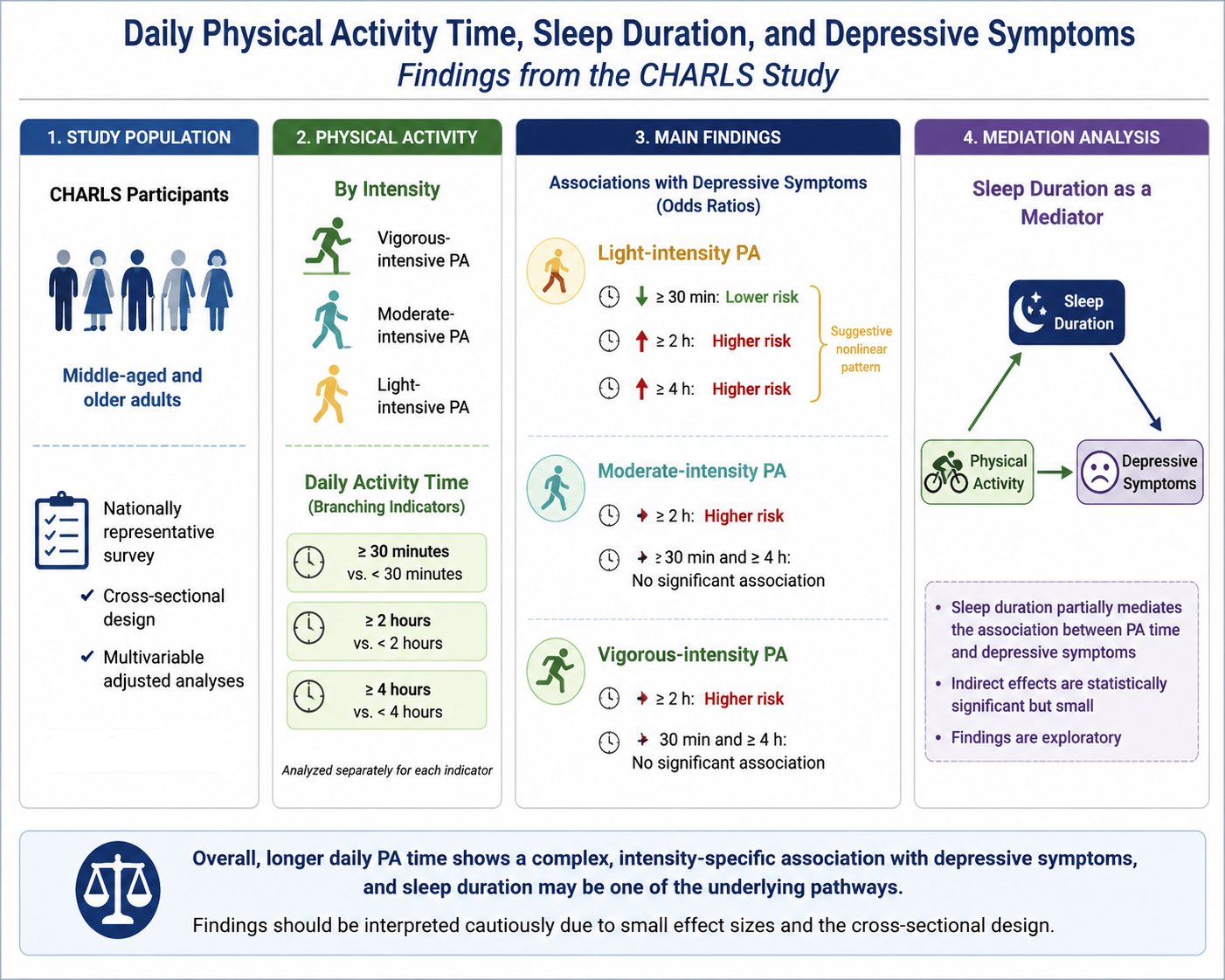
This study aimed to examine the associations between physical activity intensity, daily physical activity time, and depressive symptoms among middle-aged and older adults, and to explore the potential mediating role of sleep duration. Data were drawn from the China Health and Retirement Longitudinal Study (CHARLS), including 19,367 adults aged 45 years and older. Depressive symptoms were assessed using the Center for Epidemiologic Studies Depression Scale (CES-D). Physical activity was categorized by different intensities and self-reported daily activity time, and sleep duration was measured via self-report. Spearman correlation tests and exploratory mediation analyses were conducted to explore the relationships among physical activity, sleep, and depressive symptoms. Both moderate- and vigorous-intensity physical activity were associated with a lower risk of depressive symptoms (p < 0.001). The effect of daily activity time on depression varied nonlinearly with intensity. Sleep duration partially mediated the association between vigorous physical activity and depressive symptoms. The mental health benefits of physical activity in middle-aged and older adults depend on both intensity and duration, with a complex nonlinear relationship observed. Sleep may partially contribute to the association between physical activity and depressive symptoms, underscoring the potential importance of balancing exercise load with adequate recovery.
- Marwaha S, Palmer E, Suppes T, Cons E, Young AH, Upthegrove R. Novel and emerging treatments for major depression. Lancet. 2023;401(10371):141-153. doi: 10.1016/S0140-6736(22)02080-3
- He N, Cui L, Dong Y, et al. Detection rate of cognitive impairment and its association with sleep duration among Chinese older adults: an empirical analysis based on the 2018 CHARLS data. Chin J Gerontol. 2023;43(7):1758-1761. [In Chinese] doi: 10.3969/j.issn.1005-9202.2023.07.056
- Crispino P, Gino M, Barbagelata E, et al. Gender differences and quality of life in Parkinson’s disease. Int J Environ Res Public Health. 2021;18(1):198. doi: org/10.3390/ijerph18010198.
- Kim J. Regular physical exercise and its association with depression: a population-based study short title: exercise and depression. Psychiatry Res. 2022;309:114406. doi: 10.1016/j.psychres.2022.114406
- Wang X, Cai Z, Jiang W, Fang Y, Sun W, Wang X. Systematic review and meta-analysis of the effects of exercise on depression in adolescents. Child Adolesc Psychiatry Ment Health. 2022;16(1):1-19. doi: 10.1186/s13034-022-00453-2
- Yates BA. Tryptophan metabolism, exercise and depression. Nat Rev Endocrinol. 2025,21:201. doi: 10.1038/s41574-025-01090-3
- Lange KW, Nakamura Y, Lange KM. Sport and exercise as medicine in the prevention and treatment of depression. Front Sports Act Living. 2023;5:1-5. doi: 10.3389/fspor.2023.1136314
- Noetel M, Sanders T, Gallardo-Gómez D, et al. Effect of exercise for depression: systematic review and network meta-analysis of randomised controlled trials. BMJ. 2024;384:e75847. doi: 10.1136/bmj-2023-075847
- Gu J. Physical activity and depression in adolescents: evidence from China family panel studies. Behav Sci. 2022;12(71):1-13. doi: 10.3390/bs12030071
- Da Silva LA, Tortelli L, Motta J, et al. Effects of aquatic exercise on mental health, functional autonomy and oxidative stress in depressed elderly individuals: a randomized clinical trial. Clinics. 2019;74:e322. doi: 10.6061/clinics/2019/e322
- Li X, He S, Liu T, et al. Impact of exercise type, duration, and intensity on depressive symptoms in older adults: a systematic review and meta-analysis. Front Psychol. 2024;15:1-10. doi: 10.3389/fpsyg.2024.1484172
- Loprinzi PD. Objectively measured light and moderate-to-vigorous physical activity is associated with lower depression levels among older us adults. Aging Ment Health. 2013;17(7):801-805. doi: 10.1080/13607863.2013.801066
- Gottesman RF, Lutsey PL, Benveniste H, et al. Impact of sleep disorders and disturbed sleep on brain health: a scientific statement from the American Heart Association. Stroke. 2024;55(3):e61-76. doi: 10.1161/STR.0000000000000453
- Andersen EM, Malmgren JA, Carter WB, Patrick DL. Screening for depression in well older adults: evaluation of a short form of the CES-D. Am J Prev Med. 1994;10(2):77-84. doi: 10.1016/S0749-3797(18)30622-6
- Wang F. Different intensity treadmill exercise improve depressive-like behavior in cums mice by regulating bdnf/ mir-124/p-creb signaling pathway. J Henan Norm Univ. 2025;53(03):27-35. [In Chinese] doi: 10.16366/j.cnki.1000-2367.2024.06.28.0001
- Teychenne M, Ball K, Salmon J. Physical activity and likelihood of depression in adults: a review. Prev Med. 2008;46(5):397-411. doi: 10.1016/j.ypmed.2008.01.009
- Stanton R, Reaburn P. Exercise and the treatment of depression: a review of the exercise program variables. J Sci Med Sport. 2014;17(2):177-182. doi: 10.1016/j.jsams.2013.03.010
- Hallgren M, Nguyen T, Owen N, Stubbs B, et al. Cross-sectional and prospective relationships of passive and mentally active sedentary behaviours and physical activity with depression. Br J Psychiatry. 2020;217:413-419. doi: 10.1192/bjp.2019.60
- Liu L, Liu C, Liu X, Yang Y. Summary of the effect of an exercise intervention on antenatal depression and the optimal program: a systematic review and meta-analysis. BMC Pregnancy Childbirth. 2023;23:293. doi: 10.1186/s12884-023-05629-y
- Park AL, Furie K, Wong SE. Stronger athlete identity is a risk factor for more severe depressive symptoms after musculoskeletal injury in pediatric athletes: a systematic review. Curr Rev Musculoskelet Med. 2023;16(5):220-228. doi: 10.1007/s12178-023-09828-0
- Wang Y, Lin J, Xie T. Mechanism and future prospect of exercise in the treatment of adolescent depression. J Psychol Sci.. 2021;44(05):1208-1215. [In Chinese] doi: 10.16719/j.cnki.1671-6981.20210525
- Gujral S, Aizenstein H, Reynolds CF, Butters MA, Erickson KI. Exercise effects on depression: possible neural mechanisms. Gen Hosp Psychiatry. 2017;49:2-10. doi: 10.1016/j.genhosppsych.2017.04.012
- Pickersgill JW, Turco CV, Ramdeo K, Rehsi RS, Foglia SD, Nelson AJ. The combined influences of exercise, diet and sleep on neuroplasticity. Front Psychol. 2022;13:831819. doi: 10.3389/fpsyg.2022.831819
- Alnawwar MA, Alraddadi MI, Algethmi RA, Salem GA, Salem MA, Alharbi AA. The effect of physical activity on sleep quality and sleep disorder: a systematic review. Cureus. 2023;15(8):1-11. doi: 10.7759/cureus.43595
- You Y, Chen Y, Zhang Y, Zhang Q, Yu Y, Cao Q. Mitigation role of physical exercise participation in the relationship between blood cadmium and sleep disturbance: a cross-sectional study. BMC Public Health. 2023;23:1465. doi: 10.1186/s12889-023-16358-4
- Youngstedt SD. Effects of exercise on sleep. Clin Sports Med. 2005;24(2):355-365. doi: 10.1016/j.csm.2004.12.003
- Kekkonen E, Hall A, Antikainen R, et al. Impaired sleep, depressive symptoms, and pain as determinants of physical activity and exercise intervention adherence: an exploratory analysis of a randomized clinical trial. BMC Geriatr. 2025;25:211. doi: 10.1186/s12877-025-05830-y
- Ji C, Yang J, Lin L, Chen S. Physical exercise ameliorates anxiety, depression and sleep quality in college students: experimental evidence from exercise intensity and frequency. Behav Sci. 2022;12(61):1-11. doi: 10.3390/bs12030061