

An integrated partial least squares structural equation modeling, artificial neural network, and importance–performance map analysis framework for Industry 4.0 readiness in university startups

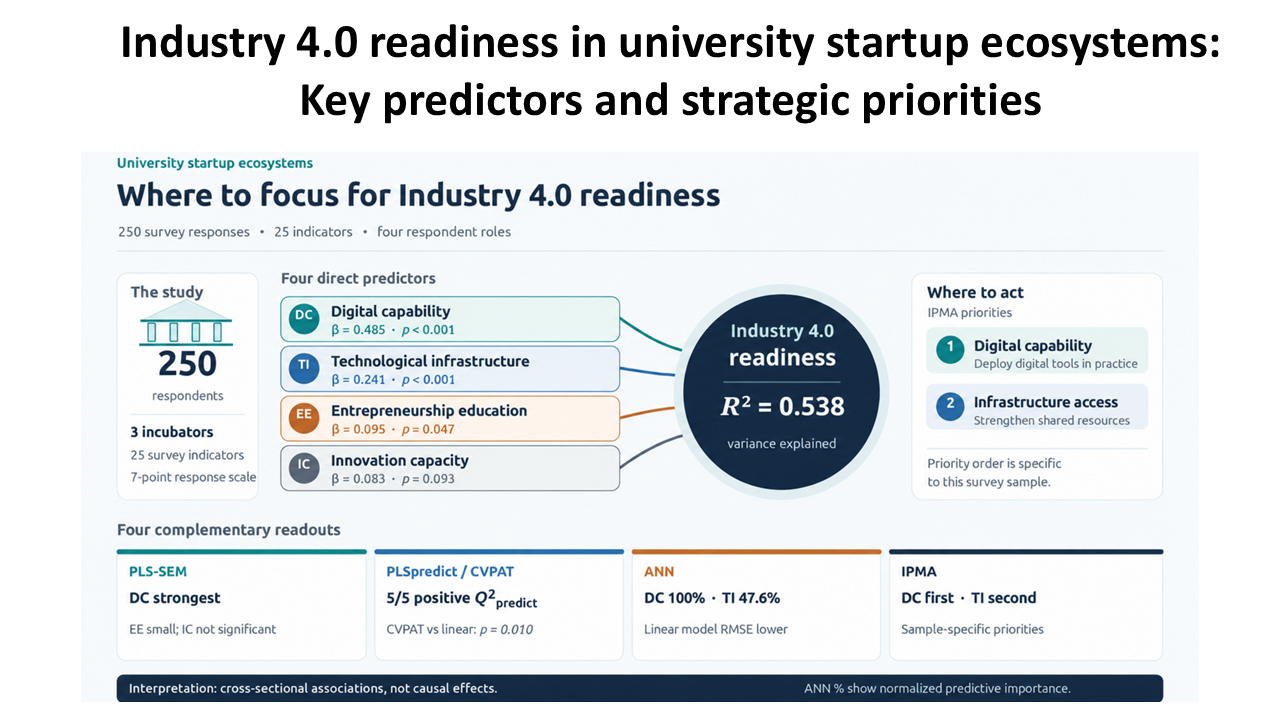
Since Industry 4.0 entered international policy and scholarly debate in 2011, the convergence of cyber-physical systems, the Internet of Things, cloud computing, data analytics, artificial intelligence, and intelligent automation has reshaped how university-linked startups are conceived, incubated, and scaled. This study evaluates an integrated partial least squares structural equation modeling (PLS-SEM), artificial neural network (ANN), PLSpredict/cross-validated predictive ability test (CVPAT), and importance–performance map analysis (IPMA) framework linking technological infrastructure (TI), innovation capacity (IC), entrepreneurship education (EE), digital capability (DC), and Industry 4.0 readiness (I4R). A quantitative cross-sectional survey using criterion-based purposive sampling produced 250 usable responses from student entrepreneurs, incubator resident venture representatives, faculty startup advisers, and innovation center employees. PLS-SEM with 5,000 bootstrap resamples showed that DC had the strongest positive association with I4R (β = 0.485, p < 0.001), followed by TI (β = 0.241, p < 0.001). EE showed a small, marginally significant positive association (β = 0.095, p = 0.047), whereas IC was not significant (β = 0.083, p = 0.093). The model explained 53.8% of the variance in I4R (R2 = 0.538). PLSpredict yielded positive Q2predict values for all I4R indicators, and construct-level CVPAT showed significantly lower PLS-SEM prediction loss than the linear-model benchmark (difference = −0.059, t = 2.602, p = 0.010). A fully specified, repeated cross-validated multilayer perceptron ANN ranked DC first (100% normalized importance), followed by TI (47.6%), EE (10.9%), and IC (10.0%); however, the matched linear benchmark achieved lower held-out root mean square error, so ANN is interpreted as a complementary ranking tool rather than evidence of superior predictive accuracy. IPMA identified DC (importance = 0.485; performance = 48.222) and TI (0.241; 46.037) as the leading intervention priorities. The framework therefore integrates explanatory assessment, out-of-sample prediction, predictive ranking, and intervention prioritization without implying causal proof from cross-sectional data.
- Kagermann H, Wahlster W, Helbig J. Recommendations for Implementing the Strategic Initiative INDUSTRIE 4.0: Securing the Future of German Manufacturing Industry: Final Report of the Industrie 4.0 Working Group. Frankfurt, Germany: Acatech, National Academy of Science and Engineering; 2013.
- Piardi L, Leitão P, Queiroz J, Pontes J. Role of digital technologies to enhance the human integration in industrial cyber-physical systems. Annu Rev Control. 2024;57:100934. https://doi.org/10.1016/j.arcontrol.2024.100934
- Greco F. Startup Ecosystems. Studies on Entrepreneurship, Structural Change and Industrial Dynamics. Cham, Switzerland: Springer; 2023. https://doi.org/10.1007/978-3-031-34414-5
- Muldoon-Smith K, Moreton L, Kotter R. Meaningful transfer: tech-knowlogical interdependencies in the digital built environment. Front Sustain Cities. 2021;3:709800. https://doi.org/10.3389/frsc.2021.709800
- Handaoui M. Digital transformation as a lever for entrepreneurial innovation in emerging business environments. J Bus Adm Econ Stud. 2025;11(2):177-196. Accessed June 15, 2026. https://asjp.cerist.dz/en/article/279069
- Robandi B, Setiawardani W. Training curriculum needs for entrepreneurship literacy of higher education in society 5.0. Curricula. 2025;4(1):567-580. https://doi.org/10.17509/curricula.v4i1.83520
- Stentoft J, Adsbøll Wickstrøm K, Philipsen K, Haug A. Drivers and barriers for Industry 4.0 readiness and practice: a SME perspective with empirical evidence. In: Proceedings of the Annual Hawaii International Conference on System Sciences. Honolulu, HI: Hawaii International Conference on System Sciences; 2019. https://doi.org/10.24251/hicss.2019.619
- Müller JM, Buliga O, Voigt KI. Fortune favors the prepared: how SMEs approach business model innovations in Industry 4.0. Technol Forecast Soc Change. 2018;132:2-17. https://doi.org/10.1016/j.techfore.2017.12.019
- Wahl D, Münch J. Turning students into Industry 4.0 entrepreneurs: design and evaluation of a tailored study program. Entrep Educ. 2022;5(3):225-259. https://doi.org/10.1007/s41959-022-00077-9
- Aghazadeh H, Zandi F, Amoozad Mahdiraji H, Sadraei R. Digital transformation and SME internationalisation: unravelling the moderated-mediation role of digital capabilities, digital resilience and digital maturity. J Enterp Inf Manag. 2024;37(5):1499-1526. https://doi.org/10.1108/JEIM-02-2023-0092
- Hoque MT, Tzokas N, Arslan A, Gupta DR, Ahammad MF. Knowledge management, operational resilience and export performance: moderating roles of strategic flexibility and maturity of digital transformation in emerging markets. Int Mark Rev. 2026;43(3):534-559. https://doi.org/10.1108/IMR-10-2024-0389
- Firmansyah D, Wahdiniwaty R. Prediction of innovation capability: the role of mediation in the relationship between digital transformation and competitiveness with the PLS-SEM model. Int J Manag Bus Intell. 2023;1(2):125-142. https://doi.org/10.59890/ijmbi.v1i2.238
- Salem IE, Elbaz AM, Magdy A, Hassan H, Ba Awain AM. Behavioural and innovative traits driving digital transformation and competitive advantage: the role of entrepreneurship orientation. Asia Pac J Bus Adm. 2026;18(2):544-566. https://doi.org/10.1108/APJBA-03-2025-0231
- Khan RU, Almazrouei FSSS, Sharairi MH, Khan MY, Harmal MAA. Digital leadership capabilities and dynamic workplaces enhance IT firm performance through digital innovation using a PLS SEM and ANN approach. Discov Sustain. 2026;7:605. https://doi.org/10.1007/s43621-026-02951-1
- Stentoft J, Adsbøll Wickstrøm K, Philipsen K, Haug A. Drivers and barriers for Industry 4.0 readiness and practice: empirical evidence from small and medium-sized manufacturers. Prod Plan Control. 2021;32(10):811-828. https://doi.org/10.1080/09537287.2020.1768318
- Hair J, Alamer A. Partial least squares structural equation modeling (PLS-SEM) in second language and education research: guidelines using an applied example. Res Methods Appl Linguist. 2022;1(3):100027. https://doi.org/10.1016/j.rmal.2022.100027
- Shmueli G, Ray S, Velasquez Estrada JM, Chatla SB. The elephant in the room: predictive performance of PLS models. J Bus Res. 2016;69(10):4552-4564. https://doi.org/10.1016/j.jbusres.2016.03.049
- Sarstedt M, Richter NF, Hauff S, Ringle CM. Combined importance-performance map analysis (cIPMA) in partial least squares structural equation modeling (PLS-SEM): a SmartPLS 4 tutorial. J Mark Anal. 2024;12(4):746-760. https://doi.org/10.1057/s41270-024-00325-y
- Büyüközkan G, Güler M. A combined hesitant fuzzy MCDM approach for supply chain analytics tool evaluation. Appl Soft Comput. 2021;112:107812. https://doi.org/10.1016/j.asoc.2021.107812
- Zambon I, Cecchini M, Egidi G, Saporito MG, Colantoni A. Revolution 4.0: industry vs. agriculture in a future development for SMEs. Processes. 2019;7(1):36. https://doi.org/10.3390/pr7010036
- Ülker N, Otrar M. University 4.0 essentials: influence of industry 4.0 on higher education. Ind High Educ. 2025;39(5):528-538. https://doi.org/10.1177/09504222241295625
- Müller JM, Kiel D, Voigt KI. What drives the implementation of Industry 4.0? The role of opportunities and challenges in the context of sustainability. Sustainability. 2018;10(1):247. https://doi.org/10.3390/su10010247
- Samo AH, Channa NA, Qureshi NA. The role of universities and entrepreneurial ecosystem in producing entrepreneurs for industry 4.0. J High Educ Theory Pract. 2021;21(11):28-40. https://doi.org/10.33423/jhetp.v21i11.4661
- Ferreira NC, Ferreira JJ. Enhancing sustainable entrepreneurship in SMEs: a multi-criteria analysis of internal initiatives and their causal relationships. Ann Oper Res. Published online 2025. https://doi.org/10.1007/s10479-024-06445-z
- Göçoğlu V, Göksu S, Kotter R. Unleashing urban technology dynamics: the interplay of AI patents, metropolitan area population, and R&D expenditures in sustainable urban development. J Urban Technol. 2025;32(3):139-161. https://doi.org/10.1080/10630732.2023.2289818
- Partridge A, Batchelder C. Startup Boosting in an Industry 4.0 Context. Saint-Denis, France: URBACT; 2022. Accessed October 27, 2026. https://urbact.eu/sites/default/files/2022-12/3.Startup%20Boosting%20thematic%20report.pdf
- Kumar JS, Balasubramani M. Digital entrepreneurship and startup ecosystem development in India in the era of Industry 4.0. SSRN. 2026. https://doi.org/10.2139/ssrn.6948878
- Hair JF, Risher JJ, Sarstedt M, Ringle CM. When to use and how to report the results of PLS-SEM. Eur Bus Rev. 2019;31(1):2-24. https://doi.org/10.1108/EBR-11-2018-0203
- Fayolle A, Liñán F. The future of research on entrepreneurial intentions. J Bus Res. 2014;67(5):663-666. https://doi.org/10.1016/j.jbusres.2013.11.024
- Nambisan S. Digital entrepreneurship: toward a digital technology perspective of entrepreneurship. Entrep Theory Pract. 2017;41(6):1029-1055. https://doi.org/10.1111/etap.12254
- Khin S, Ho TCF. Digital technology, digital capability and organizational performance: a mediating role of digital innovation. Int J Innov Sci. 2019;11(2):177-195. https://doi.org/10.1108/IJIS-08-2018-0083
- Teece DJ. Explicating dynamic capabilities: the nature and microfoundations of (sustainable) enterprise performance. Strateg Manag J. 2007;28(13):1319-1350. https://doi.org/10.1002/smj.640
- Prajogo DI, Ahmed PK. Relationships between innovation stimulus, innovation capacity, and innovation performance. R&D Manag. 2006;36(5):499-515. https://doi.org/10.1111/j.1467-9310.2006.00450.x
- Assink M. Inhibitors of disruptive innovation capability: a conceptual model. Eur J Innov Manag. 2006;9(2):215-233. https://doi.org/10.1108/14601060610663587
- Podsakoff PM, MacKenzie SB, Lee JY, Podsakoff NP. Common method biases in behavioral research: a critical review of the literature and recommended remedies. J Appl Psychol. 2003;88(5):879-903. https://doi.org/10.1037/0021-9010.88.5.879
- Kock N. Common method bias in PLS-SEM: a full collinearity assessment approach. Int J e-Collab. 2015;11(4):1-10. https://doi.org/10.4018/ijec.2015100101
- Henseler J, Ringle CM, Sarstedt M. A new criterion for assessing discriminant validity in variance-based structural equation modeling. J Acad Mark Sci. 2015;43(1):115-135. https://doi.org/10.1007/s11747-014-0403-8
- Shmueli G, Sarstedt M, Hair JF, et al. Predictive model assessment in PLS-SEM: guidelines for using PLSpredict. Eur J Mark. 2019;53(11):2322-2347. https://doi.org/10.1108/EJM-02-2019-0189
- Liengaard BD, Sharma PN, Hult GTM, et al. Prediction: coveted, yet forsaken? Introducing a cross-validated predictive ability test in partial least squares path modeling. Decis Sci. 2021;52(2):362-392. https://doi.org/10.1111/deci.12445
- Baron RM, Kenny DA. The moderator-mediator variable distinction in social psychological research: conceptual, strategic, and statistical considerations. J Pers Soc Psychol. 1986;51(6):1173-1182. https://doi.org/10.1037/0022-3514.51.6.1173
- Preacher KJ, Hayes AF. Asymptotic and resampling strategies for assessing and comparing indirect effects in multiple mediator models. Behav Res Methods. 2008;40(3):879-891. https://doi.org/10.3758/BRM.40.3.879