
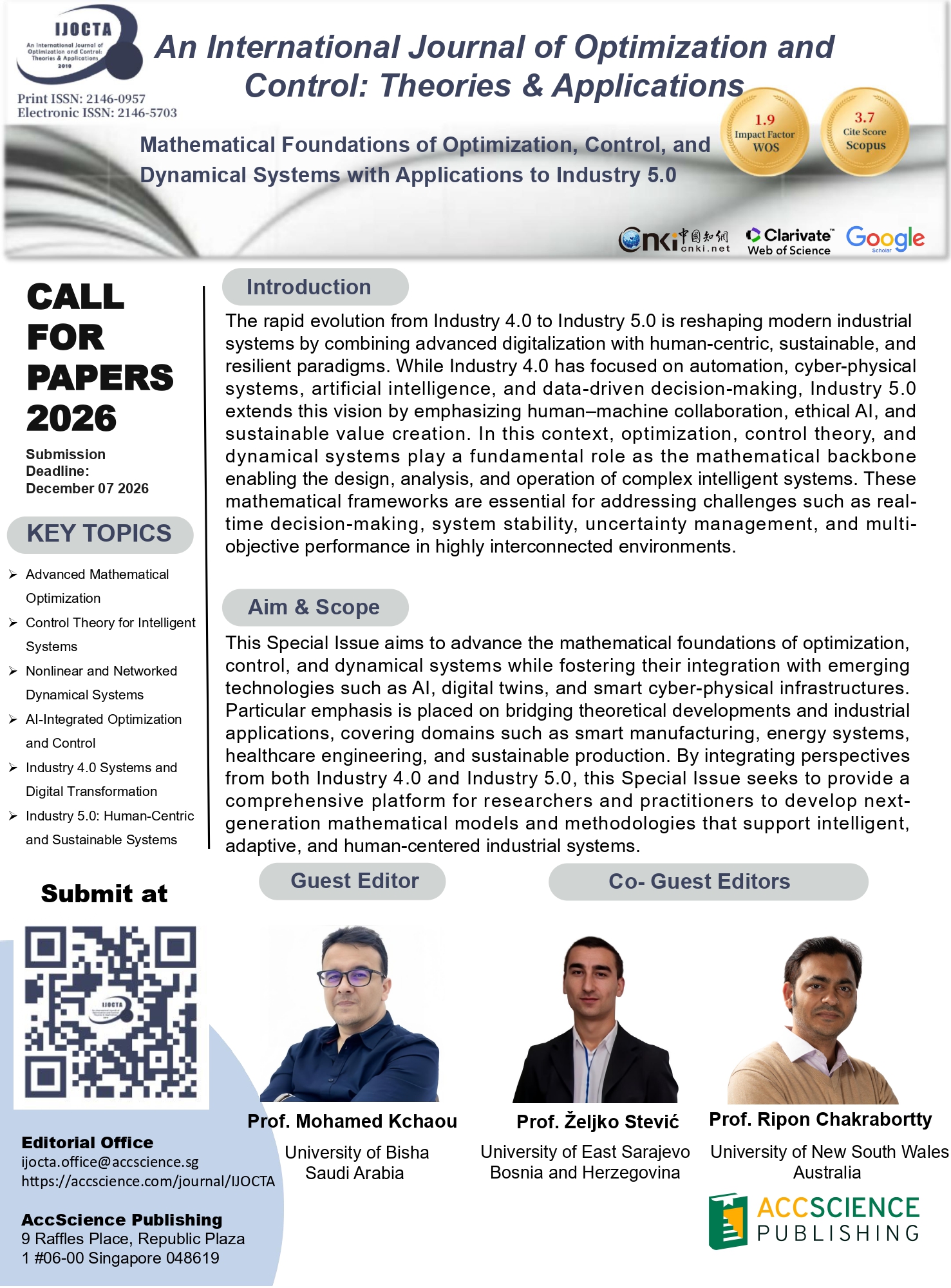
Mathematical Foundations of Optimization, Control, and Dynamical Systems with Applications to Industry 5.0


Faculty of Transport and Traffic Engineering, University of East Sarajevo, Bosnia and HerzegovinaLogistics; Supply chain management; Transport; Traffic engineering; Soft computing; Multi-criteria decision making problems; Rough set theory; Sustainability; Fuzzy set theory; Neutrosophic set theory and circular economy

the Resilient Intelligent Systems for Clean Energy Research Hub, University of New South Wales, Canberra, AustraliaDecision analytics; Applied artificial intelligence; Evolutionary computation; Applied optimization in the fields of “Project Scheduling and Supply Chain Management”
Introduction
The rapid evolution from Industry 4.0 to Industry 5.0 is reshaping modern industrial systems by combining advanced digitalization with human-centric, sustainable, and resilient paradigms. While Industry 4.0 has focused on automation, cyber-physical systems, artificial intelligence, and data-driven decision-making, Industry 5.0 extends this vision by emphasizing human–machine collaboration, ethical AI, and sustainable value creation. In this context, optimization, control theory, and dynamical systems play a fundamental role as the mathematical backbone enabling the design, analysis, and operation of complex intelligent systems. These mathematical frameworks are essential for addressing challenges such as real-time decision-making, system stability, uncertainty management, and multi-objective performance in highly interconnected environments.
Aim & Scope
This Special Issue aims to advance the mathematical foundations of optimization, control, and dynamical systems while fostering their integration with emerging technologies such as AI, digital twins, and smart cyber-physical infrastructures. Particular emphasis is placed on bridging theoretical developments and industrial applications, covering domains such as smart manufacturing, energy systems, healthcare engineering, and sustainable production. By integrating perspectives from both Industry 4.0 and Industry 5.0, this Special Issue seeks to provide a comprehensive platform for researchers and practitioners to develop next-generation mathematical models and methodologies that support intelligent, adaptive, and human-centered industrial systems.
Key Topics:
- Advanced Mathematical Optimization
- Control Theory for Intelligent Systems
- Nonlinear and Networked Dynamical Systems
- AI-Integrated Optimization and Control
- Industry 4.0 Systems and Digital Transformation
- Industry 5.0: Human-Centric and Sustainable Systems
Discrete stochastic optimal control for multi-stakeholder
governance of crop rotation and fallow insurance