
Optimal control of financial inclusion for women entrepreneurs with bifurcation, statistical and stochastic analysis

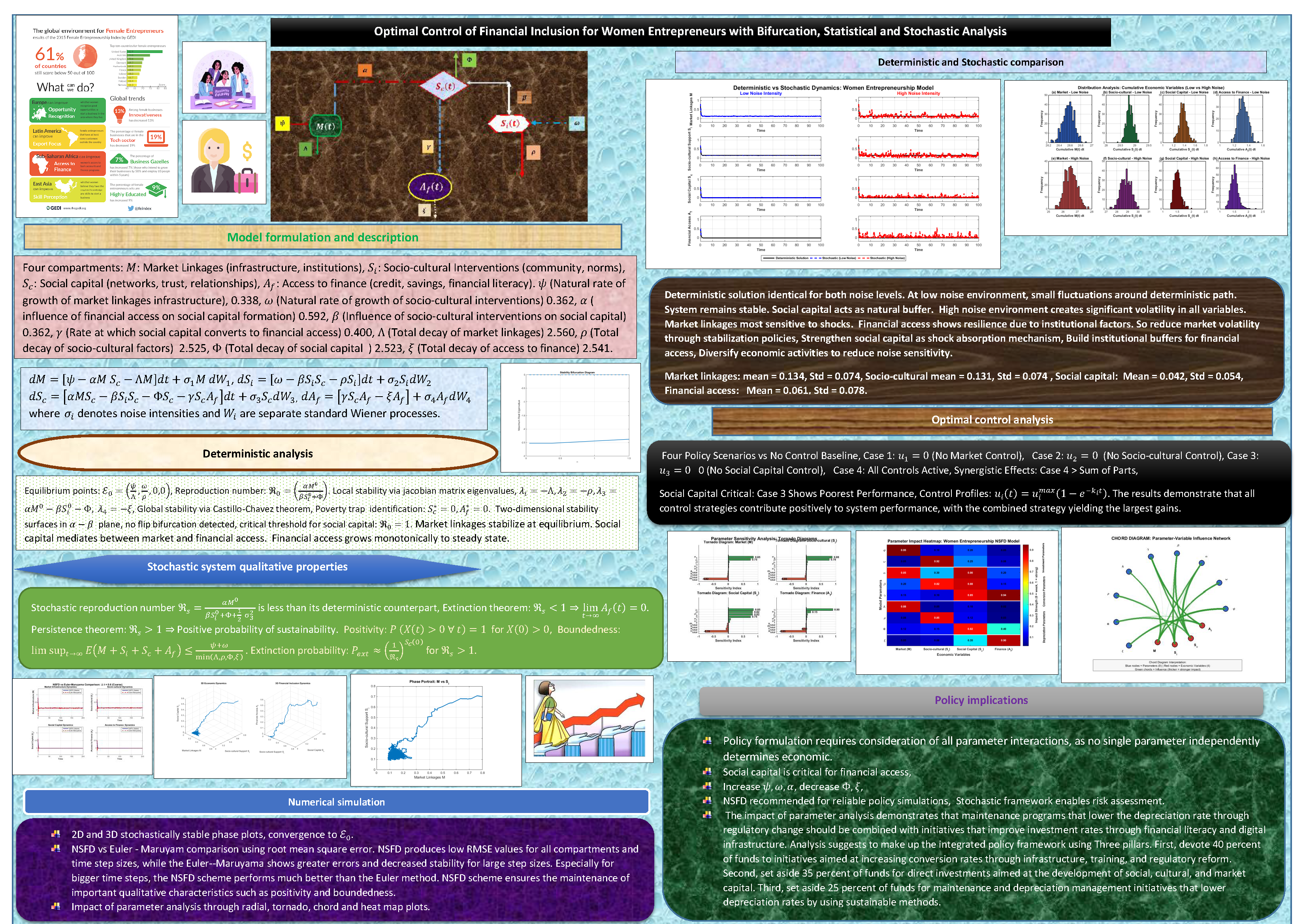
In this paper, we develop a comprehensive mathematical model incorporating market linkages, sociocultural interventions, social capital, and access to finance to examine the dynamics of women entrepreneurs. We extend the deterministic model by incorporating the random variations present in socioeconomic systems, in addition to constructiing and analyzing a stochastic nonstandard finite difference (NSFD) scheme. The methodology overcomes significant limitations of traditional numerical approaches by ensuring the preservation of positivity and boundedness for all step sizes. We compute key thresholds at which the system undergoes qualitative behavioral changes by using eigenvalue analysis, one-dimensional parameter sweeps, and two-dimensional stability surfaces. The absence of flip bifurcation verifies that the behaviour of the system is bounded and that the system does not exhibit period-doubling instabilities. The stochastic and deterministic simulations highlight the dynamic behavior of the suggested model. The impact of parameters, illustrated through radial, tornado, chord, and heat-map diagrams, shows that maintenance programs that lower the depreciation rate through regulatory change should be combined with initiatives that improve investment rates through financial literacy and digital infrastructure. Statistical validation shows the superiority of the nonstandard finite difference scheme and the effectiveness of control measures compared with the no-control case. By formulating a stochastic optimal control problem, we compare four policy cases with the no-control case, and the results show that the combination of all controls produces the highest access to finance. The NSFD scheme preserves positivity for all step sizes, whereas Euler-Maruyama generates economically non-feasible negative results for large step sizes. The findings indicate that, to prevent irregular losses in entrepreneurial capacity, effective interventions should prioritize stabilizing social networks and controlling financial access during turbulent periods, which underscores the importance of stable policy environments and consistent financial support mechanisms. In women's entrepreneurial development programs, our study offers a strong foundation for policy modeling, uncertainty quantification, and evidence-based decision-making.
- Bullough A, Guelich U, Manolova TS, Schjoedt L. Women's entrepreneurship and culture: Gender role expectations and identities, societal culture, and the entrepreneurial environment. Small Bus Econ. 2022;58(2):985-996. https://doi.org/10.1007/s11187-020-00429-6
- Adom K, Anambane G. Understanding the role of culture and gender stereotypes in women entrepreneurship through the lens of the stereotype threat theory. J Entrep Emerg Econ. 2020;12(1):100-124. https://doi.org/10.1108/JEEE-07-2018-0070
- Agrawal A, Gandhi P, Khare P. Women empowerment through entrepreneurship: Case study of a social entrepreneurial intervention in rural India. Int J Organ Anal. 2023;31(4):1122-1142. https://doi.org/10.1108/IJOA-03-2021-2659
- Polas MRH, Raju V, Muhibbullah M, Tabash MI. Rural women characteristics and sustainable entrepreneurial intention: A road to economic growth in Bangladesh. J Enterp Commun. 2022;16(3):421-449. https://doi.org/10.1108/JEC-10-2020-0183
- Sharma E, Das S. Integrated model for women empowerment in rural India. J Int Dev. 2021;33(3):594-611. https://doi.org/10.1002/jid.3539
- Al-Assaf KT, Foriki MSM, Samarah T, et al. Impact of digital marketing on promoting the local pharmaceutical products in Jordan. Int Rev Manag Mark. 2025;15(1):137-145. https://doi.org/10.32479/irmm.17707
- Khalufi NAM, Sheikh RA, Khan SMFA, Onn CW. Evaluating the impact of sustainability practices on customer relationship quality: an SEM-PLS approach to align with SDG. Sustainability. 2025;17(2):798. https://doi.org/10.3390/su17020798
- World Bank Group. Global Financial Development Report 2014: Financial Inclusion. Vol 2. World Bank Publications; 2013. https://doi.org/10.1596/978-0-8213-9985-9
- Ridgeway CL. Framed by Gender: How Gender Inequality Persists in the Modern World. Oxford University Press; 2011. https://doi.org/10.1093/acprof:oso/9780199755776.001.0001
- Sen G, Ostlin P. Gender inequity in health: Why it exists and how we can change it. Glob Public Health. 2008;3(S1):1-12. https://doi.org/10.1080/17441690801900795
- Huang J, Krivkovich A, Starikova I, Yee L, Zanoschi D. Women in the Workplace 2019. McKinsey & Co; 2019. Accessed March 15, 2026. https://www.mckinsey.com/featured-insights/gender-equality/women-in-the-workplace
- Cornwall A, Rivas AM. From gender equality and women's empowerment to global justice: Reclaiming a transformative agenda for gender and development. Third World Q. 2015;36(2):396-415. https://doi.org/10.1080/01436597.2015.1013341
- United Nations Girls' Education Initiative. Teaching and Learning: Achieving Quality for All. EFA Global Monitoring Report 2013-2014; 2014. Accessed March 15, 2026. https://unesdoc.unesco.org/ark:/48223/pf0000226662
- UN Women. Turning Promises into Action: Gender Equality in the 2030 Agenda for Sustainable Development. UN Women; 2018. https://doi.org/10.18356/917ed83e-en
- Pontryagin LS. Mathematical Theory of Optimal Processes. Routledge; 2018. https://doi.org/10.1201/9780203749319
- Lenhart S, Workman JT. Optimal Control Applied to Biological Models. Chapman & Hall/CRC; 2007. https://doi.org/10.1201/9781420011418
- Svishchuk M, Swishchuk AV. Stochastic optimal control of averaged SDDE with semi-Markov switching and with application in economics. Mathematics. 2025;13(9):1440. https://doi.org/10.3390/math13091440
- Fleming WH. Stochastic Analysis, Control, Optimization and Applications: A Volume in Honor of Wendell H. Fleming. Springer; 1999. https://doi.org/10.1007/978-1-4612-1784-8
- Kafash B, Delavarkhalafi A, Karbassi SM. A computational method for stochastic optimal control problems in financial mathematics. Asian J Control. 2016;18(4):1501-1512. https://doi.org/10.1002/asjc.1242
- Akdogan E. Stochastic Optimal Control Theory: New Applications to Finance and Insurance [master's thesis]. Ankara, Turkey: Middle East Technical University; 2017. Accessed XXX. https://etd.lib.metu.edu.tr/upload/12621076/index.pdf
- Ewald CO, Nolan C. On the adaptation of the Lagrange formalism to continuous time stochastic optimal control: A Lagrange-Chow redux. J Econ Dyn Control. 2024;162:104855. https://doi.org/10.1016/j.jedc.2024.104855
- Dai Y, Xu W, Wu X, Yan M, Xue F, Zhao J. A data-physical fusion method for economic dispatch considering high renewable penetration and security constraints. Int J Electr Power Energy Syst. 2025;168:110691. https://doi.org/10.1016/j.ijepes.2025.110691
- Naik PA, Yavuz M, Qureshi S, Owolabi KM, Soomro A, Ganie AH. Memory impacts in hepatitis C: A global analysis of a fractional-order model with an effective treatment. Comput Methods Programs Biomed. 2024;254:108306. https://doi.org/10.1016/j.cmpb.2024.108306
- Naik PA, Yeolekar BM, Qureshi S, Yeolekar M, Madzvamuse A. Modeling and analysis of the fractional-order epidemic model to investigate mutual influence in HIV/HCV co-infection. Nonlinear Dyn. 2024;112(13):11679-11710. https://doi.org/10.1007/s11071-024-09567-8
- Chen Z. Numerical Methods for Optimal Stochastic Control in Finance. LAP Lambert Academic Publishing; 2008.
- El-Mesady A, Elsonbaty A, Nisar KS, Adel W. Fractional-order mathematical modeling and optimal control strategies for women's empowerment initiatives. Ain Shams Eng J. 2025;16(11):103702. https://doi.org/10.1016/j.asej.2025.103702
- Raza A, Minhós F, Shafique U, Mohsin M. Mathematical modeling of leukemia within stochastic fractional delay differential equations. Comput Model Eng Sci. 2025;(3):3411. https://doi.org/10.32604/cmes.2025.060855
- Diekmann O, Heesterbeek JAP, Roberts MG. The construction of next-generation matrices for compartmental epidemic models. J R Soc Interface. 2010;7(47):873-885. https://doi.org/10.1098/rsif.2009.0386
- Castillo-Chavez C, Feng Z. Global stability of an age-structure model for TB and its applications to optimal vaccination strategies. Math Biosci. 1998;151(2):135-154. https://doi.org/10.1016/S0025-5564(98)10016-0
- Farman M, Ahmad A, Atta U, Nisar KS, Ghaffar A. Hyers Ulam stability and bifurcation control of leptospirosis disease dynamics and preventations: Modeling with singular and non-singular kernels. PLoS One. 2025;20(3):e0314095. https://doi.org/10.1371/journal.pone.0314095
- Ahmad A, Atta U, Akgul A, Sattar S, Ahmad MO. A study on mathematical modeling and control of leptospirosis transmission dynamics during a hurricane with asymptomatic measures. Model Earth Syst Environ. 2025;11(5):361. https://doi.org/10.1007/s40808-025-02508-7
- Mickens RE. Nonstandard finite difference schemes. In: Applications of Nonstandard Finite Difference Schemes. World Scientific; 2000:1-54. https://doi.org/10.1142/4272
- El-Mesady A, Al-shami TM, Ali HM. Optimal control efforts to reduce the transmission of HPV in a fractional-order mathematical model. Bound Value Probl. 2025;(1):42. https://doi.org/10.1186/s13661-024-01991-8
- El-Mesady A, Mahdy AMS, Ozkose F. A fractional-order model with prevention and isolation optimal control measures to reduce the transmission of Tuberculosis. J Taibah Univ Sci. 2025;19(1):2475579. https://doi.org/10.1080/16583655.2025.2475579