
Cell-laden hybrid gelatin–polyvinyl alcohol bioinks crosslinked with genipin for diabetic wound healing: A safety and efficacy analysis

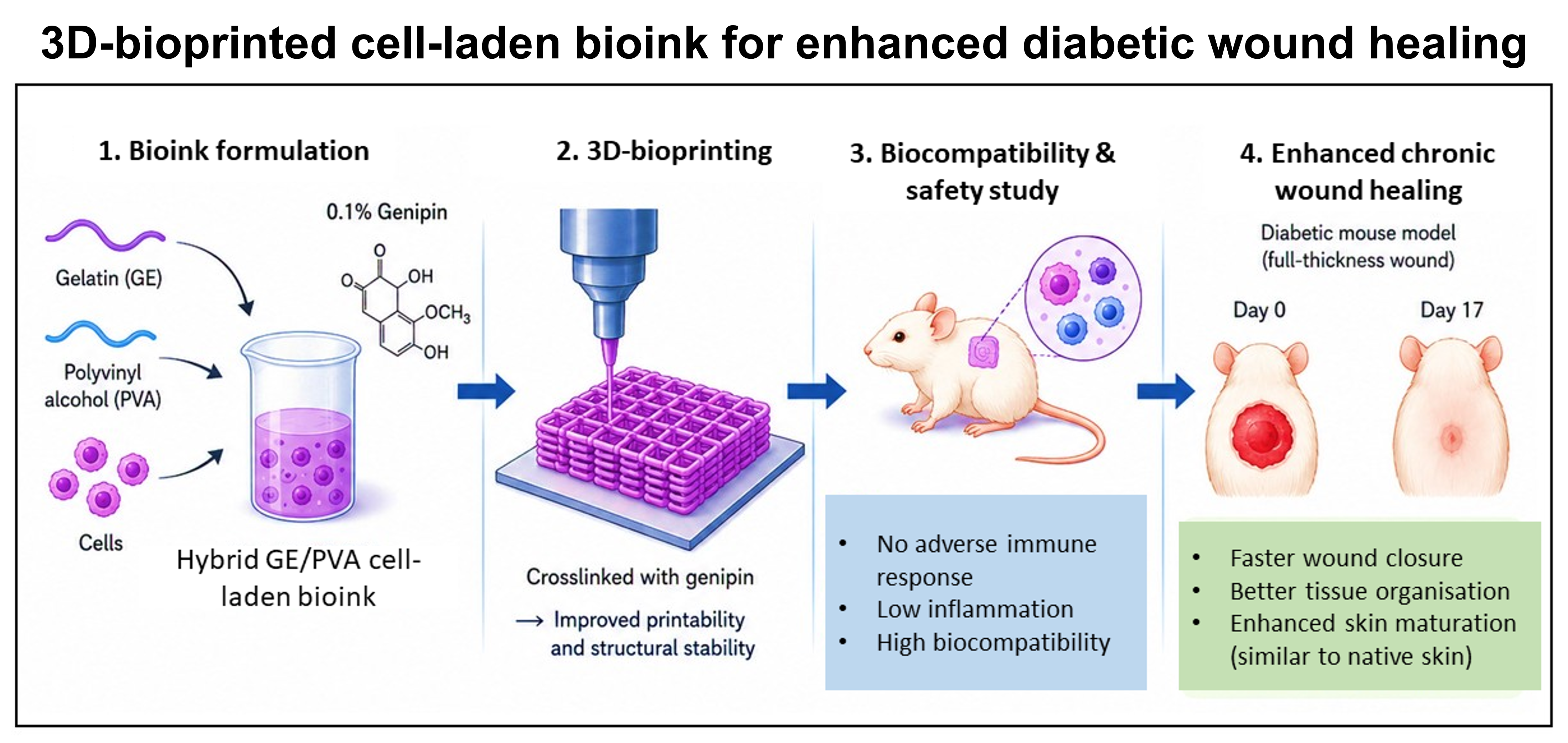
Three-dimensional (3D) bioprinting is an advanced tissue-engineering approach that utilises biomaterial-based bioinks to replace damaged skin and promote tissue regeneration. Compared with conventional skin grafting procedures, which are often painful and limited in treating extensive or irregular wounds, 3D-bioprinted constructs offer a more adaptable and minimally invasive alternative. Previously optimised biocompatible, biodegradable, and printable bioink formulations were further evaluated for skin regeneration using a diabetic mouse model of chronic wound healing from day 0 to day 17. Gelatin (GE) and polyvinyl alcohol (PVA) were formulated at different compositions (6% GE:0% PVA and 6% GE:5% PVA), with 0.1% genipin incorporated as a crosslinking agent to improve structural stability and printability. Assessment of PBMC metabolic activity supported the biocompatibility of the formulated hydrogels. In a full-thickness excisional wound model, bioink-treated groups exhibited accelerated wound closure, improved tissue organisation, and enhanced skin maturation compared with untreated controls. Furthermore, subcutaneous implantation studies revealed substantial hydrogel biodegradation within 14 days. Histological observations indicated the formation of skin microstructures resembling native tissue. Overall, these findings suggest that 3D-bioprinted GE–PVA hydrogels represent a promising strategy for promoting rapid, effective chronic wound healing and may serve as a potential alternative for future skin tissue-engineering applications.
- Masri S, Maarof M, Aziz IA, Idrus R, Fauzi MB. Performance of hybrid gelatin-PVA bioinks integrated with genipin through extrusion-based 3D bioprinting: an in vitro evaluation using human dermal fibroblasts. Int J Bioprint. 2023;9(3):677. doi: 10.18063/ijb.677
- Eriksson E, Liu PY, Schultz GS, et al. Chronic wounds: treatment consensus. Wound Repair Regen. 2022;30(2):156-171. doi: 10.1111/wrr.12994
- Atkin L. Chronic wounds: the challenges of appropriate management. Br J Community Nurs. 2019;24(Sup9):S26. doi: 10.12968/bjcn.2019.24.Sup9.S26
- Shi C, Wang C, Liu H, et al. Selection of appropriate wound dressing for various wounds. Front Bioeng Biotechnol. 2020;8:182. doi: 10.3389/fbioe.2020.00182
- Edmonds M, Manu C, Vas P. The current burden of diabetic foot disease. J Clin Orthop Trauma. 2021;17:88-93. doi: 10.1016/j.jcot.2021.01.017
- Lin C, Liu J, Sun H. Risk factors for lower extremity amputation in patients with diabetic foot ulcers: a meta-analysis. PLoS One. 2020;15(9):e0239236. doi: 10.1371/journal.pone.0239236
- Boulton AJM. The 2017 Banting Memorial Lecture The diabetic lower limb - a forty year journey: from clinical observation to clinical science. Diabet Med. 2019;36(12):1539-1549. doi: 10.1111/dme.13901
- Glover K, Stratakos AC, Varadi A, Lamprou DA. 3D scaffolds in the treatment of diabetic foot ulcers: new trends vs conventional approaches. Int J Pharm. 2021;599:120423. doi: 10.1016/j.ijpharm.2021.120423
- Güiza-Argüello VR, Solarte-David VA, Pinzón-Mora AV, Ávila-Quiroga JE, Becerra-Bayona SM. Current advances in the development of hydrogel-based wound dressings for diabetic foot ulcer treatment. Polymers (Basel). 2022;14(14):2764. doi: 10.3390/polym14142764
- Fayyazbakhsh F, Leu MC. A brief review on 3D bioprinted skin substitutes. Procedia Manuf. 2020;48:790-796. doi: 10.1016/j.promfg.2020.05.115
- He P, Zhao J, Zhang J, et al. Bioprinting of skin constructs for wound healing. Burns Trauma. 2018;6:5. doi: 10.1186/s41038-017-0104-x
- Ng WL, Bartolo P. 3D bioprinting of tissues and organs for systemic diseases and localized injuries. Mil Med Res. 2026;13(1):100006. doi: 10.1016/j.mmr.2026.100006
- Chouhan D, Dey N, Bhardwaj N, Mandal BB. Emerging and innovative approaches for wound healing and skin regeneration: current status and advances. Biomaterials. 2019;216:119267. doi: 10.1016/j.biomaterials.2019.119267
- Busra FM, Lokanathan Y, Mohd Nadzir M, Saim A, Hj Idrus R, Chowdhury SR. Attachment, Proliferation, and Morphological Properties of Human Dermal Fibroblasts on Ovine Tendon Collagen Scaffolds: A Comparative Study. Malays J Med Sci. 2017;24(2):33-43. doi: 10.21315/mjms2016.24.2.5
- Masri S, Maarof M, Mohd NF, Hiraoka Y, Tabata Y, Fauzi MB. Injectable crosslinked genipin hybrid gelatin-PVA hydrogels for future use as bioinks in expediting cutaneous healing capacity: physicochemical characterisation and cytotoxicity evaluation. Biomedicines. 2022;10(10):2651. doi: 10.3390/biomedicines10102651
- Masri S, Md Fadilah NI, Hao LQ, et al. Multifunctionalised skin substitute of hybrid gelatin-polyvinyl alcohol bioinks for chronic wound: injectable vs. 3D bioprinting. Drug Deliv Transl Res. 2024;14(4):1005-1027. doi: 10.1007/s13346-023-01447-z
- Kitada M, Ogura Y, Koya D. Rodent models of diabetic nephropathy: their utility and limitations. Int J Nephrol Renovasc Dis. 2016;9:279-290. doi: 10.2147/IJNRD.S103784
- Furman BL. Streptozotocin-induced diabetic models in mice and rats. Curr Protoc Pharmacol. 2015;70:5.47.1-5.47.20. doi: 10.1002/0471141755.ph0547s70
- Brumberg V, Astrelina T, Malivanova T, Samoilov A. Modern wound dressings: hydrogel dressings. Biomedicines. 2021;9(9):1235. doi: 10.3390/biomedicines9091235
- Javaid M, Haleem A. 3D bioprinting applications for the printing of skin: a brief study. Sensors Int. 2021;2:100123. doi: 10.1016/j.sintl.2021.100123
- Carnicer-Lombarte A, Chen ST, Malliaras GG, Barone DG. Foreign body reaction to implanted biomaterials and its impact in nerve neuroprosthetics. Front Bioeng Biotechnol. 2021;9:622524. doi: 10.3389/fbioe.2021.622524
- Rai V, Moellmer R, Agrawal DK. Clinically relevant experimental rodent models of diabetic foot ulcer. Mol Cell Biochem. 2022;477(4):1239-1247. doi: 10.1007/s11010-022-04372-w
- Mh Busra F, Rajab NF, Tabata Y, Saim AB, Idrus RBH, Chowdhury SR. Rapid treatment of full-thickness skin loss using ovine tendon collagen type I scaffold with skin cells. J Tissue Eng Regen Med. 2019;13(5):874-891. doi: 10.1002/term.2842
- Xia S, Weng T, Jin R, et al. Curcumin-incorporated 3D bioprinting gelatin methacryloyl hydrogel reduces reactive oxygen species-induced adipose-derived stem cell apoptosis and improves implanting survival in diabetic wounds. Burns Trauma. 2022;10:tkac001. doi: 10.1093/burnst/tkac001
- Rousselle P, Braye F, Dayan G. Re-epithelialization of adult skin wounds: cellular mechanisms and therapeutic strategies. Adv Drug Deliv Rev. 2019;146:344-365. doi: 10.1016/j.addr.2018.06.019
- Jia S, Zhou H, Chen J, et al. A comprehensive review of hydrogel strategies for repairing peripheral nerve injuries. Brain-X. 2025;3(4):e70012. doi: 10.1002/brx2.70012
- Jorgensen AM, Varkey M, Gorkun A, et al. Bioprinted skin recapitulates normal collagen remodeling in full-thickness wounds. Tissue Eng Part A. 2020;26(9-10):512-526. doi: 10.1089/ten.TEA.2019.0319
- Gonzalez ACO, Costa TF, Andrade ZA, Medrado ARAP. Wound healing - a literature review. An Bras Dermatol. 2016;91(5):614-620. doi: 10.1590/abd1806-4841.20164741