

Multiscale 3D printing in tissue engineering: From micro/nanoscale precision to functional organoid fabrication

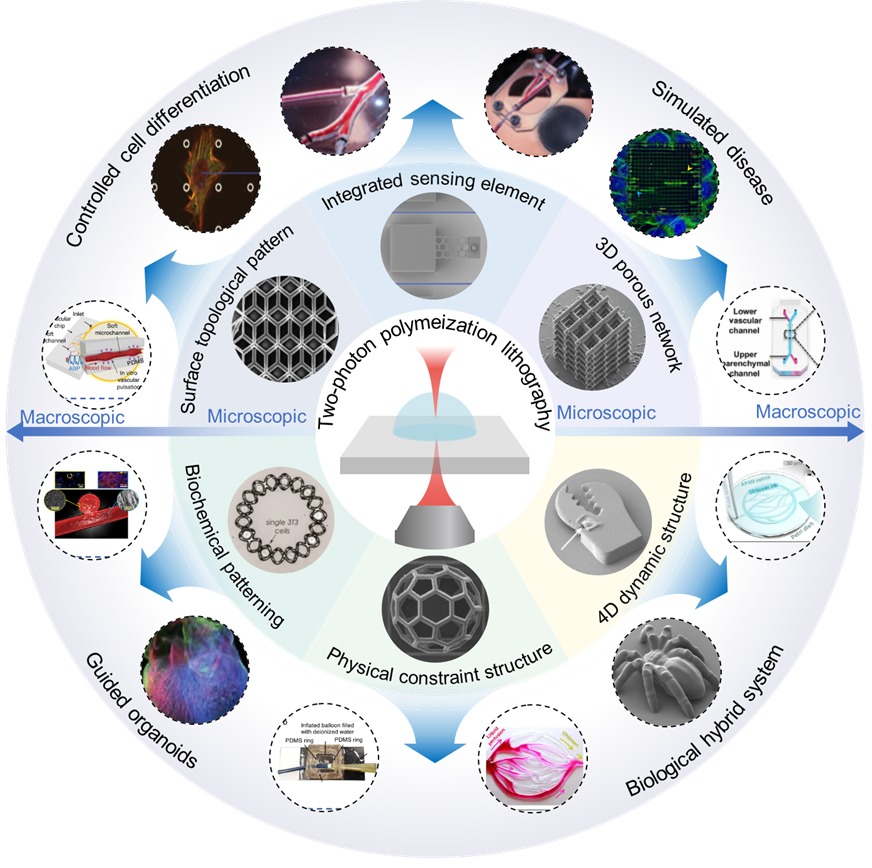
Three-dimensional (3D) biofabrication is increasingly used in tissue engineering and regenerative medicine to recreate the spatial, mechanical, and biochemical complexity of native cellular microenvironments. Among light-based 3D printing technologies, volumetric bioprinting (VBP) and two-photon polymerization (TPP) offer complementary capabilities across distinct length scales. This review examines their evolution, key advances, and potential integration within a multiscale biofabrication framework. VBP enables rapid, layer-free fabrication of centimeter-scale, cell-laden constructs by delivering spatially modulated light doses throughout a photosensitive volume. This approach reduces mechanical stress, supports high cell viability, and permits complex internal architectures, including perfusable vascular networks. Advances in computed axial lithography, holographic patterning, and bioink engineering are reviewed, with emphasis on optical transparency, control of light scattering, and rheological stability in cell-dense systems. TPP, by contrast, uses nonlinear optical confinement to achieve submicrometer resolution and precise 3D control over scaffold architecture, mechanics, and biochemical patterning. These capabilities support deterministic regulation of cell–material interactions and applications in stem cell niche engineering, neural and vascular interface design, tumor microenvironment modeling, and biohybrid microsystems. Integrating VBP and TPP may bridge organ-scale architecture and perfusion with microscale niche definition and molecular-level signaling, thereby supporting the development of functional organoids and living tissues and better addressing distinct but interdependent biological requirements across organ, tissue, cellular, and molecular scales. Remaining challenges include material heterogeneity, optical–biological coupling, scalability, and long-term tissue maturation. Future progress will require coordinated advances in materials, optical design, computational modeling, and predictive design strategies to enable the translational biofabrication of functional living systems.
- Arias-Peregrino VM, Tenorio-Barajas AY, Mendoza-Barrera CO, et al. 3D printing for tissue engineering: printing techniques, biomaterials, challenges, and the emerging role of 4D bioprinting. Bioengineering (Basel). 2025;12(9):936. doi: 10.3390/bioengineering12090936
- Ashworth JC, Cox TR. The importance of 3D fibre architecture in cancer and implications for biomaterial model design. Nat Rev Cancer. 2024;24:461-479. doi: 10.1038/s41568-024-00704-8
- Burdis R, Kelly DJ. Biofabrication and bioprinting using cellular aggregates, microtissues and organoids for the engineering of musculoskeletal tissues. Acta Biomater. 2021;126:1-14. doi: 10.1016/j.actbio.2021.03.016
- Karvinen J, Kellomäki M. Design aspects and characterization of hydrogel-based bioinks for extrusion-based bioprinting. Bioprinting. 2023;32:e00274. doi: 10.1016/j.bprint.2023.e00274
- Maturavongsadit P, Narayanan LK, Chansoria P, Shirwaiker R, Benhabbour SR. Cell-laden nanocellulose/chitosan-based bioinks for 3D bioprinting and enhanced osteogenic cell differentiation. ACS Appl Bio Mater. 2021;4:2342-2353. doi: 10.1021/acsabm.0c01108
- Miri AK, Khalilpour A, Cecen B, et al. Multiscale bioprinting of vascularized models. Biomaterials. 2019;198:204-216. doi: 10.1016/j.biomaterials.2018.08.006
- Dehghani F, Annabi N. Engineering porous scaffolds using gas-based techniques. Curr Opin Biotechnol. 2011;22(5):661-666. doi: 10.1016/j.copbio.2011.04.005
- Chausse V, Casanova-Batlle E, Canal C, et al. Solvent-cast direct-writing and electrospinning as a dual fabrication strategy for drug-eluting polymeric bioresorbable stents. Addit Manuf. 2023;71:103568. doi: 10.1016/j.addma.2023.103568
- Zhang J, Byers P, Erben A, et al. Single cell bioprinting with ultrashort laser pulses. Adv Funct Mater. 2021;31:2100066. doi: 10.1002/adfm.202100066
- Zhang X, Zhang K, Zhang L, Wang W, Li Y, He R. Additive manufacturing of cellular ceramic structures: from structure to structure–function integration. Mater Des. 2022;215:110470. doi: 10.1016/j.matdes.2022.110470
- Liu J, Wang Q, Xu K, et al. AI-enhanced magnetically controlled 4D printing: reshaping the future of medical robotics. Int J Bioprint. 2025;11(6):197-204. doi: 10.36922/IJB025420427
- Hongjin W, Han C, Baoxiang J, Shiqi Y, Xiaoyu X. Reconstituting neurovascular unit based on the close relations between neural stem cells and endothelial cells: an effective method to explore neurogenesis and angiogenesis. Rev Neurosci. 2020;31(2):143-159. doi: 10.1515/revneuro-2019-0023
- Dou XQ, Feng CL. Amino acids and peptide-based supramolecular hydrogels for three-dimensional cell culture. Adv Mater. 2017;29(16):1604062. doi: 10.1002/adma.201604062
- Kawata S, Sun HB, Tanaka T, et al. Finer features for functional microdevices. Nature. 2001;412:697-698. doi: 10.1038/35089130
- Zhao CX, Liu JN, Li BQ, et al. Multiscale construction of bifunctional electrocatalysts for long-lifespan rechargeable zinc–air batteries. Adv Funct Mater. 2020;30(36):2003619. doi: 10.1002/adfm.202003619
- O'Halloran S, Pandit A, Heise A, et al. Two-photon polymerization: fundamentals, materials, and chemical modification strategies. Adv Sci (Weinh). 2023;10(7):2204072. doi: 10.1002/advs.202204072
- Wang W, Chen Z, Lin B, et al. Two-photon polymerization-based 3D micro-scaffolds toward biomedical devices. Chem Eng J. 2024;493:152469. doi: 10.1016/j.cej.2024.152469
- Morales AR, Schafer-Hales KJ, Yanez CO, et al. Excited state intramolecular proton transfer and photophysics of a new fluorenyl two-photon fluorescent probe. Chemphyschem. 2009;10(12):2073-2081. doi: 10.1002/cphc.200900032
- Serbin J, Egbert A, Ostendorf A, et al. Femtosecond laser-induced two-photon polymerization of inorganic–organic hybrid materials for applications in photonics. Opt Lett. 2003;28(5):301-303. doi: 10.1364/OL.28.000301
- Gan Z, Cao Y, Evans R, et al. Three-dimensional deep sub-diffraction optical beam lithography with 9 nm feature size. Nat Commun. 2013;4:2061. doi: 10.1038/ncomms3061
- Florczak S, Größbacher G, Ribezzi D, et al. Adaptive and context-aware volumetric printing. Nature. 2025;645:108-114. doi: 10.1038/s41586-025-09436-7
- Kim D, Kang D, Kim D, Jang J. Volumetric bioprinting strategies for creating large-scale tissues and organs. MRS Bull. 2023;48:657-667. doi: 10.1557/s43577-023-00541-4
- Negrini NC, Volponi AA, Sharpe PT, et al. Tunable cross-linking and adhesion of gelatin hydrogels via bioorthogonal click chemistry. ACS Biomater Sci Eng. 2021;7(9):4330-4346. doi: 10.1021/acsbiomaterials.1c00136
- Yue K, Trujillo-de Santiago G, Alvarez MM, et al. Synthesis, properties, and biomedical applications of gelatin methacryloyl (GelMA) hydrogels. Biomaterials. 2015;73:254-271. doi: 10.1016/j.biomaterials.2015.08.045
- Kurian AG, Singh RK, Patel KD, et al. Multifunctional GelMA platforms with nanomaterials for advanced tissue therapeutics. Bioact Mater. 2022;8:267-295. doi: 10.1016/j.bioactmat.2021.06.027
- Ford MC, Bertram JP, Hynes SR, et al. A macroporous hydrogel for the coculture of neural progenitor and endothelial cells to form functional vascular networks in vivo. Proc Natl Acad Sci USA. 2006;103:2512-2517. doi: 10.1073/pnas.0506020102
- Xing JF, Zheng ML, Duan XM. Two-photon polymerization microfabrication of hydrogels: an advanced 3D printing technology for tissue engineering and drug delivery. Chem Soc Rev. 2015;44:5031-5039. doi: 10.1039/C5CS00278H
- Jia Y, Spiegel CA, Welle A, et al. Covalent adaptable microstructures via combining two-photon laser printing and alkoxyamine chemistry: toward living 3D microstructures. Adv Funct Mater. 2023;33:2207826. doi: 10.1002/adfm.202207826
- Mur M, Kavčič A, Jagodič U, et al. Two-photon 3D printing of functional microstructures inside living cells. Adv Mater. 2026;38(25):2519286. doi: 10.1002/adma.202519286
- Malinauskas M, Žukauskas A, Hasegawa S, et al. Ultrafast laser processing of materials: from science to industry. Light Sci Appl. 2016;5(8):e16133. doi: 10.1038/lsa.2016.133
- Ovsianikov A, Deiwick A, Van Vlierberghe S, et al. Laser fabrication of three-dimensional CAD scaffolds from photosensitive gelatin for applications in tissue engineering. Biomacromolecules. 2011;12(4):851-858. doi: 10.1021/bm1015305
- Gou M, Qu X, Zhu W, et al. Bio-inspired detoxification using 3D-printed hydrogel nanocomposites. Nat Commun. 2014;5:3774. doi: 10.1038/ncomms4774
- Zhu W, Qu X, Zhu J, et al. Direct 3D bioprinting of prevascularized tissue constructs with complex microarchitecture. Biomaterials. 2017;124:106-115. doi: 10.1016/j.biomaterials.2017.01.042
- Tumbleston JR, Shirvanyants D, Ermoshkin N, et al. Continuous liquid interface production of 3D objects. Science. 2015;347(6228):1349-1352. doi: 10.1126/science.aaa2397
- Bernal PN, Delrot P, Loterie D, et al. Volumetric bioprinting of complex living-tissue constructs within seconds. Adv Mater. 2019;31(42):1904209. doi: 10.1002/adma.201904209
- Zhao S, et al. Spatial light modulator-based printing technologies for optical elements fabrication with different materials. J Manuf Process. 2025;144:60-77. doi: 10.1016/j.jmapro.2025.04.019
- Ge Q, et al. Projection micro stereolithography based 3D printing and its applications. Int J Extrem Manuf. 2020;2(2):022004. doi: 10.1088/2631-7990/ab8d9a
- Chen J, et al. DLP 3D printing of high-resolution root scaffold with bionic bioactivity and biomechanics for personalized bio-root regeneration. Biomater Adv. 2023;151:213475. doi: 10.1016/j.bioadv.2023.213475
- Beyer M, et al. Comparative evaluation of SLA and DLP 3D printing in dental implant guides: impact on fabrication accuracy, speed, and resin usage. Dent J (Basel). 2025;13(10):471. doi: 10.3390/dj13100471
- Liu D, et al. Engineering tridimensional hydrogel tissue and organ phantoms with tunable springiness. Adv Funct Mater. 2023;33(17):2214885. doi: 10.1002/adfm.202214885
- Sun Y, et al. Projection stereolithography 3D printing high-conductive hydrogel for flexible passive wireless sensing. Adv Mater. 2024;36(25):2400103. doi: 10.1002/adma.202400103
- Maines EM, Porwal MK, Ellison CJ, Reineke TM. Sustainable advances in SLA/DLP 3D printing materials and processes. Green Chem. 2021;23(18):6863-6897. doi: 10.1039/D1GC01489G
- Kaijage DJ, Lee BJ. Multiphysics simulation of continuous liquid interface production (CLIP) 3D printing technology. Int J Precis Eng Manuf Green Technol. 2025;12(2):541-552. doi: 10.1007/s40684-024-00673-1
- Van Der Laan HL, Burns MA, Scott TF. Volumetric photopolymerization confinement through dual-wavelength photoinitiation and photoinhibition. ACS Macro Lett. 2019;8(8):899-904. doi: 10.1021/acsmacrolett.9b00412
- Mathur V, Dsouza V, Srinivasan V, et al. Volumetric additive manufacturing for cell printing: bridging industry adaptation and regulatory frontiers. ACS Biomater Sci Eng. 2025;11(1):156-181. doi: 10.1021/acsbiomaterials.4c01837
- Whyte DJ, Doeven EH, Sutti A, Kouzani AZ, Adams SD. Volumetric additive manufacturing: a new frontier in layer-less 3D printing. Addit Manuf. 2024;84:104094. doi: 10.1016/j.addma.2024.104094
- Bernal PN, Florczak S, Inacker S, et al. The road ahead in materials and technologies for volumetric 3D printing. Nat Rev Mater. 2025;10:826-841. doi: 10.1038/s41578-025-00785-3
- Lü JQ, Sun JS, Jia RP, et al. Erosion-free penalty minimization optimization for high-fidelity computed axial lithography. Addit Manuf. 2025;111:104990. doi: 10.1016/j.addma.2025.104990
- Kelly BE, Bhattacharya I, Heidari H, et al. Volumetric additive manufacturing via tomographic reconstruction. Science. 2019;363(6431):1075-1079. doi: 10.1126/science.aau7114
- Toombs JT, Luitz M, Cook CC, et al. Volumetric additive manufacturing of silica glass with microscale computed axial lithography. Science. 2022;376(6590):308-312. doi: 10.1126/science.abm6459
- Regehly M, Garmshausen Y, Reuter M, et al. Xolography for linear volumetric 3D printing. Nature. 2020;588(7839):620-624. doi: 10.1038/s41586-020-3029-7
- Ding S, He S, Shen L, et al. An instructional design strategy for optimization of GelMA hydrogels material properties. Eur Polym J. 2024;218:113336. doi: 10.1016/j.eurpolymj.2024.113336
- Gehlen J, Qiu W, Schädli GN, et al. Tomographic volumetric bioprinting of heterocellular bone-like tissues in seconds. Acta Biomater. 2023;156:49-60. doi: 10.1016/j.actbio.2022.06.020
- Melde K, Mark AG, Qiu T, et al. Holograms for acoustics. Nature. 2016;537(7621):518-522. doi: 10.1038/nature19755
- Zhang M, Jin B, Hua Y, et al. Reconfigurable dynamic acoustic holography with acoustically transparent and programmable metamaterial. Nat Commun. 2025;16(1):9126. doi: 10.1038/s41467-025-64154-y
- Derayatifar M, Habibi M, Bhat R, Packirisamy M. Holographic direct sound printing. Nat Commun. 2024;15:6691. doi: 10.1038/s41467-024-50923-8
- Li X, Xiu Y, Lee K, Zhang J, Corrigan N, Boyer C. Xolography for rapid volumetric production of objects from the nanoscopic to macroscopic length scales. Adv Mater. 2025;37(37):2503245. doi: 10.1002/adma.202503245
- Álvarez-Castaño MI, Madsen AG, Glückstad J, et al. Holographic beam shaping for volumetric 3D printing. In: Advanced Fabrication Technologies for Micro/Nano Optics and Photonics XVII. Bellingham, WA: SPIE; 2024:42. doi: 10.1117/12.3001404
- Álvarez-Castaño MI, et al. Holographic tomographic volumetric additive manufacturing. Nat Commun. 2025;16(1):1551. doi: 10.1038/s41467-025-56852-4
- Liu C, et al. Correction of a digital micromirror device lithography system for fabrication of a pixelated liquid crystal micropolarizer array. Opt Express. 2022;30(7):12014. doi: 10.1364/OE.453800
- Lim Y, Hahn J, Lee B. Phase-conjugate holographic lithography based on micromirror array recording. Appl Opt. 2011;50(34):H68. doi: 10.1364/AO.50.000H68
- Thijssen Q, Toombs J, Li CC, Taylor H, Van Vlierberghe S. From pixels to voxels: a mechanistic perspective on volumetric 3D-printing. Prog Polym Sci. 2023;147:101755. doi: 10.1016/j.progpolymsci.2023.101755
- Fairbanks BD, Schwartz MP, Bowman CN, Anseth KS. Photoinitiated polymerization of PEG-diacrylate with lithium phenyl-2,4,6-trimethylbenzoylphosphinate: polymerization rate and cytocompatibility. Biomaterials. 2009;30(35):6702-6707. doi: 10.1016/j.biomaterials.2009.08.055
- Topa-Skwarczyńska M, et al. Increasing resolution in additive manufacturing by using high-performance and non-toxic photoinitiating systems. Addit Manuf. 2024;94:104473. doi: 10.1016/j.addma.2024.104473
- Elkhoury K, Zuazola J, Vijayavenkataraman S. Bioprinting the future using light: a review on photocrosslinking reactions, photoreactive groups, and photoinitiators. SLAS Technol. 2023;28(3):142-151. doi: 10.1016/j.slast.2023.02.003
- Lian L, et al. Rapid volumetric bioprinting of decellularized extracellular matrix bioinks. Adv Mater. 2024;36(34):2304846. doi: 10.1002/adma.202304846
- Wolfel A, et al. Bioxolography using diphenyliodonium chloride and N-vinylpyrrolidone enables rapid high-resolution volumetric 3D printing of spatially encoded living matter. Adv Mater. 2025;37(37):2501052. doi: 10.1002/adma.202501052
- Dogan E, Austin A, Pourmostafa A, Yogeshwaran S, Hosseinabadi HG, Miri AK. Design considerations for photoinitiator selection in cell-laden gelatin methacryloyl hydrogels. Biomater Sci. 2026;14(3):807-816. doi: 10.1039/D5BM00550G
- Madrid-Wolff J, Boniface A, Loterie D, Delrot P, Moser C. Controlling light in scattering materials for volumetric additive manufacturing. Adv Sci (Weinh). 2022;9(22):2105144. doi: 10.1002/advs.202105144
- You S, et al. High cell density and high-resolution 3D bioprinting for fabricating vascularized tissues. Sci Adv. 2023;9(8):eade7923. doi: 10.1126/sciadv.ade7923
- Bernal PN, Bouwmeester M, Madrid-Wolff J, et al. Volumetric bioprinting of organoids and optically tuned hydrogels to build liver-like metabolic biofactories. Adv Mater. 2022;34(15):2110054. doi: 10.1002/adma.202110054
- He N, et al. Photoinhibiting via simultaneous photoabsorption and free-radical reaction for high-fidelity light-based bioprinting. Nat Commun. 2023;14(1):3063. doi: 10.1038/s41467-023-38838-2
- Madrid-Wolff J, et al. A review of materials used in tomographic volumetric additive manufacturing. MRS Commun. 2023;13(5):764-785. doi: 10.1557/s43579-023-00447-x
- Jain T, et al. Impact of cell density on the bioprinting of gelatin methacrylate (GelMA) bioinks. Bioprinting. 2021;22:e00131. doi: 10.1016/j.bprint.2021.e00131
- Dubbin K, Tabet A, Heilshorn SC. Quantitative criteria to benchmark new and existing bio-inks for cell compatibility. Biofabrication. 2017;9(4):044102. doi: 10.1088/1758-5090/aa869f
- Ribezzi D, et al. Shaping synthetic multicellular and complex multimaterial tissues via embedded extrusion-volumetric printing of microgels. Adv Mater. 2023;35(36):2301673. doi: 10.1002/adma.202301673
- Liu J, Shahriar M, Xu H, Xu C. Cell-laden bioink circulation-assisted inkjet-based bioprinting to mitigate cell sedimentation and aggregation. Biofabrication. 2022;14(4):045020. doi: 10.1088/1758-5090/ac8fb7
- An C, et al. The microparticulate inks for bioprinting applications. Mater Today Bio. 2024;24:100930. doi: 10.1016/j.mtbio.2023.100930
- Duquesne J, et al. Volumetric bioprinting of the osteoid niche. Biofabrication. 2025;17(2):025002. doi: 10.1088/1758-5090/adab25
- Qiu W, Gehlen J, Bernero M, et al. A synthetic dynamic polyvinyl alcohol photoresin for fast volumetric bioprinting of functional ultrasoft hydrogel constructs. Adv Funct Mater. 2023;33(20):2214393. doi: 10.1002/adfm.202214393
- Longoni A, Bernal PN, Falandt M, Ribezzi D, Levato R. Volumetric biofabrication strategies for regenerative medicine applications and tissue vascularization. Bone Joint J. 2025;107-B(suppl 6):40. doi: 10.1302/1358-992X.2025.6.040
- Ribezzi D, et al. Multi-material volumetric bioprinting and plug-and-play suspension bath biofabrication via bioresin molecular weight tuning and via multiwavelength alignment optics. Adv Mater. 2025;37(13):2409355. doi: 10.1002/adma.202409355
- Akbari M, Khademhosseini A. Tissue bioprinting for biology and medicine. Cell. 2022;185(15):2644-2648. doi: 10.1016/j.cell.2022.06.015
- Chansoria P, et al. Synergizing algorithmic design, photoclick chemistry and multi-material volumetric printing for accelerating complex shape engineering. Adv Sci (Weinh). 2023;10(26):2300912. doi: 10.1002/advs.202300912
- Kim W, Kim G. Engineered 3D liver-tissue model with minispheroids formed by a bioprinting process supported with in situ electrical stimulation. Bioact Mater. 2024;35:382-400. doi: 10.1016/j.bioactmat.2024.02.001
- Zhang X, Zhang X, Li Y, Zhang Y. Applications of light-based 3D bioprinting and photoactive biomaterials for tissue engineering. Materials (Basel). 2023;16(23):7461. doi: 10.3390/ma16237461
- Yang M, et al. Multi-material digital light processing (DLP) bioprinting of heterogeneous hydrogel constructs with perfusable networks. Adv Funct Mater. 2024;34(32):2316456. doi: 10.1002/adfm.202316456
- Subramanian A, et al. Reviewing the literature of 3D printing of bones and cartilage: evidence and practice. Ann 3D Print Med. 2024;16:100180. doi: 10.1016/j.stlm.2024.100180
- Zhou J, Li Q, Tian Z, Yao Q, Zhang M. Recent advances in 3D bioprinted cartilage-mimicking constructs for applications in tissue engineering. Mater Today Bio. 2023;23:100870. doi: 10.1016/j.mtbio.2023.100870
- Hao S, Wang M, Yin Z, Jing Y, Bai L, Su J. Microenvironment-targeted strategy steers advanced bone regeneration. Mater Today Bio. 2023;22:100741. doi: 10.1016/j.mtbio.2023.100741
- Xiang Y, et al. Iohexol as a refractive index tuning agent for bioinks in high cell density bioprinting. Biomater Sci. 2025;13(14):3958-3971. doi: 10.1039/D5BM00585J
- Guan J, et al. Compensating the cell-induced light scattering effect in light-based bioprinting using deep learning. Biofabrication. 2022;14(1):015011. doi: 10.1088/1758-5090/ac3b92
- Li F, et al. Efficient light-based bioprinting via rutin nanoparticle photoinhibitor for advanced biomedical applications. ACS Nano. 2024;18(33):22104-22121. doi: 10.1021/acsnano.4c05380
- Lee SJ, Jeong W, Atala A. 3D bioprinting for engineered tissue constructs and patient-specific models: current progress and prospects in clinical applications. Adv Mater. 2024;36(49):2408032. doi: 10.1002/adma.202408032
- Yang S, Wang L, Chen Q, Xu M. In situ process monitoring and automated multi-parameter evaluation using optical coherence tomography during extrusion-based bioprinting. Addit Manuf. 2021;47:102251. doi: 10.1016/j.addma.2021.102251
- Tashman JW, et al. In situ volumetric imaging and analysis of FRESH 3D bioprinted constructs using optical coherence tomography. Biofabrication. 2023;15(1):014102. doi: 10.1088/1758-5090/ac975e
- Sexton ZA, et al. Rapid model-guided design of organ-scale synthetic vasculature for biomanufacturing. Science. 2025;388(6752):1198-1204. doi: 10.1126/science.adj6152
- Levato R, Lim KS. Harnessing light in biofabrication. Biofabrication. 2023;15(2):020401. doi: 10.1088/1758-5090/acb50f
- Guo Y, Wu Y, Li Y, Rao X, Rao C. Deep phase retrieval for astronomical Shack–Hartmann wavefront sensors. Mon Not R Astron Soc. 2022;510(3):4347-4354. doi: 10.1093/mnras/stab3690
- Florczak S, et al. Multi-material integration in light-based volumetric bioprinting: pathways to enhanced precision and complexity in scaffold fabrication. In: von Freymann G, Blasco E, Chanda D, eds. Advanced Fabrication Technologies for Micro/Nano Optics and Photonics XVII. Bellingham, WA: SPIE; 2024:38. doi: 10.1117/12.3008912
- Keding C. Understanding the interplay of artificial intelligence and strategic management: four decades of research in review. Manag Rev Q. 2021;71(1):91-134. doi: 10.1007/s11301-020-00181-x
- Meyer TA, Ramirez C, Tamasi MJ, Gormley AJ. A user's guide to machine learning for polymeric biomaterials. ACS Polym Au. 2023;3(2):141-157. doi: 10.1021/acspolymersau.2c00037
- Ng WL, Chan A, Ong YS, Chua CK. Deep learning for fabrication and maturation of 3D bioprinted tissues and organs. Virtual Phys Prototyp. 2020;15(3):340-358. doi: 10.1080/17452759.2020.1771741
- Maharjan S, et al. Advanced 3D imaging and organoid bioprinting for biomedical research and therapeutic applications. Adv Drug Deliv Rev. 2024;208:115237. doi: 10.1016/j.addr.2024.115237
- Bhardwaj N, Dey S, Bhar B, Mandal BB. Bioprinted in vitro tissue models: an emerging platform for developing therapeutic interventions and disease modelling. Prog Biomed Eng. 2024;6(1):012003. doi: 10.1088/2516-1091/ad10b4
- Xu K, Han Y, Huang Y, et al. The application of 3D bioprinting in urological diseases. Mater Today Bio. 2022;16:100388. doi: 10.1016/j.mtbio.2022.100388
- Liu H, Wu C, Lin S, et al. Advances in 3D and 4D printing of soft robotics and their applications. Adv Intell Syst. 2025;7:2400699. doi: 10.1002/aisy.202400699
- De Reguardati S, Pahapill J, Mikhailov A, et al. High-accuracy reference standards for two-photon absorption in the 680–1050 nm wavelength range. Opt Express. 2016;24:9053. doi: 10.1364/OE.24.009053
- You S, Li J, Zhu W, et al. Nanoscale 3D printing of hydrogels for cellular tissue engineering. J Mater Chem B. 2018;6:2187-2197. doi: 10.1039/C8TB00301G
- He M, Zhang Z, Cao C, et al. 3D sub-diffraction printing by multicolor photoinhibition lithography: from optics to chemistry. Laser Photonics Rev. 2022;16:2100229. doi: 10.1002/lpor.202100229
- Taale M, Schamberger B, Taheri F, et al. In situ fabrication of constraints for multicellular micro-spheroids using two-photon lithography. Adv Funct Mater. 2024;34:2302356. doi: 10.1002/adfm.202302356
- Bouwmeester MC, Bernal PN, Oosterhoff LA, et al. Bioprinting of human liver-derived epithelial organoids for toxicity studies. Macromol Biosci. 2021;21:2100327. doi: 10.1002/mabi.202100327
- Gebinoga M, Katzmann J, Fernekorn U, et al. Multi-photon structuring of native polymers: a case study for structuring natural proteins. Eng Life Sci. 2013;13:368-375. doi: 10.1002/elsc.201200152
- Zhou X, Liu X, Gu Z. Photoresist development for 3D printing of conductive microstructures via two-photon polymerization. Adv Mater. 2024;36:2409326. doi: 10.1002/adma.202409326
- Paradowska-Stolarz A, Wezgowiec J, Malysa A, et al. Effects of polishing and artificial aging on mechanical properties of dental LT clear resin. J Funct Biomater. 2023;14:295. doi: 10.3390/jfb14060295
- Haas KH, Wolter H. Synthesis, properties and applications of inorganic–organic copolymers (ORMOCER). Curr Opin Solid State Mater Sci. 1999;4(6):571-580. doi: 10.1016/S1359-0286(00)00009-7
- Schlie S, Ngezahayo A, Ovsianikov A, et al. Three-dimensional cell growth on structures fabricated from ORMOCER® by two-photon polymerization technique. J Biomater Appl. 2007;22:275-287. doi: 10.1177/0885328207077590
- Schwegler N, Gebert T, Villiou M, et al. Multimaterial 3D laser printing of cell-adhesive and cell-repellent hydrogels. Small. 2024;20:2401344. doi: 10.1002/smll.202401344
- Zhu W, Huo FY, Cao LM, et al. Two-photon polymerization 3D printing of biomimetic microstructures for functionalizing surfaces to inhibit bacterial growth. Chem Eng J. 2025;511:161907. doi: 10.1016/j.cej.2025.161907
- Tezel Ö, Kahraman MV, Ceylan R, et al. Usage of 3D-printed scaffolds manufactured with bio-based photopolymer resin via 3D DLP in tissue engineering. J Polym Environ. 2025;33:3013-3028. doi: 10.1007/s10924-025-03592-7
- He Z, Chen F, He S. Fabrication of microneedles using two photon-polymerization with low numerical aperture. Opt Commun. 2024;553:130093. doi: 10.1016/j.optcom.2023.130093
- Yao Z, Zhang X, Yu W, et al. Scaffolds fabricated via two-photon polymerisation for regulating cell morphology and differentiation. Virtual Phys Prototyp. 2025;20(1):2447934. doi: 10.1080/17452759.2024.2447934
- Bran A, Orobeti S, Jipa F, et al. Tissue-like scaffolds created by two-photon polymerization for testing cancer cell behavior in confined environments. ACS Appl Bio Mater. 2025;8(8):7344-7356. doi: 10.1021/acsabm.5c01009
- Rengaraj A, Bosc L, Machillot P, et al. Engineering of a microscale niche for pancreatic tumor cells using bioactive film coatings combined with 3D-architectured scaffolds. ACS Appl Mater Interfaces. 2022;14:13107-13121. doi: 10.1021/acsami.2c01747
- Accardo A, Blatché MC, Courson R, et al. Multi-photon direct laser writing and 3D imaging of polymeric freestanding architectures for cell colonization. Small. 2017;13(27):1700621. doi: 10.1002/smll.201700621
- Costa BNL, Adão RMR, Maibohm C, et al. Cellular interaction of bone marrow mesenchymal stem cells with polymer and hydrogel 3D microscaffold templates. ACS Appl Mater Interfaces. 2022;14:13013-13024. doi: 10.1021/acsami.1c23442
- Gartner ZJ, Hu JL. Guiding tissue-scale self-organization. Nat Mater. 2021;20:2-3. doi: 10.1038/s41563-020-00885-1
- Breslin S, O'Driscoll L. Three-dimensional cell culture: the missing link in drug discovery. Drug Discov Today. 2013;18:240-249. doi: 10.1016/j.drudis.2012.10.003
- Edmondson R, Adcock AF, Yang L. Influence of matrices on 3D-cultured prostate cancer cells' drug response and expression of drug-action associated proteins. PLoS One. 2016;11(6):e0158116. doi: 10.1371/journal.pone.0158116
- He Z, He S. Two-photon polymerization of hydrogel cellular scaffolds. Opt Commun. 2025;574:131161. doi: 10.1016/j.optcom.2024.131161
- Fu H, Yu B. 3D micro/nano hydrogel structures fabricated by two-photon polymerization for biomedical applications. Front Bioeng Biotechnol. 2024;12:1339450. doi: 10.3389/fbioe.2024.1339450
- Torgersen J, Qin XH, Li Z, et al. Hydrogels for two-photon polymerization: a toolbox for mimicking the extracellular matrix. Adv Funct Mater. 2013;23:4542-4554. doi: 10.1002/adfm.201203880
- Santos LMS, Oliveira JM, Oliveira LFAM, et al. Two-photon polymerizable nanocomposites incorporating Brazilian red propolis for tailored wound healing applications. J Polym Sci. 2025;63:3978-3989. doi: 10.1002/pol.20250266
- Yarali E, Mubeen AA, Cussen K, et al. Two-photon polymerization based 4D printing of poly(N-isopropylacrylamide) hydrogel microarchitectures for reversible shape morphing. Sci Rep. 2025;15:21549. doi: 10.1038/s41598-025-06269-2
- Song J, Michas C, Chen CS, et al. Controlled cell alignment using two-photon direct laser writing-patterned hydrogels in 2D and 3D. Macromol Biosci. 2021;21:2100051. doi: 10.1002/mabi.202100051
- Jeon H, Hidai H, Hwang DJ, et al. Fabrication of arbitrary polymer patterns for cell study by two-photon polymerization process. J Biomed Mater Res A. 2010;93A:56-66. doi: 10.1002/jbm.a.32517
- Richter B, Hahn V, Bertels S, et al. Guiding cell attachment in 3D microscaffolds selectively functionalized with two distinct adhesion proteins. Adv Mater. 2017;29:1604342. doi: 10.1002/adma.201604342
- Colombo F, Taale M, Taheri F, et al. Two-photon laser printing to mechanically stimulate multicellular systems in 3D. Adv Funct Mater. 2024;34:2303601. doi: 10.1002/adfm.202303601
- Turunen S, Joki T, Hiltunen ML, et al. Direct laser writing of tubular microtowers for 3D culture of human pluripotent stem cell-derived neuronal cells. ACS Appl Mater Interfaces. 2017;9:25717-25730. doi: 10.1021/acsami.7b05536
- Eren TN, Liang J, Schneider JLG, et al. Soft and stiff 3D microstructures by step-growth photopolymerization using a single photoresin and multi-photon laser printing. Adv Funct Mater. 2026;36(5):2502876. doi: 10.1002/adfm.202502876
- Hohmann JK, Von Freymann G. Influence of direct laser written 3D topographies on proliferation and differentiation of osteoblast-like cells: towards improved implant surfaces. Adv Funct Mater. 2014;24:6573-6580. doi: 10.1002/adfm.201401390
- Koroleva A, Deiwick A, El-Tamer A, et al. In vitro development of human iPSC-derived functional neuronal networks on laser-fabricated 3D scaffolds. ACS Appl Mater Interfaces. 2021;13:7839-7853. doi: 10.1021/acsami.0c16616
- Marino A, Tricinci O, Battaglini M, et al. A 3D real-scale, biomimetic, and biohybrid model of the blood-brain barrier fabricated through two-photon lithography. Small. 2018;14:1702959. doi: 10.1002/smll.201702959
- Gullo MR, Takeuchi S, Paul O. Multicellular biohybrid materials: probing the interplay of cells of different types precisely positioned and constrained on 3D wireframe-like microstructures. Adv Healthc Mater. 2017;6:1601053. doi: 10.1002/adhm.201601053
- Ma ZC, Zhang YL, Han B, et al. Femtosecond laser programmed artificial musculoskeletal systems. Nat Commun. 2020;11:4536. doi: 10.1038/s41467-020-18117-0
- Binder S, Chalupa-Gantner F, Yoo HW, et al. Two-photon polymerization system based on a resonant scanner for high-throughput production of tissue engineering microscaffolds. Addit Manuf. 2025;97:104601. doi: 10.1016/j.addma.2024.104601
- Van Der Sanden B, Gredy L, Wion D, et al. 3D two-photon polymerization of smart cell gelatin–collagen matrixes with incorporated ruthenium complexes for the monitoring of local oxygen tensions. Acta Biomater. 2021;130:172-182. doi: 10.1016/j.actbio.2021.06.021
- Zandrini T, Shan O, Parodi V, et al. Multi-foci laser microfabrication of 3D polymeric scaffolds for stem cell expansion in regenerative medicine. Sci Rep. 2019;9:11761. doi: 10.1038/s41598-019-48080-w
- Weisgrab G, Guillaume O, Guo Z, et al. 3D printing of large-scale and highly porous biodegradable tissue engineering scaffolds from poly(trimethylene-carbonate) using two-photon-polymerization. Biofabrication. 2020;12:045036. doi: 10.1088/1758-5090/abb539
- Torgersen J, Ovsianikov A, Mironov V, et al. Photo-sensitive hydrogels for three-dimensional laser microfabrication in the presence of whole organisms. J Biomed Opt. 2012;17:105008. doi: 10.1117/1.JBO.17.10.105008
- Wagner S, Siegle L, Haeusler S, et al. From two-photon grayscale lithography to scalable replication: enabling complex aspherical micro-optics for mass production. Adv Opt Mater. 2025;13(30):2502089. doi: 10.1002/adom.202502089
- Lemma ED, Spagnolo B, De Vittorio M, et al. Studying cell mechanobiology in 3D: the two-photon lithography approach. Trends Biotechnol. 2019;37:358-372. doi: 10.1016/j.tibtech.2018.09.008
- Brassard JA, Lutolf MP. Engineering stem cell self-organization to build better organoids. Cell Stem Cell. 2019;24(6):860-876. doi: 10.1016/j.stem.2019.05.005
- Gjorevski N, Nikolaev M, Brown TE, et al. Tissue geometry drives deterministic organoid patterning. Science. 2022;375(6576):eaaw9021. doi: 10.1126/science.aaw9021
- Lawlor KT, Vanslambrouck JM, Higgins JW, et al. Cellular extrusion bioprinting improves kidney organoid reproducibility and conformation. Nat Mater. 2021;20:260-271. doi: 10.1038/s41563-020-00853-9
- Zhang Z, Wu Y, Xuan Z, et al. Self-assembly of three-dimensional liver organoids: virtual reconstruction via endocytosed polymer dots for refactoring the fine structure. Biomater Sci. 2023;11:7867-7883. doi: 10.1039/D3BM01174G
- Dobos A, Van Hoorick J, Steiger W, et al. Thiol–gelatin–norbornene bioink for laser-based high-definition bioprinting. Adv Healthc Mater. 2020;9:1900752. doi: 10.1002/adhm.201900752
- Stichel T. Two-photon polymerization as method for the fabrication of large scale biomedical scaffold applications. J Laser Micro Nanoeng. 2010;5:209-212. doi: 10.2961/jlmn.2010.03.0005
- Hidai H, Jeon H, Hwang DJ, et al. Self-standing aligned fiber scaffold fabrication by two photon photopolymerization. Biomed Microdevices. 2009;11:643-652. doi: 10.1007/s10544-008-9274-4
- Huang X, Zhang Y, Shi M, et al. A highly biocompatible bio-ink for 3D hydrogel scaffolds fabrication in the presence of living cells by two-photon polymerization. Eur Polym J. 2021;153:110505. doi: 10.1016/j.eurpolymj.2021.110505
- Vitkūnaitė E, Žymantaitė E, Mlynska A, et al. Advancing 3D spheroid research through 3D scaffolds made by two-photon polymerization. Bioengineering (Basel). 2024;11:902. doi: 10.3390/bioengineering11090902
- Shin J, Tabatabaei Rezaei N, Choi S, et al. Photocrosslinkable kidney decellularized extracellular matrix-based bioink for 3D bioprinting. Adv Healthc Mater. 2025;14:2501616. doi: 10.1002/adhm.202501616
- Brassard JA, Nikolaev M, Hübscher T, Hofer M, Lutolf MP. Recapitulating macro-scale tissue self-organization through organoid bioprinting. Nat Mater. 2021;20:22-29. doi: 10.1038/s41563-020-00803-5
- Skylar-Scott MA, Uzel SGM, Nam LL, et al. Biomanufacturing of organ-specific tissues with high cellular density and embedded vascular channels. Sci Adv. 2019;5(9):eaaw2459. doi: 10.1126/sciadv.aaw2459
- Navarro JF, Crilly S, Chan WK, et al. Cerebral organoids with integrated endothelial networks emulate the neurovascular unit and mitigate core necrosis. Adv Sci (Weinh). 2025;12(43):2507256. doi: 10.1002/advs.202507256
- Antich C, Kundu S, Frebert S, Voss T, Song MJ, Ferrer M. Bioprinting spatially guided functional 3D neural circuits with agarose-xanthan gum copolymer hydrogels. Biomaterials. 2025;318:123156. doi: 10.1016/j.biomaterials.2025.123156
- Homan KA, Gupta N, Kroll KT, et al. Flow-enhanced vascularization and maturation of kidney organoids in vitro. Nat Methods. 2019;16(3):255-262. doi: 10.1038/s41592-019-0325-y
- Kang SY, Kimura M, Shrestha S, et al. A pillar and perfusion plate platform for robust human organoid culture and analysis. Adv Healthc Mater. 2024;13(21):2302502. doi: 10.1002/adhm.202302502
- Al Reza H, Santangelo C, Iwasawa K, et al. Multi-zonal liver organoids from human pluripotent stem cells. Nature. 2025;641(8065):1258-1267. doi: 10.1038/s41586-025-08850-1
- Schuster B, Junkin M, Kashaf SS, et al. Automated microfluidic platform for dynamic and combinatorial drug screening of tumor organoids. Nat Commun. 2020;11(1):5271. doi: 10.1038/s41467-020-19058-4
- Caporale N, Leemans M, Birgersson L, et al. From cohorts to molecules: adverse impacts of endocrine disrupting mixtures. Science. 2022;375(6582):eabe8244. doi: 10.1126/science.abe8244
- Romaldini A, Spanò R, Veronesi M, Grimaldi B, Bandiera T, Sabella S. Human multi-lineage liver organoid model reveals impairment of CYP3A4 expression upon repeated exposure to graphene oxide. Cells. 2024;13(18):1542. doi: 10.3390/cells13181542
- Urciuolo A, Giobbe GG, Dong Y, et al. Hydrogel-in-hydrogel live bioprinting for guidance and control of organoids and organotypic cultures. Nat Commun. 2023;14(1):3128. doi: 10.1038/s41467-023-37953-4
- Crowe JA, El-Tamer A, Nagel D, et al. Development of two-photon polymerised scaffolds for optical interrogation and neurite guidance of human iPSC-derived cortical neuronal networks. Lab Chip. 2020;20(10):1792-1806. doi: 10.1039/C9LC01209E
- Harris N, Zou M. Controlling the organization and differentiation of human neural stem cells on Hilbert microcapillary scaffolds fabricated via two-photon lithography. Adv Healthc Mater. 2026;15(2):2501355. doi: 10.1002/adhm.202501355
- Lancaster MA, Knoblich JA. Generation of cerebral organoids from human pluripotent stem cells. Nat Protoc. 2014;9(10):2329-2340. doi: 10.1038/nprot.2014.158
- Han H, Lee S, Gao G, Yi HG, Paek SH, Jang J. Cerebrovascular-specific extracellular matrix bioink promotes blood–brain barrier properties. Biomater Res. 2024;28:0115. doi: 10.34133/bmr.0115
- Wang X, Ma Y, Niu Y, et al. Sub-second volumetric 3D printing by synthesis of holographic light fields. Nature. 2026;650:882-890. doi: 10.1038/s41586-026-10114-5
- Wang HY, Gao FY, Shi Y, et al. Sparse-view irradiation processing volumetric additive manufacturing. Int J Extrem Manuf. 2025;7(6):065001. doi: 10.1088/2631-7990/adebbf
- Han G, Lavoie NS, Patil N, et al. 3D-printed scaffolds promote enhanced spinal organoid formation for use in spinal cord injury. Adv Healthc Mater. 2025;14(24):2404817. doi: 10.1002/adhm.202404817
- Hariharan A, Ackermann M, Koss S, et al. High-speed 3D printing coupled with machine learning to accelerate alloy development for additive manufacturing. Adv Sci (Weinh). 2025;12(17):2414880. doi: 10.1002/advs.202414880
- Tan C, Li Q, Yao X, et al. Machine learning customized novel material for energy-efficient 4D printing. Adv Sci (Weinh). 2023;10(10):2206607. doi: 10.1002/advs.202206607