
3D-printed antimicrobial scaffolds for tissue repair: Intrinsic, stimuli-responsive, and topographical strategies

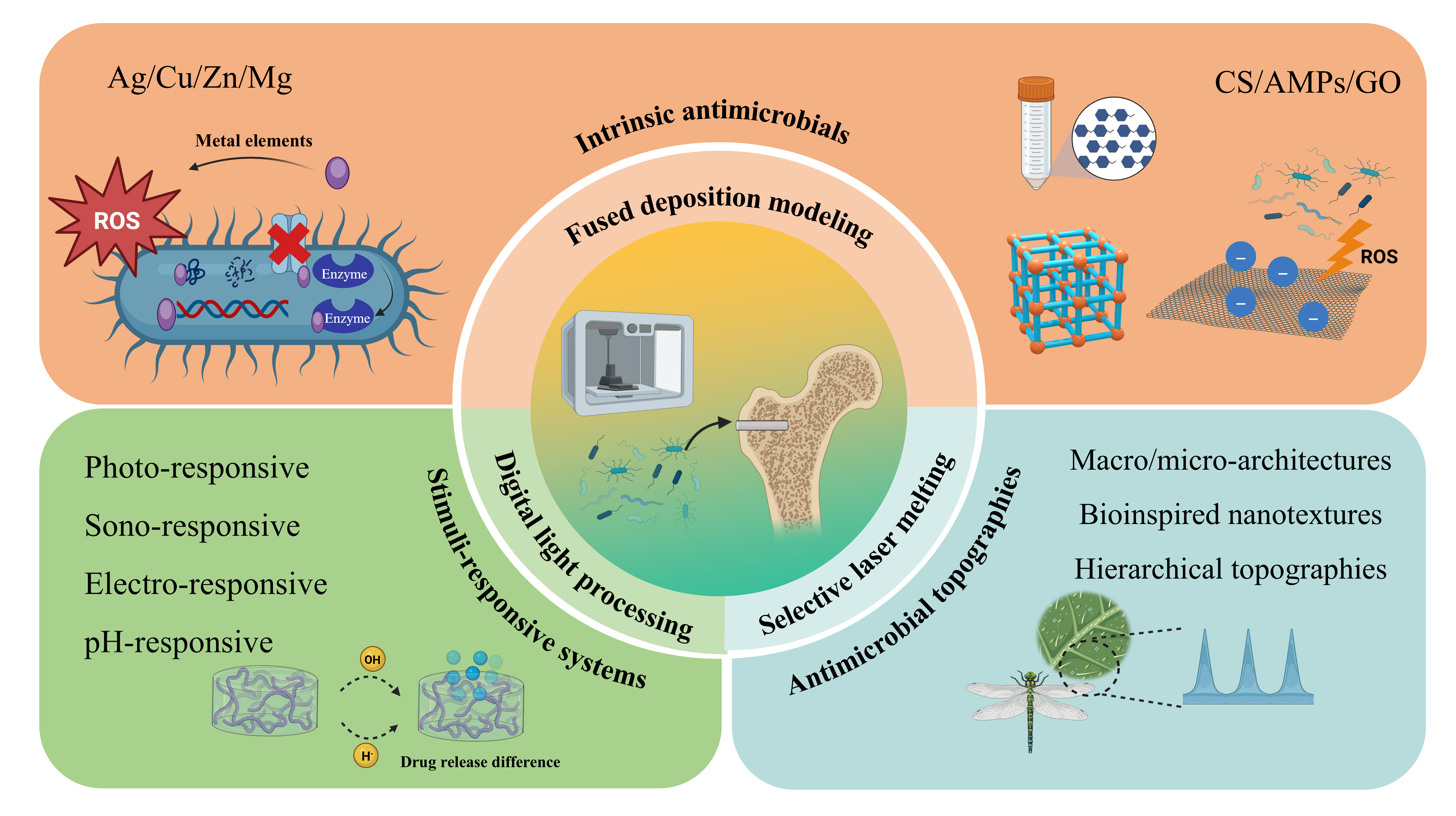
The restoration of tissue defects using 3D-printed medical implants enables precise anatomical matching and customizable microarchitectures. However, implant-associated infections and biofilm formation constitute persistent challenges, frequently compromising the efficacy of systemic antibiotic therapy and promoting drug resistance. In light of these limitations, the development of advanced 3D-printed implants endowed with localized, multifunctional antimicrobial properties has emerged as a critical clinical imperative. This review provides a systematic overview of recent progress in 3D-printed antimicrobial scaffolds, with current innovations classified into three principal synergistic strategies. The first strategy concerns implants fabricated from intrinsically antibacterial materials, which are further categorized into non-metallic systems (e.g., chitosan, antimicrobial peptides, and graphene oxide) and metal-based systems (e.g., silver, copper, zinc, magnesium, and metal–organic frameworks). These constructs provide continuous antimicrobial defense through the sustained release of bioactive ions or reactive oxygen species. The second strategy involves stimuli-responsive platforms that harness exogenous physical fields—such as photothermal, sonodynamic, or electrical stimulation—as well as endogenous biochemical cues (e.g., pH variations) to realize spatiotemporally regulated, on-demand bactericidal effects and to address infections located within deep tissue compartments. The third strategy capitalizes on structural and topographical micro‑patterning that emulates bio‑inspired architectures, thereby eliciting drug‑free mechanobactericidal actions against adherent pathogens. Moreover, this review discusses key translational challenges, particularly balancing antimicrobial efficacy with the preservation of osteogenic activity and osseointegration, while addressing manufacturing complexities. By elucidating these mechanisms, this work provides forward-looking insights to inform the rational design and clinical translation of next-generation anti-infective medical scaffolds.
- Lee SJ, Jeong W, Atala A. 3D Bioprinting for Engineered Tissue Constructs and Patient-Specific Models: Current Progress and Prospects in Clinical Applications. Adv Mater. 2024;36(49):2408032. doi: 10.1002/adma.202408032
- Wu D, Zhu DC, Zhou XY, et al. Development of Intervertebral Disc Organoids through Directed Differentiation of Mesenchymal Stem Cells and Hierarchical 3D Printing. ACS Nano. 2026;20(12):9619-9637. doi: 10.1021/acsnano.5c14391
- Zhang LJ, Yang YR, Xiong YH, et al. Infection-responsive long-term antibacterial bone plates for open fracture therapy. Bioact Mater. 2023;25:1-12. doi: 10.1016/j.bioactmat.2023.01.002
- de la Fuente-Nunez C, Cesaro A, Hancock REW. Antibiotic failure: Beyond antimicrobial resistance. Drug Resist Updat. 2023;71:101012. doi: 10.1016/j.drup.2023.101012
- Liu X, Lu S, Wang T, Wang X, Yang K, Yang H. Advances and prospects of 3D printed antibacterial bone implants: A systematic review. J Mater Sci Technol. 2024;200:227-242. doi: 10.1016/j.jmst.2024.02.040
- Qu X, Wang M, Wang M, et al. Multi-Mode Antibacterial Strategies Enabled by Gene-Transfection and Immunomodulatory Nanoparticles in 3D-Printed Scaffolds for Synergistic Exogenous and Endogenous Treatment of Infections. Adv Mater. 2022;34(18):e2200096. doi: 10.1002/adma.202200096
- Zhang S, Shi XT, Miao ZY, et al. 3D-Printed Polyurethane Tissue-Engineering Scaffold with Hierarchical Microcellular Foam Structure and Antibacterial Properties. Adv Eng Mater. 2022;24(3):2101134. doi: 10.1002/adem.202101134
- Li Z, Zhao Y, Wang Z, et al. Engineering Multifunctional Hydrogel-Integrated 3D Printed Bioactive Prosthetic Interfaces for Osteoporotic Osseointegration. Adv Healthc Mater. 2022;11(11):e2102535. doi: 10.1002/adhm.202102535
- Alizadehgiashi M, Nemr CR, Chekini M, et al. Multifunctional 3D-Printed Wound Dressings. ACS Nano. 2021;15(7):12375-12387. doi: 10.1021/acsnano.1c04499
- Xiao Y, Ding Y, Qiu J, et al. Treatment effects of 3D-printed PCL/Fe3O4@ZIF-8 magnetic nanocomposite on infected bone defect. Int J Bioprint. 2024;10(4):2271. doi: 10.36922/ijb.2271
- Li WH, Zhong JT, Wang X, et al. Intelligent Responsive Zeolitic Imidazolate Framework-8@Copper Oxide Nanocomposite 3D-Printed Scaffolds for Efficient Repair of Infected Bone Defects. ACS Nano. 2025;19(39):35154-35180. doi: 10.1021/acsnano.5c13201
- Rybak D, Du JT, Nakielski P, et al. NIR-Light Activable 3D Printed Platform Nanoarchitectured with Electrospun Plasmonic Filaments for On Demand Treatment of Infected Wounds. Adv Healthc Mater. 2025;14(6):2404274. doi: 10.1002/adhm.202404274
- Tang XX, Chen XL, Zhang SM, et al. Silk-Inspired In Situ Hydrogel with Anti-Tumor Immunity Enhanced Photodynamic Therapy for Melanoma and Infected Wound Healing. Adv Funct Mater. 2021;31(17):2101320. doi: 10.1002/adfm.202101320
- Huang Y, Wan X, Su Q, et al. Ultrasound-activated piezo-hot carriers trigger tandem catalysis coordinating cuproptosis-like bacterial death against implant infections. Nat Commun. 2024;15(1):1643. doi: 10.1038/s41467-024-45619-y
- Pan QY, Zheng Y, Zhou Y, et al. Doping Engineering of Piezo-Sonocatalytic Nanocoating Confer Dental Implants with Enhanced Antibacterial Performances and Osteogenic Activity. Adv Funct Mater. 2024;34(21):2313553. doi: 10.1002/adfm.202313553
- Chen A, Li K, Li Y, et al. Occlusion-activated autonomous piezoelectric implants for adaptive prevention of peri-implantitis. Nat Commun. 2026;17:5017. doi: 10.1038/s41467-026-71556-z
- Li Z, He D, Guo B, et al. Self-promoted electroactive biomimetic mineralized scaffolds for bacteria-infected bone regeneration. Nat Commun. 2023;14(1):6963. doi: 10.1038/s41467-023-42598-4
- Tang X, Ji X, Zhang R, Xu N, Feng Y, Pan L. Preparation and properties of a green material: a seawater degradable polyglycolic acid (PGA)/chitosan (CS) antibacterial composite material. Int J Biol Macromol. 2025;318(Pt 2):144993. doi: 10.1016/j.ijbiomac.2025.144993
- Wang YX, Wang ZC, Lu WY, Hu Y. Review on chitosan-based antibacterial hydrogels: Preparation, mechanisms, and applications. Int J Biol Macromol. 2024;255:128080. doi: 10.1016/j.ijbiomac.2023.128080
- Zhao D, Dong H, Niu Y, et al. Electrophoretic deposition of novel semi-permeable coatings on 3D-printed Ti-Nb alloy meshes for guided alveolar bone regeneration. Dent Mater. 2022;38(2):431-443. doi: 10.1016/j.dental.2021.12.026
- Zhang X, Cheng F, Islam MR, Li HB. The fabrication of the chitosan-based bioink for in vitro tissue repair and regeneration: A review. Int J Biol Macromol. 2024;257:128504. doi: 10.1016/j.ijbiomac.2023.128504
- Cabral CSD, Miguel SP, de Melo-Diogo D, Louro RO, Correia IJ. Green reduced graphene oxide functionalized 3D printed scaffolds for bone tissue regeneration. Carbon. 2019;146:513-523. doi: 10.1016/j.carbon.2019.01.100
- Kaçoglu HS, Ceylan Ö, Çelebi M. Comparative study of the effect of cross-linking degree on chitosan hydrogels synthesized with low and medium molecular weight chitosan. Polym Eng Sci. 2024;64(3):1326-1339. doi: 10.1002/pen.26619
- Yang Y, Yang S, Wang Y, et al. Anti-infective efficacy, cytocompatibility and biocompatibility of a 3D-printed osteoconductive composite scaffold functionalized with quaternized chitosan. Acta Biomater. 2016;46:112-128. doi: 10.1016/j.actbio.2016.09.035
- Chen XY, Zhou YQ, Zhou SQ, et al. 3D printing of chitosan hydrogel reinforced with tubular nanoclay for hemostasis and infected wound healing. Bioact Mater. 2025;54:404-422. doi: 10.1016/j.bioactmat.2025.08.024
- Wang C, Hong T, Cui P, Wang J, Xia J. Antimicrobial peptides towards clinical application: Delivery and formulation. Adv Drug Deliv Rev. 2021;175:113818. doi: 10.1016/j.addr.2021.05.028
- Zhang QY, Yan ZB, Meng YM, et al. Antimicrobial peptides: mechanism of action, activity and clinical potential. Mil Med Res. 2021;8(1):48. doi: 10.1186/s40779-021-00343-2
- Li MM, Zhao PZ, Wang JW, Zhang XC, Li J. Functional antimicrobial peptide-loaded 3D scaffolds for infected bone defect treatment with AI and multidimensional printing. Mater Horiz. 2025;12(1):20-36. doi: 10.1039/d4mh01124d
- Gao XH, Ding JQ, Liao CB, Xu JL, Liu XX, Lu WY. Defensins: The natural peptide antibiotic. Adv Drug Deliv Rev. 2021;179:114008. doi: 10.1016/j.addr.2021.114008
- Nagaoka I, Tamura H, Reich J. Therapeutic Potential of Cathelicidin Peptide LL-37, an Antimicrobial Agent, in a Murine Sepsis Model. Int J Mol Sci. 2020;21(17):5973. doi: 10.3390/ijms21175973
- Li X, Huang X, Li L, et al. LL-37-Coupled Porous Composite Scaffold for the Treatment of Infected Segmental Bone Defect. Pharmaceutics. 2022;15(1):88. doi: 10.3390/pharmaceutics15010088
- Hu W, Peng C, Luo W, et al. Graphene-Based Antibacterial Paper. ACS Nano. 2010;4(7):4317-4323. doi: 10.1021/nn101097v
- Tashan H, Khosravi-Darani K, Yazdian F, et al. Antibacterial Properties of Graphene Based Nanomaterials: An Emphasis on Molecular Mechanisms, Surface Engineering and Size of Sheets. Mini-Rev Org Chem. 2019;16(2):159-172. doi: 10.2174/1570193x15666180712120309
- Pham VTH, Truong VK, Quinn MDJ, et al. Graphene Induces Formation of Pores That Kill Spherical and Rod-Shaped Bacteria. ACS Nano. 2015;9(8):8458-8467. doi: 10.1021/acsnano.5b03368
- Perreault F, de Faria AF, Nejati S, Elimelech M. Antimicrobial Properties of Graphene Oxide Nanosheets: Why Size Matters. ACS Nano. 2015;9(7):7226-7236. doi: 10.1021/acsnano.5b02067
- Zou X, Zhang L, Wang Z, Luo Y. Mechanisms of the Antimicrobial Activities of Graphene Materials. J Am Chem Soc. 2016;138(7):2064-2077. doi: 10.1021/jacs.5b11411
- Jia Z, Shi Y, Xiong P, et al. From Solution to Biointerface: Graphene Self-Assemblies of Varying Lateral Sizes and Surface Properties for Biofilm Control and Osteodifferentiation. ACS Appl Mater Interfaces. 2016;8(27):17151-17165. doi: 10.1021/acsami.6b05198
- Hegab HM, ElMekawy A, Zou L, Mulcahy D, Saint CP, Ginic-Markovic M. The controversial antibacterial activity of graphene-based materials. Carbon. 2016;105:362-376. doi: 10.1016/j.carbon.2016.04.046
- An X, Ma H, Liu B, Wang J, Yan X. Graphene Oxide Reinforced Polylactic Acid/Polyurethane Antibacterial Composites. J Nanomater. 2013;2013(1). doi: 10.1155/2013/373414
- Lu B, Li T, Zhao H, et al. Graphene-based composite materials beneficial to wound healing. Nanoscale. 2012;4(9):2978-2982. doi: 10.1039/c2nr11958g
- Nie R, Sun Y, Lv H, et al. 3D printing of MXene composite hydrogel scaffolds for photothermal antibacterial activity and bone regeneration in infected bone defect models. Nanoscale. 2022;14(22):8112-8129. doi: 10.1039/d2nr02176e
- Angulo-Pineda C, Srirussamee K, Palma P, Fuenzalida VM, Cartmell SH, Palza H. Electroactive 3D Printed Scaffolds Based on Percolated Composites of Polycaprolactone With Thermally Reduced Graphene Oxide for Antibacterial and Tissue Engineering Applications. Nanomaterials. 2020;10(3):428. doi: 10.3390/nano10030428
- Melo SF, Neves SC, Pereira AT, et al. Incorporation of graphene oxide into poly(ε-caprolactone) 3D printed fibrous scaffolds improves their antimicrobial properties. Mater Sci Eng C. 2020;109:110537. doi: 10.1016/j.msec.2019.110537
- Gomes RN, Borges I, Pereira AT, et al. Antimicrobial graphene nanoplatelets coatings for silicone catheters. Carbon. 2018;139:635-647. doi: 10.1016/j.carbon.2018.06.044
- Pinto AM, Gonçalves C, Sousa DM, et al. Smaller particle size and higher oxidation improves biocompatibility of graphene-based materials. Carbon. 2016;99:318-329. doi: 10.1016/j.carbon.2015.11.076
- Tao B, Chen M, Lin C, et al. Zn-incorporation with graphene oxide on Ti substrates surface to improve osteogenic activity and inhibit bacterial adhesion. J Biomed Mater Res A. 2019;107(10):2310-2326. doi: 10.1002/jbm.a.36740
- Cometta S, Donose BC, Juárez-Saldivar A, et al. Unravelling the physicochemical and antimicrobial mechanisms of human serum albumin/tannic acid coatings for medical-grade polycaprolactone scaffolds. Bioact Mater. 2024;42:68-84. doi: 10.1016/j.bioactmat.2024.08.023
- Zhou W, Jia Z, Xiong P, et al. Bioinspired and Biomimetic AgNPs/Gentamicin-Embedded Silk Fibroin Coatings for Robust Antibacterial and Osteogenetic Applications. ACS Appl Mater Interfaces. 2017;9(31):25830-25846. doi: 10.1021/acsami.7b06757
- Smith JL, Tran N, Song T, Liang D, Qian M. Robust bulk micro-nano hierarchical copper structures possessing exceptional bactericidal efficacy. Biomaterials. 2022;280:121271. doi: 10.1016/j.biomaterials.2021.121271
- Qian J, Chen Y, Zhang W, et al. Micro/Nano-Structured Metal-Organic/Inorganic Hybrid Coatings on Biodegradable Zn for Osteogenic and Biocompatible Improvement. Adv Mater Interfaces. 2022;9(6). doi: 10.1002/admi.202101852
- Wang C, Zhang B, Yu S, et al. Incorporation of Mg-phenolic networks as a protective coating for magnesium alloy to enhance corrosion resistance and osteogenesis in vivo. J Magnesium Alloys. 2023;11(11):4247-4262. doi: 10.1016/j.jma.2022.03.010
- Perdikaki A, Galeou A, Pilatos G, et al. Ag and Cu Monometallic and Ag/Cu Bimetallic Nanoparticle-Graphene Composites with Enhanced Antibacterial Performance. ACS Appl Mater Interfaces. 2016;8(41):27498-27510. doi: 10.1021/acsami.6b08403
- Pham DQ, Gangadoo S, Berndt CC, et al. Antibacterial Longevity of a Novel Gallium Liquid Metal/Hydroxyapatite Composite Coating Fabricated by Plasma Spray. ACS Appl Mater Interfaces. 2022;14(16):18974-18988. doi: 10.1021/acsami.2c03695
- Han J, Ma Q, An Y, et al. The current status of stimuli-responsive nanotechnologies on orthopedic titanium implant surfaces. J Nanobiotechnology. 2023;21(1):277. doi: 10.1186/s12951-023-02017-8
- Jia B, Zhang Z, Zhuang Y, et al. High-strength biodegradable zinc alloy implants with antibacterial and osteogenic properties for the treatment of MRSA-induced rat osteomyelitis. Biomaterials. 2022;287:121663. doi: 10.1016/j.biomaterials.2022.121663
- Zhang E, Zhao X, Hu J, Wang R, Fu S, Qin G. Antibacterial metals and alloys for potential biomedical implants. Bioact Mater. 2021;6(8):2569-2612. doi: 10.1016/j.bioactmat.2021.01.030
- Chen Y, Li WL, Zhang C, Wu ZY, Liu J. Recent Developments of Biomaterials for Additive Manufacturing of Bone Scaffolds. Adv Healthc Mater. 2020;9(23):2000724. doi: 10.1002/adhm.202000724
- Alam F, Shukla VR, Varadarajan KM, Kumar S. Microarchitected 3D printed polylactic acid (PLA) nanocomposite scaffolds for biomedical applications. J Mech Behav Biomed Mater. 2020;103:103576. doi: 10.1016/j.jmbbm.2019.103576
- Maharubin S, Hu Y, Sooriyaarachchi D, Cong W, Tan GZ. Laser engineered net shaping of antimicrobial and biocompatible titanium-silver alloys. Mater Sci Eng C. 2019;105:110059. doi: 10.1016/j.msec.2019.110059
- Arjunan A, Robinson J, Al Ani E, Heaselgrave W, Baroutaji A, Wang C. Mechanical performance of additively manufactured pure silver antibacterial bone scaffolds. J Mech Behav Biomed Mater. 2020;112:104090. doi: 10.1016/j.jmbbm.2020.104090
- Marsh AC, Zhang Y, Poli L, et al. 3D printed bioactive and antibacterial silicate glass-ceramic scaffold by fused filament fabrication. Mater Sci Eng C. 2021;118:111516. doi: 10.1016/j.msec.2020.111516
- Qing Y, Li K, Li D, Qin Y. Antibacterial effects of silver incorporated zeolite coatings on 3D printed porous stainless steels. Mater Sci Eng C. 2020;108:110430. doi: 10.1016/j.msec.2019.110430
- Jia Z, Xiu P, Xiong P, et al. Additively Manufactured Macroporous Titanium with Silver-Releasing Micro-/Nanoporous Surface for Multipurpose Infection Control and Bone Repair - A Proof of Concept. ACS Appl Mater Interfaces. 2016;8(42):28495-28510. doi: 10.1021/acsami.6b10473
- Li JY, Li LL, Zhou J, et al. 3D printed dual-functional biomaterial with self-assembly micro-nano surface and enriched nano argentum for antibacterial and bone regeneration. Appl Mater Today. 2019;17:206-215. doi: 10.1016/j.apmt.2019.06.012
- Qiao SC, Wu DL, Li ZH, et al. The combination of multi-functional ingredients-loaded hydrogels and three-dimensional printed porous titanium alloys for infective bone defect treatment. J Tissue Eng. 2020;11:2041731420965797. doi: 10.1177/2041731420965797
- Bu LT, Wei X, Zhang YX, et al. Gradient 3D printed PEEK with nano-coating facilitates rapid manufacturing with dual enhanced osteogenic and anti-bacterial property. Mater Today Bio. 2025;35:102432. doi: 10.1016/j.mtbio.2025.102432
- Ciliveri S, Bandyopadhyay A. Enhanced osteogenesis and bactericidal performance of additively manufactured MgO- and Cu-added CpTi for load-bearing implants. Int J Bioprint. 2023;9(6):552-565. doi: 10.36922/ijb.1167
- Gao JB, Jin YT, Fan YQ, et al. Fabricating antibacterial CoCrCuFeNi high-entropy alloy via selective laser melting and in-situ alloying. J Mater Sci Technol. 2022;102:159-165. doi: 10.1016/j.jmst.2021.07.002
- Wang B, Shan XH, Gao JY, et al. 3D-Printed Hydrogel Patches Embedded with Cu-Modified Liquid Metal Nanoparticles for Accelerated Wound Healing. Adv Healthc Mater. 2025;14(15):2404986. doi: 10.1002/adhm.202404986
- Liang YJ, Dai JB, Zhang ZB, et al. Osteogenic and antibacterial enhancement by alloying design and microstructural modification of additively manufactured biodegradable metals. Biomaterials. 2026;324:123481. doi: 10.1016/j.biomaterials.2025.123481
- Zou F, Jiang JY, Lv FZ, Xia XL, Ma XS. Preparation of antibacterial and osteoconductive 3D-printed PLGA/Cu(I)@ZIF-8 nanocomposite scaffolds for infected bone repair. J Nanobiotechnol. 2020;18(1):39. doi: 10.1186/s12951-020-00594-6
- Xie K, Wang N, Guo Y, et al. Additively manufactured biodegradable porous magnesium implants for elimination of implant-related infections: An in vitro and in vivo study. Bioact Mater. 2022;8:140-152. doi: 10.1016/j.bioactmat.2021.06.032
- Cockerill I, Su Y, Sinha S, et al. Porous zinc scaffolds for bone tissue engineering applications: A novel additive manufacturing and casting approach. Mater Sci Eng C. 2020;110:110738. doi: 10.1016/j.msec.2020.110738
- Yang Y, Yang M, He C, et al. Rare earth improves strength and creep resistance of additively manufactured Zn implants. Compos B Eng. 2021;216:108882. doi: 10.1016/j.compositesb.2021.108882
- Bhattacharjee A, Bose S. 3D printed hydroxyapatite-Zn2+ functionalized starch composite bone grafts for orthopedic and dental applications. Mater Des. 2022;221:110903. doi: 10.1016/j.matdes.2022.110903
- Kodama J, Chen H, Zhou T, et al. Antibacterial efficacy of quaternized chitosan coating on 3D printed titanium cage in rat intervertebral disc space. Spine J. 2021;21(7):1217-1228. doi: 10.1016/j.spinee.2021.02.016
- Sanchez-Salcedo S, Garcia A, Gonzalez-Jimenez A, Vallet-Regi M. Antibacterial effect of 3D printed mesoporous bioactive glass scaffolds doped with metallic silver nanoparticles. Acta Biomater. 2023;155:654-666. doi: 10.1016/j.actbio.2022.10.045
- Maharubin S, Zhou Y, Tan GZ. Development and Investigation on a Silver Nanoparticle-Incorporated Electrofiltration System for Biofouling Control. IEEE Trans Nanotechnol. 2018;17(5):948-954. doi: 10.1109/tnano.2018.2832210
- Tan Z, Xu G, Orndorff PE, Shirwaiker RA. Effects of Electrically Activated Silver-Titanium Implant System Design Parameters on Time-Kill Curves Against Staphylococcus aureus. J Med Biol Eng. 2016;36(3):325-333. doi: 10.1007/s40846-016-0136-x
- Lara HH, Garza-Treviño EN, Ixtepan-Turrent L, Singh DK. Silver nanoparticles are broad-spectrum bactericidal and virucidal compounds. J Nanobiotechnol. 2011;9(1):30. doi: 10.1186/1477-3155-9-30
- Tan Z, Havell EA, Orndorff PE, Shirwaiker RA. Antibacterial efficacy and cytotoxicity of low intensity direct current activated silver-titanium implant system prototype. Biometals. 2017;30(1):113-125. doi: 10.1007/s10534-017-9993-1
- Brandt O, Mildner M, Egger AE, et al. Nanoscalic silver possesses broad-spectrum antimicrobial activities and exhibits fewer toxicological side effects than silver sulfadiazine. Nanomedicine. 2012;8(4):478-488. doi: 10.1016/j.nano.2011.07.005
- Ding M, Zhang Y, Li X, et al. Simultaneous Biofilm Disruption, Bacterial Killing, and Inflammation Elimination for Wound Treatment Using Silver Embellished Polydopamine Nanoplatform. Small. 2024;20(36):e2400927. doi: 10.1002/smll.202400927
- Verma A, Shivalkar S, Sk MP, Samanta SK, Sahoo AK. Nanocomposite of Ag nanoparticles and catalytic fluorescent carbon dots for synergistic bactericidal activity through enhanced reactive oxygen species generation. Nanotechnology. 2020;31(40):405704. doi: 10.1088/1361-6528/ab996f
- Praveen AS, Arjunan A. Effect of nano-Al2O3 addition on the microstructure and erosion wear of HVOF sprayed NiCrSiB coatings. Mater Res Express. 2019;7(1):015006. doi: 10.1088/2053-1591/ab5bda
- Praveen AS, Arjunan A. Parametric optimisation of high-velocity oxy-fuel nickel-chromium-silicon-boron and aluminium-oxide coating to improve erosion wear resistance. Mater Res Express. 2019;6(9):0696560. doi: 10.1088/2053-1591/ab301c
- Chouirfa H, Bouloussa H, Migonney V, Falentin-Daudre C. Review of titanium surface modification techniques and coatings for antibacterial applications. Acta Biomater. 2019;83:37-54. doi: 10.1016/j.actbio.2018.10.036
- Pandey A, Patel AK, S A, et al. Enhanced Tribological and Bacterial Resistance of Carbon Nanotube with Ceria- and Silver-Incorporated Hydroxyapatite Biocoating. Nanomaterials. 2018;8(6):363. doi: 10.3390/nano8060363
- Surmeneva MA, Sharonova AA, Chernousova S, et al. Incorporation of silver nanoparticles into magnetron-sputtered calcium phosphate layers on titanium as an antibacterial coating. Colloids Surf B Biointerfaces. 2017;156:104-113. doi: 10.1016/j.colsurfb.2017.05.016
- Batebi K, Abbasi Khazaei B, Afshar A. Characterization of sol-gel derived silver/fluor-hydroxyapatite composite coatings on titanium substrate. Surf Coat Technol. 2018;352:522-528. doi: 10.1016/j.surfcoat.2018.08.021
- Durdu S, Aktug SL, Korkmaz K, Yalcin E, Aktas S. Fabrication, characterization and in vitro properties of silver-incorporated TiO2 coatings on titanium by thermal evaporation and micro-arc oxidation. Surf Coat Technol. 2018;352:600-608. doi: 10.1016/j.surfcoat.2018.08.050
- Vaithilingam J, Kilsby S, Goodridge RD, Christie SDR, Edmondson S, Hague RJM. Immobilisation of an antibacterial drug to Ti6Al4V components fabricated using selective laser melting. Appl Surf Sci. 2014;314:642-654. doi: 10.1016/j.apsusc.2014.06.014
- Vikulova ES, Dorovskikh SI, Sergeevichev DS, et al. Combination of Noble Metal and Gold-Silver Nanoclusters as Enhanced Antibacterial Coatings for Ti-Based Medical Implants. Int J Mol Sci. 2025;26(24):11945. doi: 10.3390/ijms262411945
- Liang R, Xu Y, Zhao M, et al. Properties of silver contained coatings on CoCr alloys prepared by vacuum plasma spraying. Mater Sci Eng C. 2020;106:110156. doi: 10.1016/j.msec.2019.110156
- Wu X, Liu S, Chen K, et al. 3D printed chitosan-gelatine hydrogel coating on titanium alloy surface as biological fixation interface of artificial joint prosthesis. Int J Biol Macromol. 2021;182:669-679. doi: 10.1016/j.ijbiomac.2021.04.046
- Astaneh ME, Fereydouni N. Silver Nanoparticles in 3D Printing: A New Frontier in Wound Healing. ACS Omega. 2024;9(40):41107-41129. doi: 10.1021/acsomega.4c04961
- Noyce JO, Michels H, Keevil CW. Potential use of copper surfaces to reduce survival of epidemic meticillin-resistant Staphylococcus aureus in the healthcare environment. J Hosp Infect. 2006;63(3):289-297. doi: 10.1016/j.jhin.2005.12.008
- Wilks SA, Michels H, Keevil CW. The survival of Escherichia coli O157 on a range of metal surfaces. Int J Food Microbiol. 2005;105(3):445-454. doi: 10.1016/j.ijfoodmicro.2005.04.021
- Chai H, Guo L, Wang X, et al. Antibacterial effect of 317L stainless steel contained copper in prevention of implant-related infection in vitro and in vivo. J Mater Sci Mater Med. 2011;22(11):2525-2535. doi: 10.1007/s10856-011-4427-z
- Wu C, Zhou Y, Xu M, et al. Copper-containing mesoporous bioactive glass scaffolds with multifunctional properties of angiogenesis capacity, osteostimulation and antibacterial activity. Biomaterials. 2013;34(2):422-433. doi: 10.1016/j.biomaterials.2012.09.066
- Zhuang Y, Ren L, Zhang S, Wei X, Yang K, Dai K. Antibacterial effect of a copper-containing titanium alloy against implant-associated infection induced by methicillin-resistant Staphylococcus aureus. Acta Biomater. 2021;119:472-484. doi: 10.1016/j.actbio.2020.10.026
- Wu Y, Shi X, Wang J, et al. A surface metal ion-modified 3D-printed Ti-6Al-4V implant with direct and immunoregulatory antibacterial and osteogenic activity. Front Bioeng Biotechnol. 2023;11:1142264. doi: 10.3389/fbioe.2023.1142264
- Fathalla RK, Engel M, Ducho C. Targeting the binding pocket of the fluorophore 8-anilinonaphthalene-1-sulfonic acid in the bacterial enzyme MurA. Arch Pharm. 2023;356(9):2300237. doi: 10.1002/ardp.202300237
- Liu Y, Nie N, Tang H, et al. Effective Antibacterial Activity of Degradable Copper-Doped Phosphate-Based Glass Nanozymes. ACS Appl Mater Interfaces. 2021;13(10):11631-11645. doi: 10.1021/acsami.0c22746
- Shuai C, Pan G, Zhong Q, Peng S. Cu-S-Mo interfacial sites in CuO2@MoS2/PLLA scaffolds for robust synergistic antibacterial efficacy via CDT and PTT. Surfaces Interfaces. 2024;55:105432. doi: 10.1016/j.surfin.2024.105432
- Lakshminarayanan R, Ye E, Young DJ, Li Z, Loh XJ. Recent Advances in the Development of Antimicrobial Nanoparticles for Combating Resistant Pathogens. Adv Healthc Mater. 2018;7(13):e1701400. doi: 10.1002/adhm.201701400
- Liu AB, Zhang ZB, Wang X, et al. The critical role of surface characteristics in 3D-printed biodegradable Zn-based porous scaffolds for bone defect repair. Virtual Phys Prototyp. 2025;20(1):e2476035. doi: 10.1080/17452759.2025.2476035
- Chen K, Wang F, Sun X, et al. 3D-printed zinc oxide nanoparticles modified barium titanate/hydroxyapatite ultrasound-responsive piezoelectric ceramic composite scaffold for treating infected bone defects. Bioact Mater. 2025;45:479-495. doi: 10.1016/j.bioactmat.2024.11.015
- Qu X, Yang H, Jia B, Yu Z, Zheng Y, Dai K. Biodegradable Zn-Cu alloys show antibacterial activity against MRSA bone infection by inhibiting pathogen adhesion and biofilm formation. Acta Biomater. 2020;117:400-417. doi: 10.1016/j.actbio.2020.09.041
- Jiang X, Tang X, Zhang B, He L, Shi Y. Antimicrobial activity and synergistic antibacterial mechanism of a combination of zinc and rare-earth scandium against Escherichia coli. Mater Technol. 2019;35(11-12):797-806. doi: 10.1080/10667857.2019.1688534
- Yang Y, Cheng Y, Deng F, et al. A bifunctional bone scaffold combines osteogenesis and antibacterial activity via in situ grown hydroxyapatite and silver nanoparticles. Bio-Des Manuf. 2021;4(3):452-468. doi: 10.1007/s42242-021-00130-x
- Farias IAP, Dos Santos CCL, Sampaio FC. Antimicrobial Activity of Cerium Oxide Nanoparticles on Opportunistic Microorganisms: A Systematic Review. Biomed Res Int. 2018;2018:1923606. doi: 10.1155/2018/1923606
- Xia X, Song X, Li Y, et al. Antibacterial and anti-inflammatory ZIF-8@Rutin nanocomposite as an efficient agent for accelerating infected wound healing. Front Bioeng Biotechnol. 2022;10:1026743. doi: 10.3389/fbioe.2022.1026743
- Xu B, Wang H, Wang W, et al. A Single-Atom Nanozyme for Wound Disinfection Applications. Angew Chem Int Ed Engl. 2019;58(15):4911-4916. doi: 10.1002/anie.201813994
- Liu Y, Zheng Y, Chen XH, et al. Fundamental Theory of Biodegradable Metals—Definition, Criteria, and Design. Adv Funct Mater. 2019;29(18):1805402. doi: 10.1002/adfm.201805402
- Lee J, Byun H, Madhurakkat Perikamana SK, Lee S, Shin H. Current Advances in Immunomodulatory Biomaterials for Bone Regeneration. Adv Healthc Mater. 2019;8(4):e1801106. doi: 10.1002/adhm.201801106
- Nie ZX, Sun YS, Li K, et al. Non-destructive debridement and tuneable ion release via magnesium abrasion and electro-dissolution promote bone regeneration and osseointegration of infected implants. Mater Today Bio. 2026;38:103183. doi: 10.1016/j.mtbio.2026.103183
- Jiang M, Sun Y, Nie Z, et al. Cavitation erosion: An efficient method for promoting osteogenesis and immunomodulation of titanium surface. Dent Mater. 2025;41(11):1350-1360. doi: 10.1016/j.dental.2025.07.017
- Steijvers E, Shi YS, Lu H, et al. Rapid assessment of the osteogenic capacity of hydroxyapatite/aragonite using a murine tibial periosteal ossification model. Bioact Mater. 2025;45:257-273. doi: 10.1016/j.bioactmat.2024.11.025
- Shi YS, Tang SH, Yuan X, et al. In Situ 4D Printing of Polyelectrolyte/Magnetic Composites for Sutureless Gastric Perforation Sealing. Adv Mater. 2024;36(34):2307601. doi: 10.1002/adma.202307601
- Li Z, Zhang S, Wang Q, et al. Untethered & Stiffness-Tunable Ferromagnetic Liquid Robots for Cleaning Thrombus in Complex Blood Vessels. Adv Mater. 2024;36(46):e2409142. doi: 10.1002/adma.202409142
- Wang XX, Chen P, Yang H, et al. In Situ Imaging and Anti-inflammation of 3D Printed Scaffolds Enabled by AIEgen. ACS Appl Mater Interfaces. 2023;15(21):25382-25392. doi: 10.1021/acsami.3c03082
- Xue X, Zhang H, Liu H, et al. Rational Design of Multifunctional CuS Nanoparticle-PEG Composite Soft Hydrogel-Coated 3D Hard Polycaprolactone Scaffolds for Efficient Bone Regeneration. Adv Funct Mater. 2022;32(33):2202470. doi: 10.1002/adfm.202202470
- Wu Y, Liao Q, Wu L, et al. ZnL2-BPs Integrated Bone Scaffold under Sequential Photothermal Mediation: A Win-Win Strategy Delivering Antibacterial Therapy and Fostering Osteogenesis Thereafter. ACS Nano. 2021;15(11):17854-17869. doi: 10.1021/acsnano.1c06062
- He MM, Zhu C, Sun D, et al. Layer-by-layer assembled black phosphorus/chitosan composite coating for multi-functional PEEK bone scaffold. Compos B Eng. 2022;246:110266. doi: 10.1016/j.compositesb.2022.110266
- Liu WY, Zuo RT, Zhu TL, Zhu M, Zhao SC, Zhu YF. Forsterite-hydroxyapatite composite scaffolds with photothermal antibacterial activity for bone repair. J Adv Ceram. 2021;10(5):1095-1106. doi: 10.1007/s40145-021-0494-x
- Zhang L, Ng G, Kapoor-Kaushik N, et al. 2D Porphyrinic Metal-Organic Framework Nanosheets as Multidimensional Photocatalysts for Functional Materials. Angew Chem Int Ed Engl. 2021;60(42):22664-22671. doi: 10.1002/anie.202107457
- Wang Y, Frascella F, Gaglio CG, Pirri CF, Wei QF, Roppolo I. Vat Photopolymerization 3D Printing of Hydrogels Embedding Metal-Organic Frameworks for Photodynamic Antimicrobial Therapy. ACS Appl Mater Interfaces. 2024;16(42):57778-57791. doi: 10.1021/acsami.4c15168
- Sun XH, Xie SY, Fang Y, et al. A multimodal ROS logic-gated therapeutic platform disrupts the vicious cycle of senescence to promote aged bone defect repair. Bioact Mater. 2026;61:692-711. doi: 10.1016/j.bioactmat.2026.02.002
- Huang T, Sun Z, Heath DE, O'Brien-Simpson N, O'Connor AJ. 3D printed and smart alginate wound dressings with pH-responsive drug and nanoparticle release. Chem Eng J. 2024;492:152117. doi: 10.1016/j.cej.2024.152117
- Lin MY, Stehle Y, Chen L, et al. A 3D-printed chitosan-based pH-responsive dual functional scaffold for osteomyelitis: synergistic antibacterial and osteogenic treatment. Carbohydr Polym. 2025;366:123866. doi: 10.1016/j.carbpol.2025.123866
- Huo J, Jia Q, Huang H, et al. Emerging photothermal-derived multimodal synergistic therapy in combating bacterial infections. Chem Soc Rev. 2021;50(15):8762-8789. doi: 10.1039/d1cs00074h
- Fu S, Hu H, Chen J, Zhu Y, Zhao S. Silicone resin derived larnite/C scaffolds via 3D printing for potential tumor therapy and bone regeneration. Chem Eng J. 2020;382:122928. doi: 10.1016/j.cej.2019.122928
- Xie M, Zhu W, Yu KM, Zhu Z, Wang G. Effects of doping and rapid thermal processing in Y doped CdO thin films. J Alloys Compd. 2019;776:259-265. doi: 10.1016/j.jallcom.2018.10.288
- Li Y, Liu X, Li B, et al. Near-Infrared Light Triggered Phototherapy and Immunotherapy for Elimination of Methicillin-Resistant Staphylococcus aureus Biofilm Infection on Bone Implant. ACS Nano. 2020;14(7):8157-8170. doi: 10.1021/acsnano.0c01486
- Yang C, Luo Y, Lin H, Ge M, Shi J, Zhang X. Niobium Carbide MXene Augmented Medical Implant Elicits Bacterial Infection Elimination and Tissue Regeneration. ACS Nano. 2020;15(1):1086-1099. doi: 10.1021/acsnano.0c08045
- Gao Z, Song Z, Guo R, et al. Mn Single-Atom Nanozyme Functionalized 3D-Printed Bioceramic Scaffolds for Enhanced Antibacterial Activity and Bone Regeneration. Adv Healthc Mater. 2024;13(13):2303182. doi: 10.1002/adhm.202303182
- Park J, Jiang Q, Feng D, Mao L, Zhou H-C. Size-Controlled Synthesis of Porphyrinic Metal-Organic Framework and Functionalization for Targeted Photodynamic Therapy. J Am Chem Soc. 2016;138(10):3518-3525. doi: 10.1021/jacs.6b00007
- Wang C, Xie Z, deKrafft KE, Lin W. Doping Metal-Organic Frameworks for Water Oxidation, Carbon Dioxide Reduction, and Organic Photocatalysis. J Am Chem Soc. 2011;133(34):13445-13454. doi: 10.1021/ja203564w
- Meyer K, Ranocchiari M, van Bokhoven JA. Metal organic frameworks for photo-catalytic water splitting. Energy Environ Sci. 2015;8(7):1923-1937. doi: 10.1039/C5EE00161G
- He T, Ni B, Zhang S, et al. Ultrathin 2D Zirconium Metal-Organic Framework Nanosheets: Preparation and Application in Photocatalysis. Small. 2018;14(16):1703929. doi: 10.1002/smll.201703929
- Li JB, Wang Y, Fan L, et al. Liquid metal hybrid antibacterial hydrogel scaffolds from 3D printing for wound healing. Chem Eng J. 2024;496:153805. doi: 10.1016/j.cej.2024.153805
- Huang Y, Li J, Yu Z, Li J, Liang K, Deng Y. Elaborated Bio-Heterojunction With Robust Sterilization Effect for Infected Tissue Regeneration via Activating Competent Cell-Like Antibacterial Tactic. Adv Mater. 2024;36(48):e2414111. doi: 10.1002/adma.202414111
- Li X, Bai H, Yang Y, Yoon J, Wang S, Zhang X. Supramolecular Antibacterial Materials for Combatting Antibiotic Resistance. Adv Mater. 2019;31(5):e1805092. doi: 10.1002/adma.201805092
- Wang X, Zhong X, Bai L, et al. Ultrafine Titanium Monoxide (TiO1+x) Nanorods for Enhanced Sonodynamic Therapy. J Am Chem Soc. 2020;142(14):6527-6537. doi: 10.1021/jacs.9b10228
- Xu Y, Tang D, Li L, et al. A Bodipy-Based Aggregation-Induced Emission Nanoagent for Sonodynamic Antibacterial Studies. Adv Funct Mater. 2024;34(33):2315385. doi: 10.1002/adfm.202315385
- Lei C, Lei J, Zhang X, et al. Heterostructured piezocatalytic nanoparticles with enhanced ultrasound response for efficient repair of infectious bone defects. Acta Biomater. 2023;172:343-354. doi: 10.1016/j.actbio.2023.10.006
- Wu C, Cheng K, Cheng J, et al. Reinforcing titanium surface modification through the integration of piezoelectric effect and structural design to mitigate early bacterial infection. Ceram Int. 2024;50(21):42645-42655. doi: 10.1016/j.ceramint.2024.08.108
- Chen Y, Wan X, Yue Y, et al. Low-Intensity Ultrasound-Activated Cavitation Effect Triggers Piezoelectric Catalysis Coordinating Respiratory Chain Interference Tactics Against Bacterial Infection. Adv Funct Mater. 2025;35(14):2419426. doi: 10.1002/adfm.202419426
- Zhao P, Li H, Bu W. A Forward Vision for Chemodynamic Therapy: Issues and Opportunities. Angew Chem Int Ed Engl. 2023;62(7):e202210415. doi: 10.1002/anie.202210415
- Duan Y, Yu Y, Liu P, et al. Reticular Chemistry-Enabled Sonodynamic Activity of Covalent Organic Frameworks for Nanodynamic Cancer Therapy. Angew Chem Int Ed Engl. 2023;62(20):e202302146. doi: 10.1002/anie.202302146
- Shi YS, Tang SH, Zhang WF, et al. A reliable, battery-free and implantable magnetic sensing system for wireless monitoring of spinal motion in rats and humans. Chem Eng J. 2024;482:148891. doi: 10.1016/j.cej.2024.148891
- Zeglio E, Rutz AL, Winkler TE, Malliaras GG, Herland A. Conjugated Polymers for Assessing and Controlling Biological Functions. Adv Mater. 2019;31(22):1806712. doi: 10.1002/adma.201806712
- Kiamco MM, Zmuda HM, Mohamed A, et al. Hypochlorous-Acid-Generating Electrochemical Scaffold for Treatment of Wound Biofilms. Sci Rep. 2019;9(1):2683. doi: 10.1038/s41598-019-38968-y
- Zituni D, Schütt-Gerowitt H, Kopp M, et al. The growth of Staphylococcus aureus and Escherichia coli in low-direct current electric fields. Int J Oral Sci. 2014;6(1):7-14. doi: 10.1038/ijos.2013.64
- Khan SI, Blumrosen G, Vecchio D, et al. Eradication of multidrug-resistant Pseudomonas biofilm with pulsed electric fields. Biotechnol Bioeng. 2016;113(3):643-650. doi: 10.1002/bit.25818
- Del Pozo JL, Rouse MS, Patel R. Bioelectric effect and bacterial biofilms. A systematic review. Int J Artif Organs. 2008;31(9):786-795. doi: 10.1177/039139880803100906
- Shi R, Zhang J, Tian J, et al. An effective self-powered strategy to endow titanium implant surface with associated activity of anti-biofilm and osteogenesis. Nano Energy. 2020;77:105201. doi: 10.1016/j.nanoen.2020.105201
- Chen X, Liu L, Feng Y, et al. Fluid eddy induced piezo-promoted photodegradation of organic dye pollutants in wastewater on ZnO nanorod arrays/3D Ni foam. Mater Today. 2017;20(9):501-506. doi: 10.1016/j.mattod.2017.08.027
- Chen A, Wang Z, Guan Z, et al. Echinoderm stereom gradient structures enable mechanoelectrical perception. Nature. 2026;651(8105):371-376. doi: 10.1038/s41586-026-10164-9
- Khare D, Basu B, Dubey AK. Electrical stimulation and piezoelectric biomaterials for bone tissue engineering applications. Biomaterials. 2020;258:120280. doi: 10.1016/j.biomaterials.2020.120280
- Akkineni AR, Spangenberg J, Geissler M, et al. Controlled and Local Delivery of Antibiotics by 3D Core/Shell Printed Hydrogel Scaffolds to Treat Soft Tissue Infections. Pharmaceutics. 2021;13(12):2151. doi: 10.3390/pharmaceutics13122151
- Al-Tamimi AA, Aldawood E. The effect of 3D-printed bone tissue scaffolds geometrical designs on bacterial biofilm formation. Int J Bioprint. 2024;10(1):1768. doi: 10.36922/ijb.1768
- Wang JG, Gao HC, Hu Y, et al. 3D printing of Pickering emulsion inks to construct poly(D,L-lactide-co-trimethylene carbonate)-based porous bioactive scaffolds with shape memory effect. J Mater Sci. 2021;56(1):731-745. doi: 10.1007/s10853-020-05318-7
- Avik S, Nhiem T, Aaqil R, et al. Rational design of additively manufactured Ti6Al4V implants to control Staphylococcus aureus biofilm formation. Materialia. 2019;5:100250. doi: 10.1016/j.mtla.2019.100250
- Basgul C, Desantis P, Derr T, Hickok NJ, Bock RM, Kurtz SM. Exploring the mechanical strength, antimicrobial performance, and bioactivity of 3D-printed silicon nitride-PEEK composites in cervical spinal cages. Int J Bioprint. 2024;10(2):431-444. doi: 10.36922/ijb.2124
- Chopra D, Guo TQ, Jayasree A, Gulati K, Ivanovski S. Bioinspired, Bioactive, and Bactericidal: Anodized Nanotextured Dental Implants. Adv Funct Mater. 2024;34(30):2314031. doi: 10.1002/adfm.202314031
- Ge X, Zhao JM, Esmeryan KD, et al. Cicada-inspired fluoridated hydroxyapatite nanostructured surfaces synthesized by electrochemical additive manufacturing. Mater Des. 2020;193:108790. doi: 10.1016/j.matdes.2020.108790
- Tan N, Im J, Neate N, et al. Mechano-bactericidal activity of two-photon polymerized micro-and nanoscale topographies against Pseudomonas aeruginosa: Surface interactions and antibacterial efficacy. Mater Today Commun. 2024;40:109785. doi: 10.1016/j.mtcomm.2024.109785
- Maher S, Wijenayaka AR, Lima-Marques L, Yang DQ, Atkins GJ, Losic D. Advancing of Additive-Manufactured Titanium Implants with Bioinspired Micro- to Nanotopographies. ACS Biomater Sci Eng. 2021;7(2):441-450. doi: 10.1021/acsbiomaterials.0c01210