
Flowability and extrusion behavior of black soldier fly (Hermetia illucens L.) prepupae protein powder for three-dimensional food printing applications

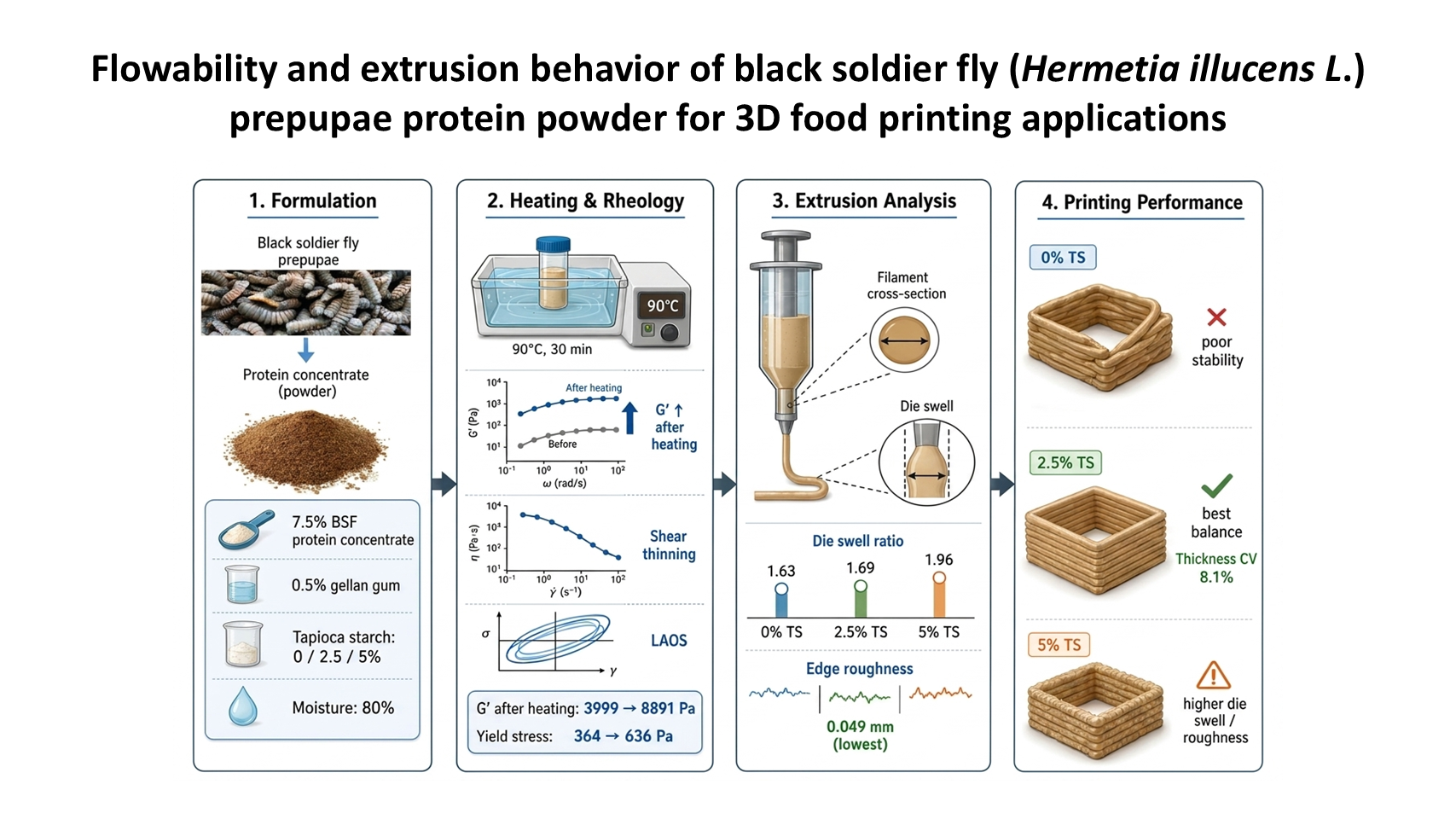
Black soldier fly (Hermetia illucens L.) prepupae (BSFP) are a sustainable protein source, but the use of full-fat prepupal protein powder in extrusion-based three-dimensional food printing is limited by poor structure and flow control. This study developed black soldier fly prepupal protein-based pastes and evaluated the effects of tapioca starch concentration and thermal treatment on rheology, die swell, and printing stability. Pastes were formulated at 80% moisture content using 0.5% gellan gum, tapioca starch at 0%, 2.5%, or 5%, and corresponding BSFP powder contents of 24.87%, 21.98%, and 19.09%, respectively. Thermal treatment significantly strengthened the paste structure, increasing the initial storage modulus to 3,998.56, 6,248.78, and 8,891.23 Pa for 0%, 2.5%, and 5% starch, respectively. Steady shear analysis showed shear-thinning behavior, while model-estimated yield stress after heating increased from 363.577 to 636.062 Pa with starch addition. Large-amplitude oscillatory shear and Chebyshev coefficient analysis showed that starch increased nonlinear elastic resistance and strain stiffening. However, 5% starch caused the high die swell ratio of 1.96 and edge roughness of 0.074 mm. The 2.5% starch formulation showed the lowest edge roughness of 0.049 mm and thickness variation of 8.1%, producing the most stable printed structure. Overall, moderate starch addition improved printability by balancing flow, recovery, and shape retention.
- Lu S, Taethaisong N, Meethip W, et al. Nutritional composition of black soldier fly larvae (Hermetia illucens L.) and its potential uses as alternative protein sources in animal diets: A review. Insects. 2022;13(9):831. doi: 10.3390/insects13090831
- Katemala K, Hanboonsong Y, Chumee S, et al. Rice bran and surimi by-products enhance nutritional quality and growth gene expression in Hermetia illucens (L.). J Insects Food Feed. 2026:1-21. doi: 10.1163/23524588-bja10424
- Barragan-Fonseca KB, Gort G, Dicke M, van Loon JJA. Effects of dietary protein and carbohydrate on life-history traits and body protein and fat contents of the black soldier fly Hermetia illucens. Physiol Entomol. 2019;44(2):148-159. doi: 10.1111/phen.12285
- Mshayisa VV. Physico-chemical, Techno-functional and Structural Properties of Native and Glycated Proteins Isolated From Black Soldier Fly (Hermetia illucens) Larvae. Doctoral dissertation. Bellville, South Africa: Cape Peninsula University of Technology; 2021. Accessed July 15, 2026. https://etd.cput.ac.za/server/api/core/bitstreams/c7b5c15b-9d84-41c5-b73f-ff6e9f592262/content
- Hron B, Rosen R. Viscosity of commercial food-based formulas and home-prepared blenderized feeds. J Pediatr Gastroenterol Nutr. 2020;70(6):e124-e128. doi: 10.1097/MPG.0000000000002657
- Oyinloye TM, Yoon WB. Impact of saturated and unsaturated oils on the nonlinear viscoelasticity, microstructure, and 3D printability of fish myofibrillar-protein-based pastes and gels. Gels. 2025;11(4):295. doi: 10.3390/gels11040295
- Jeon EY, Kim Y, Yun HJ, Kim BK, Choi YS. 3D printing of materials and printing parameters with animal resources: A review. Food Sci Anim Resour. 2024;44(2):225-238. doi: 10.5851/kosfa.2023.e73
- Tejada-Ortigoza V, Cuan-Urquizo E. Towards the development of 3D-printed food: A rheological and mechanical approach. 2022;11(9):1191. doi: 10.3390/foods11091191
- Bugday ZY, Venkatachalam A, Anderson PD, van der Sman RGM. Rheology of paste-like food inks for 3D printing: Effects of nutrient and water content. Curr Res Food Sci. 2024;9:100847. doi: 10.1016/j.crfs.2024.100847
- Kim HW, Lee JH, Park SM, et al. Effect of hydrocolloids on rheological properties and printability of vegetable inks for 3D food printing. J Food Sci. 2018;83(12):2923-2932. doi: 10.1111/1750-3841.14391
- Hu H, Guo J, Huang Z, Huang Q, Lu X. Effect of different hydrocolloids on the physicochemical, printing, and digestion properties of 3D printed purple sweet potato. Food Hydrocoll. 2023;144:109058. doi: 10.1016/j.foodhyd.2023.109058
- Oh Y, Lee S, Lee NK, Rhee JK. Improving the three-dimensional printability of potato starch loaded onto food ink. J Microbiol Biotechnol. 2024;34(4):891-901. doi: 10.4014/jmb.2311.11040
- Toniazzo T, Leverrier C, Souza NL, Almeida G, Tadini CC, Guenard-Lampron V. Influence of starch-based gels on 3D food printing: Linking printability, texture, rheological properties, and sensory evaluation. Future Foods. 2025;12:100725. doi: 10.1016/j.fufo.2025.100725
- Yan B, Zhao Z, Zhang N, et al. 3D food printing curing technology based on gellan gum. J Food Eng. 2022;327:111036. doi: 10.1016/j.jfoodeng.2022.111036
- Abdl Aali RAK, Al-Sahlany STG. Gellan gum as a unique microbial polysaccharide: Its characteristics, synthesis, and current application trends. Gels. 2024;10(3):183. doi: 10.3390/gels10030183
- Campbell M, Ortuño J, Stratakos AC, et al. Impact of thermal and high-pressure treatments on the microbiological quality and in vitro digestibility of black soldier fly (Hermetia illucens) larvae. Animals. 2020;10(4):682. doi: 10.3390/ani10040682
- Bessa LW, Pieterse E, Marais J, Dhanani K, Hoffman LC. Food safety of consuming black soldier fly (Hermetia illucens) larvae: Microbial, heavy metal and cross-reactive allergen risks. Foods. 2021;10(8):1934. doi: 10.3390/foods10081934
- Xu L, Gu L, Su Y, et al. Impact of thermal treatment on the rheological, microstructural, protein structures and extrusion 3D printing characteristics of egg yolk. Food Hydrocoll. 2020;100:105399. doi: 10.1016/j.foodhyd.2019.105399
- Cheng Y, Liang K, Chen Y, et al. Effect of molecular structure changes during starch gelatinization on its rheological and 3D printing properties. Food Hydrocoll. 2023;137:108364. doi: 10.1016/j.foodhyd.2022.108364
- Erturk MY, Le ANM, Kokini J. Advances in large amplitude oscillatory shear rheology of food materials. Front Food Sci Technol. 2023;3:1130165. doi: 10.3389/frfst.2023.1130165
- Zhang Q, Chen Y, Zhou A, et al. An end-to-end AI framework for data-driven evaluation and optimisation of direct ink writing-based 3D printing. Virtual Phys Prototyp. 2025;20(1):e2584948. doi: 10.1080/17452759.2025.2584948
- Latimer GW Jr, ed. Official Methods of Analysis of AOAC International. 20th ed. Rockville, MD: AOAC International; 2016. AOAC International.
- Folch J, Lees M, Sloane Stanley GH. A simple method for the isolation and purification of total lipides from animal tissues. J Biol Chem. 1957;226(1):497-509. doi: 10.1016/S0021-9258(18)64849-5
- Mshayisa VV, Van Wyk J, Zozo B. Nutritional, techno-functional and structural properties of black soldier fly (Hermetia illucens) larvae flours and protein concentrates. Foods. 2022;11(5):724. doi: 10.3390/foods11050724
- International Organization for Standardization. ISO 2591-1:1988: Test Sieving—Part 1:Methods Using Test Sieves of Woven Wire Cloth and Perforated Metal Plate. Geneva, Switzerland: International Organization for Standardization; 1988. Accessed July 15, 2026. https://www.iso.org/standard/7569.html
- Zhou P, Zhong K, Zhu Y. Numerical study of hydrodynamic cavitation pretreatment of food waste: Effect of pressure drop on the cavitation behavior. Processes. 2024;12(2):300. doi: 10.3390/pr12020300
- Ewoldt RH, Hosoi AE, McKinley GH. New measures for characterizing nonlinear viscoelasticity in large amplitude oscillatory shear. J Rheol. 2008;52(6):1427-1458. doi: 10.1122/1.2970095
- Joyner HS. Nonlinear (large-amplitude oscillatory shear) rheological properties and their impact on food processing and quality. Annu Rev Food Sci Technol. 2021;12(1):591-609. doi: 10.1146/annurev-food-061220-100714
- Ewoldt RH, Winter P, Maxey J, McKinley GH. Large amplitude oscillatory shear of pseudoplastic and elastoviscoplastic materials. Rheol Acta. 2010;49(2):191-212. doi: 10.1007/s00397-009-0403-7
- Kumar S, Queiroz LS, Marie R, et al. Gelling properties of black soldier fly (Hermetia illucens) larvae protein after ultrasound treatment. Food Chem. 2022;386:132826. doi: 10.1016/j.foodchem.2022.132826
- Renzetti S, Henket J, Raaijmakers E, van den Hoek I, van der Sman R. Hydrogen bond density and glass-transition temperature govern gelatinization and gel rheology in cereal and tuber starches. Curr Res Food Sci. 2025;10:101101. doi: 10.1016/j.crfs.2025.101101
- Nickerson MT, Paulson AT, Speers RA. Rheological properties of gellan solutions: Effect of calcium ions and temperature on pre-gel formation. Food Hydrocoll. 2003;17(5):577-583. doi: 10.1016/S0268-005X(02)00075-9
- Klost M, Ramirez-Huerta MI, Drusch S. Heat-induced gelation of protein from mealworm (Tenebrio molitor): Influence of pH and zinc concentration. Food Hydrocoll Health. 2022;2:100105. doi: 10.1016/j.fhfh.2022.100105
- Tavagnacco L, Chiessi E, Severini L, et al. Molecular origin of the two-step mechanism of gellan aggregation. Sci Adv. 2023;9(10):eadg4392. doi: 10.1126/sciadv.adg4392
- Maldonado-Rosas R, Tejada-Ortigoza V, Cuan-Urquizo E, et al. Evaluation of rheology and printability of 3D printing nutritious food with complex formulations. Addit Manuf. 2022;58:103030. doi: 10.1016/j.addma.2022.103030
- van der Sman R, Tian B, Ghoreishy SA, Noort M. Relationships between printability and rheology of inks for personalized nutrition. Curr Res Food Sci. 2025;11:101220. doi: 10.1016/j.crfs.2025.101220
- Duvarci OC, Yazar G, Kokini JL. The comparison of LAOS behavior of structured food materials (suspensions, emulsions and elastic networks). Trends Food Sci Technol. 2017;60:2-11. doi: 10.1016/j.tifs.2016.08.014
- Wang Y, Selomulya C. Food rheology applications of large amplitude oscillation shear (LAOS). Trends Food Sci Technol. 2022;127:221-244. doi: 10.1016/j.tifs.2022.05.018
- Yazar G, Duvarci OC, Tavman S, Kokini JL. Effect of mixing on LAOS properties of hard wheat flour dough. J Food Eng. 2016;190:195-204. doi: 10.1016/j.jfoodeng.2016.06.011
- Qin Z, Yang Y, Zhang Z, et al. A critical review: Gel-based edible inks for 3D food printing: Materials, rheology-geometry mapping, and control. Gels. 2025;11(10):780. doi: 10.3390/gels11100780
- Outrequin TCR, Gamonpilas C, Sreearunothai P, Deepaisarn S, Siriwatwechakul W. Machine learning-assisted evaluation of filament spreading during extrusion-based 3D food printing: Impact of rheological and printing parameters. J Food Eng. 2024;381:112166. doi: 10.1016/j.jfoodeng.2024.112166
- Tan C, Toh WY, Wong G, Li L. Extrusion-based 3D food printing: Materials and machines. Int J Bioprint. 2024;4(2):143. doi: 10.18063/IJB.v4i2.143