
Smart hydrogel bioinks integrated with two-dimensional nanomaterials for cardiovascular bioprinting and atherosclerosis modeling

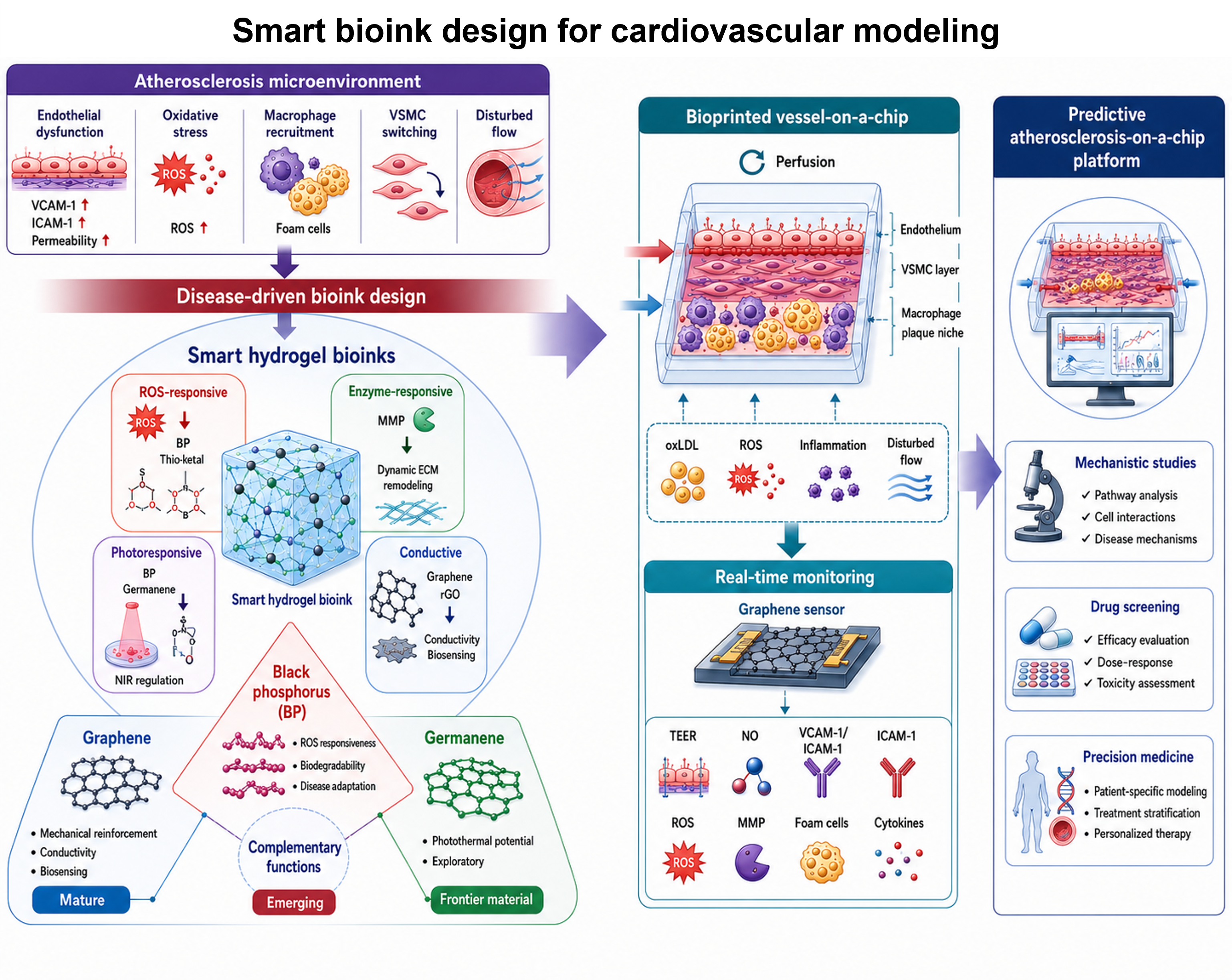
Cardiovascular diseases remain the leading cause of mortality worldwide, and atherosclerosis underlies most ischemic cardiovascular events. However, conventional in vitro and in vivo models fail to fully reproduce the complex cellular interactions, extracellular matrix remodeling, oxidative stress, and hemodynamic microenvironment of human vascular lesions. This review summarizes recent advances in stimuli-responsive hydrogel bioinks for three-dimensional bioprinting of atherosclerosis models. We discuss how disease-responsive biomaterials can dynamically regulate the cellular microenvironment and improve the physiological relevance of engineered vascular tissues. Particular emphasis is placed on the integration of two-dimensional nanomaterials. Graphene-based materials provide electrical conductivity, mechanical reinforcement, and sensing capabilities; black phosphorus offers biodegradability, photothermal responsiveness, and reactive oxygen species-sensitive behavior; and emerging Xene materials such as germanene present additional opportunities for multifunctional bioink design. We compare their respective advantages and limitations for cardiovascular bioprinting. Finally, we discuss key translational challenges, including material standardization, long-term biosafety, biological validation, manufacturing scalability, and regulatory approval. We propose that multifunctional, disease-responsive bioinks combined with advanced biofabrication technologies will accelerate the development of physiologically relevant cardiovascular disease models and precision medicine platforms.
- Porsch F, Binder CJ. Autoimmune diseases and atherosclerotic cardiovascular disease. Nat Rev Cardiol. 2024;21(11):780-807. doi: 10.1038/s41569-024-01045-7
- Shoaran M, Maffia P. Tackling inflammation in atherosclerosis. Nat Rev Cardiol. 2024;21(7):442. doi: 10.1038/s41569-024-01007-z
- Libby P, Buring JE, Badimon L, et al. Atherosclerosis. Nat Rev Dis Prim. 2019;5(1):56. doi: 10.1038/s41572-019-0106-z
- Mach F, Baigent C, Catapano AL, et al. 2019 ESC/EAS guidelines for the management of dyslipidaemias: Lipid modification to reduce cardiovascular risk. Atherosclerosis. 2019;290(1):140-205. doi: 10.1016/j.atherosclerosis.2019.08.014
- Zhang L, Zhou J, Kong W. Extracellular matrix in vascular homeostasis and disease. Nat Rev Cardiol. 2025;22(5):333-353. doi: 10.1038/S41569-024-01103-0
- Lin A, Miano JM, Fisher EA, Misra A. Chronic inflammation and vascular cell plasticity in atherosclerosis. Nat Cardiovasc Res. 2024;3(12):1408-1423. doi: 10.1038/S44161-024-00569-Y
- Döring Y, van der Vorst EPC, Weber C. Targeting immune cell recruitment in atherosclerosis. Nat Rev Cardiol. 2024;21(11):824-840. doi: 10.1038/S41569-024-01023-Z
- Stroope C, Nettersheim FS, Coon B, et al. Dysregulated cellular metabolism in atherosclerosis: mediators and therapeutic opportunities. Nat Metab. 2024;6(4):617. doi: 10.1038/S42255-024-01015-W
- Tamargo IA, Baek KI, Kim Y, Park C, Jo H. Flow-induced reprogramming of endothelial cells in atherosclerosis. Nat Rev Cardiol. 2023;20(11):738-753. doi: 10.1038/S41569-023-00883-1
- Nam U, Lee S, Ahmad A, Yi HG, Jeon JS. Microphysiological Systems as Organ-Specific In Vitro Vascular Models for Disease Modeling. BioChip J. 2024;18(3):345-356. doi: 10.1007/S13206-024-00152-4
- Zhao Y, Landau S, Okhovatian S, et al. Integrating organoids and organ-on-a-chip devices. Nat Rev Bioeng. 2024;2(7):588-608. doi: 10.1038/s44222-024-00207-z
- Khosravi R, Radisic M. Heart-on-a-chip and vasculature-on-a-chip platforms as models of cardiovascular disease. Nat Rev Cardiol. 2026;23(8):537-554. doi: 10.1038/s41569-026-01255-1
- Huang MS, Christakopoulos F, Roth JG, Heilshorn SC. Organoid bioprinting: from cells to functional tissues. Nat Rev Bioeng. 2025;3(2):126-142. doi: 10.1038/s44222-024-00268-0
- Khanna A, Ayan B, Undieh AA, Yang YP, Huang NF. Advances in three-dimensional bioprinted stem cell-based tissue engineering for cardiovascular regeneration. J Mol Cell Cardiol. 2022;169:13-27. doi: 10.1016/j.yjmcc.2022.04.017
- Kim MS, Choi Y, Lee KY. Three-Dimensional Printing and Bioprinting Strategies for Cardiovascular Constructs: From Printing Inks to Vascularization. Polym. 2025;17(17):2337. doi: 10.3390/POLYM17172337
- Wang B, Zhang J, Jiang J, Cheng C, Zhao Y. Current trends, applications, and challenges in three-dimensional bioprinting for cardiovascular disease models and therapies. iScience. 2026;29(5):115519. doi: 10.1016/j.isci.2026.115519
- Ma D, Liu J, Lu WW, Liu W, Ruan C. Dynamic bioinks for tissue/organ bioprinting: Principle, challenge, and perspective. Prog Mater Sci. 2026;155:101527. doi: 10.1016/j.pmatsci.2025.101527
- Chandarana C, Sane D, Mishra S, Chaubey A, Gohil U, Prajapati B. Recent Advances in Bioink Research for Biomedical Applications. Biomed Mater Devices. 2026;4(4):3950–3981. doi: 10.1007/S44174-025-00478-Z
- Malekmohammadi S, Aminabad NS, Sabzi A, et al. Smart and Biomimetic 3D and 4D Printed Composite Hydrogels: Opportunities for Different Biomedical Applications. Biomedicines. 2021;9(11):1-46. doi: 10.3390/biomedicines9111537
- El-Husseiny HM, Mady EA, Hamabe L, et al. Smart/stimuli-responsive hydrogels: Cutting-edge platforms for tissue engineering and other biomedical applications. Mater Today Bio. 2022;13:100186. doi: 10.1016/j.mtbio.2021.100186
- Rahimnejad M, Jahangiri S, Zirak Hassan Kiadeh S, et al. Stimuli-responsive biomaterials: smart avenue toward 4D bioprinting. Crit Rev Biotechnol. 2024;44(5):860-891. doi: 10.1080/07388551.2023.2213398
- Kim J, D A G, Debnath P, Saha P. Smart Multi-Responsive Biomaterials and Their Applications for 4D Bioprinting. Biomimetics. 2024;9(8):484. doi: 10.3390/biomimetics9080484
- Yarali E, Mirzaali MJ, Ghalayaniesfahani A, Accardo A, Diaz-Payno PJ, Zadpoor AA. 4D Printing for Biomedical Applications. Adv Mater. 2024;36(31):e2402301. doi: 10.1002/adma.202402301
- Kandasamy M, Vijayananth K, Parasuraman A, Ayrilmis N. 3D Bioprinting of Biomaterials: A Review of Advances in Techniques, Materials, and Applications. Polym Adv Technol. 2025;36(9):1-17. doi: 10.1002/pat.70324
- Batty M, Bennett MR, Yu E. The Role of Oxidative Stress in Atherosclerosis. Cells. 2022;11(23):3843. doi: 10.3390/cells11233843
- Pu M, Cao H, Zhang H, et al. ROS-responsive hydrogels: from design and additive manufacturing to biomedical applications. Mater Horizons. 2024;11(16):3721-3746. doi: 10.1039/D4MH00289J
- Gaihre B, Potes MA, Serdiuk V, Tilton M, Liu X, Lu L. Two-dimensional nanomaterials-added dynamism in 3D printing and bioprinting of biomedical platforms: Unique opportunities and challenges. Biomaterials. 2022;284:121507. doi: 10.1016/j.biomaterials.2022.121507
- Zhang J, Eyisoylu H, Qin XH, Rubert M, Müller R. 3D bioprinting of graphene oxide-incorporated cell-laden bone mimicking scaffolds for promoting scaffold fidelity, osteogenic differentiation and mineralization. Acta Biomater. 2021;121:637-652. doi: 10.1016/j.actbio.2020.12.026
- Patil R, Alimperti S. Graphene in 3D Bioprinting. J Funct Biomater. 2024;15(4):82. doi: 10.3390/jfb15040082
- Edrisi F, Baheiraei N, Razavi M, Roshanbinfar K, Imani R, Jalilinejad N. Potential of graphene-based nanomaterials for cardiac tissue engineering. J Mater Chem B. 2023;11(31):7280-7299. doi: 10.1039/D3TB00654A
- Memarian P, Bagher Z, Asghari S, Aleemardani M, Seifalian A. Emergence of graphene as a novel nanomaterial for cardiovascular applications. Nanoscale. 2024;16(27):12793-12819. doi: 10.1039/d4nr00018h
- He Z, Chen W, Hu K, et al. Resolvin D1 delivery to lesional macrophages using antioxidative black phosphorus nanosheets for atherosclerosis treatment. Nat Nanotechnol. 2024;19(9):1386–1398. doi: 10.1038/S41565-024-01687-1
- He M, Zhang X, Ran X, et al. Black Phosphorus Nanosheets Protect Neurons by Degrading Aggregative α-syn and Clearing ROS in Parkinson’s Disease. Adv Mater. 2024;36(30):e2404576. doi: 10.1002/adma.202404576
- Huang W, Hu L, Tang Y, Xie Z, Zhang H. Recent Advances in Functional 2D MXene-Based Nanostructures for Next-Generation Devices. Adv Funct Mater. 2020;30(49):2005223. doi: 10.1002/adfm.202005223
- Wang M, Huang W. Emerging Xene-Related Nanostructures for Versatile Applications. Nanomaterials. 2023;13(3):517. doi: 10.3390/nano13030517
- Wang X, Sun X, Bu T, et al. Germanene-modified chitosan hydrogel for treating bacterial wound infection: An ingenious hydrogel-assisted photothermal therapy strategy. Int J Biol Macromol. 2022;221:1558-1571. doi: 10.1016/j.ijbiomac.2022.09.128
- Kang MS, Jang HJ, Jo HJ, Raja IS, Han DW. MXene and Xene: promising frontier beyond graphene in tissue engineering and regenerative medicine. Nanoscale Horizons. 2024;9(1):93-117. doi: 10.1039/D3NH00428G
- Bennett MR, Sinha S, Owens GK. Vascular Smooth Muscle Cells in Atherosclerosis. Circ Res. 2016;118(4):692-702. doi: 10.1161/CIRCRESAHA.115.306361
- Lambert J, Jørgensen HF. Epigenetic regulation of vascular smooth muscle cell phenotypes in atherosclerosis. Atherosclerosis. 2025;401:119085. doi: 10.1016/j.atherosclerosis.2024.119085
- Grootaert MOJ, Bennett MR. Vascular smooth muscle cells in atherosclerosis: time for a re-assessment. Cardiovasc Res. 2021;117(11):2326-2339. doi: 10.1093/CVR/CVAB046
- Chen R, McVey DG, Shen D, Huang X, Ye S. Phenotypic Switching of Vascular Smooth Muscle Cells in Atherosclerosis. J Am Heart Assoc. 2023;12(20):31121. doi: 10.1161/JAHA.123.031121
- Saraswathibhatla A, Indana D, Chaudhuri O. Cell-extracellular matrix mechanotransduction in 3D. Nat Rev Mol Cell Biol. 2023;24(7):495-516. doi: 10.1038/S41580-023-00583-1
- Kong P, Cui ZY, Huang XF, Zhang DD, Guo RJ, Han M. Inflammation and atherosclerosis: signaling pathways and therapeutic intervention. Signal Transduct Target Ther. 2022;7(1):131. doi: 10.1038/S41392-022-00955-7
- Ajoolabady A, Pratico D, Lin L, et al. Inflammation in atherosclerosis: pathophysiology and mechanisms. Cell Death Dis. 2024;15(11):817. doi: 10.1038/S41419-024-07166-8
- Hou P, Fang J, Liu Z, et al. Macrophage polarization and metabolism in atherosclerosis. Cell Death Dis. 2023;14(10):691. doi: 10.1038/S41419-023-06206-Z
- Chen R, Zhang H, Tang B, et al. Macrophages in cardiovascular diseases: molecular mechanisms and therapeutic targets. Signal Transduct Target Ther. 2024;9(1):130. doi: 10.1038/S41392-024-01840-1
- Wieland EB, Kempen LJAP, Donners MMPC, Biessen EAL, Goossens P. Macrophage heterogeneity in atherosclerosis: A matter of context. Eur J Immunol. 2024;54(1):e2350464. doi: 10.1002/EJI.202350464
- Li Q, Yu S, Wang Y, et al. Multiscale bioprinted arterial models recapitulate synergistic microenvironmental interactions in vascular disease. Cell Biomater. 2026;2(5):100257. doi: 10.1016/j.celbio.2025.100257
- Förstermann U, Xia N, Li H. Roles of Vascular Oxidative Stress and Nitric Oxide in the Pathogenesis of Atherosclerosis. Circ Res. 2017;120(4):713-735. doi: 10.1161/circresaha.116.309326
- Susser LI, Rayner KJ. Through the layers: how macrophages drive atherosclerosis across the vessel wall. J Clin Invest. 2022;132(9):e157011. doi: 10.1172/jcI157011
- Gastanadui MG, Margaroli C, Litovsky S, et al. Spatial Transcriptomic Approach to Understanding Coronary Atherosclerotic Plaque Stability. Arterioscler Thromb Vasc Biol. 2024;44(11):e264-e276. doi: 10.1161/atvbaha.123.320330
- Cole JE, Monaco C. Spatial Transcriptomics: A New Frontier in Atherosclerosis Research? Arterioscler Thromb Vasc Biol. 2024;44(11):2291-2293. doi: 10.1161/atvbaha.124.321652
- Yu H, Gao R, Liu Y, Fu L, Zhou J, Li L. Stimulus-Responsive Hydrogels as Drug Delivery Systems for Inflammation Targeted Therapy. Adv Sci. 2024;11(1):1-48. doi: 10.1002/advs.202306152
- Zhang J, Sun D, Liao Y, et al. Time-Released Black Phosphorus Hydrogel Accelerates Myocardial Repairing through Antioxidant and Motivates Macrophage Polarization Properties. Biomater Res. 2024;28:0029. doi: 10.34133/BMR.0029
- Zhang J, Sun D, Guo Y, et al. Targeted delivery of black phosphorus nanosheets by ROS responsive complex hydrogel based on angiogenesis and antioxidant promotes myocardial infarction repair. J Nanobiotechnology. 2024;22(1):433. doi: 10.1186/s12951-024-02685-0
- Di Nubila A, Dilella G, Simone R, Barbieri SS. Vascular Extracellular Matrix in Atherosclerosis. Int J Mol Sci. 2024;25(22):12017. doi: 10.3390/ijms252212017
- Alonso-Herranz L, Albarrán-Juárez J, Bentzon JF. Mechanisms of fibrous cap formation in atherosclerosis. Front Cardiovasc Med. 2023;10:1-7. doi: 10.3389/fcvm.2023.1254114
- Yan A, Gotlieb AI. The microenvironment of the atheroma expresses phenotypes of plaque instability. Cardiovasc Pathol. 2023;67:107572. doi: 10.1016/j.carpath.2023.107572
- Ruddy JM, Ikonomidis JS, Jones JA. Multidimensional Contribution of Matrix Metalloproteinases to Atherosclerotic Plaque Vulnerability: Multiple Mechanisms of Inhibition to Promote Stability. J Vasc Res. 2016;53(1-2):1-16. doi: 10.1159/000446703
- Wang X, Shen Y, Shang M, Liu X, Munn LL. Endothelial mechanobiology in atherosclerosis. Cardiovasc Res. 2023;119(8):1656-1675. doi: 10.1093/cvr/cvad076
- Cheng H, Zhong W, Wang L, et al. Effects of shear stress on vascular endothelial functions in atherosclerosis and potential therapeutic approaches. Biomed Pharmacother. 2023;158:114198. doi: 10.1016/j.biopha.2022.114198
- Wang WL, Shih YT, Wei SY, Chiu JJ. Impacts of aging and fluid shear stress on vascular endothelial metabolism and atherosclerosis development. J Biomed Sci. 2025;32(1):83. doi: 10.1186/s12929-025-01177-z
- He L, Zhang CL, Chen Q, Wang L, Huang Y. Endothelial shear stress signal transduction and atherogenesis: From mechanisms to therapeutics. Pharmacol Ther. 2022;235:108152. doi: 10.1016/j.pharmthera.2022.108152
- Liu Y, Huang T, Yap NA, Lim K, Ju LA. Harnessing the power of bioprinting for the development of next-generation models of thrombosis. Bioact Mater. 2024;42:328-344. doi: 10.1016/j.bioactmat.2024.08.040
- Maringanti R, Van Dijk CGM, Meijer EM, et al. Atherosclerosis on a Chip: A 3-Dimensional Microfluidic Model of Early Arterial Events in Human Plaques. Arterioscler Thromb Vasc Biol. 2024;44(12):2453-2472. doi: 10.1161/atvbaha.124.321332
- Gong S, Li Y, Yan K, et al. The Crosstalk Between Endothelial Cells, Smooth Muscle Cells, and Macrophages in Atherosclerosis. Int J Mol Sci. 2025;26(4):1457. doi: 10.3390/ijms26041457
- Vuong TNAM, Bartolf-Kopp M, Andelovic K, et al. Integrating Computational and Biological Hemodynamic Approaches to Improve Modeling of Atherosclerotic Arteries. Adv Sci (Weinh). 2024;11(26):e2307627. doi: 10.1002/advs.202307627
- Kim JJ, Cho DW. Advanced strategies in 3D bioprinting for vascular tissue engineering and disease modelling using smart bioinks. Virtual Phys Prototyp. 2024;19(1):e2395470. doi: 10.1080/17452759.2024.2395470
- Lu P, Ruan D, Huang M, et al. Harnessing the potential of hydrogels for advanced therapeutic applications: current achievements and future directions. Signal Transduct Target Ther. 2024;9(1):166. doi: 10.1038/S41392-024-01852-X
- Neumann M, di Marco G, Iudin D, et al. Stimuli-Responsive Hydrogels: The Dynamic Smart Biomaterials of Tomorrow. Macromolecules. 2023;56(21):8377-8392. doi: 10.1021/acs.macromol.3C00967
- Ikram M, Mahmud MAP, Kalyar AA, Alomayri T, Almahri A, Hussain D. 3D-bioprinting of MXenes: Developments, medical applications, challenges, and future roadmap. Colloids Surfaces B Biointerfaces. 2025;251:114568. doi: 10.1016/j.colsurfb.2025.114568
- Choi JH, Haizan I, Choi JW. Recent advances in two-dimensional materials for the diagnosis and treatment of neurodegenerative diseases. Discov Nano. 2024;19(1):151. doi: 10.1186/S11671-024-04099-1
- Cao H, Duan L, Zhang Y, Cao J, Zhang K. Current hydrogel advances in physicochemical and biological response-driven biomedical application diversity. Signal Transduct Target Ther. 2021;6(1):426. doi: 10.1038/S41392-021-00830-X
- Miao Y, Chen Y, Luo J, et al. Black phosphorus nanosheets-enabled DNA hydrogel integrating 3D-printed scaffold for promoting vascularized bone regeneration. Bioact Mater. 2023;21:97-109. doi: 10.1016/j.bioactmat.2022.08.005
- Wolf D, Ley K. Immunity and Inflammation in Atherosclerosis. Circ Res. 2019;124(2):315-327. doi: 10.1161/CIRCRESAHA.118.313591
- Su C, Menon NV, Xu X, et al. A novel human arterial wall-on-a-chip to study endothelial inflammation and vascular smooth muscle cell migration in early atherosclerosis. Lab Chip. 2021;21(12):2359-2371. doi: 10.1039/D1LC00131K
- Kort-Mascort J, Flores-Torres S, Peza-Chavez O, et al. Decellularized ECM hydrogels: prior use considerations, applications, and opportunities in tissue engineering and biofabrication. Biomater Sci. 2023;11(2):400-431. doi: 10.1039/D2BM01273A
- Wang Z, Hu C, Zhang W, et al. Dynamically crosslinked ECM-like hydrogels loaded with ROS-responsive drug nanoparticles for treating inflammation in myocardial infarction and stroke. Compos Part B Eng. 2024;285:111734. doi: 10.1016/j.compositesb.2024.111734
- Shakeri A, Wang Y, Zhao Y, et al. Engineering Organ-on-a-Chip Systems for Vascular Diseases. Arterioscler Thromb Vasc Biol. 2023;43(12):2241-2255. doi: 10.1161/atvbaha.123.318233
- Basatemur GL, Jørgensen HF, Clarke MCH, Bennett MR, Mallat Z. Vascular smooth muscle cells in atherosclerosis. Nat Rev Cardiol. 2019;16(12):727-744. doi: 10.1038/s41569-019-0227-9
- Synofzik J, Heene S, Jonczyk R, Blume C. Ink-structing the future of vascular tissue engineering: a review of the physiological bioink design. Bio-Design Manuf 2024.72 2024;7(2):181-205. doi: 10.1007/S42242-024-00270-W
- Zhou Z, Tang W, Yang J, Fan C. Application of 4D printing and bioprinting in cardiovascular tissue engineering. Biomater Sci. 2023;11(19):6403-6420. doi: 10.1039/D3BM00312D
- Motta I, Soccio M, Guidotti G, Lotti N, Pasquinelli G. Hydrogels for Cardio and Vascular Tissue Repair and Regeneration. Gels (Basel, Switzerland). 2024;10(3):196. doi: 10.3390/GELS10030196
- El-Husseiny HM, Mady EA, El-Dakroury WA, Doghish AS, Tanaka R. Stimuli-responsive hydrogels: smart state of-the-art platforms for cardiac tissue engineering. Front Bioeng Biotechnol. 2023;11(Jun 28):1-30. doi: 10.3389/fbioe.2023.1174075
- Kalhori D, Zakeri N, Zafar-Jafarzadeh M, Moroni L, Solati-Hashjin M. Cardiovascular 3D bioprinting: A review on cardiac tissue development. Bioprinting. 2022;28(2022):e00221. doi: 10.1016/j.bprint.2022.e00221
- Schwab A, Levato R, D’Este M, Piluso S, Eglin D, Malda J. Printability and Shape Fidelity of Bioinks in 3D Bioprinting. Chem Rev. 2020;120(19):11028-11055. doi: 10.1021/acs.chemrev.0C00084
- Kamboj D, Choudhary B, Singh G, Kumar N, Narwal S, Dhingra AK. Oxidative Stress in Cardiovascular Diseases: Mechanisms and Exploring Advanced Therapies. Cardiovasc Hematol Agents Med Chem. 2025;23(3):183-201. doi: 10.2174/0118715257344485250207074727
- Ungvari Z, Tarantini S, Donato AJ, Galvan V, Csiszar A. Mechanisms of vascular aging. Circ Res. 2018;123(7):849-867. doi: 10.1161/CIRCRESAHA.118.31137
- Ungvari Z, Tarantini S, Sorond F, Merkely B, Csiszar A. Mechanisms of Vascular Aging, A Geroscience Perspective: JACC Focus Seminar. J Am Coll Cardiol. 2020;75(8):931. doi: 10.1016/j.jacc.2019.11.061
- Yuan Z, Li Y, Sun M, et al. Recent progress in ROS-responsive biomaterials for the diagnosis and treatment of cardiovascular diseases. Theranostics. 2025;15(11):5172-5219. doi: 10.7150/thno.106991
- Tapeinos C, Gao H, Bauleth-Ramos T, Santos HA. Progress in Stimuli-Responsive Biomaterials for Treating Cardiovascular and Cerebrovascular Diseases. Small. 2022;18(36):e2200291. doi: 10.1002/smll.202200291
- Zhang Y, Jiang M, Wang T. Reactive oxygen species (ROS)-responsive biomaterials for treating myocardial ischemia-reperfusion injury. Front Bioeng Biotechnol. 2024;12:1469393. doi: 10.3389/fbioe.2024.1469393
- Shen Z, Guo Z, Tan T, Hu J, Zhang Y. Reactive Oxygen Species Scavenging and Biodegradable Peptide Hydrogel as 3D Culture Scaffold for Cardiomyocytes. ACS Biomater Sci Eng. 2020;6(7):3957-3966. doi: 10.1021/acsbiomaterials.0c00340
- Tong S, Chen J, Li Y, Zhao W. Emerging Gel Technologies for Atherosclerosis Research and Intervention. Gels. 2026;12(1):80. doi: 10.3390/GELS12010080
- Fu Y, Zhou Y, Wang K, Li Z, Kong W. Extracellular Matrix Interactome in Modulating Vascular Homeostasis and Remodeling. Circ Res. 2024;134(7):931-949. doi: 10.1161/CIRCRESAHA.123.324055
- Bräuninger H, Krüger S, Bacmeister L, et al. Matrix metalloproteinases in coronary artery disease and myocardial infarction. Basic Res Cardiol. 2023;118(1):18. doi: 10.1007/S00395-023-00987-2
- Chen W, Wang C, Liu W, et al. A Matrix-Metalloproteinase-Responsive Hydrogel System for Modulating the Immune Microenvironment in Myocardial Infarction. Adv Mater. 2023;35(13):2209041. doi: 10.1002/adma.202209041
- Pi Y, Ganabady K, Celiz AD. Enzyme-responsive biomaterials for biomedical applications. Commun Mater. 2025;6(1):263. doi: 10.1038/s43246-025-00983-0
- Zustiak SP, Leach JB. Hydrolytically degradable poly(ethylene glycol) hydrogel scaffolds with tunable degradation and mechanical properties. Biomacromolecules. 2010;11(5):1348-1357. doi: 10.1021/bm100137q
- Marder M, Remmert C, Perschel JA, et al. Stem cell-derived vessels-on-chip for cardiovascular disease modeling. Cell Rep. 2024;43(4):114008. doi: 10.1016/j.celrep.2024.114008
- Ajiteru O, Sultan MT, Lee YJ, et al. A 3D Printable Electroconductive Biocomposite Bioink Based on Silk Fibroin-Conjugated Graphene Oxide. Nano Lett. 2020;20(9):6873-6883. doi: 10.1021/acs.nanolett.0c02986
- Lee M, Park J, Choe G, et al. A Conductive and Adhesive Hydrogel Composed of MXene Nanoflakes as a Paintable Cardiac Patch for Infarcted Heart Repair. ACS Nano. 2023;17(13):12290-12304. doi: 10.1021/acsnano.3c00933
- Chong J, Sung C, Nam KS, et al. Highly conductive tissue-like hydrogel interface through template-directed assembly. Nat Commun. 2023;14(1):2206. doi: 10.1038/S41467-023-37948-1
- Grzelak KA, Westerfield AD, Kumar V, et al. Electrical stimulation directs formation of perfused vasculature in engineered tissues. bioRxiv Prepr Serv Biol. Published online September 3, 2025. doi: 10.1101/2025.08.28.672965
- Qian Y, Yao Y. Mechanobiological regulation of endothelial vascularization after myocardial infarction: matrix mechanics, hydrogel strategies and applications. Biomater Sci. Published online. 2026. doi: 10.1039/D5BM01885D
- Tao Y, Chan HF, Shi B, Li M, Leong KW. Light: A Magical Tool for Controlled Drug Delivery. Adv Funct Mater. 2020;30(49):2005029. doi: 10.1002/adfm.202005029
- Luo R, Xiang X, Jiao Q, Hua H, Chen Y. Photoresponsive Hydrogels for Tissue Engineering. ACS Biomater Sci Eng. 2024;10(6):3612-3630. doi: 10.1021/acsbiomaterials.4c00314
- Zhang Y, Kumar P, Lv S, et al. Recent advances in 3D bioprinting of vascularized tissues. Mater Des. 2021;199:109398. doi: 10.1016/j.matdes.2020.109398
- Xian R, Xian H, Dong H, et al. Black Phosphorus-Loaded Gelatin Methacryloyl Hydrogels Enhance Angiogenesis via Activation of the PEAK1-MAPK Pathway. ACS Appl Mater Interfaces. 2025;17(18):26371-26385. doi: 10.1021/acsami.5C02054
- Zhang Y, Qi G, Zhang L, et al. Black phosphorus-based photothermal-responsive hydrogel enhanced osteoporotic bone injury regeneration by alleviating oxidative stress and remodeling bone homeostasis. J Nanobiotechnology. 2026;24(1):238. doi: 10.1186/s12951-026-04097-8
- Picos A, Seoane N, Campos-Toimil M, Viña D. Vascular senescence and aging: mechanisms, clinical implications, and therapeutic prospects. Biogerontology. 2025;26(3):118. doi: 10.1007/S10522-025-10256-5
- Herzog MJ, Müller P, Lechner K, et al. Arterial stiffness and vascular aging: mechanisms, prevention, and therapy. Signal Transduct Target Ther. 2025;10(1):282. doi: 10.1038/s41392-025-02346-0
- Zheng Y, Hong X, Wang J, et al. 2D Nanomaterials for Tissue Engineering and Regenerative Nanomedicines: Recent Advances and Future Challenges. Adv Healthc Mater. 2021;10(7):e2001743. doi: 10.1002/adhm.202001743
- Zorrón M, Cabrera AL, Sharma R, et al. Emerging 2D Nanomaterials-Integrated Hydrogels: Advancements in Designing Theragenerative Materials for Bone Regeneration and Disease Therapy. Adv Sci. 2024;11(31):e2403204-e2403204. doi: 10.1002/advs.202403204
- Qi W, Zhang R, Wang Z, et al. Advances in the Application of Black Phosphorus-Based Composite Biomedical Materials in the Field of Tissue Engineering. Pharmaceuticals (Basel). 2024;17(2):242. doi: 10.3390/ph17020242
- Lee H, Kim KS, Zare I, et al. Smart nanomaterials for multimodal theranostics and tissue regeneration. Coord Chem Rev. 2025;541:216801. doi: 10.1016/j.ccr.2025.216801
- Chen J, Deng M, Wang J, et al. Recent advances in injectable hydrogels for osteoarthritis treatments. Front Bioeng Biotechnol. 2025;13:1644222. doi: 10.3389/fbioe.2025.1644222
- Jalilinejad N, Rabiee M, Baheiraei N, et al. Electrically conductive carbon-based (bio)-nanomaterials for cardiac tissue engineering. Bioeng Transl Med. 2023;8(1):e10347. doi: 10.1002/btm2.10347
- Lee M, Kim MC, Lee JY. Nanomaterial-Based Electrically Conductive Hydrogels for Cardiac Tissue Repair. Int J Nanomedicine. 2022;17:6181-6200. doi: 10.2147/ijn.s386763
- Lisboa ES, Serafim C, Santana W, et al. Nanomaterials-combined methacrylated gelatin hydrogels (GelMA) for cardiac tissue constructs. J Control Release. 2024;365:617-639. doi: 10.1016/j.jconrel.2023.11.056
- Byrne R, Carrico A, Lettieri M, Rajan AK, Forster RJ, Cumba LR. Bioinks and biofabrication techniques for biosensors development: A review. Mater today Bio. 2024;28:101185. doi: 10.1016/j.mtbio.2024.101185
- Wang Z, Zhao J, Tang W, et al. Multifunctional Nanoengineered Hydrogels Consisting of Black Phosphorus Nanosheets Upregulate Bone Formation. Small. 2019;15(41):e1901560. doi: 10.1002/smll.201901560
- Li J, Liu X, Crook JM, Wallace GG. Development of 3D printable graphene oxide based bio-ink for cell support and tissue engineering. Front Bioeng Biotechnol. 2022;10:994776. doi: 10.3389/fbioe.2022.994776
- Shin SR, Zihlmann C, Akbari M, et al. Reduced Graphene Oxide-GelMA Hybrid Hydrogels as Scaffolds for Cardiac Tissue Engineering. Small. 2016;12(27):3677-3689. doi: 10.1002/smll.201600178
- Chen XB, Fazel Anvari-Yazdi A, Duan X, et al. Biomaterials / bioinks and extrusion bioprinting. Bioact Mater. 2023;28:511-536. doi: 10.1016/j.bioactmat.2023.06.006
- Santana MDV, Magulas MBS, Brito GC, et al. Cryogenic 3D Printing of GelMA/Graphene Bioinks: Improved Mechanical Strength and Structural Properties for Tissue Engineering. Int J Nanomedicine. 2024;19:10745-10765. doi: 10.2147/ijn.s486868
- Ni F, Chen Y, Wang Z, et al. Graphene derivative based hydrogels in biomedical applications. J Tissue Eng. 2024;15:20417314241282131. doi: 10.1177/20417314241282131
- Diez-Aldama I, Garcia-Villen F, Saenz-Del-Burgo L, Scaini D, Pedraz JL. Graphene Oxide Modified Bioink for 3D-Bioprinting of Vascular Graft. ACS Appl bio Mater. 2025;8(5):3858-3872. doi: 10.1021/acsabm.5c00004
- Liu N, Ye X, Yao B, et al. Advances in 3D bioprinting technology for cardiac tissue engineering and regeneration. Bioact Mater. 2021;6(5):1388-1401. doi: 10.1016/j.bioactmat.2020.10.021
- Shin SR, Aghaei-Ghareh-Bolagh B, Dang TT, et al. Cell-laden microengineered and mechanically tunable hybrid hydrogels of gelatin and graphene oxide. Adv Mater. 2013;25(44):6385-6391. doi: 10.1002/adma.201301082
- Zhou J, Yang X, Liu W, et al. Injectable OPF/graphene oxide hydrogels provide mechanical support and enhance cell electrical signaling after implantation into myocardial infarct. Theranostics. 2018;8(12):3317-3330. doi: 10.7150/THNO.25504
- Noor N, Shapira A, Edri R, Gal I, Wertheim L, Dvir T. 3D Printing of Personalized Thick and Perfusable Cardiac Patches and Hearts. Adv Sci. 2019;6(11):1900344. doi: 10.1002/advs.201900344
- Dai X, Zhang Y, Gao L, et al. A mechanically strong, highly stable, thermoplastic, and self-healable supramolecular polymer hydrogel. Adv Mater. 2015;27(23):3566-3571. doi: 10.1002/adma.201500534
- Bellet P, Gasparotto M, Pressi S, et al. Graphene-Based Scaffolds for Regenerative Medicine. Nanomater (Basel, Switzerland). 2021;11(2):1-41. doi: 10.3390/nano11020404
- Oubari H, Berkane Y, Jeljeli M, Lellouch AG, Smadja DM. Engineering the Future of Stem Cells in Vascular Reconstruction: A Leap Towards Functional Endothelialized Tissue-Engineered Vascular Conduits. Stem cell Rev reports. 2025;21(8):2796-2806. doi: 10.1007/s12015-025-10968-8
- Paul A, Hasan A, Kindi H Al, et al. Injectable graphene oxide/hydrogel-based angiogenic gene delivery system for vasculogenesis and cardiac repair. ACS Nano. 2014;8(8):8050-8062. doi: 10.1021/nn5020787
- Landau S, Okhovatian S, Zhao Y, et al. Bioengineering vascularization. Dev. 2024;151(23):dev204455. doi: 10.1242/dev.204455/363262
- Wang X, He B. Endothelial dysfunction: molecular mechanisms and clinical implications. MedComm. 2024;5(8):e651. doi: 10.1002/mcO2.651
- Lu Y, Yang G, Wang S, et al. Stretchable graphene–hydrogel interfaces for wearable and implantable bioelectronics. Nat Electron. 2024;7(1):51-65. doi: 10.1038/s41928-023-01091-y
- Cognetti JS, Moen MT, Brewer MG, et al. A photonic biosensor-integrated tissue chip platform for real-time sensing of lung epithelial inflammatory markers. Lab Chip. 2023;23(2):239-250. doi: 10.1039/d2lC00864e
- Shinde A, Illath K, Kasiviswanathan U, et al. Recent Advances of Biosensor-Integrated Organ-on-a-Chip Technologies for Diagnostics and Therapeutics. Anal Chem. 2023;95(6):3121-3146. doi: 10.1021/acs.analchem.2C05036
- Yang W, Li T, Liao S, Zhou J, Huang L. Organ-on-a-chip platforms integrated with biosensors for precise monitoring of the cells and cellular microenvironment. TrAC Trends Anal Chem. 2024;172:117569. doi: 10.1016/j.trac.2024.117569
- Kosowska K, Korycka P, Jankowska-Snopkiewicz K, et al. Graphene Oxide (GO)-Based Bioink with Enhanced 3D Printability and Mechanical Properties for Tissue Engineering Applications. Nanomater (Basel, Switzerland). 2024;14(9):760. doi: 10.3390/nano14090760
- Lee YJ, Ajiteru O, Lee JS, et al. Highly conductive, stretchable, and biocompatible graphene oxide biocomposite hydrogel for advanced tissue engineering. Biofabrication. 2024;16(4):045032. doi: 10.1088/1758-5090/ad6cf7
- Chen X, Manshaii F, Tioran K, et al. Wearable biosensors for cardiovascular monitoring leveraging nanomaterials. Adv Compos Hybrid Mater. 2024;7(3):97. doi: 10.1007/s42114-024-00906-6
- Coronado Reyes OI, Téllez Anguiano A del C, Gutiérrez Gnecchi JA, Castro Pimentel LA, García Rodríguez E. Comparison between mathematical methods to estimate blood glucose levels from ECG signals. Biosens Bioelectron X. 2024;18:100474. doi: 10.1016/j.biosx.2024.100474
- Li J, Zeng H, Zeng Z, Zeng Y, Xie T. Promising Graphene-Based Nanomaterials and Their Biomedical Applications and Potential Risks: A Comprehensive Review. ACS Biomater Sci Eng. 2021;7(12):5363-5396. doi: 10.1021/acsbiomaterials.1c00875
- Lin H, Buerki-Thurnherr T, Kaur J, et al. Environmental and Health Impacts of Graphene and Other Two-Dimensional Materials: A Graphene Flagship Perspective. ACS Nano. 2024;18(8):6038-6094. doi: 10.1021/acsnano.3c09699
- Donato KZ, Tan HL, Marangoni VS, et al. Graphene oxide classification and standardization. Sci Rep. 2023;13(1):6064. doi: 10.1038/S41598-023-33350-5
- Loret T, de Luna LAV, Lucherelli MA, et al. Lung Persistence, Biodegradation, and Elimination of Graphene-Based Materials are Predominantly Size-Dependent and Mediated by Alveolar Phagocytes. Small. 2023;19(39):e2301201. doi: 10.1002/smll.202301201
- Zhang Z, Schniepp HC, Adamson DH. Characterization of graphene oxide: Variations in reported approaches. Carbon N Y. 2019;154:510-521. doi: 10.1016/j.carbon.2019.07.103
- Tao W, Zhu X, Yu X, et al. Black Phosphorus Nanosheets as a Robust Delivery Platform for Cancer Theranostics. Adv Mater. 2017;29(1):1603276. doi: 10.1002/adma.201603276
- Wu J, Xu R, Shao M, Zhao L, Xu W, Guo Y. Phosphorus-Based Nanomaterials for Biomedical Applications: A Review. ACS Appl Nano Mater. 2024;7(10):11022-11036. doi: 10.1021/acsanm.4c00015
- Guo Y, Huang C, Zhang J, Wang Z, Guo X, Wei Y. Injectable Conductive Hydrogel Containing Black Phosphorus Nanosheets Inhibits the Oxidative Stress-Inflammation Chain during Myocardial Infarction. ACS Appl Nano Mater. 2023;6(18):16749-16767. doi: 10.1021/acsanm.3c02956
- Ling X, Wang H, Huang S, Xia F, Dresselhaus MS. The renaissance of black phosphorus. Proc Natl Acad Sci U S A. 2015;112(15):4523-4530. doi: 10.1073/pnas.1416581112
- Qian X, Gu Z, Chen Y. Two-dimensional black phosphorus nanosheets for theranostic nanomedicine. Mater Horizons. 2017;4(5):800-816. doi: 10.1039/c7mh00305f
- Sun Z, Xie H, Tang S, et al. Ultrasmall Black Phosphorus Quantum Dots: Synthesis and Use as Photothermal Agents. Angew Chem Int Ed Engl. 2015;54(39):11526-11530. doi: 10.1002/anie.201506154
- Shao J, Xie H, Huang H, et al. Biodegradable black phosphorus-based nanospheres for in vivo photothermal cancer therapy. Nat Commun. 2016;7:12967. doi: 10.1038/ncomms12967
- Li H xuan, Zhao K chi, Jiang J jia, Zhu Q san. Research progress on black phosphorus hybrids hydrogel platforms for biomedical applications. J Biol Eng. 2023;17(1):8. doi: 10.1186/s13036-023-00328-w
- Choi JR, Yong KW, Choi JY, et al. Black Phosphorus and its Biomedical Applications. Theranostics. 2018;8(4):1005-1026. doi: 10.7150/THNO.22573
- Bai X, Wang R, Hu X, et al. Two-Dimensional Biodegradable Black Phosphorus Nanosheets Promote Large Full-Thickness Wound Healing through In Situ Regeneration Therapy. ACS Nano. 2024;18(4):3553-3574. doi: 10.1021/acsnano.3c11177
- Wu N, Wang X, Das CM, et al. Bioengineering applications of black phosphorus and their toxicity assessment. Environ Sci Nano. 2021;8(12):3452-3477. doi: 10.1039/d1en00273b
- Zhang T, Wan Y, Xie H, et al. Degradation Chemistry and Stabilization of Exfoliated Few-Layer Black Phosphorus in Water. J Am Chem Soc. 2018;140(24):7561-7567. doi: 10.1021/jacs.8b02156
- Qiu Y, Yu C, Yue Z, et al. Chronological-Programmed Black Phosphorus Hydrogel for Responsive Modulation of the Pathological Microenvironment in Myocardial Infarction. ACS Appl Mater Interfaces. 2024;16(14):17323-17338. doi: 10.1021/acsami.4c01956
- Xiang Q, Yi X, Zhu XH, Wei X, Jiang DS. Regulated cell death in myocardial ischemia–reperfusion injury. Trends Endocrinol Metab. 2024;35(3):219-234. doi: 10.1016/j.tem.2023.10.010
- Qin L, Ling G, Peng F, et al. Black phosphorus nanosheets and gemcitabine encapsulated thermo-sensitive hydrogel for synergistic photothermal-chemotherapy. J Colloid Interface Sci. 2019;556:232-238. doi: 10.1016/j.jcis.2019.08.058
- Qiu M, Wang D, Liang W, et al. Novel concept of the smart NIR-light-controlled drug release of black phosphorus nanostructure for cancer therapy. Proc Natl Acad Sci U S A. 2018;115(3):501-506. doi: 10.1073/pnas.1714421115
- Chen J, Huan W, Mao L, et al. Impaired barrier integrity of endothelial cells induced by PEGylated black phosphorus nanosheets. Sci Total Environ. 2023;861:160645. doi: 10.1016/j.scitotenv.2022.160645
- Xu Y, Xu C, He L, et al. Stratified-structural hydrogel incorporated with magnesium-ion-modified black phosphorus nanosheets for promoting neuro-vascularized bone regeneration. Bioact Mater. 2022;16:271-284. doi: 10.1016/j.bioactmat.2022.02.024
- Cui H, Yu ZX, Huang Y, et al. 3D printing of thick myocardial tissue constructs with anisotropic myofibers and perfusable vascular channels. Biomater Adv. 2023;153:213579. doi: 10.1016/j.bioadv.2023.213579
- Sakamoto A, Suwa K, Kawakami R, et al. Significance of Intra-plaque Hemorrhage for the Development of High-Risk Vulnerable Plaque: Current Understanding from Basic to Clinical Points of View. Int J Mol Sci. 2023;24(17):13298. doi: 10.3390/ijms241713298
- Ugusman A, Hisam NSN, Othman NS, et al. Pharmacological interventions for intraplaque neovascularization in atherosclerosis. Pharmacol Ther. 2024;261:108685. doi: 10.1016/j.pharmthera.2024.108685
- Wang H, Gui B, Chen Y, et al. Black-Phosphorus-Reinforced Injectable Conductive Biodegradable Hydrogel for the Delivery of ADSC-Derived Exosomes to Repair Myocardial Infarction. ACS Appl Mater Interfaces. 2024;16(43):58286-58298. doi: 10.1021/acsami.4c12285
- Hasan MM, Ahmad A, Akter MZ, Choi YJ, Yi HG. Bioinks for bioprinting using plant-derived biomaterials. Biofabrication. 2024;16(4):042004. doi: 10.1088/1758-5090/ad6932
- Emebu S, Ogunleye RO, Achbergerová E, Vítková L, Ponížil P, Martinez CM. Review and proposition for model-based multivariable-multiobjective optimisation of extrusion-based bioprinting. Appl Mater Today. 2023;34:101914. doi: 10.1016/j.apmt.2023.101914
- Wang J, Cui Z, Maniruzzaman M. Bioprinting: A focus on improving bioink printability and cell performance based on different process parameters. Int J Pharm. 2023;640:123020. doi: 10.1016/j.ijpharm.2023.123020
- Cooke ME, Rosenzweig DH. The rheology of direct and suspended extrusion bioprinting. APL Bioeng. 2021;5(1):011502. doi: 10.1063/5.0031475
- Ribeiro A, Blokzijl MM, Levato R, et al. Assessing bioink shape fidelity to aid material development in 3D bioprinting. Biofabrication. 2018;10(1):014102. doi: 10.1088/1758-5090/aa90e2
- Groll J, Burdick JA, Cho DW, et al. A definition of bioinks and their distinction from biomaterial inks. Biofabrication. 2019;11(1):013001. doi: 10.1088/1758-5090/aaec52
- Guo J, Du L. An update on ox-LDL-inducing vascular smooth muscle cell-derived foam cells in atherosclerosis. Front Cell Dev Biol. 2024;12:1-12. doi: 10.3389/fcell.2024.1481505
- Kong Z, Wang X. Bioprinting Technologies and Bioinks for Vascular Model Establishment. Int J Mol Sci. 2023;24(1):891. doi: 10.3390/ijms24010891
- Ashtari K, Nazari H, Ko H, et al. Electrically conductive nanomaterials for cardiac tissue engineering. Adv Drug Deliv Rev. 2019;144:162-179. doi: 10.1016/j.addr.2019.06.001
- Luo X, Zhang M, Dai W, et al. Targeted nanoparticles triggered by plaque microenvironment for atherosclerosis treatment through cascade effects of reactive oxygen species scavenging and anti-inflammation. J Nanobiotechnology. 2024;22(1):440. doi: 10.1186/s12951-024-02652-9
- Chen X, Sun Z, Peng X, et al. Graphene Oxide/Black Phosphorus Functionalized Collagen Scaffolds with Enhanced Near-Infrared Controlled In Situ Biomineralization for Promoting Infectious Bone Defect Repair through PI3K/Akt Pathway. ACS Appl Mater Interfaces. 2024;16(38):50369-50388. doi: 10.1021/acsami.4c10284
- Akther F, Sajin D, Moonshi SS, et al. An intimal-lumen model in a microfluidic device: potential platform for atherosclerosis-related studies. Lab Chip. 2025;25(3):354-369. doi: 10.1039/d4lc00868e
- Chegel R, Behzad S. Tunable Electronic, Optical, and Thermal Properties of two- dimensional Germanene via an external electric field. Sci Rep. 2020;10(1):704. doi: 10.1038/S41598-020-57558-x
- Rohaizad N, Mayorga-Martinez CC, Fojtů M, Latiff NM, Pumera M. Two-dimensional materials in biomedical, biosensing and sensing applications. Chem Soc Rev. 2021;50(1):619-657. doi: 10.1039/d0CS00150c
- Tao W, Kong N, Ji X, et al. Emerging two-dimensional monoelemental materials (Xenes) for biomedical applications. Chem Soc Rev. 2019;48(11):2891-2912. doi: 10.1039/c8cs00823j
- Kang Y, Zhang H, Chen L, et al. The marriage of Xenes and hydrogels: Fundamentals, applications, and outlook. Innov. 2022;3(6):100327. doi: 10.1016/j.xinn.2022.100327
- Garg M, Thakur A. A review: Biomedical applications of phosphorene, antimonene, and germanene-based 2D material/hydrogel complexes. J Mater Sci. 2023;58(1):34-45. doi: 10.1007/S10853-022-07954-7
- Ge M, Zong M, Xu D, et al. Freestanding germanene nanosheets for rapid degradation and photothermal conversion. Mater Today Nano. 2021;15:100119. doi: 10.1016/j.mtnano.2021.100119
- Liu N, Bo G, Liu Y, Xu X, Du Y, Dou SX. Recent Progress on Germanene and Functionalized Germanene: Preparation, Characterizations, Applications, and Challenges. Small. 2019;15(32):1805147. doi: 10.1002/smll.201805147
- Ng S, Pumera M. 2D Functionalized Germananes: Synthesis and Applications. Adv Mater. 2023;35(7):1-37. doi: 10.1002/adma.202207196
- Kupchak I, Bechstedt F, Pulci O, Gori P. Tuning the optical absorption and exciton bound states of germanene by chemical functionalization. Sci Rep. 2024;14(1):25182. doi: 10.1038/S41598-024-75620-W
- Kovalska E, Antonatos N, Luxa J, Sofer Z. Edge-Hydrogenated Germanene by Electrochemical Decalcification-Exfoliation of CaGe2: Germanene-Enabled Vapor Sensor. ACS Nano. 2021;15(10):16709-16718. doi: 10.1021/acsnano.1c06675
- Miri AK, Khalilpour A, Cecen B, Maharjan S, Shin SR, Khademhosseini A. Multiscale bioprinting of vascularized models. Biomaterials. 2019;198:204-216. doi: 10.1016/j.biomaterials.2018.08.006
- Samal S, Sahoo SP, Acharya B. Nanotechnology-Driven cardiac tissue engineering and 3D bioprinting: Mechanistic insights into myocardial repair and regeneration. Nano Trends. 2025;12:100155. doi: 10.1016/j.nwnano.2025.100155
- Karvinen J, Kellomäki M. Design aspects and characterization of hydrogel-based bioinks for extrusion-based bioprinting. Bioprinting. 2023;32:e00274. doi: 10.1016/j.bprint.2023.e00274
- Suzuki S, Katsube D, Yano M, et al. Germanene Reformation from Oxidized Germanene on Ag(111)/Ge(111) by Vacuum Annealing. Small methods. 2025;9(3):e2400863. doi: 10.1002/smtd.202400863
- Ouyang J, Feng C, Ji X, et al. 2D Monoelemental Germanene Quantum Dots: Synthesis as Robust Photothermal Agents for Photonic Cancer Nanomedicine. Angew Chem Int Ed Engl. 2019;58(38):13405-13410. doi: 10.1002/ANIE.201908377
- Geevarghese R, Żur-Pińska J, Parisi D, Włodarczyk-Biegun MK. A comprehensive protocol for hydrogel-based bioink design: balancing printability, stability, and biocompatibility. J Mater Chem B. 2025;13(42):13750-13768. doi: 10.1039/d5tb00737b
- Resende MAA, Rigo ECS, Vercik A. Printability of Bioinks: A Consolidated Definition for Additive Manufacturing. ACS omega. 2025;10(48):58110–58122. doi: 10.1021/acsomega.5c00727
- Bianco E, Butler S, Jiang S, Restrepo OD, Windl W, Goldberger JE. Stability and Exfoliation of Germanane: A Germanium Graphane Analogue. ACS Nano. 2013;7(5):4414-4421. doi: 10.1021/nn4009406
- Wang H, Wang C, Zhang Y, et al. Recent Advances in Xenes Based FET for Biosensing Applications. Adv Sci (Weinh). 2025;12(21):e2500752. doi: 10.1002/advs.202500752
- Duan X, Liu Z, Xie Z, et al. Emerging monoelemental 2D materials (Xenes) for biosensor applications. Nano Res. 2023;16(5):7030-7052. doi: 10.1007/S12274-023-5418-3
- Dixit M, Shrestha LK, Ariga K, Pati F. Carbon-Based Nanoarchitectonics in Advancing Cardiac Tissue Bioprinting: A Review. ACS Appl Nano Mater. 2024;7(21):24638-24652. doi: 10.1021/acsanm.4C04441
- Ding Q, Sun T, Su W, et al. Bioinspired Multifunctional Black Phosphorus Hydrogel with Antibacterial and Antioxidant Properties: A Stepwise Countermeasure for Diabetic Skin Wound Healing. Adv Healthc Mater. 2022;11(12):e2102791. doi: 10.1002/adhm.202102791
- Wu Y, Okesola BO, Xu J, et al. Disordered protein-graphene oxide co-assembly and supramolecular biofabrication of functional fluidic devices. Nat Commun. 2020;11(1):1182. doi: 10.1038/S41467-020-14716-Z
- Kaviani S, Talebi A, Labbaf S, Karimzadeh F. Conductive GelMA/alginate/polypyrrole/graphene hydrogel as a potential scaffold for cardiac tissue engineering; Physiochemical, mechanical, and biological evaluations. Int J Biol Macromol. 2024;259(Pt 2):129276. doi: 10.1016/j.ijbiomac.2024.129276
- Liu F, Ding N, Huo D, et al. Surface-Engineered Monocyte Inhibits Atherosclerotic Plaque Destabilization via Graphene Quantum Dot-Mediated MicroRNA Delivery. Adv Healthc Mater. 2019;8(15):e1900386. doi: 10.1002/adhm.201900386
- Chung S, Revia RA, Zhang M. Graphene Quantum Dots and Their Applications in Bioimaging, Biosensing, and Therapy. Adv Mater. 2021;33(22):e1904362. doi: 10.1002/adma.201904362
- Yan Z, Liu Z, Yang B, Zhu X, Song E, Song Y. Long-term exposure of molybdenum disulfide nanosheets leads to hepatic lipid accumulation and atherogenesis in apolipoprotein E deficient mice. NanoImpact. 2023;30:100462. doi: 10.1016/j.impact.2023.100462
- Ge X, Cui H, Kong J, et al. A Non-Invasive Nanoprobe for In Vivo Photoacoustic Imaging of Vulnerable Atherosclerotic Plaque. Adv Mater. 2020;32(38):e2000037. doi: 10.1002/adma.202000037
- Bai Q, Lao X, Pang SY, et al. Plaque-Targeted Delivery of Fluoride-Free MXene Nanozyme for Alleviating Atherosclerosis via Sonocatalytic Therapy. Adv Mater. 2025;37(48):1-16. doi: 10.1002/adma.202420189
- Leung CM, de Haan P, Ronaldson-Bouchard K, et al. A guide to the organ-on-a-chip. Nat Rev Methods Prim. 2022;2(1):33. doi: 10.1038/s43586-022-00118-6
- Augustin HG, Koh GY. Organotypic vasculature: From descriptive heterogeneity to functional pathophysiology. Science. 2017;357(6353):1-12. doi: 10.1126/science.aal2379
- Li J, Chen X, Hu M, et al. The application of composite scaffold materials based on decellularized vascular matrix in tissue engineering: a review. Biomed Eng Online. 2023;22(1):62. doi: 10.1186/S12938-023-01120-z
- Ouyang Z, Zhong J, Shen J, Zeng Y. The cell origins of foam cell and lipid metabolism regulated by mechanical stress in atherosclerosis. Front Physiol. 2023;14:01-09. doi: 10.3389/fphys.2023.1179828
- Fernandez DM, Rahman AH, Fernandez NF, et al. Single-cell immune landscape of human atherosclerotic plaques. Nat Med. 2019;25(10):1576-1588. doi: 10.1038/S41591-019-0590-4
- La Chica Lhoëst MT, Martinez A, Claudi L, et al. Mechanisms modulating foam cell formation in the arterial intima: exploring new therapeutic opportunities in atherosclerosis. Front Cardiovasc Med. 2024;11:1381520. doi: 10.3389/fcvm.2024.1381520
- Chen J, Zhang X, Millican R, et al. Recent Progress in in vitro Models for Atherosclerosis Studies. Front Cardiovasc Med. 2021;8:1-23. doi: 10.3389/fcvm.2021.790529
- Wang R, Zhang H, Li S, et al. Current progress of in vitro vascular models on microfluidic chips. Biofabrication. 2025;17(2):022004. doi: 10.1088/1758-5090/adb182
- Garcia-Sabaté A, Mohamed WKE, Sapudom J, Alatoom A, Al Safadi L, Teo JCM. Biomimetic 3D Models for Investigating the Role of Monocytes and Macrophages in Atherosclerosis. Bioeng (Basel, Switzerland). 2020;7(3):1-20. doi: 10.3390/bioengineering7030113
- Akther F, Sajin D, Moonshi SS, Wu Y, Vazquez-Prada KX, Ta HT. Modeling Foam Cell Formation in A Hydrogel-Based 3D-Intimal Model: A Study of The Role of Multi-Diseases During Early Atherosclerosis. Adv Biol. 2024;8(4):e2300463. doi: 10.1002/adbi.202300463
- Naiyeju I, Lehoux S, Tabrizian M. Key parameters for designing robust 2D and 3D spheroid models for in vitro atherosclerosis research. Bioeng Transl Med. 2025;10(3):e10736. doi: 10.1002/btm2.10736
- Krug A, Inserra G, Drewes R, et al. Three-dimensional spheroid models for cardiovascular biology and pathology. Mechanobiol Med. 2025;3(3):100144. doi: 10.1016/j.mbm.2025.100144
- Parma L, Sachs N, Sobczak N, et al. CXCL12 Derived From ACKR1+ Intraplaque Neovessels Mediates CD8+ T Cell Recruitment in Human Atherosclerosis. Circulation. 2025;151(8):581-584. doi: 10.1161/CIRCULATIONAHA.124.072560
- Mallone A, Stenger C, Von Eckardstein A, Hoerstrup SP, Weber B. Biofabricating atherosclerotic plaques: In vitro engineering of a three-dimensional human fibroatheroma model. Biomaterials. 2018;150:49-59. doi: 10.1016/j.biomaterials.2017.09.034
- Wang Y, Liu A, Zhang X, et al. Microfluidic organ-on-a-chip for modeling coronary artery disease: Recent applications, limitations and potential. J Tissue Eng. 2025;16:20417314251394447. doi: 10.1177/20417314251394447
- Quintard C, Tubbs E, Jonsson G, et al. A microfluidic platform integrating functional vascularized organoids-on-chip. Nat Commun. 2024;15(1):1452. doi: 10.1038/s41467-024-45710-4
- Chandra Sekar N, Khoshmanesh K, Baratchi S. Bioengineered models of cardiovascular diseases. Atherosclerosis. 2024;393:117565. doi: 10.1016/j.atherosclerosis.2024.117565
- Chang SQ, Qiao L, Abodunrin OD, Zou L, Huang NP. Advanced technologies of artery-on-a-chip: a review of construction strategies and disease models. Angiogenesis. 2026;29(2):17. doi: 10.1007/S10456-026-10030-2
- Yarbrough D, Chen R, Katsouleas K, et al. Artery-on-Chip Demonstrates Mechanical and Functional Features of Healthy and Diseased Living Smooth Muscle Tissue. Adv Funct Mater. Published online July 1, 2026. 2026:e76324. doi: 10.1002/adfm.76324
- Gold KA, Saha B, Rajeeva Pandian NK, et al. 3D Bioprinted Multicellular Vascular Models. Adv Healthc Mater. 2021;10(21):e2101141. doi: 10.1002/adhm.202101141
- Wang Z, Lee SJ, Cheng HJ, Yoo JJ, Atala A. 3D bioprinted functional and contractile cardiac tissue constructs. Acta Biomater. 2018;70:48-56. doi: 10.1016/j.actbio.2018.02.007
- Dell AC, Maresca J, Davis BA, Isaji T, Dardik A, Geibel JP. Development and deployment of a functional 3D-bioprinted blood vessel. Sci Reports. 2025;15(1):11668. doi: 10.1038/s41598-025-93276-y
- Krajewska U, Chechli´nska C, Kurzyk A, Vascularisation in 3D bioprinted models: emerging solutions engineering functional tissues and tumour models. Biofabrication. 2026;18(2):022001. doi: 10.1088/1758-5090/AE2F02
- Liao Y, Gallegos-Martínez S, Kuang X, Du Y, Zhang YS, Zhang Y. Hybrid bioprinting of hierarchical vascular networks at capillary-scale resolution. Nat Chem Eng. 2026;3(6):328-339. doi: 10.1038/s44286-026-00396-x
- Chandra DK, Reis RL, Kundu SC, Kumar A, Mahapatra C. Nanomaterials-Based Hybrid Bioink Platforms in Advancing 3D Bioprinting Technologies for Regenerative Medicine. ACS Biomater Sci Eng. 2024;10(7):4145-4174. doi: 10.1021/acsbiomaterials.4c00166
- Jin X, Li Y, Ran H, Zhang Z, Cheng P, Wu Y. Smart nanomaterial-crosslinked hydrogels for biomedical applications. Smart Mater Med. 2025;6(3):417-433. doi: 10.1016/j.smaim.2025.11.001
- Ribezzi D, Zegwaart JP, Van Gansbeke T, et al. Multi-material Volumetric Bioprinting and Plug-and-play Suspension Bath Biofabrication via Bioresin Molecular Weight Tuning and via Multiwavelength Alignment Optics. Adv Mater. 2025;37(13):e2409355. doi: 10.1002/adma.202409355
- Aizarna-Lopetegui U, Größbacher G, Herrero-Ruiz A, et al. Hybrid Plasmonic Bioresins and dECM-Based Materials for Volumetric Bioprinting of Vascular-Inspired Architectures. ACS Appl Mater Interfaces. 2025;17(25):36982-36991. doi: 10.1021/acsami.5c03880
- Kong D, Ryu JC, Shin N, et al. In Vitro Modeling of Atherosclerosis Using iPSC-Derived Blood Vessel Organoids. Adv Healthc Mater. 2025;14(1):e2400919. doi: 10.1002/adhm.202400919
- Taylor CA, Figueroa CA. Patient-specific modeling of cardiovascular mechanics. Annu Rev Biomed Eng. 2009;11:109-134. doi: 10.1146/annurev.bioeng.10.061807.160521
- Jackson ML, Bond AR, George SJ. Mechanobiology of the endothelium in vascular health and disease: in vitro shear stress models. Cardiovasc drugs Ther. 2023;37(5):997-1010. doi: 10.1007/S10557-022-07385-1
- Aitken C, Mehta V, Schwartz MA, Tzima E. Mechanisms of endothelial flow sensing. Nat Cardiovasc Res. 2023;2(6):517-529. doi: 10.1038/S44161-023-00276-0
- Tabas I, Bornfeldt KE. Macrophage Phenotype and Function in Different Stages of Atherosclerosis. Circ Res. 2016;118(4):653-667. doi: 10.1161/CIRCRESAHA.115.306256
- De Meyer GRY, Zurek M, Puylaert P, Martinet W. Programmed death of macrophages in atherosclerosis: mechanisms and therapeutic targets. Nat Rev Cardiol. 2024;21(5):312-325. doi: 10.1038/S41569-023-00957-0
- Lee J, Choi JH. Deciphering Macrophage Phenotypes upon Lipid Uptake and Atherosclerosis. Immune Netw. 2020;20(3):1-21. doi: 10.4110/IN.2020.20.E22
- Moore KJ, Sheedy FJ, Fisher EA. Macrophages in atherosclerosis: a dynamic balance. Nat Rev Immunol. 2013;13(10):709-721. doi: 10.1038/NRI3520
- Roy P, Orecchioni M, Ley K. How the immune system shapes atherosclerosis: roles of innate and adaptive immunity. Nat Rev Immunol. 2022;22(4):251-265. doi: 10.1038/S41577-021-00584-1
- Guan Y, Racioppi L, Gerecht S. Engineering biomaterials to tailor the microenvironment for macrophage–endothelium interactions. Nat Rev Mater. 2023;8(10):688-699. doi: 10.1038/s41578-023-00591-9
- Imhof BA, Aurrand-Lions M. Adhesion mechanisms regulating the migration of monocytes. Nat Rev Immunol. 2004;4(6):432-444. doi: 10.1038/nri1375
- Whitworth CP, Polacheck WJ. Vascular organs-on-chip made with patient-derived endothelial cells: technologies to transform drug discovery and disease modeling. Expert Opin Drug Discov. 2024;19(3):339-351. doi: 10.1080/17460441.2023.2294947
- Jiang H, Li X, Chen T, et al. Bioprinted vascular tissue: Assessing functions from cellular, tissue to organ levels. Mater today Bio. 2023;23:100846. doi: 10.1016/j.mtbio.2023.100846
- Tabish TA, Zhu Y, Shukla S, et al. Graphene nanocomposites for real-time electrochemical sensing of nitric oxide in biological systems. Appl Phys Rev. 2023;10(4):041310. doi: 10.1063/5.0162640
- Ochieng BO, Zhao L, Ye Z. Three-Dimensional Bioprinting in Vascular Tissue Engineering and Tissue Vascularization of Cardiovascular Diseases. Tissue Eng Part B Rev. 2024;30(3):340-358. doi: 10.1089/TEN.TEB.2023.0175
- Lai J, Liu Y, Lu G, et al. 4D bioprinting of programmed dynamic tissues. Bioact Mater. 2024;37:348-377. doi: 10.1016/j.bioactmat.2024.03.033
- Liu J, Zhu M, Bai N, et al. Microfluidic Perfusable Pathological Vasculature for Atherosclerosis Drug Screening. Res (Washington, DC). 2025;8:0902. doi: 10.34133/research.0902
- Chae S, Ha DH, Lee H. 3D bioprinting strategy for engineering vascularized tissue models. Int J bioprinting. 2023;9(5):748. doi: 10.18063/ijb.748
- Kizhisseri M, Gharaie S, Schluter J. An analytical method informed by clinical imaging data for estimating outlet boundary conditions in computational fluid dynamics analysis of carotid artery blood flow. Sci Rep. 2023;13(1):14973. doi: 10.1038/S41598-023-42004-5
- Mir A, Lee E, Shih W, et al. 3D Bioprinting for Vascularization. Bioeng (Basel, Switzerland). 2023;10(5):606. doi: 10.3390/bioengineering10050606
- Zhou Y, Sekar NC, Thurgood P, et al. Bioengineered Vascular Model of Foam Cell Formation. ACS Biomater Sci Eng. 2023;9(12):6947-6955. doi: 10.1021/acsbiomaterials.3c01308
- Agarwal T, Onesto V, Banerjee D, et al. 3D bioprinting in tissue engineering: current state-of-the-art and challenges towards system standardization and clinical translation. Biofabrication. 2025;17(4):045001. doi: 10.1088/1758-5090/ade47a
- Wang Z, Hao Z, Yu S, Huang C, Pan Y, Zhao X. A Wearable and Deformable Graphene-Based Affinity Nanosensor for Monitoring of Cytokines in Biofluids. Nanomater (Basel, Switzerland). 2020;10(8):1-9. doi: 10.3390/nano10081503
- Sun Z, Zhao J, Leung E, et al. Three-Dimensional Bioprinting in Cardiovascular Disease: Current Status and Future Directions. Biomolecules. 2023;13(8):1180. doi: 10.3390/biom13081180
- Kim J. Characterization of Biocompatibility of Functional Bioinks for 3D Bioprinting. Bioeng (Basel, Switzerland). 2023;10(4):457. doi: 10.3390/bioengineering10040457
- Alves T, Mota WS, Barros C, et al. Review of scientific literature and standard guidelines for the characterization of graphene-based materials. J Mater Sci. 2024;59(32):14948-14980. doi: 10.1007/S10853-024-10061-4
- Bai M, Wan H, Zhang Y, et al. Two-dimensional nanomaterials based on rare earth elements for biomedical applications. Chem Sci. 2024;15(41):16887-16907. doi: 10.1039/d4sc02625j
- Wang Z, Guo H, Zhang J, Qian Y, Liu Y. Two-Dimensional Nanomaterials in Hydrogels and Their Potential Bio-Applications. Lubr. 2024;12(5):149. doi: 10.3390/lubricants12050149
- Libby P. The changing landscape of atherosclerosis. Nature. 2021;592(7855):524-533. doi: 10.1038/S41586-021-03392-8
- Ou L, Tan X, Qiao S, et al. Graphene-Based Material-Mediated Immunomodulation in Tissue Engineering and Regeneration: Mechanism and Significance. ACS Nano. 2023;17(19):18669-18687. doi: 10.1021/acsnano.3C03857
- Ding X, Pu Y, Tang M, Zhang T. Pulmonary hazard identifications of Graphene family nanomaterials: Adverse outcome pathways framework based on toxicity mechanisms. Sci Total Environ. 2023;857(Pt 1):159329. doi: 10.1016/j.scitotenv.2022.159329
- Smith LS, Haidari H, Amsalu A, et al. Black Phosphorus Nanoflakes: An Emerging Nanomaterial for Clinical Wound Management and Biomedical Applications. Int J Mol Sci. 2024;25(23):12824. doi: 10.3390/ijms252312824
- Yedgar S, Barshtein G, Gural A. Hemolytic Activity of Nanoparticles as a Marker of Their Hemocompatibility. Micromachines. 2022;13(12):2091. doi: 10.3390/mi13122091
- Kim Y, Chica-Carrillo EC, Lee HJ. Microfabricated sensors for non-invasive, real-time monitoring of organoids. Micro Nano Syst Lett. 2024;12(1):26. doi: 10.1186/S40486-024-00216-y
- Liu S, Kumari S, He H, et al. Biosensors integrated 3D organoid/organ-on-a-chip system: A real-time biomechanical, biophysical, and biochemical monitoring and characterization. Biosens Bioelectron. 2023;231:115285. doi: 10.1016/j.bios.2023.115285
- Flynn CD, Chang D, Mahmud A, et al. Biomolecular sensors for advanced physiological monitoring. Nat Rev Bioeng. 2023;1(8):560-575. doi: 10.1038/s44222-023-00067-z
- Wu J, Liu H, Chen W, Ma B, Ju H. Device integration of electrochemical biosensors. Nat Rev Bioeng. 2023;1(5):346-360. doi: 10.1038/S44222-023-00032-W
- Chen S, Sun Y, Fan X, et al. Review on two-dimensional material-based field-effect transistor biosensors: accomplishments, mechanisms, and perspectives. J Nanobiotechnology. 2023;21(1):144. doi: 10.1186/S12951-023-01898-z
- He W, Deng J, Ma B, et al. Recent Advancements of Bioinks for 3D Bioprinting of Human Tissues and Organs. ACS Appl Bio Mater. 2023;7(1):17-43. doi: 10.1021/acsabm.3C00806
- Havelikar U, Ghorpade KB, Kumar A, et al. Comprehensive insights into mechanism of nanotoxicity, assessment methods and regulatory challenges of nanomedicines. Discov Nano. 2024;19(1):165. doi: 10.1186/S11671-024-04118-1
- Shyam R, Palaniappan A. Effect of sterilization techniques on biomaterial inks’ properties and 3D bioprinting parameters. Bioprinting. 2023;33:e00294. doi: 10.1016/j.bprint.2023.E00294
- Liang K. Tissue Bioprinting: Promise and Challenges. Bioeng. 2023;10(12):1400. doi: 10.3390/bioengineering10121400
- Nahon DM, Moerkens R, Aydogmus H, et al. Standardizing designed and emergent quantitative features in microphysiological systems. Nat Biomed Eng. 2024;8(8):941-962. doi: 10.1038/S41551-024-01236-0
- Wang Y, Zhang X, Yue H. Two-dimensional nanomaterials induced nano-bio interfacial effects and biomedical applications in cancer treatment. J Nanobiotechnology. 2024;22(1):67. doi: 10.1186/S12951-024-02319-5
- Xu Y, Chen S, Zhang Y, et al. Antibacterial black phosphorus nanosheets for biomedical applications. J Mater Chem B. 2023;11(30):7069-7093. doi: 10.1039/D3TB00723E
- Chen X, He W, Liang Y, et al. Enhanced degradation of few-layer black phosphorus by fulvic acid: Processes and mechanisms. Water Res. 2023;238:120014. doi: 10.1016/j.watres.2023.120014
- Mandrycky CJ, Howard CC, Rayner SG, Shin YJ, Zheng Y. Organ-on-a-chip systems for vascular biology. J Mol Cell Cardiol. 2021;159:1-13. doi: 10.1016/j.yjmcc.2021.06.002
- Ingber DE. Human organs-on-chips for disease modelling, drug development and personalized medicine. Nat Rev Genet. 2022;23(8):467-491. doi: 10.1038/S41576-022-00466-9
- Wang D, Maharjan S, Kuang X, et al. Microfluidic bioprinting of tough hydrogel-based vascular conduits for functional blood vessels. Sci Adv. 2022;8(43):eabq6900. doi: 10.1126/sciadv.abq6900
- Grebenyuk S, Abdel Fattah AR, Kumar M, et al. Large-scale perfused tissues via synthetic 3D soft microfluidics. Nat Commun. 2023;14(1):193. doi: 10.1038/S41467-022-35619-1
- Huang Y, Liu T, Huang Q, Wang Y. From Organ-on-a-Chip to Human-on-a-Chip: A Review of Research Progress and Latest Applications. ACS Sensors. 2024;9(7):3466-3488. doi: 10.1021/acssensors.4c00004
- Zhang B, Korolj A, Lai BFL, Radisic M. Advances in organ-on-a-chip engineering. Nat Rev Mater. 2018;3(8):257-278. doi: 10.1038/s41578-018-0034-7
- Ugodnikov A, Persson H, Simmons CA. Bridging barriers: advances and challenges in modeling biological barriers and measuring barrier integrity in organ-on-chip systems. Lab Chip. 2024;24(13):3199-3225. doi: 10.1039/d3lc01027a
- Liu J, Han X, Zhang T, Tian K, Li Z, Luo F. Reactive oxygen species (ROS) scavenging biomaterials for anti-inflammatory diseases: from mechanism to therapy. J Hematol Oncol. 2023;16(1):116. doi: 10.1186/S13045-023-01512-7
- Liu J, Jia B, Li Z, Li W. Reactive oxygen species-responsive polymer drug delivery systems. Front Bioeng Biotechnol. 2023;11:01-11. doi: 10.3389/fbioe.2023.1115603
- Amirthalingam S, Rajendran AK, Moon YG, Hwang NS. Stimuli-responsive dynamic hydrogels: design, properties and tissue engineering applications. Mater Horizons. 2023;10(9):3325-3350. doi: 10.1039/d3mh00399J
- Chen S, Qiao Z, Niu Y, et al. Wearable flexible microfluidic sensing technologies. Nat Rev Bioeng. 2023;1(12):950-971. doi: 10.1038/s44222-023-00094-w
- Song JW, Munn LL. Fluid forces control endothelial sprouting. Proc Natl Acad Sci U S A. 2011;108(37):15342-15347. doi: 10.1073/pnas.1105316108
- Zhu W, Ma X, Gou M, Mei D, Zhang K, Chen S. 3D printing of functional biomaterials for tissue engineering. Curr Opin Biotechnol. 2016;40:103-112. doi: 10.1016/j.copbio.2016.03.014
- Wang Q, Zhang Y, Ma Y, Wang M, Pan G. Nano-crosslinked dynamic hydrogels for biomedical applications. Mater Today Bio. 2023;20:100640. doi: 10.1016/j.mtbio.2023.100640