
Bioprinting for organoid construction and its future application prospects

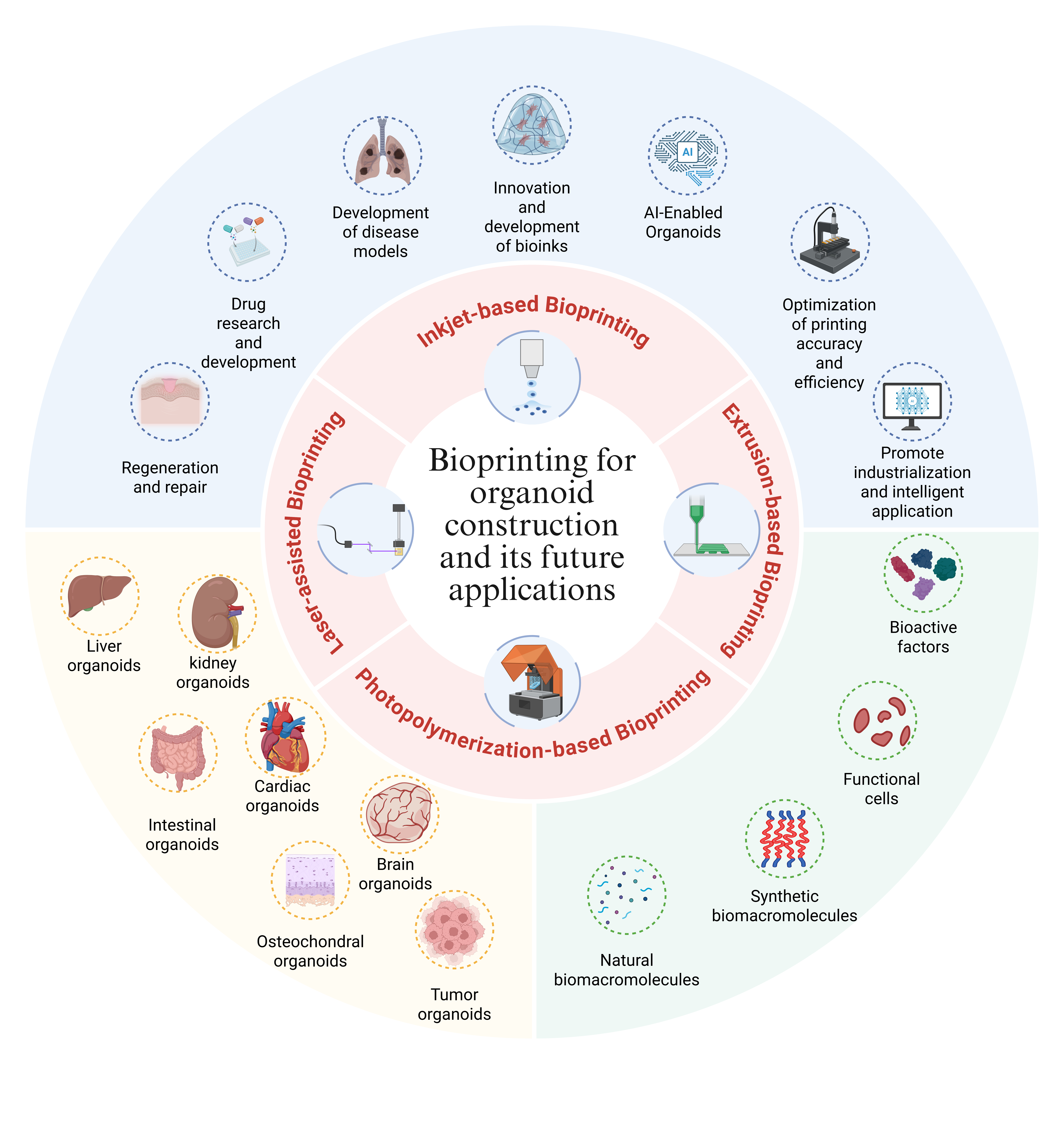
Bioprinting technology integrates computer-aided design with precision deposition manufacturing to achieve the spatially controlled assembly of cells, biomaterials and bioactive factors, providing important technical support for the standardized construction of functional organoids. This review systematically summarizes recent advances in bioprinting applications for organoid engineering, with particular attention to the adaptation criteria of printing technologies for different organoid systems. First, the working principles, technical features, representative commercial platforms and application scopes of four mainstream bioprinting modalities (inkjet-based, extrusion-based, photopolymerization-based and laser-assisted bioprinting) are summarized, and a standardized horizontal comparison of their core performance parameters is provided. Second, the classification, biological functions and optimization strategies of three core bioink components (biomacromolecular matrices, functional cells and bioactive factors) are comprehensively discussed. On this basis, representative research progress in seven major organoid categories, namely liver, intestinal, osteochondral, tumor, renal, cardiac and cerebral organoids, is described, and the differential requirements of diverse organoid scenarios for printing protocols are systematically analyzed. In addition, four bottleneck challenges limiting current development are examined, including the trade-off between printing resolution and structural complexity, maintenance of cell viability and biological function, construction of hierarchical vascular networks, and cost and scalability issues, together with corresponding targeted technical solutions. Finally, future directions are discussed from the perspectives of tissue and organ regeneration, precision medicine, drug toxicity evaluation, bioink innovation, and AI-driven intelligent biomanufacturing (covering formulation prediction, developmental simulation, in-process quality control and personalized structural design), aiming to provide theoretical references and technical selection guidelines for technological iteration and clinical translation in this interdisciplinary field.
- Paul GM, Rezaienia A, Wen P, et al. Medical applications for 3D printing: recent developments. Mo Med. 2018;115(1):75-81.
- Mendoza-Cerezo L, Jesús MR-R, Macías-García A, et al. Evolution of bioprinting and current applications. Int J Bioprint. 2023;9(4):742. doi: 10.18063/ijb.742
- Alave Reyes-Furrer A, De Andrade S, Bachmann D, et al. Matrigel 3D bioprinting of contractile human skeletal muscle models recapitulating exercise and pharmacological responses. Commun Biol. 2021;4(1):1183. doi: 10.1038/s42003-021-02691-0
- Kim W, Lee Y, Kang D, et al. 3D inkjet-bioprinted lung-on-a-chip. ACS Biomater Sci Eng. 2023;9(5):2806-2815. doi: 10.1021/acsbiomaterials.3c00089
- Carberry BJ, Hergert JE, Yavitt FM, et al. 3D printing of sacrificial thioester elastomers using digital light processing for templating 3D organoid structures in soft biomatrices. Biofabrication. 2021;13(4):044104. doi: 10.1088/1758-5090/ac1c98
- Keriquel V, Oliveira H, Rémy M, et al. In situ printing of mesenchymal stromal cells, by laser-assisted bioprinting, for in vivo bone regeneration applications. Sci Rep. 2017;7(1):1778. doi: 10.1038/s41598-017-01914-x
- Serpe F, Nalin F, Tirelli MC, et al. Microfluidic 3D bioprinting of foamed fibers with controlled micromorphology. ACS Appl Mater Interfaces. 2025;17(9):13632-13645. doi: 10.1021/acsami.4c22450
- Panwar A, Tan LP. Current status of bioinks for micro-extrusion-based 3D bioprinting. Molecules. 2016;21(6):685. doi: 10.3390/molecules21060685
- Xu H, Liu J, Zhang Z, Xu C. A review on cell damage, viability, and functionality during 3D bioprinting. Mil Med Res. 2022;9(1):70. doi: 10.1186/s40779-022-00429-5
- Shahabipour F, Ashammakhi N, Oskuee RK, et al. Key components of engineering vascularized 3-dimensional bioprinted bone constructs. Transl Res. 2020;216:57-76. doi: 10.1016/j.trsl.2019.08.010
- Elemoso A, Shalunov G, Balakhovsky YM, et al. 3D bioprinting: The roller coaster ride to commercialization. Int J Bioprint. 2020;6(3):301. doi: 10.18063/ijb.v6i3.301
- Ren Y, Yang X, Ma Z, et al. Developments and opportunities for 3D bioprinted organoids. Int J Bioprint. 2021;7(3):364. doi: 10.18063/ijb.v7i3.364
- Yan HHN, Chan AS, Lai FP-L, Leung SY. Organoid cultures for cancer modeling. Cell Stem Cell. 2023;30(7):917-937. doi: 10.1016/j.stem.2023.05.012
- Chen EP, Toksoy Z, Davis BA, Geibel JP. 3D Bioprinting of Vascularized Tissues for in vitro and in vivo Applications. Front Bioeng Biotechnol. 2021;9:664188. doi: 10.3389/fbioe.2021.664188
- Budharaju H, Sundaramurthi D, Sethuraman S. Embedded 3D bioprinting–An emerging strategy to fabricate biomimetic & large vascularized tissue constructs. Bioact Mater. 2024;32:356-384. doi: 10.1016/j.bioactmat.2023.10.012
- Chakraborty J, Ghosh S. Developmental biology-based 3D bioprinting: an off-the-shelf strategy to induce tissue regeneration. ACS Biomater Sci Eng. 2025;11(8):4552-4569. doi: 10.1021/acsbiomaterials.5c00213
- Huang J, Jia S, Liang R, et al. Construction of organoids using bioprinting technology: a frontier exploration of cartilage repair. J Orthop Transl. 2025;54:37-50. doi: 10.1016/j.jot.2025.06.020
- Huh D, Hamilton GA, Ingber DE. From 3D cell culture to organs-on-chips. Trends Cell Biol. 2011;21(12):745-754. doi: 10.1016/j.tcb.2011.09.005
- Suthiwanich K, Hagiwara M. Localization of multiple hydrogels with MultiCUBE platform spatially guides 3D tissue morphogenesis in vitro. Adv Mater Technol. 2023;8(4):2201660. doi: 10.1002/admt.202201660
- Zimmermann R, Hentschel C, Schrön F, et al. High resolution bioprinting of multi-component hydrogels. Biofabrication. 2019;11(4):045008. doi: 10.1088/1758-5090/ab2aa1
- Li X, Liu B, Pei B, et al. Inkjet bioprinting of biomaterials. Chem Rev. 2020;120(19):10793-10833. doi: 10.1021/acs.chemrev.0c00008
- Xu T, Gregory CA, Molnar P, et al. Viability and electrophysiology of neural cell structures generated by the inkjet printing method. Biomaterials. 2006;27(19):3580-3588. doi: 10.1016/j.biomaterials.2006.01.048
- Cross-Najafi AA, Farag K, Chen AM, et al. The long road to develop custom-built livers: current status of 3D liver bioprinting. Transplantation. 2024;108(2):357-368. doi: 10.1097/TP.0000000000004668
- Park JA, Lee HR, Park SY, Jung S. Self‐organization of fibroblast‐laden 3D collagen microstructures from inkjet‐printed cell patterns. Adv Biosyst. 2020;4(5):1900280. doi: 10.1002/adbi.201900280
- Xu H, Liu J, Zhang Z, Xu C. Cell sedimentation during 3D bioprinting: a mini review. Bio-Des Manuf. 2022;5(3):617-626. doi: 10.1007/s42242-022-00183-6
- Kang D, Park JA, Kim W, et al. All‐inkjet‐printed 3D alveolar barrier model with physiologically relevant microarchitecture. Adv Sci. 2021;8(10):2004990. doi: 10.1002/advs.202004990
- Summers AJ, Devadhasan JP, Gu J, et al. Optimization of an antibody microarray printing process using a designed experiment. ACS Omega. 2022;7(36):32262-32271. doi: 10.1021/acsomega.2c03595
- Wüst S, Müller R, Hofmann S. Controlled positioning of cells in biomaterials-approaches towards 3D tissue printing. J Funct Biomater. 2011;2(3):119-154. doi: 10.3390/jfb2030119
- Bolander J, Mota C, Ooi HW, et al. Bioinspired development of an in vitro engineered fracture callus for the treatment of critical long bone defects. Adv Funct Mater. 2021;31(46):2104159. doi: 10.1002/adfm.202104159
- Neufeld L, Yeini E, Reisman N, et al. Microengineered perfusable 3D-bioprinted glioblastoma model for in vivo mimicry of tumor microenvironment. Sci Adv. 2021;7(34):eabi9119. doi: 10.1126/sciadv.abi9119
- Tabriz AG, Hermida MA, Leslie NR, Shu W. Three-dimensional bioprinting of complex cell laden alginate hydrogel structures. Biofabrication. 2015;7(4):045012. doi: 10.1088/1758-5090/7/4/045012
- Skardal A, Devarasetty M, Kang H-W, et al. A hydrogel bioink toolkit for mimicking native tissue biochemical and mechanical properties in bioprinted tissue constructs. Acta Biomater. 2015;25:24-34. doi: 10.1016/j.actbio.2015.07.030
- Placone JK, Engler AJ. Recent advances in extrusion‐based 3D printing for biomedical applications. Adv Healthcare Mater. 2018;7(8):1701161. doi: 10.1002/adhm.201701161
- Billiet T, Gevaert E, De Schryver T, et al. The 3D printing of gelatin methacrylamide cell-laden tissue-engineered constructs with high cell viability. Biomaterials. 2014;35(1):49-62. doi: 10.1016/j.biomaterials.2013.09.078
- Blaeser A, Duarte Campos DF, Puster U, et al. Controlling shear stress in 3D bioprinting is a key factor to balance printing resolution and stem cell integrity. Adv Healthcare Mater. 2016;5(3):326-333. doi: 10.1002/adhm.201500677
- Yan Y, Li X, Gao Y, et al. 3D bioprinting of human neural tissues with functional connectivity. Cell Stem Cell. 2024;31(2):260-274. doi: 10.1016/j.stem.2023.12.009
- Angelats Lobo D, Ginestra P. Cell bioprinting: the 3D-bioplotter™ case. Materials. 2019;12(23):4005. doi: 10.3390/ma12234005
- Tong A, Pham QL, Abatemarco P, et al. Review of low-cost 3D bioprinters: state of the market and observed future trends. SLAS Technol. 2021;26(4):333-366. doi: 10.1177/24726303211020297
- Li W, Wang M, Ma H, et al. Stereolithography apparatus and digital light processing-based 3D bioprinting for tissue fabrication. iScience. 2023;26(2):106039. doi: 10.1016/j.isci.2023.106039
- Hafa L, Breideband L, Ramirez Posada L, et al. Light sheet-based laser patterning bioprinting produces long-term viable full-thickness skin constructs. Adv Mater. 2024;36(8):2306258. doi: 10.1002/adma.202306258
- Li F, Li X, Dai S, et al. Efficient light-based bioprinting via rutin nanoparticle photoinhibitor for advanced biomedical applications. ACS Nano. 2024;18(33):22104-22121. doi: 10.1021/acsnano.4c05380
- Gao T, Liu Z, Yin J, et al. Novel low-cytotoxic and highly efficient type I photoinitiators for visible LED-/sunlight-induced photopolymerization and high-precision 3D printing. Angew Chem. 2025;137(18):e202425598. doi: 10.1002/anie.202425598
- Phogat S, Guo TJF, Thiam F, Osei ET. Establishing a 3D vascularized tri-culture model of the human airways via a digital light processing bioprinter. Biotechnol Bioeng. 2025;122(8):2273-2280. doi: 10.1002/bit.29013
- Fleck E, Keck C, Ryszka K, et al. Low-viscosity polydimethylsiloxane resin for facile 3D printing of elastomeric microfluidics. Micromachines. 2023;14(4):773. doi: 10.3390/mi14040773
- Bedir T, Sahoo SS, Kadian S, et al. Effect of geometric design on the mechanical performance of digital light processing (DLP)-printed microneedles. Micromachines. 2025;16(11):1221. doi: 10.3390/mi16111221
- Zhang S, Chen X, Shan M, et al. Convergence of 3D bioprinting and nanotechnology in tissue engineering scaffolds. Biomimetics. 2023;8(1):94. doi: 10.3390/biomimetics8010094
- Chang J, Sun X. Laser-induced forward transfer based laser bioprinting in biomedical applications. Front Bioeng Biotechnol. 2023;11:1255782. doi: 10.3389/fbioe.2023.1255782
- Finny AS, Popoola O, Andreescu S. 3D-printable nanocellulose-based functional materials: fundamentals and applications. Nanomaterials. 2021;11(9):2358. doi: 10.3390/nano11092358
- Gibriel A. Effect of target length on specificity and sensitivity of oligonucleotide microarrays: a comparison between dendrimer and modified PCR based labelling methods. Open Biochem J. 2014;8:11-20. doi: 10.2174/1874091x01408010011
- Elango J, Zamora-Ledezma C. Rheological, structural, and biological trade-offs in bioink design for 3d bioprinting. Gels. 2025;11(8):659. doi: 10.3390/gels11080659
- Chen H, Zhang B, Huang J. Recent advances and applications of artificial intelligence in 3D bioprinting. Biophys Rev. 2024;5(3):031301. doi: 10.1063/5.0190208
- Manzoli S, Merotto E, Piccoli M, et al. An overview of 3D bioprinting impact on cell viability: from damage assessment to protection solutions. J Funct Biomater. 2025;16(12):436. doi: 10.3390/jfb16120436
- Derman ID, Kim MH, Sarikaya MD, et al. Unconventional bioprinting modalities for advanced tissue biofabrication. Biomaterials. 2025;326:123704. doi: 10.1016/j.biomaterials.2025.123704
- Li Z, Li K, Zhang C, et al. Bioprinted organoids: an innovative engine in biomedicine. Adv Sci. 2025;12(33):e07317. doi: 10.1002/advs.202507317
- Ho Y, Liao Y, Liao L, et al. Advances of cell printing technology in organoid engineering. Tissue Eng Part B Rev. Published online June 12, 2025. doi: 10.1089/ten.teb.2025.0048
- Chun J, Lim KY, Kim J, et al. 3D bioprinting for next-generation personalized medicine. Int J Mol Sci. 2023;24(7):6357. doi: 10.3390/ijms24076357
- Unagolla JM, Jayasuriya AC. Hydrogel-based 3D bioprinting: a comprehensive review on cell-laden hydrogels, bioink formulations, and future perspectives. Appl Mater Today. 2020;18:100479. doi: 10.1016/j.apmt.2019.100479
- Saldin LT, Cramer MC, Velankar SS, et al. Extracellular matrix hydrogels from decellularized tissues: Structure and function. Acta Biomater. 2017;49:1-15. doi: 10.1016/j.actbio.2016.11.068
- Skardal A, Mack D, Kapetanovic E, et al. Bioprinted amniotic fluid-derived stem cells accelerate healing of large skin wounds. Stem Cells Transl Med. 2012;1(11):792-802. doi: 10.5966/sctm.2012-0088
- Shoulders MD, Raines RT. Collagen structure and stability. Annu Rev Biochem. 2009;78(1):929-958. doi: 10.1146/annurev.biochem.77.032207.120833
- Khew ST, Tong YW. The specific recognition of a cell binding sequence derived from type I collagen by Hep3B and L929 cells. Biomacromolecules. 2007;8(10):3153-3161. doi: 10.1021/bm700587j
- El-Sherbiny IM, Yacoub MH. Hydrogel scaffolds for tissue engineering: Progress and challenges. Glob Cardiol Sci Pract. 2013;2013(3):38. doi: 10.5339/gcsp.2013.38
- Hospodiuk M, Dey M, Sosnoski D, Ozbolat IT. The bioink: A comprehensive review on bioprintable materials. Biotechnol Adv. 2017;35(2):217-239. doi: 10.1016/j.biotechadv.2016.12.006
- Lee KY, Mooney DJ. Alginate: properties and biomedical applications. Prog Polym Sci. 2012;37(1):106-126. doi: 10.1016/j.progpolymsci.2011.06.003
- Wang L, Shelton RM, Cooper PR, et al. Evaluation of sodium alginate for bone marrow cell tissue engineering. Biomaterials. 2003;24(20):3475-3481. doi: 10.1016/S0142-9612(03)00167-4
- Pandit AH, Mazumdar N, Ahmad S. Periodate oxidized hyaluronic acid-based hydrogel scaffolds for tissue engineering applications. Int J Biol Macromol. 2019;137:853-869. doi: 10.1016/j.ijbiomac.2019.07.014
- Xu X, Jha AK, Harrington DA, et al. Hyaluronic acid-based hydrogels: from a natural polysaccharide to complex networks. Soft Matter. 2012;8(12):3280-3294. doi: 10.1039/c2sm06463d
- Pescosolido L, Schuurman W, Malda J, et al. Hyaluronic acid and dextran-based semi-IPN hydrogels as biomaterials for bioprinting. Biomacromolecules. 2011;12(5):1831-1838. doi: 10.1021/bm200178w
- Kleinman HK, Martin GR. Matrigel: Basement membrane matrix with biological activity. Semin Cancer Biol. 2005;15(5):378-386. doi: 10.1016/j.semcancer.2005.05.004
- Liu X, Hao M, Chen Z, et al. 3D bioprinted neural tissue constructs for spinal cord injury repair. Biomaterials. 2021;272:120771. doi: 10.1016/j.biomaterials.2021.120771
- Xu R, Fang Y, Zhang Z, et al. Recent advances in biodegradable and biocompatible synthetic polymers used in skin wound healing. Materials. 2023;16(15):5459. doi: 10.3390/ma16155459
- Zhu J. Bioactive modification of poly (ethylene glycol) hydrogels for tissue engineering. Biomaterials. 2010;31(17):4639-4656. doi: 10.1016/j.biomaterials.2010.02.044
- Qiao F, Zou Y, Bie B, Lv Y. Dual siRNA‐loaded cell membrane functionalized matrix facilitates bone regeneration with angiogenesis and neurogenesis. Small. 2024;20(8):2307062. doi: 10.1002/smll.202307062
- Balla E, Daniilidis V, Karlioti G, et al. Poly (lactic Acid): A versatile biobased polymer for the future with multifunctional properties—From monomer synthesis, polymerization techniques and molecular weight increase to PLA applications. Polymers. 2021;13(11):1822. doi: 10.3390/polym13111822
- Alavi MS, Memarpour S, Pazhohan‐Nezhad H, et al. Applications of poly (lactic acid) in bone tissue engineering: A review article. Artif Organs. 2023;47(9):1423-1430. doi: 10.1111/aor.14612
- Rezvani Ghomi E, Nourbakhsh N, Akbari Kenari M, et al. Collagen‐based biomaterials for biomedical applications. J Biomed Mater Res Part B Appl Biomater. 2021;109(12):1986-1999. doi: 10.1002/jbm.b.34881
- Gao L, Wei Y, Tan Y, et al. Irrigating degradation properties of silk fibroin–collagen type II composite cartilage scaffold in vitro and in vivo. Biomater Adv. 2023;149:213389. doi: 10.1016/j.bioadv.2023.213389
- Dong C, Lv Y. Application of collagen scaffold in tissue engineering: recent advances and new perspectives. Polymers. 2016;8(2):42. doi: 10.3390/polym8020042
- Negrescu AM, Cimpean A. A recent insight into research pertaining to collagen-based hydrogels as dressings for chronic skin wounds. Gels. 2025;11(7):527. doi: 10.3390/gels11070527
- Axpe E, Oyen ML. Applications of alginate-based bioinks in 3D bioprinting. Int J Mol Sci. 2016;17(12):1976. doi: 10.3390/ijms17121976
- Cano-Vicent A, Tunon-Molina A, Bakshi H, et al. Biocompatible alginate film crosslinked with Ca2+ and Zn2+ possesses antibacterial, antiviral, and anticancer activities. ACS Omega. 2023;8(27):24396-24405. doi: 10.1021/acsomega.3c01935
- Farshidfar N, Iravani S, Varma RS. Alginate-based biomaterials in tissue engineering and regenerative medicine. Mar Drugs. 2023;21(3):189. doi: 10.3390/md21030189
- Iaconisi GN, Lunetti P, Gallo N, et al. Hyaluronic acid: a powerful biomolecule with wide-ranging applications—a comprehensive review. Int J Mol Sci. 2023;24(12):10296. doi: 10.3390/ijms241210296
- Shim H, Kim Y, Park KH, et al. Hyaluronic acid microparticles promote uniform differentiation and survival of stem cells in spheroid cultures. ACS Omega. 2025;10(32):36267-36275. doi: 10.1021/acsomega.5c04198
- Tamada Y, Takeuchi H, Suzuki N, et al. Cell surface expression of hyaluronan on human ovarian cancer cells inversely correlates with their adhesion to peritoneal mesothelial cells. Tumor Biol. 2012;33(4):1215-1222. doi: 10.1007/s13277-012-0369-4
- Yamagishi R, Miura S, Yabu K, et al. Fabrication technology of self-dissolving sodium hyaluronate gels ultrafine microneedles for medical applications with UV-curing gas-permeable mold. Gels. 2024;10(1):65. doi: 10.3390/gels10010065
- Kawase E, Nakatsuji N. Development of substrates for the culture of human pluripotent stem cells. Biomater Sci. 2023;11(9):2974-2987. doi: 10.1039/D2BM01473D
- Murphy C, Naderlinger E, Mater A, et al. Comparison of human recombinant protein coatings and fibroblast-ECM to Matrigel for induced pluripotent stem cell culture and renal podocyte differentiation. ALTEX. 2022;40(1):141-159. doi: 10.14573/altex.2112204
- Chen B, Cheng T, Roffler SR. Polyethylene glycol immunogenicity: theoretical, clinical, and practical aspects of anti-polyethylene glycol antibodies. ACS Nano. 2021;15(9):14022-14048. doi: 10.1021/acsnano.1c05922
- Perrino C, Lee S, Spencer ND. Quantitative comparison of the hydration capacity of surface-bound dextran and polyethylene glycol. Langmuir. 2024;40(27):14130-14140. doi: 10.1021/acs.langmuir.4c01582
- Liang J, Guo Z, Timmerman A, et al. Enhanced mechanical and cell adhesive properties of photo-crosslinked PEG hydrogels by incorporation of gelatin in the networks. Biomed Mater. 2019;14(2):024102. doi: 10.1088/1748-605X/aaf31b
- Maietta S, Russo T, De Santis R, et al. Further theoretical insight into the mechanical properties of polycaprolactone loaded with organic–inorganic hybrid fillers. Materials. 2018;11(2):312. doi: 10.3390/ma11020312
- Homaeigohar S, Boccaccini AR. Nature-derived and synthetic additives to poly (ɛ-caprolactone) nanofibrous systems for biomedicine; an updated overview. Front Chem. 2022;9:809676. doi: 10.3389/fchem.2021.809676
- Maduka CV, Alhaj M, Ural E, et al. Polylactide degradation activates immune cells by metabolic reprogramming. Adv Sci. 2023;10(31):2304632. doi: 10.1002/advs.202304632
- Naser AZ, Deiab I, Darras BM. Poly (lactic acid)(PLA) and polyhydroxyalkanoates (PHAs), green alternatives to petroleum-based plastics: a review. RSC Adv. 2021;11(28):17151-17196. doi: 10.1039/D1RA02390J
- Marquez-Curtis LA, Janowska-Wieczorek A, McGann LE, Elliott JAW. Mesenchymal stromal cells derived from various tissues: Biological, clinical and cryopreservation aspects. Cryobiology. 2015;71(2):181-197. doi: 10.1016/j.cryobiol.2015.07.003
- Wagner W, Ho AD, Zenke M. Different facets of aging in human mesenchymal stem cells. Tissue Eng Part B Rev. 2010;16(4):445-453. doi: 10.1089/ten.teb.2009.0825
- Im GI. Bone marrow‐derived stem/stromal cells and adipose tissue‐derived stem/stromal cells: Their comparative efficacies and synergistic effects. J Biomed Mater Res Part A. 2017;105(9):2640-2648. doi: 10.1002/jbm.a.36089
- Trzyna A, Banaś-Ząbczyk A. Adipose-derived stem cells secretome and its potential application in “stem cell-free therapy”. Biomolecules. 2021;11(6):878. doi: 10.3390/biom11060878
- Chan YW, So C, Yau KL, et al. Adipose‐derived stem cells and cancer cells fuse to generate cancer stem cell‐like cells with increased tumorigenicity. J Cell Physiol. 2020;235(10):6794-6807. doi: 10.1002/jcp.29574
- Zhang J, Liu Y, Chen Y, et al. Adipose‐derived stem cells: current applications and future directions in the regeneration of multiple tissues. Stem Cells Int. 2020;2020(1):8810813. doi: 10.1155/2020/8810813
- Choudhery MS, Badowski M, Muise A, et al. Donor age negatively impacts adipose tissue-derived mesenchymal stem cell expansion and differentiation. J Transl Med. 2014;12(1):8. doi: 10.1186/1479-5876-12-8
- Zhang Y, Zhuang H, Ren X, et al. Therapeutic effects of different intervention forms of human umbilical cord mesenchymal stem cells in the treatment of osteoarthritis. Front Cell Dev Biol. 2023;11:1246504. doi: 10.3389/fcell.2023.1246504
- Chen X, Zheng J, Yin L, et al. Transplantation of three mesenchymal stem cells for knee osteoarthritis, which cell and type are more beneficial? A systematic review and network meta-analysis. J Orthop Surg Res. 2024;19(1):366. doi: 10.1186/s13018-024-04846-1
- Yang Z, Wang B, Liu W, et al. In situ self-assembled organoid for osteochondral tissue regeneration with dual functional units. Bioact Mater. 2023;27:200-215. doi: 10.1016/j.bioactmat.2023.04.002
- Vaskovich-Koubi D, Buzhor MG, Krinsky A, et al. Patient-Derived 3D-Bioprinted models of pancreatic Cancer: Toward personalized therapy and overcoming tumor microenvironment challenges. Adv Drug Delivery Rev. 2025:115670. doi: 10.1016/j.addr.2025.115670
- Piotrowska U, Tsoi J, Singh P, et al. 3D bioprinting and artificial intelligence for tumor microenvironment modeling: a scoping review of models, methods, and integration pathways. Mol Pharm. 2025;22(10):5801-5823. doi: 10.1021/acs.molpharmaceut.5c01062
- Maggiotto F, Bova L, Micheli S, et al. 3D bioprinting for the production of a perfusable vascularized model of a cancer niche. Front Bioeng Biotechnol. 2025;13:1484738. doi: 10.3389/fbioe.2025.1484738
- Shukla AK, Shukla S, Suryawanshi SP, et al. High-throughput 3D bioprinted organoids of skin cancer utilized for diagnosis and personalized therapy. Curr Oncol. 2025;32(12):653. doi: 10.3390/curroncol32120653
- Souralova T, Rehakova D, Jeseta M, et al. The manufacture of xeno-and feeder-free clinical-grade human embryonic stem cell lines: First step for cell therapy. Int J Mol Sci. 2022;23(20):12500. doi: 10.3390/ijms232012500
- Esfahani SN, Irizarry AMR, Xue X, et al. Micro/nanoengineered technologies for human pluripotent stem cells maintenance and differentiation. Nano Today. 2021;41:101310. doi: 10.1016/j.nantod.2021.101310
- Posfai E, Lanner F, Mulas C, Leitch HG. All models are wrong, but some are useful: Establishing standards for stem cell-based embryo models. Stem Cell Rep. 2021;16(5):1117-1141. doi: 10.1016/j.stemcr.2021.03.019
- Fowler JL, Ang LT, Loh KM. A critical look: Challenges in differentiating human pluripotent stem cells into desired cell types and organoids. Wiley Interdiscip Rev Dev Biol. 2020;9(3):e368. doi: 10.1002/wdev.368
- Frederiksen HR, Glantz A, Vøls KK, et al. CRISPR-Cas9 immune-evasive hESCs are rejected following transplantation into immunocompetent mice. Front Genome Ed. 2024;6:1403395. doi: 10.3389/fgeed.2024.1403395
- Kim B, Kim J, Lee S. Unleashing the power of undifferentiated induced pluripotent stem cell bioprinting: current progress and future prospects. Int J Stem Cells. 2024;17(1):38-50. doi: 10.15283/ijsc23146
- Fu B, Shen J, Chen Y, et al. Narrative review of gene modification: applications in three-dimensional (3D) bioprinting. Ann Transl Med. 2021;9(19):1502. doi: 10.21037/atm-21-2854
- Dhaiban S, Chandran S, Noshi M, Sajini AA. Clinical translation of human iPSC technologies: advances, safety concerns, and future directions. Front Cell Dev Biol. 2025;13:1627149. doi: 10.3389/fcell.2025.1627149
- Cerneckis J, Cai H, Shi Y. Induced pluripotent stem cells (iPSCs): molecular mechanisms of induction and applications. Signal Transduct Target Ther. 2024;9(1):112. doi: 10.1038/s41392-024-01809-0
- Kim J-H, Kawase E, Bharti K, et al. Perspectives on the cost of goods for hPSC banks for manufacture of cell therapies. npj Regener Med. 2022;7(1):54. doi: 10.1038/s41536-022-00242-7
- Sawamoto N, Doi D, Nakanishi E, et al. Phase I/II trial of iPS-cell-derived dopaminergic cells for Parkinson’s disease. Nature. 2025;641(8064):971-977. doi: 10.1038/s41586-025-08700-0
- Chen X, Ye S, Ying Q. Stem cell maintenance by manipulating signaling pathways: past, current and future. BMB Rep. 2015;48(12):668. doi: 10.5483/BMBRep.2015.48.12.215
- Liu TM, Tew W, Yang Z, et al. Understanding the molecular basis of mesenchymal stem cell stemness: implications for clinical applications. Cell Death Dis. 2025;16(1):778. doi: 10.1038/s41419-025-08094-x
- Afonso MB, Marques V, Van Mil SWC, Rodrigues CMP. Human liver organoids: From generation to applications. Hepatology. 2024;79(6):1432-1451. doi: 10.1097/HEP.0000000000000343
- Ma X, Qu X, Zhu W, et al. Deterministically patterned biomimetic human iPSC-derived hepatic model via rapid 3D bioprinting. Proc Natl Acad Sci USA. 2016;113(8):2206-2211. doi: 10.1073/pnas.1524510113
- Bhatia SN, Underhill GH, Zaret KS, Fox IJ. Cell and tissue engineering for liver disease. Sci Transl Med. 2014;6(245):245sr2. doi: 10.1126/scitranslmed.3005975
- Ali ASM, Wu D, Bannach-Brown A, et al. 3D bioprinting of liver models: A systematic scoping review of methods, bioinks, and reporting quality. Mater Today Bio. 2024;26:100991. doi: 10.1016/j.mtbio.2024.100991
- Shrestha S, Lekkala VKR, Acharya P, et al. Reproducible generation of human liver organoids (HLOs) on a pillar plate platform via microarray 3D bioprinting. Lab Chip. 2024;24(10):2747-2761. doi: 10.1039/D4LC00149D
- Yan J, Ye Z, Lu Y, et al. 3D bioprinting lobule-like hepatorganoids with induced vascularization for orthotopic implantation. Mater Today Bio. 2025;31:101515. doi: 10.1016/j.mtbio.2025.101515
- Yang H, Sun L, Pang Y, et al. Three-dimensional bioprinted hepatorganoids prolong survival of mice with liver failure. Gut. 2021;70(3):567-574. doi: 10.1136/gutjnl-2019-319960
- Xiang T, Wang J, Li H. Current applications of intestinal organoids: a review. Stem Cell Res Ther. 2024;15(1):155. doi: 10.1186/s13287-024-03768-3
- Sato T, Vries RG, Snippert HJ, et al. Single Lgr5 stem cells build crypt-villus structures in vitro without a mesenchymal niche. Nature. 2009;459(7244):262-265. doi: 10.1038/nature07935
- Pimenta J, Ribeiro R, Almeida R, et al. Organ-on-chip approaches for intestinal 3D in vitro modeling. Cell Mol Gastroenterol Hepatol. 2022;13(2):351-367. doi: 10.1016/j.jcmgh.2021.08.015
- Kjar A, McFarland B, Mecham K, et al. Engineering of tissue constructs using coaxial bioprinting. Bioact Mater. 2021;6(2):460-471. doi: 10.1016/j.bioactmat.2020.08.020
- Li Y, Cheng S, Shi H, et al. 3D embedded bioprinting of large-scale intestine with complex structural organization and blood capillaries. Biofabrication. 2024;16(4):045001. doi: 10.1088/1758-5090/ad5b1b
- Torras N, Zabalo J, Abril E, et al. A bioprinted 3D gut model with crypt-villus structures to mimic the intestinal epithelial-stromal microenvironment. Biomater Adv. 2023;153:213534. doi: 10.1016/j.bioadv.2023.213534
- Finkbeiner SR, Freeman JJ, Wieck MM, et al. Generation of tissue-engineered small intestine using embryonic stem cell-derived human intestinal organoids. Biol Open. 2015;4(11):1462-1472. doi: 10.1242/bio.013235
- Jacob G, Shimomura K, Nakamura N. Osteochondral injury, management and tissue engineering approaches. Front Cell Dev Biol. 2020;8:580868. doi: 10.3389/fcell.2020.580868
- Faeed M, Ghiasvand M, Fareghzadeh B, Taghiyar L. Osteochondral organoids: current advances, applications, and upcoming challenges. Stem Cell Res Ther. 2024;15(1):183. doi: 10.1186/s13287-024-03790-5
- Doyle SE, Snow F, Duchi S, et al. 3D printed multiphasic scaffolds for osteochondral repair: challenges and opportunities. Int J Mol Sci. 2021;22(22):12420. doi: 10.3390/ijms222212420
- Cao B, Zhang K, Zuo R, et al. 3D-bioprinted functional scaffold based on synergistic induction of i-PRF and laponite exerts efficient and personalized bone regeneration via miRNA-mediated TGF-β/Smads signaling. Int J Surg. 2025;111(5):3193-3211. doi: 10.1097/JS9.0000000000002312
- Karam AS, Kronemberger GS, Chattahy K, Kelly DJ. Cell-only bioprinting of articular cartilage progenitor cells within a physically constraining support bath to engineer structurally organized grafts. Bioact Mater. 2026;59:251-265. doi: 10.1016/j.bioactmat.2025.12.013
- Jiao Y, Lu S, Zhang J, Zhen J. Applications in osteochondral organoids for osteoarthritis research: from pathomimetic modeling to tissue engineering repair. Front Bioeng Biotechnol. 2025;13:1629608. doi: 10.3389/fbioe.2025.1629608
- Chen Z, Bo Q, Wang C, et al. Single BMSC-derived cartilage organoids for gradient heterogeneous osteochondral regeneration by leveraging native vascular microenvironment. J Nanobiotechnol. 2025;23(1):325. doi: 10.1186/s12951-025-03403-0
- Bowes A, Collins A, Oakley F, et al. Bioprinted high-cell-density laminar scaffolds stimulate extracellular matrix production in osteochondral co-cultures. Int J Mol Sci. 2024;25(20):11131. doi: 10.3390/ijms252011131
- Xiao Y, Li Y, Jing X, et al. Organoid models in oncology: advancing precision cancer therapy and vaccine development. Cancer Biol Med. 2025;22(8):903-927. doi: 10.20892/j.issn.2095-3941.2025.0127
- Wang X, Luo Y, Ma Y, et al. Converging bioprinting and organoids to better recapitulate the tumor microenvironment. Trends Biotechnol. 2024;42(5):648-663. doi: 10.1016/j.tibtech.2023.11.006
- Mao S, Xie R, Shou J, et al. Bioprinting of patient-derived heterogeneous renal cell carcinoma organoids for personalized therapy. Biofabrication. 2025;17(4):045008. doi: 10.1088/1758-5090/adecc5
- Zhang F, Lin DSY, Rajasekar S, et al. Pump-less platform enables long-term recirculating perfusion of 3D printed tubular tissues. Adv Healthcare Mater. 2023;12(27):e2300423. doi: 10.1002/adhm.202300423
- Formica C, Addario G, Fagiolino S, et al. Microfluidic bioprinting as a tool to produce hiPSCs-derived renal organoids. Biofabrication. 2025;17(3):035016. doi: 10.1088/1758-5090/addb7e
- Shin J, Tabatabaei Rezaei N, Choi S, et al. Photocrosslinkable kidney decellularized extracellular matrix-based bioink for 3D bioprinting. Adv Healthcare Mater. 2025;14(24):e2501616. doi: 10.1002/adhm.202501616
- Fransen MFJ, Addario G, Bouten CVC, et al. Bioprinting of kidney in vitro models: cells, biomaterials, and manufacturing techniques. Essays Biochem. 2021;65(3):587-602. doi: 10.1042/ebc20200158
- Yang H, Zhang J, Li Y, et al. Multiscale organization of neural networks in a 3D bioprinted matrix. Adv Sci. 2025;12(30):e04455. doi: 10.1002/advs.202504455
- Choi T, Park J, Lee S, et al. 3D bioprinted neural tissues: emerging strategies for regeneration and disease modeling. Pharmaceutics. 2025;17(9):1176. doi: 10.3390/pharmaceutics17091176
- Kupfer ME, Lin WH, Ravikumar V, et al. In situ expansion, differentiation, and electromechanical coupling of human cardiac muscle in a 3D bioprinted, chambered organoid. Circ Res. 2020;127(2):207-224. doi: 10.1161/circresaha.119.316155
- Fang Y, Guo Y, Wu B, et al. Expanding embedded 3D bioprinting capability for engineering complex organs with freeform vascular networks. Adv Mater. 2023;35(22):e2205082. doi: 10.1002/adma.202205082
- Kim MS, Choi Y, Lee KY. Three-dimensional printing and bioprinting strategies for cardiovascular constructs: from printing inks to vascularization. Polymers. 2025;17(17) doi: 10.3390/polym17172337
- Wang Y, Liu A, Lin Y, et al. A rational framework for 3D bioprinting of organoids: From assembly mechanisms and material properties to functional outcomes. Int J Bioprint. 2026;12(2):2337. doi: 10.36922/ijb025010539
- Lv W, Zhou H, Aazmi A, et al. Constructing biomimetic liver models through biomaterials and vasculature engineering. Regen Biomater. 2022;9:rbac079. doi: 10.1093/rb/rbac079
- Saiki N, Nio Y, Yoneyama Y, et al. Self-organization of sinusoidal vessels in pluripotent stem cell-derived human liver bud organoids. Nat Biomed Eng. 2025;9(11):1869-1885. doi: 10.1038/s41551-025-01416-6
- Brassard JA, Nikolaev M, Hübscher T, et al. Recapitulating macro-scale tissue self-organization through organoid bioprinting. Nat Mater. 2021;20(1):22-29. doi: 10.1038/s41563-020-00803-5
- Rea M, Lisa LD, Pagnotta G, et al. Establishing a bioink assessment protocol: GelMA and collagen in the bioprinting of a potential in vitro intestinal model. ACS Biomater Sci Eng. 2025;11(4):2456-2467. doi: 10.1021/acsbiomaterials.5c00034
- Gao Z, Du H, Yu S, et al. 3D bioprinted human-scale intestine models for physiological and microbial insights through fluid-driven heterogeneity. Sci Adv. 2025;11(47):eady6562. doi: 10.1126/sciadv.ady6562
- Ren J, Huang S. Intestinal organoids in inflammatory bowel disease: advances, applications, and future directions. Front Cell Dev Biol. 2025;13:1517121. doi: 10.3389/fcell.2025.1517121
- Truong H, Guvendiren M. Bioprinting the osteochondral interface: advances, challenges, and future directions. Tissue Eng Part A. Published online January 7, 2025 doi: 10.1177/19373341251410101
- Jahangir S, Vecstaudza J, Augurio A, et al. Cell-laden 3D printed GelMA/HAp and THA hydrogel bioinks: development of osteochondral tissue-like bioinks. Materials. 2023;16(22):7214. doi: 10.3390/ma16227214
- Nedrelow DS, Townsend JM, Detamore MS. Osteochondral regeneration with anatomical scaffold 3D-printing-design considerations for interface integration. J Biomed Mater Res Part A. 2025;113(1):e37804. doi: 10.1002/jbm.a.37804
- Cui X, Jiao J, Yang L, et al. Advanced tumor organoid bioprinting strategy for oncology research. Mater Today Bio. 2024;28:101198. doi: 10.1016/j.mtbio.2024.101198
- Spagnol G, Sensi F, De Tommasi O, et al. Patient derived organoids (PDOs), extracellular matrix (ECM), tumor microenvironment (TME) and drug screening: state of the art and clinical implications of ovarian cancer organoids in the era of precision medicine. Cancers. 2023;15(7):2059. doi: 10.3390/cancers15072059
- Zhang C, Wang Q, Li K, et al. Mechanoadaptation via myosin cytoplasmic redistribution protects circulating tumor cells from shear-induced death during hematogenous dissemination. Adv Sci. 2026;13(33):e23112. doi: 10.1002/advs.202523112
- Lawlor KT, Vanslambrouck JM, Higgins JW, et al. Cellular extrusion bioprinting improves kidney organoid reproducibility and conformation. Nat Mater. 2021;20(2):260-271. doi: 10.1038/s41563-020-00853-9
- Homan KA, Gupta N, Kroll KT, et al. Flow-enhanced vascularization and maturation of kidney organoids in vitro. Nat Methods. 2019;16(3):255-262. doi: 10.1038/s41592-019-0325-y
- Tabibzadeh N, Satlin LM, Jain S, Morizane R. Navigating the kidney organoid: insights into assessment and enhancement of nephron function. Am J Physiol Renal Physiol. 2023;325(6):F695-F706. doi: 10.1152/ajprenal.00166.2023
- Layrolle P, Payoux P, Chavanas S. Message in a scaffold: natural biomaterials for three-dimensional (3D) bioprinting of human brain organoids. Biomolecules. 2023;13(1):25. doi: 10.3390/biom13010025
- Tan S, Qiu L, Lee JWL, Zeng L. Advances in 3D bioprinting for modeling the blood-brain barrier in neurodegenerative diseases. Front Mol Biosci. 2025;12:1703403. doi: 10.3389/fmolb.2025.1703403
- Yin J, Yan M, Wang Y, et al. 3D bioprinting of low-concentration cell-laden gelatin methacrylate (GelMA) bioinks with a two-step cross-linking strategy. ACS Appl Mater Interfaces. 2018;10(8):6849-6857. doi: 10.1021/acsami.7b16059
- Wolfe JT, He W, Kim MS, et al. 3D-bioprinting of patient-derived cardiac tissue models for studying congenital heart disease. Front Cardiovasc Med. 2023;10:1162731. doi: 10.3389/fcvm.2023.1162731
- Leung MC, Laksman Z. 3D bioprinting functional engineered heart tissues. Int J Mol Sci. 2025;26(21):10707. doi: 10.3390/ijms262110707
- Roche CD, Brereton RJL, Ashton AW, et al. Current challenges in three-dimensional bioprinting heart tissues for cardiac surgery. Eur J Cardiothorac Surg. 2020;58(3):500-510. doi: 10.1093/ejcts/ezaa093
- Kato B, Wisser G, Agrawal DK, et al. 3D bioprinting of cardiac tissue: current challenges and perspectives. J Mater Sci Mater Med. 2021;32(5):54. doi: 10.1007/s10856-021-06520-y
- Shapira A, Dvir T. 3D tissue and organ printing—hope and reality. Adv Sci. 2021;8(10):2003751. doi: 10.1002/advs.202003751
- Liu F, Quan R, Vyas C, Aslan E. Hybrid biomanufacturing systems applied in tissue regeneration. Int J Bioprint. 2022;9(1):646. doi: 10.18063/ijb.v9i1.646
- Bercea M. Rheology as a tool for fine-tuning the properties of printable bioinspired gels. Molecules. 2023;28(6):2766. doi: 10.3390/molecules28062766
- Bertassoni LE. Bioprinting of complex multicellular organs with advanced functionality—recent progress and challenges ahead. Adv Mater. 2022;34(3):2101321. doi: 10.1002/adma.202101321
- Teixeira MC, Lameirinhas NS, Carvalho JPF, et al. A guide to polysaccharide-based hydrogel bioinks for 3D bioprinting applications. Int J Mol Sci. 2022;23(12):6564. doi: 10.3390/ijms23126564
- Zhang S, Xu G, Wu J, et al. Microphysiological constructs and systems: biofabrication tactics, biomimetic evaluation approaches, and biomedical applications. Small Methods. 2024;8(1):2300685. doi: 10.1002/smtd.202300685
- Seymour AJ, Westerfield AD, Cornelius VC, et al. Bioprinted microvasculature: progressing from structure to function. Biofabrication. 2022;14(2):022002. doi: 10.1088/1758-5090/ac4fb5
- Al Qassab M, Merheb M, Sayadi S, et al. Organ-specific strategies in bioprinting: Addressing translational challenges in the heart, liver, kidney, and pancreas. J Funct Biomater. 2025;16(10):356. doi: 10.3390/jfb16100356
- Malkani S, Prado O, Stevens KR. Sacrificial templating for accelerating clinical translation of engineered organs. ACS Biomater Sci Eng. 2024;11(1):1-12. doi: 10.1021/acsbiomaterials.4c01824
- Wang K, Lan X, Chen J, et al. One-step coaxial 3D printing of pre-vascularized skin organoid models with ADSC microspheres for enhanced wound healing. Adv Sci. 2026;13(9):e17409. doi: 10.1002/advs.202517409
- Zhao X, Xu Z, Xiao L, et al. Review on the vascularization of organoids and organoids-on-a-Chip. Front Bioeng Biotechnol. 2021;9:637048. doi: 10.3389/fbioe.2021.637048
- Urbischek M, Rannikmae H, Foets T, et al. Organoid culture media formulated with growth factors of defined cellular activity. Sci Rep. 2019;9(1):6193. doi: 10.1038/s41598-019-42604-0
- Tashman JW, Shiwarski DJ, Feinberg AW. Development of a high-performance open-source 3D bioprinter. Sci Rep. 2022;12(1):22652. doi: 10.1038/s41598-022-26809-4
- Lee H. Engineering in vitro models: Bioprinting of organoids with artificial intelligence. Cyborg Bionic Syst. 2023;4:0018. doi: 10.34133/cbsystems.0018
- Xie Z, Wang L, Zhang Y. Advances in organoid culture research. Glob Med Genet. 2022;09(04):268-276. doi: 10.1055/s-0042-1756662
- Gomes Gama JF, Dias EA, Aguiar Coelho RMG, et al. Development and implementation of a significantly low-cost 3D bioprinter using recycled scrap material. Front Bioeng Biotechnol. 2023;11:1108396. doi: 10.3389/fbioe.2023.1108396
- Atala A, Bischof JC, Chen CS, et al. The need for an organoid manufacturing, preservation, and distribution center. Stem Cells Transl Med. 2025;14(7):szaf031. doi: 10.1093/stcltm/szaf031
- Wang X, Zhang D, Singh YP, et al. Progress in organ bioprinting for regenerative medicine. Engineering. 2024;42:121-142. doi: 10.1016/j.eng.2024.04.023
- Davoodi E, Li J, Ma X, et al. Imaging-guided deep tissue in vivo sound printing. Science. 2025;388(6747):616-623. doi: 10.1126/science.adt0293
- Li Z, Chen L, Wu J, et al. A review of 3D bioprinting for organoids. Med Rev. 2025;5(4):318-338. doi: 10.1515/mr-2024-0089
- Roy N, Cucullo L. Organs-on-chips in drug development: engineering foundations, artificial intelligence, and clinical translation. Biosensors. 2026;16(3):155. doi: 10.3390/bios16030155
- Zhang Y, Wang F, Li R, et al. Immune-instructive bone organoids via non-immunogenic plant-based bioinks for enhanced bone repair. Matter. 2026;9(4):102651. doi: 10.1016/j.matt.2026.102651
- Yeh Y, Chen P, Chen K, Lee IC. Innovative MXene/SilMA-based conductive bioink for three dimensional bioprinting of neural stem cell spheroids in neural tissue engineering. ACS Appl Mater Interfaces. 2025;17(7):10402-10416. doi: 10.1021/acsami.4c19373
- Marques DMC, Jabouille M, Gusmão A, et al. Microalgae-enriched (bio) inks for 3D bioprinting of cultured seafood. npj Sci Food. 2025;9(1):23. doi: 10.1038/s41538-025-00386-y
- Deng B, Lasaosa FL, Chen D, et al. An interactive Bayesian optimization framework for intelligent design of HAMA/GelMA hybrid hydrogels. Polym Test. 2026;156:109132. doi: 10.1016/j.polymertesting.2026.109132
- Shin J, Kang R, Hyun K, et al. Machine learning-enhanced optimization for high-throughput precision in cellular droplet bioprinting. Adv Sci. 2025;12(20):e2412831. doi: 10.1002/advs.202412831
- Chen Y, Yang X, Zhang Y, et al. Flowerbed-inspired biomimetic 3D-printed scaffolds functionalized with urine-derived stem cell exosomes promote alveolar bone regeneration by regulating energy metabolism. Theranostics. 2026;16(7):3826-3856. doi: 10.7150/thno.123700
- Filippi M, Mekkattu M, Katzschmann RK. Sustainable biofabrication: from bioprinting to AI-driven predictive methods. Trends Biotechnol. 2025;43(2):290-303. doi: 10.1016/j.tibtech.2024.07.002
- Bai L, Su J. Artificial intelligence virtual organoids (AIVOs). Bioact Mater. 2026;59:45-68. doi: 10.1016/j.bioactmat.2025.12.030
- Balkhair O, Albalushi H. Artificial intelligence in organoid-based disease modeling: a new frontier in precision medicine. Biomimetics. 2025;10(12):845. doi: 10.3390/biomimetics10120845
- Silva Robazzi JV, Derman ID, Gupta D, et al. The synergy of artificial intelligence and 3D bioprinting: unlocking new frontiers in precision and tissue fabrication. Adv Funct Mater. 2025;36(1). doi: 10.1002/adfm.202509530
- Huang D, Li Z, Li G, et al. Biomimetic structural design in 3D-printed scaffolds for bone tissue engineering. Mater Today Bio. 2025;32:101664. doi: 10.1016/j.mtbio.2025.101664
- Zhang Z, Zhou X, Fang Y, et al. AI-driven 3D bioprinting for regenerative medicine: From bench to bedside. Bioact Mater. 2025;45:201-230. doi: 10.1016/j.bioactmat.2024.11.021