
Bioactive integration and stimuli-responsive therapeutic regulation in additively manufactured metallic orthopedic implants

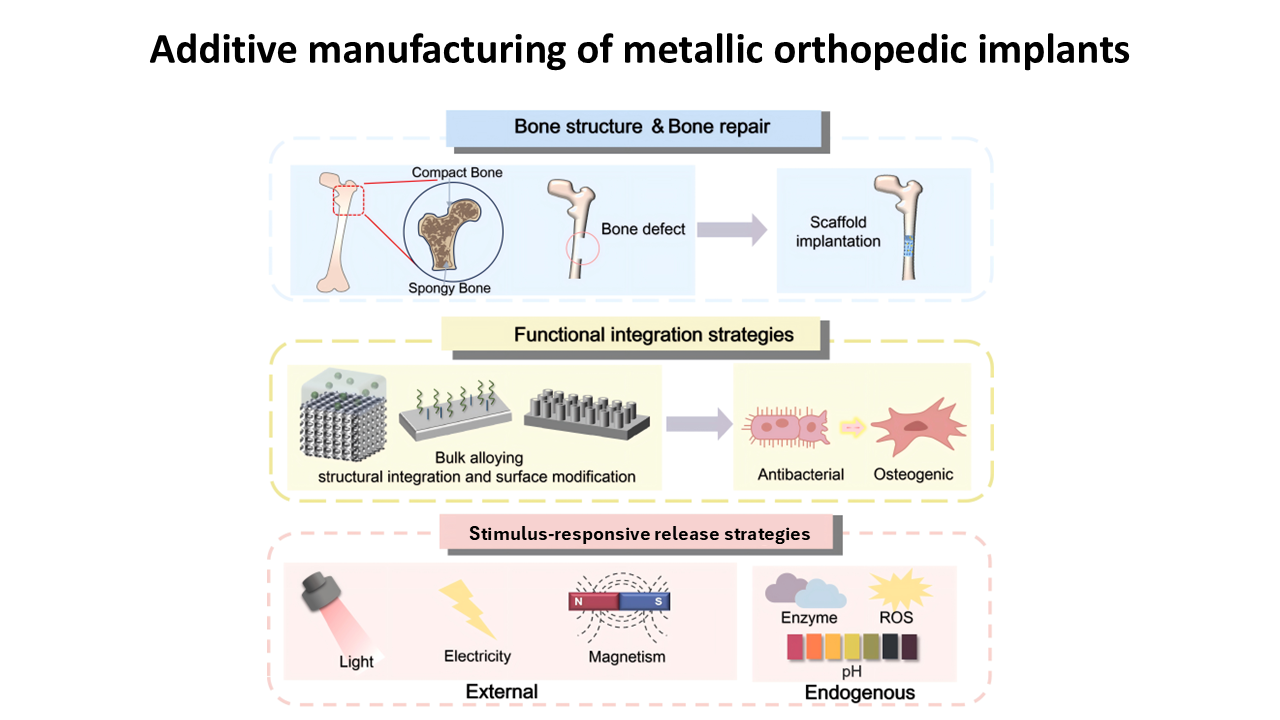
Additive manufacturing (AM) has accelerated the evolution of metallic orthopedic implants from passive structural substitutes toward multifunctional therapeutic platforms. Leveraging the geometric freedom and compositional flexibility of AM, bioactive substances can be integrated into metallic implants through multiple strategies to regulate the peri-implant microenvironment and enhance tissue regeneration. This review summarizes recent advances in bioactive integration and responsive therapeutic release in additively manufactured metallic orthopedic implants. First, major biofunctionalization strategies are discussed, including surface modification, bulk alloying, and structurally integrated reservoirs. These approaches enable the incorporation of antibacterial, osteogenic, angiogenic, and immunomodulatory functions through localized delivery of antibiotics, bioactive ions, peptides, growth factors, and small-molecule therapeutics. Subsequently, recent progress in stimuli-responsive release systems is reviewed, including endogenous stimuli such as pH, enzymes, and reactive oxygen species, as well as exogenous stimuli such as light, magnetic fields, and electrical stimulation, which enable on-demand and microenvironment-adaptive therapy. The relationships among implant architecture, bioactive integration, and dynamic therapeutic regulation are further discussed to highlight the unique advantages of AM in constructing multifunctional implants. Finally, current challenges associated with multifunctional AM metallic implants are discussed, particularly the need to achieve synergistic biofunctionality, maintain structural and mechanical integrity under process constraints, ensure predictable therapeutic release, and establish reliable process–structure–property relationships. This review provides insights into the development of intelligent metallic implants that simultaneously provide mechanical support and actively regulate therapy.
- Yang C, Fang H, Dou Q, et al. Progress in bone repair scaffolds: Interdisciplinary perspective for mechanism and material design. Coord Chem Rev. 2026;549:217355. doi: 10.1016/j.ccr.2025.217355
- Ma Y, Song X, Luo B, et al. 3D-printed triboelectric scaffolds for fabricating BMSC-derived cartilage to repair bone defects and promote endochondral ossification. Bioact Mater. 2026;58:685-700. doi: 10.1016/j.bioactmat.2025.11.044
- Lu H, Li Z, Duan Z, et al. Photothermal catalytic reduction and bone tissue engineering towards a three‐in‐one therapy strategy for osteosarcoma. Adv Mater. 2024;36(40):2408016. doi: 10.1002/adma.202408016
- Wang T, Ouyang H, Luo Y, et al. Rehabilitation exercise–driven symbiotic electrical stimulation system accelerating bone regeneration. Sci Adv. 2024;10(1):eadi6799. doi: 10.1126/sciadv.adi6799
- Collon K, Gallo MC, Lieberman JR. Musculoskeletal tissue engineering: regional gene therapy for bone repair. Biomaterials. 2021;275:120901. doi: 10.1016/j.biomaterials.2021.120901
- Kinzel M, Kalra A, Tripathi G, Dharmani-Khan P, Khan F, Storek J. Lack of both donor and recipient anti-EBV T cells in EBV seronegative recipients of grafts from seropositive donors. Bone Marrow Transplant. 2023;58(3):332-333. doi: 10.1038/s41409-022-01884-3
- Bai Y, Wu N, Li X, et al. Recent progress of 3D printed responsive scaffolds for bone repair: A review. Mater Today Bio. 2025;35:102351. doi: 10.1016/j.mtbio.2025.102351
- Qin T, Lian X, Ullah A, et al. The multi-scale porous and hydrophilic 3D printed polycaprolactone/silk fibroin/β-tricalcium phosphate bone scaffolds effect on femoral defect repair. Int J Biol Macromol. 2025;330:148230. doi: 10.1016/j.ijbiomac.2025.148230
- Lu X, Guo Z, Zhou X, et al. Deformation behavior and corrosion resistance of bio-inspired porous Ti-6Al-4V implants fabricated by selective laser melting. Powder Technol. 2026;472:122147. doi: 10.1016/j.powtec.2026.122147
- Wu X, Jing X, She J, Yuan H, Pan F. The influence of zinc content on degradation control and mechanical behavior of Mg-Zn-Mn alloys for bone implants. Mater Today Commun. 2025;48:113610. doi: 10.1016/j.mtcomm.2025.113610
- Chao L, Chao Q, Feng Q, et al. Design of bionic porous structure of bone scaffolds and analysis of fatigue and permeability characteristics. Front Bioeng Biotechnol. 2026;14:1765370. doi: 10.3389/fbioe.2026.1765370
- Shi J, Dai W, Gupta A, et al. Frontiers of hydroxyapatite composites in bionic bone tissue engineering. Materials. 2022;15(23):8475. doi: 10.3390/ma15238475
- Cui Y-W, Wang L, Zhang L-C. Towards load-bearing biomedical titanium-based alloys: From essential requirements to future developments. Prog Mater Sci. 2024;144:101277. doi: 10.1016/j.pmatsci.2024.101277
- Ouyang L, He X, Liao Y, et al. Electric field stimulation-responsive hydrogels for bone regeneration: from mechanisms to applications. Bone Res. 2026;14(1):4. doi: 10.1038/s41413-025-00482-5
- Yan Y, Kang Y, Li D, et al. Microstructure, mechanical properties and corrosion behavior of porous Mg-6 wt.% Zn scaffolds for bone tissue engineering. J Mater Eng Perform. 2018;27(3):970-984. doi: 10.1007/s11665-018-3189-x
- Zaharin HA, Abdul Rani AM, Azam FI, et al. Effect of Unit Cell Type and Pore Size on Porosity and Mechanical Behavior of Additively Manufactured Ti6Al4V Scaffolds. Materials. 2018;11(12):2402. doi: 10.3390/ma11122402
- Tsai CH, Hung CH, Kuo CN, Chen CY, Peng YN, Shie MY. Improved bioactivity of 3D printed porous titanium alloy scaffold with chitosan/magnesium-calcium silicate composite for orthopaedic applications. Materials. 2019;12(2):203. doi: 10.3390/ma12020203
- Zhang C, Poudel I, Mita N, et al. Amikacin Coated 3D-Printed Metal Devices for Prevention of Postsurgical Infections (PSIs). Pharmaceutics. 2025;17(7):911. doi: 10.3390/pharmaceutics17070911
- Yang Z, Jiang D, Zhou M, et al. Osteoblastic differentiation and antibacterial activity of reduced graphene oxide modified titanium alloy implant surfaces prepared via friction stir processing. J Mater Sci Technol. 2025;236:150-162. doi: 10.1016/j.jmst.2025.03.022
- Mahajan A, Devgan S, Kalyanasundaram D. Surface alteration of Cobalt-Chromium and duplex stainless steel alloys for biomedical applications: a concise review. Mater Manuf Process. 2023;38(3):260-270. doi: 10.1080/10426914.2022.2105873
- Yang K, Ren Y. Nickel-free austenitic stainless steels for medical applications. Sci Technol Adv Mater. 2010;11(1):014105. doi: 10.1088/1468-6996/11/1/014105
- Chen Q, Thouas G. Metallic implant biomaterials. Mater Sci Eng R. 2015;87:1-57. doi: 10.1016/j.mser.2014.10.001
- Geetha M, Singh AK, Asokamani R, Gogia AK. Ti based biomaterials, the ultimate choice for orthopaedic implants–A review. Prog Mater Sci. 2009;54(3):397-425. doi: 10.1016/j.pmatsci.2008.06.004
- Zhao L, Pei X, Jiang L, et al. Bionic design and 3D printing of porous titanium alloy scaffolds for bone tissue repair. Compos B Eng. 2019;162:154-161. doi: 10.1016/j.compositesb.2018.10.094
- Yaman P, Kucukyildirim BO. Tailoring Ti3C2Tx MXene multilayers for biomaterial integration: synthesis, characterization, and cytotoxicity. Mater Sci Eng B. 2026;323:118752. doi: 10.1016/j.mseb.2025.118752
- Niu J, Xiong M, Guan X, et al. The in vivo degradation and bone-implant interface of Mg-Nd-Zn-Zr alloy screws: 18 months post-operation results. Corros Sci. 2016;113:183-187. doi: 10.1016/j.corsci.2016.10.009
- Moravej M, Mantovani D. Biodegradable metals for cardiovascular stent application: interests and new opportunities. Int J Mol Sci. 2011;12(7):4250-4270. doi: 10.3390/ijms12074250
- Zhao L, Wang X, Wang T, Xia Y, Cui C. Mechanical properties and biodegradation of porous Zn-1Al alloy scaffolds. Mater Lett. 2019;247:75-78. doi: 10.1016/j.matlet.2019.03.097
- Kabir H, Munir K, Wen C, Li Y. Recent research and progress of biodegradable zinc alloys and composites for biomedical applications: Biomechanical and biocorrosion perspectives. Bioact Mater. 2021;6(3):836-879. doi: 10.1016/j.bioactmat.2020.09.013
- Liang H, Tu J, Wang B, et al. Improved osseointegration and segmental stability of 3D-printed porous tantalum cages with micro-scale structures for spinal fusion. Int J Bioprint. 2025;11(1):517-531. doi: 10.36922/ijb.4811
- Gao Y, Jiang W, Zeng D, Liang X, Ma C, Xiao W. Additive manufacturing of titanium alloys for biomedical applications: A systematic review. Rev Mater Res. 2025;1(1):100011. doi: 10.1016/j.revmat.2025.100011
- Koju N, Niraula S, Fotovvati B. Additively manufactured porous Ti6Al4V for bone implants: a review. Metals. 2022;12(4):687. doi: 10.3390/met12040687
- Dzogbewu T. Additive manufacturing of porous Ti-based alloys for biomedical applications–a review. J New Gen Sci. 2017;15(1):278-294.
- Nabeel M, Farooq A, Miraj S, Yahya U, Hamad K, Deen K. Comparison of the properties of additively manufactured 316L stainless steel for orthopedic applications: a review. World Sci Annu Rev Funct Mater. 2023;1:2230001. doi: 10.1142/S281092282230001X
- Ara I, Bajwa D, Raeisi A. A review on the wear performance of additively manufactured 316L stainless steel: process, structure, and performance. J Mater Sci. 2025;60(13):5686-5720. doi: 10.1007/s10853-025-10775-z
- Acharya S, Soni R, Suwas S, Chatterjee K. Additive manufacturing of Co–Cr alloys for biomedical applications: A concise review. J Mater Res. 2021;36(19):3746-3760. doi: 10.1557/s43578-021-00244-z
- Shafizadeh M, Yapici GG. Wear performance of additive-manufactured and heat-treated CoCrMo alloy. Mater Lett. 2026;405:139761. doi: 10.1016/j.matlet.2025.139761
- Aikin M, Shalomeev V, Kukhar V, et al. Recent advances in biodegradable magnesium alloys for medical implants: evolution, innovations, and clinical translation. Crystals. 2025;15(8):671. doi: 10.3390/cryst15080671
- Hashemi TS, Jaiswal S, McCarthy HO, Levingstone TJ, Dunne NJ. Biofunctionalisation of porous additively manufactured magnesium-based alloys for orthopaedic applications: a review. Biomater Adv. 2025;169:214170. doi: 10.1016/j.bioadv.2024.214170
- Gracheva A, Polozov I, Popovich A. Additive manufacturing of biodegradable metallic implants by selective laser melting: current research status and application perspectives. Metals. 2025;15(7):754. doi: 10.3390/met15070754
- Yang X, Peng Z, Fang Y, Tang Y, Shen H-H, Zhu Y. Review of additively manufactured zinc alloys by laser powder bed fusion for biomedical applications. Rare Met. 2025;44(11):8262-8291. doi: 10.1007/s12598-025-03518-1
- Wang J, Zhang Y, Huang W, et al. Biodegradable porous zinc scaffolds for bone regeneration: multiscale architecture, degradation control, and osteo-immunomodulation. Curr Opin Solid State Mater Sci. 2026;42:101270. doi: 10.1016/j.cossms.2026.101270
- Chua K, Khan I, Malhotra R, Zhu D. Additive manufacturing and 3D printing of metallic biomaterials. Eng Regen. 2021;2:288-299. doi: 10.1016/j.engreg.2021.11.002
- Li Y, Jiang D, Zhu R, Yang C, Wang L, Zhang LC. Revolutionizing medical implant fabrication: advances in additive manufacturing of biomedical metals. Int J Extrem Manuf. 2025;7(2):022002. doi: 10.1088/2631-7990/ad92cc
- Luo D, Ran Z, Wu J, et al. Accuracy validation of patient-specific 3D-printed acetabular revision prostheses: A stereotactic accuracy analysis. Int J Bioprint. 2025;11(3):307-318. doi: 10.36922/IJB025120096
- Wang B, Zhou C, Zhou J, et al. Niti minimal surface porous scaffolds matching human bone characteristics: mechanical, permeability and osteogenic properties. Virtual Phys Prototyp. 2026;21(1):e2633475. doi: 10.1080/17452759.2026.2633475
- Tan SLA, Zhao M, Li Z, et al. Horsetail-inspired lattice structures for bone scaffold applications. Int J Bioprint. 2024;10(4):2326. doi: 10.36922/ijb.2326
- Wang B, Yang C, Zheng C, et al. Effects of modeling strategies of triply periodic minimal surface on the mechanical properties and permeability of biomedical TC4 porous scaffolds. Int J Bioprint. 2024;10(3):2565. doi: 10.36922/ijb.2565
- Liu J, Wang K, Wang R, et al. Effect of lattice type on biomechanical and osseointegration properties of 3D-printed porous Ti6Al4V scaffolds. Int J Bioprint. 2024;10(2):1698. doi: 10.36922/ijb.1698
- Ardila L, Garciandia F, González-Díaz J, et al. Effect of IN718 recycled powder reuse on properties of parts manufactured by means of selective laser melting. Phys Procedia. 2014;56:99-107. doi: 10.1016/j.phpro.2014.08.152
- Wauthle R, Van der Stok J, Yavari SA, et al. Additively manufactured porous tantalum implants. Acta Biomater. 2015;14:217-225. doi: 10.1016/j.actbio.2014.12.003
- Mazzoli A. Selective laser sintering in biomedical engineering. Med Biol Eng Comput. 2013;51(3):245-256. doi: 10.1007/s11517-012-1001-x
- Zhao X, Li S, Zhang M, et al. Comparison of the microstructures and mechanical properties of Ti–6Al–4V fabricated by selective laser melting and electron beam melting. Mater Des. 2016;95:21-31. doi: 10.1016/j.matdes.2015.12.135
- Zaharin HA, Abdul Rani AM, Ginta TL, Azam FI. Additive Manufacturing Technology for Biomedical Components: A review. IOP Conf Ser Mater Sci Eng. 2018;328(1):012003. doi: 10.1088/1757-899X/328/1/012003
- Hong D, Chou D-T, Velikokhatnyi OI, et al. Binder-jetting 3D printing and alloy development of new biodegradable Fe-Mn-Ca/Mg alloys. Acta Biomater. 2016;45:375-386. doi: 10.1016/j.actbio.2016.08.032
- Shakor P, Chu S, Puzatova A, Dini E. Review of binder jetting 3D printing in the construction industry. Prog Addit Manuf. 2022;7(4):643-669. doi: 10.1007/s40964-021-00252-9
- Putra N, Leeflang M, Minneboo M, et al. Extrusion-based 3D printed biodegradable porous iron. Acta Biomater. 2021;121:741-756. doi: 10.1016/j.actbio.2020.11.022
- Zhang H, Sun H, Zhang L, et al. Coaxial 3D printing scaffolds with sequential antibacterial and osteogenic functions to effectively repair infected mandibular defects. Adv Funct Mater. 2024;34(44):2407483. doi: 10.1002/adfm.202407483
- Zhu Y, Dai B, Li X, et al. Periosteum-inspired membranes integrated with bioactive magnesium oxychloride ceramic nanoneedles for guided bone regeneration. ACS Appl Mater Interfaces. 2022;14(35):39830-39842. doi: 10.1021/acsami.2c10615
- Hu W, Mao T, Chen J, et al. Robust adhesive, antibacterial, pro-angiogenic and osteogenic bone adhesives with moderate degradability facilitating bone regeneration. Bioact Mater. 2026;56:353-367. doi: 10.1016/j.bioactmat.2025.08.031
- Jing Z, Zhang T, Xiu P, et al. Functionalization of 3D-printed titanium alloy orthopedic implants: a literature review. Biomed Mater. 2020;15(5):052003. doi: 10.1088/1748-605X/ab9078
- Vyavahare S, Mahesh V, Mahesh V, Harursampath D. Additively manufactured meta-biomaterials: A state-of-the-art review. Compos Struct. 2023;305:116491. doi: 10.1016/j.compstruct.2022.116491
- Kechagias S, Munford MJ, Masure FCH, van Arkel RJ, Oosterbeek RN. Lattice Structures for Bone Replacement: The Intersection of Bone Biomechanics, Lattice Design, and Additive Manufacturing. Adv Mater Technol. 2026:e01885. doi: 10.1002/admt.202501885
- Li J, Zheng Y, Yu Z, et al. Surface-modified titanium and titanium-based alloys for improved osteogenesis: A critical review. Heliyon. 2024;10(1):e23779. doi: 10.1016/j.heliyon.2023.e23779
- Akay S, Yaghmur A. Recent Advances in Antibacterial Coatings to Combat Orthopedic Implant-Associated Infections. Molecules. 2024;29(5):1172. doi: 10.3390/molecules29051172
- Zhang B, Lu D, Duan H. Recent advances in responsive antibacterial materials: design and application scenarios. Biomater Sci. 2023;11(2):356-379. doi: 10.1039/d2bm01573k
- Zhao P, Si L, He H, et al. Development and evaluation of dual-controlled release antibiotic-loaded bone scaffolds. Int J Bioprint. 2025;11(6):430-450. doi: 10.36922/IJB025330325
- Mullins ND, Deadman BJ, Moynihan HA, et al. The impact of storage conditions upon gentamicin coated antimicrobial implants. J Pharm Anal. 2016;6(6):374-381. doi: 10.1016/j.jpha.2016.05.002
- Gordon O, Lee DE, Liu B, et al. Dynamic PET-facilitated modeling and high-dose rifampin regimens for Staphylococcus aureus orthopedic implant–associated infections. Sci Transl Med. 2021;13(622):eabl6851. doi: 10.1126/scitranslmed.abl6851
- Wehrli W. Rifampin: mechanisms of action and resistance. Rev Infect Dis. 1983;5(suppl 3):S407-S411. doi: 10.1093/clinids/5.supplement_3.s407
- Zhang C, Li J, Lin L, et al. The impact of rifampin on the efficacy of implant retention and prosthesis removal in staphylococcal periprosthetic joint infection. Front Cell Infect Microbiol. 2025;15. doi: 10.3389/fcimb.2025.1587436
- Mohamed W, Sommer U, Sethi S, et al. Intracellular proliferation of S. aureus in osteoblasts and effects of rifampicin and gentamicin on S. aureus intracellular proliferation and survival. Eur Cell Mater. 2014;28:258-268. doi: 10.22203/eCM.v028a18
- Kobata SI, Teixeira LEM, Fernandes SOA, Faraco AAG, Vidigal PVT, Araújo ID. Prevention of bone infection after open fracture using a chitosan with ciprofloxacin implant in animal model. Acta Cir Bras. 2020;35(8):e202000803. doi: 10.1590/s0102-865020200080000003
- Tan H, Ma R, Lin C, Liu Z, Tang T. Quaternized Chitosan as an Antimicrobial Agent: Antimicrobial Activity, Mechanism of Action and Biomedical Applications in Orthopedics. Int J Mol Sci. 2013;14(1):1854-1869. doi: 10.3390/ijms14011854
- Zapata ME, Tovar CD, Hernandez JH. The Role of Chitosan and Graphene Oxide in Bioactive and Antibacterial Properties of Acrylic Bone Cements. Biomolecules. 2020;10(12):1616. doi: 10.3390/biom10121616
- Ke CL, Deng FS, Chuang CY, Lin CH. Antimicrobial Actions and Applications of Chitosan. Polymers. 2021;13(6):904. doi: 10.3390/polym13060904
- Costa B, Martínez-de-Tejada G, Gomes PAC, L. Martins MC, Costa F. Antimicrobial Peptides in the Battle against Orthopedic Implant-Related Infections: A Review. Pharmaceutics. 2021;13(11):1918. doi: 10.3390/pharmaceutics13111918
- Ageitos JM, Sánchez-Pérez A, Calo-Mata P, Villa TG. Antimicrobial peptides (AMPs): Ancient compounds that represent novel weapons in the fight against bacteria. Biochem Pharmacol. 2017;133:117-138. doi: 10.1016/j.bcp.2016.09.018
- Batoni G, Maisetta G, Esin S. Antimicrobial peptides and their interaction with biofilms of medically relevant bacteria. Biochim Biophys Acta. 2016;1858(5):1044-1060. doi: 10.1016/j.bbamem.2015.10.013
- Pletzer D, Coleman SR, Hancock RE. Anti-biofilm peptides as a new weapon in antimicrobial warfare. Curr Opin Microbiol. 2016;33:35-40. doi: 10.1016/j.mib.2016.05.016
- Burla A, Khandelwal M, Vaidya M. Antibacterial properties of Cu containing complex concentrated alloys. Mater Today Commun. 2022;33:104915. doi: 10.1016/j.mtcomm.2022.104915
- Zou YH, Wang J, Cui LY, et al. Corrosion resistance and antibacterial activity of zinc-loaded montmorillonite coatings on biodegradable magnesium alloy AZ31. Acta Biomater. 2019;98:196-214. doi: 10.1016/j.actbio.2019.05.069
- Pareek V, Gupta R, Panwar J. Do physico-chemical properties of silver nanoparticles decide their interaction with biological media and bactericidal action? A review. Mater Sci Eng C. 2018;90:739-749. doi: 10.1016/j.msec.2018.04.093
- Qing Y, Cheng L, Li R, et al. Potential antibacterial mechanism of silver nanoparticles and the optimization of orthopedic implants by advanced modification technologies. Int J Nanomedicine. 2018;13:3311-3327. doi: 10.2147/ijn.S165125
- Dai Q, Zong Y, Zhu J, et al. A chronological regulated implant coating with antibacterial and osteogenesis constructed by TA-mediated LbL self-assembly. Mater Des. 2024;241:112897. doi: 10.1016/j.matdes.2024.112897
- Gui X, Zhang B, Qin Y, et al. Structural and material double mechanical enhancement of HAp scaffolds promote bone defect regeneration. Compos A. 2025;189:108600. doi: 10.1016/j.compositesa.2024.108600
- Pajarinen J, Cenni E, Savarino L, et al. Profile of toll-like receptor-positive cells in septic and aseptic loosening of total hip arthroplasty implants. J Biomed Mater Res A. 2010;94(1):84-92. doi: 10.1002/jbm.a.32674
- Choi J, Lee EJ, Lim HJ, et al. Development of 3D-bioprinted artificial blood vessels loaded with rapamycin-nanoparticles for ischemic repair. Int J Bioprint. 2024;10(2):1465. doi: 10.36922/ijb.1465
- El Bialy I, Jiskoot W, Reza Nejadnik M. Formulation, Delivery and Stability of Bone Morphogenetic Proteins for Effective Bone Regeneration. Pharm Res. 2017;34(6):1152-1170. doi: 10.1007/s11095-017-2147-x
- Wozney JM. Bone Morphogenetic Proteins. Prog Growth Factor Res. 1989;1(4):267-280. doi: 10.1016/0955-2235(89)90015-X
- Berten-Schunk L, Roger Y, Bunjes H, Hoffmann A. Release of TGF-β3 from Surface-Modified PCL Fiber Mats Triggers a Dose-Dependent Chondrogenic Differentiation of Human Mesenchymal Stromal Cells. Pharmaceutics. 2023;15(4):1303. doi: 10.3390/pharmaceutics15041303
- Grosso A, Lunger A, Burger MG, et al. VEGF dose controls the coupling of angiogenesis and osteogenesis in engineered bone. NPJ Regen Med. 2023;8(1):15. doi: 10.1038/s41536-023-00288-1
- Guo Y, Jin X, Xiong W, Tan W, Zhou Y. Restoration of vasculogenic microtissue sprouting in osteogenic niches using PDGF-BB for prevascularized bone engineering. Tissue Cell. 2026;98:103168. doi: 10.1016/j.tice.2025.103168
- Yang F, Lin Y, Shen S, et al. Polydopamine chelating strontium on graphene oxide enhances the mechanical and osteogenic induction properties of PLLA/PGA bone scaffold. Int J Bioprint. 2024;10(3):1829. doi: 10.36922/ijb.1829
- Bai H, Cui Y, Wang C, et al. 3D printed porous biomimetic composition sustained release zoledronate to promote osteointegration of osteoporotic defects. Mater Des. 2020;189:108513. doi: 10.1016/j.matdes.2020.108513
- Zhu C, Jia Y, Tang Y, et al. Functionalized chitosan hydrogel promotes osseointegration at the interface of 3D printed titanium alloy scaffolds. Int J Biol Macromol. 2024;266:131169. doi: 10.1016/j.ijbiomac.2024.131169
- Li S, Cui Y, Liu H, et al. Dual-functional 3D-printed porous bioactive scaffold enhanced bone repair by promoting osteogenesis and angiogenesis. Mater Today Bio. 2024;24:100943. doi: 10.1016/j.mtbio.2024.100943
- Chu F, Wang Z, Zhang D, et al. Research on the osteogenic properties of 3D-printed porous titanium alloy scaffolds loaded with Gelma/PAAM-ZOL composite hydrogels. Int J Biol Macromol. 2024;276:134050. doi: 10.1016/j.ijbiomac.2024.134050
- Baek J, Moon W, Chung SH, Kim B-S. Injectable ABA Triblock Copolyether Hydrogel for Dental Implant-Mediated Drug Delivery. Biomacromolecules. 2026;27(1):930-937. doi: 10.1021/acs.biomac.5c02307
- Sheng X, Che Z, Qiao H, et al. A functional mineralized collagen hydrogel to promote angiogenic and osteogenic for osseointegration of 3D-printed titanium alloy microporous scaffolds. Int J Biol Macromol. 2024;277:133806. doi: 10.1016/j.ijbiomac.2024.133806
- Wang Y, Wang Y, Yu L, et al. Collagen-Coated 3D-Printed Magnesium Alloy Scaffold with Controlled Mg2+ Release for Enhanced Repair of Critical-Sized Bone Defects. ACS Appl Mater Interfaces. 2025;17(45):61760-61774. doi: 10.1021/acsami.5c16661
- Wu L, Pei X, Dou Q, et al. 3D Printed Calcium Phosphate Physiochemically Dual-Regulating Pro-Osteogenesis and Antiosteolysis for Enhancing Bone Tissue Regeneration. ACS Appl Mater Interfaces. 2024;16(28):37007-37016. doi: 10.1021/acsami.4c06318
- Knaislová A, Horkavcová D, Jablonská E, Vojtěch D. Sol-gel TiO2-based coatings in 3D printed porous Ti-6Al-4V alloy structures as efficient antibacterial drug delivery systems: Thorough structural and biological characterization. Appl Surf Sci Adv. 2025;29:100816. doi: 10.1016/j.apsadv.2025.100816
- Tabia Z, Bricha M, El Mabrouk K, Vaudreuil S. Manufacturing of a metallic 3D framework coated with a bioglass matrix for implant applications. J Mater Sci. 2021;56(2):1658-1672. doi: 10.1007/s10853-020-05370-3
- Ye J, Miao B, Xiong Y, et al. 3D printed porous magnesium metal scaffolds with bioactive coating for bone defect repair: enhancing angiogenesis and osteogenesis. J Nanobiotechnology. 2025;23(1):160. doi: 10.1186/s12951-025-03222-3
- Zhao Z, Ma S, Wu C, et al. Chimeric Peptides Quickly Modify the Surface of Personalized 3D Printing Titanium Implants to Promote Osseointegration. ACS Appl Mater Interfaces. 2021;13(29):33981-33994. doi: 10.1021/acsami.1c11207
- Migita S, Sakashita K, Saito Y, Suyalatu, Yamazaki T. Co–Cr–Mo alloy binding peptide as molecular glue for constructing biomedical surfaces. J Appl Biomater Funct Mater. 2020;18. doi: 10.1177/2280800020924739
- Cui C, Zhao Y, Yan J, et al. Peptide platform for 3D-printed Ti implants with synergistic antibacterial and osteogenic functions to enhance osseointegration. Mater Today Bio. 2025;30:101430. doi: 10.1016/j.mtbio.2024.101430
- Lei H, Cao H, Chen X, et al. A Functionalized 3D-Printed Ti6Al4V “Cell Climbing Frame” Inspired by Marine Sponges to Recruit and Rejuvenate Autologous BMSCs in Osteoporotic Bone Repair. Adv Mater. 2025;37(11):2413238. doi: 10.1002/adma.202413238
- Chen Z, Wang B, Yang C, et al. 3D Printed Pedicle Screws with Microarc Oxidation Ceramic Interfaces Enhance Osteointegration and Orthopedic Fixation Feasibility. ACS Appl Mater Interfaces. 2024;16(25):31983-31996. doi: 10.1021/acsami.4c03628
- Chen HB, Cui LY, Liu WN, et al. In vitro degradation, antibacterial activity and drug release of levofloxacin-loaded coatings on Mg alloy AZ31: The effect of chain length. Prog Org Coat. 2024;189:108327. doi: 10.1016/j.porgcoat.2024.108327
- Sun J, Liu SS, Zou D, et al. A novel porous interbody fusion cage modified by microarc oxidation and hydrothermal treatment technology accelerate osseointegration and spinal fusion in sheep. RSC Adv. 2024;14(44):31966-31978. doi: 10.1039/d3ra08185k
- Xiu P, Jia Z, Lv J, et al. Tailored Surface Treatment of 3D Printed Porous Ti6Al4V by Microarc Oxidation for Enhanced Osseointegration via Optimized Bone In-Growth Patterns and Interlocked Bone/Implant Interface. ACS Appl Mater Interfaces. 2016;8(28):17964-17975. doi: 10.1021/acsami.6b05893
- Yang X, Wu L, Li C, et al. Synergistic Amelioration of Osseointegration and Osteoimmunomodulation with a Microarc Oxidation-Treated Three-Dimensionally Printed Ti-24Nb-4Zr-8Sn Scaffold via Surface Activity and Low Elastic Modulus. ACS Appl Mater Interfaces. 2024;16(3):3171-3186. doi: 10.1021/acsami.3c16459
- Yue X, Xu K, Wang S, et al. SLM Magnesium Alloy Micro-Arc Oxidation Coating. Materials. 2024;17(20):4988. doi: 10.3390/ma17204988
- Fazel M, Salimijazi HR, Shamanian M, et al. Osteogenic and antibacterial surfaces on additively manufactured porous Ti-6Al-4V implants: Combining silver nanoparticles with hydrothermally synthesized HA nanocrystals. Mater Sci Eng C. 2021;120:111745. doi: 10.1016/j.msec.2020.111745
- van Hengel IAJ, Riool M, Fratila-Apachitei LE, et al. Selective laser melting porous metallic implants with immobilized silver nanoparticles kill and prevent biofilm formation by methicillin-resistant Staphylococcus aureus. Biomaterials. 2017;140:1-15. doi: 10.1016/j.biomaterials.2017.02.030
- Yao S, Jiang D, Uglov VV, Ma F, Chen Y, Wang L. Comprehensive review on additive manufacturing of porous biomedical titanium alloys: Structural design, surface modification and applications. Int J Bioprint. 2026;12(3):026160143. doi: 10.36922/ijb026160143
- Zhang Z, Li Y, He P, et al. Nanotube-decorated hierarchical tantalum scaffold promoted early osseointegration. Nanomedicine. 2021;35:102390. doi: 10.1016/j.nano.2021.102390
- Zhao P, Liu Y, Li T, et al. 3D printed titanium scaffolds with ordered TiO2 nanotubular surface and mesoporous bioactive glass for bone repair. Prog Nat Sci. 2020;30(4):502-509. doi: 10.1016/j.pnsc.2020.08.009
- Ran Z, Zhao B, Luo D, et al. Promotion of osteogenic differentiation and bone healing in tantalum-coated 3D-printed Ti6Al4V alloy scaffolds using chemical vapor deposition. Mater Des. 2025;258:114722. doi: 10.1016/j.matdes.2025.114722
- Guo Y, Ren L, Xie K, et al. Functionalized TiCu/Ti-Cu-N-Coated 3D-Printed Porous Ti6Al4V Scaffold Promotes Bone Regeneration through BMSC Recruitment. Adv Mater Interfaces. 2020;7(6):1901632. doi: 10.1002/admi.201901632
- Hu Y, Lei H, Tan Z, et al. Silver-doped diamond-like carbon antibacterial coating for 3D-printed titanium alloy total joint implants: Fabrication, characterization and biological function evaluation. J Mater Res Technol. 2025;39:8707-8717. doi: 10.1016/j.jmrt.2025.11.099
- Brodie EG, Robinson KJ, Sigston E, Molotnikov A, Frith JE. Osteogenic Potential of Additively Manufactured TiTa Alloys. ACS Appl Bio Mater. 2021;4(1):1003-1014. doi: 10.1021/acsabm.0c01450
- Li J, Cao F, Chen X, et al. Additively manufactured Tantalum-titanium alloys with optimized osteogenic and immunomodulatory properties for load-bearing orthopedic implants. Bioact Mater. 2026;58:49-69. doi: 10.1016/j.bioactmat.2025.11.029
- Liang H, Zhao D, Feng X, et al. 3D-printed porous titanium scaffolds incorporating niobium for high bone regeneration capacity. Mater Des. 2020;194:108890. doi: 10.1016/j.matdes.2020.108890
- Liu A, Zhang Z, Liang Y, et al. Magnesium-induced strengthening, degradation and osteogenesis for additively manufactured Zn-Mg orthopedic implants. Acta Biomater. 2025;197:495-506. doi: 10.1016/j.actbio.2025.03.025
- Qin Y, Liu A, Guo H, et al. Additive manufacturing of Zn-Mg alloy porous scaffolds with enhanced osseointegration: In vitro and in vivo studies. Acta Biomater. 2022;145:403-415. doi: 10.1016/j.actbio.2022.03.055
- Xu X, Lu Y, Yang X, et al. Copper-Modified Ti6Al4V Suppresses Inflammatory Response and Osteoclastogenesis while Enhancing Extracellular Matrix Formation for Osteoporotic Bone Regeneration. ACS Biomater Sci Eng. 2018;4(9):3364-3373. doi: 10.1021/acsbiomaterials.8b00736
- Xu D, Chen W, Lu Y, et al. 3D-printed Cu-bearing titanium alloy crowns for pediatric oral health: biocompatibility, antibacterial activity, and internal fit. J Adv Res. 2025. doi: 10.1016/j.jare.2025.12.024
- Jiang D, Xie L, Wang L. Current application status of multi-scale simulation and machine learning in research on high-entropy alloys. J Mater Res Technol. 2023;26:1341-1374. doi: 10.1016/j.jmrt.2023.07.233
- Jiang D, Luo M, Liu C, et al. 3D Printing parameter optimisation combined with heat treatment for achieving high density and enhanced performance in refractory high-entropy alloys. Virtual Phys Prototyp. 2025;20(1):e2524524. doi: 10.1080/17452759.2025.2524524
- Mao Y, Jiang D, Vladimir U, Jing Z, Wang L. Machine learning-driven additive manufacturing of biomedical metals: A review of forward prediction, inverse optimization, and quality control. Eng Sci Add Manuf. 2025;1(4):025440031. doi: 10.36922/esam025440031
- Peng P, Peng Y, Liu F, et al. Bayesian optimization and explainable machine learning for High-dimensional multi-objective optimization of biodegradable magnesium alloys. J Mater Sci Technol. 2025;238:132-145. doi: 10.1016/j.jmst.2025.02.059
- Marković G, Manojlović V, Ružić J, Sokić M. Predicting Low-Modulus Biocompatible Titanium Alloys Using Machine Learning. Materials. 2023;16(19):6355. doi: 10.3390/ma16196355
- Mukherjee R, Datta S. Materials Informatics Driven Designing Mg Alloys for Biodegradable Short-Term Implants Using Machine Learning. JOM. 2025;77(1):20-38. doi: 10.1007/s11837-024-06924-5
- Šalandová M, Leeflang MA, Klimopoulou M, Fratila-Apachitei LE, Apachitei I, Zadpoor AA. On-Demand Magnetically-Activated Drug Delivery from Additively Manufactured Porous Bone Implants to Tackle Antibiotic-Resistant Infections. Adv Mater Technol. 2024;9(8):2301616. doi: 10.1002/admt.202301616
- Karavasili C, Boyce H, Blanco J, et al. 3D-printed antibiotic-eluting pedicle screws for antimicrobial prophylaxis in instrumented spinal fusion. Cell Rep Phys Sci. 2024;5(12):102320. doi: 10.1016/j.xcrp.2024.102320
- Fan D, Zhang C, Wang H, et al. Fabrication of a composite 3D-printed titanium alloy combined with controlled in situ drug release to prevent osteosarcoma recurrence. Mater Today Bio. 2023;20:100683. doi: 10.1016/j.mtbio.2023.100683
- Pereira MMA, Piazza RD, Barbugli PA, et al. Targeted Infection Control and Tissue Integration via pH-Sensitive Smart Coatings on Implant Surfaces. ACS Appl Mater Interfaces. 2025;18(1):2584-2603. doi: 10.1021/acsami.5c19344
- Zhou W, Bai T, Wang L, et al. Biomimetic AgNPs@antimicrobial peptide/silk fibroin coating for infection-trigger antibacterial capability and enhanced osseointegration. Bioact Mater. 2023;20:64-80. doi: 10.1016/j.bioactmat.2022.05.015
- Zhang F, Hu Q, Wei Y, et al. Surface modification of titanium implants by pH-Responsive coating designed for Self-Adaptive antibacterial and promoted osseointegration. Chem Eng J. 2022;435:134802. doi: 10.1016/j.cej.2022.134802
- Zeng Y, Sun C, Yu Z, Zhang K, Nie P, Wang C. Microsphere-Coated Drug Reservoirs in Titanium Implants with pH-Responsive and Osmolality-Adaptive Drug Release for Enhanced Antibacterial Efficacy and Biocompatibility. ACS Appl Mater Interfaces. 2025;17(47):64193-64202. doi: 10.1021/acsami.5c16548
- Li Z, Zhao Y, Wang Z, et al. Engineering Multifunctional Hydrogel-Integrated 3D Printed Bioactive Prosthetic Interfaces for Osteoporotic Osseointegration. Adv Healthc Mater. 2022;11(11):2102535. doi: 10.1002/adhm.202102535
- Sutrisno L, Hu Y, Shen X, et al. Fabrication of hyaluronidase-responsive biocompatible multilayers on BMP2 loaded titanium nanotube for the bacterial infection prevention. Mater Sci Eng C. 2018;89:95-105. doi: 10.1016/j.msec.2018.03.024
- Yuan Z, Huang S, Lan S, et al. Surface engineering of titanium implants with enzyme-triggered antibacterial properties and enhanced osseointegration in vivo. J Mater Chem B. 2018;6(48):8090-8104. doi: 10.1039/C8TB01918E
- Yu Y, Ran Q, Shen X, Zheng H, Cai K. Enzyme responsive titanium substrates with antibacterial property and osteo/angio-genic differentiation potentials. Colloids Surf B Biointerfaces. 2020;185:110592. doi: 10.1016/j.colsurfb.2019.110592
- Chen M, Li M, Ren X, et al. DNAzyme Nanoconstruct-Integrated Autonomously-Adaptive Coatings Enhance Titanium-Implant Osteointegration by Cooperative Angiogenesis and Vessel Remodeling. ACS Nano. 2023;17(16):15942-15961. doi: 10.1021/acsnano.3c04049
- Bashiru M, Macchi S, Forson M, et al. Doxorubicin-Based Ionic Nanomedicines for Combined Chemo-Phototherapy of Cancer. ACS Appl Nano Mater. 2024;7(2):2176-2189. doi: 10.1021/acsanm.3c05464
- Lange N, Szlasa W, Saczko J, Chwiłkowska A. Potential of Cyanine Derived Dyes in Photodynamic Therapy. Pharmaceutics. 2021;13(6):818. doi: 10.3390/pharmaceutics13060818
- Perini G, Palmieri V, D’Ascenzo M, et al. Near-infrared controlled release of mesenchymal stem cells secretome from bioprinted graphene-based microbeads for nerve regeneration. Int J Bioprint. 2024;10(1):1045.doi: 10.36922/ijb.1045
- Chen S, Wang Y, Li J, et al. 3D-printed Mg-substituted hydroxyapatite/gelatin methacryloyl hydrogels encapsulated with PDA@DOX particles for bone tumor therapy and bone tissue regeneration. Int J Bioprint. 2024;10(5):3526. doi: 10.36922/ijb.3526
- Wang MK, Xiao F, Xu X. Antibacterial properties and biological activity of 3D-printed titanium alloy implants with a near-infrared photoresponsive surface. Int J Implant Dent. 2025;11(1):3. doi: 10.1186/s40729-024-00587-2
- Ji Z, Wan Y, Zou Y, Wang H, Liang X, Liu P. Dual-release 3D-printed porous Ti–6Al–4V implant with drug-eluting photothermal micro-nanotopographies: combating osteosarcoma recurrence, infections, and enhancing osteogenesis. Biomaterials. 2026;327:123749. doi: 10.1016/j.biomaterials.2025.123749
- Cai B, Huang L, Wang J, et al. 3D Printed Multifunctional Ti6Al4V-Based Hybrid Scaffold for the Management of Osteosarcoma. Bioconjug Chem. 2021;32(10):2184-2194. doi: 10.1021/acs.bioconjchem.1c00367
- Zhang G, Wu Z, Yang Y, et al. A multifunctional antibacterial coating on bone implants for osteosarcoma therapy and enhanced osteointegration. Chem Eng J. 2022;428:131155. doi: 10.1016/j.cej.2021.131155
- Mah C, Fraites TJ, Zolotukhin I, et al. Improved Method of Recombinant AAV2 Delivery for Systemic Targeted Gene Therapy. Mol Ther. 2002;6(1):106-112. doi: 10.1006/mthe.2001.0636
- Wang Y, Rouabhia M, Zhang Z. Pulsed electrical stimulation benefits wound healing by activating skin fibroblasts through the TGFβ1/ERK/NF-κB axis. Biochim Biophys Acta Gen Subj. 2016;1860(7):1551-1559. doi: 10.1016/j.bbagen.2016.03.023
- Liao J, Chen W, Yang M, et al. Conducting photopolymers on orthopeadic implants having a switch of priority between promoting osteogenic and antibacterial activity. Mater Horiz. 2018;5(3):545-552. doi: 10.1039/C8MH00285A
- Kuang Y, Chen S-X, Chen H. Responsive nanoplatforms: Versatile design strategies for efficient cancer theranostics. Mater Des. 2023;232:112076. doi: 10.1016/j.matdes.2023.112076
- Campbell S, Preciado Rivera N, Said S, et al. Injectable On-Demand Pulsatile Drug Delivery Hydrogels Using Alternating Magnetic Field-Triggered Polymer Glass Transitions. ACS Appl Mater Interfaces. 2023;15(42):48892-48902. doi: 10.1021/acsami.3c09299
- Li F, Qin Y, Lee J, et al. Stimuli-responsive nano-assemblies for remotely controlled drug delivery. J Control Release. 2020;322:566-592. doi: 10.1016/j.jconrel.2020.03.051
- Zeng D, Wang H, Yu Z, et al. Near-infrared light and magnetic field dual-responsive 3D printed scaffolds for sequential treatment of infected bone defects. Biofabrication. 2025;17(3):035031. doi: 10.1088/1758-5090/adebb3