
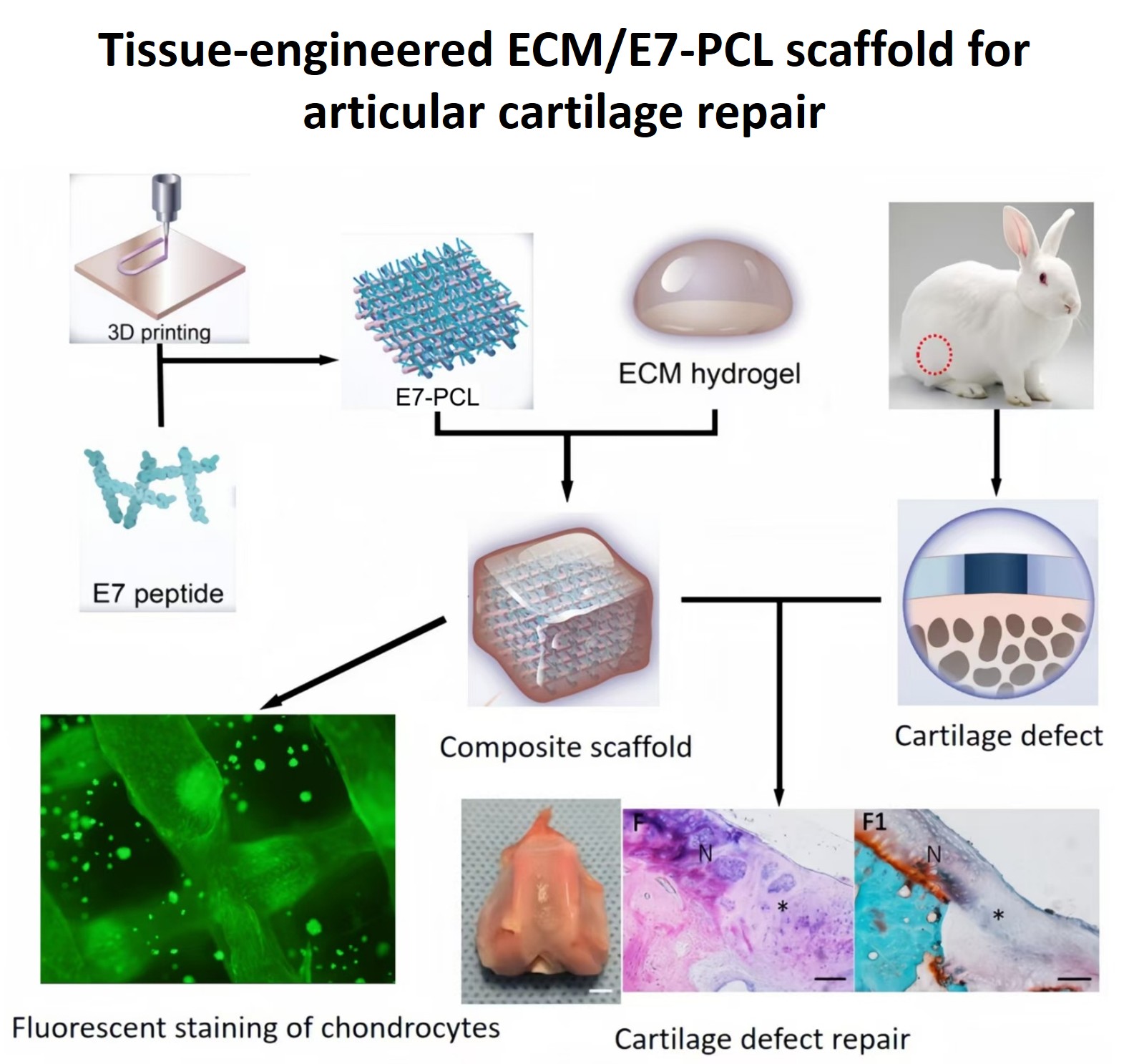
Construction of a 3D-printed polycaprolactone scaffold functionalized with extracellular matrix and an MSC-affinity peptide for articular cartilage repair

Cartilage damage has emerged as a major clinical challenge due to the limited intrinsic regenerative capacity of articular cartilage. Current cartilage repair strategies often rely on exogenous cells and growth factors to promote tissue regeneration; however, their clinical translation is hindered by high costs, complex manufacturing processes, and potential immunogenicity. Thus, the development of high-performance acellular tissue-engineering scaffolds has attracted increasing attention. In this study, we engineered a biomimetic ternary composite scaffold consisting of polycaprolactone (PCL), a bone marrow mesenchymal stem cell (BMSC)-affinity peptide, and cartilage extracellular matrix (ECM) to facilitate efficient cartilage regeneration through synergistic multifunctional effects. PCL scaffolds with well-defined porous architectures and favorable mechanical properties were fabricated using three-dimensional (3D) printing. Following surface functionalization with the mesenchymal stem cell (MSC)-affinity peptide E7, the scaffolds were further coated with decellularized cartilage ECM. This biomimetic design enhances cell adhesion, selectively recruits endogenous MSCs, and provides the structural support required for tissue regeneration. Moreover, the bioactive components and biochemical cues retained within the ECM promote chondrogenic differentiation. In vitro studies demonstrated that E7-modified PCL (E7-PCL) significantly enhanced MSC adhesion and recruitment. The ECM/E7-modified composite scaffold further promoted stem-cell adhesion, proliferation, chondrogenic differentiation, and extracellular matrix deposition while maintaining excellent biocompatibility and mechanical integrity. In vivo, implantation of the ECM/E7-PCL (E/E7-P) scaffold resulted in markedly improved cartilage repair compared with ECM/PCL (E/P) scaffolds and untreated controls. Overall, these findings from in vitro and rabbit in vivo experiments indicate that E/E7-P represents a promising acellular tissue-engineering candidate for cartilage defect regeneration, pending further validation in more comprehensive experimental models.
- Qiao Z, Lian M, Han Y, et al. Bioinspired stratified electrowritten fiber-reinforced hydrogel constructs with layer-specific induction capacity for functional osteochondral regeneration. Biomaterials. 2021;266:120385. doi: 10.1016/j.biomaterials.2020.120385
- Richter DL, Tanksley JA, Miller MD. Osteochondral autograft transplantation: a review of the surgical technique and outcomes. Sports Med Arthrosc Rev. 2016;24(2):74-78. doi: 10.1097/jsa.0000000000000099
- Lin X, Zhang Y, Li J, et al. Biomimetic multizonal scaffolds for the reconstruction of zonal articular cartilage in chondral and osteochondral defects. Bioact Mater. 2025;43:510-549. doi: 10.1016/j.bioactmat.2024.10.001
- Sherman SL, Thyssen E, Nuelle CW. Osteochondral autologous transplantation. Clin Sports Med. 2017;36(3):489-500. doi: 10.1016/j.csm.2017.02.006
- Wang Z, Li Z, Li Z, Wu B, Liu Y, Wu W. Cartilaginous extracellular matrix derived from decellularized chondrocyte sheets for the reconstruction of osteochondral defects in rabbits. Acta Biomater. 2018;81:129-145. doi: 10.1016/j.actbio.2018.10.005
- Farr J, Gracitelli GC, Shah N, Chang EY, Gomoll AH. High failure rate of a decellularized osteochondral allograft for the treatment of cartilage lesions. Am J Sports Med. 2016;44(8):2015-2022. doi: 10.1177/0363546516645086
- Ladegaard Skov A. Like cartilage, but simpler. Nature. 2015;517(7532):25-26. doi: 10.1038/517025a
- Hu X, Xu J, Li W, et al. Therapeutic “tool” in reconstruction and regeneration of tissue engineering for osteochondral repair. Appl Biochem Biotechnol. 2020;191(2):785-809. doi: 10.1007/s12010-019-03214-8
- Zhang B, Huang J, Narayan RJ. Gradient scaffolds for osteochondral tissue engineering and regeneration. J Mater Chem B. 2020;8(36):8149-8170. doi: 10.1039/d0tb00688b
- Mendes LF, Katagiri H, Tam WL, et al. Advancing osteochondral tissue engineering: bone morphogenetic protein, transforming growth factor, and fibroblast growth factor signaling drive ordered differentiation of periosteal cells resulting in stable cartilage and bone formation in vivo. Stem Cell Res Ther. 2018;9(1):42. doi: 10.1186/s13287-018-0787-3
- Sacks D, Baxter B, Campbell BC, et al. Multisociety consensus quality improvement revised consensus statement for endovascular therapy of acute ischemic stroke. Int J Stroke. 2018;13(6):612-632. doi: 10.1177/1747493018778713
- Aravamudhan A, Ramos DM, Nip J, et al. Osteoinductive small molecules: growth factor alternatives for bone tissue engineering. Curr Pharm Des. 2013;19(19):3420-3428. doi: 10.2174/1381612811319190008
- Xiao H, Huang W, Xiong K, et al. Osteochondral repair using scaffolds with gradient pore sizes constructed with silk fibroin, chitosan, and nano-hydroxyapatite. Int J Nanomedicine. 2019;14:2011-2027. doi: 10.2147/IJN.S191627
- Yin L, Wu Y, Yang Z, et al. Characterization and application of size-sorted zonal chondrocytes for articular cartilage regeneration. Biomaterials. 2018;165:66-78. doi: 10.1016/j.biomaterials.2018.02.050
- Bauza-Mayol G, Quintela M, Brozovich A, et al. Biomimetic scaffolds modulate the posttraumatic inflammatory response in articular cartilage contributing to enhanced neoformation of cartilaginous tissue in vivo. Adv Healthc Mater. 2022;11(1):2101127. doi: 10.1002/adhm.202101127
- Liang C, Wang G, Liang C, et al. Hierarchically patterned triple-layered gelatin-based electrospun membrane functionalized by cell-specific extracellular matrix for periodontal regeneration. Dent Mater. 2024;40(1):90-101. doi: 10.1016/j.dental.2023.10.022
- Wang P, Zhao Z, Li Z, et al. Attenuation of osteoarthritis progression via locoregional delivery of Klotho-expressing plasmid DNA and tanshinone IIA through a stem cell-homing hydrogel. J Nanobiotechnol. 2024;22(1):325. doi: 10.1186/s12951-024-02608-z
- Zhang G, He S, He X, et al. Local recruitment of autologous stem cells via a targeting microgel for precise cartilage repair without surgery. Adv Mater. 2025;37(33):2505544. doi: 10.1002/adma.202505544
- Gao F, Xu Z, Liang Q, et al. Osteochondral regeneration with 3D-printed biodegradable high-strength supramolecular polymer reinforced-gelatin hydrogel scaffolds. Adv Sci. 2019;6(15):1900867. doi: 10.1002/advs.201900867
- Deng C, Zhu H, Li J, et al. Bioactive scaffolds for regeneration of cartilage and subchondral bone interface. Theranostics. 2018;8(7):1940-1955. doi: 10.7150/thno.23674
- Castilho M, Mouser V, Chen M, Malda J, Ito K. Bi-layered micro-fibre reinforced hydrogels for articular cartilage regeneration. Acta Biomater. 2019;95:297-306. doi: 10.1016/j.actbio.2019.06.030
- Chen L, Deng C, Li J, et al. 3D printing of a lithium-calcium-silicate crystal bioscaffold with dual bioactivities for osteochondral interface reconstruction. Biomaterials. 2019;196:138-150. doi: 10.1016/j.biomaterials.2018.04.005
- Wang K, Liu L, Xie J, Shen L, Tao J, Zhu J. Facile strategy to generate aligned polymer nanofibers: effects on cell adhesion. ACS Appl Mater Interfaces. 2018;10(2):1566-1574. doi: 10.1021/acsami.7b16057
- Li S, Sun B, Li X, Yuan X. Characterization of electrospun core/shell poly(vinyl pyrrolidone)/poly(L-lactide-co-ε-caprolactone) fibrous membranes and their cytocompatibility in vitro. J Biomater Sci Polym Ed. 2008;19(2):245-258. doi: 10.1163/156856208783432499
- Xu Y, Li D, Yin Z, et al. Tissue-engineered trachea regeneration using decellularized trachea matrix treated with laser micropore technique. Acta Biomater. 2017;58:113-121. doi: 10.1016/j.actbio.2017.05.010
- Fu L, Li P, Li H, et al. The application of bioreactors for cartilage tissue engineering: advances, limitations, and future perspectives. Stem Cells Int. 2021;2021:1-13. doi: 10.1155/2021/6621806
- Yang Z, Li H, Tian Y, et al. Biofunctionalized structure and ingredient mimicking scaffolds achieving recruitment and chondrogenesis for staged cartilage regeneration. Front Cell Dev Biol. 2021;9:655440. doi: 10.3389/fcell.2021.655440
- Wang X, Song X, Li T, et al. Aptamer-functionalized bioscaffold enhances cartilage repair by improving stem cell recruitment in osteochondral defects of rabbit knees. Am J Sports Med. 2019;47(10):2316-2326. doi: 10.1177/0363546519856355
- Huang H, Zhang X, Hu X, et al. A functional biphasic biomaterial homing mesenchymal stem cells for in vivo cartilage regeneration. Biomaterials. 2014;35(36):9608-9619. doi: 10.1016/j.biomaterials.2014.08.020
- Duan P, Pan Z, Cao L, et al. The effects of pore size in bilayered poly (lactide‐co‐glycolide) scaffolds on restoring osteochondral defects in rabbits. J Biomed Mater Res A. 2014;102(1):180-192. doi: 10.1002/jbm.a.34683.
- Pattnaik A, Sanket AS, Pradhan S, et al. Designing of gradient scaffolds and their applications in tissue regeneration. Biomaterials. 2023;296:122078. doi: 10.1016/j.biomaterials.2023.122078.
- Zhu M, Jin J, Seddiqi H, Bakker AD. Novel three-dimensional preclinical model for investigating cartilage regeneration, incorporating physiological and pathological mechanical loading. Tissue Eng Part C Methods. 2025;31(10):367-379. doi: 10.1177/19373384251390654
- Chen M, Feng Z, Guo W, et al. PCL-MECM-based hydrogel hybrid scaffolds and meniscal fibrochondrocytes promote whole meniscus regeneration in a rabbit meniscectomy model. ACS Appl Mater Interfaces. 2019;11(44):41626-41639. doi: 10.1021/acsami.9b13611
- Vikingsson L, Claessens B, Gómez-Tejedor JA, Gallego Ferrer G, Gómez Ribelles JL. Relationship between micro-porosity, water permeability and mechanical behavior in scaffolds for cartilage engineering. J Mech Behav Biomed Mater. 2015;48:60-69. doi: 10.1016/j.jmbbm.2015.03.021
- Shen C, Zhou Z, Li R, et al. Silk fibroin-based hydrogels for cartilage organoids in osteoarthritis treatment. Theranostics. 2025;15(2):560-584. doi: 10.7150/thno.103491
- Li S, Sun H, Lu Q, et al. Bionic ECM scaffolds for directional articular hyaline cartilage regeneration and long-term homeostasis maintenance. Biomater Adv. 2025;173:214292. doi: 10.1016/j.bioadv.2025.214292
- Mirmusavi MH, Ahmadian M, Karbasi S. Polycaprolactone-chitosan/multi-walled carbon nanotube: a highly strengthened electrospun nanocomposite scaffold for cartilage tissue engineering. Int J Biol Macromol. 2022;209:1801-1814. doi: 10.1016/j.ijbiomac.2022.04.152
- Ghadirian S, Shariati L, Karbasi S. Evaluation of the effects of cartilage decellularized ECM in optimizing PHB-chitosan-HNT/chitosan-ECM core-shell electrospun scaffold: physicochemical and biological properties. Biomater Adv. 2025;172:214249. doi: 10.1016/j.bioadv.2025.214249
- Wei W, Ma Y, Yao X, et al. Advanced hydrogels for the repair of cartilage defects and regeneration. Bioact Mater. 2021;6(4):998-1011. doi: 10.1016/j.bioactmat.2020.09.030
- Nordberg RC, Bielajew BJ, Takahashi T, Dai S, Hu JC, Athanasiou KA. Recent advancements in cartilage tissue engineering innovation and translation. Nat Rev Rheumatol. 2024;20(6):323-346. doi: 10.1038/s41584-024-01118-4