
State-of-the-art research progress and emerging strategies in digital light processing bioprinting for skin regeneration

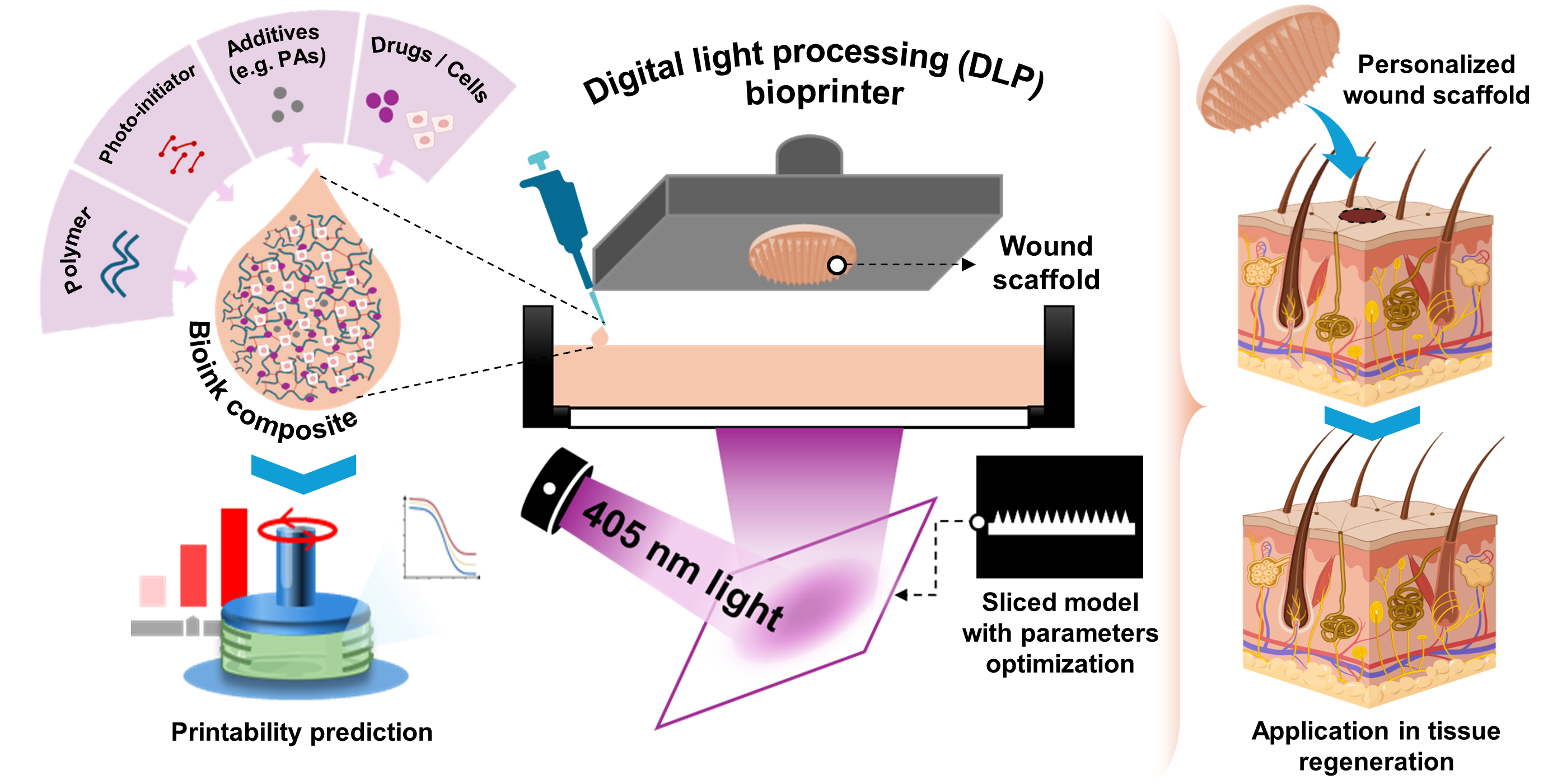
Skin injuries, including burns, chronic wounds, and diabetic ulcers, present significant clinical challenges due to impaired healing, high risk of infection, and limited efficacy of conventional transdermal patches. Owing to recent advances in biomaterials and regenerative medicine, skin-repair strategies are currently focused on engineered patches that better mimic the native tissue structure and function. In particular, digital light processing (DLP)-based 3D printing is a powerful platform for fabricating high-resolution, personalized skin patches with precise architectural control compared to conventional approaches. The rapid layer-by-layer photopolymerization of hydrogel-based materials enables the creation of mechanically compliant biocompatible constructs that support cell proliferation, immunomodulation, angiogenesis, and extracellular matrix remodeling. Furthermore, DLP technology enables controlled therapeutic delivery by facilitating the integration of advanced functionalities, such as microneedle arrays, vascularized architectures, and stimuli-responsive systems. This review systematically discusses the fundamental principles of DLP printing, key parameters that govern printing fidelity, recent progress in bioink development, and emerging applications of DLP-fabricated skin patches in wound healing and skin regeneration. Additionally, current challenges and future perspectives are highlighted to guide the continued development and clinical translation of DLP-based regenerative skin therapies.
- Dąbrowska A, Spano F, Derler S, Adlhart C, Spencer ND, Rossi RM. The relationship between skin function, barrier properties, and body-dependent factors. Skin Res Technol. 2018;24(2):165-174. doi: 10.1111/srt.12424
- Menon GK, Kligman AM. Barrier functions of human skin: a holistic view. Skin Pharmacol Physiol. 2009;22(4):178-189. doi: 10.1159/000231523
- Wong R, Geyer S, Weninger W, Guimberteau JC, Wong JK. The dynamic anatomy and patterning of skin. Exp Dermatol. 2016;25(2):92-98. doi: 10.1111/exd.12832
- Fahad FI, Ahn M, Kim BS. Advanced 3D-printed microneedle patches for smart drug delivery in wound care. Int J Bioprint. 2025;11(2):184-215. doi: 10.36922/ijb.8514
- Pang Y, Liu B, Jiang J, et al. Recent advances in immunocompetent human skin-on-chip models: Construction strategies and biomedical applications. Bioact Mater. 2026;64:94-134. doi: 10.1016/j.bioactmat.2026.04.030
- Sen CK. Human Wound and Its Burden: Updated 2020 Compendium of Estimates. Adv Wound Care. 2021;10(5):281-292. doi: 10.1089/wound.2021.0026
- Rodriguez-Rodriguez N, Martinez-Jimenez I, Garcia-Ojalvo A, et al. Wound Chronicity, Impaired Immunity and Infection in Diabetic Patients. MEDICC Rev. 2022;24(1):44-58. doi: 10.37757/MR2021.V23.N3.8
- Nuutila K, Eriksson E. Moist Wound Healing with Commonly Available Dressings. Adv Wound Care. 2021;10(12):685-698. doi: 10.1089/wound.2020.1232
- Farahani M, Shafiee A. Wound Healing: From Passive to Smart Dressings. Adv Healthc Mater. 2021;10(16):e2100477. doi: 10.1002/adhm.202100477
- Tiwari R, Pathak K. Local Drug Delivery Strategies towards Wound Healing. Pharmaceutics. 2023;15(2):634. doi: 10.3390/pharmaceutics15020634
- Norouzi S, Shemshaki NS, Norouzi E, et al. Recent advances in biomaterials for tissue-engineered constructs: Essential factors and engineering techniques. Mater Today Chem. 2024;37:102016. doi: 10.1016/j.mtchem.2024.102016
- Dutra Alves NS, Reigado GR, Santos M, et al. Advances in regenerative medicine-based approaches for skin regeneration and rejuvenation. Front Bioeng Biotechnol. 2025;13:1527854. doi: 10.3389/fbioe.2025.1527854
- Golebiowska AA, Intravaia JT, Sathe VM, Kumbar SG, Nukavarapu SP. Decellularized extracellular matrix biomaterials for regenerative therapies: Advances, challenges and clinical prospects. Bioact Mater. 2024;32:98-123. doi: 10.1016/j.bioactmat.2023.09.017
- Hu T, Fang J, Shen Y, et al. Advances of naturally derived biomedical polymers in tissue engineering. Front Chem. 2024;12:1469183. doi: 10.3389/fchem.2024.1469183
- Uchida DT, Bruschi ML. 3D Printing as a Technological Strategy for the Personalized Treatment of Wound Healing. AAPS PharmSciTech. 2023;24(1):41. doi: 10.1208/s12249-023-02503-0
- Singh S, Kumar M, Kumar D, Kumar S, Chopra S, Bhatia A. Therapeutic Precision: Unveiling the Potential of 3D Printing in Drug Delivery, Tissue Engineering, and Regenerative Medicine. 3D Print Addit Manuf. 2025;12(5):447-473. doi: 10.1089/3dp.2023.0364
- Chen SS, Wang M. Fabrication, Properties, and Applications of Scaffolds for Bone Tissue Regeneration. Adv Mater Technol. 2026;11(9):e01877. doi: 10.1002/admt.202501877
- Li Y, Zhang X, Zhang X, Zhang Y, Hou D. Recent Progress of the Vat Photopolymerization Technique in Tissue Engineering: A Brief Review of Mechanisms, Methods, Materials, and Applications. Polymers. 2023;15(19):3940. doi: 10.3390/polym15193940
- Wang XH, Liu JH, Zhang Y, et al. Advances in precision microfabrication through digital light processing: system development, material and applications. Virtual Phys Prototyp. 2023;18(1):e2248101. doi: 10.1080/17452759.2023.2248101
- Zhu Y, Guo S, Ravichandran D, et al. 3D-Printed Polymeric Biomaterials for Health Applications. Adv Healthc Mater. 2025;14(1):e2402571. doi: 10.1002/adhm.202402571
- Alparslan C, Bayraktar Ş. Advances in Digital Light Processing (DLP) Bioprinting: A Review of Biomaterials and Its Applications, Innovations, Challenges, and Future Perspectives. Polymers. 2025;17(9):1287. doi: 10.3390/polym17091287
- Tsegay F. 3D Printing Hydrogel Based Smart Patches for Wounds. Master's Thesis. Abu Dhabi, UAE: Khalifa University of Science; 2022.
- Ye T, Chai MY, Wang ZX, Shao TR, Liu J, Shi XT. 3D-Printed Hydrogels with Engineered Nanocrystalline Domains as Functional Vascular Constructs. ACS Nano. 2024;18(37):25765-25777. doi: 10.1021/acsnano.4c08359
- Pilavci E, Altan E, Guldorum Y, et al. Hydrogel-Based Microneedles Via 3D DLP Printing: A New Frontier in Controlled Drug Delivery. In: Microneedles (MNs)-Based Technology. Singapore: Springer; 2025:87-116. doi: 10.1007/978-981-96-3916-8_4
- Zhang W, Hu J, Wu H, Lin XF, Cai LM. Stimuli-responsive hydrogel dressing for wound healing. APL Mater. 2025;13(1):010601. doi: 10.1063/5.0245545
- Katiyar S, Singh D, Kumari S, Srivastava P, Mishra A. Novel strategies for designing regenerative skin products for accelerated wound healing. 3 Biotech. 2022;12(11):316. doi: 10.1007/s13205-022-03331-y
- Deng X, Gould M, Ali MA. A review of current advancements for wound healing: Biomaterial applications and medical devices. J Biomed Mater Res B Appl Biomater. 2022;110(11):2542-2573. doi: 10.1002/jbm.b.35086
- Hama R, Reinhardt JW, Ulziibayar A, Watanabe T, Kelly J, Shinoka T. Recent Tissue Engineering Approaches to Mimicking the Extracellular Matrix Structure for Skin Regeneration. Biomimetics. 2023;8(1):130. doi: 10.3390/biomimetics8010130
- Rahmati M, Blaker JJ, Lyngstadaas SP, Mano JF, Haugen HJ. Designing multigradient biomaterials for skin regeneration. Mater Today Adv. 2020;5:100051. doi: 10.1016/j.mtadv.2019.100051
- Bruzauskaite I, Bironaite D, Bagdonas E, Bernotiene E. Scaffolds and cells for tissue regeneration: different scaffold pore sizes-different cell effects. Cytotechnology. 2016;68(3):355-369. doi: 10.1007/s10616-015-9895-4
- Gaharwar AK, Singh I, Khademhosseini A. Engineered biomaterials for in situ tissue regeneration. Nat Rev Mater. 2020;5(9):686-705. doi: 10.1038/s41578-020-0209-x
- Zhang M, Xing J, Zhong Y, Zhang T, Liu X, Xing D. Advanced function, design and application of skin substitutes for skin regeneration. Mater Today Bio. 2024;24:100918. doi: 10.1016/j.mtbio.2023.100918
- Wahlsten A, Stracuzzi A, Luchtefeld I, et al. Multiscale mechanical analysis of the elastic modulus of skin. Acta Biomater. 2023;170:155-168. doi: 10.1016/j.actbio.2023.08.030
- Espina JA, Marchant CL, Barriga EH. Durotaxis: the mechanical control of directed cell migration. FEBS J. 2022;289(10):2736-2754. doi: 10.1111/febs.15862
- Mamun AA, Shao C, Geng P, Wang S, Xiao J. Recent advances in molecular mechanisms of skin wound healing and its treatments. Front Immunol. 2024;15:1395479. doi: 10.3389/fimmu.2024.1395479
- Tottoli EM, Dorati R, Genta I, Chiesa E, Pisani S, Conti B. Skin Wound Healing Process and New Emerging Technologies for Skin Wound Care and Regeneration. Pharmaceutics. 2020;12(8):735. doi: 10.3390/pharmaceutics12080735
- Yang Y, Huang J, Zeng A, Long X, Yu N, Wang X. The role of the skin microbiome in wound healing. Burns Trauma. 2024;12:tkad059. doi: 10.1093/burnst/tkad059
- Moon S, Hong J, Go S, Kim BS. Immunomodulation for Tissue Repair and Regeneration. Tissue Eng Regen Med. 2023;20(3):389-409. doi: 10.1007/s13770-023-00525-0
- Yuqiang W, Ziyan Z, Xuedi S, Chengdong P. Recent progress in immunomodulation-based strategies for bone repair. Regen Ther. 2026;31:101054. doi: 10.1016/j.reth.2025.101054
- Chen S, Saeed A, Liu Q, et al. Macrophages in immunoregulation and therapeutics. Signal Transduct Target Ther. 2023;8(1):207. doi: 10.1038/s41392-023-01452-1
- Della Rocca Y, Fonticoli L, Rajan TS, et al. Hypoxia: molecular pathophysiological mechanisms in human diseases. J Physiol Biochem. 2022;78(4):739-752. doi: 10.1007/s13105-022-00912-6
- Hadjipanayi E, Schilling AF. Hypoxia-based strategies for angiogenic induction: the dawn of a new era for ischemia therapy and tissue regeneration. Organogenesis. 2013;9(4):261-272. doi: 10.4161/org.25970
- Moghanian A, Hosseini SH, Baino F, et al. Recent Advancements in Oxygen-Releasing Materials for Tissue Regenerative Medicine and Wound Healing. Mater Today Commun. 2026;50:114582. doi: 10.1016/j.mtcomm.2025.114582
- Shi Y, Guo S, Tian J, et al. Biomaterials-mediated sequential drug delivery: Emerging trends for wound healing. Asian J Pharm Sci. 2025;20(6):101088. doi: 10.1016/j.ajps.2025.101088
- Zhao X, Xu H, Sun Y, Yang Y, Guo B. Self-Adaptive Wound Dressings for Wound Healing and Repair. Adv Mater. 2026;38(29):e15854. doi: 10.1002/adma.202515854
- Chen Y, Shafiq M, Liu M, Morsi Y, Mo X. Advanced fabrication for electrospun three-dimensional nanofiber aerogels and scaffolds. Bioact Mater. 2020;5(4):963-979. doi: 10.1016/j.bioactmat.2020.06.023
- Kai D, Jin G, Prabhakaran MP, Ramakrishna S. Electrospun synthetic and natural nanofibers for regenerative medicine and stem cells. Biotechnol J. 2013;8(1):59-72. doi: 10.1002/biot.201200249
- Ma YQ, Zhou RY, Yang M, et al. Electrospinning-based bone tissue scaffold construction: Progress and trends. Mater Des. 2025;252:113792. doi: 10.1016/j.matdes.2025.113792
- Li J, Fischer P. Advances in extrusion-based bioprinting enabled by advanced printhead and nozzle designs. Mater Today Bio. 2026;37:102941. doi: 10.1016/j.mtbio.2026.102941
- Malekpour A, Chen X. Printability and Cell Viability in Extrusion-Based Bioprinting from Experimental, Computational, and Machine Learning Views. J Funct Biomater. 2022;13(2):40. doi: 10.3390/jfb13020040
- Schwab A, Levato R, D'Este M, Piluso S, Eglin D, Malda J. Printability and Shape Fidelity of Bioinks in 3D Bioprinting. Chem Rev. 2020;120(19):11028-11055. doi: 10.1021/acs.chemrev.0c00084
- Ng WL, Shkolnikov V. Optimizing cell deposition for inkjet-based bioprinting. Int J Bioprint. 2024;10(2):182-206. doi: 10.36922/ijb.2135
- Derakhshanfar S, Mbeleck R, Xu K, Zhang X, Zhong W, Xing M. 3D bioprinting for biomedical devices and tissue engineering: A review of recent trends and advances. Bioact Mater. 2018;3(2):144-156. doi: 10.1016/j.bioactmat.2017.11.008
- Afridi A, Al Rashid A, Koç M. Recent advances in the development of stereolithography-based additive manufacturing processes: A review of applications and challenges. Bioprinting. 2024;43:e00360. doi: 10.1016/j.bprint.2024.e00360
- Hu Y, Luo Z, Bao Y. Trends in Photopolymerization 3D Printing for Advanced Drug Delivery Applications. Biomacromolecules. 2025;26(1):85-117. doi: 10.1021/acs.biomac.4c01004
- Jeong YG, Yoo JJ, Lee SJ, Kim MS. 3D digital light process bioprinting: Cutting-edge platforms for resolution of organ fabrication. Mater Today Bio. 2024;29:101284. doi: 10.1016/j.mtbio.2024.101284
- Jiao T, Wang Z, Han G, Liu C, He C, Ma S. 3D Bioprinting for structural and functional skin regeneration: Technologies, bioinks, and key challenges. Biointerphases. 2026;21(1):010801. doi: 10.1116/6.0004978
- Yu K, Zhang X, Sun Y, et al. Printability during projection-based 3D bioprinting. Bioact Mater. 2022;11:254-267. doi: 10.1016/j.bioactmat.2021.09.021
- Swetha S, Sahiti TJ, Priya GS, Harshitha K, Anil A. Review on digital light processing (DLP) and effect of printing parameters on quality of print. Interactions. 2024;245(1):178. doi: 10.1007/s10751-024-02018-5
- Chaudhary R, Fabbri P, Leoni E, Mazzanti F, Akbari R, Antonini C. Additive manufacturing by digital light processing: a review. Prog Addit Manuf. 2023;8(2):331-351. doi: 10.1007/s40964-022-00336-0
- Mathur V, Agarwal P, Kasturi M, Srinivasan V, Seetharam RN, Vasanthan KS. Innovative bioinks for 3D bioprinting: Exploring technological potential and regulatory challenges. J Tissue Eng. 2025;16:20417314241308022. doi: 10.1177/20417314241308022
- Tong F, Zhang X, Wang X, et al. Digital Light Processing of Methacrylated Silk Fibroin Microneedles: Precision Engineering for Enhanced Transdermal Delivery and Skin Regeneration. ACS Appl Bio Mater. 2025;8(7):6025-6039. doi: 10.1021/acsabm.5c00621
- Fu C, Liu G, Fan Y, et al. Highly printable and multifunctional cell-laden collagen-based bioinks for precise DLP bioprinting and rapid diabetic wound regeneration. Mater Today Bio. 2025;32:101908. doi: 10.1016/j.mtbio.2025.101908
- Huh J, Moon YW, Park J, Atala A, Yoo JJ, Lee SJ. Combinations of photoinitiator and UV absorber for cell-based digital light processing (DLP) bioprinting. Biofabrication. 2021;13(3):034103. doi: 10.1088/1758-5090/abfd7a
- Calafel MI, Criado-Gonzalez M, Aguirresarobe R, Fernández M, Mijangos C. From rheological concepts to additive manufacturing assessment of hydrogel-based materials for advanced bioprinting applications. Mater Adv. 2025;6(14):4566-4597. doi: 10.1039/d5ma00019j
- Vazquez-Martel C, Becker L, Liebig WV, Elsner P, Blasco E. Vegetable Oils as Sustainable Inks for Additive Manufacturing: A Comparative Study. ACS Sustainable Chem Eng. 2021;9(49):16840-16848. doi: 10.1021/acssuschemeng.1c06784
- Wang XH, Liu JH, Dong RH, Gilchrist MD, Zhang N. High-precision digital light processing (DLP) printing of microstructures for microfluidics applications based on a machine learning approach. Virtual Phys Prototyp. 2024;19(1):e2318774. doi: 10.1080/17452759.2024.2318774
- Lim KS, Galarraga JH, Cui X, Lindberg GCJ, Burdick JA, Woodfield TBF. Fundamentals and Applications of Photo-Cross-Linking in Bioprinting. Chem Rev. 2020;120(19):10662-10694. doi: 10.1021/acs.chemrev.9b00812
- You S, Wang P, Schimelman J, Hwang HH, Chen S. High-fidelity 3D Printing using Flashing Photopolymerization. Addit Manuf. 2019;30:100834. doi: 10.1016/j.addma.2019.100834
- Law ACC, Wang R, Chung J, et al. Process parameter optimization for reproducible fabrication of layer porosity quality of 3D-printed tissue scaffold. J Intell Manuf. 2024;35(4):1825-1844. doi: 10.1007/s10845-023-02141-0
- Li W, Hu X, Liu H, et al. 3D light-curing printing to construct versatile octopus-bionic patches. J Mater Chem B. 2023;11(22):5010-5020. doi: 10.1039/d3tb00590a
- Kumari S, Mondal P, Chatterjee K. Digital light processing-based 3D bioprinting of kappa-carrageenan hydrogels for engineering cell-loaded tissue scaffolds. Carbohydr Polym. 2022;290:119508. doi: 10.1016/j.carbpol.2022.119508
- Choi KY, Ajiteru O, Hong H, et al. A digital light processing 3D-printed artificial skin model and full-thickness wound models using silk fibroin bioink. Acta Biomater. 2023;164:159-174. doi: 10.1016/j.actbio.2023.04.034
- Nail A, Liu H, Meng DC, et al. 3D-printed insulin/GOx-loaded ZIF-8 microneedles via hydrogen-bond-enhanced photopolymerization for transdermal drug delivery. Surfaces Interfaces. 2025;72:107005. doi: 10.1016/j.surfin.2025.107005
- He XC, Chen XN, Liu YH, et al. A blue light 3D printable hydrogel with water absorption, antibacterial, and hemostatic properties for skin wound healing. Chem Eng J. 2024;493:152439. doi: 10.1016/j.cej.2024.152439
- Yang XX, Yao LY, Sun XX, Wang LL, Xiao JX. Low-temperature DLP 3D printing of low-concentration collagen methacryloyl for the fabrication of durable and bioactive personalized scaffolds. Chem Eng J. 2024;497:155650. doi: 10.1016/j.cej.2024.155650
- Wang Y, Li Y, Zhou H, et al. Innovations in theoretical modeling for vat photopolymerization. Mater Des. 2026;262:115384. doi: 10.1016/j.matdes.2025.115384
- Kolibaba TJ, Killgore JP, Caplins BW, et al. Results of an interlaboratory study on the working curve in vat photopolymerization. Addit Manuf. 2024;84:104082. doi: 10.1016/j.addma.2024.104082
- Shahzadi L. New chemical resins for SLA-based 3D printers. Thesis. Hobart, Australia: University of Tasmania; 2022.
- Li Y, Mao QJ, Yin J, Wang YF, Fu JZ, Huang Y. Theoretical prediction and experimental validation of the digital light processing (DLP) working curve for photocurable materials. Addit Manuf. 2021;37:101716. doi: 10.1016/j.addma.2020.101716
- Hofstetter C, Orman S, Baudis S, Stampfl J. Combining cure depth and cure degree, a new way to fully characterize novel photopolymers. Addit Manuf. 2018;24:166-172. doi: 10.1016/j.addma.2018.09.025
- Arias-Ferreiro G, Ares-Pernas A, Lasagabaster-Latorre A, et al. Printability Study of a Conductive Polyaniline/Acrylic Formulation for 3D Printing. Polymers. 2021;13(13):2068. doi: 10.3390/polym13132068
- Caplins BW, Kolibaba TJ, Arp U, et al. Influence of Spectral Bandwidth on the Working Curve in Vat Photopolymerization. Addit Manuf. 2024;85:104172. doi: 10.1016/j.addma.2024.104172
- Billerbeck K, Hägele C, Träger J. Relation of the working curve and exposure intensity in VPP 3D-printing. Prog Addit Manuf. 2024;9(4):1015-1023. doi: 10.1007/s40964-023-00498-5
- Gladush GG, Smurov I. Physics of Laser Materials Processing: Theory and Experiment. Vol 146. Berlin, Germany: Springer Science & Business Media; 2011.
- Steudel F, Lisec T, Nolte PW, et al. Pixelated phosphors for high-resolution and high-contrast white light sources: erratum. Opt Express. 2019;27(6):9097-9098. doi: 10.1364/OE.27.009097
- Seeboth A, Lötzsch D, Potechius E. Phase transitions and phase separations in aqueous polyether systems. Colloid Polym Sci. 2001;279(7):696-704. doi: 10.1007/s003960000474
- Auger JC, Barrera RG, Stout B. Scattering efficiency of clusters composed by aggregated spheres. J Quant Spectrosc Radiat Transf. 2003;79:521-531. doi: 10.1016/S0022-4073(02)00305-9
- Sun Y, Yu K, Nie J, et al. Modeling the printability of photocuring and strength adjustable hydrogel bioink during projection-based 3D bioprinting. Biofabrication. 2021;13(3):035032. doi: 10.1088/1758-5090/aba413
- Li Y, Mao QJ, Li XK, et al. High-fidelity and high-efficiency additive manufacturing using tunable pre-curing digital light processing. Addit Manuf. 2019;30:100889. doi: 10.1016/j.addma.2019.100889
- Escobar ICP, Chaves L, Paula CTB, Pereira P, Serra AC, Coelho JFJ. Development of a Tunable Dextran-PCL Biomaterial Photoink for High-Resolution DLP 3D Printing in Biomedical Applications. ACS Appl Mater Interfaces. 2025;17(46):63272-63285. doi: 10.1021/acsami.5c18856
- Quan H, Zhang T, Xu H, Luo S, Nie J, Zhu X. Photo-curing 3D printing technique and its challenges. Bioact Mater. 2020;5(1):110-115. doi: 10.1016/j.bioactmat.2019.12.003
- Garciamendez-Mijares CE, Aguilar FJ, Hernandez P, et al. Design considerations for digital light processing bioprinters. Appl Phys Rev. 2024;11(3):031314. doi: 10.1063/5.0187558
- Guerra AJ, Lammel-Lindemann J, Katko A, et al. Optimization of photocrosslinkable resin components and 3D printing process parameters. Acta Biomater. 2019;97:154-161. doi: 10.1016/j.actbio.2019.07.045
- Sherman SL, Kadioglu O, Currier GF, Kierl JP, Li J. Accuracy of digital light processing printing of 3-dimensional dental models. Am J Orthod Dentofacial Orthop. 2020;157(3):422-428. doi: 10.1016/j.ajodo.2019.10.012
- Das S, Jegadeesan JT, Basu B. Gelatin Methacryloyl (GelMA)-Based Biomaterial Inks: Process Science for 3D/4D Printing and Current Status. Biomacromolecules. 2024;25(4):2156-2221. doi: 10.1021/acs.biomac.3c01271
- Pagac M, Hajnys J, Ma QP, et al. A Review of Vat Photopolymerization Technology: Materials, Applications, Challenges, and Future Trends of 3D Printing. Polymers. 2021;13(4):598. doi: 10.3390/polym13040598
- Hakim Khalili M, Zhang R, Wilson S, Goel S, Impey SA, Aria AI. Additive Manufacturing and Physicomechanical Characteristics of PEGDA Hydrogels: Recent Advances and Perspective for Tissue Engineering. Polymers. 2023;15(10):2341. doi: 10.3390/polym15102341
- Lim J, Bupphathong S, Huang W, Lin CH. Three-Dimensional Bioprinting of Biocompatible Photosensitive Polymers for Tissue Engineering Application. Tissue Eng Part B Rev. 2023;29(6):710-722. doi: 10.1089/ten.TEB.2023.0072
- Uysal E. Development of Biocompatible and Flexible Polymers for DLP Processing and Improvement of Mechanical Properties. PhD Thesis. Istanbul, Turkey: Marmara Universitesi; 2021.
- Azani MR, Hassanpour A. UV-Curable Polymer Nanocomposites: Material Selection, Formulations, and Recent Advances. J Compos Sci. 2024;8(11):441. doi: 10.3390/jcs8110441
- Kim M, Kang D, Han H, Jang J. Light-activated decellularized extracellular matrix-based bioinks for enhanced mechanical integrity. Mater Today Bio. 2025;32:101859. doi: 10.1016/j.mtbio.2025.101859
- Wu Q, Chauhan M, Khamaisi B, Nassar-Marjiya E, Farah S. Biomimetic 3D-Printed Adaptive Hydrogel Bioadhesives Featuring Superior Infection Resistance for Challenging Tissue Adhesion, Hemostasis, and Healthcare. Adv Mater. 2025;37(44):e2502850. doi: 10.1002/adma.202502850
- Silva R, Medeiros M, Paula CTB, et al. Light-Mediated 3D-Printed Wound Dressings Based on Natural Polymers with Improved Adhesion and Antioxidant Properties. Polymers. 2025;17(8):1114. doi: 10.3390/polym17081114
- Wu Z, Liu J, Lin J, et al. Novel Digital Light Processing Printing Strategy Using a Collagen-Based Bioink with Prospective Cross-Linker Procyanidins. Biomacromolecules. 2022;23(1):240-252. doi: 10.1021/acs.biomac.1c01244
- Chen D, Sun L, Wang J, et al. Carboxymethyl chitosan microneedles patch with tunable stiffness regulates wound scar-free repair. J Biomech. 2025;189:112846. doi: 10.1016/j.jbiomech.2025.112846
- Ghosh S, Pati F. Decellularized extracellular matrix and silk fibroin-based hybrid biomaterials: A comprehensive review on fabrication techniques and tissue-specific applications. Int J Biol Macromol. 2023;253(Pt 8):127410. doi: 10.1016/j.ijbiomac.2023.127410
- Vernengo AJ, Grad S, Eglin D, Alini M, Li Z. Bioprinting Tissue Analogues with Decellularized Extracellular Matrix Bioink for Regeneration and Tissue Models of Cartilage and Intervertebral Discs. Adv Funct Mater. 2020;30(44):1909044. doi: 10.1002/adfm.201909044
- Hewawasam RS, Blomberg R, Serbedzija P, Magin CM. Chemical Modification of Human Decellularized Extracellular Matrix for Incorporation into Phototunable Hybrid-Hydrogel Models of Tissue Fibrosis. ACS Appl Mater Interfaces. 2023;15(12):15071-15083. doi: 10.1021/acsami.2c18330
- Loh JM, Lim YJL, Tay JT, Cheng HM, Tey HL, Liang K. Design and fabrication of customizable microneedles enabled by 3D printing for biomedical applications. Bioact Mater. 2024;32:222-241. doi: 10.1016/j.bioactmat.2023.09.022
- Zhu Q, Zhou X, Zhang Y, et al. White-light crosslinkable milk protein bioadhesive with ultrafast gelation for first-aid wound treatment. Biomater Res. 2023;27(1):6. doi: 10.1186/s40824-023-00346-1
- Chen S, Xiong Y, Yang F, et al. Approaches to scarless burn wound healing: application of 3D printed skin substitutes with dual properties of anti-infection and balancing wound hydration levels. EBioMedicine. 2024;106:105258. doi: 10.1016/j.ebiom.2024.105258
- Vyas J, Raytthatha N, Vyas P, et al. Biomaterial-Based Additive Manufactured Composite/Scaffolds for Tissue Engineering and Regenerative Medicine: A Comprehensive Review. Polymers. 2025;17(8):1090. doi: 10.3390/polym17081090
- Zheng L, Tseomashko N, Voronova A, Vasil'kov A, Hu XQ, Wang XY. Recent advances of collagen composite biomaterials for biomedical engineering: antibacterial functionalization and 3D-printed architecturalization. Collagen Leather. 2024;6(1):22. doi: 10.1186/s42825-024-00164-8
- Li M, Sun L, Liu Z, et al. 3D bioprinting of heterogeneous tissue-engineered skin containing human dermal fibroblasts and keratinocytes. Biomater Sci. 2023;11(7):2461-2477. doi: 10.1039/d2bm02092k
- Shan J, Che J, Song C, Zhao Y. Emerging antibacterial nanozymes for wound healing. Smart Med. 2023;2(3):e20220025. doi: 10.1002/SMMD.20220025
- Shariatzadeh FJ, Currie S, Logsetty S, Spiwak R, Liu S. Enhancing wound healing and minimizing scarring: A comprehensive review of nanofiber technology in wound dressings. Prog Mater Sci. 2025;147:101350. doi: 10.1016/j.pmatsci.2024.101350
- Zhang L, Song Q, Yang P, Liu Z. HAMA/GelMA-based hydrogel microneedle patch via DLP 3D bioprinting for high-efficiency ISF extraction. Int J Pharm. 2025;680:125800. doi: 10.1016/j.ijpharm.2025.125800
- Lin DM, Li MQ, Wang LL, et al. Multifunctional Hydrogel Based on Silk Fibroin Promotes Tissue Repair and Regeneration. Adv Funct Mater. 2024;34(39):2405255. doi: 10.1002/adfm.202405255
- Zhu J, Zhou H, Gerhard EM, et al. Smart bioadhesives for wound healing and closure. Bioact Mater. 2023;19:360-375. doi: 10.1016/j.bioactmat.2022.04.020
- Hou CS, Yi B, Yao X. Revolutionizing Bioadhesives With Intelligent Technologies: Toward Precision and Smart Control. Adv Funct Mater. 2026;36(47):e32185. doi: 10.1002/adfm.202532185
- Lu Z, Cui J, Liu F, et al. A 4D Printed Adhesive, Thermo-Contractile, and Degradable Hydrogel for Diabetic Wound Healing. Adv Healthc Mater. 2024;13(10):e2303499. doi: 10.1002/adhm.202303499
- Saha RK, Hassan M, Ali MR, Islam MM, Das A. Advancements in Sustainable Bioprinting: Materials, Challenges and Opportunities in Transition from 3D to 4D Printing. Biomed Eng Adv. 2026;11:100216. doi: 10.1016/j.bea.2026.100216
- Yucer S, Sarac B, Ciftci F. Bioprinting revolution: Innovative design of 3D bioactive scaffolds for living organs and transdermal tissues. Bioeng Transl Med. 2025;10(6):e70080. doi: 10.1002/btm2.70080
- Eming SA, Martin P, Tomic-Canic M. Wound repair and regeneration: mechanisms, signaling, and translation. Sci Transl Med. 2014;6(265):265sr6. doi: 10.1126/scitranslmed.3009337
- Frykberg RG, Banks J. Challenges in the Treatment of Chronic Wounds. Adv Wound Care. 2015;4(9):560-582. doi: 10.1089/wound.2015.0635
- Yao H, Jing SL, Huang KX, et al. Clinical Features and Mechanisms of Differential Wound Healing and Scarring Across Anatomical Sites. Adv Wound Care. 2026;15(8):580-595. doi: 10.1177/21621918251387627
- Xiao J, Dai X, An X, et al. Precision Strategies for Enhanced Chronic Skin Wound Healing Using Multifunctional Hydrogels. Precis Med Eng. 2025;3(1):100054. doi: 10.1016/j.preme.2025.100054
- Liu H, Nail A, Meng D, et al. Bioinspired 3D-Printed NIR-Responsive MXene-Based Multifunctional Eutectogel Microneedles for Personalized Infected Wound Healing. Adv Healthc Mater. 2026;14(16):e2501344. doi: 10.1002/adhm.202501344
- Pfalzgraff A, Brandenburg K, Weindl G. Antimicrobial Peptides and Their Therapeutic Potential for Bacterial Skin Infections and Wounds. Front Pharmacol. 2018;9:281. doi: 10.3389/fphar.2018.00281
- Park J, Kim J, Fakhraei Lahiji S, Kim YH. Dual-Phase Antibacterial and Anti-inflammatory Self-Locking Microarray Patches for the Effective Treatment of Acne Vulgaris. ACS Appl Mater Interfaces. 2025;17(32):45438-45447. doi: 10.1021/acsami.5c07718
- Chen Y, Wang C, Zhang Z, et al. 3D-printed piezocatalytic hydrogels for effective antibacterial treatment of infected wounds. Int J Biol Macromol. 2024;268(Pt 2):131637. doi: 10.1016/j.ijbiomac.2024.131637
- Tao J, Xu X, Wang S, et al. Polydiacetylene-Nanoparticle-Functionalized Microgels for Topical Bacterial Infection Treatment. ACS Macro Lett. 2019;8(5):563-568. doi: 10.1021/acsmacrolett.9b00196
- Chen Z, Wang Y, Kai Y, et al. Vine Tea Combined with a Lidocaine Microneedle Patch for Enhanced Treatment of Psoriasis. ACS Omega. 2025;10(43):50904-50913. doi: 10.1021/acsomega.5c03831
- Wang L, Yang K, Xie XX, et al. Macrophages as Multifaceted Orchestrators of Tissue Repair: Bridging Inflammation, Regeneration, and Therapeutic Innovation. J Inflamm Res. 2025;18:8945-8959. doi: 10.2147/Jir.S527764
- Schilrreff P, Alexiev U. Chronic Inflammation in Non-Healing Skin Wounds and Promising Natural Bioactive Compounds Treatment. Int J Mol Sci. 2022;23(9):4928. doi: 10.3390/ijms23094928
- Yan L, Wang J, Cai X, et al. Macrophage plasticity: signaling pathways, tissue repair, and regeneration. MedComm. 2024;5(8):e658. doi: 10.1002/mco2.658
- Mantovani A, Biswas SK, Galdiero MR, Sica A, Locati M. Macrophage plasticity and polarization in tissue repair and remodelling. J Pathol. 2013;229(2):176-185. doi: 10.1002/path.4133
- Lee J, Dutta SD, Acharya R, et al. Stimuli-Responsive 3D Printable Conductive Hydrogel: A Step toward Regulating Macrophage Polarization and Wound Healing. Adv Healthc Mater. 2024;13(4):e2302394. doi: 10.1002/adhm.202302394
- Shahin H, Elmasry M, Steinvall I, Söberg F, El-Serafi A. Vascularization is the next challenge for skin tissue engineering as a solution for burn management. Burns Trauma. 2020;8:tkaa022. doi: 10.1093/burnst/tkaa022
- Amirsadeghi A, Jafari A, Eggermont LJ, Hashemi SS, Bencherif SA, Khorram M. Vascularization strategies for skin tissue engineering. Biomater Sci. 2020;8(15):4073-4094. doi: 10.1039/d0bm00266f
- Zhou F, Hong Y, Liang R, et al. Rapid printing of bio-inspired 3D tissue constructs for skin regeneration. Biomaterials. 2020;258:120287. doi: 10.1016/j.biomaterials.2020.120287
- Mazari-Arrighi E, Lepine M, Ayollo D, et al. Self-Organization of Long-Lasting Human Endothelial Capillary-Like Networks Guided by DLP Bioprinting. Adv Healthc Mater. 2024;13(14):e2302830. doi: 10.1002/adhm.202302830
- Saghazadeh S, Rinoldi C, Schot M, et al. Drug delivery systems and materials for wound healing applications. Adv Drug Deliv Rev. 2018;127:138-166. doi: 10.1016/j.addr.2018.04.008
- Liu YH, He CF, Qiao TH, et al. Coral-Inspired Hollow Microneedle Patch with Smart Sensor Therapy for Wound Infection. Adv Funct Mater. 2024;34(24):2314071. doi: 10.1002/adfm.202314071
- Li B, Wu T, Liu B, et al. Digital light processing-printed personalized gelatin Methacryloyl/silk fibroin Methacryloyl hydrogel microneedles loaded with platelet-rich proteins for accelerated wound healing. Int J Biol Macromol. 2025;316(Pt 1):144693. doi: 10.1016/j.ijbiomac.2025.144693
- Fang ZX, Lin L, Li ZQ, et al. Stimuli-responsive heparin-drug conjugates co-assembled into stable nanomedicines for cancer therapy. Acta Biomater. 2023;164:422-434. doi: 10.1016/j.actbio.2023.04.016
- Joshi A, Kaur T, Joshi A, Gugulothu SB, Choudhury S, Singh N. Light-Mediated 3D Printing of Micro-Pyramid-Decorated Tailorable Wound Dressings with Endogenous Growth Factor Sequestration for Improved Wound Healing. ACS Appl Mater Interfaces. 2023;15(1):327-337. doi: 10.1021/acsami.2c16418
- Yun M, Langford L, Russell L, Ndiforamang N, Zhang A, Bai W. Emerging stimuli-responsive hydrogels for enhancing chronic wound healing. RSC Appl Polym. 2026;4(1):53-82. doi: 10.1039/d5lp00092k
- Hama R, Aytemiz D, Moseti KO, Kameda T, Nakazawa Y. Silk Fibroin Conjugated with Heparin Promotes Epithelialization and Wound Healing. Polymers. 2022;14(17):3582. doi: 10.3390/polym14173582
- Sun YZ, Wang XC, Tang M, et al. 3D Printing of Succulent-Inspired Microneedle Array for Enhanced Tissue Adhesion and Controllable Drug Release. Adv Mater Technol. 2024;9(15):2400216. doi: 10.1002/admt.202400216
- Guo S, Cui H, Agarwal T, Zhang LG. Nanomaterials in 4D Printing: Expanding the Frontiers of Advanced Manufacturing. Small. 2024;20(30):e2307750. doi: 10.1002/smll.202307750
- Ding L, Shangguan H, Tu H, et al. Multi-Stimulus-Responsive Smart Hydrogels: Response Mechanisms, Synthesis Strategies, and Frontiers in Biomedical Applications. ACS Biomater Sci Eng. 2026;12(4):2045-2078. doi: 10.1021/acsbiomaterials.5c02155
- Yang S, Zhang W, Gao L, et al. Customizable glucose-responsive gelatin methacryloyl-based hydrogel microneedle patches for antibacterial therapy and promoted diabetic wound healing. Int J Biol Macromol. 2025;332(Pt 2):148610. doi: 10.1016/j.ijbiomac.2025.148610
- Umur E, Bayrak E, Arslan F, et al. Advances in Three Dimensional Bioprinting for Wound Healing: A Comprehensive Review. Appl Sci. 2023;13(18):10269. doi: 10.3390/app131810269
- Zhu Z, Wang J, Pei X, et al. Blue-ringed octopus-inspired microneedle patch for robust tissue surface adhesion and active injection drug delivery. Sci Adv. 2023;9(25):eadh2213. doi: 10.1126/sciadv.adh2213
- Makvandi P, Maleki A, Shabani M, et al. Bioinspired microneedle patches: Biomimetic designs, fabrication, and biomedical applications. Matter. 2022;5(2):390-429. doi: 10.1016/j.matt.2021.11.021
- Baik S, Lee HJ, Kim DW, Kim JW, Lee Y, Pang C. Bioinspired Adhesive Architectures: From Skin Patch to Integrated Bioelectronics. Adv Mater. 2019;31(34):e1803309. doi: 10.1002/adma.201803309
- Ma H, Liu Z, Lu X, et al. 3D printed multi-coupled bioinspired skin-electronic interfaces with enhanced adhesion for monitoring and treatment. Acta Biomater. 2024;187:183-198. doi: 10.1016/j.actbio.2024.08.048
- Yang ZR, Yang XQ, Du KH, et al. Advancements in hemostatic and bioactive materials for full-course wound management: From hemostasis to scar prevention. Mater Today Adv. 2026;30:100812. doi: 10.1016/j.mtadv.2026.100812
- Kim H, Kang B, Cui XL, et al. Light-Activated Decellularized Extracellular Matrix-Based Bioinks for Volumetric Tissue Analogs at the Centimeter Scale. Adv Funct Mater. 2021;31(32):2011252. doi: 10.1002/adfm.202011252
- Bedir T, Baykara D, Yildirim R, et al. Three-Dimensional-Printed GelMA-KerMA Composite Patches as an Innovative Platform for Potential Tissue Engineering of Tympanic Membrane Perforations. Nanomaterials. 2024;14(7):563. doi: 10.3390/nano14070563
- Tabatabaei Rezaei N, Kumar H, Liu H, et al. Bioprinting of hepatic tissue model using photocrosslinkable dECM-containing composite hydrogel. Mater Today Bio. 2025;32:101824. doi: 10.1016/j.mtbio.2025.101824
- Jindal S, Bisharat M, Khamaisi B, et al. Biofilm-Antagonist Ginger-Based 3D-Printable Photoresins for Complex Implant Designs Exhibiting Advanced Multifunctional Biomedical Applications. Adv Mater. 2026;38(15):e03351. doi: 10.1002/adma.202503351
- Fan Y, Fu C, Wang J, et al. Zinc-enhanced methacrylated collagen bioinks with dual crosslinking for high-resolution DLP bioprinting of personalized anti-aging skin therapy. Int J Biol Macromol. 2025;330(Pt 4):148163. doi: 10.1016/j.ijbiomac.2025.148163
- Chansoria P, Chaudhari A, Etter EL, et al. Instantly adhesive and ultra-elastic patches for dynamic organ and wound repair. Nat Commun. 2024;15(1):4720. doi: 10.1038/s41467-024-48980-0
- Hu Y, Tang H, Xu N, et al. Adhesive, Flexible, and Fast Degradable 3D-Printed Wound Dressings with a Simple Composition. Adv Healthc Mater. 2024;13(3):e2302063. doi: 10.1002/adhm.202302063
- Yao C, Zhao Y, Wu Y, et al. Single-Doped W18O49-x@Au-Embedded Dual-Network Silk Fibroin Hydrogel for NIR-Responsive Phototherapeutic Wound Healing. Adv Healthc Mater. 2026;15(7):e03108. doi: 10.1002/adhm.202503108
- Amara H, Alam F, El Turk S, Butt H. 3D-printed and In-situ prepared hydrogel anti-bacterial wound patch with silver nanoparticle embedded matrix. Heliyon. 2025;11(4):e42186. doi: 10.1016/j.heliyon.2025.e42186
- Fu C, Fan Y, Wang J, et al. Development of a Dual-Cross-Linked Collagen-Based Bioink for High-Resolution 3D Bioprinting and Antiaging. Biomacromolecules. 2026;27(1):309-321. doi: 10.1021/acs.biomac.5c01416
- Lin YH, Liu EW, Lin YJ, Ng HY, Lee JJ, Hsu TT. The Synergistic Effect of Electrical Stimulation and Dermal Fibroblast Cells-Laden 3D Conductive Hydrogel for Full-Thickness Wound Healing. Int J Mol Sci. 2023;24(14):11698. doi: 10.3390/ijms241411698