

Recent advances and challenges in 3D bioprinting for skin tissue regeneration

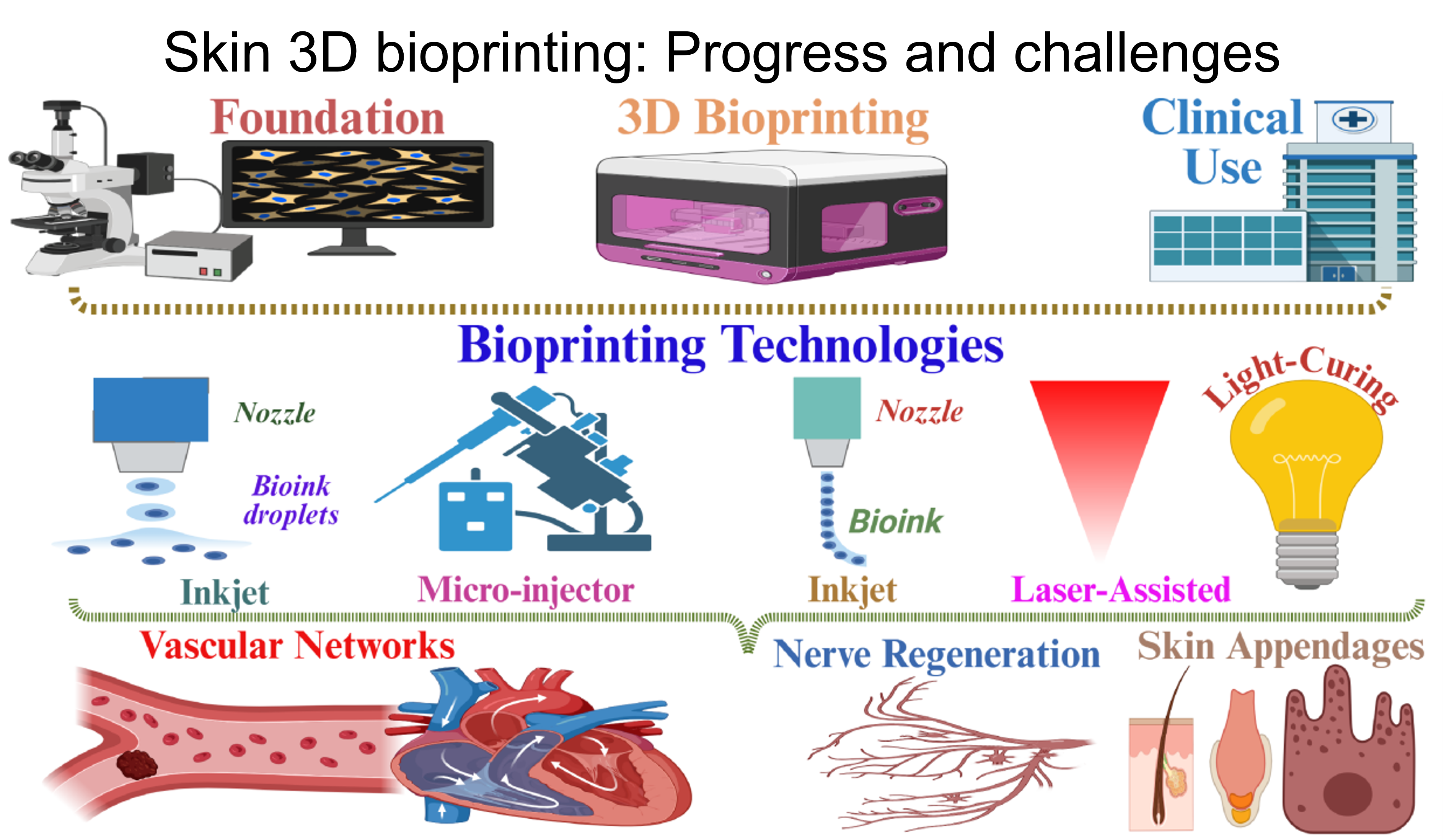
Three-dimensional (3D) bioprinting has transformed skin tissue regeneration by enabling the fabrication of skin-like structures with precisely controlled properties. This review critically examines recent advances and challenges in 3D bioprinting for skin tissue engineering (2020–2026), organized around a unifying materials-design framework linking bioink properties to wound healing phase requirements and printing technology selection. Wound healing mechanisms, cell types, bioink formulations, and major bioprinting technologies (inkjet, extrusion, laser-assisted, light-curing) are comparatively evaluated for resolution, cell viability, material compatibility, and scalability. 3D bioprinting enables vascular network formation, nerve regeneration, and regrowth of skin appendages, including sweat glands, hair follicles, and pigmentation, while patient-specific constructs reduce rejection risk and improve outcomes. Four clinical niches where bioprinting offers a genuine advantage are identified: chronic wounds, cosmetically critical areas, full-thickness burns exceeding 40% total body surface area, and in vitro pharmaceutical testing. Existing approaches remain limited in mimicking physiological complexity, multi-material compatibility, and long-term stability. Critical gaps persist in elastin regeneration, matrix mechanotransduction, immune-material interactions, and transition to Good Manufacturing Practice-compliant manufacturing. This review also evaluates under-addressed translational barriers, including regulatory pathways, scalability, and cost-effectiveness. Further progress requires convergence of stem cell technology, advanced bioink design, and artificial intelligence-driven optimization. Interdisciplinary collaboration remains essential to advance bioprinting toward clinical application in severe skin injuries and regenerative medicine.
- Gopee NH, Winheim E, Olabi B, et al. A prenatal skin atlas reveals immune regulation of human skin morphogenesis. Nature. 2024;635(8039):679-689. doi: 10.1038/s41586-024-08002-x
- Groeber F, Holeiter M, Hampel M, Hinderer S, Schenke-Layland K. Skin tissue engineering--in vivo and in vitro applications. Adv Drug Deliv Rev. 2011;63(4-5):352-366. doi: 10.1016/j.addr.2011.01.005
- Mahajan N, Soker S, Murphy SV. Regenerative Medicine Approaches for Skin Wound Healing: from Allografts to Engineered Skin Substitutes. Curr Transplant Rep. 2024;11(4):207-221. doi: 10.1007/s40472-024-00453-5
- Jeong YG, Yoo JJ, Lee SJ, Kim MS. 3D digital light process bioprinting: Cutting-edge platforms for resolution of organ fabrication. Mater Today Bio. 2024;29:101284. doi: 10.1016/j.mtbio.2024.101284
- Vijayavenkataraman S, Lu WF, Fuh JY. 3D bioprinting of skin: a state-of-the-art review on modelling, materials, and processes. Biofabrication. 2016;8(3):032001. doi: 10.1088/1758-5090/8/3/032001
- Li Q, Lan P. Activation of immune signals during organ transplantation. Signal Transduct Target Ther. 2023;8(1):110. doi: 10.1038/s41392-023-01377-9
- Derakhshanfar S, Mbeleck R, Xu K, Zhang X, Zhong W, Xing M. 3D bioprinting for biomedical devices and tissue engineering: A review of recent trends and advances. Bioact Mater. 2018;3(2):144-156. doi: 10.1016/j.bioactmat.2017.11.008
- Tan SH, Ngo ZH, Sci DB, Leavesley D, Liang K. Recent Advances in the Design of Three-Dimensional and Bioprinted Scaffolds for Full-Thickness Wound Healing. Tissue Eng Part B Rev. 2022;28(1):160-181. doi: 10.1089/ten.TEB.2020.0339
- Xiao J, Dai X, An X, et al. Precision strategies for enhanced chronic skin wound healing using multifunctional hydrogels. Precis Med Eng. 2026;3(1):100054. doi: 10.1016/j.preme.2025.100054
- Waidi YO, Jain N. Unlocking new possibilities: application of MXenes in 3D bioprinting for advanced therapy. Nanoscale. 2024;16(43):20037-20047. doi: 10.1039/d4nr02906b
- Di Stefano AB, Urrata V, Schilders K, et al. Three-Dimensional Bioprinting Techniques in Skin Regeneration: Current Insights and Future Perspectives. Life. 2025;15(5):787. doi: 10.3390/life15050787
- Liu H, Xing F, Yu P, et al. A review of biomacromolecule-based 3D bioprinting strategies for structure-function integrated repair of skin tissues. Int J Biol Macromol. 2024;268:131623. doi: 10.1016/j.ijbiomac.2024.131623
- Carvalho LN, Peres LC, Alonso-Goulart V, et al. Recent advances in the 3D skin bioprinting for regenerative medicine: Cells, biomaterials, and methods. J Biomater Appl. 2024;39(5):421-438. doi: 10.1177/08853282241276799
- Wei Q, An Y, Zhao X, Li M, Zhang J. Three-dimensional bioprinting of tissue-engineered skin: Biomaterials, fabrication techniques, challenging difficulties, and future directions: A review. Int J Biol Macromol. 2024;266(Pt 1):131281. doi: 10.1016/j.ijbiomac.2024.131281
- Velnar T, Bailey T, Smrkolj V. The wound healing process: an overview of the cellular and molecular mechanisms. J Int Med Res. 2009;37(5):1528-1542. doi: 10.1177/147323000903700531
- Naba A. Mechanisms of assembly and remodelling of the extracellular matrix. Nat Rev Mol Cell Biol. 2024;25(11):865-885. doi: 10.1038/s41580-024-00767-3
- Yang G, Mahadik B, Choi JY, Fisher JP. Vascularization in tissue engineering: fundamentals and state-of-art. Prog Biomed Eng (Bristol). 2020;2(1):012002. doi: 10.1088/2516-1091/ab5637
- Singh D, Rai V, Agrawal DK. Regulation of Collagen I and Collagen III in Tissue Injury and Regeneration. Cardiol Cardiovasc Med. 2023;7(1):5-16. doi: 10.26502/fccm.92920302
- Atiyeh BS, Ioannovich J, Al-Amm CA, El-Musa KA. Management of acute and chronic open wounds: the importance of moist environment in optimal wound healing. Curr Pharm Biotechnol. 2002;3(3):179-195. doi: 10.2174/1389201023378283
- Singer AJ, Clark RA. Cutaneous wound healing. N Engl J Med. 1999;341(10):738-746. doi: 10.1056/nejm199909023411006
- Bhardwaj N, Chouhan D, Mandal BB. Tissue Engineered Skin and Wound Healing: Current Strategies and Future Directions. Curr Pharm Des. 2017;23(24):3455-3482. doi: 10.2174/1381612823666170526094606
- Tripathi S, Mandal SS, Bauri S, Maiti P. 3D bioprinting and its innovative approach for biomedical applications. MedComm. 2023;4(1):e194. doi: 10.1002/mco2.194
- Wang M, Li W, Tang G, Garciamendez-Mijares CE, Zhang YS. Engineering (Bio)Materials through Shrinkage and Expansion. Adv Healthc Mater. 2021;10(14):e2100380. doi: 10.1002/adhm.202100380
- Oualla-Bachiri W, Fernández-González A, Quiñones-Vico MI, Arias-Santiago S. From Grafts to Human Bioengineered Vascularized Skin Substitutes. Int J Mol Sci. 2020;21(21). doi: 10.3390/ijms21218197
- Syed MB, Ahmed TAE, Hincke MT. The Promise of 3D Biomaterial Bioprinting for Wound-Healing and Skin Tissue Restoration. Life. 2026;16(5):718. doi: 10.3390/life16050718
- Nahak BK, Roy Chowdhury J, Sharma MK, et al. Advancements in multimodal approaches for enhanced wound healing: From chemical to physical strategies. Mater Today. 2025;88:1087-1125. doi: 10.1016/j.mattod.2025.07.009
- Yücer S, Sarac B, Ciftci F. Bioprinting revolution: Innovative design of 3D bioactive scaffolds for living organs and transdermal tissues. Bioeng Transl Med. 2025;10(6):e70080. doi: 10.1002/btm2.70080
- Bajaj P, Schweller RM, Khademhosseini A, West JL, Bashir R. 3D biofabrication strategies for tissue engineering and regenerative medicine. Annu Rev Biomed Eng. 2014;16:247-276. doi: 10.1146/annurev-bioeng-071813-105155
- Pedde RD, Mirani B, Navaei A, et al. Emerging Biofabrication Strategies for Engineering Complex Tissue Constructs. Adv Mater. 2017;29(19):1606061. doi: 10.1002/adma.201606061
- Dey M, Ozbolat IT. 3D bioprinting of cells, tissues and organs. Sci Rep. 2020;10(1):14023. doi: 10.1038/s41598-020-70086-y
- Matai I, Kaur G, Seyedsalehi A, McClinton A, Laurencin CT. Progress in 3D bioprinting technology for tissue/organ regenerative engineering. Biomaterials. 2020;226:119536. doi: 10.1016/j.biomaterials.2019.119536
- Sharma C, Raza MA, Purohit SD, et al. Cellulose-based 3D printing bio-inks for biomedical applications: A review. Int J Biol Macromol. 2025;305:141174. doi: 10.1016/j.ijbiomac.2025.141174
- Manzoli S, Merotto E, Piccoli M, Gobbo P, Todros S, Pavan PG. An Overview of 3D Bioprinting Impact on Cell Viability: From Damage Assessment to Protection Solutions. J Funct Biomater. 2025;16(12):436. doi: 10.3390/jfb16120436
- Abdulhussain R, Adebisi A, Conway BR, Asare-Addo K. Electrospun nanofibers: Exploring process parameters, polymer selection, and recent applications in pharmaceuticals and drug delivery. J Drug Deliv Sci Technol. 2023;90:105156. doi: 10.1016/j.jddst.2023.105156
- Li W, Li J, Pan C, Lee J-S, Kim BS, Gao G. Light-based 3D bioprinting techniques for illuminating the advances of vascular tissue engineering. Mater Today Bio. 2024;29:101286. doi: 10.1016/j.mtbio.2024.101286
- Park JA, Yoon S, Kwon J, et al. Freeform micropatterning of living cells into cell culture medium using direct inkjet printing. Sci Rep. 2017;7(1):14610. doi: 10.1038/s41598-017-14726-w
- Yoon S, Park JA, Lee HR, Yoon WH, Hwang DS, Jung S. Inkjet-Spray Hybrid Printing for 3D Freeform Fabrication of Multilayered Hydrogel Structures. Adv Healthc Mater. 2018;7(14):e1800050. doi: 10.1002/adhm.201800050
- Negro A, Cherbuin T, Lutolf MP. 3D Inkjet Printing of Complex, Cell-Laden Hydrogel Structures. Sci Rep. 2018;8(1):17099. doi: 10.1038/s41598-018-35504-2
- Park JA, Lee HR, Park SY, Jung S. Self-Organization of Fibroblast-Laden 3D Collagen Microstructures from Inkjet-Printed Cell Patterns. Adv Biosyst. 2020;4(5):e1900280. doi: 10.1002/adbi.201900280
- Boland T, Xu T, Damon B, Cui X. Application of inkjet printing to tissue engineering. Biotechnol J. 2006;1(9):910-917. doi: 10.1002/biot.200600081
- Daikuara LY, Chen X, Yue Z, et al. 3D Bioprinting Constructs to Facilitate Skin Regeneration. Adv Funct Mater. 2022;32(3):2105080. doi: 10.1002/adfm.202105080
- Yan WC, Davoodi P, Vijayavenkataraman S, et al. 3D bioprinting of skin tissue: From pre-processing to final product evaluation. Adv Drug Deliv Rev. 2018;132:270-295. doi: 10.1016/j.addr.2018.07.016
- Koch L, Deiwick A, Schlie S, et al. Skin tissue generation by laser cell printing. Biotechnol Bioeng. 2012;109(7):1855-1863. doi: 10.1002/bit.24455
- Zhang X, Zhang X, Li Y, Zhang Y. Applications of Light-Based 3D Bioprinting and Photoactive Biomaterials for Tissue Engineering. Materials (Basel). 2023;16(23):7461. doi: 10.3390/ma16237461
- Fang W, Yu Z, Gao G, et al. Light-based 3D bioprinting technology applied to repair and regeneration of different tissues: A rational proposal for biomedical applications. Mater Today Bio. 2024;27:101135. doi: 10.1016/j.mtbio.2024.101135
- Zhang J, Hu Q, Wang S, Tao J, Gou M. Digital Light Processing Based Three-dimensional Printing for Medical Applications. Int J Bioprint. 2020;6(1):242. doi: 10.18063/ijb.v6i1.242
- Jeong M, Radomski K, Lopez D, Liu JT, Lee JD, Lee SJ. Materials and Applications of 3D Printing Technology in Dentistry: An Overview. Dent J. 2023;12(1):1. doi: 10.3390/dj12010001
- Zhang AP, Qu X, Soman P, et al. Rapid fabrication of complex 3D extracellular microenvironments by dynamic optical projection stereolithography. Adv Mater. 2012;24(31):4266-4270. doi: 10.1002/adma.201202024
- Zhu W, Qu X, Zhu J, et al. Direct 3D bioprinting of prevascularized tissue constructs with complex microarchitecture. Biomaterials. 2017;124:106-115. doi: 10.1016/j.biomaterials.2017.01.042
- Zhou F, Hong Y, Liang R, et al. Rapid printing of bio-inspired 3D tissue constructs for skin regeneration. Biomaterials. 2020;258:120287. doi: 10.1016/j.biomaterials.2020.120287
- Khan SA, Ahmad H, Zhu G, Pang H, Zhang Y. Three-Dimensional Printing of Hydrogels for Flexible Sensors: A Review. Gels. 2024;10(3):187. doi: 10.3390/gels10030187
- Hribar KC, Soman P, Warner J, Chung P, Chen S. Light-assisted direct-write of 3D functional biomaterials. Lab Chip. 2014;14(2):268-275. doi: 10.1039/c3lc50634g
- Davoodi E, Sarikhani E, Montazerian H, et al. Extrusion and Microfluidic-Based Bioprinting to Fabricate Biomimetic Tissues and Organs. Adv Mater Technol. 2020;5(8):1901044. doi: 10.1002/admt.201901044
- Son J, Li S, Jeong W. Bioprinting Vascularized Constructs for Clinical Relevance: Engineering Hydrogel Systems for Biological Maturity. Gels. 2025;11(8):636. doi: 10.3390/gels11080636
- Alparslan C, Bayraktar Ş. Advances in Digital Light Processing (DLP) Bioprinting: A Review of Biomaterials and Its Applications, Innovations, Challenges, and Future Perspectives. Polymers. 2025;17(9):1287. doi: 10.3390/polym17091287
- Groll J, Burdick JA, Cho DW, et al. A definition of bioinks and their distinction from biomaterial inks. Biofabrication. 2018;11(1):013001. doi: 10.1088/1758-5090/aaec52
- Pasierb A, Jezierska M, Karpuk A, Czuwara J, Rudnicka L. 3D skin bioprinting: future potential for skin regeneration. Postepy Dermatol Alergol. 2022;39(5):845-851. doi: 10.5114/ada.2021.109692
- Liu F, Chen Q, Liu C, et al. Natural Polymers for Organ 3D Bioprinting. Polymers. 2018;10(11):1278. doi: 10.3390/polym10111278
- Shoulders MD, Raines RT. Collagen structure and stability. Annu Rev Biochem. 2009;78:929-958. doi: 10.1146/annurev.biochem.77.032207.120833
- Kim BS, Lee JS, Gao G, Cho DW. Direct 3D cell-printing of human skin with functional transwell system. Biofabrication. 2017;9(2):025034. doi: 10.1088/1758-5090/aa71c8
- Lei M, Wang X. Biodegradable Polymers and Stem Cells for Bioprinting. Molecules. 2016;21(5):539. doi: 10.3390/molecules21050539
- Gungor-Ozkerim PS, Inci I, Zhang YS, Khademhosseini A, Dokmeci MR. Bioinks for 3D bioprinting: an overview. Biomater Sci. 2018;6(5):915-946. doi: 10.1039/c7bm00765e
- Singh YP, Moses JC, Kim MH, et al. Three-tier framework for high-throughput biofabrication: Integrating 3D bioprinting, assistive platforms, and translational opportunities. Bioact Mater. 2026;57:726-753. doi: 10.1016/j.bioactmat.2025.11.024
- Fedorovich NE, Schuurman W, Wijnberg HM, et al. Biofabrication of osteochondral tissue equivalents by printing topologically defined, cell-laden hydrogel scaffolds. Tissue Eng Part C Methods. 2012;18(1):33-44. doi: 10.1089/ten.TEC.2011.0060
- Cavallo A, Radaelli G, Al Kayal T, et al. Optimization of Gelatin and Crosslinker Concentrations in a Gelatin/Alginate-Based Bioink with Potential Applications in a Simplified Skin Model. Molecules. 2025;30(3):649. doi: 10.3390/molecules30030649
- Yang X, Li X, Wu Z, Cao L. Photocrosslinked methacrylated natural macromolecular hydrogels for tissue engineering: A review. Int J Biol Macromol. 2023;246:125570. doi: 10.1016/j.ijbiomac.2023.125570
- Li S, Dan X, Chen H, et al. Developing fibrin-based biomaterials/scaffolds in tissue engineering. Bioact Mater. 2024;40:597-623. doi: 10.1016/j.bioactmat.2024.08.006
- Pourchet LJ, Thepot A, Albouy M, et al. Human Skin 3D Bioprinting Using Scaffold-Free Approach. Adv Healthc Mater. 2017;6(4):1601101. doi: 10.1002/adhm.201601101
- Zhang Z, Zhou X, Fang Y, Xiong Z, Zhang T. AI-driven 3D bioprinting for regenerative medicine: From bench to bedside. Bioact Mater. 2025;45:201-230. doi: 10.1016/j.bioactmat.2024.11.021
- Sakthiabirami K, Park Y, Kyeong Jo S, Hee Kim M, Hwang Song J. Decellularized Extracellular Matrix (dECM) in Tendon Regeneration: A Comprehensive Review. Adv Healthc Mater. Published online November 17, 2025:e03676. doi: 10.1002/adhm.202503676
- Liu H, Xing F, Yu P, et al. Biomimetic fabrication bioprinting strategies based on decellularized extracellular matrix for musculoskeletal tissue regeneration: Current status and future perspectives. Mater Des. 2024;243:113072. doi: 10.1016/j.matdes.2024.113072
- Swinehart IT, Badylak SF. Extracellular matrix bioscaffolds in tissue remodeling and morphogenesis. Dev Dyn. 2016;245(3):351-360. doi: 10.1002/dvdy.24379
- Bojorges H, López-Rubio A, Martínez-Abad A, Fabra MJ. Overview of alginate extraction processes: Impact on alginate molecular structure and techno-functional properties. Trends Food Sci Technol. 2023;140:104142. doi: 10.1016/j.tifs.2023.104142
- Su J, Liu C, Sun A, et al. Hemostatic and antimicrobial properties of chitosan-based wound healing dressings: A review. Int J Biol Macromol. 2025;306:141570. doi: 10.1016/j.ijbiomac.2025.141570
- Prakash A, Malviya R, Sridhar SB, Wadhwa T, Shareef J, Tripathy DB. Polysaccharides as functional biomaterials in 3D bioprinting: Strategies for antimicrobial applications. Next Mater. 2025;9:101255. doi: 10.1016/j.nxmate.2025.101255
- Yuan Z, Bai X, Li S, et al. Multimaterial and Multidimensional Bioprinting in Regenerative Medicine: Advances, Limitations, and Future Directions. Adv Healthc Mater. 2025;14(18):2500475. doi: 10.1002/adhm.202500475
- Naqash F, Masoodi FA, Rather SA, Wani SM, Gani A. Emerging concepts in the nutraceutical and functional properties of Pectin-A Review. Carbohydr Polym. 2017;168:227-239. doi: 10.1016/j.carbpol.2017.03.058
- Villanova JC, Ayres E, Oréfice RL. Design, characterization and preliminary in vitro evaluation of a mucoadhesive polymer based on modified pectin and acrylic monomers with potential use as a pharmaceutical excipient. Carbohydr Polym. 2015;121:372-381. doi: 10.1016/j.carbpol.2014.12.052
- Ullah F, Javed F, Mushtaq I, et al. Development of highly-reproducible hydrogel based bioink for regeneration of skin-tissues via 3-D bioprinting technology. Int J Biol Macromol. 2023;230:123131. doi: 10.1016/j.ijbiomac.2022.123131
- López-Gómez P, Mehwish N, Ginebra M-P, Mas-Moruno C. Bioactive and degradable PEG hydrogels: A multifunctional approach for tissue regeneration and antibacterial protection. Biomater Adv. 2026;180:214553. doi: 10.1016/j.bioadv.2025.214553
- Rowley JA, Madlambayan G, Mooney DJ. Alginate hydrogels as synthetic extracellular matrix materials. Biomaterials. 1999;20(1):45-53. doi: 10.1016/s0142-9612(98)00107-0
- Ahmed A-B, Thatcher S, Khorsandi J, et al. Platelet-Rich Plasma (PRP) and Recombinant Growth Factor Therapies in Cutaneous Wound Healing: Mechanisms, Clinical Applications, and Future Directions. J Clin Med. 2025;14(23):8583. doi: 10.3390/jcm14238583
- Zhao M, Wang J, Zhang J, et al. Functionalizing multi-component bioink with platelet-rich plasma for customized in-situ bilayer bioprinting for wound healing. Mater Today Bio. 2022;16:100334. doi: 10.1016/j.mtbio.2022.100334
- Deptuła M, Zawrzykraj M, Sawicka J, Banach-Kopeć A, Tylingo R, Pikuła M. Application of 3D-printed hydrogels in wound healing and regenerative medicine. Biomed Pharmacother. 2023;167:115416. doi: 10.1016/j.biopha.2023.115416
- Younes I, Rinaudo M. Chitin and chitosan preparation from marine sources. Structure, properties and applications. Mar Drugs. 2015;13(3):1133-1174. doi: 10.3390/md13031133
- Polisetti N, Gießl A, Zenkel M, et al. Melanocytes as emerging key players in niche regulation of limbal epithelial stem cells. Ocul Surf. 2021;22:172-189. doi: 10.1016/j.jtos.2021.08.006
- Hofmann E, Fink J, Pignet al, et al. Human In Vitro Skin Models for Wound Healing and Wound Healing Disorders. Biomedicines. 2023;11(4):1056. doi: 10.3390/biomedicines11041056
- Kwak S, Song CL, Lee J, et al. Development of pluripotent stem cell-derived epidermal organoids that generate effective extracellular vesicles in skin regeneration. Biomaterials. 2024;307:122522. doi: 10.1016/j.biomaterials.2024.122522
- Sindhi K, Pingili RB, Beldar V, Bhattacharya S, Rahaman J, Mukherjee D. The role of biomaterials-based scaffolds in advancing skin tissue construct. J Tissue Viability. 2025;34(2):100858. doi: 10.1016/j.jtv.2025.100858
- Li Y, Kilian KA. Bridging the Gap: From 2D Cell Culture to 3D Microengineered Extracellular Matrices. Adv Healthc Mater. 2015;4(18):2780-2796. doi: 10.1002/adhm.201500427
- Shet VB, Navalgund L, Joshi K, R H, Mubarak NM. Chapter 18 - Commercial bioproducts from bioreactor. In: Shet VB, Kanthakere S, Mubarak NM, Karri RR, Hadi Dehghani M, eds. Biotechnology Engineering. Amsterdam, Netherlands: Elsevier; 2025:391-410. doi: 10.1016/B978-0-443-31476-6.00023-3
- Persaud A, Maus A, Strait L, Zhu D. 3D Bioprinting with Live Cells. Eng Regen. 2022;3(3):292-309. doi: 10.1016/j.engreg.2022.07.002
- Ahn M, Cho WW, Lee H, et al. Engineering of Uniform Epidermal Layers via Sacrificial Gelatin Bioink-Assisted 3D Extrusion Bioprinting of Skin. Adv Healthc Mater. 2023;12(27):e2301015. doi: 10.1002/adhm.202301015
- Ramasamy S, Davoodi P, Vijayavenkataraman S, et al. Optimized construction of a full thickness human skin equivalent using 3D bioprinting and a PCL/collagen dermal scaffold. Bioprinting. 2021;21:e00123. doi: 10.1016/j.bprint.2020.e00123
- Gao D, Wang Z, Wu Z, et al. 3D-printing of solvent exchange deposition modeling (SEDM) for a bilayered flexible skin substitute of poly (lactide-co-glycolide) with bioorthogonally engineered EGF. Mater Sci Eng C. 2020;112:110942. doi: 10.1016/j.msec.2020.110942
- Liu J, Zhou Z, Zhang M, Song F, Feng C, Liu H. Simple and robust 3D bioprinting of full-thickness human skin tissue. Bioengineered. 2022;13(4):10087-10097. doi: 10.1080/21655979.2022.2063651
- Huling J, Ko IK, Atala A, Yoo JJ. Fabrication of biomimetic vascular scaffolds for 3D tissue constructs using vascular corrosion casts. Acta Biomater. 2016;32:190-197. doi: 10.1016/j.actbio.2016.01.005
- Yanez M, Rincon J, Dones A, De Maria C, Gonzales R, Boland T. In vivo assessment of printed microvasculature in a bilayer skin graft to treat full-thickness wounds. Tissue Eng Part A. 2015;21(1-2):224-233. doi: 10.1089/ten.TEA.2013.0561
- Abaci HE, Guo Z, Coffman A, et al. Human Skin Constructs with Spatially Controlled Vasculature Using Primary and iPSC-Derived Endothelial Cells. Adv Healthc Mater. 2016;5(14):1800-1807. doi: 10.1002/adhm.201500936
- Lu D, Cai K, Zeng Z, et al. VEGF loading heparinized hyaluronic acid macroporous hydrogels for enhanced 3D endothelial cell migration and vascularization. Biomater Adv. 2025;167:214094. doi: 10.1016/j.bioadv.2024.214094
- Laverdet B, Danigo A, Girard D, Magy L, Demiot C, Desmoulière A. Skin innervation: important roles during normal and pathological cutaneous repair. Histol Histopathol. 2015;30(8):875-892. doi: 10.14670/hh-11-610
- Jiang JP, Liu XY, Zhao F, et al. Three-dimensional bioprinting collagen/silk fibroin scaffold combined with neural stem cells promotes nerve regeneration after spinal cord injury. Neural Regen Res. 2020;15(5):959-968. doi: 10.4103/1673-5374.268974
- Zhang S, Zheng H, Tratnyek PG. Advanced redox processes for sustainable water treatment. Nat Water. 2023;1(8):666-681. doi: 10.1038/s44221-023-00098-1
- Gao S, Tang Y, Sun W, et al. 3D-bioprinted GelMA nerve guidance conduits promoted peripheral nerve regeneration by inducing trans-differentiation of MSCs into SCLCs via PIEZO1/YAP axis. Mater Today Adv. 2023;17:100325. doi: 10.1016/j.mtadv.2022.100325
- Muller Q, Beaudet MJ, De Serres-Bérard T, Bellenfant S, Flacher V, Berthod F. Development of an innervated tissue-engineered skin with human sensory neurons and Schwann cells differentiated from iPS cells. Acta Biomater. 2018;82:93-101. doi: 10.1016/j.actbio.2018.10.011
- Hu Y, Wu Y, Gou Z, et al. 3D-engineering of Cellularized Conduits for Peripheral Nerve Regeneration. Sci Rep. 2016;6:32184. doi: 10.1038/srep32184
- Huang S, Yao B, Xie J, Fu X. 3D bioprinted extracellular matrix mimics facilitate directed differentiation of epithelial progenitors for sweat gland regeneration. Acta Biomater. 2016;32:170-177. doi: 10.1016/j.actbio.2015.12.039
- Yao B, Wang R, Wang Y, et al. Biochemical and structural cues of 3D-printed matrix synergistically direct MSC differentiation for functional sweat gland regeneration. Sci Adv. 2020;6(10):eaaz1094. doi: 10.1126/sciadv.aaz1094
- Juraski AC, Sharma S, Sparanese S, et al. 3D bioprinting for organ and organoid models and disease modeling. Expert Opin Drug Discov. 2023;18(9):1043-1059. doi: 10.1080/17460441.2023.2234280
- Min D, Lee W, Bae IH, Lee TR, Croce P, Yoo SS. Bioprinting of biomimetic skin containing melanocytes. Exp Dermatol. 2018;27(5):453-459. doi: 10.1111/exd.13376
- Wu JJ, Zhu TY, Lu YG, et al. Hair follicle reformation induced by dermal papilla cells from human scalp skin. Arch Dermatol Res. 2006;298(4):183-190. doi: 10.1007/s00403-006-0686-9
- Li S, Hu M, Lorenz HP. Treatment of Full-Thickness Skin Wounds with Blood-Derived CD34(+) Precursor Cells Enhances Healing with Hair Follicle Regeneration. Adv Wound Care. 2020;9(5):264-276. doi: 10.1089/wound.2019.0974
- Liu D, Song K, Xie G, Li L. MBR-UV/Cl2 system in treating polluted surface water with typical PPCP contamination. Sci Rep. 2020;10(1):8835. doi: 10.1038/s41598-020-65845-w
- Fu Z, Ouyang L, Xu R, Yang Y, Sun W. Responsive biomaterials for 3D bioprinting: A review. Mater Today. 2022;52:112-132. doi: 10.1016/j.mattod.2022.01.001
- Liu J, Garcia J, Leahy LM, et al. 3D Printing of Multifunctional Conductive Polymer Composite Hydrogels. Adv Funct Mater. 2023;33(37):2214196. doi: 10.1002/adfm.202214196
- Zhang H, Zhou C, Zeng H, Deng L, Shi Z. Can Cu2ZnSnS4 nanoparticles be used as heterogeneous catalysts for sulfadiazine degradation? J Hazard Mater. 2020;395:122613. doi: 10.1016/j.jhazmat.2020.122613
- Mirshafiei M, Rashedi H, Yazdian F, Rahdar A, Baino F. Advancements in tissue and organ 3D bioprinting: Current techniques, applications, and future perspectives. Mater Des. 2024;240:112853. doi: 10.1016/j.matdes.2024.112853
- Tan B, Gan S, Wang X, Liu W, Li X. Applications of 3D bioprinting in tissue engineering: advantages, deficiencies, improvements, and future perspectives. J Mater Chem B. 2021;9(27):5385-5413. doi: 10.1039/d1tb00172h
- Fang H, Xu J, Ma H, et al. Functional materials of 3D bioprinting for wound dressings and skin tissue engineering applications: A review. Int J Bioprint. 2023;9(5):757. doi: 10.18063/ijb.757
- Chogan F, Chen Y, Maneyapanda E, et al. Advances in stem cell-based tissue-engineered skin substitutes for burns. Trends Biotechnol. Published online April 22, 2026. doi: 10.1016/j.tibtech.2026.04.001
- Duan B, Hockaday LA, Kang KH, Butcher JT. 3D bioprinting of heterogeneous aortic valve conduits with alginate/gelatin hydrogels. J Biomed Mater Res A. 2013;101(5):1255-1264. doi: 10.1002/jbm.a.34420