
Convergence of 3D bioprinting, bone organoids, and organ-on-chip systems for orthopedic disease modeling and regenerative applications

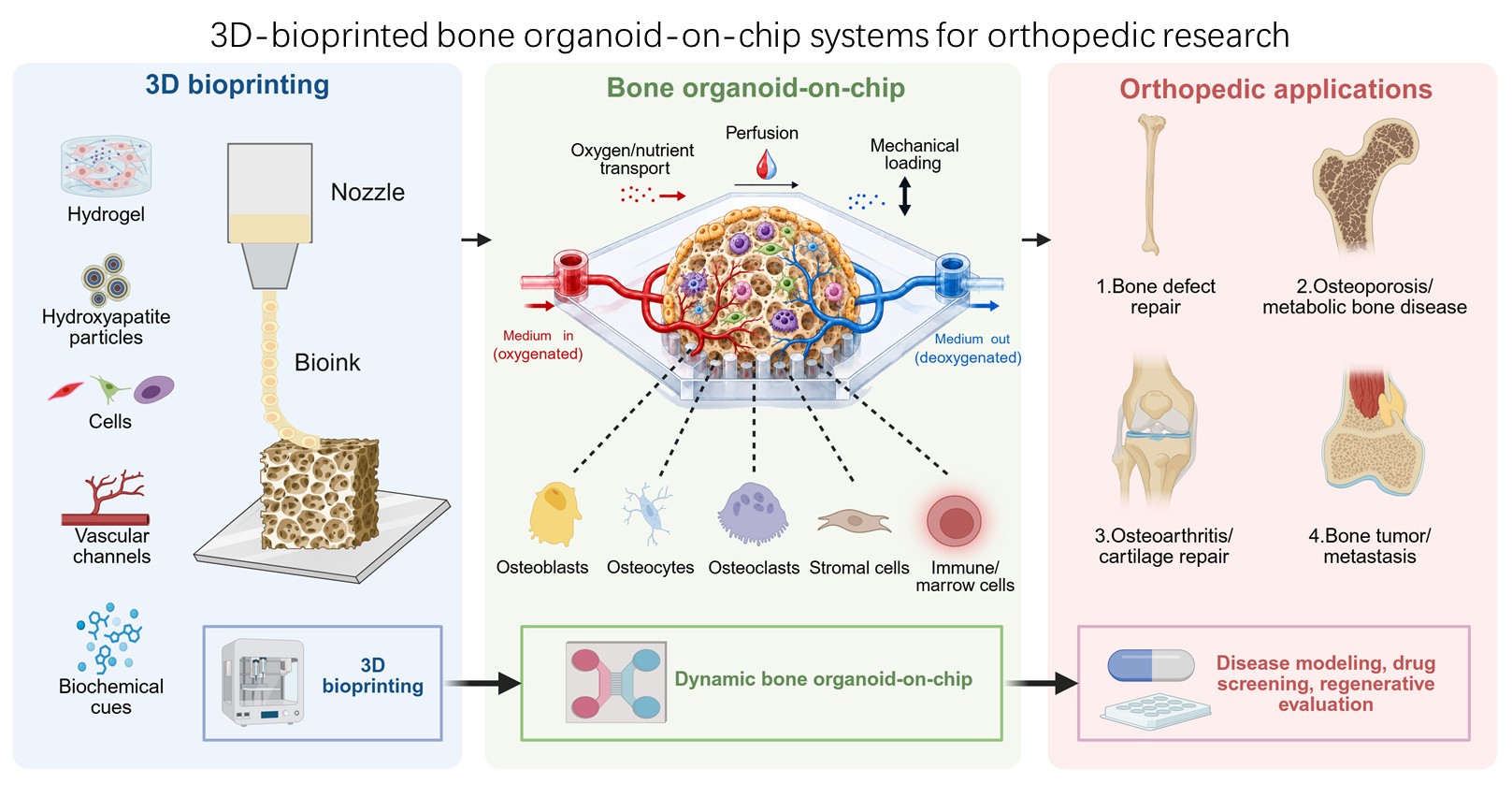
Bone disorders remain difficult to model because native bone is a mineralized, vascularized, mechanosensitive, and multicellular organ whose remodeling depends on tightly coordinated matrix, transport, biochemical, and mechanical cues. This review examines how three-dimensional (3D) bioprinting-enabled bone organoids and organ-on-chip systems can be integrated to construct more physiologically relevant platforms for orthopedic research. Unlike previous reviews that discuss bone organoids, 3D bioprinting, or bone-on-chip systems as separate technologies, this review addresses the conceptual and translational gap between biological self-organization, programmable biofabrication, and dynamic microphysiological regulation in orthopedic modeling. We synthesize current advances in bone microenvironment modeling, focusing on organoid-based biomimicry, programmable scaffold fabrication, perfusable and mechanically active chip systems, and disease-oriented applications. The analysis shows that 3D bioprinting transforms bone microenvironment reconstruction from empirical scaffold fabrication into a controllable strategy, enabling the systematic engineering of matrix composition, pore architecture, mineralization, vascular-like channels, multicellular organization, and biochemical patterning. Organ-on-chip platforms further enhance these constructs by introducing dynamic perfusion, mechanical stimulation, compartmentalized crosstalk, and disease-relevant microenvironmental regulation. Together, these technologies support emerging applications in bone defect repair, osteoporosis and metabolic bone disease modeling, osteoarthritis and osteochondral interface reconstruction, and bone tumor or metastasis research. Despite persistent limitations in tissue maturation, vascular hierarchy, immune and hematopoietic integration, long-term stability, and standardization, the convergence of organoids, 3D bioprinting, and microphysiological systems provides a versatile foundation for mechanistic studies, drug evaluation, personalized therapeutic testing, and future regenerative strategies in orthopedics.
- Hoong CWS, Saul D, Khosla S, Sfeir JG. Advances in the management of osteoporosis. BMJ. 2025;390:e081250. doi: 10.1136/bmj-2024-081250
- Kim JS, Borges S, Clauw DJ, et al. FDA/Arthritis Foundation osteoarthritis drug development workshop recap: Assessment of long-term benefit. Semin Arthritis Rheum. 2022;56:152070. doi: 10.1016/j.semarthrit.2022.152070
- Huang EE, Zhang N, Shen H, et al. Novel Techniques and Future Perspective for Investigating Critical-Size Bone Defects. Bioengineering (Basel). 2022;9(4):171. doi: 10.3390/bioengineering9040171
- DiGirolamo DJ, Clemens TL, Kousteni S. The skeleton as an endocrine organ. Nat Rev Rheumatol. 2012;8(11):674-683. doi: 10.1038/nrrheum.2012.157
- Schlesinger PH, Blair HC, Beer Stolz D, et al. Cellular and extracellular matrix of bone, with principles of synthesis and dependency of mineral deposition on cell membrane transport. Am J Physiol Cell Physiol. 2020;318(1):C111-C124. doi: 10.1152/ajpcell.00120.2019
- Wang L, You X, Zhang L, Zhang C, Zou W. Mechanical regulation of bone remodeling. Bone Res. 2022;10(1):16. doi: 10.1038/s41413-022-00190-4
- Yuste I, Luciano FC, González-Burgos E, Lalatsa A, Serrano DR. Mimicking bone microenvironment: 2D and 3D in vitro models of human osteoblasts. Pharmacol Res. 2021;169:105626. doi: 10.1016/j.phrs.2021.105626
- Verdugo-Avello F, Wychowaniec JK, Villacis-Aguirre CA, D'Este M, Toledo JR. Bone microphysiological models for biomedical research. Lab Chip. 2025;25(5):806-836. doi: 10.1039/d4lc00762j
- Lancaster MA, Knoblich JA. Organogenesis in a dish: modeling development and disease using organoid technologies. Science. 2014;345(6194):1247125. doi: 10.1126/science.1247125
- Tang XY, Wu S, Wang D, et al. Human organoids in basic research and clinical applications. Signal Transduct Target Ther. 2022;7(1):168. doi: 10.1038/s41392-022-01024-9
- Bai L, Zhou D, Li G, Liu J, Chen X, Su J. Engineering bone/cartilage organoids: strategy, progress, and application. Bone Res. 2024;12(1):66. doi: 10.1038/s41413-024-00376-y
- Zhu M, Fan Z, Chen M, Xu K, Jiang Y, Su J. Biomineralization empowers bone organoids. Biomaterials. 2026;326:123703. doi: 10.1016/j.biomaterials.2025.123703
- Huang D, Li Z, Li G, et al. Biomimetic structural design in 3D-printed scaffolds for bone tissue engineering. Mater Today Bio. 2025;32:101664. doi: 10.1016/j.mtbio.2025.101664
- Huang MS, Christakopoulos F, Roth JG, Heilshorn SC. Organoid bioprinting: from cells to functional tissues. Nat Rev Bioeng. 2025;3(2):126-142. doi: 10.1038/s44222-024-00268-0
- Ajalik RE, Alenchery RG, Cognetti JS, et al. Human Organ-on-a-Chip Microphysiological Systems to Model Musculoskeletal Pathologies and Accelerate Therapeutic Discovery. Front Bioeng Biotechnol. 2022;10:846230. doi: 10.3389/fbioe.2022.846230
- Zhong C, Tang Z, Yu X, et al. Advances in the Construction and Application of Bone-on-a-Chip Based on Microfluidic Technologies. J Biomed Mater Res B Appl Biomater. 2024;112(12):e35502. doi: 10.1002/jbm.b.35502
- Chauhdari T, Zaidi SA, Su J, Ding Y. Organoids meet microfluidics: recent advancements, challenges, and future of organoids-on-chip. In Vitro Model. 2025;4(1):71-88. doi: 10.1007/s44164-025-00086-7
- Papamichail L, Koch LS, Veerman D, Broersen K, van der Meer AD. Organoids-on-a-chip: microfluidic technology enables culture of organoids with enhanced tissue function and potential for disease modeling. Front Bioeng Biotechnol. 2025;13:1515340. doi: 10.3389/fbioe.2025.1515340
- Lou X, Zhou Q, Dong Z, Bai L, Su J, Yue H. Innovative strategies for bone organoid: Synergistic application and exploration of advanced technologies. J Orthop Translat. 2025;54:180-198. doi: 10.1016/j.jot.2025.07.010
- Zhao Y, Landau S, Okhovatian S, et al. Integrating organoids and organ-on-a-chip devices. Nat Rev Bioeng. 2024;2(7):588-608. doi: 10.1038/s44222-024-00207-z
- Gao D, Li R, Pan J, et al. 3D bioprinting bone/cartilage organoids: construction, applications, and challenges. J Orthop Translat. 2025;55:75-93. doi: 10.1016/j.jot.2025.08.008
- Hu Y, Zhang H, Wang S, et al. Bone/cartilage organoid on-chip: Construction strategy and application. Bioact Mater. 2023;25:29-41. doi: 10.1016/j.bioactmat.2023.01.016
- Duan J, Fang Y, Tian Y, Wang Z, Yang B, Xiong Z. 3D Bioprinting of Prevascularized Bone Organoids for Rapid In Situ Cranial Bone Reconstruction. Adv Healthc Mater. 2025;14(16):e2501376. doi: 10.1002/adhm.202501376
- Ressler A, Žužić A, Ivanišević I, Kamboj N, Ivanković H. Ionic substituted hydroxyapatite for bone regeneration applications: A review. Open Ceramics. 2021;6:100122. doi: 10.1016/j.oceram.2021.100122
- Li X, Kordsmeier J, Xiong J. New Advances in Osteocyte Mechanotransduction. Curr Osteoporos Rep. 2021;19(1):101-106. doi: 10.1007/s11914-020-00650-y
- Qin L, Liu W, Cao H, Xiao G. Molecular mechanosensors in osteocytes. Bone Res. 2020;8:23. doi: 10.1038/s41413-020-0099-y
- Barnes GL, Kostenuik PJ, Gerstenfeld LC, Einhorn TA. Growth factor regulation of fracture repair. J Bone Miner Res. 1999;14(11):1805-1815. doi: 10.1359/jbmr.1999.14.11.1805
- Weilbaecher KN, Guise TA, McCauley LK. Cancer to bone: a fatal attraction. Nat Rev Cancer. 2011;11(6):411-425. doi: 10.1038/nrc3055
- Owen-Woods C, Kusumbe A. Fundamentals of bone vasculature: Specialization, interactions and functions. Semin Cell Dev Biol. 2022;123:36-47. doi: 10.1016/j.semcdb.2021.06.025
- Glaser DE, Curtis MB, Sariano PA, et al. Organ-on-a-chip model of vascularized human bone marrow niches. Biomaterials. 2022;280:121245. doi: 10.1016/j.biomaterials.2021.121245
- Maggiotto F, Bova L, Micheli S, et al. 3D bioprinting for the production of a perfusable vascularized model of a cancer niche. Front Bioeng Biotechnol. 2025;13:1484738. doi: 10.3389/fbioe.2025.1484738
- Harris N, Miller C, Zou M. A Versatile Platform for Designing and Fabricating Multi-Material Perfusable 3D Microvasculatures. Micromachines (Basel). 2025;16(6):691. doi: 10.3390/mi16060691
- Pan B, Shao L, Jiang J, et al. 3D printing sacrificial templates for manufacturing hydrogel constructs with channel networks. Mater Des. 2022;222:111012. doi: 10.1016/j.matdes.2022.111012
- Su R, Wang F, McAlpine MC. 3D printed microfluidics: advances in strategies, integration, and applications. Lab Chip. 2023;23(5):1279-1299. doi: 10.1039/d2lc01177h
- Scheinpflug J, Höfer CT, Schmerbeck SS, et al. A microphysiological system for studying human bone biology under simultaneous control of oxygen tension and mechanical loading. Lab Chip. 2023;23(15):3405-3423. doi: 10.1039/d3lc00154g
- Wu X, Shi W, Liu X, Gu Z. Recent advances in 3D-printing-based organ-on-a-chip. EngMedicine. 2024;1(1):100003. doi: 10.1016/j.engmed.2024.100003
- Zhang YS, Haghiashtiani G, Hübscher T, et al. 3D extrusion bioprinting. Nat Rev Methods Primers. 2021;1(1):75. doi: 10.1038/s43586-021-00073-8
- Lv N, Zhou Z, Hou M, et al. Research progress of vascularization strategies of tissue-engineered bone. Front Bioeng Biotechnol. 2024;11:1291969. doi: 10.3389/fbioe.2023.1291969
- Chen Y, Guo B, Ma G, Cao H. Sensory nerve regulation of bone homeostasis: Emerging therapeutic opportunities for bone-related diseases. Ageing Res Rev. 2024;99:102372. doi: 10.1016/j.arr.2024.102372
- Lee SS, Du X, Kim I, Ferguson SJ. Scaffolds for bone-tissue engineering. Matter. 2022;5(9):2722-2759. doi: 10.1016/j.matt.2022.06.003
- Tang X, Xu H, Liu X, Yang Y, Li Z. Advances in 3D-Printed scaffolds for bone defect repair: material strategies and synergistic functional performance. Front Bioeng Biotechnol. 2025;13:1707406. doi: 10.3389/fbioe.2025.1707406
- Zenobi E, Merco M, Mochi F, et al. Tailoring the Microarchitectures of 3D Printed Bone-like Scaffolds for Tissue Engineering Applications. Bioengineering (Basel). 2023;10(5):567. doi: 10.3390/bioengineering10050567
- Zhao Y, Liu D, Ren L, Wang X, Ma D. Recent Progress of 3D Printing Bioceramic Scaffolds for Bone Regeneration. Tissue Eng Part B Rev. 2025:19373341251372914. doi: 10.1177/19373341251372914
- Wang J, Wu Y, Li G, et al. Engineering Large-Scale Self-Mineralizing Bone Organoids with Bone Matrix-Inspired Hydroxyapatite Hybrid Bioinks. Adv Mater. 2024;36(30):e2309875. doi: 10.1002/adma.202309875
- Qin D, Wang N, You XG, Zhang AD, Chen XG, Liu Y. Collagen-based biocomposites inspired by bone hierarchical structures for advanced bone regeneration: ongoing research and perspectives. Biomater Sci. 2022;10(2):318-353. doi: 10.1039/d1bm01294k
- Ralston SH. Bone structure and metabolism. Medicine. 2021;49(9):567-571. doi: 10.1016/j.mpmed.2021.06.009
- Zhang Y, Zhao Y, Sun Z, et al. Bone-on-a-chip recapitulates dynamic bone remodeling. Acta Biomater. 2025;208:280-292. doi: 10.1016/j.actbio.2025.10.039
- Yu L, Wei M. Biomineralization of Collagen-Based Materials for Hard Tissue Repair. Int J Mol Sci. 2021;22(2):944. doi: 10.3390/ijms22020944
- Ramirez-Fernandez O, Zuñiga-Aguilar E. Design and Development of a Bone-on-a-Chip System to Generate Microphysiologic Models. In: Microphysiological Systems for Disease Modeling. Cham, Switzerland: Springer Nature Switzerland; 2025:101-105. doi: 10.1007/978-3-031-82123-3_10
- de Souza JR, Rahimnejad M, Soares IPM, et al. 3D Printing β-TCP-laden GelMA/Alginate Interpenetrating-Polymer-Network Biomaterial Inks for Bone Tissue Engineering. Bioprinting. 2025;49:e00413. doi: 10.1016/j.bprint.2025.e00413
- Tolmacheva N, Bhattacharyya A, Noh I. Calcium Phosphate Biomaterials for 3D Bioprinting in Bone Tissue Engineering. Biomimetics (Basel). 2024;9(2):95. doi: 10.3390/biomimetics9020095
- Chen X, Sun Z, Peng X, et al. Graphene Oxide/Black Phosphorus Functionalized Collagen Scaffolds with Enhanced Near-Infrared Controlled In Situ Biomineralization for Promoting Infectious Bone Defect Repair through PI3K/Akt Pathway. ACS Appl Mater Interfaces. 2024;16(38):50369-50388. doi: 10.1021/acsami.4c10284
- Yu SY, Wu T, Xu KH, et al. 3D bioprinted biomimetic MOF-functionalized hydrogel scaffolds for bone regeneration: Synergistic osteogenesis and osteoimmunomodulation. Mater Today Bio. 2025;32:101740. doi: 10.1016/j.mtbio.2025.101740
- Liu Y, Wan Y, Li C, et al. Gradient scaffolds in bone-soft tissue interface engineering: Structural characteristics, fabrication techniques, and emerging trends. J Orthop Translat. 2025;50:333-353. doi: 10.1016/j.jot.2024.10.015
- Ye F, Yang H, Hong C, Wu X, Dai H. Design and characterization of 3D printed gradient scaffolds with spatial distribution of pore sizes. Ceram Int. 2025;51(9):12185-12196. doi: 10.1016/j.ceramint.2025.01.070
- Picado-Tejero D, Mendoza-Cerezo L, Rodríguez-Rego JM, Carrasco-Amador JP, Marcos-Romero AC. Recent Advances in 3D Bioprinting of Porous Scaffolds for Tissue Engineering: A Narrative and Critical Review. J Funct Biomater. 2025;16(9):328. doi: 10.3390/jfb16090328
- Petite H, Viateau V, Bensaïd W, et al. Tissue-engineered bone regeneration. Nat Biotechnol. 2000;18(9):959-963. doi: 10.1038/79449
- Banerjee D, Singh YP, Datta P, et al. Strategies for 3D bioprinting of spheroids: A comprehensive review. Biomaterials. 2022;291:121881. doi: 10.1016/j.biomaterials.2022.121881
- Liu H, Liu J, Sun C, Wang Y, Sun Y, Shi X. Design and Fabrication of Biomimetic Gradient Bone Tissue Engineering Scaffolds: Evolution from Single-Gradient to Multi-Gradient. Gels. 2026;12(2):131. doi: 10.3390/gels12020131
- Maharjan S, Ma C, Singh B, et al. Advanced 3D imaging and organoid bioprinting for biomedical research and therapeutic applications. Adv Drug Deliv Rev. 2024;208:115237. doi: 10.1016/j.addr.2024.115237
- Wang C, Yue H, Liu J, Zhao Q, He Z, Li K, et al. Advanced reconfigurable scaffolds fabricated by 4D printing for treating critical-size bone defects of irregular shapes. Biofabrication. 2020;12(4):045025. doi: 10.1088/1758-5090/abab5b
- Bhandari A, Ghosh RN, Namboothiri PK, Peter M. A review of stimuli-responsive materials in 4D bioprinting for biomedical applications. Mater Adv. 2026;7(1):17-39. doi: 10.1039/D5MA00679A
- Sorokina LV, Shahbazian-Yassar R, Shokuhfar T. Collagen biomineralization: pathways, mechanisms, and thermodynamics. Emergent Mater. 2021;4(5):1205-1224. doi: 10.1007/s42247-021-00226-1
- Adams GJ, Cook RB, Hutchinson JR, Zioupos P. Microarchitecture and morphology of bone tissue over a wide range of BV/TV assessed by micro-computed tomography and three different threshold backgrounds. Med Eng Phys. 2022;106:103828. doi: 10.1016/j.medengphy.2022.103828
- Huang CY, Lin WL. High-throughput quantification of osteogenesis in WJ-MSCs using Alizarin Red S, von Kossa, and Picro-Sirius red. Future Sci OA. 2025;11(1):2567169. doi: 10.1080/20565623.2025.2567169
- Zhu Y, Yu X, Liu H, et al. Strategies of functionalized GelMA-based bioinks for bone regeneration: Recent advances and future perspectives. Bioact Mater. 2024;38:346-373. doi: 10.1016/j.bioactmat.2024.04.032
- Jo HJ, Kang MS, Kim JM, Raja IS, Jang HJ, Park KM, Han DW. Bioactive Ions-Loaded Bioinks Primed for 3D Printing of Artificial Tissues. Biomed Mater Devices. 2024;2(2):811-833. doi: 10.1007/s44174-023-00151-3
- de Silva L, Bernal PN, Rosenberg A, Malda J, Levato R, Gawlitta D. Biofabricating the vascular tree in engineered bone tissue. Acta Biomater. 2023;156:250-268. doi: 10.1016/j.actbio.2022.08.051
- Petrillo S, Genova T, Chinigò G, et al. Endothelial Cells Promote Osteogenesis by Establishing a Functional and Metabolic Coupling With Human Mesenchymal Stem Cells. Front Physiol. 2021;12:813547. doi: 10.3389/fphys.2021.813547
- de Barros NR, Harb SV, da Silva Horinouchi CD, et al. Advances in 3D Bioprinting and Microfluidics for Organ-on-a-Chip Platforms. Polymers (Basel). 2025;17(22):3078. doi: 10.3390/polym17223078
- Cao UMN, Zhang Y, Chen J, Sayson D, Pillai S, Tran SD. Microfluidic Organ-on-A-chip: A Guide to Biomaterial Choice and Fabrication. Int J Mol Sci. 2023;24(4):3232. doi: 10.3390/ijms24043232
- Tsiklin IL, Shabunin AV, Kolsanov AV, Volova LT. In Vivo Bone Tissue Engineering Strategies: Advances and Prospects. Polymers (Basel). 2022;14(15):3222. doi: 10.3390/polym14153222
- Wrublewsky S, Schultz J, Ammo T, et al. Biofabrication of prevascularized spheroids for bone tissue engineering by fusion of microvascular fragments with osteoblasts. Front Bioeng Biotechnol. 2024;12:1436519. doi: 10.3389/fbioe.2024.1436519
- Dornhof J, Zieger V, Kieninger J, et al. Bioprinting-based automated deposition of single cancer cell spheroids into oxygen sensor microelectrode wells. Lab Chip. 2022;22(22):4369-4381. doi: 10.1039/d2lc00705c
- Meyer KV, Winkler S, Lienig P, Dräger G, Bahnemann J. 3D-Printed Microfluidic Perfusion System for Parallel Monitoring of Hydrogel-Embedded Cell Cultures. Cells. 2023;12(14):1816. doi: 10.3390/cells12141816
- Liu H, Chen H, Han Q, et al. Recent advancement in vascularized tissue-engineered bone based on materials design and modification. Mater Today Bio. 2023;23:100858. doi: 10.1016/j.mtbio.2023.100858
- Zhou C, Li Z, Xu J, Yu D, Xuan L, Wang X. Multilayered microfluidic platform for three-dimensional vascularized organ-on-a-chip applications. Bio-Des Manuf. 2025;8(6):930-947. doi: 10.1631/bdm.2500091
- Hsu HH, Ko PL, Peng CC, Cheng YJ, Wu HM, Tung YC. Studying sprouting angiogenesis under combination of oxygen gradients and co-culture of fibroblasts using microfluidic cell culture model. Mater Today Bio. 2023;21:100703. doi: 10.1016/j.mtbio.2023.100703
- Huang CBX, Tu TY. Recent advances in vascularized tumor-on-a-chip. Front Oncol. 2023;13:1150332. doi: 10.3389/fonc.2023.1150332
- Crippa M, Talò G, Lamouline A, et al. A microfluidic model of human vascularized breast cancer metastasis to bone for the study of neutrophil-cancer cell interactions. Mater Today Bio. 2022;17:100460. doi: 10.1016/j.mtbio.2022.100460
- Barbato MG, Pereira RC, Mollica H, Palange A, Ferreira M, Decuzzi P. A permeable on-chip microvasculature for assessing the transport of macromolecules and polymeric nanoconstructs. J Colloid Interface Sci. 2021;594:409-423. doi: 10.1016/j.jcis.2021.03.053
- Lee S, Kim YG, Jung HI, Lim JS, Nam KC, Choi HS, Kwak BS. Bone-on-a-chip simulating bone metastasis in osteoporosis. Biofabrication. 2024;16(4):045025. doi: 10.1088/1758-5090/ad6cf9
- Choi JUA, Kijas AW, Lauko J, Rowan AE. The Mechanosensory Role of Osteocytes and Implications for Bone Health and Disease States. Front Cell Dev Biol. 2021;9:770143. doi: 10.3389/fcell.2021.770143
- Zhang Y, Yu T, Ding J, Li Z. Bone-on-a-chip platforms and integrated biosensors: Towards advanced in vitro bone models with real-time biosensing. Biosens Bioelectron. 2023;219:114798. doi: 10.1016/j.bios.2022.114798
- Cho S, Lee S, Ahn SI. Design and engineering of organ-on-a-chip. Biomed Eng Lett. 2023;13(2):97-109. doi: 10.1007/s13534-022-00258-4
- Vis MAM, Zhao F, Bodelier ESR, et al. Osteogenesis and osteoclastogenesis on a chip: Engineering a self-assembling 3D coculture. Bone. 2023;173:116812. doi: 10.1016/j.bone.2023.116812
- Sang W, Ural A. Influence of Osteocyte Lacunar-Canalicular Morphology and Network Architecture on Osteocyte Mechanosensitivity. Curr Osteoporos Rep. 2023;21(4):401-413. doi: 10.1007/s11914-023-00792-9
- Moriishi T, Komori T. Osteocytes: Their Lacunocanalicular Structure and Mechanoresponses. Int J Mol Sci. 2022;23(8):4373. doi: 10.3390/ijms23084373
- Banh L, Cheung KK, Chan MWY, Young EWK, Viswanathan S. Advances in organ-on-a-chip systems for modelling joint tissue and osteoarthritic diseases. Osteoarthritis Cartilage. 2022;30(8):1050-1061. doi: 10.1016/j.joca.2022.03.012
- Lin X, Chen J, Feng X, Wang H, Li R, Liu H, Liu H, Sun C. In situ deformation measurement of 3D printed scaffold and mechano-regulation in tissue engineering. Opt Lasers Eng. 2023;169:107719. doi: 10.1016/j.optlaseng.2023.107719
- Peitso V, Sarmadian Z, Henriques J, Lauwers E, Paggi CA, Mobasheri A. Development of a Microphysiological Cartilage-on-Chip Platform for Dynamic Biomechanical Stimulation of Three-Dimensional Encapsulated Chondrocytes in Agarose Hydrogels. Curr Protoc. 2024;4(12):e70079. doi: 10.1002/cpz1.70079
- Rindt WD, Krug M, Yamada S, et al. A 3D bioreactor model to study osteocyte differentiation and mechanobiology under perfusion and compressive mechanical loading. Acta Biomater. 2024;184:210-225. doi: 10.1016/j.actbio.2024.06.041
- Nonaka T, Murata D, Yoshizato H, et al. Bio-3D printing of scaffold-free ADSC-derived cartilage constructs comparable to natural cartilage in vitro. J Orthop Surg Res. 2025;20(1):182. doi: 10.1186/s13018-025-05604-7
- Busch C, Nyamondo K, Wheadon H. Complexities of modeling the bone marrow microenvironment to facilitate hematopoietic research. Exp Hematol. 2024;135:104233. doi: 10.1016/j.exphem.2024.104233
- Andreev D, Kachler K, Schett G, Bozec A. Rheumatoid arthritis and osteoimmunology: The adverse impact of a deregulated immune system on bone metabolism. Bone. 2022;162:116468. doi: 10.1016/j.bone.2022.116468
- Paggi CA, Teixeira LM, Le Gac S, Karperien M. Joint-on-chip platforms: entering a new era of in vitro models for arthritis. Nat Rev Rheumatol. 2022;18(4):217-231. doi: 10.1038/s41584-021-00736-697.
- Martinelli C, Chakraborty S, Buccioli G, et al. Engineering macrophage responses through 3D scaffold microarchitecture. Mater Today Bio. 2025;35:102328. doi: 10.1016/j.mtbio.2025.102328
- Olijnik AA, Rodriguez-Romera A, Wong ZC, et al. Generating human bone marrow organoids for disease modeling and drug discovery. Nat Protoc. 2024;19(7):2117-2146. doi: 10.1038/s41596-024-00971-7
- Bourgine PE. Human bone marrow organoids: emerging progress but persisting challenges. Trends Biotechnol. 2026;44(1):11-21. doi: 10.1016/j.tibtech.2025.05.028
- Morgan M, Nazemian V, Harrington K, Ivanusic JJ. Mini review: The role of sensory innervation to subchondral bone in osteoarthritis pain. Front Endocrinol (Lausanne). 2022;13:1047943. doi: 10.3389/fendo.2022.1047943
- Bukhari MMM, Khabooshani M, Naqvi SM, McNamara LM. Estrogen deficiency alters vascularization and mineralization dynamics: insight from a novel 3-D humanized and vascularized bone organoid model. Am J Physiol Cell Physiol. 2025;328(3):C743-C756. doi: 10.1152/ajpcell.00738.2024
- Sriram G, Makkar H. Microfluidic organ-on-chip systems for periodontal research: advances and future directions. Front Bioeng Biotechnol. 2024;12:1490453. doi: 10.3389/fbioe.2024.1490453
- Hu Q, Acharya A, Shum HC, Leung WK, Pelekos G. Gum-on-a-Chip Exploring Host-Microbe Interactions: Periodontal Disease Modeling and Drug Discovery. J Tissue Eng. 2025;16:20417314251314356. doi: 10.1177/20417314251314356
- Chen C, Hui J, Tian T, et al. Biomimetic bone-vessel interface-on-a-chip for simulating periodontal physiological and pathological microenvironment. Regen Biomater. 2025;12:rbaf111. doi: 10.1093/rb/rbaf111
- Komatsu N, Takayanagi H. Mechanisms of joint destruction in rheumatoid arthritis - immune cell-fibroblast-bone interactions. Nat Rev Rheumatol. 2022;18(7):415-429. doi: 10.1038/s41584-022-00793-5
- Collet Q, Velard F, Laurent F, Josse J. Intracellular Staphylococcus aureus in osteoblasts and osteocytes and its impact on bone homeostasis during osteomyelitis. Bone. 2025;198:117536. doi: 10.1016/j.bone.2025.117536
- Van Os L, Engelhardt B, Guenat OT. Integration of immune cells in organs-on-chips: a tutorial. Front Bioeng Biotechnol. 2023;11:1191104. doi: 10.3389/fbioe.2023.1191104
- Piergiovanni M, Leite SB, Corvi R, Whelan M. Standardisation needs for organ on chip devices. Lab Chip. 2021;21(15):2857-2868. doi: 10.1039/d1lc00241d
- Wang Y, Gao Y, Pan Y, et al. Emerging trends in organ-on-a-chip systems for drug screening. Acta Pharm Sin B. 2023;13(6):2483-2509. doi: 10.1016/j.apsb.2023.02.006
- Takegahara N, Kim H, Choi Y. RANKL biology. Bone. 2022;159:116353. doi: 10.1016/j.bone.2022.116353
- Li B, Wang P, Jiao J, Wei H, Xu W, Zhou P. Roles of the RANKL-RANK Axis in Immunity-Implications for Pathogenesis and Treatment of Bone Metastasis. Front Immunol. 2022;13:824117. doi: 10.3389/fimmu.2022.824117
- Gharacheh H, Guvendiren M. Three-dimensional bioprinting vascularized bone tissue. MRS Bull. 2023;48(6):668-675. doi: 10.1557/s43577-023-00547-y
- Dalisson B, Charbonnier B, Aoude A, et al. Skeletal regeneration for segmental bone loss: Vascularised grafts, analogues and surrogates. Acta Biomater. 2021;136:37-55. doi: 10.1016/j.actbio.2021.09.053
- Haeusner S, Jauković A, Kupczyk E, Herrmann M. Review: cellularity in bone marrow autografts for bone and fracture healing. Am J Physiol Cell Physiol. 2023;324(2):C517-C531. doi: 10.1152/ajpcell.00482.2022
- Quek J, Vizetto-Duarte C, Teoh SH, Choo Y. Towards Stem Cell Therapy for Critical-Sized Segmental Bone Defects: Current Trends and Challenges on the Path to Clinical Translation. J Funct Biomater. 2024;15(6):145. doi: 10.3390/jfb15060145
- Zhang X, Jiang W, Wu X, et al. Divide-and-conquer strategy with engineered ossification center organoids for rapid bone healing through developmental cell recruitment. Nat Commun. 2025;16(1):6200. doi: 10.1038/s41467-025-61619-y
- Rahimnejad M, Nasrollahi Boroujeni N, Jahangiri S, et al. Prevascularized Micro-/Nano-Sized Spheroid/Bead Aggregates for Vascular Tissue Engineering. Nanomicro Lett. 2021;13(1):182. doi: 10.1007/s40820-021-00697-1
- Chen S, Chen X, Geng Z, Su J. The horizon of bone organoid: A perspective on construction and application. Bioact Mater. 2022;18:15-25. doi: 10.1016/j.bioactmat.2022.01.048
- Shen Y, Benlabiod C, Watson E, et al. comBO: A combined human bone and lympho-myeloid bone marrow organoid for preclinical modeling of hematopoietic disorders. Cell Stem Cell. 2026;33(3):421-437.e7. doi: 10.1016/j.stem.2026.01.010
- Mirkhalaf M, Men Y, Wang R, No Y, Zreiqat H. Personalized 3D printed bone scaffolds: A review. Acta Biomater. 2023;156:110-124. doi: 10.1016/j.actbio.2022.04.014
- Morrison AI, Sjoerds MJ, Vonk LA, Gibbs S, Koning JJ. In vitro immunity: an overview of immunocompetent organ-on-chip models. Front Immunol. 2024;15:1373186. doi: 10.3389/fimmu.2024.1373186
- Arutyunyan I, Elchaninov A, Sukhikh G, Fatkhudinov T. Cryopreservation of Tissue-Engineered Scaffold-Based Constructs: from Concept to Reality. Stem Cell Rev Rep. 2022;18(4):1234-1252. doi: 10.1007/s12015-021-10299-4
- Nulty J, Freeman FE, Browe DC, et al. 3D bioprinting of prevascularised implants for the repair of critically-sized bone defects. Acta Biomater. 2021;126:154-169. doi: 10.1016/j.actbio.2021.03.003
- Ahire JJ, Kumar V, Rohilla A. Understanding Osteoporosis: Human Bone Density, Genetic Mechanisms, Gut Microbiota, and Future Prospects. Probiotics Antimicrob Proteins. 2024;16(3):875-883. doi: 10.1007/s12602-023-10185-0
- Koh NYY, Miszkiewicz JJ, Fac ML, Wee NKY, Sims NA. Preclinical Rodent Models for Human Bone Disease, Including a Focus on Cortical Bone. Endocr Rev. 2024;45(4):493-520. doi: 10.1210/endrev/bnae004
- Kong Y, Yang Y, Hou Y, Wang Y, Li W, Song Y. Advance in the application of organoids in bone diseases. Front Cell Dev Biol. 2024;12:1459891. doi: 10.3389/fcell.2024.1459891
- Lipreri MV, Di Pompo G, Boanini E, et al. Bone on-a-chip: a 3D dendritic network in a screening platform for osteocyte-targeted drugs. Biofabrication. 2023;15(4):045019. doi: 10.1088/1758-5090/acee23
- Wang H, Zhu W, Xu C, Su W, Li Z. Engineering organoids-on-chips for drug testing and evaluation. Metabolism. 2025;162:156065. doi: 10.1016/j.metabol.2024.156065
- McDonald MM, Kim AS, Mulholland BS, Rauner M. New Insights Into Osteoclast Biology. JBMR Plus. 2021;5(9):e10539. doi: 10.1002/jbm4.10539
- Sharipol A, Lesch ML, Soto CA, Frisch BJ. Bone Marrow Microenvironment-On-Chip for Culture of Functional Hematopoietic Stem Cells. Front Bioeng Biotechnol. 2022;10:855777. doi: 10.3389/fbioe.2022.855777
- Shi V, Morgan EF. Estrogen and estrogen receptors mediate the mechanobiology of bone disease and repair. Bone. 2024;188:117220. doi: 10.1016/j.bone.2024.117220
- Shroff T, Aina K, Maass C, et al. Studying metabolism with multi-organ chips: new tools for disease modelling, pharmacokinetics and pharmacodynamics. Open Biol. 2022;12(3):210333. doi: 10.1098/rsob.210333
- Schini M, Vilaca T, Gossiel F, Salam S, Eastell R. Bone Turnover Markers: Basic Biology to Clinical Applications. Endocr Rev. 2023;44(3):417-473. doi: 10.1210/endrev/bnac031
- Zhou L, Huang J, Li C, et al. Organoids and organs-on-chips: Recent advances, applications in drug development, and regulatory challenges. Med. 2025;6(4):100667. doi: 10.1016/j.medj.2025.100667
- Li X, Zhang Z, Tian T, Chen C, Xu X, He Y, Zang Y, Mao H, Hui J, Liu H. High-throughput microfluidic generation of self-assembled, uniform 3D vascularized and mineralized bone organoids without matrix biomaterials. Talanta Open. 2025;12:100531. doi: 10.1016/j.talo.2025.100531
- Paek K, Kim S, Tak S, Kim MK, Park J, Chung S, et al. A high-throughput biomimetic bone-on-a-chip platform with artificial intelligence-assisted image analysis for osteoporosis drug testing. Bioeng Transl Med. 2023;8(1):e10313. doi: 10.1002/btm2.10313
- Lampart FL, Iber D, Doumpas N. Organoids in high-throughput and high-content screenings. Front Chem Eng. 2023;5:1120348. doi: 10.3389/fceng.2023.1120348
- Bozal SB, Sjogren G, Costa AP, et al. Development of an automated 3D high content cell screening platform for organoid phenotyping. SLAS Discov. 2024;29(7):100182. doi: 10.1016/j.slasd.2024.100182
- Liu C, Zhang X, Yu R. Bone Organoids as Advanced Models for Osteoporosis: Development, Application, and Future Prospects. Int J Mol Sci. 2026;27(7):3118. doi: 10.3390/ijms27073118
- Xie Z, Liu M, Wang S, et al. Advances and Challenges in Constructing Bone Organoids Using Cells Derived from Human Pluripotent Stem Cells: A Review. Stem Cell Rev Rep. 2026;22:371-402. doi: 10.1007/s12015-025-11017-0
- Hu Y, Chen X, Wang S, Jing Y, Su J. Subchondral bone microenvironment in osteoarthritis and pain. Bone Res. 2021;9(1):20. doi: 10.1038/s41413-021-00147-z
- Johnson PA, Ackerman JE, Kurowska-Stolarska M, Coles M, Buckley CD, Dakin SG. Three-dimensional, in-vitro approaches for modelling soft-tissue joint diseases. Lancet Rheumatol. 2023;5(9):e553-e563. doi: 10.1016/s2665-9913(23)00190-x
- Nordberg RC, Wen DH, Wang D, Hu JC, Athanasiou KA. Challenges and recent advances in engineering the osteochondral interface. Curr Opin Biomed Eng. 2024;31:100546. doi: 10.1016/j.cobme.2024.100546
- Li ZA, Sant S, Cho SK, et al. Synovial joint-on-a-chip for modeling arthritis: progress, pitfalls, and potential. Trends Biotechnol. 2023;41(4):511-527. doi: 10.1016/j.tibtech.2022.07.011
- Zhang Y, Li G, Wang J, Zhou F, Ren X, Su J. Small Joint Organoids 3D Bioprinting: Construction Strategy and Application. Small. 2024;20(8):e2302506. doi: 10.1002/smll.202302506
- Zelinka A, Roelofs AJ, Kandel RA, De Bari C. Cellular therapy and tissue engineering for cartilage repair. Osteoarthritis Cartilage. 2022;30(12):1547-1560. doi: 10.1016/j.joca.2022.07.012
- Wang XH, Liu N, Zhang H, Yin ZS, Zha ZG. From cells to organs: progress and potential in cartilaginous organoids research. J Transl Med. 2023;21(1):926. doi: 10.1186/s12967-023-04591-9
- Jiao R, Lin X, Wang J, et al. 3D-printed constructs deliver bioactive cargos to expedite cartilage regeneration. J Pharm Anal. 2024;14(12):100925. doi: 10.1016/j.jpha.2023.12.015
- Dimaraki A, Díaz-Payno PJ, Minneboo M, et al. Bioprinting of a Zonal-Specific Cell Density Scaffold: A Biomimetic Approach for Cartilage Tissue Engineering. Appl Sci. 2021;11(17):7821. doi: 10.3390/app11177821
- Paggi CA, Hendriks J, Karperien M, Le Gac S. Emulating the chondrocyte microenvironment using multi-directional mechanical stimulation in a cartilage-on-chip. Lab Chip. 2022;22(9):1815-1828. doi: 10.1039/d1lc01069g
- Roehm KD, Chiesa I, Haithcock D, Gottardi R, Prabhakarpandian B. A vascularized microfluidic model of the osteochondral unit for modeling inflammatory response and therapeutic screening. Lab Chip. 2025;25(3):370-382. doi: 10.1039/d4lc00651h
- Mirazi H, Wood ST. Microfluidic chip-based co-culture system for modeling human joint inflammation in osteoarthritis research. Front Pharmacol. 2025;16:1579228. doi: 10.3389/fphar.2025.1579228
- Rydén M, Önnerfjord P. In Vitro Models and Proteomics in Osteoarthritis Research. Adv Exp Med Biol. 2023;1402:57-68. doi: 10.1007/978-3-031-25588-5_4
- Ma Z, Liu Y, Chen R, Fan H, Kong L, Cao X. A novel perspective on bone tumors: advances in organoid research. Front Pharmacol. 2025;16:1550163. doi: 10.3389/fphar.2025.1550163
- Wang X, Luo Y, Ma Y, Wang P, Yao R. Converging bioprinting and organoids to better recapitulate the tumor microenvironment. Trends Biotechnol. 2024;42(5):648-663. doi: 10.1016/j.tibtech.2023.11.006
- Cui X, Jiao J, Yang L, et al. Advanced tumor organoid bioprinting strategy for oncology research. Mater Today Bio. 2024;28:101198. doi: 10.1016/j.mtbio.2024.101198
- Puce A, Ferraresi V, Biagini R, Soddu S, Loria R. Three-dimensional preclinical models for Osteosarcoma: Advances and translational prospects. Biomed Pharmacother. 2025;191:118471. doi: 10.1016/j.biopha.2025.118471
- Frankenbach-Désor T, Niesner I, Ahmed P, et al. Tissue-engineered patient-derived osteosarcoma models dissecting tumour-bone interactions. Cancer Metastasis Rev. 2024;44(1):8. doi: 10.1007/s10555-024-10218-2
- Sandhu V, Bakkalci D, Wei S, Cheema U. Enhanced Biomimetics of Three-Dimensional Osteosarcoma Models: A Scoping Review. Cancers (Basel). 2023;16(1):164. doi: 10.3390/cancers16010164
- Lu Z, Miao X, Zhang C, et al. An osteosarcoma-on-a-chip model for studying osteosarcoma matrix-cell interactions and drug responses. Bioact Mater. 2024;34:1-16. doi: 10.1016/j.bioactmat.2023.12.005
- Lipreri MV, Totaro MT, Raimondi I, Cortini M, Baldini N, Avnet S. A customizable micropatterned platform for osteosarcoma spheroid generation, imaging, and drug screening. Biomater Adv. 2025;177:214419. doi: 10.1016/j.bioadv.2025.214419
- Madan A, Saini R, Dhiman N, Juan SH, Satapathy MK. Organoids as Next-Generation Models for Tumor Heterogeneity, Personalized Therapy, and Cancer Research: Advancements, Applications, and Future Directions. Organoids. 2025;4(4):23. doi: 10.3390/organoids4040023
- Cristini N, Tavakoli M, Sanati M, Yavari SA. Exploring bone-tumor interactions through 3D in vitro models: Implications for primary and metastatic cancers. J Bone Oncol. 2025;53:100698. doi: 10.1016/j.jbo.2025.100698
- Zeng G, Yu Y, Wang M, et al. Advancing cancer research through organoid technology. J Transl Med. 2024;22(1):1007. doi: 10.1186/s12967-024-05824-1
- Ahn J, Kim DH, Koo DJ, et al. 3D microengineered vascularized tumor spheroids for drug delivery and efficacy testing. Acta Biomater. 2023;165:153-167. doi: 10.1016/j.actbio.2022.10.009
- Tuladhar A, Guffroy M, Finnema SJ, et al. Investigation of bone toxicity in drug development: review of current and emerging technologies. Toxicol Sci. 2025;208(2):207-224. doi: 10.1093/toxsci/kfaf131
- Thorel L, Perréard M, Florent R, et al. Patient-derived tumor organoids: a new avenue for preclinical research and precision medicine in oncology. Exp Mol Med. 2024;56(7):1531-1551. doi: 10.1038/s12276-024-01272-5
- Nie JH, Wan CY, Li H, et al. Personalized prediction of chemotherapy efficacy in osteosarcoma through patient-derived organoids: correlation with survival and tumor proliferation potential. J Exp Clin Cancer Res. 2025;45(1):16. doi: 10.1186/s13046-025-03541-1
- Verstegen MMA, Coppes RP, Beghin A, et al. Clinical applications of human organoids. Nat Med. 2025;31(2):409-421. doi: 10.1038/s41591-024-03489-3
- Fois MG, van Griensven M, Giselbrecht S, Habibović P, Truckenmüller RK, Tahmasebi Birgani ZN. Mini-bones: miniaturized bone in vitro models. Trends Biotechnol. 2024;42(7):910-928. doi: 10.1016/j.tibtech.2024.01.004
- Xie C, Liang R, Ye J, et al. High-efficient engineering of osteo-callus organoids for rapid bone regeneration within one month. Biomaterials. 2022;288:121741. doi: 10.1016/j.biomaterials.2022.121741