

Data-driven design and mechanical validation of three-dimensional-printed biphasic osteochondral scaffolds with interlocking interface using Ti6Al4V

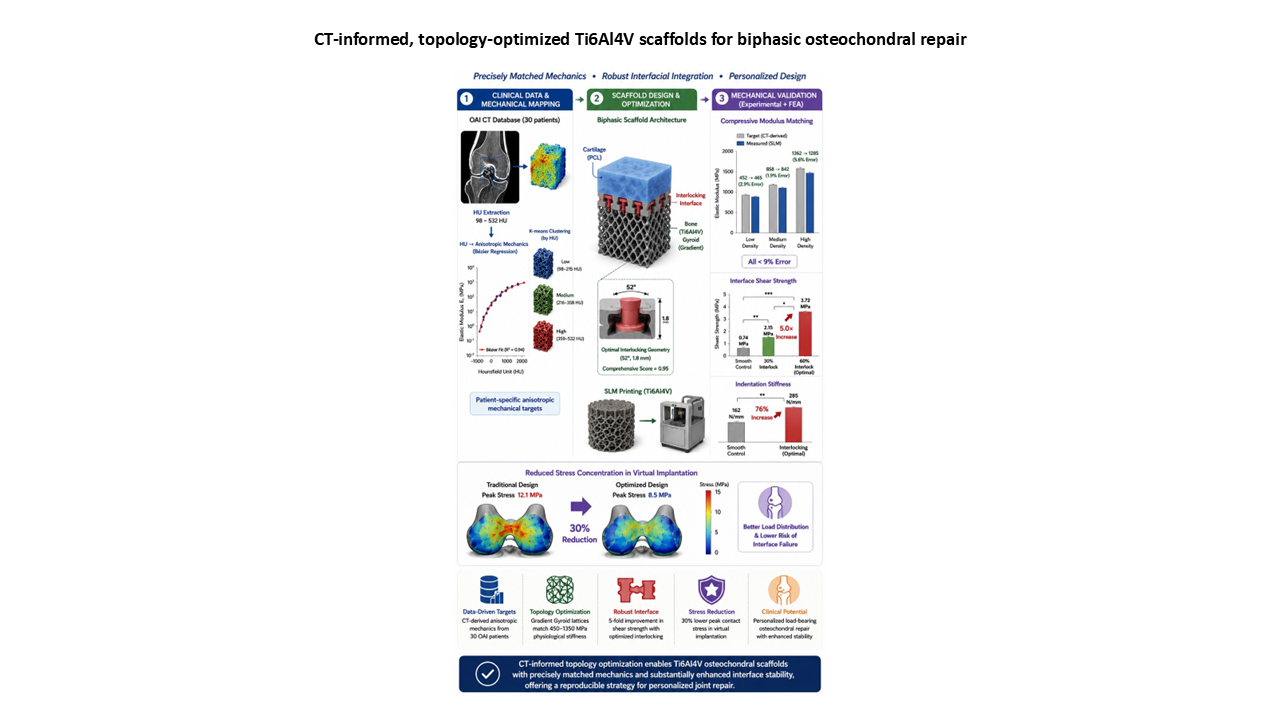
Osteochondral defects require biomimetic scaffolds. These scaffolds must simultaneously reproduce the mechanical heterogeneity of subchondral bone and maintain stable integration between bone and cartilage. In this study, we developed a data-driven design and validation framework for patient-specific biphasic Ti6Al4V osteochondral scaffolds using public computed tomography (CT) datasets and finite element optimization. CT images from the Osteoarthritis Initiative database were analyzed to extract Hounsfield unit (HU) distributions and derive anisotropic mechanical parameters through density–elasticity mapping, yielding three representative design targets corresponding to low-, medium-, and high-density cancellous bone. Gradient Gyroid scaffolds with region-specific porosity and strut parameters were subsequently designed to match these physiological targets. To improve osteochondral integration, an interlocking interface architecture incorporating peg-based mechanical anchoring was optimized using parametric finite element response surface modeling and Bayesian optimization. The scaffolds were fabricated via selective laser melting using Ti6Al4V powder and comprehensively characterized through quasi-static compression, hemispherical indentation, and interface shear testing. The fabricated scaffolds exhibited high geometric fidelity, with average dimensional deviations of less than 0.15 mm. The measured macroscopic compressive moduli demonstrated excellent manufacturing fidelity, deviating by less than 10% from the CT-derived design targets across all density groups, thereby offering a viable path to mitigate clinical stress shielding. Furthermore, the optimized interlocking interface significantly increased both indentation stiffness and destructive interface shear strength relative to smooth-interface controls (p < 0.01), closely matching finite element predictions of minimized stress concentration at the osteochondral junction. Taken together, these findings demonstrate that CT-informed, topology-optimized Ti6Al4V scaffold architectures can achieve precisely matched porous mechanics while substantially expanding interface stability, providing a highly reproducible and translatable strategy for personalized load-bearing joint repair applications.
- Safiri S, Kolahi AA, Smith E. Global, regional and national burden of osteoarthritis 1990–2017: a systematic analysis of the Global Burden of Disease Study 2017. Ann Rheum Dis. 2020;79(6):819-828. doi: 10.1136/annrheumdis-2019-216515
- Dormer NH, Berkland CJ, Detamore MS. Emerging techniques in stratified designs and continuous gradients for tissue engineering of interfaces. Ann Biomed Eng. 2010;38(6):2121-2141. doi: 10.1007/s10439-010-0033-3
- Yildirim N, Amanzhanova A, Kulzhanova G. Osteochondral interface: regenerative engineering and challenges. ACS Biomater Sci Eng. 2023;9(3):1205-1223. doi: 10.1021/acsbiomaterials.2c01321
- Hangody L, Füles P. Autologous osteochondral mosaicplasty for the treatment of full-thickness defects of weight-bearing joints: ten years of experimental and clinical experience. J Bone Joint Surg Am. 2003;85-A Suppl 2:25-32. doi: 10.2106/00004623-200300002-00004
- De Luca V, Bozzetto L, Giglio C, et al. Clinical outcomes of a digitally supported approach for self-management of type 2 diabetes mellitus. Front Public Health. 2023;11. doi: 10.3389/fpubh.2023.1219661
- Zhou J, Liu L, Zhi P, Dong Y, Liu Z, Fan Y. Personalized Design of 3D-Printed Osteochondral Scaffold for Osteoarthritis Patients with Different Bone Conditions and Mechanical Evaluation. Bioengineering. 2025;12(11). doi: 10.3390/bioengineering12111226
- Koons GL, Diba M, Mikos AG. Materials design for bone-tissue engineering. Nat Rev Mater. 2020;5(8):584-603. doi: 10.1038/s41578-020-0204-2
- Doyle SE, Snow F, Duchi S. 3D printed multiphasic scaffolds for osteochondral repair: challenges and opportunities. Int J Mol Sci. 2021;22(22):12420. doi: 10.3390/ijms222212420
- Wu Q, Tang Z, Chen C, et al. Dual-bionic titanium scaffolds based on a gyroid-sheet structure and BaTiO3 piezoelectric coating: a synergistic approach for bone defect repair. Mater Futures. 2025;4(4):045401. doi: 10.1088/2752-5724/ae0142
- Wang J, Huang Z, Han Z, et al. TPMS-Gyroid Scaffold-Mediated Up-Regulation of ITGB1 for Enhanced Cell Adhesion and Immune-Modulatory Osteogenesis. Adv Healthc Mater. 2025;14(20):2404768. doi: 10.1002/adhm.202404768
- Bittner SM, Guo JL, Melchiorri A, Mikos AG. Three-dimensional printing of multilayered tissue engineering scaffolds. Mater Today. 2018;21(8):861-874. doi: 10.1016/j.mattod.2018.02.006
- Liu N, Wang H, Fu Z, et al. Quercetin-Coating Promotes Osteogenic Differentiation, Osseointegration and Anti-Inflammatory Properties of Nano-Topographic Modificated 3D-Printed Ti6Al4V Implant. Front Bioeng Biotechnol. 2022;10:933135. doi: 10.3389/fbioe.2022.933135
- Gatti AA, Keir PJ, Noseworthy MD, Maly MR. Investigating acute changes in osteoarthritic cartilage by integrating biomechanics and statistical shape models of bone: data from the osteoarthritis initiative. MAGMA. 2022;35(5):861-873. doi: 10.1007/s10334-022-01004-8
- Gerhardt LC, Boccaccini AR. Bioactive glass and glass-ceramic scaffolds for bone tissue engineering. Materials. 2010;3(7):3867-3910. doi: 10.3390/ma3073867
- Liu Y, Zheng Y, Chen X-H, et al. Fundamental Theory of Biodegradable Metals—Definition, Criteria, and Design. Adv Funct Mater. 2019;29(18):1805402. doi: 10.1002/adfm.201805402
- Bao G, Fan Q, Ge D, et al. In vitro and in vivo studies to evaluate the feasibility of Zn-0.1Li and Zn-0.8Mg application in the uterine cavity microenvironment compared to pure zinc. Acta Biomater. 2021;123:393-406. doi: 10.1016/j.actbio.2020.12.048
- Choe R, Devoy E, Jabari E, Packer JD, Fisher JP. Biomechanical aspects of osteochondral regeneration: implications and strategies for three-dimensional bioprinting. Tissue Eng Part B Rev. 2022;28(4):766-788. doi: 10.1089/ten.teb.2021.0101
- Flachsmann ER, Broom ND, Oloyede A. A biomechanical investigation of unconstrained shear failure of the osteochondral region under impact loading. Clin Biomech. 1995;10(3):156-165. doi: 10.1016/0268-0033(95)93706-Y
- Nedrelow DS, Townsend JM, Detamore MS. Osteochondral regeneration with anatomical scaffold 3D-printing-design considerations for interface integration. J Biomed Mater Res A. 2024;113(1):e37804. doi: 10.1002/jbm.a.37804
- Alcala-Orozco CR, Cui X, Hooper GJ, Lim KS, Woodfield TBF. Converging functionality: strategies for 3D hybrid-construct biofabrication and the role of composite biomaterials for skeletal regeneration. Acta Biomater. 2021;132:188-216. doi: 10.1016/j.actbio.2021.03.008
- Altunbek M, Afghah F, Caliskan OS, Yoo JJ, Koc B. Design and bioprinting for tissue interfaces. Biofabrication. 2023;15(2):022002. doi: 10.1088/1758-5090/acb73d
- Helguero CG, Amaya JL, Komatsu DE. Trabecular scaffolds' mechanical properties of bone reconstruction using biomimetic implants. Procedia CIRP. 2017;65:121-126. doi: 10.1016/j.procir.2017.04.033
- Schreiber JJ, Anderson PA, Rosas HG, Buchholz AL, Au AG. Hounsfield units for assessing bone mineral density and strength: a tool for osteoporosis management. J Bone Joint Surg Am. 2011;93(11):1057-1063. doi: 10.2106/JBJS.J.00160
- Yau HT, Chen QF, Huang HY, Vu-Dinh H. From computed tomography to 3D printed heterogeneous scaffolds: a novel approach to simulating bone characteristics using octree adaptive subdivision. Mater Des. 2024;245:113277. doi: 10.1016/j.matdes.2024.113277
- Bi S, Wang F, Fu L, Ma S, Wang Z, Zhang Q. Mechanics and Long-Term Stability of Porous Titanium Scaffolds with Rhombic Dodecahedrons. J Mater Eng Perform. 2026;35(8):7612-7624. doi: 10.1007/s11665-025-12189-z
- Arif ZU, Khalid MY, Noroozi R. Recent advances in 3D-printed polylactide and polycaprolactone-based biomaterials for tissue engineering applications. Int J Biol Macromol. 2022;218:930-968. doi: 10.1016/j.ijbiomac.2022.07.140
- Wang X, Xu S, Zhou S, Xu W, Leary M, Choong P, et al. Topological design and additive manufacturing of porous metals for bone scaffolds and orthopaedic implants: a review. Biomaterials. 2016;83:127-141. doi: 10.1016/j.biomaterials.2016.01.012
- Naghavi SA, Tamaddon M, Wang L, Leeflang S, Milleret V, Zadpoor AA. Mechanical characterisation and numerical modelling of TPMS-based gyroid and diamond Ti6Al4V scaffolds for bone implants. J Mech Behav Biomed Mater. 2022;126:104980. doi: 10.1016/j.jmbbm.2021.104980
- Broom ND, Oloyede A, Flachsmann R, Hows M. Dynamic fracture characteristics of the osteochondral junction undergoing shear deformation. Med Eng Phys. 1996;18(5):396-404. doi: 10.1016/1350-4533(95)00067-4
- Diloksumpan P, de Ruijter M, Castilho M, et al. Combining multi-scale 3D printing technologies to engineer reinforced hydrogel-ceramic interfaces. Biofabrication. 2020;12(2):025014. doi: 10.1088/1758-5090/ab69d9
- Ahmad SZ, Masood MH, Khattab MU, Ahmad SS, Zaidi SAA, Khan SZ. Recent Developments in Novel TPMS Lattice Materials: Design Optimization, Performance Control, and Applications in Biomimetic Scaffolds. Materials. 2025;18(22):5209. doi: 10.3390/ma18225209
- Yu K, Zhang W, Lu L, et al. MG-LDM: A multimodal guided latent diffusion model with Mamba-based temporal encoding for inverse topological design of tissue engineering skin substitutes. Adv Eng Inform. 2026;71:104275. doi: 10.1016/j.aei.2025.104275
- Ghouse S, Reznikov N, Boughton OR. The design and in vivo testing of a locally stiffness-matched porous scaffold. Appl Mater Today. 2019;15:377-388. doi: 10.1016/j.apmt.2019.02.017
- Alsheghri AA, Alageel O, Amine Mezour M, et al. Bio-inspired and optimized interlocking features for strengthening metal/polymer interfaces in additively manufactured prostheses. Acta Biomater. 2018;80:425-434. doi: 10.1016/j.actbio.2018.09.029
- Holmes B, Zhu W, Li J, Lee JD, Zhang LG. Development of Novel Three-Dimensional Printed Scaffolds for Osteochondral Regeneration. Tissue Eng Part A. 2015;21(1-2):403-415. doi: 10.1089/ten.tea.2014.0138
- Wang L, Liu Y, Yang Y, Li Y, Bai M. Bonding performance of 3D printing concrete with self-locking interfaces exposed to compression–shear and compression–splitting stresses. Addit Manuf. 2021;42:101992. doi: 10.1016/j.addma.2021.101992