

Design and manufacturing of a 3D-printed field-driven metamaterial pelvic bone plate

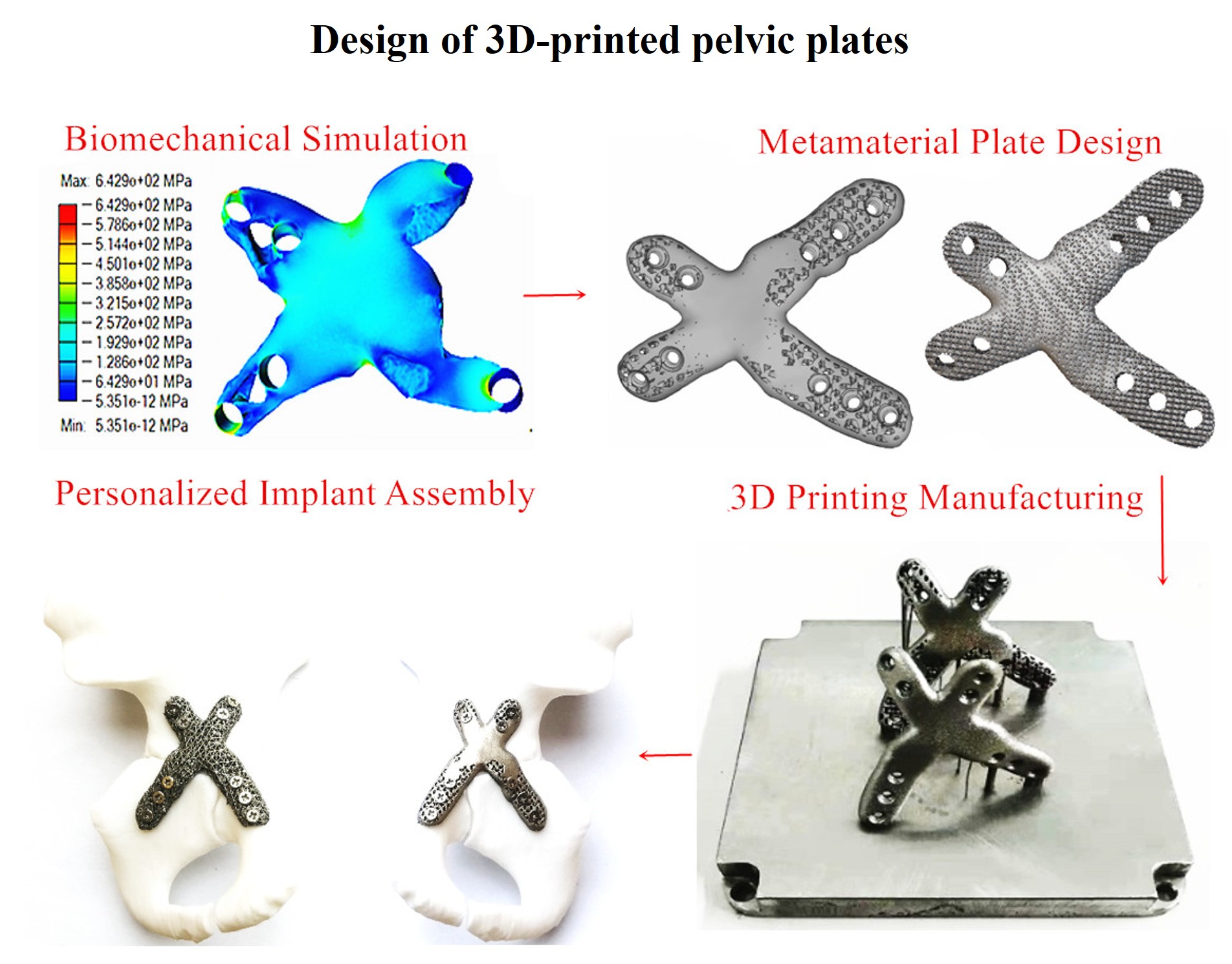
Conventional pelvic bone plates have inherent limitations, including poor anatomical matching, unsatisfactory mechanical performance, excessive weight, and inadequate biocompatibility. This study aims to develop a personalized pelvic bone plate by integrating field-driven metamaterial design with three-dimensional (3D) printing. The methodology involves computed tomography (CT) and Mimics software for reconstruction of the pelvic model, finite element simulation for topology optimization, and 3D printing for direct fabrication of the designed plate. The results demonstrate that the bone plate reconstructed from the pelvic fracture surface exhibited high anatomical fit. After topology optimization, the deformation of the bone plate increased by approximately 15%, accompanied by uniform stress distribution without obvious stress concentration. For the field-driven porous bone plate, the relative density of the porous structure increased with increasing local stress. The partially porous bone plate achieved a 30.77 % weight reduction while combining the favorable mechanical properties of solid plates with the biological potential of porous architectures. The 3D-printed personalized bone plate exhibited excellent forming quality, surface finish, and assembly fit. This study demonstrates the feasibility of the proposed structural design and 3D printing process, providing theoretical support and technical references for the subsequent development of high-performance personalized pelvic bone plates.
- GBD 2019 Fracture Collaborators. Global, regional, and national burden of bone fractures in 204 countries and territories, 1990-2019: a systematic analysis from the Global Burden of Disease Study 2019. Lancet Healthy Longev. 2021;2(9):e580-e592. doi: 10.1016/S2666-7568(21)00172-0
- Wang Y, Zhang H, Liang W. Degradation behavior and mechanical properties of magnesium alloy plate in vivo. J Med Biomech. 2021;36(6):935-939. [In Chinese] doi: 10.16156/j.1004-7220.2021.06.016
- Han Z, Bin H, Wang B, et al. Application of 3D printing technology in preoperative planning of scapular fracture. Chin J Tissue Eng Res. 2020;24(12):1864-1869. [In Chinese] doi: 10.3969/j.issn.2095-4344.1987
- Ilhan E, Ulag S, Sahin AY, et al. Fabrication of tissue-engineered tympanic membrane patches using 3D-printing technology. J Mech Behav Biomed Mater. 2021;114:104219. doi: 10.1016/j.jmbbm.2020.104219
- Xu Y, Liu B, Zhang Y, Lin F, Yin X. Analysis of the application effect of S2 alar screw in 23 cases of complex lower lumbar spine surgery. Fujian Med J. 2019;41(2):37-40. [In Chinese] doi: 10.20148/j.fmj.2019.02.016
- Liu J, Ren Z, Zhang S, et al. In vitro cytological comparison of osseointegration properties between biomimetic bone trabecular and regular porous structure. J Xi'an Jiaotong Univ (Med Ed). 2023;44(6):983-989. [In Chinese] doi: 10.7652/jdyxb202306023
- Zhang G, Li J, Li J, Zhou X, Xie J, Wang A. Selective laser melting molding of individualized femur implant: design, process, optimization. J Bionic Eng. 2021;18(1):128-137. doi: 10.1007/s42235-021-0007-1
- Al-Dulimi Z, Wallis M, Tan DK, Maniruzzaman M, Nokhodchi A. 3D printing technology as innovative solutions for biomedical applications. Drug Discov Today. 2021;26(2):360-383. doi: 10.1016/j.drudis.2020.11.013
- Zhang G, Li J, Wang H, Shangguan C, Xie J, Zhou Y. Research on the impact toughness of 3D-printed CoCrMo alloy components based on fractal theory. Biomimetics. 2025;10(5):292. doi: 10.3390/biomimetics10050292
- Kurzynowski T, Pawlak A, Smolina I. The potential of SLM technology for processing magnesium alloys in aerospace industry. Arch Civ Mech Eng. 2020;20(1):23. doi: 10.1007/s43452-020-00033-1
- Wei Z, Li H, Xiong X, Zou F, Zou Y, Shuang F. 3D printed personalized plate internal fixation for severe tibial plateau fractures. Chin J Bone Jt Inj. 2021;36(10):1087-1089. [In Chinese] doi: 10.7531/j.issn.1672-9935.2021.10.027
- Wang H, Wang M. Biomechanical research and analysis of 3D printed personalized acetabular bone plate design. Orthop Biomech Mater Clin Res. 2020;17(6):41-44. [In Chinese] doi: 10.3969/j.issn.1672-5972.2020.06.010
- Zhang C, Jia D, Li F. Design and simulation of a titanium alloy lattice bone plate for 3D printing. J Shanghai Jiaotong Univ. 2021;55(2):170-178. [In Chinese] doi: 10.16183/j.cnki.jsjtu.2019.196
- Shi H, Zhao F, Wei S, Ma Z, Wang Y. Evaluated the digital design combined with three-dimensional printing technique in the treatment of complicated tibial plateau fractures. Ningxia Med J. 2019;41(10):875-878. [In Chinese] doi: 10.13621/j.1001-5949.2019.10.0875
- Pobloth AM, Checa S, Razi H, et al. Mechanobiologically optimized 3D titanium-mesh scaffolds enhance bone regeneration in critical segmental defects in sheep. Sci Transl Med. 2018;10(423):eaam8828. doi: 10.1126/scitranslmed.aam8828
- Vijayavenkataraman S, Gopinath A, Lu WF. A new design of 3D-printed orthopedic bone plates with auxetic structures to mitigate stress shielding and improve intra-operative bending. Bio-Des Manuf. 2020;3(2):98-108. doi: 10.1007/s42242-020-00066-8
- Mie K, Ishimoto T, Okamoto M, et al. Impaired bone quality characterized by apatite orientation under stress shielding following fixing of a fracture of the radius with a 3D printed Ti-6Al-4V custom-made bone plate in dogs. PLoS One. 2020;15(9):e0237678. doi: 10.1371/journal.pone.0237678
- Liu B, Ma Z, Li J, et al. Experimental study of a 3D printed permanent implantable porous Ta-coated bone plate for fracture fixation. Bioact Mater. 2022;10:269-280. doi: 10.1016/j.bioactmat.2021.09.009
- Yao Y, Mo Z, Wu G, et al. A personalized 3D-printed plate for tibiotalocalcaneal arthrodesis: design, fabrication, biomechanical evaluation and postoperative assessment. Comput Biol Med. 2021;133:104368. doi: 10.1016/j.compbiomed.2021.104368
- Hrabe NW, Heinl P, Bordia RK, Körner C, Fernandes RJ. Maintenance of a bone collagen phenotype by osteoblast-like cells in 3D periodic porous titanium (Ti-6Al-4V) structures fabricated by selective electron beam melting. Connect Tissue Res. 2013;54(6):351-360. doi: 10.3109/03008207.2013.822864
- Günther F, Pilz S, Hirsch F, et al. Shape optimization of additively manufactured lattices based on triply periodic minimal surfaces. Addit Manuf. 2023;73:103659. doi: 10.1016/j.addma.2023.103659
- El-Sayed MA, Essa K, Ghazy M, Hassanin H. Design optimization of additively manufactured titanium lattice structures for biomedical implants. Int J Adv Manuf Technol. 2020;110(9-10):2257-2268. doi: 10.1007/s00170-020-05982-8
- Al-Tamimi AA. Topology optimization of patient-specific custom-fit distal tibia plate: a spiral distal tibia bone fracture. Appl Sci. 2022;12(20):10569. doi: 10.3390/app122010569
- Strömberg N. Optimal grading of TPMS-based lattice structures with transversely isotropic elastic bulk properties. Eng Optim. 2021;53(11):1871-1883. doi: 10.1080/0305215x.2020.1837790
- China Food and Drug Administration. YY 0017-2016: Implants for Osteosynthesis—Metallic Bone Plates. Beijing, China: China Food and Drug Administration; 2016. [In Chinese]
- Wang L, Kang J, Sun C, Li D, Cao Y, Jin Z. Mapping porous microstructures to yield desired mechanical properties for application in 3D printed bone scaffolds and orthopaedic implants. Mater Des. 2017;133:62-68. doi: 10.1016/j.matdes.2017.07.021
- Satapathy PK, Sahoo B, Panda LN. Finite element analysis of functionally graded bone plate at femur bone fracture site. IOP Conf Ser: Mater Sci Eng. 2018;330(1):012027. doi: 10.1088/1757-899x/330/1/012027
- Zhang G, Li J, Shangguan C, et al. Design and performance of 3D-printed cross-scale metamaterial porous structures for orthopedic implants. Int J Bioprint. 2025;11(6):515-530. doi: 10.36922/IJB025390401
- Guoqing Z, Junxin L, Xiaoyu Z, Anmin W. Optimization design of support structure based on 3D printing technology. Sci Rep. 2024;14(1):18225. doi: 10.1038/s41598-024-68733-9
- Wei X. Surface roughness control and process optimization of Ti6Al4V formed by laser selective melting. Master's thesis. Guangzhou, China: South China University of Technology; 2022. [In Chinese] doi: 10.27151/d.cnki.ghnlu.2022.000043