

Emerging bioprinting strategies for osteoporosis research and bone regeneration

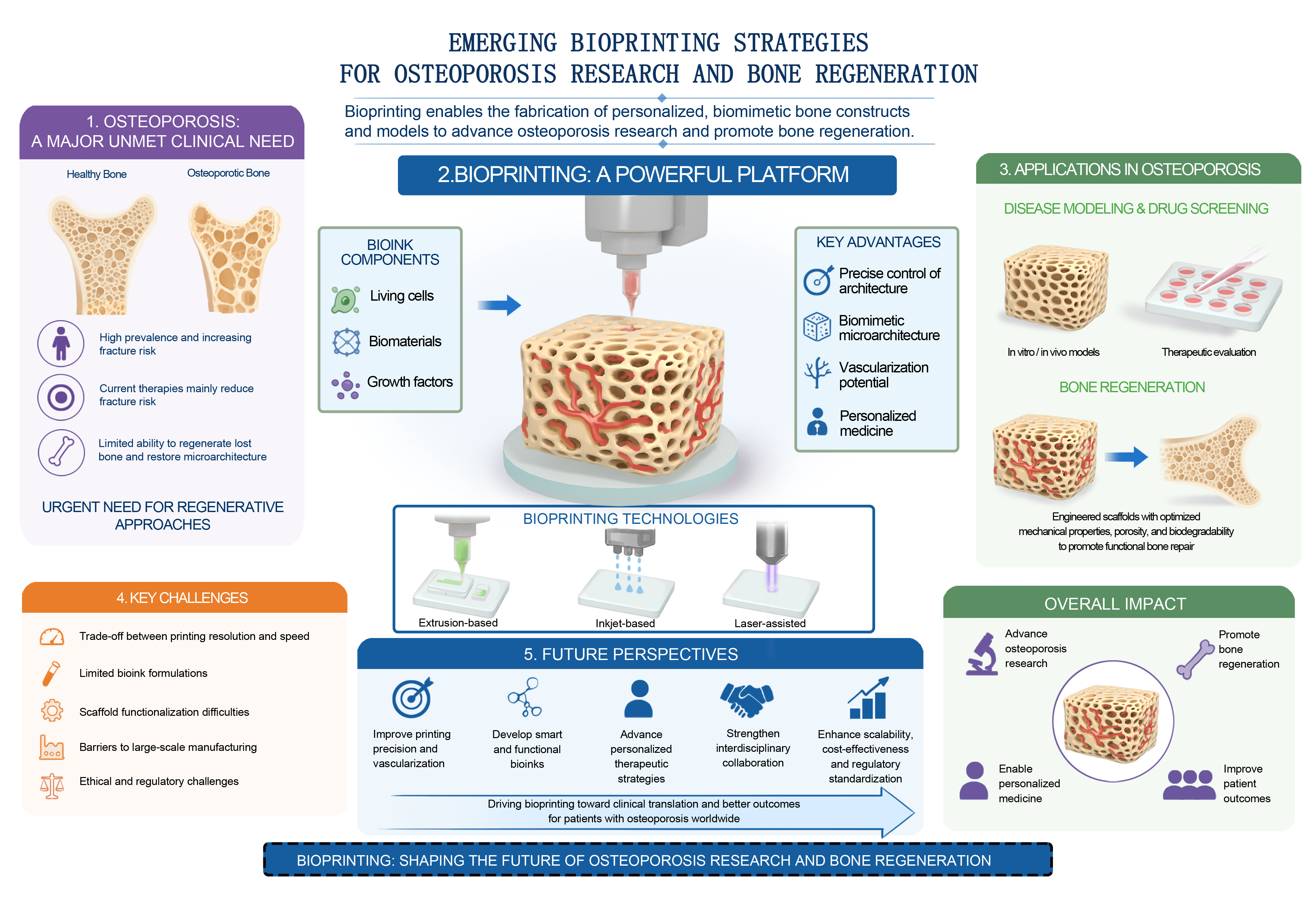
Bioprinting has emerged as a promising technology for osteoporosis research and bone tissue engineering by enabling the fabrication of personalized scaffolds that mimic key features of the native bone microarchitecture. Through 3D biofabrication, this technology facilitates the development of accurate osteoporotic bone models for in vitro and in vivo studies, drug screening, and the evaluation of therapeutic strategies. Bioprinted animal models and cell culture systems provide controlled platforms for investigating disease progression and testing candidate therapies, thereby addressing several limitations of conventional research approaches. In addition, bioprinting has advanced the design of bone substitutes by enabling precise control over scaffold properties such as mechanical strength, porosity, and biodegradability, all of which are critical for bone regeneration. Nevertheless, several challenges remain, including the trade-off between printing resolution and speed, limitations in current bioink formulations, difficulties in scaffold functionalization, and barriers to large-scale manufacturing. The clinical translation of bioprinted constructs is further complicated by ethical and regulatory challenges, particularly with respect to stem cell applications and product approval pathways. Despite these challenges, bioprinting continues to demonstrate considerable potential in osteoporosis research and therapy, with ongoing efforts focused on improving printing precision, developing smart bioinks, and advancing personalized therapeutic strategies. Continued interdisciplinary collaboration, together with improvements in scalability, cost-effectiveness, and regulatory standardization, will be essential for integrating bioprinting into clinical practice and ultimately improving outcomes for patients with osteoporosis worldwide.
- Rachner TD, Khosla S, Hofbauer LC. Osteoporosis: now and the future. The Lancet. 2011;377(9773):1276-1287. doi: 10.1016/s0140-6736(10)62349-5
- Carey JJ, Chih-Hsing Wu P, Bergin D. Risk assessment tools for osteoporosis and fractures in 2022. Best Pract Res Clin Rheumatol. 2022;36(3):101775. doi: 10.1016/j.berh.2022.101775
- Srivastava M, Deal C. Osteoporosis in elderly: prevention and treatment. Clin Geriatr Med. 2002;18(3):529-555. doi: 10.1016/s0749-0690(02)00022-8
- van Staa TP, Dennison EM, Leufkens HG, Cooper C. Epidemiology of fractures in England and Wales. Bone. 2001;29(6):517-522. doi: 10.1016/s8756-3282(01)00614-7
- Ho WC, Chang CC, Wu WT, et al. Effect of Osteoporosis Treatments on Osteoarthritis Progression in Postmenopausal Women: A Review of the Literature. Curr Rheumatol Rep. 2024;26(5):188-195. doi: 10.1007/s11926-024-01139-8
- Meier C, Lamy O, Krieg MA, et al. The role of teriparatide in sequential and combination therapy of osteoporosis. Swiss Med Wkly. 2014;144(2324):w13952. doi: 10.4414/smw.2014.13952
- Fuggle NR, Cooper C, Harvey NC, et al. Assessment of Cardiovascular Safety of Anti-Osteoporosis Drugs. Drugs. 2020;80(15):1537-1552. doi: 10.1007/s40265-020-01364-2
- Zhang S, Lee Y, Liu Y, Yu Y, Han I. Stem Cell and Regenerative Therapies for the Treatment of Osteoporotic Vertebral Compression Fractures. Int J Mol Sci. 2024;25(9):4979. doi: 10.3390/ijms25094979
- Juraski AC, Sharma S, Sparanese S, et al. 3D bioprinting for organ and organoid models and disease modeling. Expert Opin Drug Discov. 2023;18(9):1043-1059. doi: 10.1080/17460441.2023.2234280
- Singh M, Jonnalagadda S. Advances in bioprinting using additive manufacturing. Eur J Pharm Sci. 2020;143:105167. doi: 10.1016/j.ejps.2019.105167
- Chen XB, Fazel Anvari-Yazdi A, Duan X, et al. Biomaterials / bioinks and extrusion bioprinting. Bioact Mater. 2023;28:511-536. doi: 10.1016/j.bioactmat.2023.06.006
- Zhang J, Wehrle E, Rubert M, Müller R. 3D Bioprinting of Human Tissues: Biofabrication, Bioinks, and Bioreactors. Int J Mol Sci. 2021;22(8):3971. doi: 10.3390/ijms22083971
- Bisht B, Hope A, Mukherjee A, Paul MK. Advances in the Fabrication of Scaffold and 3D Printing of Biomimetic Bone Graft. Ann Biomed Eng. 2021;49(4):1128-1150. doi: 10.1007/s10439-021-02752-9
- Chiticaru EA, Ioniță M. Commercially available bioinks and state-of-the-art lab-made formulations for bone tissue engineering: A comprehensive review. Mater Today Bio. 2024;29:101341. doi: 10.1016/j.mtbio.2024.101341
- Pasierb A, Jezierska M, Karpuk A, Czuwara J, Rudnicka L. 3D skin bioprinting: future potential for skin regeneration. Adv Dermatol Allergol. 2022;39(5):845-851. doi: 10.5114/ada.2021.109692
- Sörgel CA, Cai A, Schmid R, Horch RE. Perspectives on the Current State of Bioprinted Skin Substitutes for Wound Healing. Biomedicines. 2023;11(10):2678. doi: 10.3390/biomedicines11102678
- Mok SW, Nizak R, Fu SC, et al. From the printer: Potential of three-dimensional printing for orthopaedic applications. J Orthop Translat. 2016;6:42-49. doi: 10.1016/j.jot.2016.04.003
- Xia Z, Jin S, Ye K. Tissue and Organ 3D Bioprinting. SLAS Technology. 2018;23(4):301-314. doi: 10.1177/2472630318760515
- Liu F, Chen Q, Liu C, et al. Natural Polymers for Organ 3D Bioprinting. Polymers. 2018;10(11):1278. doi: 10.3390/polym10111278
- Sun Z. Clinical Applications of Patient-Specific 3D Printed Models in Cardiovascular Disease: Current Status and Future Directions. Biomolecules. 2020;10(11):1577. doi: 10.3390/biom10111577
- Ho-Shui-Ling A, Bolander J, Rustom LE, Johnson AW, Luyten FP, Picart C. Bone regeneration strategies: Engineered scaffolds, bioactive molecules and stem cells current stage and future perspectives. Biomaterials. 2018;180:143-162. doi: 10.1016/j.biomaterials.2018.07.017
- Xing F, Xiang Z, Rommens PM, Ritz U. 3D Bioprinting for Vascularized Tissue-Engineered Bone Fabrication. Materials. 2020;13(10):2278. doi: 10.3390/ma13102278
- Pragnere S, Essayan L, El-Kholti N, Petiot E, Pailler-Mattei C. In vitro bioprinted 3D model enhancing osteoblast-to-osteocyte differentiation. Biofabrication. 2025;17(1):015021. doi: 10.1088/1758-5090/ad8ca6
- Fischetti T, Borciani G, Avnet S, et al. Incorporation/Enrichment of 3D Bioprinted Constructs by Biomimetic Nanoparticles: Tuning Printability and Cell Behavior in Bone Models. Nanomaterials. 2023;13(14):2040. doi: 10.3390/nano13142040
- Moghimi N, Kamaraj M, Zehtabi F, et al. Development of bioactive short fiber-reinforced printable hydrogels with tunable mechanical and osteogenic properties for bone repair. J Mater Chem B. 2024;12(11):2818-2830. doi: 10.1039/d3tb02924g
- Koo Y, Lee H, Lim CS, Kwon SY, Han I, Kim GH. Highly porous multiple-cell-laden collagen/hydroxyapatite scaffolds for bone tissue engineering. Int J Biol Macromol. 2022;222(Pt A):1264-1276. doi: 10.1016/j.ijbiomac.2022.09.249
- Ran Z, Wang Y, Li J, et al. 3D-printed biodegradable magnesium alloy scaffolds with zoledronic acid-loaded ceramic composite coating promote osteoporotic bone defect repair. Int J Bioprintg. 2023;9(5):769. doi: 10.18063/ijb.769
- Sun X, Jiao X, Yang X, et al. 3D bioprinting of osteon-mimetic scaffolds with hierarchical microchannels for vascularized bone tissue regeneration. Biofabrication. 2022;14(3):035008. doi: 10.1088/1758-5090/ac6700
- Rodríguez-Merchán EC. Bone Healing Materials in the Treatment of Recalcitrant Nonunions and Bone Defects. Int J Mol Sci. 2022;23(6):3352. doi: 10.3390/ijms23063352
- Bahraminasab M. Challenges on optimization of 3D-printed bone scaffolds. Biomed Eng Online. 2020;19(1):69. doi: 10.1186/s12938-020-00810-2
- Murphy SV, Atala A. 3D bioprinting of tissues and organs. Nat Biotechnol. 2014;32(8):773-785. doi: 10.1038/nbt.2958
- Wang C, Huang W, Zhou Y, et al. 3D printing of bone tissue engineering scaffolds. Bioact Mater. 2020;5(1):82-91. doi: 10.1016/j.bioactmat.2020.01.004
- Pavek A, Nartker C, Saleh M, et al. Tissue Engineering Through 3D Bioprinting to Recreate and Study Bone Disease. Biomedicines. 2021;9(5):551. doi: 10.3390/biomedicines9050551
- Salah M, Tayebi L, Moharamzadeh K, Naini FB. Three-dimensional bio-printing and bone tissue engineering: technical innovations and potential applications in maxillofacial reconstructive surgery. Maxillofac Plast Reconstr Surg. 2020;42(1):18. doi: 10.1186/s40902-020-00263-6
- Gungor-Ozkerim PS, Inci I, Zhang YS, Khademhosseini A, Dokmeci MR. Bioinks for 3D bioprinting: an overview. Biomater Sci. 2018;6(5):915-946. doi: 10.1039/c7bm00765e
- Gudapati H, Dey M, Ozbolat I. A comprehensive review on droplet-based bioprinting: Past, present and future. Biomaterials. 2016;102:20-42. doi: 10.1016/j.biomaterials.2016.06.012
- Jang J, Park HJ, Kim SW, et al. 3D printed complex tissue construct using stem cell-laden decellularized extracellular matrix bioinks for cardiac repair. Biomaterials. 2017;112:264-274. doi: 10.1016/j.biomaterials.2016.10.026
- Dou C, Perez V, Qu J, Tsin A, Xu B, Li JJCR. A state‐of‐the‐art review of laser‐assisted bioprinting and its future research trends. CBEN. 2021;8(5):517-534. doi: 10.1002/cben.202000037
- Mandrycky C, Wang Z, Kim K, Kim DH. 3D bioprinting for engineering complex tissues. Biotechnol Adv. 2016;34(4):422-434. doi: 10.1016/j.biotechadv.2015.12.011
- Fang Y, Frampton JP, Raghavan S, et al. Rapid generation of multiplexed cell cocultures using acoustic droplet ejection followed by aqueous two-phase exclusion patterning. Tissue Eng Part C-Me. 2012;18(9):647-657. doi: 10.1089/ten.TEC.2011.0709
- Li X, Liu B, Pei B, et al. Inkjet Bioprinting of Biomaterials. Chem Rev. 2020;120(19):10793-10833. doi: 10.1021/acs.chemrev.0c00008
- Adhikari J, Roy A, Das A, et al. Effects of Processing Parameters of 3D Bioprinting on the Cellular Activity of Bioinks. Macromol Biosci. 2021;21(1):e2000179. doi: 10.1002/mabi.202000179
- Cui X, Breitenkamp K, Finn MG, Lotz M, D’Lima DD. Direct human cartilage repair using three-dimensional bioprinting technology. Tissue Eng Part A. 2012;18(11-12):1304-1312. doi: 10.1089/ten.TEA.2011.0543
- Cui X, Breitenkamp K, Lotz M, D’Lima D. Synergistic action of fibroblast growth factor-2 and transforming growth factor-beta1 enhances bioprinted human neocartilage formation. Biotechnol Bioeng. 2012;109(9):2357-2368. doi: 10.1002/bit.24488
- Skardal A, Zhang J, McCoard L, Xu X, Oottamasathien S, Prestwich GD. Photocrosslinkable hyaluronan-gelatin hydrogels for two-step bioprinting. Tissue Eng Part A. 2010;16(8):2675-2685. doi: 10.1089/ten.TEA.2009.0798
- Fielding GA, Bandyopadhyay A, Bose S. Effects of silica and zinc oxide doping on mechanical and biological properties of 3D printed tricalcium phosphate tissue engineering scaffolds. Dent Mater. 2012;28(2):113-122. doi: 10.1016/j.dental.2011.09.010
- Zhang L, Yang G, Johnson BN, Jia X. Three-dimensional (3D) printed scaffold and material selection for bone repair. Acta Biomater. 2019;84:16-33. doi: 10.1016/j.actbio.2018.11.039
- Chang R, Nam J, Sun W. Effects of dispensing pressure and nozzle diameter on cell survival from solid freeform fabrication-based direct cell writing. Tissue Eng Part A. 2008;14(1):41-48. doi: 10.1089/ten.a.2007.0004
- Pati F, Jang J, Ha DH, et al. Printing three-dimensional tissue analogues with decellularized extracellular matrix bioink. Nat Commun. 2014;5:3935. doi: 10.1038/ncomms4935
- Hölzl K, Lin S, Tytgat L, Van Vlierberghe S, Gu L, Ovsianikov A. Bioink properties before, during and after 3D bioprinting. Biofabrication. 2016;8(3):032002. doi: 10.1088/1758-5090/8/3/032002
- Guillemot F, Souquet A, Catros S, Guillotin B. Laser-assisted cell printing: principle, physical parameters versus cell fate and perspectives in tissue engineering. Nanomedicine. 2010;5(3):507-515. doi: 10.2217/nnm.10.14
- Swetha S, Lavanya K, Sruthi R, Selvamurugan N. An insight into cell-laden 3D-printed constructs for bone tissue engineering. J Mater Chem B. 2020;8(43):9836-9862. doi: 10.1039/d0tb02019b
- Guillemot F, Souquet A, Catros S, et al. High-throughput laser printing of cells and biomaterials for tissue engineering. Acta Biomater. 2010;6(7):2494-2500. doi: 10.1016/j.actbio.2009.09.029
- Hopp B, Smausz T, Kresz N, et al. Survival and proliferative ability of various living cell types after laser-induced forward transfer. Tissue Eng. 2005;11(11-12):1817-1823. doi: 10.1089/ten.2005.11.1817
- Keriquel V, Oliveira H, Rémy M, et al. In situ printing of mesenchymal stromal cells, by laser-assisted bioprinting, for in vivo bone regeneration applications. Sci Rep. 2017;7(1):1778. doi: 10.1038/s41598-017-01914-x
- Yang Y, Zhang Q, Xu T, et al. Photocrosslinkable nanocomposite ink for printing strong, biodegradable and bioactive bone graft. Biomaterials. 2020;263:120378. doi: 10.1016/j.biomaterials.2020.120378
- Krolinski A, Sommer K, Wiesner J, Friedrich O, Vielreicher M. Optimized Method of 3D Scaffold Seeding, Cell Cultivation, and Monitoring Cell Status for Bone Tissue Engineering. Methods Mol Biol. 2023;2644:467-480. doi: 10.1007/978-1-0716-3052-5_30
- Kelder C, Bakker AD, Klein-Nulend J, Wismeijer D. The 3D Printing of Calcium Phosphate with K-Carrageenan under Conditions Permitting the Incorporation of Biological Components-A Method. J Funct Biomater. 2018;9(4):57. doi: 10.3390/jfb9040057
- Roseti L, Parisi V, Petretta M, et al. Scaffolds for Bone Tissue Engineering: State of the art and new perspectives. Mat Sci Eng C-Mater. 2017;78:1246-1262. doi: 10.1016/j.msec.2017.05.017
- Cidonio G, Glinka M, Dawson JI, Oreffo ROC. The cell in the ink: Improving biofabrication by printing stem cells for skeletal regenerative medicine. Biomaterials. 2019;209:10-24. doi: 10.1016/j.biomaterials.2019.04.009
- Ortega MA, De Leon-Oliva D, Liviu Boaru D, et al. Advances in 3D bioprinting to enhance translational applications in bone tissue engineering and regenerative medicine. Histol Histopathol. 2024;40(2):147-156. doi: 10.14670/hh-18-763
- Kang HW, Lee SJ, Ko IK, Kengla C, Yoo JJ, Atala A. A 3D bioprinting system to produce human-scale tissue constructs with structural integrity. Nat Biotechnol. 2016;34(3):312-319. doi: 10.1038/nbt.3413
- Walthers CM, Nazemi AK, Patel SL, Wu BM, Dunn JC. The effect of scaffold macroporosity on angiogenesis and cell survival in tissue-engineered smooth muscle. Biomaterials. 2014;35(19):5129-5137. doi: 10.1016/j.biomaterials.2014.03.025
- Yang J, Chen Z, Gao C, et al. A mechanical-assisted post-bioprinting strategy for challenging bone defects repair. Nat Commun. 2024;15(1):3565. doi: 10.1038/s41467-024-48023-8
- Chen CH, Chang WJ, Chen YS, et al. Development of a Novel Hybrid Suture Anchor for Osteoporosis by Integrating Titanium 3D Printing and Traditional Machining. Int J Bioprintg. 2022;8(4):608. doi: 10.18063/ijb.v8i4.608
- Lai PL, Huang SF, Wang HW, Liu PH, Lin CL. Designing an anatomical contour titanium 3D-printed oblique lumbar interbody fusion cage with porous structure and embedded fixation screws for patients with osteoporosis. Int J Bioprintg. 2023;9(5):772. doi: 10.18063/ijb.772
- Lafuente-Merchan M, Ruiz-Alonso S, García-Villén F, et al. 3D Bioprinted Hydroxyapatite or Graphene Oxide Containing Nanocellulose-Based Scaffolds for Bone Regeneration. Macromol Biosci. 2022;22(11):e2200236. doi: 10.1002/mabi.202200236
- Wang CY, Chiu YC, Lee AK, Lin YA, Lin PY, Shie MY. Biofabrication of Gingival Fibroblast Cell-Laden Collagen/Strontium-Doped Calcium Silicate 3D-Printed Bi-Layered Scaffold for Osteoporotic Periodontal Regeneration. Biomedicines. 2021;9(4):431. doi: 10.3390/biomedicines9040431
- Esmaeili S, Akbari Aghdam H, Motififard M, et al. A porous polymeric-hydroxyapatite scaffold used for femur fractures treatment: fabrication, analysis, and simulation. Eur J Orthop Surg Traumatol. 2020;30(1):123-131. doi: 10.1007/s00590-019-02530-3
- Huang SF, Chang CM, Liao CY, Chan YT, Li ZY, Lin CL. Biomechanical evaluation of an osteoporotic anatomical 3D printed posterior lumbar interbody fusion cage with internal lattice design based on weighted topology optimization. Int J Bioprintg. 2023;9(3):697. doi: 10.18063/ijb.697
- Henkel J, Woodruff MA, Epari DR, et al. Bone Regeneration Based on Tissue Engineering Conceptions - A 21st Century Perspective. Bone Res. 2013;1(3):216-248. doi: 10.4248/br201303002
- Collins MN, Ren G, Young K, Pina S, Reis RL, Oliveira JM. Scaffold Fabrication Technologies and Structure/Function Properties in Bone Tissue Engineering. Adv Funct Mater. 2021;31(21):2010609. doi: 10.1002/adfm.202010609
- Perić Kačarević Ž, Rider P, Alkildani S, et al. An introduction to bone tissue engineering. Int J Artif Organs. 2020;43(2):69-86. doi: 10.1177/0391398819876286
- Woodard JR, Hilldore AJ, Lan SK, et al. The mechanical properties and osteoconductivity of hydroxyapatite bone scaffolds with multi-scale porosity. Biomaterials. 2007;28(1):45-54. doi: 10.1016/j.biomaterials.2006.08.021
- Turnbull G, Clarke J, Picard F, et al. 3D bioactive composite scaffolds for bone tissue engineering. Bioact Mater. 2018;3(3):278-314. doi: 10.1016/j.bioactmat.2017.10.001
- Maisani M, Pezzoli D, Chassande O, Mantovani D. Cellularizing hydrogel-based scaffolds to repair bone tissue: How to create a physiologically relevant micro-environment? J Tissue Eng. 2017;8:2041731417712073. doi: 10.1177/2041731417712073
- Nguyen DT, Burg KJ. Bone tissue engineering and regenerative medicine: targeting pathological fractures. J Biomed Mater Res A. 2015;103(1):420-429. doi: 10.1002/jbm.a.35139
- Ghassemi T, Shahroodi A, Ebrahimzadeh MH, Mousavian A, Movaffagh J, Moradi A. Current Concepts in Scaffolding for Bone Tissue Engineering. Arch Bone Jt Surg. 2018;6(2):90-99.
- Chou DT, Wells D, Hong D, Lee B, Kuhn H, Kumta PN. Novel processing of iron-manganese alloy-based biomaterials by inkjet 3-D printing. Acta Biomater. 2013;9(10):8593-8603. doi: 10.1016/j.actbio.2013.04.016
- Mishra R, Bishop T, Valerio IL, Fisher JP, Dean D. The potential impact of bone tissue engineering in the clinic. Regenerative Medicine. 2016;11(6):571-587. doi: 10.2217/rme-2016-0042
- Pedrero SG, Llamas-Sillero P, Serrano-López J. A Multidisciplinary Journey towards Bone Tissue Engineering. Materials. 2021;14(17):4896. doi: 10.3390/ma14174896
- Ardeshirylajimi A. Applied Induced Pluripotent Stem Cells in Combination With Biomaterials in Bone Tissue Engineering. J Cell Biochem. 2017;118(10):3034-3042. doi: 10.1002/jcb.25996
- Battafarano G, Rossi M, De Martino V, et al. Strategies for Bone Regeneration: From Graft to Tissue Engineering. Int J Mol Sci. 2021;22(3):1128. doi: 10.3390/ijms22031128
- Holmes B, Bulusu K, Plesniak M, Zhang LG. A synergistic approach to the design, fabrication and evaluation of 3D printed micro and nano featured scaffolds for vascularized bone tissue repair. Nanotechnology. 2016;27(6):064001. doi: 10.1088/0957-4484/27/6/064001
- Dou C, Li J, He J, et al. Bone-targeted pH-responsive cerium nanoparticles for anabolic therapy in osteoporosis. Bioact Mater. 2021;6(12):4697-4706. doi: 10.1016/j.bioactmat.2021.04.038
- Meng X, Wang WD, Li SR, Sun ZJ, Zhang L. Harnessing cerium-based biomaterials for the treatment of bone diseases. Acta Biomater. 2024;183:30-49. doi: 10.1016/j.actbio.2024.05.046
- Yuan K, Mei J, Shao D, et al. Cerium Oxide Nanoparticles Regulate Osteoclast Differentiation Bidirectionally by Modulating the Cellular Production of Reactive Oxygen Species. Int J Nanomed. 2020;15:6355-6372. doi: 10.2147/ijn.s257741
- Huang S, Liang N, Hu Y, Zhou X, Abidi N. Polydopamine-Assisted Surface Modification for Bone Biosubstitutes. Biomed Res Int. 2016;2016:2389895. doi: 10.1155/2016/2389895
- Liu L, Yu F, Li L, et al. Bone marrow stromal cells stimulated by strontium-substituted calcium silicate ceramics: release of exosomal miR-146a regulates osteogenesis and angiogenesis. Acta Biomater. 2021;119:444-457. doi: 10.1016/j.actbio.2020.10.038
- Zhang J, Han Y, Song M, et al. Selenium Improves Bone Microenvironment-Related Hematopoiesis and Immunity in T-2 Toxin-Exposed Mice. J Agr Food Chem. 2023;71(5):2590-2599. doi: 10.1021/acs.jafc.2c08275
- Xie Y, Hu C, Feng Y, et al. Osteoimmunomodulatory effects of biomaterial modification strategies on macrophage polarization and bone regeneration. Regen Biomater. 2020;7(3):233-245. doi: 10.1093/rb/rbaa006
- Dutta SD, Ganguly K, Patil TV, Randhawa A, Lim KT. Unraveling the potential of 3D bioprinted immunomodulatory materials for regulating macrophage polarization: State-of-the-art in bone and associated tissue regeneration. Bioact Mater. 2023;28:284-310. doi: 10.1016/j.bioactmat.2023.05.014
- Boyce BF, Xing L. Functions of RANKL/RANK/OPG in bone modeling and remodeling. Arch Biochem Biophys. 2008;473(2):139-146. doi: 10.1016/j.abb.2008.03.018
- Dempster DW, Lambing CL, Kostenuik PJ, Grauer A. Role of RANK ligand and denosumab, a targeted RANK ligand inhibitor, in bone health and osteoporosis: a review of preclinical and clinical data. Clin Ther. 2012;34(3):521-536. doi: 10.1016/j.clinthera.2012.02.002
- Tezel T, Kovan VJRPJ. Determination of optimum production parameters for 3D printers based on nozzle diameter. Rapid Prototyping J. 2022;28(1):185-194. doi: 10.1108/RPJ-08-2020-0185
- Kang SW, Mueller J. Multiscale 3D printing via active nozzle size and shape control. Sci Adv. 2024;10(23):eadn7772. doi: 10.1126/sciadv.adn7772
- McMahon RE, Wang L, Skoracki R, Mathur AB. Development of nanomaterials for bone repair and regeneration. J Biomed Mater Res B Appl Biomater. 2013;101(2):387-397. doi: 10.1002/jbm.b.32823
- Wegst UG, Bai H, Saiz E, Tomsia AP, Ritchie RO. Bioinspired structural materials. Nat Mater. 2015;14(1):23-36. doi: 10.1038/nmat4089
- Frenkel D, Ginsbury E, Sharabi M. The Mechanics of Bioinspired Stiff-to-Compliant Multi-Material 3D-Printed Interfaces. Biomimetics. 2022;7(4):170. doi: 10.3390/biomimetics7040170
- An JH, Kim HY. Scaffolds Bioink for Three-Dimensional (3D) Bioprinting. Food Sci Anim Resour. 2025;45(1):126-144. doi: 10.5851/kosfa.2024.e120
- Xing Q, Liu Y, Thomas JL, et al. 3D bioprinting of cell-laden constructs: technologies, bioink design, and biomedical applications. Biomed Mater. 2026;21(1):012001. doi: 10.1088/1748-605X/ae2725
- Li X, Jian H, Han Q, et al. Three-dimensional (3D) bioprinting of medium toughened dipeptide hydrogel scaffolds with Hofmeister effect. J Colloid Interface Sci. 2023;639:1-6. doi: 10.1016/j.jcis.2023.02.033
- Cui Y, Zhu T, Li D, et al. Bisphosphonate-Functionalized Scaffolds for Enhanced Bone Regeneration. Adv Healthc Mater. 2019;8(23):e1901073. doi: 10.1002/adhm.201901073
- Niu H, Ma Y, Wu G, et al. Multicellularity-interweaved bone regeneration of BMP-2-loaded scaffold with orchestrated kinetics of resorption and osteogenesis. Biomaterials. 2019;216:119216. doi: 10.1016/j.biomaterials.2019.05.027
- Kupikowska-Stobba B, Kasprzak M. Fabrication of nanoparticles for bone regeneration: new insight into applications of nanoemulsion technology. J Mater Chem B. 2021;9(26):5221-5244. doi: 10.1039/d1tb00559f
- Watcharajittanont N, Tabrizian M, Ekarattanawong S, Meesane J. Bone-mimicking scaffold based on silk fibroin incorporated with hydroxyapatite and titanium oxide as enhanced osteo-conductive material for bone tissue formation: fabrication, characterization, properties, and in vitro testing. Biomed Mater. 2023;18(6):065007. doi: 10.1088/1748-605X/acf542
- Chen X, Han S, Wu W, et al. Harnessing 4D Printing Bioscaffolds for Advanced Orthopedics. Small. 2022;18(36):e2106824. doi: 10.1002/smll.202106824
- Zhang Y, Zhai D, Xu M, et al. 3D-printed bioceramic scaffolds with antibacterial and osteogenic activity. Biofabrication. 2017;9(2):025037. doi: 10.1088/1758-5090/aa6ed6
- Kai D, Tan MJ, Prabhakaran MP, et al. Biocompatible electrically conductive nanofibers from inorganic-organic shape memory polymers. Colloid Surface B. 2016;148:557-565. doi: 10.1016/j.colsurfb.2016.09.035
- Kahl M, Gertig M, Hoyer P, Friedrich O, Gilbert DF. Ultra-Low-Cost 3D Bioprinting: Modification and Application of an Off-the-Shelf Desktop 3D-Printer for Biofabrication. Front Bioeng Biotechnol. 2019;7:184. doi: 10.3389/fbioe.2019.00184
- Goddard E, Dodds S. Ethics and Policy for Bioprinting. Methods Mol Biol. 2020;2140:43-64. doi: 10.1007/978-1-0716-0520-2_4
- Patuzzo S, Goracci G, Gasperini L, Ciliberti R. 3D Bioprinting Technology: Scientific Aspects and Ethical Issues. Sci Eng Ethics. 2018;24(2):335-348. doi: 10.1007/s11948-017-9918-y
- Cheptsov VS, Tsypina SI, Minaev NV, Yusupov VI, Chichkov BN. New microorganism isolation techniques with emphasis on laser printing. Int J Bioprintg. 2019;5(1):165. doi: 10.18063/ijb.v5i1.165
- Levato R, Lim KS. Harnessing light in biofabrication. Biofabrication. 2023;15(2):020401. doi: 10.1088/1758-5090/acb50f
- Kumar MS, Varma P, Kandasubramanian B. From lab to life: advances in in-situ bioprinting and bioink technology. Biomed Mater. 2025;20(1):012004. doi: 10.1088/1748-605X/ad9dd0
- Codrea CI, Lincu D, Ene VL, et al. Three-Dimensional-Printed Composite Scaffolds Containing Poly-ε-Caprolactone and Strontium-Doped Hydroxyapatite for Osteoporotic Bone Restoration. Polymers. 2024;16(11):1511. doi: 10.3390/polym16111511
- Wang Z, Xiang P, Xu Z, et al. The Role of Magnesium, Zinc, and Strontium in Osteoporotic Fracture Repair. Bioengineering. 2025;12(2):201. doi: 10.3390/bioengineering12020201
- Zhao Q, Ni Y, Wei H, et al. Ion incorporation into bone grafting materials. Periodontology 2000. 2024;94(1):213-230. doi: 10.1111/prd.12533
- Hsiao K, Lee BJ, Samuelsen T, et al. Single-digit-micrometer-resolution continuous liquid interface production. Sci Adv. 2022;8(46):eabq2846. doi: 10.1126/sciadv.abq2846
- Jing S, Lian L, Hou Y, et al. Advances in volumetric bioprinting. Biofabrication. 2024;16(1):012004. doi: 10.1088/1758-5090/ad0978
- Ma X, Liu J, Zhu W, et al. 3D bioprinting of functional tissue models for personalized drug screening and in vitro disease modeling. Adv Drug Deliv Rev. 2018;132:235-251. doi: 10.1016/j.addr.2018.06.011
- Zheng X, Huang J, Lin J, et al. 3D bioprinting in orthopedics translational research. J Biomater Sci Polym Ed. 2019;30(13):1172-1187. doi: 10.1080/09205063.2019.1623989