
Selective laser melting-fabricated porous tantalum scaffold integrated with nano-MgO/alginate hydrogel for enhanced osteogenesis and immunomodulation in critical-size bone defect repair

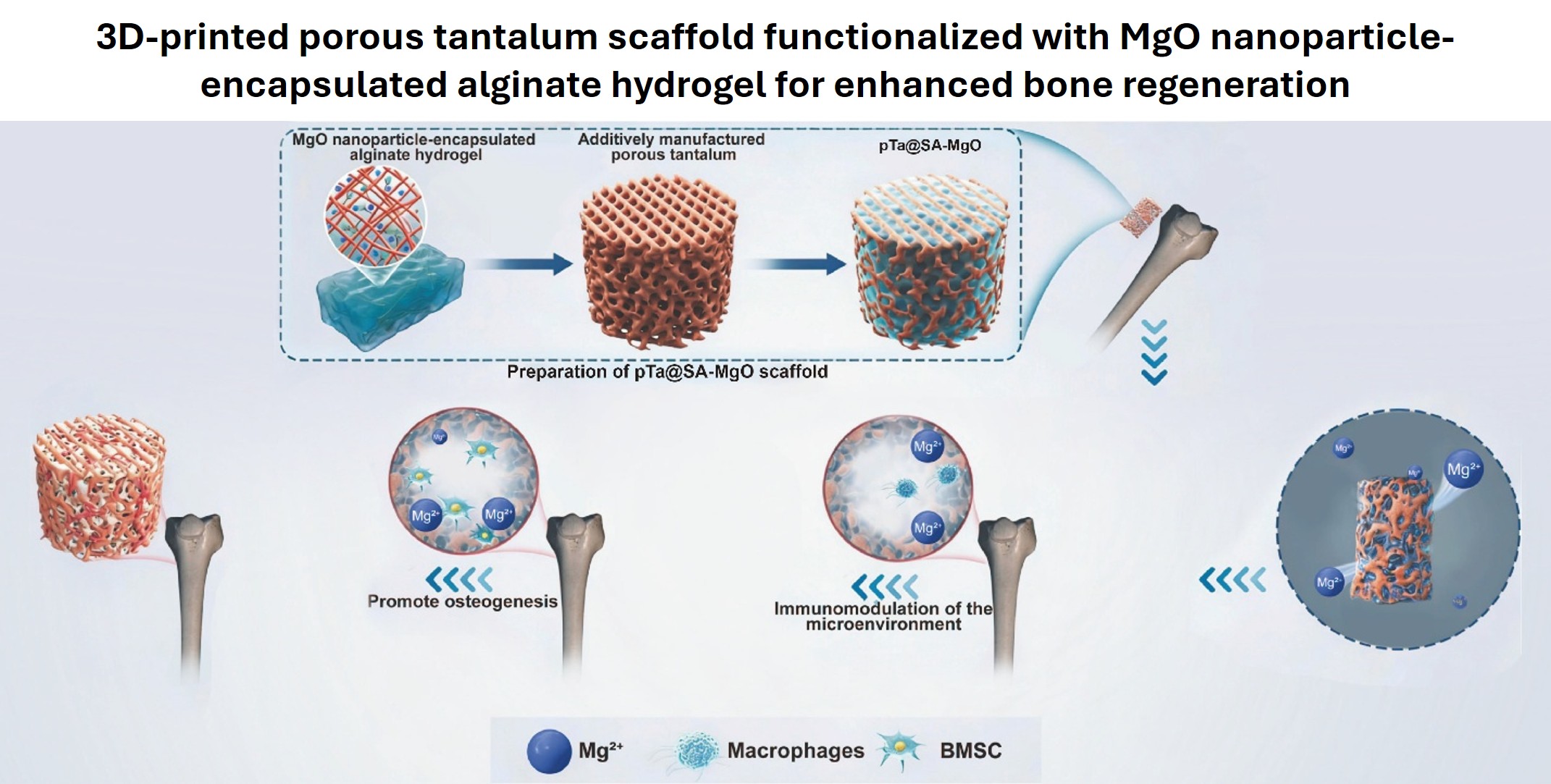
The effective repair of critical-sized bone defects remains a major challenge in bone tissue engineering. While porous tantalum (pTa) scaffolds fabricated by selective laser melting offer excellent mechanical compatibility and structural stability, their inherent biological inertness limits their osteogenic potential. This study aims to develop a functionally enhanced composite scaffold by filling three-dimensional–printed pTa with an alginate hydrogel incorporated with nano-magnesium oxide particles (pTa@SA-MgO). The hydrogel acted as a carrier for controlled Mg2+ ion release. Comprehensive in vitro and in vivo evaluations revealed that this composite scaffold significantly promoted osteogenic activities, including MC3T3-E1 cell proliferation, migration, adhesion, and differentiation (as evidenced by increased alkaline phosphatase activity, mineralized nodule formation, and upregulation of Runx2, Ocn, Opn, and Col1a1 gene expression). Moreover, it modulated the immune microenvironment by enhancing M2 macrophage polarization and suppressing M1 macrophage polarization. In a rabbit femoral defect model, the pTa@SA-MgO scaffold demonstrated superior bone regeneration compared to controls, with greater bone volume and enhanced new bone formation. This research successfully integrates a sustained ion release strategy with a high-performance metallic scaffold, providing new insights into the design of bone repair materials with synergistic mechanical support and bioactive functionality.
- Xu W, Gao W, Zhang Y, et al. Injectable HAMA-CPC hydrogels loaded with high-yield 3D bioprinted adipose-derived stem cell small extracellular vesicles for increased bone repair. J Nanobiotechnology. 2025;23(1). doi: 10.1186/s12951-025-03596-4
- Gao C, Qiu ZY, Hou JW, et al. Clinical observation of mineralized collagen bone grafting after curettage of benign bone tumors. Regen Biomater. 2020;7(6):567-575. doi: 10.1093/rb/rbaa031
- Zhu W, Li C, Yao M, et al. Advances in osseointegration of biomimetic mineralized collagen and inorganic metal elements of natural bone for bone repair. Regen Biomater. 2023;10. doi: 10.1093/rb/rbad030
- Song Y, Wang N, Shi H, et al. Biomaterials combined with ADSCs for bone tissue engineering: current advances and applications. Regen Biomater. 2023;10. doi: 10.1093/rb/rbad083
- Su X, Wei L, Xu Z, et al. Evaluation and Application of Silk Fibroin Based Biomaterials to Promote Cartilage Regeneration in Osteoarthritis Therapy. Biomedicines. 2023;11(8):2244. doi: 10.3390/biomedicines11082244
- Goncharov EN, Koval OA, Nikolaevich Bezuglov E, et al. Conservative Treatment in Avascular Necrosis of the Femoral Head: A Systematic Review. Med Sci. 2024;12(3):32. doi: 10.3390/medsci12030032
- Wei Y, Lyu P, Bi R, et al. Neural Regeneration in Regenerative Endodontic Treatment: An Overview and Current Trends. Int J Mol Sci. 2022;23(24):15492. doi: 10.3390/ijms232415492
- Lu Y, Deshmukh S, Jones I, et al. Biodegradable magnesium alloys for orthopaedic applications. Biomater Transl. 2021;2(3):214. doi: 10.12336/biomatertransl.2021.03.005
- Yu L, Sun F, Wang Y, et al. Effects of MgO nanoparticle addition on the mechanical properties, degradation properties, antibacterial properties and in vitro and in vivo biological properties of 3D-printed Zn scaffolds. Bioact Mater. 2024;37:72-85. doi: 10.1016/j.bioactmat.2024.03.016
- Cao B, Xie L, Xu Y, et al. Dual-core-component multiphasic bioceramic granules with selective-area porous structures facilitating bone tissue regeneration and repair. RSC Adv. 2024;14(15):10526-10537. doi: 10.1039/d4ra00911h
- Jaeyoung R, Kang HS, Kang BH, et al. Effect of rhBMP-2 applied with a 3D-printed titanium implant on new bone formation in rabbit calvarium. J Appl Oral Sci. 2021;29. doi: 10.1590/1678-7757-2020-1092
- Gao H, Yang J, Jin X, et al. Static Compressive Behavior and Failure Mechanism of Tantalum Scaffolds with Optimized Periodic Lattice Fabricated by Laser-Based Additive Manufacturing. 3D Print Addit Manuf. 2023;10(5):887-904. doi: 10.1089/3dp.2021.0253
- Mao S, Liu Y, Wang F, et al. Design and biomechanical analysis of patient-specific porous tantalum prostheses for knee joint revision surgery. Int J Bioprint. 2024;9(4):735. doi: 10.18063/ijb.735
- Fu M, Li J, Liu M, et al. Sericin/Nano-Hydroxyapatite Hydrogels Based on Graphene Oxide for Effective Bone Regeneration via Immunomodulation and Osteoinduction. Int J Nanomedicine. 2023;18:1875-1895. doi: 10.2147/ijn.S399487
- Li L, Pan C, Zhang X, et al. Efficacy of cementless porous tantalum tibial components versus cemented tibial components in primary total knee arthroplasty: A meta-analysis. Medicine. 2024;103(14):e37697. doi: 10.1097/md.0000000000037697
- Ji Y, Hou M, Zhang J, et al. Preparation and Properties of Partial-Degradable ZrO(2)-Chitosan Particles-GelMA Composite Scaffolds. Polymers. 2022;14(19):4233. doi: 10.3390/polym14194233
- Zheng C, Attarilar S, Li K, et al. 3D-printed HA15-loaded β-Tricalcium Phosphate/Poly (Lactic-co-glycolic acid) Bone Tissue Scaffold Promotes Bone Regeneration in Rabbit Radial Defects. Int J Bioprint. 2021;7(1):317. doi: 10.18063/ijb.v7i1.317
- Pouroutzidou GK, Papadopoulou L, Lazaridou M, et al. Composite PLGA-Nanobioceramic Coating on Moxifloxacin-Loaded Akermanite 3D Porous Scaffolds for Bone Tissue Regeneration. Pharmaceutics. 2023;15(3):819. doi: 10.3390/pharmaceutics15030819
- Tang Z, Li X, Tan Y, et al. The material and biological characteristics of osteoinductive calcium phosphate ceramics. Regen Biomater. 2017;5(1):43-59. doi: 10.1093/rb/rbx024
- Ma C, de Barros NR, Zheng T, et al. 3D Printing and Surface Engineering of Ti6Al4V Scaffolds for Enhanced Osseointegration in an In Vitro Study. Biomimetics. 2024;9(7):423. doi: 10.3390/biomimetics9070423
- Luo L, Wen Z, Hong G, et al. Reliable lateral Zn deposition along (002) plane by oxidized PAN separator for zinc-ion batteries. RSC Adv. 2023;13(50):34947-34957. doi: 10.1039/d3ra05177c
- Li M, Zhao Z, Yi J. Biomaterials Designed to Modulate Reactive Oxygen Species for Enhanced Bone Regeneration in Diabetic Conditions. J Funct Biomater. 2024;15(8):220. doi: 10.3390/jfb15080220
- Dutta SD, Ganguly K, Patil TV, et al. Unraveling the potential of 3D bioprinted immunomodulatory materials for regulating macrophage polarization: State-of-the-art in bone and associated tissue regeneration. Bioact Mater. 2023;28:284-310. doi: 10.1016/j.bioactmat.2023.05.014
- Novella I, Rupaedah B, Eddy DR, et al. The Influence of Polyvinyl Alcohol Porogen Addition on the Nanostructural Characteristics of Hydroxyapatite. Materials. 2023;16(18):6313. doi: 10.3390/ma16186313
- Rasmussen AN, Thomsen BL, Christensen JB, et al. Quartz-Enhanced Photoacoustic Spectroscopy Assisted by Partial Least-Squares Regression for Multi-Gas Measurements. Sensors. 2023;23(18):7984. doi: 10.3390/s23187984
- Han L, Peng K, Qiu LY, et al. Hitchhiking on Controlled-Release Drug Delivery Systems: Opportunities and Challenges for Cancer Vaccines. Front Pharmacol. 2021;12. doi: 10.3389/fphar.2021.679602
- Frent OD, Vicas LG, Duteanu N, et al. Sodium Alginate-Natural Microencapsulation Material of Polymeric Microparticles. Int J Mol Sci. 2022;23(20):12108. doi: 10.3390/ijms232012108
- Zhang B, Bai M, Yang M, et al. Injectable nanocomposite hydrogel for localized precision delivery of dexamethasone after traumatic brain injury: dual modulation of neuroinflammation and blood-brain barrier restoration. J Transl Med. 2025;23(1). doi: 10.1186/s12967-025-06528-w
- Luo Z, Ma J, Wang Y, et al. Application of Mg-MOF-loaded gelatin microspheres with osteogenic, angiogenic, and ROS scavenging capabilities in bone defect repair. Int J Biol Macromol. 2024;280:135721. doi: 10.1016/j.ijbiomac.2024.135721
- Zhang X, Chen Q, Mao X. Magnesium Enhances Osteogenesis of BMSCs by Tuning Osteoimmunomodulation. Biomed Res Int. 2019;2019:1-13. doi: 10.1155/2019/7908205
- Zhou Y, Yang Y, Liu R, et al. Research Progress of Polydopamine Hydrogel in the Prevention and Treatment of Oral Diseases. Int J Nanomedicine. 2023;18:2623-2645. doi: 10.2147/ijn.S407044
- Hao J, Du L, He Y, et al. Bioceramic Surface Topography Regulating Immune Osteogenesis. BME Front. 2025;6. doi: 10.34133/bmef.0089
- Hou Z, Liu X, Zhang X, et al. Construction of Silver-Calcium Micro-Galvanic Cell on Titanium for Immunoregulation Osteogenesis. BME Front. 2025;6. doi: 10.34133/bmef.0173
- Zeng M, Huang Z, Cen X, et al. Biomimetic Gradient Hydrogels with High Toughness and Antibacterial Properties. Gels. 2023;10(1):6. doi: 10.3390/gels10010006
- Mulvee M, Vasiljevic N, Mann S, Patil AJ. StimuliResponsive Nucleotide-Amino Acid Hybrid Supramolecular Hydrogels. Gels. 2021;7(3):146. doi: 10.3390/gels7030146
- Wang X, Liu W, Yu X, et al. Advances in surface modification of tantalum and porous tantalum for rapid osseointegration: A thematic review. Front Bioeng Biotechnol. 2022;10. doi: 10.3389/fbioe.2022.983695
- Xiao L, Li Y, Geng R, et al. Polymer composite microspheres loading (177)Lu radionuclide for interventional radioembolization therapy and real-time SPECT imaging of hepatic cancer. Biomater Res. 2023;27(1). doi: 10.1186/s40824-023-00455-x
- Danchuk O, Levchenko A, da Silva Mesquita R, et al. Meeting Contemporary Challenges: Development of Nanomaterials for Veterinary Medicine. Pharmaceutics. 2023;15(9):2326. doi: 10.3390/pharmaceutics15092326
- Zhao D, Cheng L, Lu F, et al. Design, fabrication and clinical characterization of additively manufactured tantalum hip joint prosthesis. Regen Biomater. 2024;11. doi: 10.1093/rb/rbae057
- Li J, Cheng L, Yang J, et al. Study on the performance of selected laser melting porous Ta scaffolds with different porosities used as orthopedics implant biomaterial. J Mater Res Technol. 2025;36:9320-9332. doi: 10.1016/j.jmrt.2025.05.195
- Gao H, Yang J, Jin X, et al. Porous tantalum scaffolds: Fabrication, structure, properties, and orthopedic applications. Mater Des. 2021;210:110095. doi: 10.1016/j.matdes.2021.110095
- Yang J, Gao H, Zhang D, et al. Static Compressive Behavior and Material Failure Mechanism of Trabecular Tantalum Scaffolds Fabricated by Laser Powder Bed Fusion-based Additive Manufacturing. Int J Bioprint. 2021;8(1):438. doi: 10.18063/ijb.v8i1.438
- Lin Z, Wu J, Qiao W, et al. Precisely controlled delivery of magnesium ions thru sponge-like monodisperse PLGA/nano-MgO-alginate core-shell microsphere device to enable in-situ bone regeneration. Biomaterials. 2018;174:1-16. doi: 10.1016/j.biomaterials.2018.05.011
- Ma L, Cheng S, Ji X, et al. Immobilizing magnesium ions on 3D printed porous tantalum scaffolds with polydopamine for improved vascularization and osteogenesis. Mater Sci Eng C Mater Biol Appl. 2020;117:111303. doi: 10.1016/j.msec.2020.111303
- Xu J, Wu D, Ge B, et al. Selective Laser Melting of the Porous Ta Scaffold with Mg-Doped Calcium Phosphate Coating for Orthopedic Applications. ACS Biomater Sci Eng. 2024;10(3):1435-1447. doi: 10.1021/acsbiomaterials.3c01503
- Liu W, Wang T, Yang C, et al. Alkaline biodegradable implants for osteoporotic bone defects--importance of microenvironment pH. Osteoporos Int. 2016;27(1):93-104. doi: 10.1007/s00198-015-3217-8
- Siffert RS. The role of alkaline phosphatase in osteogenesis. J Exp Med. 1951;93(5):415-426. doi: 10.1084/jem.93.5.415
- Gu L, Huang R, Ni N, et al. Mg-Cross-Linked Alginate Hydrogel Induces BMSC/Macrophage Crosstalk to Enhance Bone Tissue Regeneration via Dual Promotion of the Ligand-Receptor Pairing of the OSM/miR-370-3p-gp130 Signaling Pathway. ACS Appl Mater Interfaces. 2024;16(24):30685-30702. doi: 10.1021/acsami.4c02795
- Zhao Z, Li G, Ruan H, et al. Capturing Magnesium Ions via Microfluidic Hydrogel Microspheres for Promoting Cancellous Bone Regeneration. ACS Nano. 2021;15(8):13041-13054. doi: 10.1021/acsnano.1c02147
- Wang M, Chen F, Wang J, et al. Calcium phosphate altered the cytokine secretion of macrophages and influenced the homing of mesenchymal stem cells. J Mater Chem B. 2018;6(29):4765-4774. doi: 10.1039/c8tb01201f
- Gu P, Zhu Z, Xiao X, et al. Actively Infiltrative Micro/Nanochannels Propel Cell Migration-to-Mechanoactivation Transition for Centralized Osteogenesis. ACS Nano. 2025;19(34):31092-31106. doi: 10.1021/acsnano.5c09462
- Chen KH, Chen CY, Wang WR, et al. Development and evaluation of an injectable ChitHCl-MgSO(4)-DDA hydrogel for bone regeneration: In vitro and in vivo studies on cell migration and osteogenesis enhancement. Biomater Adv. 2024;163:213963. doi: 10.1016/j.bioadv.2024.213963
- Zhao D, Witte F, Lu F, et al. Current status on clinical applications of magnesium-based orthopaedic implants: A review from clinical translational perspective. Biomaterials. 2017;112:287-302. doi: 10.1016/j.biomaterials.2016.10.017
- Cheng P, Han P, Zhao C, et al. High-purity magnesium interference screws promote fibrocartilaginous entheses regeneration in the anterior cruciate ligament reconstruction rabbit model via accumulation of BMP-2 and VEGF. Biomaterials. 2016;81:14-26. doi: 10.1016/j.biomaterials.2015.12.005
- Zhao N, Zhu D. Collagen self-assembly on orthopedic magnesium biomaterials surface and subsequent bone cell attachment. PLoS ONE. 2014;9(10):e110420. doi: 10.1371/journal.pone.0110420
- Zhang X, Zu H, Zhao D, et al. Ion channel functional protein kinase TRPM7 regulates Mg ions to promote the osteoinduction of human osteoblast via PI3K pathway: In vitro simulation of the bone-repairing effect of Mg-based alloy implant. Acta Biomater. 2017;63:369-382. doi: 10.1016/j.actbio.2017.08.051
- Chen S, Liu F, Xin H, et al. Boosting MRSA Infectious Osteoporosis Treatment: Mg-Doped Nanofilm on Vacancy-Enriched TiO2 Coating for Providing In Situ Sonodynamic Bacteria-Killing and Osteogenic Alkaline Microenvironment. Adv Funct Mater. 2024;34(11). doi: 10.1002/adfm.202311965
- Avery D, Morandini L, Celt N, et al. Immune cell response to orthopedic and craniofacial biomaterials depends on biomaterial composition. Acta Biomater. 2023;161:285-297. doi: 10.1016/j.actbio.2023.03.007
- Liu A, Liao H, Zhang X, et al. A novel tantalum scaffold promoting osteoporotic osseointegration by controlled immune regulation. Int J Bioprint. 2025;11(2):474-493. doi: 10.36922/ijb.8595
- Sun Q, Zhou Y, Zhang A, et al. The immunomodulatory effects and mechanisms of magnesium-containing implants in bone regeneration: A review. J Magnes Alloy. 2024;12(7):2695-2710. doi: 10.1016/j.jma.2024.05.011
- Bessa-Gonçalves M, Ribeiro-Machado C, Costa M, et al. Magnesium incorporation in fibrinogen scaffolds promotes macrophage polarization towards M2 phenotype. Acta Biomater. 2023;155:667-683. doi: 10.1016/j.actbio.2022.10.046