

Data-driven rheology enables predictive embedded bioprinting

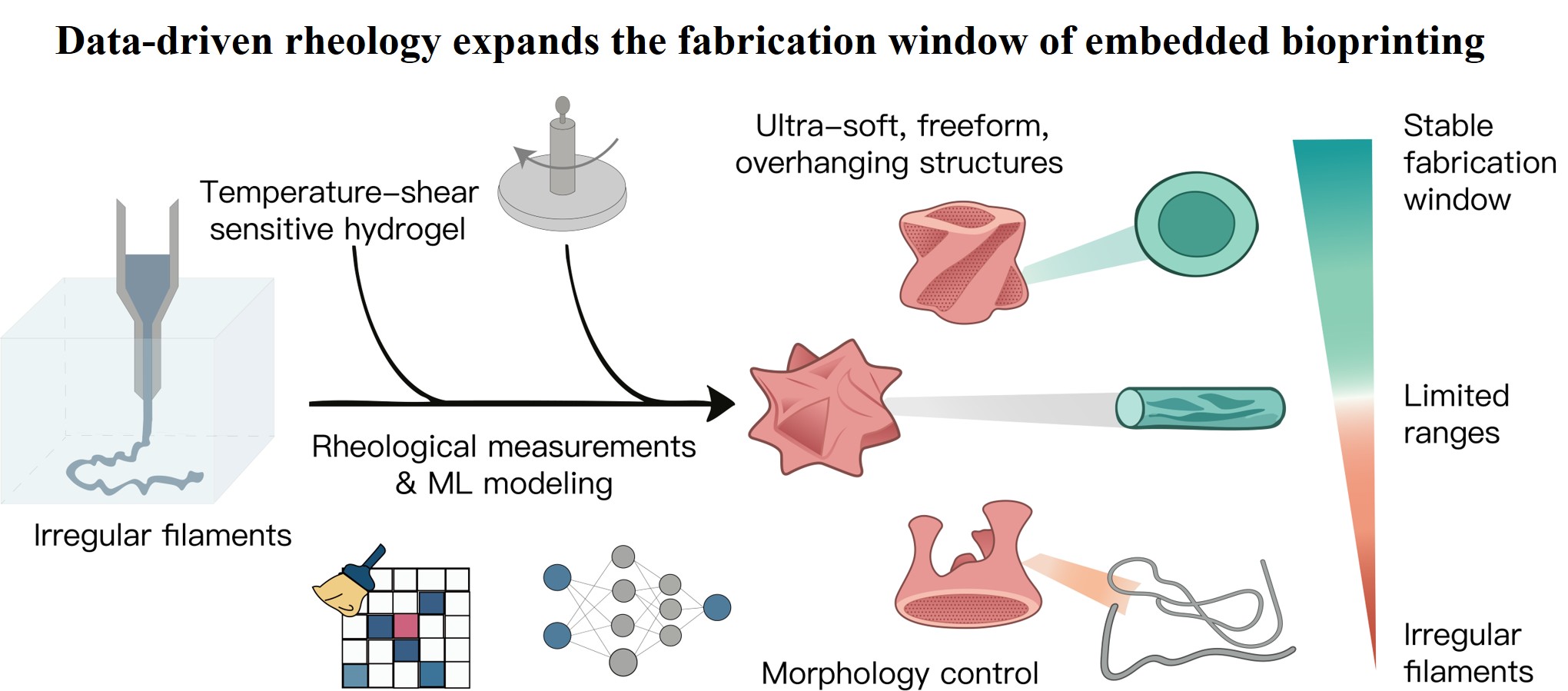
Precise control of filament formation remains a central barrier in extrusion-based bioprinting, where small deviations in material behavior can lead to large variations in structure and cellular outcome. Here, we present a data-driven rheology framework that enables predictive embedded bioprinting by directly linking material behavior to process outcome. A machine learning model was used to capture the coupled temperature-shear response of a thermosensitive gelatin methacryloyl bioink and the shear-dependent behavior of the supporting bath, and was integrated into process analysis. This approach improved predictions of both flow disturbances and filament geometry, with reduced errors in aspect ratio and filament width compared to conventional constitutive models. The improved predictability translated into controllable fabrication, enabling stable filament formation across a wide size range (160–800 μm) and the reliable construction of ultra-soft, freeform, and overhanging structures with preserved three-dimensional fidelity. This level of control also carried biological consequences, as well-defined filaments supported faster post-printing recovery, enhanced alignment, stronger myosin heavy chain expression, and transcriptional signatures consistent with a more favorable differentiation state. These results show that improving rheological description could move embedded bioprinting toward predictive manufacturing, where geometry and biological outcome can be coordinated through material-informed design.
- Li Q, Yu S, Wang Y, et al. Multiscale bioprinted arterial models recapitulate synergistic microenvironmental interactions in vascular disease. Cell Biomater. 2026;2(5):100257. doi: 10.1016/j.celbio.2025.100257
- Zeng Q, Yang Y, Wang H, et al. 3D printing of structural bionic and functionalized hydrogels for the construction of macroscale human cardiac tissues. Biomaterials. 2026;325:123573. doi: 10.1016/j.biomaterials.2025.123573
- Ding S, Ye X, Chen Y, et al. An electro-responsive functional neurovascularized engineered muscle. Cell Biomater. 2026;2(5):100305. doi: 10.1016/j.cellbio.2025.100305
- Li Q, Yu S, Wang Y, et al. Programmable embedded bioprinting for one-step manufacturing of arterial models with customized contractile and metabolic functions. Trends Biotechnol. 2025;43(4):918-945. doi: 10.1016/j.tibtech.2024.11.019
- Jia M, Fan T, Jia T, Liu X, Liu H, Gu Q. Temporal and spatial regulation of biomimetic vascularization in 3D-printed skeletal muscles. Bio-Des Manuf. 2024;7(5):597-610. doi: 10.1007/s42242-024-00315-0
- Freeman S, Ramos R, Alexis Chando P, et al. A bioink blend for rotary 3D bioprinting tissue engineered small-diameter vascular constructs. Acta Biomater. 2019;95:152-164. doi: 10.1016/j.actbio.2019.06.052
- Bosch-Rue E, Delgado LM, Gil FJ, Perez RA. Direct extrusion of individually encapsulated endothelial and smooth muscle cells mimicking blood vessel structures and vascular native cell alignment. Biofabrication. 2021;13(1):015003. doi: 10.1088/1758-5090/abbd27
- Shi L, Carstensen H, Hölzl K, et al. Dynamic Coordination Chemistry Enables Free Directional Printing of Biopolymer Hydrogel. Chem Mater. 2017;29(14):5816-5823. doi: 10.1021/acs.chemmater.7b00128
- Cooke ME, Rosenzweig DH. The rheology of direct and suspended extrusion bioprinting. APL Bioeng. 2021;5(1):011502. doi: 10.1063/5.0031475
- Li Q, Zhang B, Xue Q, et al. A Systematic Thermal Analysis for Accurately Predicting the Extrusion Printability of Alginate-Gelatin-Based Hydrogel Bioinks. Int J Bioprint. 2021;7(3):394. doi: 10.18063/ijb.v7i3.394
- Bhattacharjee T, Zehnder SM, Rowe KG, et al. Writing in the granular gel medium. Sci Adv. 2015;1(8):e1500655. doi: 10.1126/sciadv.1500655
- Chang H, Liu Q, Zimmerman JF, et al. Recreating the heart's helical structure-function relationship with focused rotary jet spinning. Science. 2022;377(6602):180-185. doi: 10.1126/science.abl6395
- Govindharaj M, Al Hashimi N, Soman SS, Zhou J, AlAwadhi S, Vijayavenkataraman S. 3D-bioprinted tri-layered cellulose/collagen-based drug-eluting fillers for the treatment of deep tunneling wounds. Bio-Des Manuf. 2024;7(6):938-954. doi: 10.1007/s42242-024-00305-2
- Sarah R, Schimmelpfennig K, Rohauer R, Lewis CL, Limon SM, Habib A. Characterization and Machine Learning-Driven Property Prediction of a Novel Hybrid Hydrogel Bioink Considering Extrusion-Based 3D Bioprinting. Gels. 2025;11(1):45. doi: 10.3390/gels11010045
- Hu X, Wang J, Yang S, et al. Evaluation of the 3D printable temperature-responsive shape-memory PLTG terpolymers for minimally invasive surgery. Bio-Des Manuf. 2025;8(5):709-723. doi: 10.1631/bdm.2400486
- Sun J, Gong Y, He Y, et al. Process optimization for coaxial extrusion-based bioprinting: A comprehensive analysis of material behavior, structural precision, and cell viability. Addit Manuf. 2025;100:104682. doi: 10.1016/j.addma.2025.104682
- Jin Y, Chai W, Huang Y. Printability study of hydrogel solution extrusion in nanoclay yield-stress bath during printing-then-gelation biofabrication. Mater Sci Eng C. 2017;80:313-325. doi: 10.1016/j.msec.2017.05.144
- Gold KA, Saha B, Rajeeva Pandian NK, et al. 3D Bioprinted Multicellular Vascular Models. Adv Healthc Mater. 2021;10(21):e2101141. doi: 10.1002/adhm.202101141
- He C, He J, Wu C, et al. 3D printing for tissue/organ regeneration in China. Bio-Des Manuf. 2025;8(2):169-242. doi: 10.1631/bdm.2400309
- Oh D, Shirzad M, Chang Kim M, Chung E-J, Nam SY. Rheology-informed hierarchical machine learning model for the prediction of printing resolution in extrusion-based bioprinting. Int J Bioprint. 2023;9(6):1280. doi: 10.36922/ijb.1280
- Li Q, Ma L, Gao Z, et al. Regulable Supporting Baths for Embedded Printing of Soft Biomaterials with Variable Stiffness. ACS Appl Mater Interfaces. 2022;14(37):41695-41711. doi: 10.1021/acsami.2c09221
- Thielicke W, Sonntag R. Particle Image Velocimetry for MATLAB: Accuracy and enhanced algorithms in PIVlab. J Open Res Softw. 2021;9(1):12. doi: 10.5334/jors.334
- Garcia-Cruz MR, Postma A, Frith JE, Meagher L. Printability and bio-functionality of a shear thinning methacrylated xanthan–gelatin composite bioink. Biofabrication. 2021;13(3):035023. doi: 10.1088/1758-5090/abec2d
- Grosskopf AK, Truby RL, Kim H, Perazzo A, Lewis JA, Stone HA. Viscoplastic Matrix Materials for Embedded 3D Printing. ACS Appl Mater Interfaces. 2018;10(27):23353-23361. doi: 10.1021/acsami.7b19818
- Ding S, Li S, Shen Z, et al. Biomimetically neurovascularized engineered muscle tissue for craniofacial volumetric muscle loss. Bio-Des Manuf. 2025;8(3):331-343. doi: 10.1631/bdm.2400005
- Valle-Tenney R, Rebolledo D, Acuna MJ, Brandan E. HIF-hypoxia signaling in skeletal muscle physiology and fibrosis. J Cell Commun Signal. 2020;14(2):147-158. doi: 10.1007/s12079-020-00553-8
- Fulco M, Cen Y, Zhao P, et al. Glucose restriction inhibits skeletal myoblast differentiation by activating SIRT1 through AMPK-mediated regulation of Nampt. Dev Cell. 2008;14(5):661-673. doi: 10.1016/j.devcel.2008.02.004
- Yang Y, Li L, Fei J, Li Z. C2C12 myoblasts differentiate into myofibroblasts via the TGF-β1 signaling pathway mediated by Fibulin2. Gene. 2025;936:149048. doi: 10.1016/j.gene.2024.149048
- Shi A, Hillege MMG, Wust RCI, Wu G, Jaspers RT. Synergistic short-term and long-term effects of TGF-β1 and 3 on collagen production in differentiating myoblasts. Biochem Biophys Res Commun. 2021;547:176-182. doi: 10.1016/j.bbrc.2021.02.007
- Shintaku J, Peterson JM, Talbert EE, et al. MyoD Regulates Skeletal Muscle Oxidative Metabolism Cooperatively with Alternative NF-κB. Cell Rep. 2016;17(2):514-526. doi: 10.1016/j.celrep.2016.09.010
- Judson RN, Tremblay AM, Knopp P, et al. The Hippo pathway member Yap plays a key role in influencing fate decisions in muscle satellite cells. J Cell Sci. 2012;125(24):6009-6019. doi: 10.1242/jcs.109546
- Takebe T, Sekine K, Enomura M, et al. Vascularized and functional human liver from an iPSC-derived organ bud transplant. Nature. 2013;499(7459):481-484. doi: 10.1038/nature12271
- Shin S, Kwak H, Shin D, Hyun J. Solid matrix-assisted printing for three-dimensional structuring of a viscoelastic medium surface. Nat Commun. 2019;10(1):4650. doi: 10.1038/s41467-019-12585-9
- Zhao J, Hussain M, Wang M, Li Z, He N. Embedded 3D printing of multi-internal surfaces of hydrogels. Addit Manuf. 2020;32:101097. doi: 10.1016/j.addma.2020.101097
- Wang Z, Wang X, Huang Y, et al. Cav3.3-mediated endochondral ossification in a three-dimensional bioprinted GelMA hydrogel. Bio-Des Manuf. 2024;7(6):983-999. doi: 10.1007/s42242-024-00287-1
- Hinton TJ, Jallerat Q, Palchesko RN, et al. Three-dimensional printing of complex biological structures by freeform reversible embedding of suspended hydrogels. Sci Adv. 2015;1(9):e1500758. doi: 10.1126/sciadv.1500758
- Lee A, Hudson A, Shiwarski D, et al. 3D bioprinting of collagen to rebuild components of the human heart. Science. 2019;365(6452):482-487. doi: 10.1126/science.aav9051