
Hydroxyapatite–alginate–gelatin bioinks for bioprinting: Printability, microarchitecture, and dental pulp stem cell viability and morphology

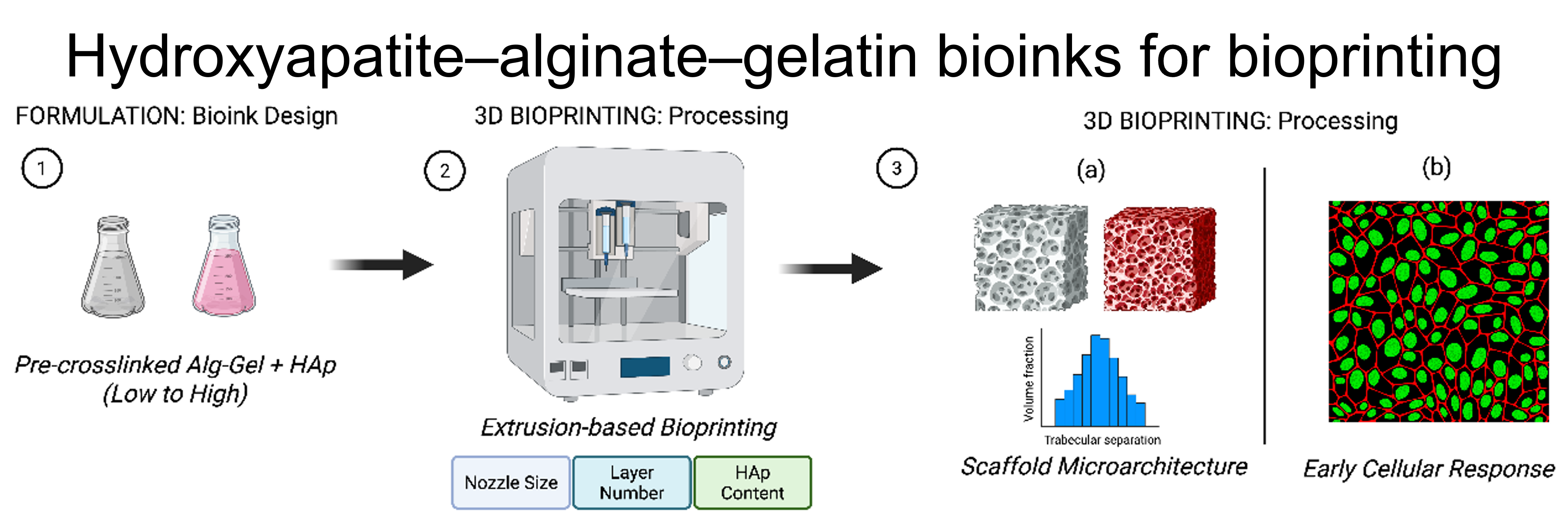
Three-dimensional (3D) bioprinting enables the fabrication of scaffolds with highly controlled architectures; however, the extent to which modest shifts in bioink composition simultaneously influence scaffold stabilization and the resulting early cellular microenvironment remains insufficiently understood. This study investigated the influence of hydroxyapatite (HAp) concentration within a low loading range (1–2% w/v) on the printability, crosslinking stability, and microarchitecture of pre-crosslinked alginate–gelatin composite bioinks, as well as on the immediate viability and morphological adaptation of encapsulated human dental pulp stem cells (hDPSCs). Bioinks were characterized via physicochemical analysis, while printing performance was evaluated under varied operational conditions. Structural properties were assessed through micro-computed tomography (micro-CT) and swelling kinetics, whereas early cellular responses were monitored via Live/Dead staining and fluorescence-based morphometric analysis. Printability parameters were primarily dictated by nozzle diameter and layer count, with the 22G nozzle yielding larger pore sizes (1,132 vs. 940 µm) and pore areas (0.749 vs. 0.515 mm2) than the 20G nozzle. Micro-CT confirmed highly interconnected structures with porosities of 74–78%, where the 2% HAp group promoted a highly homogeneous trabecular spacing centered between 700 and 850 µm. Incremental HAp content significantly suppressed matrix swelling kinetics in a concentration-dependent manner. Biologically, all formulations sustained high post-printing cell survival (>70%) that exceeded 90% after seven days. HAp-containing hydrogels promoted significantly higher cell viability and increased cell spreading areas. These findings underscore that small variations in HAp content influence scaffold stabilization kinetics and early stem cell behavior, while manufacturing parameters remain the primary determinants of initial geometry.
- Picado-Tejero D, Mendoza-Cerezo L, Rodríguez-Rego JM, Carrasco-Amador JP, Marcos-Romero AC. Recent Advances in 3D Bioprinting of Porous Scaffolds for Tissue Engineering: A Narrative and Critical Review. J Funct Biomater. 2025;16(9):328. doi: 10.3390/jfb16090328
- Kyle S, Jessop ZM, Al-Sabah A, Whitaker IS. 'Printability' of Candidate Biomaterials for Extrusion Based 3D Printing: State-of-the-Art. Adv Healthc Mater. 2017;6(16):1700264. doi: 10.1002/adhm.201700264
- Groll J, Burdick JA, Cho DW, et al. A definition of bioinks and their distinction from biomaterial inks. Biofabrication. 2018;11(1):013001. doi: 10.1088/1758-5090/aaec52
- Pahlevanzadeh F, Mokhtari H, Bakhsheshi-Rad HR, et al. Recent Trends in Three-Dimensional Bioinks Based on Alginate for Biomedical Applications. Materials. 2020;13(18):3980. doi: 10.3390/ma13183980
- Zhang J, Wehrle E, Vetsch JR, Paul GR, Rubert M, Müller R. Alginate dependent changes of physical properties in 3D bioprinted cell-laden porous scaffolds affect cell viability and cell morphology. Biomed Mater. 2019;14(6):065009. doi: 10.1088/1748-605X/ab3c74
- You P, Sun H, Chen H, et al. Composite bioink incorporating cell-laden liver decellularized extracellular matrix for bioprinting of scaffolds for bone tissue engineering. Biomater Adv. 2024;165:214017. doi: 10.1016/j.bioadv.2024.214017
- Aazmi A, Zhang D, Mazzaglia C, et al. Biofabrication methods for reconstructing extracellular matrix mimetics. Bioact Mater. 2024;31:475-496. doi: 10.1016/j.bioactmat.2023.08.018
- Gebeshuber IC, Khawas S, Sharma R, Sharma N. Bioprinted Scaffolds for Biomimetic Applications: A State-of-the-Art Technology. Biomimetics. 2025;10(9):595. doi: 10.3390/biomimetics10090595
- Gao T, Gillispie GJ, Copus JS, et al. Optimization of gelatin–alginate composite bioink printability using rheological parameters: a systematic approach. Biofabrication. 2018;10(3):034106. doi: 10.1088/1758-5090/aacdc7
- Varaprasad K, Karthikeyan C, Yallapu MM, Sadiku R. The significance of biomacromolecule alginate for the 3D printing of hydrogels for biomedical applications. Int J Biol Macromol. 2022;212:561-578. doi: 10.1016/j.ijbiomac.2022.05.157
- Fang W, Yang M, Wang L, et al. Hydrogels for 3D bioprinting in tissue engineering and regenerative medicine: Current progress and challenges. Int J Bioprint. 2023;9(5):759. doi: 10.18063/ijb.759
- Sahoo DR, Biswal T. Alginate and its application to tissue engineering. SN Appl Sci. 2021;3(1):30. doi: 10.1007/s42452-020-04096-w
- Zhang Y, Shu T, Wang S, et al. The Osteoinductivity of Calcium Phosphate-Based Biomaterials: A Tight Interaction With Bone Healing. Front Bioeng Biotechnol. 2022;10:911180. doi: 10.3389/fbioe.2022.911180
- Tolmacheva N, Bhattacharyya A, Noh I. Calcium Phosphate Biomaterials for 3D Bioprinting in Bone Tissue Engineering. Biomimetics. 2024;9(2):95. doi: 10.3390/biomimetics9020095
- Wang Z, Liang W, Wang G, et al. Construction Form and Application of Three-Dimensional Bioprinting Ink Containing Hydroxyapatite. Tissue Eng Part B Rev. 2024;30(5):507-521. doi: 10.1089/ten.teb.2023.0280
- Anaya-Sampayo LM, Roa NS, Martínez-Cardozo C, García-Robayo DA, Rodríguez-Lorenzo LM. Influence of Hydroxyapatite and Gelatin Content on Crosslinking Dynamics and HDFn Cell Viability in Alginate Bioinks for 3D Bioprinting. Polymers. 2024;16(22):3224. doi: 10.3390/polym16223224
- Hassan MN, Eltawila AM, Mohamed-Ahmed S, et al. Correlation between Ca Release and Osteoconduction by 3D-Printed Hydroxyapatite-Based Templates. ACS Appl Mater Interfaces. 2024;16(22):28056-28069. doi: 10.1021/acsami.4c01472
- Bendtsen ST, Quinnell SP, Wei M. Development of a novel alginate-polyvinyl alcohol-hydroxyapatite hydrogel for 3D bioprinting bone tissue engineered scaffolds. J Biomed Mater Res A. 2017;105(5):1457-1468. doi: 10.1002/jbm.a.36036
- Zamorano M, Aguilar-Gallardo C, Lugo A, Jimenez L, Farias JG, Mantalaris A. Engineering an Integrated Bioprocess to Produce Human Dental Pulp Stem Cell-Alginate-Based Bone Organoids. Int J Mol Sci. 2025;26(9):4348. doi: 10.3390/ijms26094348
- Hamad-Alrashid H, Muntión S, Sánchez-Guijo F, et al. Bone Regeneration with Dental Pulp Stem Cells in an Experimental Model. J Pers Med. 2024;14(11):1075. doi: 10.3390/jpm14111075
- Liu Y, Xiong W, Li J, et al. Application of dental pulp stem cells for bone regeneration. Front Med (Lausanne). 2024;11:1339573. doi: 10.3389/fmed.2024.1339573
- Budharaju H, Sundaramurthi D, Sethuraman S. Efficient dual crosslinking of protein–in–polysaccharide bioink for biofabrication of cardiac tissue constructs. Biomater Adv. 2023;152:213486. doi: 10.1016/j.bioadv.2023.213486
- Kara A, Distler T, Polley C, et al. 3D printed gelatin/decellularized bone composite scaffolds for bone tissue engineering: Fabrication, characterization and cytocompatibility study. Mater Today Bio. 2022;15:100309. doi: 10.1016/j.mtbio.2022.100309
- Compaired PM, García-Gareta E, Pérez MÁ. An experimental workflow for bioprinting optimization: Application to a custom-made biomaterial ink. Int J Bioprint. 2025;0(0):025120094. doi: 10.36922/IJB025120094
- Kolan KCR, Saxena A, Bromet BA, et al. Bioprinting with adipose stem cells and hydrogel modified with bioactive glass. Int J Bioprint. 2024;10(2):2057. doi: 10.36922/ijb.2057
- Jahani Kadousaraei M, Yamada S, Aydin MS, et al. Bioprinting of mesenchymal stem cells in low concentration gelatin methacryloyl/alginate blends without ionic crosslinking of alginate. Sci Rep. 2025;15(1):6609. doi: 10.1038/s41598-025-90389-2
- Gonzalez-Fernandez T, Tenorio AJ, Campbell KT, Silva EA, Leach JK. Alginate-Based Bioinks for 3D Bioprinting and Fabrication of Anatomically Accurate Bone Grafts. Tissue Eng Part A. 2021;27(17-18):1168-1181. doi: 10.1089/ten.tea.2020.0305
- Tharakan S, Khondkar S, Lee S, et al. 3D Printed Osteoblast–Alginate/Collagen Hydrogels Promote Survival, Proliferation and Mineralization at Low Doses of Strontium Calcium Polyphosphate. Pharmaceutics. 2022;15(1):11. doi: 10.3390/pharmaceutics15010011
- Fox J, Weisberg S. An R Companion to Applied Regression. 3rd ed. Thousand Oaks, CA: SAGE Publications; 2019. https://socialsciences.mcmaster.ca/jfox/Books/Companion/
- Lakens D. Calculating and reporting effect sizes to facilitate cumulative science: a practical primer for t-tests and ANOVAs. Front Psychol. 2013;4. doi: 10.3389/fpsyg.2013.00863
- Field A. Discovering Statistics Using IBM SPSS Statistics. 4th ed. Thousand Oaks, CA: SAGE Publications; 2013.
- Wickham H, François R, Henry L, Müller K, Vaughan D. dplyr: A grammar of data manipulation. Published online 2023. https://CRAN.R-project.org/package=dplyr
- Wickham H. ggplot2: Elegant Graphics for Data Analysis. New York, NY: Springer-Verlag New York; 2016. https://ggplot2.tidyverse.org
- Kassambara A. ggpubr: "ggplot2" based publication ready plots. Published online 2023. https://CRAN.R-project.org/package=ggpubr
- Boularaoui S, Al Hussein G, Khan KA, Christoforou N, Stefanini C. An overview of extrusion-based bioprinting with a focus on induced shear stress and its effect on cell viability. Bioprinting. 2020;20:e00093. doi: 10.1016/j.bprint.2020.e00093
- Freeman S, Calabro S, Williams R, Jin S, Ye K. Bioink Formulation and Machine Learning-Empowered Bioprinting Optimization. Front Bioeng Biotechnol. 2022;10:913579. doi: 10.3389/fbioe.2022.913579
- Pottathara YB, Kokol V. Effect of nozzle diameter and cross-linking on the micro-structure, compressive and biodegradation properties of 3D printed gelatin/collagen/hydroxyapatite hydrogel. Bioprinting. 2023;31:e00266. doi: 10.1016/j.bprint.2023.e00266
- Jodati H, Yılmaz B, Evis Z. A review of bioceramic porous scaffolds for hard tissue applications: Effects of structural features. Ceram Int. 2020;46(10):15725-15739. doi: 10.1016/j.ceramint.2020.03.192
- Jiao J, Hong Q, Zhang D, et al. Influence of porosity on osteogenesis, bone growth and osteointegration in trabecular tantalum scaffolds fabricated by additive manufacturing. Front Bioeng Biotechnol. 2023;11:1117954. doi: 10.3389/fbioe.2023.1117954
- Ghayor C, Weber FE. Osteoconductive Microarchitecture of Bone Substitutes for Bone Regeneration Revisited. Front Physiol. 2018;9:960. doi: 10.3389/fphys.2018.00960
- Gronthos S, Brahim J, Li W, et al. Stem Cell Properties of Human Dental Pulp Stem Cells. J Dent Res. 2002;81(8):531-535. doi: 10.1177/154405910208100806
- Yu J, He H, Tang C, et al. Differentiation potential of STRO-1+ dental pulp stem cells changes during cell passaging. BMC Cell Biol. 2010;11(1):32. doi: 10.1186/1471-2121-11-32
- Awais S, Balouch SS, Riaz N, Choudhery MS. Human Dental Pulp Stem Cells Exhibit Osteogenic Differentiation Potential. Open Life Sci. 2020;15(1):229-236. doi: 10.1515/biol-2020-0023