
Intelligent process control and stimulus-responsive 4D transformation in extrusion-based 3D food printing: A critical review

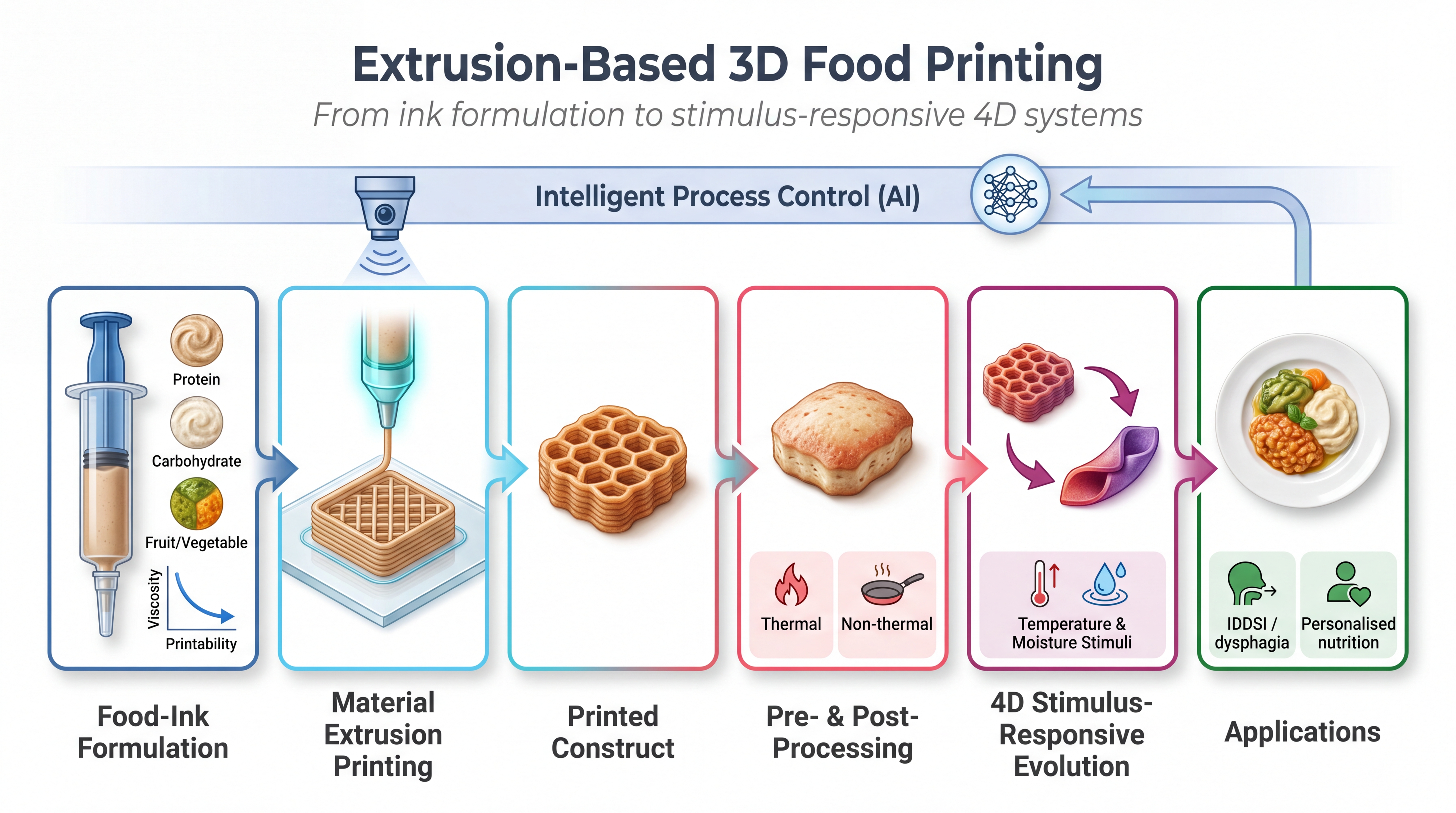
Three-dimensional food printing (3DFP) presents unparalleled opportunities for personalised nutrition, clinical dysphagia management, decentralised on-demand production, and space-mission food provision. However, industrial translation remains constrained by inconsistent rheological characterisation, limited cross-material generalisation of process-control models, and the absence of integrated quality-control frameworks for post-processed and stimulus-responsive constructs. Although extrusion-based 3DFP offers the broadest substrate compatibility among additive manufacturing routes, prior reviews have treated ink formulation, process control, post-processing, and four-dimensional (4D) transformation as separate domains. In this work, extrusion-based 3DFP is reviewed in an integrated manner. Rheological foundations and substrate-specific ink design are examined across hydrocolloid, protein, starch, fruit/vegetable, dairy, meat, and bioactive-loaded systems. Intelligent process control is then discussed through three integrated axes: computational fluid dynamics modelling, data-driven low-field nuclear magnetic resonance with machine-learning prediction, and real-time computer-vision feedback. Pre- and post-processing engineering is examined alongside an integrated quality-control framework, and recent stimulus-responsive 4D studies are organised by trigger and response. Synergistic integration of these domains demonstrates clinical and personalised-nutrition potential beyond that of any single-domain approach. This article systematically reviews the ink design, intelligent process control, post-processing engineering, and stimulus-responsive 4D transformation of extrusion-based 3DFP, aiming to provide valuable insights for the development of intelligent food-printing systems.
- Thorakkattu P, Awasti N, Sajith Babu K, et al. 3D printing: trends and approaches toward achieving long-term sustainability in the food industry. Crit Rev Biotechnol. 2025;45:48-68. doi: 10.1080/07388551.2024.2344577
- International Organization for Standardization; ASTM International. ISO/ASTM 52900:2021(en), Additive manufacturing—General principles—Fundamentals and vocabulary. Published 2021. Accessed June 8, 2026. https://www.iso.org/obp/ui/#iso:std:iso-astm:52900:ed-2:v1:en
- Lille M, Nurmela A, Nordlund E, Metsä-Kortelainen S, Sozer N. Applicability of protein and fiber-rich food materials in extrusion-based 3D printing. J Food Eng. 2018;220:20-27. doi: 10.1016/j.jfoodeng.2017.04.034
- Pallottino F, Hakola L, Costa C, et al. Printing on Food or Food Printing: a Review. Food Bioprocess Technol. 2016;9:725-733. doi: 10.1007/s11947-016-1692-3
- Vadodaria S, Mills T. Jetting-based 3D printing of edible materials. Food Hydrocolloids. 2020;106:105857. doi: 10.1016/j.foodhyd.2020.105857
- Sun J, Zhou W, Huang D, Fuh JYH, Hong GS. An Overview of 3D Printing Technologies for Food Fabrication. Food Bioprocess Technol. 2015;8:1605-1615. doi: 10.1007/s11947-015-1528-6
- Sun J, Zhou W, Yan L, Huang D, Lin L. Extrusion-based food printing for digitalized food design and nutrition control. J Food Eng. 2018;220:1-11. doi: 10.1016/j.jfoodeng.2017.02.028
- Godoi FC, Prakash S, Bhandari BR. 3d printing technologies applied for food design: Status and prospects. J Food Eng. 2016;179:44-54. doi: 10.1016/j.jfoodeng.2016.01.025
- Shen D, Zhang M, Mujumdar AS, Li J. Advances and application of efficient physical fields in extrusion based 3D food printing technology. Trends Food Sci Technol. 2023;131:104-117. doi: 10.1016/j.tifs.2022.11.017
- Caulier S, Doets E, Noort M. An exploratory consumer study of 3D printed food perception in a real-life military setting. Food Qual Prefer. 2020;86:104001. doi: 10.1016/j.foodqual.2020.104001
- Tang T, Zhang M, Bhandari B, Li C. Personalized transformation of 3D printing for traditional multi-material food with stuffing: A review. Food Bioscience. 2024;59:104112. doi: 10.1016/j.fbio.2024.104112
- Teng X, Li C, Mujumdar AS, Zhang M. Progress in Extrusion-Based Food Printing Technology for Enhanced Printability and Printing Efficiency of Typical Personalized Foods: A Review. Foods. 2022;11:4111. doi: 10.3390/foods11244111
- Zhang JY, Pandya JK, McClements DJ, Lu J, Kinchla AJ. Advancements in 3D food printing: a comprehensive overview of properties and opportunities. Crit Rev Food Sci Nutr. 2022;62:4752-4768. doi: 10.1080/10408398.2021.1878103
- Wang M, Li D, Zang Z, et al. 3D food printing: Applications of plant-based materials in extrusion-based food printing. Crit Rev Food Sci Nutr. 2022;62:7184-7198. doi: 10.1080/10408398.2021.1911929
- Lee SH, Kim HW, Park HJ. Integrated design of micro-fibrous food with multi-materials fabricated by uniaxial 3D printing. Food Res Int. 2023;165:112529. doi: 10.1016/j.foodres.2023.112529
- Phuhongsung P, Zhang M, Bhandari B. 4D printing of products based on soy protein isolate via microwave heating for flavor development. Food Res Int. 2020;137:109605. doi: 10.1016/j.foodres.2020.109605
- Raja V, Nimbkar S, Moses JA, Ramachandran Nair SV, Anandharamakrishnan C. Modeling and Simulation of 3D Food Printing Systems—Scope, Advances, and Challenges. Foods. 2023;12:3412. doi: 10.3390/foods12183412
- Chen F, Zhang M, Liu Z, Bhandari B. 4D deformation based on double-layer structure of the pumpkin/paper. Food Structure. 2021;27:100168. doi: 10.1016/j.foostr.2020.100168
- Jeon S, Park SJ, Moon SK, Yang D. End-to-end processing of recycled carbon fiber composites: From waste hydrogen tanks to mechanically enhanced additive-manufactured components. Chem Eng J. 2025;525:169661. doi: 10.1016/j.cej.2025.169661
- Jeon S, Kim J, Go A, Choi JP, Yang D, Moon SK. AI-Based Mechanical Properties Prediction of Sintering-Aging Combined Effect in Metal-Material Extrusion. Int J Precis Eng Manuf-Green Tech. Published online March 30, 2026. doi: 10.1007/s40684-025-00826-w
- Jeon S, Park SJ, Moon SK, Yang D. Enhanced mechanical properties and reduced anisotropy of material extrusion-manufactured short carbon fibre-reinforced plastic via cold isostatic pressing. Virtual Phys Prototyp. 2025;20:e2499934. doi: 10.1080/17452759.2025.2499934
- Hao L, Mellor S, Seaman O, Henderson J, Sewell N, Sloan M. Material characterisation and process development for chocolate additive layer manufacturing. Virtual Phys Prototyp. 2010;5:57-64. doi: 10.1080/17452751003753212
- Lanaro M, Forrestal DP, Scheurer S, et al. 3D printing complex chocolate objects: Platform design, optimization and evaluation. J Food Eng. 2017;215:13-22. doi: 10.1016/j.jfoodeng.2017.06.029
- Mantihal S, Prakash S, Godoi FC, Bhandari B. Optimization of chocolate 3D printing by correlating thermal and flow properties with 3D structure modeling. Innov Food Sci Emerg Technol. 2017;44:21-29. doi: 10.1016/j.ifset.2017.09.012
- Mantihal S, Prakash S, Godoi FC, Bhandari B. Effect of additives on thermal, rheological and tribological properties of 3D printed dark chocolate. Food Res Int. 2019;119:161-169. doi: 10.1016/j.foodres.2019.01.056
- Karyappa R, Hashimoto M. Chocolate-based Ink Three-dimensional Printing (Ci3DP). Sci Rep. 2019;9:14178. doi: 10.1038/s41598-019-50583-5
- Liu Z, Zhang M, Bhandari B, Yang C. Impact of rheological properties of mashed potatoes on 3D printing. J Food Eng. 2018;220:76-82. doi: 10.1016/j.jfoodeng.2017.04.017
- Zhu S, Stieger MA, Van Der Goot AJ, Schutyser MAI. Extrusion-based 3D printing of food pastes: Correlating rheological properties with printing behaviour. Innov Food Sci Emerg Technol. 2019;58:102214. doi: 10.1016/j.ifset.2019.102214
- Guo Z, Arslan M, Li Z, et al. Application of Protein in Extrusion-Based 3D Food Printing: Current Status and Prospectus. Foods. 2022;11:1902. doi: 10.3390/foods11131902
- Hussain S, Malakar S, Arora VK. Extrusion-Based 3D Food Printing: Technological Approaches, Material Characteristics, Printing Stability, and Post-processing. Food Eng Rev. 2022;14:100-119. doi: 10.1007/s12393-021-09293-w
- Kadival A, Kour M, Meena D, Mitra J. Extrusion-Based 3D Food Printing: Printability Assessment and Improvement Techniques. Food Bioprocess Technol. 2023;16:987-1008. doi: 10.1007/s11947-022-02931-z
- Lazou AE. Food extrusion: An advanced process for innovation and novel product development. Crit Rev Food Sci Nutr. 2024;64:4532-4560. doi: 10.1080/10408398.2022.2143474
- Voon SL, An J, Wong G, Zhang Y, Chua CK. 3D food printing: a categorised review of inks and their development. Virtual Phys Prototyp. 2019;14:203-218. doi: 10.1080/17452759.2019.1603508
- Tejada-Ortigoza V, Cuan-Urquizo E. Towards the Development of 3D-Printed Food: A Rheological and Mechanical Approach. Foods. 2022;11:1191. doi: 10.3390/foods11091191
- Outrequin TCR, Gamonpilas C, Siriwatwechakul W, Sreearunothai P. Extrusion-based 3D printing of food biopolymers: A highlight on the important rheological parameters to reach printability. J Food Eng. 2023;342:111371. doi: 10.1016/j.jfoodeng.2022.111371
- Raut S, Pawase PA, Khalid S, et al. Recent advances in 3D food printing: A critical review of emerging technologies, material innovations, and novel applications. Appl Food Res. 2026;6:101773. doi: 10.1016/j.afres.2026.101773
- Chauhan P, Kaushal M, Vaidya D, Gupta A, Kashyap S, Suthar P. Personalized nutrition to intelligent foods with 3D and 4D printing. Appl Food Res. 2025;5:100863. doi: 10.1016/j.afres.2025.100863
- Seol J, Kim J, Hong Y, et al. Toward intelligent 3D food printing: a review on the perspective of materials, fabrication, monitoring, and control. Crit Rev Food Sci Nutr. 2026;66:1012-1043. doi: 10.1080/10408398.2025.2538546
- Thangalakshmi S, Arora VK, Prithviraj V. Printability Assessment and Optimization of Process Parameters for 3D Printing of Rice Flour and Jaggery Paste. J Biosyst Eng. 2022;47:248-262. doi: 10.1007/s42853-022-00143-z
- Thangalakshmi S, Arora VK, Kaur BP, Malakar S. Investigation on rice flour and jaggery paste as food material for extrusion-based 3D printing. J Food Process Preserv. 2021;45(4):e15375. doi: 10.1111/jfpp.15375
- Wang L, Zhang M, Bhandari B, Yang C. Investigation on fish surimi gel as promising food material for 3D printing. J Food Eng. 2018;220:101-108. doi: 10.1016/j.jfoodeng.2017.02.029
- Derossi A, Paolillo M, Caporizzi R, Severini C. Extending the 3D food printing tests at high speed. Material deposition and effect of non-printing movements on the final quality of printed structures. J Food Eng. 2020;275:109865. doi: 10.1016/j.jfoodeng.2019.109865
- In J, Jeong H, Song S, Min SC. Determination of Material Requirements for 3D Gel Food Printing Using a Fused Deposition Modeling 3D Printer. Foods. 2021;10:2272. doi: 10.3390/foods10102272
- Dick A, Bhandari B, Dong X, Prakash S. Feasibility study of hydrocolloid incorporated 3D printed pork as dysphagia food. Food Hydrocolloids. 2020;107:105940. doi: 10.1016/j.foodhyd.2020.105940
- Liu Y, Sun Q, Wei S, et al. LF-NMR as a tool for predicting the 3D printability of surimi-starch systems. Food Chem. 2022;374:131727. doi: 10.1016/j.foodchem.2021.131727
- Oyinloye TM, Yoon WB. Stability of 3D printing using a mixture of pea protein and alginate: Precision and application of additive layer manufacturing simulation approach for stress distribution. J Food Eng. 2021;288:110127. doi: 10.1016/j.jfoodeng.2020.110127
- Venkatachalam A, Balasubramaniam A, Wilms PFC, Zhang L, Schutyser MAI. Impact of varying macronutrient composition on the printability of pea-based inks in extrusion-based 3D food printing. Food Hydrocolloids. 2023;142:108760. doi: 10.1016/j.foodhyd.2023.108760
- Dong X, Pan Y, Zhao W, et al. Impact of microbial transglutaminase on 3D printing quality of Scomberomorus niphonius surimi. LWT. 2020;124:109123. doi: 10.1016/j.lwt.2020.109123
- Chen H, Zhang M, Rao Z. Effect of ultrasound-assisted thawing on gelling and 3D printing properties of silver carp surimi. Food Res Int. 2021;145:110405. doi: 10.1016/j.foodres.2021.110405
- Liu Z, Dick A, Prakash S, Bhandari B, Zhang M. Texture Modification of 3D Printed Air-Fried Potato Snack by Varying Its Internal Structure with the Potential to Reduce Oil Content. Food Bioprocess Technol. 2020;13:564-576. doi: 10.1007/s11947-020-02408-x
- Teng X, Zhang M, Mujumdar AS. Strategies for controlling over-puffing of 3D-printed potato gel during microwave processing. LWT. 2022;153:112508. doi: 10.1016/j.lwt.2021.112508
- Liu Z, Bhandari B, Prakash S, Mantihal S, Zhang M. Linking rheology and printability of a multicomponent gel system of carrageenan-xanthan-starch in extrusion based additive manufacturing. Food Hydrocolloids. 2019;87:413-424. doi: 10.1016/j.foodhyd.2018.08.026
- Guo C, Zhang M, Devahastin S. 3D extrusion-based printability evaluation of selected cereal grains by computational fluid dynamic simulation. J Food Eng. 2020;286:110113. doi: 10.1016/j.jfoodeng.2020.110113
- Kadival A, Mitra J, Machavaram R, Kaushal M. 3D printing of rice starch incorporated peanut protein isolate paste: Rheological characterization and simulation of flow properties. Innov Food Sci Emerg Technol. 2024;94:103669. doi: 10.1016/j.ifset.2024.103669
- Liu Q, Zhang N, Wei W, et al. Assessing the dynamic extrusion-based 3D printing process for power-law fluid using numerical simulation. J Food Eng. 2020;275:109861. doi: 10.1016/j.jfoodeng.2019.109861
- Liu Z, Zhang M, Ye Y. Indirect prediction of 3D printability of mashed potatoes based on LF-NMR measurements. J Food Eng. 2020;287:110137. doi: 10.1016/j.jfoodeng.2020.110137
- Chen H, Zhang M, Yang C. Comparative analysis of 3D printability and rheological properties of surimi gels via LF-NMR and dielectric characteristics. J Food Eng. 2021;292:110278. doi: 10.1016/j.jfoodeng.2020.110278
- Guo C, Zhang M, Chen H. Suitability of low-field nuclear magnetic resonance (LF-NMR) combining with back propagation artificial neural network (BP-ANN) to predict printability of polysaccharide hydrogels 3D printing. Int J Food Sci Tech. 2021;56:2264-2272. doi: 10.1111/ijfs.14844
- Jiao X, Ren G, Law CL, et al. Novel strategy for optimizing of corn starch-based ink food 3D printing process: Printability prediction based on BP-ANN model. Int J Biol Macromol. 2024;276:133921. doi: 10.1016/j.ijbiomac.2024.133921
- Outrequin TCR, Gamonpilas C, Sreearunothai P, Deepaisarn S, Siriwatwechakul W. Machine learning assisted evaluation of the filament spreading during extrusion-based 3D food printing: Impact of the rheological and printing parameters. J Food Eng. 2024;381:112166. doi: 10.1016/j.jfoodeng.2024.112166
- Pan Y, Sun Q, Liu Y, et al. The relationship between rheological and textural properties of shrimp surimi adding starch and 3D printability based on principal component analysis. Food Sci Nutr. 2021;9:2985-2999. doi: 10.1002/fsn3.2257
- Kim SM, Wen Y, Kim HW, Park HJ. Textural and sensory qualities of low-calorie surimi with carrageenan inserted as a protein substitute using coaxial extrusion 3D food printing. J Food Eng. 2022;333:111141. doi: 10.1016/j.jfoodeng.2022.111141
- Xie Y, Yu X, Wang Y, et al. Role of dietary fiber and flaxseed oil in altering the physicochemical properties and 3D printability of cod protein composite gel. J Food Eng. 2022;327:111053. doi: 10.1016/j.jfoodeng.2022.111053
- Kim SM, Kim HW, Park HJ. Preparation and characterization of surimi-based imitation crab meat using coaxial extrusion three-dimensional food printing. Innov Food Sci Emerg Technol. 2021;71:102711. doi: 10.1016/j.ifset.2021.102711
- Dick A, Bhandari B, Prakash S. Printability and textural assessment of modified-texture cooked beef pastes for dysphagia patients. Future Foods. 2021;3:100006. doi: 10.1016/j.fufo.2020.100006
- Wilson A, Anukiruthika T, Moses JA, Anandharamakrishnan C. Customized Shapes for Chicken Meat-Based Products: Feasibility Study on 3D-Printed Nuggets. Food Bioprocess Technol. 2020;13:1968-1983. doi: 10.1007/s11947-020-02537-3
- Park JW, Lee SH, Kim HW, Park HJ. Application of extrusion-based 3D food printing to regulate marbling patterns of restructured beef steak. Meat Sci. 2023;202:109203. doi: 10.1016/j.meatsci.2023.109203
- Hussain S, Arora VK, Malakar S. Formulation of protein-enriched 3D printable food matrix and evaluation of textural, rheological characteristics, and printing stability. J Food Process Preserv. 2021;45:e15182. doi: 10.1111/jfpp.15182
- Ma Y, Schutyser MAI, Boom RM, Zhang L. Thermographic and rheological characterization of viscoelastic materials for hot-extrusion 3D food printing. Innov Food Sci Emerg Technol. 2022;81:103135. doi: 10.1016/j.ifset.2022.103135
- Xu L, Gu L, Su Y, et al. Impact of thermal treatment on the rheological, microstructural, protein structures and extrusion 3D printing characteristics of egg yolk. Food Hydrocolloids. 2020;100:105399. doi: 10.1016/j.foodhyd.2019.105399
- Bareen MA, Joshi S, Sahu JK, Prakash S, Bhandari B. Assessment of 3D printability of heat acid coagulated milk semi-solids 'soft cheese' by correlating rheological, microstructural, and textural properties. J Food Eng. 2021;300:110506. doi: 10.1016/j.jfoodeng.2021.110506
- Joshi S, Sahu JK, Bareen MA, et al. Assessment of 3D printability of composite dairy matrix by correlating with its rheological properties. Food Res Int. 2021;141:110111. doi: 10.1016/j.foodres.2021.110111
- Anukiruthika T, Moses JA, Anandharamakrishnan C. 3D printing of egg yolk and white with rice flour blends. J Food Eng. 2020;265:109691. doi: 10.1016/j.jfoodeng.2019.109691
- Phuhongsung P, Zhang M, Devahastin S. Investigation on 3D printing ability of soybean protein isolate gels and correlations with their rheological and textural properties via LF-NMR spectroscopic characteristics. LWT. 2020;122:109019. doi: 10.1016/j.lwt.2020.109019
- Phuhongsung P, Zhang M, Devahastin S. Influence of Surface pH on Color, Texture and Flavor of 3D Printed Composite Mixture of Soy Protein Isolate, Pumpkin, and Beetroot. Food Bioprocess Technol. 2020;13:1600-1610. doi: 10.1007/s11947-020-02497-8
- Chen J, Sun H, Mu T, et al. Effect of temperature on rheological, structural, and textural properties of soy protein isolate pastes for 3D food printing. J Food Eng. 2022;323:110917. doi: 10.1016/j.jfoodeng.2021.110917
- Fan H, Zhang M, Liu Z, Ye Y. Effect of microwave-salt synergetic pre-treatment on the 3D printing performance of SPI-strawberry ink system. LWT. 2020;122:109004. doi: 10.1016/j.lwt.2019.109004
- Yu J, Wang X, Li D, Wang L, Wang Y. Development of soy protein isolate emulsion gels as extrusion-based 3D food printing inks: Effect of polysaccharides incorporation. Food Hydrocolloids. 2022;131:107824. doi: 10.1016/j.foodhyd.2022.107824
- Wang S, Liu S. 3D Printing of Soy Protein- and Gluten-Based Gels Facilitated by Thermosensitive Cocoa Butter in a Model Study. ACS Food Sci Technol. 2021;1:1990-1996. doi: 10.1021/acsfoodscitech.1c00311
- Feng T, Fan C, Wang X, Wang X, Xia S, Huang Q. Food-grade Pickering emulsions and high internal phase Pickering emulsions encapsulating cinnamaldehyde based on pea protein-pectin-EGCG complexes for extrusion 3D printing. Food Hydrocolloids. 2022;124:107265. doi: 10.1016/j.foodhyd.2021.107265
- Kim Y, Kim HW, Park HJ. Effect of pea protein isolate incorporation on 3D printing performance and tailing effect of banana paste. LWT. 2021;150:111916. doi: 10.1016/j.lwt.2021.111916
- Sun Y, Zhang M, Chen H. LF-NMR intelligent evaluation of rheology and printability for 3D printing of cookie dough pretreated by microwave. LWT. 2020;132:109752. doi: 10.1016/j.lwt.2020.109752
- Habuš M, Golubić P, Vukušić Pavičić T, et al. Influence of Flour Type, Dough Acidity, Printing Temperature and Bran Pre-processing on Browning and 3D Printing Performance of Snacks. Food Bioprocess Technol. 2021;14:2365-2379. doi: 10.1007/s11947-021-02732-w
- Liu Y, Tang T, Duan S, et al. Effects of sodium alginate and rice variety on the physicochemical characteristics and 3D printing feasibility of rice paste. LWT. 2020;127:109360. doi: 10.1016/j.lwt.2020.109360
- Liu Y, Tang T, Duan S, Qin Z, Zhao H, Wang M, et al. Applicability of Rice Doughs as Promising Food Materials in Extrusion-Based 3D Printing. Food Bioprocess Technol. 2020;13:548-563. doi: 10.1007/s11947-020-02415-y
- Fahmy AR, Becker T, Jekle M. 3D printing and additive manufacturing of cereal-based materials: Quality analysis of starch-based systems using a camera-based morphological approach. Innov Food Sci Emerg Technol. 2020;63:102384. doi: 10.1016/j.ifset.2020.102384
- Huang M, Zhang M, Guo C. 3D printability of brown rice gel modified by some food hydrocolloids. J Food Process Preserv. 2020;44:e14502. doi: 10.1111/jfpp.14502
- Guo C, Zhang M, Devahastin S. Improvement of 3D printability of buckwheat starch-pectin system via synergistic Ca2+-microwave pretreatment. Food Hydrocolloids. 2021;113:106483. doi: 10.1016/j.foodhyd.2020.106483
- Xu K, Zhang M, Bhandari B. Effect of Novel Ultrasonic-Microwave Combined Pretreatment on the Quality of 3D Printed Wheat Starch-Papaya System. Food Biophysics. 2020;15:249-260. doi: 10.1007/s11483-019-09615-w
- Liu Z, Chen H, Zheng B, Xie F, Chen L. Understanding the structure and rheological properties of potato starch induced by hot-extrusion 3D printing. Food Hydrocolloids. 2020;105:105812. doi: 10.1016/j.foodhyd.2020.105812
- Maniglia BC, Pataro G, Ferrari G, Augusto PED, Le-Bail P, Le-Bail A. Pulsed electric fields (PEF) treatment to enhance starch 3D printing application: Effect on structure, properties, and functionality of wheat and cassava starches. Innov Food Sci Emerg Technol. 2021;68:102602. doi: 10.1016/j.ifset.2021.102602
- Maniglia BC, Lima DC, Matta Junior MD, Le-Bail P, Le-Bail A, Augusto PED. Preparation of cassava starch hydrogels for application in 3D printing using dry heating treatment (DHT): A prospective study on the effects of DHT and gelatinization conditions. Food Res Int. 2020;128:108803. doi: 10.1016/j.foodres.2019.108803
- Ma S, Liu J, Zhang Q, et al. 3D printing performance using radio frequency electromagnetic wave modified potato starch. Innov Food Sci Emerg Technol. 2022;80:103064. doi: 10.1016/j.ifset.2022.103064
- Feng C, Zhang M, Bhandari B, Ye Y. Use of potato processing by-product: Effects on the 3D printing characteristics of the yam and the texture of air-fried yam snacks. LWT. 2020;125:109265. doi: 10.1016/j.lwt.2020.109265
- Feng C, Zhang M, Liu Z, Mujumdar A, Wang Y, Chang L. Effect of drying method on post-processing stability and quality of 3D printed rose-yam paste. Drying Technol. 2021;39:1196-1204. doi: 10.1080/07373937.2020.1851708
- Shi Y, Zhang M, Bhandari B. Effect of addition of beeswax based oleogel on 3D printing of potato starch-protein system. Food Structure. 2021;27:100176. doi: 10.1016/j.foostr.2021.100176
- Feng L, Wu J, Song J, et al. Effect of particle size distribution on the carotenoids release, physicochemical properties and 3D printing characteristics of carrot pulp. LWT. 2021;139:110576. doi: 10.1016/j.lwt.2020.110576
- Park SM, Kim HW, Park HJ. Callus-based 3D printing for food exemplified with carrot tissues and its potential for innovative food production. J Food Eng. 2020;271:109781. doi: 10.1016/j.jfoodeng.2019.109781
- Jo GH, Lim WS, Kim HW, Park HJ. Post-processing and printability evaluation of red ginseng snacks for three-dimensional (3D) printing. Food Bioscience. 2021;42:101094. doi: 10.1016/j.fbio.2021.101094
- Keerthana K, Anukiruthika T, Moses JA, Anandharamakrishnan C. Development of fiber-enriched 3D printed snacks from alternative foods: A study on button mushroom. J Food Eng. 2020;287:110116. doi: 10.1016/j.jfoodeng.2020.110116
- Xing X, Chitrakar B, Hati S, et al. Development of black fungus-based 3D printed foods as dysphagia diet: Effect of gums incorporation. Food Hydrocolloids. 2022;123:107173. doi: 10.1016/j.foodhyd.2021.107173
- Liu Z, Bhandari B, Guo C, et al. 3D Printing of Shiitake Mushroom Incorporated with Gums as Dysphagia Diet. Foods. 2021;10:2189. doi: 10.3390/foods10092189
- Pant A, Lee AY, Karyappa R, et al. 3D food printing of fresh vegetables using food hydrocolloids for dysphagic patients. Food Hydrocolloids. 2021;114:106546. doi: 10.1016/j.foodhyd.2020.106546
- Liu L, Ciftci ON. Effects of high oil compositions and printing parameters on food paste properties and printability in a 3D printing food processing model. J Food Eng. 2021;288:110135. doi: 10.1016/j.jfoodeng.2020.110135
- Wang M, Lu X, Zheng X, et al. Rheological and physicochemical properties of Spirulina platensis residues-based inks for extrusion 3D food printing. Food Res Int. 2023;169:112823. doi: 10.1016/j.foodres.2023.112823
- Liu Y, Yi S, Ye T, et al. Effects of ultrasonic treatment and homogenization on physicochemical properties of okara dietary fibers for 3D printing cookies. Ultrason Sonochem. 2021;77:105693. doi: 10.1016/j.ultsonch.2021.105693
- Lee CP, Takahashi M, Arai S, Lee C-LK, Hashimoto M. 3D Printing of Okara Ink: The Effect of Particle Size on the Printability. ACS Food Sci Technol. 2021;1:2053-2061. doi: 10.1021/acsfoodscitech.1c00236
- Liu Z, Bhandari B, Zhang M. Incorporation of probiotics (Bifidobacterium animalis subsp. lactis) into 3D printed mashed potatoes: Effects of variables on the viability. Food Res Int. 2020;128:108795. doi: 10.1016/j.foodres.2019.108795
- Kuo C-C, Clark S, Qin H, Shi X. Development of a shelf-stable, gel-based delivery system for probiotics by encapsulation, 3D printing, and freeze-drying. LWT. 2022;157:113075. doi: 10.1016/j.lwt.2022.113075
- Yoha KS, Anukiruthika T, Anila W, Moses JA, Anandharamakrishnan C. 3D printing of encapsulated probiotics: Effect of different post-processing methods on the stability of Lactiplantibacillus plantarum (NCIM 2083) under static in vitro digestion conditions and during storage. LWT. 2021;146:111461. doi: 10.1016/j.lwt.2021.111461
- Vieira MV, Oliveira SM, Amado IR, et al. 3D printed functional cookies fortified with Arthrospira platensis: Evaluation of its antioxidant potential and physical-chemical characterization. Food Hydrocolloids. 2020;107:105893. doi: 10.1016/j.foodhyd.2020.105893
- Ning X, Devahastin S, Wang X, et al. Understanding 3D food printing through computer simulation and extrusion force analysis. J Food Eng. 2024;370:111972. doi: 10.1016/j.jfoodeng.2024.111972
- Ju E, Seol J, Kim S, Kim S, Kim S-J, Son HI. Comparison of deep learning models for 3D food printing monitoring system. J Food Eng. 2026;409:112903. doi: 10.1016/j.jfoodeng.2025.112903
- Ma Y, Schutyser MAI, Boom RM, Zhang L. Predicting the extrudability of complex food materials during 3D printing based on image analysis and gray-box data-driven modelling. Innov Food Sci Emerg Technol. 2021;73:102764. doi: 10.1016/j.ifset.2021.102764
- Cui S, Cui Y, Blennow A, Zhong Y, Liu X. Artificial intelligence-driven pre-estimation of printability and textural properties of starch-based gels in 3D food printing. Food Hydrocolloids. 2026;175:112422. doi: 10.1016/j.foodhyd.2026.112422
- Maldonado-Rosas R, Alfaro-Ponce M, Cuan-Urquizo E, Tejada-Ortigoza V. Printability prediction of food formulations for 3D printing using a Gaussian process regression model. J Food Eng. 2025;395:112534. doi: 10.1016/j.jfoodeng.2025.112534
- Lu Y, Rai R, Nitin N. Image-based assessment and machine learning-enabled prediction of printability of polysaccharides-based food ink for 3D printing. Food Res Int. 2023;173:113384. doi: 10.1016/j.foodres.2023.113384
- Tang T, Zhang M, Adhikari B, Li C, Lin J. Indirect prediction of the 3D printability of polysaccharide gels using multiple machine learning (ML) models. Int J Biol Macromol. 2024;280:135769. doi: 10.1016/j.ijbiomac.2024.135769
- Chen J, Kong Y, Huang Q. Analysis of surimi extrusion behavior during 3D printing by modified Computational Fluid Dynamics (CFD) and quick prediction of printability using machine learning based on texture data. Innov Food Sci Emerg Technol. 2024;94:103698. doi: 10.1016/j.ifset.2024.103698
- Lee D, Jeong S, Yun S, Lee S. Artificial intelligence-based prediction of the rheological properties of hydrocolloids for plant-based meat analogues. J Sci Food Agric. 2024;104:5114-5123. doi: 10.1002/jsfa.13334
- Zhang Q, Chen Y, Zhou A, et al. An end-to-end AI framework for data-driven evaluation and optimisation of direct ink writing-based 3D printing. Virtual Phys Prototyp. 2025;20:e2584948. doi: 10.1080/17452759.2025.2584948
- Ma Y, Potappel J, Schutyser MAI, Boom RM, Zhang L. Quantitative analysis of 3D food printing layer extrusion accuracy: Contextualizing automated image analysis with human evaluations: Quantifying 3D food printing accuracy. Curr Res Food Sci. 2023;6:100511. doi: 10.1016/j.crfs.2023.100511
- Ma Y, Potappel J, Chauhan A, Schutyser MAI, Boom RM, Zhang L. Improving 3D food printing performance using computer vision and feedforward nozzle motion control. J Food Eng. 2023;339:111277. doi: 10.1016/j.jfoodeng.2022.111277
- Lee CKW, Xu Y, Yuan Q, et al. Advanced 3D Food Printing with Simultaneous Cooking and Generative AI Design. Adv Mater. 2025;37:2408282. doi: 10.1002/adma.202408282
- Bhandarkar VV, Das B, Tandon P. Real-time remote monitoring and defect detection in smart additive manufacturing for reduced material wastage. Measurement. 2025;252:117362. doi: 10.1016/j.measurement.2025.117362
- Tan JS, Ng WL. 3D Printing of Salmon Sashimi Analogues Using Fish-Derived Food Inks: Printability, Texture, and Nutritional Evaluation. Food Bioprocess Technol. 2025;18:8539-8553. doi: 10.1007/s11947-025-03943-1
- Bhuiyan MHR, Yeasmen N, Ngadi MO. Effect of food hydrocolloids on 3D meat-analog printing and deep-fat-frying. Food Hydrocolloids. 2025;159:110716. doi: 10.1016/j.foodhyd.2024.110716
- Guénard-Lampron V, Masson M, Leichtnam O, Blumenthal D. Impact of 3D printing and post-processing parameters on shape, texture and microstructure of carrot appetizer cake. Innov Food Sci Emerg Technol. 2021;72:102738. doi: 10.1016/j.ifset.2021.102738
- Severini C, Azzollini D, Albenzio M, Derossi A. On printability, quality and nutritional properties of 3D printed cereal based snacks enriched with edible insects. Food Res Int. 2018;106:666-676. doi: 10.1016/j.foodres.2018.01.034
- Kewuyemi YO, Kesa H, Meijboom R, Alimi OA, Adebo OA. 3D food printing improves color profile and structural properties of the derived novel whole-grain sourdough and malt biscuits. Sci Rep. 2022;12:12347. doi: 10.1038/s41598-022-16659-5
- Venkatachalam A, Wilms PFC, Patón Baeza J, Schutyser MAI, Zhang L. Formulation of pea-based inks with different starches to produce customized 3D printed and baked snacks. Curr Res Food Sci. 2026;12:101320. doi: 10.1016/j.crfs.2026.101320
- Gautam AR, Benjakul S, Surasani VKR, Singh A. 3D Food Printing of Surimi Gels: Optimization of Printing Parameters and Textural Properties for Dysphagia-Friendly Applications. J Food Sci. 2026;91:e71049. doi: 10.1111/1750-3841.71049
- Pan Y, Sun Q, Liu Y, et al. Investigation on 3D printing of shrimp surimi under different printing parameters and thermal processing conditions. Curr Res Food Sci. 2024;8:100745. doi: 10.1016/j.crfs.2024.100745
- Santhoshkumar P, Raja V, Priyadarshini SR, Moses JA. Impact of Baking and Steaming of 3D printed Pearl millet - Banana pulp blends on physicochemical and sensory attributes. Int J Gastron Food Sci. 2024;37:100962. doi: 10.1016/j.ijgfs.2024.100962
- Krishnaraj P, Anukiruthika T, Choudhary P, Moses JA, Anandharamakrishnan C. 3D Extrusion Printing and Post-Processing of Fibre-Rich Snack from Indigenous Composite Flour. Food Bioprocess Technol. 2019;12:1776-1786. doi: 10.1007/s11947-019-02336-5
- Liu Z, Zhang M. Texture properties of microwave post-processed 3D printed potato snack with different ingredients and infill structure. Future Foods. 2021;3:100017. doi: 10.1016/j.fufo.2021.100017
- Li X, Cao W, Liu W, et al. Effects of microwave freeze drying on the shape fidelity, anti-digestion and physicochemical properties of 3D-printed chlorogenic acid-sweet potato starch. Int J Biol Macromol. 2026;360:151851. doi: 10.1016/j.ijbiomac.2026.151851
- Shen C, Chen W, Li C, Chen X, Cui H, Lin L. 4D printing system stimulated by curcumin/whey protein isolate nanoparticles: A comparative study of sensitive color change and post-processing. J Food Eng. 2023;342:111357. doi: 10.1016/j.jfoodeng.2022.111357
- In J, Im S, Min SC. Cold plasma treatment to improve jelly production using a fused deposition modeling 3D printer. Food Sci Biotechnol. 2023;32:39-46. doi: 10.1007/s10068-022-01170-4
- Li R, Wang N, Ma C, Wang J, Wang J, Yang X. Effect and mechanism of ultrasound time and storage time on physicochemical properties, 3D printing accuracy, and microstructure of ovalbumin-gellan gum emulsion gels. Food Chem. 2025;477:143518. doi: 10.1016/j.foodchem.2025.143518
- Brodkorb A, Egger L, Alminger M, et al. INFOGEST static in vitro simulation of gastrointestinal food digestion. Nat Protoc. 2019;14:991-1014. doi: 10.1038/s41596-018-0119-1
- Liu Z, He C, Guo C, Chen F, Bhandari B, Zhang M. Dehydration-triggered shape transformation of 4D printed edible gel structure affected by material property and heating mechanism. Food Hydrocolloids. 2021;115:106608. doi: 10.1016/j.foodhyd.2021.106608
- Noree S, Pinyakit Y, Tungkijanansin N, Kulsing C, Hoven VP. Shape transformation of 4D printed edible insects triggered by thermal dehydration. J Food Eng. 2023;358:111666. doi: 10.1016/j.jfoodeng.2023.111666
- He C, Zhang M, Devahastin S. Investigation on Spontaneous Shape Change of 4D Printed Starch-Based Purees from Purple Sweet Potatoes As Induced by Microwave Dehydration. ACS Appl Mater Interfaces. 2020;12:37896-37905. doi: 10.1021/acsami.0c10899
- Koirala S, Prakash S, Karim A, Bhandari B. 4D shape morphing in 3D-printed pea protein structures through designed surface grooves under drying and frying conditions. Innov Food Sci Emerg Technol. 2025;100:103924. doi: 10.1016/j.ifset.2025.103924
- Shi Y, Zhang M, Phuhongsung P. Microwave-induced spontaneous deformation of purple potato puree and oleogel in 4D printing. J Food Eng. 2022;313:110757. doi: 10.1016/j.jfoodeng.2021.110757
- Niu D, Zhang M, Mujumdar AS, Li J. Research on Microwave-Induced Bidirectional Deformation of Coix Seed Compound Materials in 4D Printing. Food Bioprocess Technol. 2023;16:2400-2415. doi: 10.1007/s11947-023-03078-1
- Guo J, Zhang M, Li J, Fang Z. Using Soy Protein Isolate to Improve the Deformation Properties of 4D-Printed Oat Flour Butterfly. Food Bioprocess Technol. 2023;16:1165-1176. doi: 10.1007/s11947-023-02994-6
- van der Sman RGM, Curatolo M, Teresi L. Programmable shape morphing of drying foods via symmetry breaking. Curr Res Food Sci. 2025;11:101238. doi: 10.1016/j.crfs.2025.101238
- He C, Zhang M, Guo C. 4D printing of mashed potato/purple sweet potato puree with spontaneous color change. Innov Food Sci Emerg Technol. 2020;59:102250. doi: 10.1016/j.ifset.2019.102250
- Ghazal AF, Zhang M, Bhandari B, Chen H. Investigation on spontaneous 4D changes in color and flavor of healthy 3D printed food materials over time in response to external or internal pH stimulus. Food Res Int. 2021;142:110215. doi: 10.1016/j.foodres.2021.110215
- Su C, Wu Y, Vardhanabhuti B, Lin M. 4D printing of dysphagia foods using pea protein and purple sweet potato flour. Food Bioscience. 2025;64:105887. doi: 10.1016/j.fbio.2025.105887
- Shanthamma S, Preethi R, Moses JA, Anandharamakrishnan C. 4D Printing of Sago Starch with Turmeric Blends: A Study on pH-Triggered Spontaneous Color Transformation. ACS Food Sci Technol. 2021;1:669-679. doi: 10.1021/acsfoodscitech.0c00151
- Cen S, Li Z, Guo Z, et al. 4D printing of a citrus pectin/β-CD Pickering emulsion: A study on temperature induced color transformation. Addit Manuf. 2022;56:102925. doi: 10.1016/j.addma.2022.102925
- Ghazal AF, Zhang M, Guo Z. Microwave-induced rapid 4D change in color of 3D printed apple/potato starch gel with red cabbage juice-loaded WPI/GA mixture. Food Res Int. 2023;172:113138. doi: 10.1016/j.foodres.2023.113138
- Chen X, Zhang M, Tang T, Yu D. The color/shape/flavor of yam gel with double emulsified microcapsules changed synchronously in 4D printing induced by microwave. Int J Biol Macromol. 2024;260:129631. doi: 10.1016/j.ijbiomac.2024.129631
- Zhan J, Fu J, Jin D, et al. Surimi freshness monitoring of 4D printing material with anthocyanin. J Food Eng. 2023;358:111678. doi: 10.1016/j.jfoodeng.2023.111678
- Li G, Zhan J, Huang J, et al. Enhanced fresh-keeping capacity of printed surimi by Ca2+-nano starch-lutein and its nondestructive freshness monitoring based on 4D printed anthocyanin. Int J Biol Macromol. 2023;252:126543. doi: 10.1016/j.ijbiomac.2023.126543
- Zhu J, Yang Y, Qiao S, et al. 4D printing of betanin/gelatin/nano-chitin complexes-functionalized surimi via disulfide bonds, and its applicability in dysphagia diets. Food Hydrocolloids. 2024;152:109891. doi: 10.1016/j.foodhyd.2024.109891
- Guo C, Zhang M, Devahastin S. Color/aroma changes of 3D-Printed buckwheat dough with yellow flesh peach as triggered by microwave heating of gelatin-gum Arabic complex coacervates. Food Hydrocolloids. 2021;112:106358. doi: 10.1016/j.foodhyd.2020.106358
- Xiao K, Zhang Y, Pan L, Tu K. Study on color and flavor changes of 4D printed white mushroom gel with microcapsules containing gelatin/β-cyclodextrin induced by microwave heating. Int J Biol Macromol. 2024;279:135365. doi: 10.1016/j.ijbiomac.2024.135365
- Chen J, Zhang M, Devahastin S. UV-C irradiation-triggered nutritional change of 4D printed ergosterol-incorporated purple sweet potato pastes: Conversion of ergosterol into vitamin D2. LWT. 2021;150:111944. doi: 10.1016/j.lwt.2021.111944
- Chen J, Zhang M, Mujumdar AS, Phuhongsunge P. 4D printing induced by microwave and ultrasound for mushroom mixtures: Efficient conversion of ergosterol into vitamin D2. Food Chem. 2022;387:132840. doi: 10.1016/j.foodchem.2022.132840
- Chen J, Teng X, Zhang M, Bhandari B, Adhikari B, Yu D. 5D Food Printing with Color Change Induced by Probiotic Growth in a Starch-Protein-Based Gel System. Food Bioprocess Technol. 2023;16:2304-2314. doi: 10.1007/s11947-023-03064-7
- Hu X, Tang H, Wang J, Zou L, Su X, Xu B. Mycelial growth stimulus-responsive 4D printing: A novel approach for mycelium-based meat analogs fabrication. Innov Food Sci Emerg Technol. 2026;108:104405. doi: 10.1016/j.ifset.2025.104405
- Guo C, Zhang M, Bhandari B, Devahastin S. Investigation on simultaneous change of deformation, color and aroma of 4D printed starch-based pastes from fruit and vegetable as induced by microwave. Food Res Int. 2022;157:111214. doi: 10.1016/j.foodres.2022.111214
- Tang T, Zhang M, Mujumdar AS, Teng X. 3D printed white radish/potato gel with microcapsules: Color/flavor change induced by microwave-infrared heating. Food Res Int. 2022;158:111496. doi: 10.1016/j.foodres.2022.111496
- Huang Y, Zhang M, Pattarapon P, Mujumdar AS. 4D printing of mixed vegetable gel based on deformation and discoloration induced by acidification and dehydration. J Food Process Eng. 2022;45:e14172. doi: 10.1111/jfpe.14172
- Zhao Y, Xiong G, Yang Z, Pan B, Xiao X. Multi-Dimensional Food Printing Technology: Evolution, Applications, and Challenges From 3D to Higher Dimensions. J Food Sci. 2026;91:e70826. doi: 10.1111/1750-3841.70826
- Lv Y, Wang B, Cheng Y, Lv W, Zeng S, Xiao H. Printing characteristics and microwave infrared-induced 4D printing of chestnut powder composite paste. J Food Eng. 2024;382:112197. doi: 10.1016/j.jfoodeng.2024.112197
- Ma Y, Fu L, He F, et al. Application of AI-Driven Multi-Dimensional Food Printing Technology for Valorization of Food By-Products. J Agric Food Chem. 2026;74:4131-4150. doi: 10.1021/acs.jafc.5c11224