

Exosome-integrated bioinks for 3D bioprinting in regenerative medicine: Design strategies and applications

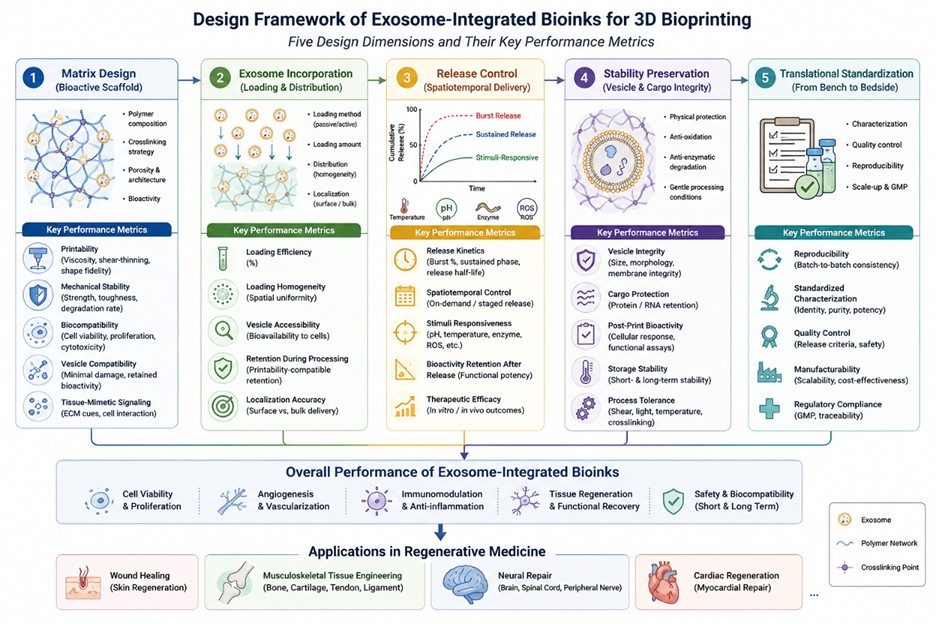
Exosome-containing “hybrid bioinks” integrate the mechanical properties of 3D bioinks with the bioactive contents of extracellular vesicles, enabling the fabrication of bioactive tissue constructs amenable to 3D printing. Here, we summarize how 3D bioprinting hybrid bioinks can develop tissue constructs with regenerative capacity, immunomodulatory function, angiogenic ability, and cell differentiation guidance. Despite recent advances in integrating exosomes into bioinks, the rational design of these systems remains underdeveloped. This limitation arises not only from the intrinsic complexity of vesicle–matrix interactions, but also from the lack of standardized design principles and unified performance evaluation frameworks. This challenge is further compounded by source-dependent heterogeneity in exosomal composition and function. In addition, current systems offer limited control over loading efficiency, spatial distribution, and release kinetics, and there is still no consensus on how to assess post-fabrication vesicle stability, bioactivity retention, or therapeutic performance. Together, these limitations hinder reproducibility, cross-study comparability, and the establishment of predictive design rules for clinically translatable exosome-integrated bioinks. Therefore, this review critically discusses recent trends in the design of exosome-laden bioconstructs, including their major advantages and drawbacks. From a design perspective, key considerations include bioactive matrix engineering, exosome loading, triggered release, and construct integrity during biofabrication. Design parameters affecting the overall performance of the construct are discussed in light of the challenges and standardization issues of developing clinically relevant exosome-loaded bioengineered constructs. Moreover, recent progress in exosome isolation and characterization, and state-of-the-art enabling technologies are discussed. Therapeutic applications reviewed here include wound healing, musculoskeletal tissue engineering, neural repair, and cardiac regeneration, highlighting the diverse therapeutic potential of exosomes. In the last section, we outline programmable bioink integration, stimuli-responsive materials, and computational design approaches toward the future generation of biofabrication technologies for regenerative medicine and precision therapeutics.
- Murphy SV, Atala A. 3D bioprinting of tissues and organs. Nat Biotechnol. 2014;32(8):773-785. doi: 10.1038/nbt.2958
- Mandrycky C, Wang Z, Kim K, Kim D-H. 3D bioprinting for engineering complex tissues. Biotechnol Adv. 2016;34(4):422-434. doi: 10.1016/j.biotechadv.2015.12.011
- Groll J, Boland T, Blunk T, et al. Biofabrication: reappraising the definition of an evolving field. Biofabrication. 2016;8(1):013001. doi: 10.1088/1758-5090/8/1/013001
- Daly AC, Prendergast ME, Hughes AJ, Burdick JA. Bioprinting for the biologist. Cell. 2021;184(1):18-32. doi: 10.1016/j.cell.2020.12.002
- Heinrich MA, Liu W, Jimenez A, et al. 3D bioprinting: from benches to translational applications. Small. 2019;15(23):1805510. doi: 10.1002/smll.201805510D
- Chimene D, Lennox KK, Kaunas RR, Gaharwar AK. Advanced bioinks for 3D printing: a materials science perspective. Ann Biomed Eng. 2016;44(6):2090-2102. doi: 10.1007/s10439-016-1638-y
- Hospodiuk M, Dey M, Sosnoski D, Ozbolat IT. The bioink: A comprehensive review on bioprintable materials. Biotechnol Adv. 2017;35(2):217-239. doi: 10.1016/j.biotechadv.2016.12.006
- Yue K, Trujillo-de Santiago G, Alvarez MM, et al. Synthesis, properties, and biomedical applications of gelatin methacryloyl (GelMA) hydrogels. Biomaterials. 2015;73:254-271. doi: 10.1016/j.biomaterials.2015.08.045
- Zhu J, Marchant RE. Design properties of hydrogel tissue-engineering scaffolds. Expert Rev Med Devices 2011;8(5):607-626. doi: 10.1586/erd.11.27
- Liu W, Zhang YS, Heinrich MA, et al. Rapid continuous multimaterial extrusion bioprinting. Adv Mater. 2017;29(3):1604630. doi: 10.1002/adma.201604630
- Lee K, Silva EA, Mooney DJ. Growth factor delivery-based tissue engineering: general approaches and a review of recent developments. J R Soc Interface. 2011;8(55):153-170. doi: 10.1098/rsif.2010.0223
- Chen RR, Mooney DJ. Polymeric growth factor delivery strategies for tissue engineering. Pharm Res. 2003;20(8):1103-1112. doi: 10.1023/A:1025034925152
- Uebersax L, Merkle HP, Meinel L. Insulin-like growth factor I releasing silk fibroin scaffolds induce chondrogenic differentiation of human mesenchymal stem cells. J Control Release. 2008;127(1):12-21. doi: 10.1016/j.jconrel.2007.11.006
- Kalluri R, LeBleu VS. The biology, function, and biomedical applications of exosomes. Science. 2020;367(6478):eaau6977. doi: 10.1126/science.aau6977
- Zhang Y, Liu Y, Liu H, Tang WH. Exosomes: biogenesis, biologic function and clinical potential. Cell Biosci. 2019;9:19. doi: 10.1186/s13578-019-0282-2
- Théry C, Witwer KW, Aikawa E, et al. Minimal information for studies of extracellular vesicles 2018 (MISEV2018): a position statement of the International Society for Extracellular Vesicles and update of the MISEV2014 guidelines. J Extracell Vesicles 2018;7(1):1535750. doi: 10.1080/20013078.2018.1535750
- Liao W, Du Y, Zhang C, et al. Exosomes: The next generation of endogenous nanomaterials for advanced drug delivery and therapy. Acta Biomater. 2019;86:1-14. doi: 10.1016/j.actbio.2018.12.045
- Wang Q, Liu Y, Zhang S, et al. Exosome-based bioinks for 3D bioprinting applications in tissue engineering and regenerative medicine. Int J Bioprinting 2023;9(6):0114. doi: 10.36922/ijb.0114
- Camacho-Cardenosa M, Pulido-Escribano V, Estrella- Guisado G, et al. Bioprinted Hydrogels as Vehicles for the Application of Extracellular Vesicles in Regenerative Medicine. Gels. 2025;11(3). doi: 10.3390/gels11030191
- Pegtel DM, Gould SJ. Exosomes. Annu Rev Biochem. 2019;88(1):487-514. doi: 10.1146/annurev-biochem-013118-111902
- Mathieu M, Martin-Jaular L, Lavieu G, Théry C. Specificities of secretion and uptake of exosomes and other extracellular vesicles for cell-to-cell communication. Nat Cell Biol. 2019;21(1):9-17. doi: 10.1038/s41556-018-0250-9
- Tkach M, Théry C. Communication by extracellular vesicles: where we are and where we need to go. Cell. 2016;164(6):1226-1232. doi: 10.1016/j.cell.2016.01.043
- Phinney DG, Pittenger MF. Concise review: MSC-derived exosomes for cell-free therapy. Stem Cells. 2017;35(4):851-858. doi: 10.1002/stem.2575
- Witwer KW, Van Balkom BW, Bruno S, et al. Defining mesenchymal stromal cell (MSC)-derived small extracellular vesicles for therapeutic applications. J Extracell Vesicles. 2019;8(1):1609206. doi: 10.1080/20013078.2019.1609206
- Lener T, Gimona M, Aigner L, et al. Applying extracellular vesicles based therapeutics in clinical trials–an ISEV position paper. J Extracell Vesicles. 2015;4(1):30087. doi: 10.3402/jev.v4.30087
- Wiklander OP, Nordin JZ, O’Loughlin A, et al. Extracellular vesicle in vivo biodistribution is determined by cell source, route of administration and targeting. J Extracell Vesicles. 2015;4(1):26316. doi: 10.3402/jev.v4.26316
- Smyth T, Kullberg M, Malik N, et al. Biodistribution and delivery efficiency of unmodified tumor-derived exosomes. J Control Release. 2015;199:145-55. doi: 10.1016/j.jconrel.2014.12.013
- Liu XQ, Sheng R. The Role of Exosomes as Endogenous Nanocarriers for Targeted Drug Delivery: Isolation, Engineering, and Clinical Progress in Neurological and Other Diseases. J Integr Neurosci. 2025;24(12):47443. doi: 10.31083/JIN47443
- Zhang K, Zhao X, Chen X, et al. Enhanced therapeutic effects of mesenchymal stem cell-derived exosomes with an injectable hydrogel for hindlimb ischemia treatment. ACS Appl Mater Interfaces. 2018;10(36):30081-30091. doi: 10.1021/acsami.8b08449
- Raposo G, Stoorvogel W. Extracellular vesicles: exosomes, microvesicles, and friends. J Cell Biol. 2013;200(4):373-83. doi: 10.1083/jcb.201211138
- Yu J, Sane S, Kim JE, et al. Biogenesis and delivery of extracellular vesicles: harnessing the power of EVs for diagnostics and therapeutics. Front Mol Biosci. 2023;10:1330400. doi: 10.3389/fmolb.2023.1330400
- Liu Q, Huang J, Xia J, Liang Y, Li G. Tracking tools of extracellular vesicles for biomedical research. Front Bioeng Biotechnol. 2022;10:943712. doi: 10.3389/fbioe.2022.943712
- Vader P, Mol EA, Pasterkamp G, Schiffelers RM. Extracellular vesicles for drug delivery. Adv Drug Deliv Rev. 2016;106:148-156. doi: 10.1016/j.addr.2016.02.006
- Doyle LM, Wang MZ. Overview of Extracellular Vesicles, Their Origin, Composition, Purpose, and Methods for Exosome Isolation and Analysis. Cells. 2019;8(7). doi: 10.3390/ cells8070727
- Armstrong JP, Holme MN, Stevens MM. Re-engineering extracellular vesicles as smart nanoscale therapeutics. ACS Nano. 2017;11(1):69-83. doi: 10.1021/acsnano.6b07607
- Liang Y, Lehrich BM, Zheng S, Lu M. Emerging methods in biomarker identification for extracellular vesicle‐based liquid biopsy. J Extracell Vesicles. 2021;10(7):e12090. doi: 10.1002/jev2.12090
- Nguyen TH, Duong CM, Nguyen X-H, Than UTT. Mesenchymal stem cell-derived extracellular vesicles for osteoarthritis treatment: extracellular matrix protection, chondrocyte and osteocyte physiology, pain and inflammation management. Cells. 2021;10(11):2887. doi: 10.3390/cells10112887
- Mirsky NA, Ehlen QT, Greenfield JA, et al. Three- Dimensional Bioprinting: A Comprehensive Review for Applications in Tissue Engineering and Regenerative Medicine. Bioengineering. 2024;11(8). doi: 10.3390/ bioengineering11080777
- Ozbolat IT, Hospodiuk M. Current advances and future perspectives in extrusion-based bioprinting. Biomaterials. 2016;76:321-43. doi: 10.1016/j.biomaterials.2015.10.076
- Highley CB, Rodell CB, Burdick JA. Direct 3D Printing of Shear-Thinning Hydrogels into Self-Healing Hydrogels. Adv Mater. 2015;27(34):5075-5079.
- Gaharwar AK, Peppas NA, Khademhosseini A. Nanocomposite hydrogels for biomedical applications. Biotechnol Bioeng. 2014;111(3):441-53. doi: 10.1002/bit.25160
- Lee KY, Mooney DJ. Alginate: properties and biomedical applications. Prog Polym Sci. 2012;37(1):106-126. doi: 10.1016/j.progpolymsci.2011.06.003
- Klouda L, Mikos AG. Thermoresponsive hydrogels in biomedical applications. Eur J Pharm Biopharm. 2008;68(1):34-45. doi: 10.1016/j.ejpb.2007.02.025
- Stuart MA, Huck WT, Genzer J, et al. Emerging applications of stimuli-responsive polymer materials. Nat Mater. 2010;9(2):101-113. doi: 10.1038/nmat2614
- Wu Z, Shi G, Li L, et al. Recent advances in smart responsive hydrogel microspheres for tissue regeneration: preparation, characteristics and applications. Mater Horiz. 2025;12(21):8943-8988. doi: 10.1039/d5mh01020a
- Miao S, Castro N, Nowicki M, et al. 4D printing of polymeric materials for tissue and organ regeneration. Mater Today. 2017;20(10):577-591. doi: 10.1016/j.mattod.2017.06.005
- Gladman AS, Matsumoto EA, Nuzzo RG, Mahadevan L, Lewis JA. Biomimetic 4D printing. Nat Mater. 2016;15(4):413-418. doi: 10.1038/nmat4544
- Suvarna P, Likhith K, Nison M, et al. Responsive to revolutionary: thermoresponsive hydrogels pioneering drug delivery and tissue engineering. Mater Des. 2026;266:115973. doi: 10.1016/j.matdes.2026.115973
- Huang J, Jia S, Liang R, et al. Construction of organoids using bioprinting technology: a frontier exploration of cartilage repair. J Orthop Translat. 2025;54:37-50. doi: 10.1016/j.jot.2025.06.020
- Zhu J. Bioactive modification of poly(ethylene glycol) hydrogels for tissue engineering. Biomaterials. 2010;31(17):4639-56. doi: 10.1016/j.biomaterials.2010.02.044
- Li G, Luo Y, Hu Z, et al. Recent Advances in Peptide- Functionalized Hydrogels for Bone Tissue Engineering. ACS Biomater Sci Eng. 2025;11(4):1970-1989. doi: 10.1021/acsbiomaterials.4c02198
- Zhong R, Talebian S, Mendes BB, et al. Hydrogels for RNA delivery. Nat Mater. 2023;22(7):818-831. doi: 10.1038/s41563-023-01472-w
- Andree L, Yang F, Brock R, Leeuwenburgh SCG. Designing biomaterials for the delivery of RNA therapeutics to stimulate bone healing. Mater Today Bio. 2021;10:100105. doi: 10.1016/j.mtbio.2021.100105
- Huang J, Xiong J, Yang L, et al. Cell-free exosome-laden scaffolds for tissue repair. Nanoscale. 2021;13(19):8740-8750. doi: 10.1039/d1nr01314a
- Hu W, Wang W, Chen Z, Chen Y, Wang Z. Engineered exosomes and composite biomaterials for tissue regeneration. Theranostics. 2024;14(5):2099-2126. doi: 10.7150/thno.93088
- Lou W, Qiu X, Qin Y, et al. 3D-printed advanced scaffold armed with exosomes derived from human skeletal stem cell identified by single-cell RNA sequencing enhances osteochondral regeneration. Bioact Mater. 2025;51:231-256. doi: 10.1016/j.bioactmat.2025.04.028
- Hosseini Karimi SN, Sarisozen B, Oguz F, Sokullu E. Bioprinting of Exosomes. Biomater Sci. 2026;14(9):2154-2171. doi: 10.1039/d5bm01754h
- Quinteira R, Gimondi S, Melica ME, et al. 3D bioprinting meets nanotherapeutics: a vehicle for sustained extracellular vesicle delivery. Biomaterials. 2026;328:123851. doi: 10.1016/j.biomaterials.2025.123851
- Selvam S, Midhun BT, Bhowmick T, Chandru A. Bioprinting of exosomes: Prospects and challenges for clinical applications. Int J Bioprint. 2023;9(2):690. doi: 10.18063/ijb.690
- Witwer KW, Théry C. Extracellular vesicles or exosomes? On primacy, precision, and popularity influencing a choice of nomenclature. J Extracellular Vesicle. 2019;8(1). doi: 10.1080/20013078.2019.1648167
- Zhang J, Tian X, Li Y, et al. Stem cell-derived exosomes: a comprehensive review of biomedical applications, challenges, and future directions. Int. J. Nanomed. 2025:10857-10905. doi: 10.2147/IJN.S527137
- Zhang Y, Zhao L, Li Y, et al. Advanced extracellular vesicle bioinformatic nanomaterials: from enrichment, decoding to clinical diagnostics. J Nanobiotechnology. 2023;21(1):366. doi: 10.1186/s12951-023-02127-3
- Moradi A, Khosravi N, Khanyile BS, Sharifianjazi F, Sorkhabi M. 3D Bioprinting Bioinks: an up-to-date overview. J Compos Compd. 2024;6(20). doi: 10.61186/jcc.6.3.3
- Dutta SD, An JM, Hexiu J, et al. 3D bioprinting of engineered exosomes secreted from M2-polarized macrophages through immunomodulatory biomaterial promotes in vivo wound healing and angiogenesis. Bioact Mater. 2025;45:345-362. doi: 10.1016/j.bioactmat.2024.11.026
- Shi Y, Chen L, Wang Y, et al. 3D-bioprinted hydrogel with MALAT1 exosomes for diabetic wound healing. J Radiat Res Appl Sci. 2025;18(4):101949. doi: 10.1016/j.jrras.2025.101949
- Zhu H, Cheng K, Tian M, et al. 3D-printed scaffold loaded with baicalin exosomes promotes bone defect repair via mediating PRRX2 to alleviate inflammation. iScience. 2026;29(1). doi: 10.1016/j.isci.2025.113565 External Link
- Luo L, Zheng W, Li J, et al. 3D-Printed Titanium Trabecular Scaffolds with Sustained Release of Hypoxia-Induced Exosomes for Dual-Mimetic Bone Regeneration. Adv Sci. 2025;12(23):e2500599. doi: 10.1002/advs.202500599
- Zhang L, Chen G, Pang J, et al. 3D bioprinted NSC-EVs hydrogel scaffold promotes sustained functional repair via autophagy activation after TBI in mice. Chem Eng J. 2025:167836. doi: 10.1016/j.cej.2025.167836
- Zhang A, Sun B, Nan C, et al. Effects of 3D-printed exosome-functionalized brain acellular matrix hydrogel on neuroinflammation in rats following cerebral hemorrhage. Stem Cell Res Ther. 2025;16(1):196. doi: 10.1186/s13287-025-04332-3
- Sun T, Huang L, Sun Q, et al. 3D-bioprinted mesenchymal stem cell-derived exosomes reprogram macrophages via PI3K/AKT to accelerate nerve regeneration. J Transl Med. 2026;24(1). doi: 10.1186/s12967-026-07845-4
- Hashemi A, Ezati M, Zumberg I, et al. In vitro evaluation of 3D-printed conductive chitosan-polyaniline scaffolds with exosome release for enhanced angiogenesis and cardiomyocyte protection. RSC Adv. 2025;15(21):16826-16844. doi: 10.1039/d5ra02940f
- Xu Z, Hong W, Mo Y, et al. Stem cells derived exosome laden oxygen generating hydrogel composites with good electrical conductivity for the tissue-repairing process of post-myocardial infarction. J Nanobiotechnol. 2025;23(1):213. doi: 10.1186/s12951-025-03289-y
- Enayati M, Riedmüller C, Rohringer S, et al. 3D-printed cardiac patch coated with human extracellular matrix hydrogel: Significant improvement of cell adhesion and immune reaction. Int J Bioprint. 2025;11(1):532. doi: 10.36922/ijb.6383
- Zheng Y, Pan C, Xu P, Liu K. Hydrogel-mediated extracellular vesicles for enhanced wound healing: the latest progress, and their prospects for 3D bioprinting. J Nanobiotechnol. 2024;22(1):57. doi: 10.1186/s12951-024-02315-9
- Consumer Alert on Regenerative Medicine Products Including Stem Cells and Exosomes. Food and Drug Administration. Accessed May 25, 2026. https://www. fda.gov/vaccines-blood-biologics/consumers-biologics/consumer-alert-regenerative-medicine-products-including-stem-cells-and-exosomes
- Public Safety Notification on Exosome Products. Food and Drug Administration. Accessed May 25, 2026. https:// www.fda.gov/vaccines-blood-biologics/safety-availability-biologics/public-safety-notification-exosome-products
- Frequently Asked Questions About Combination Products. Food and Drug Administration. Accessed May 25, 2026. https://www.fda.gov/combination-products/about-combination-products/frequently-asked-questions-about-combination-products
- RFD Process. Food and Drug Administration. Accessed May 25, 2026. https://www.fda.gov/combination-products/rfd-process
- Clinical Trials Information System. European Medicines Agency. Accessed May 25, 2026. https://www.ema.europa. eu/en/human-regulatory-overview/research-development/clinical-trials-human-medicines/clinical-trials-information-system?utm_source=chatgpt.com
- Advanced therapy medicinal products: Overview. European Medicines Agency. Accessed May 25, 2026. https://www. ema.europa.eu/en/human-regulatory-overview/advanced-therapy-medicinal-products-overview
- Advanced therapies: marketing authorisation. European Medicines Agency. Accessed May 25, 2026. https:// www.ema.europa.eu/en/human-regulatory-overview/marketing-authorisation/advanced-therapies-marketing-authorisation?utm_source=chatgpt.com
- Scientific recommendations on classification of advanced therapy medicinal products. European Medicines Agency. Accessed May 25, 2026. https://www.ema.europa.eu/en/human-regulatory-overview/marketing-authorisation/advanced-therapies-marketing-authorisation/scientific-recommendations-classification-advanced-therapy-medicinal-products
- 2023 Drug Evaluation Report. National Medical Products Administration. Accessed May 25, 2026. https://www.nmpa.gov.cn/directory/web/nmpa/images/1707039824076019627.pdf [In Chinese]
- Mancha Sánchez E, Gómez-Blanco JC, López Nieto E, et al. Hydrogels for bioprinting: A systematic review of hydrogels synthesis, bioprinting parameters, and bioprinted structures behavior. Front Bioeng Biotechnol. 2020;8:776. doi: 10.3389/fbioe.2020.00776