

Clinical maturity of 3D printing and bioprinting technologies: A systematic analysis of clinical trials across medical applications

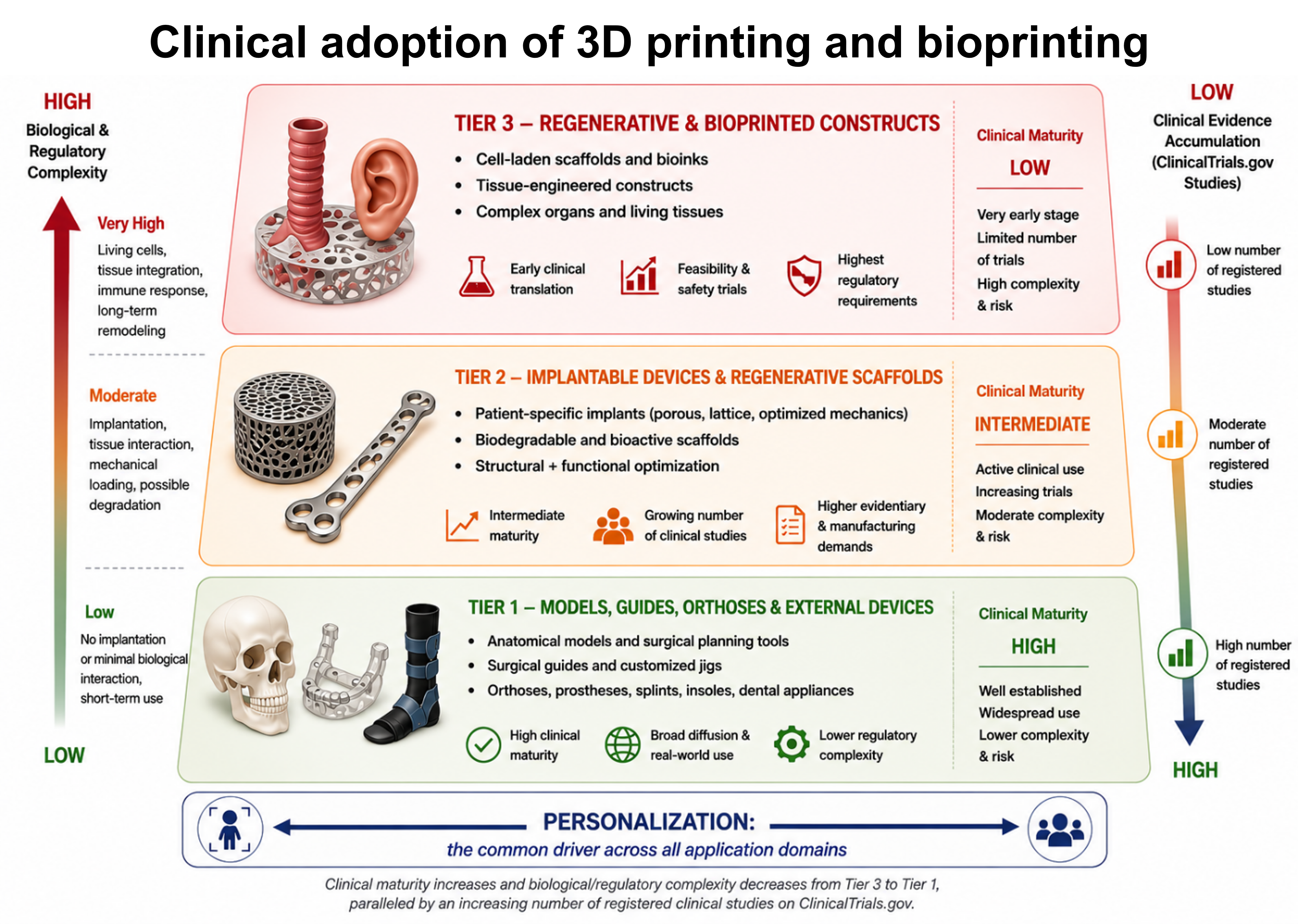
Three-dimensional (3D) printing and bioprinting technologies are increasingly being integrated into clinical research and healthcare, enabling the development of patient-specific medical devices, anatomical models, and bioengineered constructs. This study analyzed registered clinical trials in ClinicalTrials.gov to characterize the current clinical landscape and relative degree of clinical maturity of medical 3D printing and bioprinting technologies across different application domains. Search terms included 3D printing, bioprinting, additive manufacturing, patient-specific devices, surgical guides, scaffolds, and biofabrication. Eligible studies involved human subjects and clinical applications related to diagnosis, treatment, surgical planning, or rehabilitation. The identified trials (ca. 700) were categorized into four main domains: patient-specific anatomical models, disease models, orthoses and assistive devices, and implantable prostheses and regenerative scaffolds. Anatomical models represent the most extensively translated application, with widespread use in surgical planning, procedural simulation, and patient communication across multiple specialties. Orthoses and assistive devices also account for a substantial proportion of studies, reflecting the growing adoption of digital workflows for personalized rehabilitation solutions. Implantable prostheses and scaffolds constitute a rapidly expanding area, particularly in orthopedics and maxillofacial surgery, where customization improves anatomical fit and functional outcomes. In contrast, bioprinting-based disease models and regenerative constructs remain limited to early-stage clinical investigations. Overall, the distribution and design of clinical trials reveal a gradient of translational development, with mechanically driven applications showing broader clinical adoption than biologically complex systems. Continued advances in materials, manufacturing processes, and regulatory frameworks will be critical to support large-scale clinical validation and broader implementation of these technologies in personalized and regenerative medicine.
- Martelli N, Serrano C, van den Brink H, et al. Advantages and disadvantages of 3-dimensional printing in surgery: a systematic review. Surgery. 2016;159(6):1485-1500. doi: 10.1016/j.surg.2015.12.017
- Gilbert F, O’Connell CD, Mladenovska T, Dodds S. Print me an organ? Ethical and regulatory issues emerging from 3D bioprinting in medicine. Sci Eng Ethics. 2018;24(1):73-91. doi: 10.1007/s11948-017-9874-6
- Kumar Gupta D, Ali MH, Ali A, et al. 3D printing technology in healthcare: applications, regulatory understanding, IP repository, and clinical trial status. J Drug Target. 2022;30(2):131-150. doi: 10.1080/1061186X.2021.1935973
- Zhou W, Gao L, Wu M, Liu J. AI-driven integration of multimodal CT/MRI imaging and 3D printing in medicine: advances, clinical applications, and future directions. Int J Bioprint. 2026;12(1):125-144. doi: 10.36922/IJB025390404
- Matai I, Kaur G, Seyedsalehi A, McClinton A, Laurencin CT. Progress in 3D bioprinting technology for tissue/organ regenerative engineering. Biomaterials. 2020;226:119536. doi: 10.1016/j.biomaterials.2019.119536
- Rodríguez-Pombo L, Martínez-Castro L, Xu X, et al. Simultaneous fabrication of multiple tablets within seconds using tomographic volumetric 3D printing. Int J Pharm X. 2023;5:100166. doi: 10.1016/j.ijpx.2023.100166
- Castilho M, de Ruijter M, Beirne S, et al. Multitechnology biofabrication: a new approach for the manufacturing of functional tissue structures? Trends Biotechnol. 2020;38(12):1316-1328. doi: 10.1016/j.tibtech.2020.04.014
- Zhang Z, Zhou X, Fang Y, Xiong Z, Zhang T. AI-driven 3D bioprinting for regenerative medicine: from bench to bedside. Bioact Mater. 2025;45:201-230. doi: 10.1016/j.bioactmat.2024.11.021
- Aboal-Castro L, Radziunas-Salinas Y, Pita-Vilar M, et al. Laser-assisted micropatterned 3D-printed scaffolds with customizable surface topography and porosity for modulation of cell function. Adv Healthc Mater. 2025;14(3). doi: 10.1002/adhm.202403992
- Alemayehu DG, Zhang Z, Tahir E, Gateau D, Zhang DF, Ma X. Preoperative planning using 3D printing technology in orthopedic surgery. Biomed Res Int. 2021;2021:7940242. doi: 10.1155/2021/7940242
- Wu Y, Liu J, Kang L, et al. An overview of 3D-printed metal implants in orthopedic applications: present and future perspectives. Heliyon. 2023;9(7). doi: 10.1016/j.heliyon.2023.e17718
- Vennam S, Vijayasankar KN, Pati F. 3D-printed personalized assistive devices: a material, technique, and medical condition perspective. Appl Mater Today. 2024;40:102403. doi: 10.1016/j.apmt.2024.102403
- Martin-Piedra MA, Carmona G, Campos F, et al. Histological assessment of nanostructured fibrin-agarose skin substitutes grafted in burnt patients: a time-course study. Bioeng Transl Med. 2023;8(6). doi: 10.1002/btm2.10572
- Kang Y, Yeo M, Derman ID, et al. Intraoperative bioprinting of human adipose-derived stem cells and extracellular matrix induces hair follicle-like downgrowths and adipose tissue formation during full-thickness craniomaxillofacial skin reconstruction. Bioact Mater. 2023;33:114-128. doi: 10.1016/j.bioactmat.2023.10.034
- Alvarez-Lorenzo C, Ramirez-Romero A, Peixoto D, Vivero- Lopez M, Rodríguez-Moldes I, Concheiro A. Biomimetic cell membrane-coated scaffolds for enhanced tissue regeneration. Adv Mater. 2025;37(40). doi: 10.1002/adma.202507084
- Calvo-Haro JA, Pascau J, Mediavilla-Santos L, et al. Conceptual evolution of 3D printing in orthopedic surgery and traumatology: from “do it yourself ” to “point-of-care manufacturing.” BMC Musculoskelet Disord. 2021;22(1):360. doi: 10.1186/s12891-021-04224-6
- Sobrón FB, Dos Santos-Vaquinhas A, Alonso B, Parra G, Pérez-Mañanes R, Vaquero J. Technique tip: 3D printing surgical guide for pes cavus midfoot osteotomy. Foot Ankle Surg. 2022;28(3):371-377. doi: 10.1016/j.fas.2021.05.001
- Okshah A, Saini RS, Binduhayyim RIH, et al. Clinical, technical, and economic outcomes of 3D-printed bone substitutes in maxillofacial reconstruction: a systematic review and meta-analysis. J Craniomaxillofac Surg. 2026;54(6):104508. doi: 10.1016/j.jcms.2026.104508
- Javaid M, Haleem A. Current status and challenges of additive manufacturing in orthopaedics: an overview. J Clin Orthop Trauma. 2019;10(2):380-386. doi: 10.1016/j.jcot.2018.05.008
- Pereira JS, Xavier ASMS, Monteiro RDS, et al. 3D-printed orthoses and prostheses for people with physical disability in rehabilitation centers: a scoping review. BMC Musculoskelet Disord. 2024;25(1):783. doi: 10.1186/s12891-024-07875-3
- Bliley JM, Shiwarski DJ, Feinberg AW. 3D-bioprinted human tissue and the path toward clinical translation. Sci Transl Med. 2022;14(666). doi: 10.1126/scitranslmed.abo7047
- Hu J, Yang X, Yang X, Xu H. Clinical trial of 3D-printed PCL/β-TCP composite scaffold for craniofacial reconstruction in China. J Craniofac Surg. 2025;36(6):2158-2160. doi: 10.1097/SCS.0000000000011829
- Masanet S, Jutand MA, Margue G, Hoarau H, Bernhard JC. Using 3D-printing technology for patient education: a review of the literature. 3D Print Med. 2025;11(1):49. doi: 10.1186/s41205-025-00296-5
- Tan G, Ioannou N, Mathew E, Tagalakis AD, Lamprou DA, Yu-Wai-Man C. 3D printing in ophthalmology: from medical implants to personalised medicine. Int J Pharm. 2022;625:122094. doi: 10.1016/j.ijpharm.2022.122094
- Safali S, Berk T, Makelov B, Acar MA, Gueorguiev B, Pape HC. The possibilities of personalized 3D-printed implants: a case series study. Medicina (Kaunas). 2023;59(2):249. doi: 10.3390/medicina59020249
- Aleinikov VG, Kerimbayev TT, Kenzhegulov YN, et al. Biomechanical and clinical evaluation of 3D-printed personalized vertebral implants after total en bloc spondylectomy: two-year follow-up outcomes. 3D Print Med. 2025;11(1):43. doi: 10.1186/s41205-025-00294-7
- Chen Z, Yang Y, Liu B, Li X, Tian Y. Application of 3D-printed porous prosthesis for the reconstruction of infectious bone defect with concomitant severe soft tissue lesion: a case series of 13 cases. BMC Musculoskelet Disord. 2024;25(1):1090. doi: 10.1186/s12891-024-08248-6
- Hassan S, Gomez-Reyes E, Enciso-Martinez E, et al. Tunable and compartmentalized multimaterial bioprinting for complex living tissue constructs. ACS Appl Mater Interfaces. 2022;14(46):51602-51618. doi: 10.1021/acsami.2c12585
- Lu Y, Chen X, Han F, et al. 3D printing of self-healing personalized liver models for surgical training and preoperative planning. Nat Commun. 2023;14:8447. doi: 10.1038/s41467-023-44324-6
- Blanco-Fernandez B, Bagci G, Perez-Amodio S, et al. A bioprinted breast cancer model using bioinks of decellularized breast tissue for studying cancer stemness, invasion, and drug efficacy. Acta Biomater. 2025;203:306- 321. doi: 10.1016/j.actbio.2025.07.054
- Gato-Diaz U, Blanco-Garcia S, Peixoto D, Concheiro A, Alvarez-Lorenzo C, Blanco-Fernandez B. A 3D-bioprinted pancreatic cancer model using collagen-gelatin methacrylamide-alginate bioinks to mimic the desmoplastic microenvironment. Biomacromolecules. 2025;26(11):7275- 7288. doi: 10.1021/acs.biomac.5c00450
- Laubach M, Cheers GM, Frankenbach-Désor T, et al. Clinical translation of 3D-printed patient-specific bone implants: a consensus statement. Int J Surg. 2025;111(11):7497-7506. doi: 10.1097/JS9.0000000000002944
- Ventola CL. Medical applications for 3D printing: current and projected uses. P T. 2014;39(10):704-711.
- Tack P, Victor J, Gemmel P, Annemans L. 3D-printing techniques in a medical setting: a systematic literature review. Biomed Eng Online. 2016;15(1):115. doi: 10.1186/s12938-016-0236-4
- Sabanik P, Liu TC, Tabatabaeian M, Rocha MG, Surathu N, Lawson NC. A review of current systems, materials, and protocols for 3D-printed splints, crowns, and dentures. J Esthet Restor Dent. 2026;38(3):635-651. doi: 10.1111/jerd.70125
- Long T, Tan L, Liu X. Three-dimensional printing in modern orthopedic trauma surgery: a comprehensive analysis of technical evolution and clinical translation. Front Med (Lausanne). 2025;12:1560909. doi: 10.3389/fmed.2025.1560909
- Moreta-Martinez R, Pose-Díez-de-la-Lastra A, Calvo- Haro JA, Mediavilla-Santos L, Pérez-Mañanes R, Pascau J. Combining augmented reality and 3D printing to improve surgical workflows in orthopedic oncology: smartphone application and clinical evaluation. Sensors (Basel). 2021;21(4):1370. doi: 10.3390/s21041370
- Hussein N, Honjo O, Barron DJ, Yoo SJ. Supravalvular aortic stenosis repair: surgical training of 2 repair techniques using 3D-printed models. Interact Cardiovasc Thorac Surg. 2021;33(6):966-968. doi: 10.1093/icvts/ivab198
- Raffaele A, Mauri V, Negrini M, et al. Elaboration and development of a realistic 3D-printed model for training in ultrasound-guided placement of peripheral central venous catheter in children. J Vasc Access. 2024;25(6):1767-1774. doi: 10.1177/11297298231187005
- Wegner M, Dusse F, Beeser F, et al. Comparing simulation training of bronchoscopy-guided percutaneous dilatational tracheostomy using conventional versus 3D-printed simulators (TRAC-Sim study). J Intensive Care Med. 2024;39(9):820-828. doi: 10.1177/08850666241232918
- Schuh S, Schiele S, Rubeck A, Hinske LC, Welzel J, Schneller A. Teaching punch biopsy and suturing with a 3D-printed skin model: design and integration into the medical curriculum. 3D Print Med. 2026;12(1):7. doi: 10.1186/s41205-026-00317-x
- Kargul M, Skórka P, Gutowski P, Kazimierczak A, Rynio P. Empowering EVAR: revolutionizing patient understanding and qualification with 3D printing. J Cardiovasc Dev Dis. 2024;11(11):365. doi: 10.3390/jcdd11110365
- Ma X, Liu J, Zhu W, et al. 3D bioprinting of functional tissue models for personalized drug screening and in vitro disease modeling. Adv Drug Deliv Rev. 2018;132:235-251. doi: 10.1016/j.addr.2018.06.011
- Bertelli F, Singh A, Lam CZ, et al. Advancements in 3D modeling technologies for congenital heart disease: integrating 3D printing, virtual reality, and holograms. Pediatr Radiol. 2026;56:28-39. doi: 10.1007/s00247-025-06433-w
- Gómez-Ciriza G, Gómez-Cía T, Rivas-González JA, Velasco Forte MN, Valverde I. Affordable three-dimensional printed heart models. Front Cardiovasc Med. 2021;8:642011. doi: 10.3389/fcvm.2021.642011
- Wake N, Rosenkrantz AB, Huang R, et al. Impact of 3D-printed models on quantitative surgical outcomes for patients undergoing robotic-assisted radical prostatectomy: a cohort study. Abdom Radiol (NY). 2023;48(4):1401-1408. doi: 10.1007/s00261-023-03815-2
- Bhardwaj N, Dey S, Bhar B, Mandal BB. Bioprinted in vitro tissue models: an emerging platform for developing therapeutic interventions and disease modelling. Prog Biomed Eng. 2024;6:012003. doi: 10.1088/2516-1091/ad10b4
- Restan Perez M, da Silva VA, Cortez PE, Joddar B, Willerth SM. 3D-bioprinted cardiac tissues and their potential for disease modeling. J 3D Print Med. 2023;7(2). doi: 10.2217/3dp-2022-0023
- Ozbek II, Saybasili H, Ulgen KO. Applications of 3D bioprinting technology to brain cells and brain tumor models: special emphasis to glioblastoma. ACS Biomater Sci Eng. 2024;10(5):2616-2635. doi: 10.1021/acsbiomaterials.3c01569
- Quílez C, Bebiano LB, Jones E, et al. Targeting the complexity of in vitro skin models: a review of cutting-edge developments. J Invest Dermatol. 2024;144(12):2650-2670. doi: 10.1016/j.jid.2024.04.032
- Huët MAL, Aujayeb P, Sujeeun LY, Bhaw-Luximon A. Three-dimensional bioprinted platforms for disease management: cancer and chronic wounds. R Soc Open Sci. 2026;13(4):251464. doi: 10.1098/rsos.251464
- Agarwal T, Onesto V, Banerjee D, et al. 3D bioprinting in tissue engineering: current state-of-the-art and challenges towards system standardization and clinical translation. Biofabrication. 2025;17(4):042003. doi: 10.1088/1758-5090/ade47a
- FDA Modernization Act 3.0, HR 2821, 119th Cong. 2025. Accessed May 4, 2026. https://www.congress.gov/bill/119th-congress/house-bill/2821/text/ih
- European Medicines Agency. Regulatory acceptance of new approach methodologies (NAMs) to reduce animal use testing. Accessed May 4, 2026. https://www.ema.europa. eu/en/human-regulatory-overview/research-development/ ethical-use-animals-medicine-testing/regulatory-acceptance-new-approach-methodologies-nams-reduce-animal-use-testing
- Mehta V, Karnam G, Madgula V. Liver-on-chips for drug discovery and development. Mater Today Bio. 2024;27:101143. doi: 10.1016/j.mtbio.2024.101143
- Gato-Diaz U, de Castro-Alves L, Concheiro A, et al. Biomimetic core-shell breast cancer models using alginate, gelatin, and collagen I: simulating the tumor matrix for drug evaluation. Int J Biol Macromol. 2026;335(pt 1):149205. doi: 10.1016/j.ijbiomac.2025.149205
- Lee T, Kyung SY, Kwon M, Park B, Ko J. Innovations in skin microphysiological systems for nonclinical testing and FDA modernization. Microsyst Nanoeng. 2026;12(1):44. doi: 10.1038/s41378-025-01149-1
- Alrasheedi NH, Tlija M, Elloumi N, Louhichi B. A critical review of 3D-printed orthoses towards workflow implementation in clinical practice. J Eng Res. 2025;13(2):1038-1051. doi: 10.1016/j.jer.2024.01.024
- Atallah H, Qufabz T, Bakhsh HR, Ferriero G. The current state of 3D-printed orthoses clinical outcomes: a systematic review. BMC Musculoskelet Disord. 2025;26(1):822. doi: 10.1186/s12891-025-09070-4
- Wang JZ, Wojciechowski EA, Paine T, Burns J, Cheng TL. Feasibility of designing, manufacturing and delivering 3D-printed ankle-foot orthoses: an updated systematic review. J Foot Ankle Res. 2025;18(4). doi: 10.1002/jfa2.70097
- Kumar R, Sarangi SK. 3D-printed customized diabetic foot insoles with architecture-designed lattice structures: a case study. Biomed Phys Eng Express. 2023;10(1):015019. doi: 10.1088/2057-1976/ad1732
- Pangestu PA, Harito C, Sitepu E, Herawan SG, Abrori SA, Tobing CCL. 3D-printed ankle-foot orthosis (AFO) with optimized material and design for children with cerebral palsy. Designs. 2026;10(1):1. doi: 10.3390/designs10010001
- Qin C, Luo X, Yang Y, Lun Y, Yang S, Chen L. Therapeutic outcomes of customized 3D-printed ankle-foot orthoses in children with spastic cerebral palsy: a case series study. Front Pediatr. 2025;13:1661098. doi: 10.3389/fped.2025.1661098
- Hwang SJ, Seo J, Cha JY, et al. Utility of customized 3D compression mask with pressure sensors on facial burn scars: a single-blinded, randomized controlled trial. Burns. 2024;50(7):1885-1897. doi: 10.1016/j.burns.2024.05.021
- Khorsandi D, Fahimipour A, Abasian P, et al. 3D and 4D printing in dentistry and maxillofacial surgery: printing techniques, materials, and applications. Acta Biomater. 2021;122:26-49. doi: 10.1016/j.actbio.2020.12.044
- Keeling A, Osnes C, Davda K, et al. A pilot randomised controlled trial to compare 3D-printed versus conventionally fabricated complete dentures. Eur J Prosthodont Restor Dent. 2025;33(4):370-378. doi: 10.1922/EJPRD_2835Keeling09
- Lejnieks M, Akota I, Jākobsone G, Neimane L, Uribe SE. Clinical efficacy of CBCT and 3D-printed replicas in molar autotransplantation: a controlled clinical trial. Dent Traumatol. 2025;41(2):161-170. doi: 10.1111/edt.13012
- Çoban Gündogan Z, Özyilmaz ÖY, Kara Ö. Comparison of color stability and wear resistance of different 3D-printed definitive restorative resins. J Prosthet Dent. Published online 2026. doi: 10.1016/j.prosdent.2026.04.014
- Chen R. 3D printed medical devices: FDA, EU MDR regulatory guide (2026). MedDeviceGuide. Published April 15, 2026. Accessed May 4, 2026. https://meddeviceguide. com/blog/3d-printed-medical-devices-regulatory-guide
- Perez Rodriguez Garcia G, Kelbert J, Saleh D, et al. Optimal cage biomaterials for fusion and subsidence outcomes in lumbar spinal fusion: a network meta-analysis of 4881 patients. Eur Spine J. In press. doi: 10.1007/s00586-026-09920-2
- Wang L, Yang C, Sun C, et al. Fused deposition modeling PEEK implants for personalized surgical application: from clinical need to biofabrication. Int J Bioprint. 2022;8(4):615. doi: 10.18063/ijb.v8i4.615
- Park JW, Kang HG. Application of 3-dimensional printing implants for bone tumors. Clin Exp Pediatr. 2022;65(10):476- 482. doi: 10.3345/cep.2021.01326
- Laubach M, Hildebrand F, Suresh S, et al. The concept of scaffold-guided bone regeneration for the treatment of long bone defects: current clinical application and future perspective. J Funct Biomater. 2023;14(7):341. doi: 10.3390/jfb14070341
- González Álvarez A, Pérez Mañanes R, Calvo Haro JA, Mediavilla Santos L, Pascau J. Manufacturing evaluation of seven medical device companies during the production of a 3D-printed titanium pelvic implant. Int J Bioprint. 2024;10(2):0140. doi: 10.36922/ijb.0140
- Yuste I, Luciano FC, Rodríguez C, et al. Antimicrobial 3D-printed implants for periprosthetic joint infections. Drug Deliv Transl Res. 2026;16(5):1333-1348. doi: 10.1007/s13346-025-01934-5
- Goracci C, Juloski J, D’Amico C, et al. Clinically relevant properties of 3D-printable materials for intraoral use in orthodontics: a critical review of the literature. Materials (Basel). 2023;16(6):2166. doi: 10.3390/ma16062166
- Manita PG, Garcia-Orue I, Santos-Vizcaino E, Hernandez RM, Igartua M. 3D bioprinting of functional skin substitutes: from current achievements to future goals. Pharmaceuticals (Basel). 2021;14(4):362. doi: 10.3390/ph14040362
- Olejnik A, Semba JA, Kulpa A, Dańczak-Pazdrowska A, Rybka JD, Gornowicz-Porowska J. 3D bioprinting in skin-related research: recent achievements and application perspectives. ACS Synth Biol. 2022;11(1):26-38. doi: 10.1021/acssynbio.1c00547
- Bellia-Munzon G, Cieri P, Toselli L, et al. Resorbable airway splints, stents, and 3D reconstruction and printing of the airway in tracheobronchomalacia. Semin Pediatr Surg. 2021;30(3):151063. doi: 10.1016/j.sempedsurg.2021.151063
- Hashimoto S, Taniguchi D, Doi R, et al. Bio-3D printing with smooth muscle cells derived from human iPSCs via neural crest and its application for tracheal regeneration. Biofabrication. 2026;18(1):015003. doi: 10.1088/1758-5090/ae1665
- Goyanes A, Madla CM, Umerji A, et al. Automated therapy preparation of isoleucine formulations using 3D printing for the treatment of MSUD: first single-centre, prospective, crossover study in patients. Int J Pharm. 2019;567:118497. doi: 10.1016/j.ijpharm.2019.118497
- Rodríguez-Pombo L, de Castro-López MJ, Sánchez-Pintos P, et al. Paediatric clinical study of 3D-printed personalised medicines for rare metabolic disorders. Int J Pharm. 2024;657:124140. doi: 10.1016/j.ijpharm.2024.124140
- Parramon-Teixido CJ, Rodríguez-Pombo L, Basit AW, et al. A framework for conducting clinical trials involving 3D printing of medicines at the point of care. Drug Deliv Transl Res. 2025;15(9):3078-3097. doi: 10.1007/s13346-025-01868-y
- Regulation (EU) 2017/745 of the European Parliament and of the Council of April 5, 2017 on medical devices, amending Directive 2001/83/EC, Regulation (EC) No. 178/2002, and Regulation (EC) No. 1223/2009 and repealing Council Directives 90/385/EEC and 93/42/EEC. Accessed May 4, 2026. https://eur-lex.europa.eu/legal-content/EN/ TXT/?uri=CELEX:32017R0745
- Regulation (EU) 2024/1689 of the European Parliament and of the Council of June 13, 2024 laying down harmonised rules on artificial intelligence and amending Regulations (EC) No. 300/2008, (EU) No. 167/2013, (EU) No. 168/2013, (EU) 2018/858, (EU) 2018/1139, and (EU) 2019/2144 and Directives 2014/90/EU, (EU) 2016/797, and (EU) 2020/1828 (Artificial Intelligence Act). Accessed May 4, 2026. https://eur-lex.europa.eu/legal-content/EN/TXT/ HTML/?uri=OJ:L_202401689
- Regulation (EU) 2025/327 of the European Parliament and of the Council of February 11, 2025 on the European Health Data Space and amending Directive 2011/24/ EU and Regulation (EU) 2024/2847. Accessed May 4, 2026. https://eur-lex.europa.eu/legal-content/EN/TXT/ HTML/?uri=OJ:L_202500327