
3D bioprinting of iPSC-derived tissues: From structural fabrication to functional maturation and clinical translation

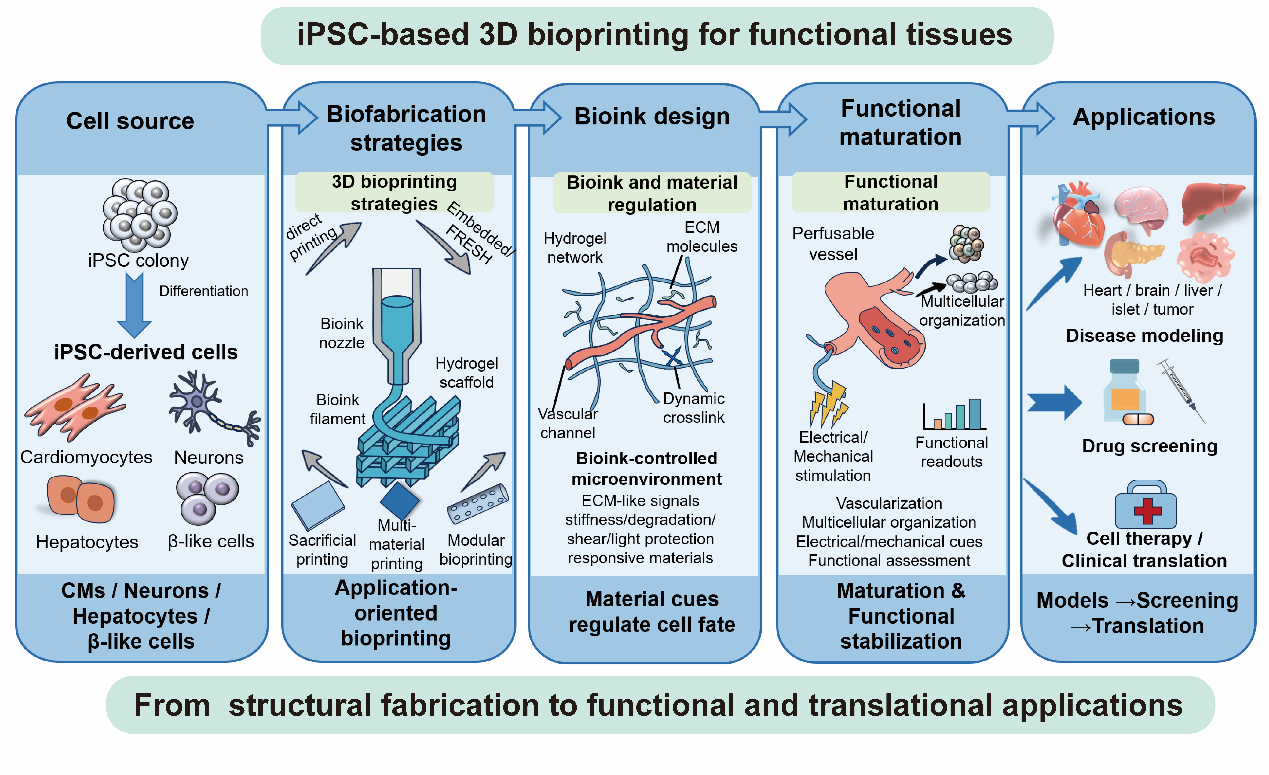
Three-dimensional bioprinting combined with induced pluripotent stem cells (iPSCs) offers a practical route to building human tissue models with improved structural and functional relevance. By controlling cell placement and local microenvironments, these systems better reproduce tissue organization and multicellular interactions than conventional culture methods. This review provides a comprehensive analysis of recent advances in iPSC-based bioprinting, with a focus on how biofabrication strategies shape tissue organization and function. Recent work has shifted the field away from simply achieving structural fidelity toward maintaining stable and reproducible function. Progress in bioink design, vascularization strategies, and multi-material printing has enabled the generation of cardiac tissues with perfusable networks, neural constructs with coordinated activity, and metabolic tissues with sustained functional output. These advances have strengthened the use of bioprinted tissues in disease modeling and drug evaluation. Evidence from early clinical studies suggests that translation is currently driven by modular and well-defined products rather than fully printed organs. Cardiac patches, dopaminergic progenitor cell therapies, stem cell–derived islets, and retinal implants illustrate how simpler, function-oriented constructs can meet clinical and manufacturing requirements. The review further discusses key challenges for clinical translation, including tissue maturation, manufacturing scalability, and regulatory standardization. By connecting technological advances with emerging clinical evidence, this review establishes a conceptual framework for translating iPSC-based bioprinting into practical therapeutic applications.
- Takahashi K, Tanabe K, Ohnuki M, et al. Induction of pluripotent stem cells from adult human fibroblasts by defined factors. Cell. 2007;131(5):861-872. doi: 10.1016/j.cell.2007.11.019
- Yu J, Vodyanik MA, Smuga-Otto K, et al. Induced pluripotent stem cell lines derived from human somatic cells. Science. 2007;318(5858):1917-1920. doi: 10.1126/science.1151526
- Shi Y, Inoue H, Wu JC, Yamanaka S. Induced pluripotent stem cell technology: a decade of progress. Nat Rev Drug Discov. 2017;16(2):115-130. doi: 10.1038/nrd.2016.245
- Yang X, Pabon L, Murry CE. Engineering adolescence: maturation of human pluripotent stem cell-derived cardiomyocytes. Circ Res. 2014;114(3):511-523. doi: 10.1161/circresaha.114.300558
- Engler AJ, Sen S, Sweeney HL, Discher DE. Matrix elasticity directs stem cell lineage specification. Cell. 2006;126(4):677- 689. doi: 10.1016/j.cell.2006.06.044
- Vining KH, Mooney DJ. Mechanical forces direct stem cell behaviour in development and regeneration. Nat Rev Mol Cell Biol. 2017;18(12):728-742. doi: 10.1038/nrm.2017.108
- Clevers H. Modeling Development and Disease with Organoids. Cell. 2016;165(7):1586-1597. doi: 10.1016/j.cell.2016.05.082
- Ewart L, Dehne EM, Fabre K, et al. Application of Microphysiological Systems to Enhance Safety Assessment in Drug Discovery. Annu Rev Pharmacol Toxicol. 2018;58:65- 82. doi: 10.1146/annurev-pharmtox-010617-052722
- Lancaster MA, Knoblich JA. Organogenesis in a dish: modeling development and disease using organoid technologies. Science. 2014;345(6194):1247125. doi: 10.1126/science.1247125
- Murphy SV, Atala A. 3D bioprinting of tissues and organs. Nat Biotechnol. 2014;32(8):773-785. doi: 10.1038/nbt.2958
- Mandrycky C, Wang Z, Kim K, Kim DH. 3D bioprinting for engineering complex tissues. Biotechnol Adv. 2016;34(4):422- 434. doi: 10.1016/j.biotechadv.2015.12.011
- Ozbolat IT, Hospodiuk M. Current advances and future perspectives in extrusion-based bioprinting. Biomaterials. 2016;76:321-343. doi: 10.1016/j.biomaterials.2015.10.076
- Groll J, Boland T, Blunk T, et al. Biofabrication: reappraising the definition of an evolving field. Biofabrication. 2016;8(1):013001. doi: 10.1088/1758-5090/8/1/013001
- Skylar-Scott MA, Uzel SGM, Nam LL, et al. Biomanufacturing of organ-specific tissues with high cellular density and embedded vascular channels. Sci Adv. 2019;5(9):eaaw2459. doi: 10.1126/sciadv.aaw2459
- Noor N, Shapira A, Edri R, Gal I, Wertheim L, Dvir T. 3D Printing of Personalized Thick and Perfusable Cardiac Patches and Hearts. Adv Sci (Weinh). 2019;6(11):1900344. doi: 10.1002/advs.201900344
- Daly AC, Prendergast ME, Hughes AJ, Burdick JA. Bioprinting for the Biologist. Cell. 2021;184(1):18-32. doi: 10.1016/j.cell.2020.12.002
- Jin Y, Mikhailova E, Lei M, et al. Integration of 3D-printed cerebral cortical tissue into an ex vivo lesioned brain slice. Nat Commun. 2023;14(1):5986. doi: 10.1038/s41467-023-41356-w
- Roth JG, Brunel LG, Huang MS, et al. Spatially controlled construction of assembloids using bioprinting. Nat Commun. 2023;14(1):4346. doi: 10.1038/s41467-023-40006-5
- Stankey PP, Kroll KT, Ainscough AJ, et al. Embedding Biomimetic Vascular Networks via Coaxial Sacrificial Writing into Functional Tissue. Adv Mater. 2024;36(36):e2401528. doi: 10.1002/adma.202401528
- Brassard JA, Lutolf MP. Engineering Stem Cell Self-organization to Build Better Organoids. Cell Stem Cell. 2019;24(6):860-876. doi: 10.1016/j.stem.2019.05.005
- Takebe T, Wells JM. Organoids by design. Science. 2019;364(6444):956-959. doi: 10.1126/science.aaw7567
- Sun W, Starly B, Daly AC, et al. The bioprinting roadmap. Biofabrication. 2020;12(2):022002. doi: 10.1088/1758-5090/ab5158
- Blaeser A, Duarte Campos DF, Puster U, Richtering W, Stevens MM, Fischer H. Controlling Shear Stress in 3D Bioprinting is a Key Factor to Balance Printing Resolution and Stem Cell Integrity. Adv Healthc Mater. 2016;5(3):326- 333. doi: 10.1002/adhm.201500677
- Blaeser A, Duarte Campos DF, Weber M, et al. Biofabrication under fluorocarbon: a novel freeform fabrication technique to generate high aspect ratio tissue-engineered constructs. Biores Open Access. 2013;2(5):374-384. doi: 10.1089/biores.2013.0031
- Brauer E, Balciunaite A, Kollert MR, et al. Biocompatible Ink Optimization Enables Functional Volumetric Bioprinting With Xolography. Adv Mater. 2026;38(6):e12058. doi: 10.1002/adma.202512058
- Raimondi MT, Eaton SM, Nava MM, Laganà M, Cerullo G, Osellame R. Two-photon laser polymerization: from fundamentals to biomedical application in tissue engineering and regenerative medicine. J Appl Biomater Funct Mater. 2012;10(1):55-65. doi: 10.5301/JABB.2012.9249
- Kim B, Kim J, Lee S. Unleashing the Power of Undifferentiated Induced Pluripotent Stem Cell Bioprinting: Current Progress and Future Prospects. Int J Stem Cells. 2024;17(1):38-50. doi: 10.15283/ijsc23146
- Karbassi E, Fenix A, Marchiano S, et al. Cardiomyocyte maturation: advances in knowledge and implications for regenerative medicine. Nat Rev Cardiol. 2020;17(6):341-359. doi: 10.1038/s41569-019-0331-x
- Dey M, Ozbolat IT. 3D bioprinting of cells, tissues and organs. Sci Rep. 2020;10(1):14023. doi: 10.1038/s41598-020-70086-y
- Pati F, Jang J, Ha DH, et al. Printing three-dimensional tissue analogues with decellularized extracellular matrix bioink. Nat Commun. 2014;5:3935. doi: 10.1038/ncomms4935
- Gu Z, Fu J, Lin H, He Y. Development of 3D bioprinting: From printing methods to biomedical applications. Asian J Pharm Sci. 2020;15(5):529-557. doi: 10.1016/j.ajps.2019.11.003
- Du B, Dai Z, Wang H, Ren Z, Li D. Advances and Prospects in Using Induced Pluripotent Stem Cells for 3D Bioprinting in Cardiac Tissue Engineering. Rev Cardiovasc Med. 2025;26(3):26697. doi: 10.31083/rcm26697
- Faulkner-Jones A, Fyfe C, Cornelissen DJ, et al. Bioprinting of human pluripotent stem cells and their directed differentiation into hepatocyte-like cells for the generation of mini-livers in 3D. Biofabrication. 2015;7(4):044102. doi: 10.1088/1758-5090/7/4/044102
- Gu Q, Tomaskovic-Crook E, Wallace GG, Crook JM. 3D Bioprinting Human Induced Pluripotent Stem Cell Constructs for In Situ Cell Proliferation and Successive Multilineage Differentiation. Adv Healthc Mater. 2017;6(17):1700175. doi: 10.1002/adhm.201700175
- Hull SM, Brunel LG, Heilshorn SC. 3D Bioprinting of Cell- Laden Hydrogels for Improved Biological Functionality. Adv Mater. 2022;34(2):e2103691. doi: 10.1002/adma.202103691
- Bedell ML, Navara AM, Du Y, Zhang S, Mikos AG. Polymeric Systems for Bioprinting. Chem Rev. 2020;120(19):10744- 10792. doi: 10.1021/acs.chemrev.9b00834
- Ji S, Guvendiren M. Recent Advances in Bioink Design for 3D Bioprinting of Tissues and Organs. Front Bioeng Biotechnol. 2017;5:23. doi: 10.3389/fbioe.2017.00023
- Hinton TJ, Jallerat Q, Palchesko RN, et al. Three-dimensional printing of complex biological structures by freeform reversible embedding of suspended hydrogels. Sci Adv. 2015;1(9):e1500758. doi: 10.1126/sciadv.1500758
- Bhattacharjee T, Zehnder SM, Rowe KG, et al. Writing in the granular gel medium. Sci Adv. 2015;1(8):e1500655. doi: 10.1126/sciadv.1500655
- Kolesky DB, Homan KA, Skylar-Scott MA, Lewis JA. Three-dimensional bioprinting of thick vascularized tissues. Proc Natl Acad Sci USA. 2016;113(12):3179-3184. doi: 10.1073/pnas.1521342113
- Miller JS, Stevens KR, Yang MT, et al. Rapid casting of patterned vascular networks for perfusable engineered three-dimensional tissues. Nat Mater. 2012;11(9):768-774. doi: 10.1038/nmat3357
- Kolesky DB, Truby RL, Gladman AS, Busbee TA, Homan KA, Lewis JA. 3D bioprinting of vascularized, heterogeneous cell-laden tissue constructs. Adv Mater. 2014;26(19):3124- 3130. doi: 10.1002/adma.201305506
- Ng WL, Lee JM, Yeong WY, Win Naing M. Microvalve-based bioprinting - process, bio-inks and applications. Biomater Sci. 2017;5(4):632-647. doi: 10.1039/c6bm00861e
- Liu J, Miller K, Ma X, et al. Direct 3D bioprinting of cardiac micro-tissues mimicking native myocardium. Biomaterials. 2020;256:120204. doi: 10.1016/j.biomaterials.2020.120204
- Man Y, Liu Y, Chen Q, et al. Organoids-On-a-Chip for Personalized Precision Medicine. Adv Healthc Mater. 2024;13(30):e2401843. doi: 10.1002/adhm.202401843
- Mello E, Sorrentino S, Bucciarelli A, et al. Geometrical constraints dictate assembly and phenotype of human iPSC-derived motoneuronal spheroids. Stem Cell Res Ther. 2025;16(1):417. doi: 10.1186/s13287-025-04547-4
- Takebe T, Zhang B, Radisic M. Synergistic Engineering: Organoids Meet Organs-on-a-Chip. Cell Stem Cell. 2017;21(3):297-300. doi: 10.1016/j.stem.2017.08.016
- Wang X, Wang Z, Zhai W, et al. Engineering Biological Tissues from the Bottom-Up: Recent Advances and Future Prospects. Micromachines (Basel). 2022;13(1):75. doi: 10.3390/mi13010075
- Stevens KR, Scull MA, Ramanan V, et al. In situ expansion of engineered human liver tissue in a mouse model of chronic liver disease. Sci Transl Med. 2017;9(399):eaah5505. doi: 10.1126/scitranslmed.aah5505
- Daly AC, Davidson MD, Burdick JA. 3D bioprinting of high cell-density heterogeneous tissue models through spheroid fusion within self-healing hydrogels. Nat Commun. 2021;12(1):753. doi: 10.1038/s41467-021-21029-2
- Kim MH, Singh YP, Celik N, et al. High-throughput bioprinting of spheroids for scalable tissue fabrication. Nat Commun. 2024;15(1):10083. doi: 10.1038/s41467-024-54504-7
- Haase A, Ruhparwar A, Martin U. GMP-compliant manufacturing of iPSC-derived therapeutic cell products: Technologies, applications, risks and limitations. Adv Drug Deliv Rev. 2026;229:115744. doi: 10.1016/j.addr.2025.115744
- Turnbull IC, Gaitas A. Characterizing induced pluripotent stem cells and derived cardiomyocytes: insights from nano scale mass measurements and mechanical properties. Nanoscale Adv. 2024;6(4):1059-1064. doi: 10.1039/d3na00727h
- Limraksasin P, Nattasit P, Manokawinchoke J, et al. Application of shear stress for enhanced osteogenic differentiation of mouse induced pluripotent stem cells. Sci Rep. 2022;12(1):19021. doi: 10.1038/s41598-022-21479-8
- Saha S, Ji L, de Pablo JJ, Palecek SP. Inhibition of human embryonic stem cell differentiation by mechanical strain. J Cell Physiol. 2006;206(1):126-137. doi: 10.1002/jcp.20441
- Momcilovic O, Knobloch L, Fornsaglio J, Varum S, Easley C, Schatten G. DNA damage responses in human induced pluripotent stem cells and embryonic stem cells. PLoS One. 2010;5(10):e13410. doi: 10.1371/journal.pone.0013410
- Highley CB, Song KH, Daly AC, Burdick JA. Jammed Microgel Inks for 3D Printing Applications. Adv Sci (Weinh). 2019;6(1):1801076. doi: 10.1002/advs.201801076
- Li YC, Zhang YS, Akpek A, Shin SR, Khademhosseini A. 4D bioprinting: the next-generation technology for biofabrication enabled by stimuli-responsive materials. Biofabrication. 2016;9(1):012001. doi: 10.1088/1758-5090/9/1/012001
- Luo LZ, Gopalakrishna-Pillai S, Nay SL, et al. DNA repair in human pluripotent stem cells is distinct from that in non-pluripotent human cells. PLoS One. 2012;7(3):e30541. doi: 10.1371/journal.pone.0030541
- Rocha CRR, Lerner LK, Okamoto OK, Marchetto MC, Menck CFM. The role of DNA repair in the pluripotency and differentiation of human stem cells. Mutat Res Rev Mutat Res. 2013;752(1):25-35. doi: 10.1016/j.mrrev.2012.09.001
- Sancar A, Lindsey-Boltz LA, Unsal-Kacmaz K, Linn S. Molecular mechanisms of mammalian DNA repair and the DNA damage checkpoints. Annu Rev Biochem. 2004;73:39- 85. doi: 10.1146/annurev.biochem.73.011303.073723
- Dannenmann B, Lehle S, Hildebrand DG, et al. High glutathione and glutathione peroxidase-2 levels mediate cell-type-specific DNA damage protection in human induced pluripotent stem cells. Stem Cell Reports. 2015;4(5):886-898. doi: 10.1016/j.stemcr.2015.04.004
- Wu JY, Yeager K, Tavakol DN, et al. Directed differentiation of human iPSCs into mesenchymal lineages by optogenetic control of TGF-beta signaling. Cell Rep. 2023;42(5):112509. doi: 10.1016/j.celrep.2023.112509
- Lin H, Zhang D, Alexander PG, et al. Application of visible light-based projection stereolithography for live cell-scaffold fabrication with designed architecture. Biomaterials. 2013;34(2):331-339. doi: 10.1016/j.biomaterials.2012.09.048
- Luo L, Kawakatsu M, Guo CW, et al. Effects of antioxidants on the quality and genomic stability of induced pluripotent stem cells. Sci Rep. 2014;4:3779. doi: 10.1038/srep03779
- Kelly BE, Bhattacharya I, Heidari H, Shusteff M, Spadaccini CM, Taylor HK. Volumetric additive manufacturing via tomographic reconstruction. Science. 2019;363(6431):1075- 1079. doi: 10.1126/science.aau7114
- Gungor-Ozkerim PS, Inci I, Zhang YS, Khademhosseini A, Dokmeci MR. Bioinks for 3D bioprinting: an overview. Biomater Sci. 2018;6(5):915-946. doi: 10.1039/c7bm00765e
- Murphy WL, McDevitt TC, Engler AJ. Materials as stem cell regulators. Nat Mater. 2014;13(6):547-557. doi: 10.1038/nmat3937
- Panwar A, Tan LP. Current Status of Bioinks for Micro- Extrusion-Based 3D Bioprinting. Molecules. 2016;21(6):685. doi: 10.3390/molecules21060685
- Lutolf MP, Hubbell JA. Synthetic biomaterials as instructive extracellular microenvironments for morphogenesis in tissue engineering. Nat Biotechnol. 2005;23(1):47-55. doi: 10.1038/nbt1055
- Tibbitt MW, Anseth KS. Hydrogels as extracellular matrix mimics for 3D cell culture. Biotechnol Bioeng. 2009;103(4):655-663. doi: 10.1002/bit.22361
- Chaudhuri O, Cooper-White J, Janmey PA, Mooney DJ, Shenoy VB. Effects of extracellular matrix viscoelasticity on cellular behaviour. Nature. 2020;584(7822):535-546. doi: 10.1038/s41586-020-2612-2
- Amorim PA, Agten H, Vermeulen M, Van Vlierberghe S, Geris L, Bloemen V. Novel GelMA/GelMA-AEMA Hydrogel Blend with Enhanced Printability as a Carrier for iPSC-Derived Chondrocytes In Vitro. Gels. 2025;11(9):698. doi: 10.3390/gels11090698
- Pal V, Gupta D, Liu S, et al. Interparticle Crosslinked Ion-Responsive Microgels for 3D and 4D (Bio)Printing Applications. Small. 2025;21(36):e02262. doi: 10.1002/smll.202502262
- Place ES, Evans ND, Stevens MM. Complexity in biomaterials for tissue engineering. Nat Mater. 2009;8(6):457-470. doi: 10.1038/nmat2441
- Lifwergren P, Schoen V, Naeimipour S, et al. Printing and Rerouting of Elastic and Protease Responsive Shape Memory Hydrogel Filaments. Adv Healthc Mater. 2025;14(22):e2502262. doi: 10.1002/adhm.202502262
- Landau S, Kieda J, Khosravi R, et al. Cell driven elastomeric particle packing in composite bioinks for engineering and implantation of stable 3D printed structures. Bioact Mater. 2025;44:411-427. doi: 10.1016/j.bioactmat.2024.10.008
- Hynes RO. The extracellular matrix: not just pretty fibrils. Science. 2009;326(5957):1216-1219. doi: 10.1126/science.1176009
- Theocharis AD, Skandalis SS, Gialeli C, Karamanos NK. Extracellular matrix structure. Adv Drug Deliv Rev. 2016;97:4-27. doi: 10.1016/j.addr.2015.11.001
- Jin C, Zhang X, Jin Y, Chien PN, Heo CY. Acellular Extracellular Matrix Scaffolds in Regenerative Medicine: Advances in Decellularization and Clinical Applications. J Funct Biomater. 2025;16(10):383. doi: 10.3390/jfb16100383
- Yan Y, Martin LM, Bosco DB, et al. Differential effects of acellular embryonic matrices on pluripotent stem cell expansion and neural differentiation. Biomaterials. 2015;73:231-242. doi: 10.1016/j.biomaterials.2015.09.020
- Zhang W, Du A, Liu S, Lv M, Chen S. Research progress in decellularized extracellular matrix-derived hydrogels. Regen Ther. 2021;18:88-96. doi: 10.1016/j.reth.2021.04.002
- Wang J, Huang D, Ren H, Zhao Y. Biomimetic Vascularized iPSC-Hepatocyte Spheroids for Liver Regeneration. Adv Sci (Weinh). 2025;12(6):e2405662. doi: 10.1002/advs.202405662
- Kalogeropoulou M, Díaz-Payno PJ, Mirzaali MJ, van Osch G, Fratila-Apachitei LE, Zadpoor AA. 4D printed shape-shifting biomaterials for tissue engineering and regenerative medicine applications. Biofabrication. 2024;16(2):022002. doi: 10.1088/1758-5090/ad1e6f
- Pylostomou A, Wychowaniec JK, Tognato R, et al. EXPECT: A thermosensitive embedded bioprinting platform for guided spatial cell organization. Smart Mater Med. 2025;6(3):347-367. doi: 10.1016/j.smaim.2025.09.002
- Liang W, Bhatia S, Reisbeck F, et al. Thermoresponsive Hydrogels as Microniches for Growth and Controlled Release of Induced Pluripotent Stem Cells. Adv Funct Mater. 2021;31(40):2010630. doi: 10.1002/adfm.202010630
- Ansari A, Bhowmik S, Zhang K, et al. A Visible Light- Responsive Hydrogel to Study the Effect of Dynamic Tissue Stiffness on Cellular Mechanosensing. Adv Funct Mater. 2025;35(35):2501585. doi: 10.1002/adfm.202501585
- Pramanick A, Hayes T, Sergis V, McEvoy E, Pandit A, Daly AC. 4D Bioprinting Shape-Morphing Tissues in Granular Support Hydrogels: Sculpting Structure and Guiding Maturation. Adv Funct Mater. 2025;35(5):2414559. doi: 10.1002/adfm.202414559
- Mathur V, Agarwal P, Kasturi M, Varadharajan S, Devi ES, Vasanthan KS. Transformative bioprinting: 4D printing and its role in the evolution of engineering and personalized medicine. Discov Nano. 2025;20(1):118. doi: 10.1186/s11671-025-04230-w
- Rosales AM, Anseth KS. The design of reversible hydrogels to capture extracellular matrix dynamics. Nat Rev Mater. 2016;1:15012. doi: 10.1038/natrevmats.2015.12
- House A, Santillan A, Correa E, Youssef V, Guvendiren M. Cellular Alignment and Matrix Stiffening Induced Changes in Human Induced Pluripotent Stem Cell Derived Cardiomyocytes. Adv Healthc Mater. 2025;14(6):e2402228. doi: 10.1002/adhm.202402228
- Linke P, Munding N, Kimmle E, et al. Reversible Host-Guest Crosslinks in Supramolecular Hydrogels for On-Demand Mechanical Stimulation of Human Mesenchymal Stem Cells. Adv Healthc Mater. 2024;13(10):e2302607. doi: 10.1002/adhm.202302607
- Liu B, Li H, Meng F, et al. 4D printed hydrogel scaffold with swelling-stiffening properties and programmable deformation for minimally invasive implantation. Nat Commun. 2024;15(1):1587. doi: 10.1038/s41467-024-45938-0
- Wang Z, Gu J, Zhang D, Zhang Y, Chen J. Structurally Dynamic Gelatin-Based Hydrogels with Self-Healing, Shape Memory, and Cytocompatible Properties for 4D Printing. Biomacromolecules. 2023;24(1):109-117. doi: 10.1021/acs.biomac.2c00924
- Shin SR, Jung SM, Zalabany M, et al. Carbon-nanotube-embedded hydrogel sheets for engineering cardiac constructs and bioactuators. ACS Nano. 2013;7(3):2369-2380. doi: 10.1021/nn305559j
- Ding A, Gasvoda KL, Cleveland DS, Ayyagari S, Alsberg E. Cell Contractile Force-Mediated Morphogenetic Tissue Engineering via 4D Printed Degradable Hydrogel Scaffolds. Adv Sci (Weinh). 2025;12(48):e07288. doi: 10.1002/advs.202507288
- Vegas AJ, Veiseh O, Doloff JC, et al. Combinatorial hydrogel library enables identification of materials that mitigate the foreign body response in primates. Nat Biotechnol. 2016;34(3):345-352. doi: 10.1038/nbt.3462
- Pagliuca FW, Millman JR, Gürtler M, et al. Generation of functional human pancreatic β cells in vitro. Cell. 2014;159(2):428-439. doi: 10.1016/j.cell.2014.09.040
- Bliley JM, Stang MA, Behre A, Feinberg AW. Advances in 3D Bioprinted Cardiac Tissue Using Stem Cell-Derived Cardiomyocytes. Stem Cells Transl Med. 2024;13(5):425- 435. doi: 10.1093/stcltm/szae014
- He J, Wang J, Pang Y, et al. Bioprinting of a Hepatic Tissue Model Using Human-Induced Pluripotent Stem Cell-derived Hepatocytes for Drug-Induced Hepatotoxicity Evaluation. Int J Bioprint. 2022;8(3):581. doi: 10.18063/ijb.v8i3.581
- Balboa D, Barsby T, Lithovius V, et al. Functional, metabolic and transcriptional maturation of human pancreatic islets derived from stem cells. Nat Biotechnol. 2022;40(7):1042- 1055. doi: 10.1038/s41587-022-01219-z
- Benwood C, Walters-Shumka J, Scheck K, Willerth SM. 3D bioprinting patient-derived induced pluripotent stem cell models of Alzheimer’s disease using a smart bioink. Bioelectron Med. 2023;9(1):10. doi: 10.1186/s42234-023-00112-7
- Chen S, Wang W, Shen L, et al. A 3D-printed microdevice encapsulates vascularized islets composed of iPSC-derived beta-like cells and microvascular fragments for type 1 diabetes treatment. Biomaterials. 2025;315:122947. doi: 10.1016/j.biomaterials.2024.122947
- Ronaldson-Bouchard K, Ma SP, Yeager K, et al. Advanced maturation of human cardiac tissue grown from pluripotent stem cells. Nature. 2018;556(7700):239-243. doi: 10.1038/s41586-018-0016-3
- Ma X, Qu X, Zhu W, et al. Deterministically patterned biomimetic human iPSC-derived hepatic model via rapid 3D bioprinting. Proc Natl Acad Sci USA. 2016;113(8):2206- 2211. doi: 10.1073/pnas.1524510113
- Yan Y, Li X, Gao Y, et al. 3D bioprinting of human neural tissues with functional connectivity. Cell Stem Cell. 2024;31(2):260-274.e7. doi: 10.1016/j.stem.2023.12.009
- Grigoryan B, Paulsen SJ, Corbett DC, et al. Multivascular networks and functional intravascular topologies within biocompatible hydrogels. Science. 2019;364(6439):458-464. doi: 10.1126/science.aav9750
- Zhang D, Shadrin IY, Lam J, Xian HQ, Snodgrass HR, Bursac N. Tissue-engineered cardiac patch for advanced functional maturation of human ESC-derived cardiomyocytes. Biomaterials. 2013;34(23):5813-5820. doi: 10.1016/j.biomaterials.2013.04.026
- Huebsch N, Mooney DJ. Inspiration and application in the evolution of biomaterials. Nature. 2009;462(7272):426-432. doi: 10.1038/nature08601
- Jo Y, Hwang DG, Kim M, Yong U, Jang J. Bioprinting-assisted tissue assembly to generate organ substitutes at scale. Trends Biotechnol. 2023;41(1):93-105. doi: 10.1016/j.tibtech.2022.07.001
- Cao X, Mircea M, Cascione S, et al. Tissue microenvironment dictates the state of human iPSC-derived endothelial cells of distinct developmental origin in 3D cardiac microtissues. iScience. 2025;28(10):113611. doi: 10.1016/j.isci.2025.113611
- Bonatti AF, Vozzi G, Chua CK, Maria C. A Deep Learning Quality Control Loop of the Extrusion-based Bioprinting Process. Int J Bioprint. 2022;8(4):620. doi: 10.18063/ijb.v8i4.620
- Yang S, Chen Q, Wang L, Xu M. In situ defect detection and feedback control with three-dimensional extrusion-based bioprinter-associated optical coherence tomography. Int J Bioprint. 2023;9(1):624. doi: 10.18063/ijb.v9i1.624
- Han Q, Wang R, Wang X. Standardization and Supervision of Tissue Engineered Medical Products in China. Tissue Eng Part C Methods. 2021;27(12):635-638. doi: 10.1089/ten.tec.2021.29027.qha
- Mills RJ, Titmarsh DM, Koenig X, et al. Functional screening in human cardiac organoids reveals a metabolic mechanism for cardiomyocyte cell cycle arrest. Proc Natl Acad Sci USA. 2017;114(40):E8372-E8381. doi: 10.1073/pnas.1707316114
- Truong D, Fiorelli R, Barrientos ES, et al. A three-dimensional (3D) organotypic microfluidic model for glioma stem cells - Vascular interactions. Biomaterials. 2019;198:63-77. doi: 10.1016/j.biomaterials.2018.07.048
- Homan KA, Gupta N, Kroll KT, et al. Flow-enhanced vascularization and maturation of kidney organoids in vitro. Nat Methods. 2019;16(3):255-262. doi: 10.1038/s41592-019-0325-y
- Neal JT, Li X, Zhu J, et al. Organoid Modeling of the Tumor Immune Microenvironment. Cell. 2018;175(7):1972-1988. e16. doi: 10.1016/j.cell.2018.11.021
- Reid JA, Mollica PA, Bruno RD, Sachs PC. Consistent and reproducible cultures of large-scale 3D mammary epithelial structures using an accessible bioprinting platform. Breast Cancer Res. 2018;20(1):122. doi: 10.1186/s13058-018-1045-4
- Jebran AF, Seidler T, Tiburcy M, et al. Engineered heart muscle allografts for heart repair in primates and humans. Nature. 2025;639(8054):503-511. doi: 10.1038/s41586-024-08463-0
- Takahashi R, Nakanishi E, Yamakado H, Sawamoto N, Takahashi J. Allogenic transplantation therapy of iPS cell-derived dopamine progenitors for Parkinson’s disease -Current status of the Kyoto Trial and future perspectives. Parkinsonism Relat Disord. 2025;135:107833. doi: 10.1016/j.parkreldis.2025.107833
- Chang JW, Na HK, Chang KW, et al. Phase 1/2a clinical trial of hESC-derived dopamine progenitors in Parkinson’s disease. Cell. 2025;188(25):7036-7048.e11. doi: 10.1016/j.cell.2025.09.010
- Reichman TW, Markmann JF, Odorico J, et al. Stem Cell- Derived, Fully Differentiated Islets for Type 1 Diabetes. N Engl J Med. 2025;393(9):858-868. doi: 10.1056/NEJMoa2506549
- Wang S, Du Y, Zhang B, et al. Transplantation of chemically induced pluripotent stem-cell-derived islets under abdominal anterior rectus sheath in a type 1 diabetes patient. Cell. 2024;187(22):6152-6164.e18. doi: 10.1016/j.cell.2024.09.004
- Mandai M, Watanabe A, Kurimoto Y, et al. Autologous Induced Stem-Cell-Derived Retinal Cells for Macular Degeneration. N Engl J Med. 2017;376(11):1038-1046. doi: 10.1056/NEJMoa1608368
- Humayun MS, Clegg DO, Dayan MS, et al. Long-term Follow-up of a Phase 1/2a Clinical Trial of a Stem Cell- Derived Bioengineered Retinal Pigment Epithelium Implant for Geographic Atrophy. Ophthalmology. 2024;131(6):682- 691. doi: 10.1016/j.ophtha.2023.12.028
- Rao RC, Arduini BL, Borden S, et al. Safety and tolerability of RPESC-RPE transplantation in patients with dry age-related macular degeneration: Low-dose clinical outcomes. Cell Stem Cell. 2025;32(11):1659-1670.e4. doi: 10.1016/j.stem.2025.08.012
- McKenna SL, Ehsanian R, Liu CY, et al. Ten-year safety of pluripotent stem cell transplantation in acute thoracic spinal cord injury. J Neurosurg Spine. 2022;37(3):321-330. doi: 10.3171/2021.12.SPINE21622
- Wimmer RA, Leopoldi A, Aichinger M, et al. Human blood vessel organoids as a model of diabetic vasculopathy. Nature. 2019;565(7740):505-510. doi: 10.1038/s41586-018-0858-8
- Lewis-Israeli YR, Wasserman AH, Gabalski MA, et al. Self-assembling human heart organoids for the modeling of cardiac development and congenital heart disease. Nat Commun. 2021;12(1):5142. doi: 10.1038/s41467-021-25329-5
- Takebe T, Sekine K, Enomura M, et al. Vascularized and functional human liver from an iPSC-derived organ bud transplant. Nature. 2013;499(7459):481-484. doi: 10.1038/nature12271
- Olmer R, Lange A, Selzer S, et al. Suspension culture of human pluripotent stem cells in controlled, stirred bioreactors. Tissue Eng Part C Methods. 2012;18(10):772- 784. doi: 10.1089/ten.TEC.2011.0717
- Carpenter MK. Regulatory considerations for pluripotent stem cell therapies. Prog Brain Res. 2017;230:151-163. doi: 10.1016/bs.pbr.2016.12.008
- Iglesias-Lopez C, Agusti A, Obach M, Vallano A. Regulatory Framework for Advanced Therapy Medicinal Products in Europe and United States. Front Pharmacol. 2019;10:921. doi: 10.3389/fphar.2019.00921
- Ouyang L, Highley CB, Rodell CB, Sun W, Burdick JA. 3D Printing of Shear-Thinning Hyaluronic Acid Hydrogels with Secondary Cross-Linking. ACS Biomater Sci Eng. 2016;2(10):1743-1751. doi: 10.1021/acsbiomaterials.6b00158
- Kerscher P, Kaczmarek JA, Head SE, et al. Direct Production of Human Cardiac Tissues by Pluripotent Stem Cell Encapsulation in Gelatin Methacryloyl. ACS Biomater Sci Eng. 2017;3(8):1499-1509. doi: 10.1021/acsbiomaterials.6b00226
- Chimene D, Peak CW, Gentry JL, et al. Nanoengineered Ionic-Covalent Entanglement (NICE) Bioinks for 3D Bioprinting. ACS Appl Mater Interfaces. 2018;10(12):9957- 9968. doi: 10.1021/acsami.7b19808
- An J, Chua CK, Mironov V. Application of Machine Learning in 3D Bioprinting: Focus on Development of Big Data and Digital Twin. Int J Bioprint. 2021;7(1):342. doi: 10.18063/ijb.v7i1.342
- Jin Z, Zhang Z, Shao X, Gu GX. Monitoring Anomalies in 3D Bioprinting with Deep Neural Networks. ACS Biomater Sci Eng. 2023;9(7):3945-3952. doi: 10.1021/acsbiomaterials.0c01761
- Conev A, Litsa EE, Perez MR, Diba M, Mikos AG, Kavraki LE. Machine Learning-Guided Three-Dimensional Printing of Tissue Engineering Scaffolds. Tissue Eng Part A. 2020;26(23-24):1359-1368. doi: 10.1089/ten.TEA.2020.0191
- Freeman S, Calabro S, Williams R, Jin S, Ye K. Bioink Formulation and Machine Learning-Empowered Bioprinting Optimization. Front Bioeng Biotechnol. 2022;10:913579. doi: 10.3389/fbioe.2022.913579