
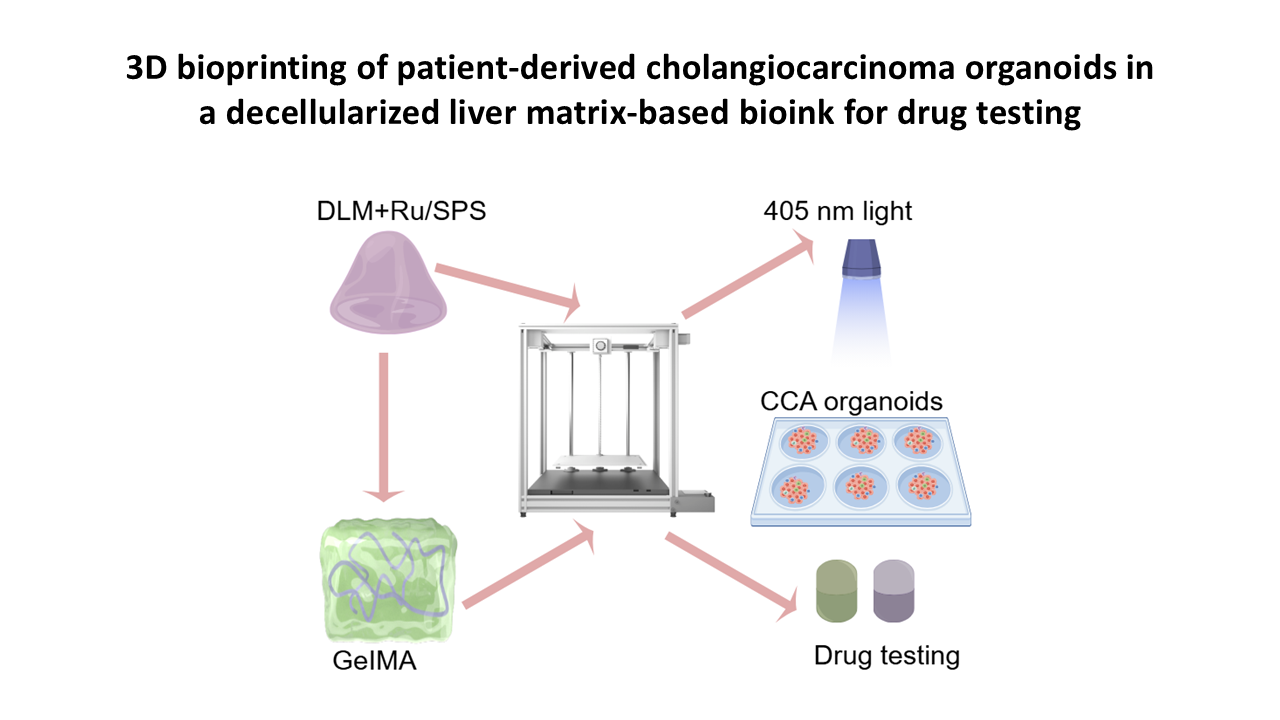
3D bioprinting of patient-derived cholangiocarcinoma organoids in a decellularized liver matrix-based bioink for drug testing

Cholangiocarcinoma (CCA) shows marked interpatient heterogeneity in chemotherapy response, highlighting the need for physiologically relevant, standardized, and reproducible in vitro models for individualized drug screening. However, Matrigel-based organoid models lack hepatobiliary extracellular matrix cues, and many bioprinting strategies rely on dissociated or fragmented organoids, disrupting native architecture and spatial organization. To address these limitations, we developed a composite bioink for direct bioprinting of patient-derived CCA organoid (CCAO) fragments that retained multicellular organization, enabling standardized culture, imaging, and drug-response evaluation. Although decellularized liver matrix (DLM) was used to reconstruct the tissue-specific microenvironment, its weak gelation, poor mechanical properties, and limited printability restricted its application. Tris(2,2’-bipyridyl)ruthenium(II)/sodium persulfate (Ru/SPS) and gelatin methacryloyl (GelMA) were introduced to improve photocrosslinking, mechanical support, and printability. DLM retained key components of the hepatic extracellular matrix, including collagen, fibronectin, laminin, and glycosaminoglycans. With GelMA and Ru/SPS, the bioink achieved rapid visible-light crosslinking (405 nm, 50 seconds), tunable mechanical properties, and good extrusion-printing compatibility. Among the tested formulations, the DLM-Ru/SPS:GelMA (4:1) group showed the best balance of printability, transparency, and organoid-compatible microstructure. Using this optimized bioink, organoid fragments were patterned and reassembled into viable spheroids that retained key CCA features and maintained high viability (>80%). The platform also enabled reproducible assessment of drug response, demonstrating dose-dependent cisplatin sensitivity and enhanced cytotoxicity with cisplatin–gemcitabine treatment. In summary, this study established a DLM-based direct bioprinting platform for CCAOs and a standardized system for individualized therapeutic evaluation.
- Li Z, Zhou H, Xia Z, et al. HMGA1 augments palbociclib efficacy via PI3K/mTOR signaling in intrahepatic cholangiocarcinoma. Biomark Res. 2023;11(1):33. doi: 10.1186/s40364-023-00473-w
- Cao H, Huang T, Dai M, et al. Tumor Microenvironment and its Implications for Antitumor Immunity in Cholangiocarcinoma: Future Perspectives for Novel Therapies. Int J Biol Sci. 2022;18(14):5369-5390. doi: 10.7150/ijbs.73949
- Ilyas SI, Affo S, Goyal L, et al. Cholangiocarcinoma - novel biological insights and therapeutic strategies. Nat Rev Clin Oncol. 2023;20(7):470-486. doi: 10.1038/s41571-023-00770-1
- Serra-Camprubi Q, Verdaguer H, Oliveros W, et al. Human Metastatic Cholangiocarcinoma Patient-Derived Xenografts and Tumoroids for Preclinical Drug Evaluation. Clin Cancer Res. 2023;29(2):432-445. doi: 10.1158/1078-0432.CCR-22-2551
- Wabitsch S, Tandon M, Ruf B, et al. Anti-PD-1 in Combination With Trametinib Suppresses Tumor Growth and Improves Survival of Intrahepatic Cholangiocarcinoma in Mice. Cell Mol Gastroenterol Hepatol. 2021;12(3):1166- 1178. doi: 10.1016/j.jcmgh.2021.05.011
- Lapitz A, Azkargorta M, Milkiewicz P, et al. Liquid biopsy-based protein biomarkers for risk prediction, early diagnosis, and prognostication of cholangiocarcinoma. J Hepatol. 2023;79(1):93-108. doi: 10.1016/j.jhep.2023.02.027
- Cadamuro M, Al-Taee AGonda TA. Advanced endoscopy meets molecular diagnosis of cholangiocarcinoma. J Hepatol. 2023;78(5):1063-1072. doi: 10.1016/j.jhep.2023.01.027
- Zhang N, Sun L, Zhou S, et al. Cholangiocarcinoma PDHA1 succinylation suppresses macrophage antigen presentation via alpha-ketoglutaric acid accumulation. Nat Commun. 2025;16(1):3177. doi: 10.1038/s41467-025-58429-7
- Lin YY, Kuo HH, He ZJ, et al. SLC25A11-mediated reprogramming of mitochondrial redox state and lipid peroxidation confers NRF2-dependent ferroptosis resistance in biliary tract cancer. Cell Mol Biol Lett. 2026;31(1). doi: 10.1186/s11658-025-00843-2
- Liu C, Wang X, Liu E, et al. Deciphering cholangiocarcinoma heterogeneity and specific progenitor cell niche of extrahepatic cholangiocarcinoma at single-cell resolution. J Hematol Oncol. 2025;18(1):66. doi: 10.1186/s13045-025-01716-z
- Feng Y, Zhao M, Wang L, et al. The heterogeneity of signaling pathways and drug responses in intrahepatic cholangiocarcinoma with distinct genetic mutations. Cell Death Dis. 2024;15(1):34. doi: 10.1038/s41419-023-06406-7
- Li S, Yang K, Chen X, et al. Simultaneous 2D and 3D cell culture array for multicellular geometry, drug discovery and tumor microenvironment reconstruction. Biofabrication. 2021;13(4). doi: 10.1088/1758-5090/ac1ea8
- Abuwatfa WH, Pitt WGHusseini GA. Scaffold-based 3D cell culture models in cancer research. J Biomed Sci. 2024;31(1):7. doi: 10.1186/s12929-024-00994-y
- Barozzi DScielzo C. Emerging Strategies in 3D Culture Models for Hematological Cancers. Hemasphere. 2023;7(8):e932. doi: 10.1097/HS9.0000000000000932
- Xiang H, Chen F, Dong Z, et al. A microfluidic tumor-on-chip platform deciphers hypoxia-driven FOXO3a/PD-L1 signaling in gastric cancer immunotherapy resistance. Mater Today Bio. 2025;33:101925. doi: 10.1016/j.mtbio.2025.101925
- Qiao L, Yang G, Deng T, et al. Prophylactic supplementation with biogenic selenium nanoparticles mitigated intestinal barrier oxidative damage through suppressing epithelial-immune crosstalk with gut-on-a-chip. J Adv Res. 2026;80:197-218. doi: 10.1016/j.jare.2025.04.023
- Nguyen OTP, Misun PM, Hierlemann ALohasz C. A Versatile Intestine-on-Chip System for Deciphering the Immunopathogenesis of Inflammatory Bowel Disease. Adv Healthc Mater. 2024;13(7):e2302454. doi: 10.1002/adhm.202302454
- Zheng M, Qu J, Xiang DXing L. Organoids in lung cancer brain metastasis: Foundational research, clinical translation, and prospective outlooks. Biochim Biophys Acta Rev Cancer. 2025;1880(1):189235. doi: 10.1016/j.bbcan.2024.189235
- Li Z, Fu C, Chen Y, et al. D-amino acid oxidase suppresses hepatocellular carcinoma via oxidizing D-amino acids. J Transl Med. 2025;23(1):1359. doi: 10.1186/s12967-025-07399-x
- Di Carlo E. Tumor-on-chip’s alliance with molecular pathology against metastatic disease. J Biomed Sci. 2026;33(1):9. doi: 10.1186/s12929-025-01209-8
- Lu Y, Du L, Sun M, et al. Patient-Derived 3D-Bioprinted Intrahepatic Cholangiocarcinoma Models Recapitulate Tumor Autologous Traits and Predict Personalized Adjuvant Therapy. Adv Sci. 2026;13(22):e22025. doi: 10.1002/advs.202522025
- Zhang X, Jiang W, Wu X, et al. Divide-and-conquer strategy with engineered ossification center organoids for rapid bone healing through developmental cell recruitment. Nat Commun. 2025;16(1):6200. doi: 10.1038/s41467-025-61619-y
- Habib MAKhoda B. Rheological Analysis of Bio-ink for 3D Bio-printing Processes. J Manuf Process. 2022;76:708-718. doi: 10.1016/j.jmapro.2022.02.048
- Debnath S, Agrawal A, Jain N, Chatterjee KPlayer DJ. Collagen as a bio-ink for 3D printing: a critical review. J Mater Chem B. 2025;13(6):1890-1919. doi: 10.1039/d4tb01060d
- Kozlowski MT, Crook CJKu HT. Towards organoid culture without Matrigel. Commun Biol. 2021;4(1):1387. doi: 10.1038/s42003-021-02910-8
- Zhu L, Yuhan J, Yu H, Zhang B, Huang KZhu L. Decellularized Extracellular Matrix for Remodeling Bioengineering Organoid’s Microenvironment. Small. 2023;19(25):e2207752. doi: 10.1002/smll.202207752
- Gan Z, Qin X, Liu H, Liu JQin J. Recent advances in defined hydrogels in organoid research. Bioact Mater. 2023;28:386- 401. doi: 10.1016/j.bioactmat.2023.06.004
- Guo X, Liu B, Zhang Y, et al. Decellularized extracellular matrix for organoid and engineered organ culture. J Tissue Eng. 2024;15:20417314241300386. doi: 10.1177/20417314241300386
- Perin F, Ouyang L, Lim KS, et al. Bioprinted Constructs in the Regulatory Landscape: Current State and Future Perspectives. Adv Mater. 2026;38(4):e04037. doi: 10.1002/adma.202504037
- Xu P, Kankala RK, Wang SChen A. Decellularized extracellular matrix-based composite scaffolds for tissue engineering and regenerative medicine. Regen Biomater. 2024;11:rbad107. doi: 10.1093/rb/rbad107
- Willemse J, van Tienderen G, van Hengel E, et al. Hydrogels derived from decellularized liver tissue support the growth and differentiation of cholangiocyte organoids. Biomaterials. 2022;284:121473. doi: 10.1016/j.biomaterials.2022.121473
- Tabatabaei Rezaei N, Kumar H, Liu H, et al. Bioprinting of hepatic tissue model using photocrosslinkable dECM-containing composite hydrogel. Mater Today Bio. 2025;32:101824. doi: 10.1016/j.mtbio.2025.101824
- Fang W, Yang M, Wang L, et al. Hydrogels for 3D bioprinting in tissue engineering and regenerative medicine: Current progress and challenges. Int J Bioprint. 2023;9(5):759. doi: 10.18063/ijb.759
- Musah SArzaghi H. Unleashing the power of biomaterials to enhance organoid differentiation and function. Nat Methods. 2024;21(9):1575-1577. doi: 10.1038/s41592-024-02393-5
- Liu S, Chen G, Chen Z, Wang FLv Y. Research progress on stiffness controllable scaffolds based on gelatin methacryloyl hydrogels for tissue repair and reconstruction. Int J Biol Macromol. 2025;321:146485. doi: 10.1016/j.ijbiomac.2025.146485
- Zhou M, Lee BH, Tan YJTan LP. Microbial transglutaminase induced controlled crosslinking of gelatin methacryloyl to tailor rheological properties for 3D printing. Biofabrication. 2019;11(2):025011. doi: 10.1088/1758-5090/ab063f
- Hu W, Bei HP, Jiang H, et al. DLM-GelMA/tumor slice sandwich structured tumor on a chip for drug efficacy testing. Lab Chip. 2024;24(15):3718-3727. doi: 10.1039/d4lc00278d
- Wu L, Wu G, Wu D, et al. Stiffness-Tunable Hydrogel Microfluidic Chip Reveals the Role of Stiffness in Cholangiocarcinoma Invasion and Pre-Metastatic Niche Formation. Adv Healthc Mater. 2026;15(9):e03515. doi: 10.1002/adhm.202503515
- Zhou B, Jiang X, Zhou X, et al. GelMA-based bioactive hydrogel scaffolds with multiple bone defect repair functions: therapeutic strategies and recent advances. Biomater Res. 2023;27(1):86. doi: 10.1186/s40824-023-00422-6
- Smits J, van der Pol A, Goumans MJ, Bouten CVCJorba I. GelMA hydrogel dual photo-crosslinking to dynamically modulate ECM stiffness. Front Bioeng Biotechnol. 2024;12:1363525. doi: 10.3389/fbioe.2024.1363525
- Crapo PM, Gilbert TWBadylak SF. An overview of tissue and whole organ decellularization processes. Biomaterials. 2011;32(12):3233-3243. doi: 10.1016/j.biomaterials.2011.01.057
- Pati F, Jang J, Ha DH, et al. Printing three-dimensional tissue analogues with decellularized extracellular matrix bioink. Nat Commun. 2014;5(1):3935. doi: 10.1038/ncomms4935
- Mao Q, Wang Y, Li Y, et al. Fabrication of liver microtissue with liver decellularized extracellular matrix (dECM) bioink by digital light processing (DLP) bioprinting. Mater Sci Eng C. 2020;109:110625. doi: 10.1016/j.msec.2020.110625
- Yu C, Ma X, Zhu W, et al. Scanningless and continuous 3D bioprinting of human tissues with decellularized extracellular matrix. Biomaterials. 2019;194:1-13. doi: 10.1016/j.biomaterials.2018.12.009
- Lim KS, Klotz BJ, Lindberg GCJ, et al. Visible Light Cross- Linking of Gelatin Hydrogels Offers an Enhanced Cell Microenvironment with Improved Light Penetration Depth. Macromol Biosci. 2019;19(6):e1900098. doi: 10.1002/mabi.201900098