
Plant-based food inks and extrusion 3D printing for personalized nutrition

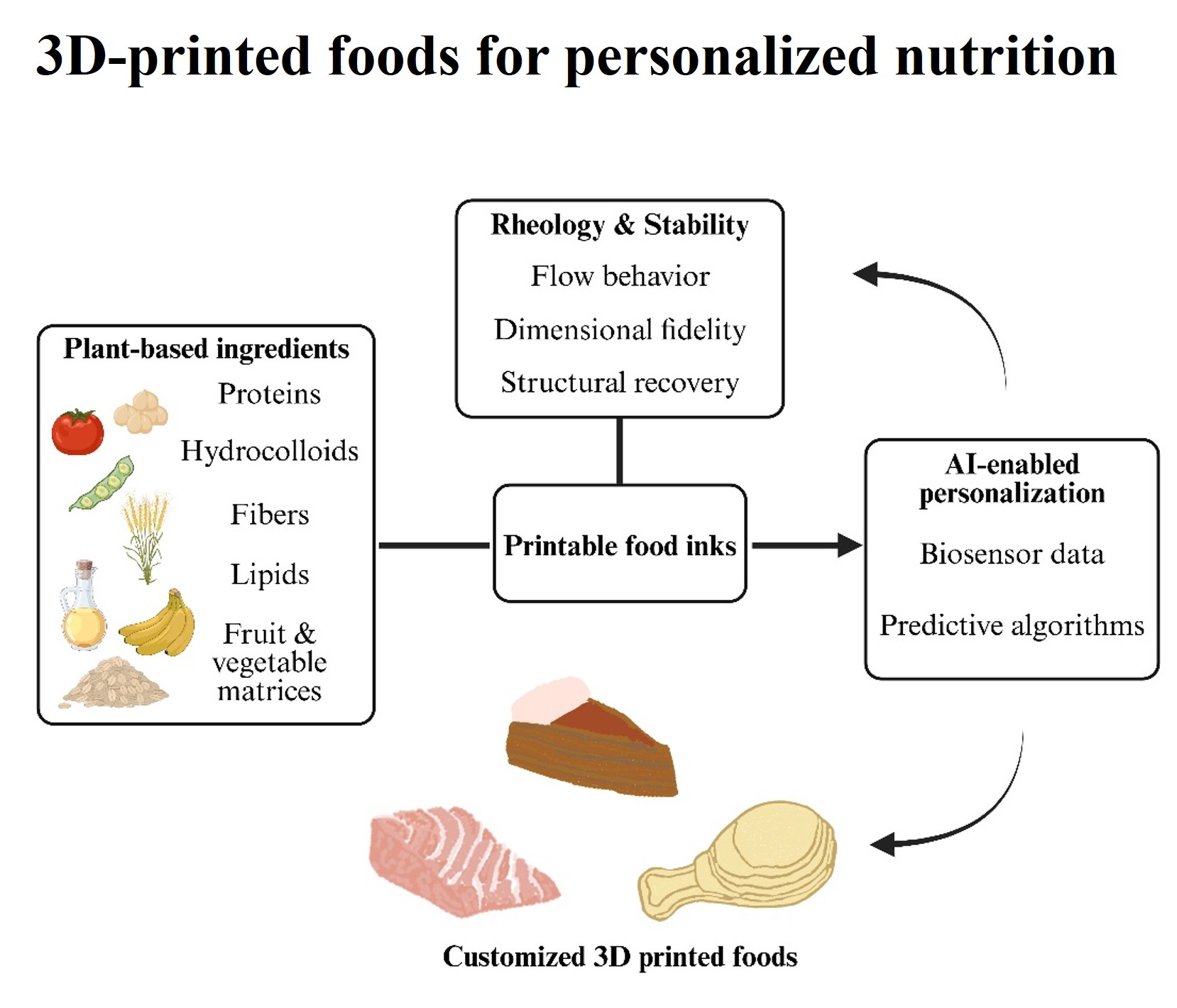
Plant-based food inks are formulations of edible biomaterials derived from plants for printing customized three-dimensional (3D) foods or meals. Extrusion-based 3D food printing has emerged as a promising technique for producing digitally designed meals with tailored geometry, texture, and nutritional composition. These printed structures hold significant potential for personalized nutrition by enabling the development of foods aligned with individual dietary needs, metabolic responses, and sensory preferences. Successful printing and downstream dietary applications depend critically on the functional properties of food inks, including rheological behavior, printability, mechanical stability, and compatibility with nutrient or bioactive incorporation, as well as the selection of printing parameters. This review synthesizes the latest developments in plant-based ingredients and food-grade materials suitable for 3D printing, with emphasis on protein isolates, hydrocolloids, fibers, lipids, and fruit- and vegetable-derived matrices. It further examines advances in 3D food printing technologies and their capacity for customization across shape, texture, and spatial nutrient distribution. The integration of artificial intelligence (AI)-based health monitoring is discussed as an emerging framework for real-time dietary adjustment, leveraging biosensors and predictive algorithms to support precision nutrition. Key consumer, safety, cybersecurity, and regulatory considerations are evaluated to contextualize the broader adoption of AI-guided, 3D-printed personalized meals. Finally, major challenges and future research directions are identified, including the development of next-generation printable materials, the creation of closed-loop AI–printer–sensor platforms, clinical validation for chronic disease management, and strategies to improve sustainability and scalability.
- Zeevi D, Korem T, Zmora N, et al. Personalized Nutrition by Prediction of Glycemic Responses. Cell. 2015;163(5):1079- 1094. doi: 10.1016/j.cell.2015.11.001
- Agrawal K, Goktas P, Kumar N, Leung MF. Artificial intelligence in personalized nutrition and food manufacturing: a comprehensive review of methods, applications, and future directions. Front Nutr. 2025;12. doi: 10.3389/fnut.2025.1636980
- Lee BY, Ordovás JM, Parks EJ, et al. Research gaps and opportunities in precision nutrition: an NIH workshop report. Am J Clin Nutr. 2022;116(6):1877-1900. doi: 10.1093/ajcn/nqac237
- Derossi A, Spence C, Corradini MG, et al. Personalized, digitally designed 3D printed food towards the reshaping of food manufacturing and consumption. NPJ Sci Food. 2024;8(1):54. doi: 10.1038/s41538-024-00296-5
- Sohel A, Sahu S, Mitchell GR, Patel MK. 3D Food Printing: A comprehensive review and critical analysis on technologies, food materials, applications, challenges, and future prospects. Food Eng Rev. 2025;17(2):220-248. doi: 10.1007/s12393-025-09400-1
- Zhong L, Lewis JR, Sim M, et al. Three-dimensional food printing: its readiness for a food and nutrition insecure world. Proc Nutr Soc. 2023;82(4):468-477. doi: 10.1017/S0029665123003002
- Qin Z, Yang Y, Zhang Z, et al. A critical review: Gel-based edible inks for 3D food printing: Materials, rheology– geometry mapping, and control. Gels. 2025;11(10):780. doi: 10.3390/gels11100780
- Kaveti B. Rheological analysis of 3D printed edible food inks. AZoM. June 13, 2022. Accessed March 16, 2026. https:// www.azom.com/article.aspx?ArticleID=21771
- Aparnna VP, Khamrui K, Prasad WG. Rheological properties and printability of a cane sugar added milk solid-based food ink for extrusion 3D printing. J Food Sci Technol. Published online August 6, 2025. doi: 10.1007/s13197-025-06405-w
- Kassem JM, Abdulqahar FW, Zaky AA, et al. Micro and nanoencapsulation of omega-3 fatty acids: Functional applications and future perspectives in food systems. Food Saf Health. 2025;4(2):280-298. doi: 10.1002/fsh3.70071
- Ramdath DD, Lu ZH, Maharaj PL, Winberg J, Brummer Y, Hawke A. Proximate analysis and nutritional evaluation of twenty Canadian lentils by principal component and cluster analyses. Foods. 2020;9(2):175. doi: 10.3390/foods9020175
- Amiri M, Raeisi-Dehkordi H, Sarrafzadegan N, Forbes SC, Salehi-Abargouei A. The effects of Canola oil on cardiovascular risk factors: A systematic review and meta-analysis with dose-response analysis of controlled clinical trials. Nutr Metab Cardiovasc Dis. 2020;30(12):2133-2145. doi: 10.1016/j.numecd.2020.06.007
- Ms Wolever T, Rahn M, Dioum E, et al. An Oat β-Glucan Beverage Reduces LDL Cholesterol and Cardiovascular Disease Risk in Men and Women with Borderline High Cholesterol: A Double-Blind, Randomized, Controlled Clinical Trial. J Nutr. 2021;151(9):2655-2666. doi: 10.1093/jn/nxab154
- Şentürk PK, Stone AK, Candoğan K, Nickerson MT. Assessment of various protein concentrates for suitability in 3D printed plant-based meat analogs for dysphagia diets. Food Measure. 2025;19(12):9909-9923. doi: 10.1007/s11694-025-03619-6
- Qiu L, Zhang M, Adhikari B, Lin J, Luo Z. Preparation and characterization of 3D printed texture-modified food for the elderly using mung bean protein, rose powder, and flaxseed gum. J Food Eng. 2024;361:111750. doi: 10.1016/j.jfoodeng.2023.111750
- Niu D, Zhang M, Mujumdar AS, Li J. Investigation of 3D printing of toddler foods with special shape and function based on fenugreek gum and flaxseed protein. Int J Biol Macromol. 2023;253(Pt 5):127203. doi: 10.1016/j.ijbiomac.2023.127203
- Chen Q, Wu Y, Lin H, et al. 3D-printed flaxseed gum-myofibrillar protein gel for elderly dysphagia: Multi-scale structural modulation via molecular interaction and lycopene release in bionic dynamic digestion. Food Hydrocoll. 2026;172:111927. doi: 10.1016/j.foodhyd.2025.111927
- Ji C, Jiang T, Liu L, Zhang J, You L. Continuous glucose monitoring combined with artificial intelligence: redefining the pathway for prediabetes management. Front Endocrinol (Lausanne). 2025;16:1571362. doi: 10.3389/fendo.2025.1571362
- Wang X, Si J, Li Y, et al. Effectiveness and safety of AI-driven closed-loop systems in diabetes management: a systematic review and meta-analysis. Diabetol Metab Syndr. 2025;17:238. doi: 10.1186/s13098-025-01819-0
- Jin X, Cai A, Xu T, Zhang X. Artificial intelligence biosensors for continuous glucose monitoring. Interdiscip Mater. 2023;2(2):290-307. doi: 10.1002/idm2.12069
- Chakraborty P, Eqbal MdD, Ahmed J. Three-dimensional printing and its application to legume proteins: A review. Legum Sci. 2023;5(2):e172. doi: 10.1002/leg3.172
- Liu X, Blumenthal D, Guénard-Lampron V. From printability to palatability: A sensory and hedonic study of 3D-printed cereal- and legume-based products. Innov Food Sci Emerg Technol. 2025;104:104078. doi: 10.1016/j.ifset.2025.104078
- Chuanxing F, Qi W, Hui L, Quancheng Z, Wang M. Effects of pea protein on the properties of potato starch-based 3D printing materials. Int J Eng Res Appl. 2018;14(3). doi: 10.1016/j.fbio.2023.102994
- Liu Z, Chen X, Ruan M, et al. 3D printed dysphagia diet using pea protein gel modified by xanthan gum with different pyruvate group content. Food Chem X. 2025;25:102121. doi: 10.1016/j.fochx.2024.102121
- Zhu Y, Chen L, Zhang X, et al. 3D-printed pea protein–based dysphagia diet affected by different hydrocolloids. Food Bioprocess Technol. 2024;17(6):1492-1506. doi: 10.1007/s11947-023-03210-1
- Oyinloye TM, Yoon WB. Stability of 3D printing using a mixture of pea protein and alginate: Precision and application of additive layer manufacturing simulation approach for stress distribution. J Food Eng. 2021;288:110127. doi: 10.1016/j.jfoodeng.2020.110127
- Guo J, Zhang M, Adhikari B, Ma Y, Luo Z. Formulation and characterization of 3D printed chickpea protein isolate-mixed cereal dysphagia diet. Int J Biol Macromol. 2023;253:127251. doi: 10.1016/j.ijbiomac.2023.127251
- Lee J, Hong Y, Jang KJ. Investigation of 3D food-printing materials derived from chickpea cooking water (Aquafaba). J Agric Life Environ Sci. 2025;37(2):149-163. doi: 10.22698/jales.20250012
- Tay JU, Oh JLE, Lu Y, Antipina MN, Zhou W, Huang D. 3D printing of prawn mimics with faba proteins: The effects of transglutaminase and curdlan gum on texture. Int J Biol Macromol. 2024;274:133235. doi: 10.1016/j.ijbiomac.2024.133235
- Johansson M, Nilsson K, Knab F, Langton M. Faba bean fractions for 3D printing of protein-, starch- and fibre-rich foods. Processes. 2022;10(3):466. doi: 10.3390/pr10030466
- Wahbi M, Litke Q, Levin D, Liu S, France KJD, Kontopoulou M. Compatibilization of PLA/PBAT blends with epoxidized canola oil for 3D printing applications. Mater Adv. 2024;5(12):5194-5203. doi: 10.1039/D4MA00233D
- Bao Y, Yang T, Jiang H. Effect of 3D printing accuracy by wheat starch gel combined with canola oil. Int J Biol Macromol. 2024;282:136614. doi: 10.1016/j.ijbiomac.2024.136614
- Severini C, Derossi A, Ricci I, Caporizzi R, Fiore A. Printing a blend of fruit and vegetables. New advances on critical variables and shelf life of 3D edible objects. J Food Eng. 2018;220:89-100. doi: 10.1016/j.jfoodeng.2017.08.025
- Bebek Markovinović A, Brdar D, Putnik P, et al. Strawberry tree fruits (Arbutus unedo L.): Bioactive composition, cellular antioxidant activity, and 3D printing of functional foods. Food Chem. 2024;433:137287. doi: 10.1016/j.foodchem.2023.137287
- Kolić I, Halambek J, Bursać Kovačević D, Zavadlav S. Potential Application of Black Goji Berry (Lycium ruthenicum Murray) in 3D Printing of Functional Food. In: AGROSYM Book of Abstracts. 2025:223. Accessed March 19, 2026. https://www.croris.hr/crosbi/publikacija/prilog-skup/902278
- Sundarsingh A, Zhang M, Mujumdar AS, Li J. Research progress in printing formulation for 3D printing of healthy future foods. Food Bioprocess Technol. 2024;17(11):3408- 3439. doi: 10.1007/s11947-023-03265-0
- Tomašević I, Putnik P, Valjak F, et al. 3D printing as novel tool for fruit-based functional food production. Curr Opin Food Sci. 2021;41:138-145. doi: 10.1016/j.cofs.2021.03.015
- Zhao L, Zhang M, Chitrakar B, Adhikari B. Recent advances in functional 3D printing of foods: a review of functions of ingredients and internal structures. Crit Rev Food Sci Nutr. 2021;61(21):3489-3503. doi: 10.1080/10408398.2020.1799327
- Chen DXB. Extrusion Bioprinting of Scaffolds for Tissue Engineering. Cham, Switzerland: Springer International Publishing; 2025. doi: 10.1007/978-3-031-72471-8
- Chen XB, Fazel Anvari-Yazdi A, Duan X, et al. Biomaterials / bioinks and extrusion bioprinting. Bioact Mater. 2023;28:511-536. doi: 10.1016/j.bioactmat.2023.06.006
- Chen XB. Modeling of rotary screw fluid dispensing processes. J Electron Packag. 2007;129(2):172-178. doi: 10.1115/1.2721090
- Chen XB, Kai J. Modeling of positive-displacement fluid dispensing processes. IEEE Trans Compon Packaging Manuf Technol. 2004;27(3):157-163. doi: 10.1109/TEPM.2004.843083
- Ning L, Yang B, Mohabatpour F, et al. Process-induced cell damage: pneumatic versus screw-driven bioprinting. Biofabrication. 2020;12(2):025011. doi: 10.1088/1758-5090/ab5f53
- Sun J, Zhou W, Huang D, Fuh JYH, Hong GS. An overview of 3D printing technologies for food fabrication. Food Bioprocess Technol. 2015;8(8):1605-1615. doi: 10.1007/s11947-015-1528-6
- Liu Z, Zhang M, Bhandari B, Wang Y. 3D printing: Printing precision and application in food sector. Trends Food Sci Technol. 2017;69:83-94. doi: 10.1016/j.tifs.2017.08.018
- Toniazzo T, Leverrier C, Souza NL, Almeida G, Tadini CC, Guenard-Lampron V. Influence of starch-based gels on 3D food printing: Linking printability, texture, rheological properties, and sensory evaluation. Future Foods. 2025;12:100725. doi: 10.1016/j.fufo.2025.100725
- Chao C, Nam HK, Park HJ, Kim HW. Potentials of 3D printing in nutritional and textural customization of personalized food for elderly with dysphagia. Appl Biol Chem. 2024;67(1):25. doi: 10.1186/s13765-023-00854-7
- Yang F, Zhang M, Bhandari B. Recent development in 3D food printing. Crit Rev Food Sci Nutr. 2017;57(14):3145- 3153. doi: 10.1080/10408398.2015.1094732
- Tejada-Ortigoza V, Cuan-Urquizo E. Towards the development of 3D-printed food: A rheological and mechanical approach. Foods. 2022;11(9):1191. doi: 10.3390/foods11091191
- Fu Z, Naghieh S, Xu C, Wang C, Sun W, Chen X. Printability in extrusion bioprinting. Biofabrication. 2021;13(3):033001. doi: 10.1088/1758-5090/abe7ab
- Kadival A, Kour M, Meena D, Mitra J. Extrusion-based 3D food printing: Printability assessment and improvement techniques. Food Bioprocess Technol. 2023;16(5):987-1008. doi: 10.1007/s11947-022-02931-z
- Phuhongsung P, Zhang M, Devahastin S, Mujumdar AS. Defects in 3D/4D food printing and their possible solutions: A comprehensive review. Compr Rev Food Sci Food Saf. 2022;21(4):3455-3479. doi: 10.1111/1541-4337.12984
- Briones SC, Mussagy CU, Farias FO, Córdova A. Functional hydrogels in food applications: A review of crosslinking technologies, encapsulation trends, and emerging challenges. Polymers (Basel). 2025;17(21):2955. doi: 10.3390/polym17212955
- Sarker Md, Chen XB. Modeling the flow behavior and flow rate of medium viscosity alginate for scaffold fabrication with a three-dimensional bioplotter. J Manuf Sci Eng. 2017;139(8):081002. doi: 10.1115/1.4036226
- Chen XB, Li MG, Cao N. Modeling of the fluid volume transferred in contact dispensing processes. IEEE Trans Compon Packaging Manuf Technol. 2009;32(3):133-137. doi: 10.1109/TEPM.2009.2020515
- Li MG, Tian XY, Chen XB. Modeling of flow rate, pore size, and porosity for the dispensing-based tissue scaffolds fabrication. J Manuf Sci Eng. 2009;131(3):034501. doi: 10.1115/1.3123331
- Chen XB, Li MG, Ke H. Modeling of the flow rate in the dispensing-based process for fabricating tissue scaffolds. J Manuf Sci Eng. 2008;130(2):021003. doi: 10.1115/1.2789725
- Chen XB, Ke H. Effects of fluid properties on dispensing processes for electronics packaging. IEEE Trans Compon Packaging Manuf Technol. 2006;29(2):75-82. doi: 10.1109/TEPM.2006.874964
- Dick A, Bhandari B, Dong X, Prakash S. Feasibility study of hydrocolloid incorporated 3D printed pork as dysphagia food. Food Hydrocoll. 2020;107:105940. doi: 10.1016/j.foodhyd.2020.105940
- Sha L, Xiong YL. Plant protein-based alternatives of reconstructed meat: Science, technology, and challenges. Trends Food Sci Technol. 2020;102:51-61. doi: 10.1016/j.tifs.2020.05.022
- Zhang C, Wang CS, Girard M, Therriault D, Heuzey MC. 3D printed protein/polysaccharide food simulant for dysphagia diet: Impact of cellulose nanocrystals. Food Hydrocoll. 2024;148:109455. doi: 10.1016/j.foodhyd.2023.109455
- Zhang J, Liu B, Wang Y, Pan P, Song S, Yu L. Effect of cellulose fibers on the structure, rheological and 3D printing properties of corn starch-based hydrogel ink. Int J Biol Macromol. 2025;306:141443. doi: 10.1016/j.ijbiomac.2025.141443
- Yu Q, Zhang M, Mujumdar AS, Li J. AI-based additive manufacturing for future food: Potential applications, challenges and possible solutions. Innov Food Sci Emerg Technol. 2024;92:103599. doi: 10.1016/j.ifset.2024.103599
- Malekpour A, Chen X. Printability and cell viability in extrusion-based bioprinting from experimental, computational, and machine learning views. J Funct Biomater. 2022;13(2):40. doi: 10.3390/jfb13020040
- Zhu W, Iskandar MM, Baeghbali V, Kubow S. Three-dimensional printing of foods: A critical review of the present state in healthcare applications, and potential risks and benefits. Foods. 2023;12(17):3287. doi: 10.3390/foods12173287
- Chen Z, Qiu Y, Zhang G, et al. Harnessing plant protein-flavor interactions: A new frontier for flavor regulation in 3D-printed plant-based meat. Trends Food Sci Technol. 2026;172:105683. doi: 10.1016/j.tifs.2026.105683
- Arshad A, Zhao J, Sun Y, Li X, Gao K, Liang J. Exploring plant-based materials in 3D printing: Developing sustainable, nutrient-rich inks for personalized nutrition and special dietary needs. J Future Foods. Published online January 31, 2026. doi: 10.1016/j.jfutfo.2026.01.033
- Niu Y, Jin S, Wang Y, Xiao Q. Application of three-dimensional printed food for patients with dysphagia: a scoping review. Eur Arch Otorhinolaryngol. 2026;293(3):1363-1377. doi: 10.1007/s00405-025-09705-1
- Shao J, Zheng Z, Hu J, Sriboonvorakul N, Lin S. 3D-printed foods for dysphagia: A bibliometric review. Foods. 2025;14(12):2058. doi: 10.3390/foods14122058
- Molimi MB, Egan P, Adebo OA. Progress in three-dimensional (3D) printed foods for dysphagia patients: Food sources, processing techniques, printability, nutrition, acceptability, and safety aspects. Food Res Int. 2025;202:115629. doi: 10.1016/j.foodres.2024.115629
- Tsubaki S, Ide A, Slocombe DR, Castell O, Maamoun I, Igura N. Radiofrequency and microwave 3D bioprinting of emulsion gel for dysphagia diets. Sci Rep. 2025;15(1):25023. doi: 10.1038/s41598-025-06804-1
- Dick A, Yong SFY. A case study on implementing a HACCP plan in the production process of 3D-printed beef puree. Food Qual Saf. 2025;9:fyaf034. doi: 10.1093/fqsafe/fyaf034
- Arshad R, Saqib A, Sharif HR, Liaqat A, Xu B. Recent advances in 3D food printing: Therapeutic implications, opportunities, potential applications, and challenges in the food industry. Food Res Int. 2025;203:115791. doi: 10.1016/j.foodres.2025.115791
- Rinshana PF, Murugesan B, Kim YH, Alaguthevar R, Rhim JW. Advances in 3D food printing technology: innovation and applications in the food industry. Food Sci Biotechnol. 2025;34(2):403-421. doi: 10.1007/s10068-024-01779-7
- Chen Y, Bi S, Gu J, et al. Achieving personalized nutrition for patients with diabetic complications via 3D food printing. Int J Bioprint. 2024;0(0):1862. doi: 10.36922/ijb.1862
- Carvajal-Mena N, Tabilo-Munizaga G, Pérez-Won M, Lemus- Mondaca R. Valorization of salmon industry by-products: Evaluation of salmon skin gelatin as a biomaterial suitable for 3D food printing. LWT. 2022;155:112931. doi: 10.1016/j.lwt.2021.112931
- Funami T. Next target for food hydrocolloid studies: Texture design of foods using hydrocolloid technology. Food Hydrocoll. 2011;25(8):1904-1914. doi: 10.1016/j.foodhyd.2011.03.010
- Boldt LJS, Hobbs JE, Lloyd-Smith P, Yang Y. Beyond labels: Exploring consumer preferences for plant-based meat labeling policies. Appl Econ Perspect Policy. 2026;48(1):123- 136. doi: 10.1002/aepp.70013
- Lanz M, Hartmann C, Egan P, Siegrist M. Consumer acceptance of cultured, plant-based, 3D-printed meat and fish alternatives. Future Foods. 2024;9:100297. doi: 10.1016/j.fufo.2024.100297
- Slade P. If you build it, will they eat it? Consumer preferences for plant-based and cultured meat burgers. Appetite. 2018;125:428-437. doi: 10.1016/j.appet.2018.02.030
- Manstan T, McSweeney MB. Consumers’ attitudes towards and acceptance of 3D printed foods in comparison with conventional food products. Int J Food Sci Technol. 2020;55(1):323-331. doi: 10.1111/ijfs.14292
- Caulier S, Doets E, Noort M. An exploratory consumer study of 3D printed food perception in a real-life military setting. Food Qual Prefer. 2020;86:104001. doi: 10.1016/j.foodqual.2020.104001
- Chang MY, Hsia WJ, Chen HS. Breaking conventional eating habits: Perception and acceptance of 3D-printed food among Taiwanese university students. Nutrients. 2024;16(8):1162. doi: 10.3390/nu16081162
- Kamrath C, Wensing J, De Steur H, Bröring S. Explaining the intention to consume 3D-printed food via the food technology acceptance model and trust dynamics. Int J Consum Stud. 2025;49(4):e70081. doi: 10.1111/ijcs.70081
- Yang CX, Baker LM, Mattox A, Diehl D, Honeycutt S. The forgotten factor: Exploring consumer perceptions of artificial intelligence in the food and agriculture systems. Future Foods. 2025;11:100553. doi: 10.1016/j.fufo.2025.100553
- Bi C, Cui X, Sun Z, Jin Y. Thinking AI or feeling AI? The effect of AI on consumers’ willingness to purchase healthy food from the perspective of nudge. Humanit Soc Sci Commun. 2025;12(1):1032. doi: 10.1057/s41599-025-05391-w
- Lusk JL, Briggeman BC. Food values. Am J Agric Econ. 2009;91(1):184-196. doi: 10.1111/j.1467-8276.2008.01175.x
- Yang Y, Hobbs JE. Food values and heterogeneous consumer responses to nanotechnology. Can J Agric Econ. 2020;68(3):289-313. doi: 10.1111/cjag.12225
- Ritota M, Melloni S, Cianfrini G, Narducci V, Ruggeri S, Turfani V. Recent advances in inks for 3D food printing: A Review. Appl Sci (Basel). 2025;15(22). doi: 10.3390/app152211891
- Kok Wah JN. AI-driven 3D and 4D food printing: Innovations for sustainability, personalization, and global applications. Food Rev Int. 2026;42(2):773-801. doi: 10.1080/87559129.2025.2502438
- Bhuiyan MNI, Nahid M. Smart nutrition: AI and 3D printing for personalized diets. Food Nutr. 2025;1(2):100032. doi: 10.1016/j.fnutr.2025.100032