
Modeling, mechanistic analysis, and control strategy for hydrogel extrusion hysteresis in piston-extrusion 3D printing

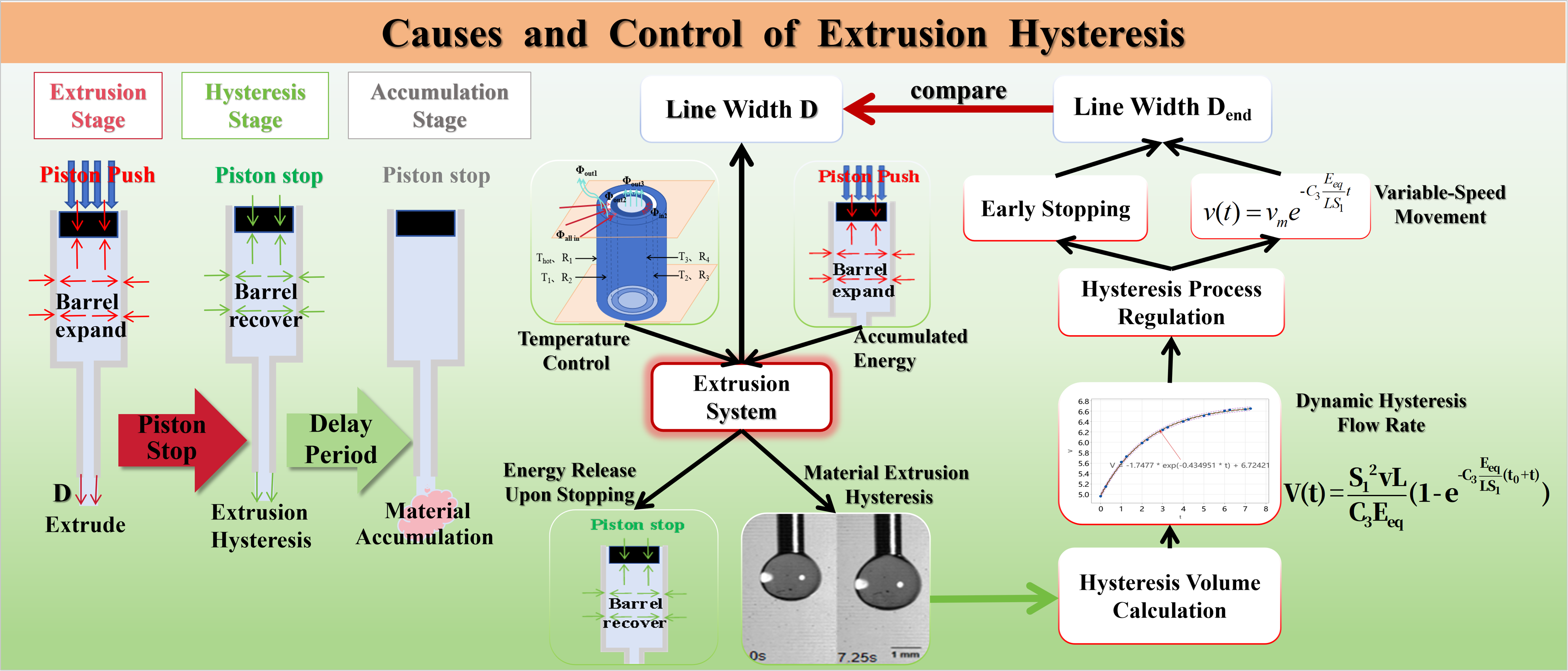
Piston extrusion-based 3D bioprinting is a widely used technology in tissue engineering; however, the phenomenon of extrusion hysteresis severely constrains its printing accuracy. This study investigates the hysteresis mechanism using a low-viscosity gelatin hydrogel as a model material and develops effective control strategies through mathematical modeling. Rheological characterization determined the material’s gelation point (29.8 °C)and the optimal printing temperature window. Subsequently, precise syringe temperature control was achieved using a heat transfer model, which exhibited a low prediction error of only 0.0065 °C. We constructed an extrusion hysteresis model that simultaneously accounts for the elastic deformation of the syringe and the compressibility of the material. A static model derived from mechanical analysis provided a formula for calculating the extrusion hysteresis volume, while a dynamic model revealed that the resulting flow rate follows an exponential decay law. Experimental validation assessed the influences of critical parameters, including piston velocity (0.020–0.030 mm/s), nozzle diameter (0.46–0.75 mm), temperature (30–35 °C), and various material types. The results demonstrated that the compressible model predictions aligned well with experimental data. However, the finest nozzle (0.46 mm) exhibited larger errors, attributed to rapid heat dissipation and increased susceptibility to premature gelation. Based on the dynamic model, we propose a control strategy employing a premature extrusion stop with adjusted movement speed. Printing experiments confirmed that for low-viscosity hydrogels, this strategy reduced accidental deposition in non-printing areas compared to standard retraction (withdrawal) strategies. This research provides a theoretical framework for optimizing the accuracy of piston extrusion systems and advances the mitigation of defects caused by extrusion hysteresis in the 3D printing of low-viscosity hydrogels.
- Richards D, Jia J, Yost M, Markwald R, Mei Y. 3D Bioprinting for Vascularized Tissue Fabrication. Ann Biomed Eng. 2017;45(1):132-147. doi: 10.1007/s10439-016-1653-z
- He P, Zhao JN, Zhang JM, et al. Bioprinting of skin constructs for wound healing. Burns Trauma. 2018;6:10. doi: 10.1186/s41038-017-0104-x
- Daly AC, Critchley SE, Rencsok EM, Kelly DJ. A comparison of different bioinks for 3D bioprinting of fibrocartilage and hyaline cartilage. Biofabrication. 2016;8(4):045002. doi: 10.1088/1758-5090/8/4/045002
- Zhang JH, Wehrle E, Rubert M, Müller R. 3D Bioprinting of Human Tissues: Biofabrication, Bioinks, and Bioreactors. Int J Mol Sci. 2021;22(8):3971. doi: 10.3390/ijms22083971
- Teixeira MC, Singh KK, de Melo BAG, Severino P, Cardoso JC, Souto EB. 3D bioprinting: An innovative technique for biofabrication applied to regenerative medicine and tissue engineering. In: Nanotechnology and Regenerative Medicine. Amsterdam, Netherlands: Elsevier; 2023:195-232. doi: 10.1016/b978-0-323-90471-1.00012-8
- Matai I, Kaur G, Seyedsalehi A, McClinton A, Laurencin CT. Progress in 3D bioprinting technology for tissue/organ regenerative engineering. Biomaterials. 2020;226:119536. doi: 10.1016/j.biomaterials.2019.119536
- Ning LQ, Chen XB. A brief review of extrusion-based tissue scaffold bio-printing. Biotechnol J. 2017;12(8):18. doi: 10.1002/biot.201600671
- Thareja P, Swarupa S, Ahmad S, Jinugu ME. Hydrogel-based inks for extrusion 3D printing: A rheological viewpoint. Curr Opin Colloid Interface Sci. 2025;77:101918. doi: 10.1016/j.cocis.2025.101918
- 3D extrusion bioprinting. Nat Rev Methods Primers. 2021;1(1). doi: 10.1038/s43586-021-00078-3
- Zhou LL, Su SH. Design and Validation of a Piston- Driven Syringe-Extrusion Bioprinter Using an FDM Frame. Biomimetics. 2025;10(12):811. doi: 10.3390/biomimetics10120811
- Sun W, Wan Y. Biomaterials 3D Printing: Technology and Application. Beijing, China: Science Press; 2022:49-71.
- da Fonseca JHL, Corzo IJM, Azoubel RA, et al. Real-time force and rheological measurement for hydrogels 3D bioprinting using a piston-driven extrusion system. Bioprinting. 2025;52:e00446. doi: 10.1016/j.bprint.2025.e00446
- Ramesh S, Harrysson OLA, Rao PK, et al. Extrusion bioprinting: Recent progress, challenges, and future opportunities. Bioprinting. 2021;21. doi: 10.1016/j.bprint.2020.e00116
- Fisch P, Holub M, Zenobi-Wong M. Improved accuracy and precision of bioprinting through progressive cavity pump-controlled extrusion. Biofabrication. 2021;13(1):18. doi: 10.1088/1758-5090/abc39b
- Gómez-Blanco JC, Pagador JB, Galván-Chacón VP, et al. Computational simulation-based comparative analysis of standard 3D printing and conical nozzles for pneumatic and piston-driven bioprinting. Int J Bioprint. 2023;9(4):730. doi: 10.18063/ijb.730
- Woods P, Smith C, Clark S, Habib A. Integrating Pneumatic and Thermal Control in 3D Bioprinting for Improved Bio- Ink Handling. Designs. 2024;8(4):83. doi: 10.3390/designs8040083
- Bonatti AF, Vozzi G, Chua CK, De Maria C. A Deep Learning Quality Control Loop of the Extrusion-based Bioprinting Process. Int J Bioprint. 2022;8(4):620. doi: 10.18063/ijb.v8i4.620
- Moroni L, Boland T, Burdick JA, et al. Biofabrication: A Guide to Technology and Terminology. Trends Biotechnol. 2018;36(4):384-402. doi: 10.1016/j.tibtech.2017.10.015
- Ribeiro A, Blokzijl MM, Levato R, et al. Assessing bioink shape fidelity to aid material development in 3D bioprinting. Biofabrication. 2018;10(1):9. doi: 10.1088/1758-5090/aa90e2
- Cooke ME, Rosenzweig DH. The rheology of direct and suspended extrusion bioprinting. APL Bioeng. 2021;5(1):011502. doi: 10.1063/5.0031475
- Unagolla JM, Jayasuriya AC. Hydrogel-based 3D bioprinting: A comprehensive review on cell-laden hydrogels, bioink formulations, and future perspectives. Appl Mater Today. 2020;18:100479. doi: 10.1016/j.apmt.2019.100479
- Herrada-Manchón H, Fernández MA, Aguilar E. Essential Guide to Hydrogel Rheology in Extrusion 3D Printing: How to Measure It and Why It Matters? Gels. 2023;9(7):21. doi: 10.3390/gels9070517
- Gao T, Gillispie GJ, Copus JS, et al. Optimization of gelatin-alginate composite bioink printability using rheological parameters: a systematic approach. Biofabrication. 2018;10(3):9. doi: 10.1088/1758-5090/aacdc7
- Yin J, Yan ML, Wang YC, Fu JZ, Suo HR. 3D Bioprinting of Low-Concentration Cell-Laden Gelatin Methacrylate (GelMA) Bioinks with a Two-Step Cross-linking Strategy. ACS Appl Mater Interfaces. 2018;10(8):6849-6857. doi: 10.1021/acsami.7b16059
- Zhou Y, Liao SL, Chu YJ, et al. An injectable bioink with rapid prototyping in the air and in-situ mild polymerization for 3D bioprinting. Biofabrication. 2021;13(4):045026. doi: 10.1088/1758-5090/ac23e4
- Palacín-García R, Goñi L, Gómez-del Río T. Exploring the Rheological Properties of 3D Bioprinted Alginate- Based Hydrogels for Tissue Engineering. Biomimetics. 2025;10(8):491. doi: 10.3390/biomimetics10080491
- Schwab A, Levato R, D’Este M, Piluso S, Eglin D, Malda J. Printability and Shape Fidelity of Bioinks in 3D Bioprinting. Chem Rev. 2020;120(19):10850-10877. doi: 10.1021/acs.chemrev.0c00084
- Chen X, Anvari-Yazdi AF, Duan X, et al. Biomaterials / bioinks and extrusion bioprinting. Bioact Mater. 2023;28:511-536. doi: 10.1016/j.bioactmat.2023.06.006
- Ouyang LL, Yao R, Zhao Y, Sun W. Effect of bioink properties on printability and cell viability for 3D bioplotting of embryonic stem cells. Biofabrication. 2016;8(3):12. doi: 10.1088/1758-5090/8/3/035020
- Zhang CL, Elvitigala K, Mubarok W, Okano Y, Sakai S. Machine learning-based prediction and optimisation framework for as-extruded cell viability in extrusion-based 3D bioprinting. Virtual Phys Prototyp. 2024;19(1):e2400330. doi: 10.1080/17452759.2024.2400330
- Gao Q, Yu KC, Chen FZ, Lu LH, Zhang P. Investigation on the Temperature Distribution Uniformity of an Extrusion- Based 3D Print Head and Its Temperature Control Strategy. Pharmaceutics. 2022;14(10):15. doi: 10.3390/pharmaceutics14102108
- Incropera FP, DeWitt DP, Bergman TL, Lavine AS, Ge X, Ye H. Fundamentals of Heat and Mass Transfer. 6th ed. Beijing, China: Chemical Industry Press; 2025:2-9.
- Hibbeler RC, Wang Y. Mechanics of Materials. Beijing, China: Publishing House of Electronics Industry; 2006:89- 94.
- Zhang M, Jing S, Li G. Advanced Engineering Fluid Mechanics. Xi’an, China: Xi’an Jiaotong University Press; 2006:73-78.
- Li BW, Huang CZ, Wang Z, et al. Modeling of Extrusion 3D Bioprinting Precision Considering the Non-Newtonian Rheological Dynamics of Gelatin-Chitosan Hydrogels. ACS Appl Polym Mater. 2025;7(3):1257-1270. doi: 10.1021/acsapm.4c02866
- He Y, Yang FF, Zhao HM, Gao Q, Xia B, Fu JZ. Research on the printability of hydrogels in 3D bioprinting. Sci Rep. 2016;6:13. doi: 10.1038/srep29977