
Low-density ZIF-8 coating optimizes the immune microenvironment of 3D-printed PCL scaffolds and promotes cranial defect repair

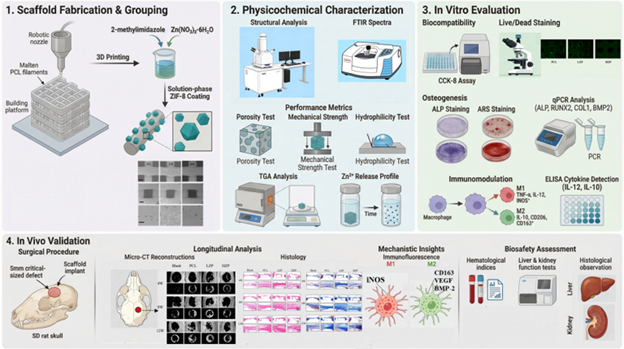
The hydrophobicity of 3D-printed polycaprolactone (PCL) scaffolds leads to insufficient cell adhesion, limiting their application in bone repair. This study constructed zeolitic imidazolate framework-8 (ZIF-8) modified PCL scaffolds with different coating densities and systematically evaluated their physicochemical properties and osteogenic effects. The results showed that low-density ZIF-8-coated PCL scaffolds exhibited better biocompatibility and osteogenic differentiation promotion capacity, while maintaining structural stability and mechanical properties. Mechanistically, the low-density coating can induce macrophages toward M2 polarization, thereby forming a more favorable osteogenic immune microenvironment. Simultaneously, in a rat skull defect model, this scaffold significantly promoted new bone regeneration and defect repair. This study indicates that ZIF-8 coating density is a key parameter affecting the immunomodulatory osteogenic efficacy of PCL scaffolds, providing a basis for the design and optimization of metal–organic framework-based coated scaffolds.
- Zhao Y, Wang J, Xu L, et al. Beyond Bone Loss: A Biology Perspective on Osteoporosis Pathogenesis, Multi-Omics Approaches, and Interconnected Mechanisms. Biomedicines. 2025;13(6):1443. doi: 10.3390/biomedicines13061443
- Zhang Y, Wang Y, Ning X, et al. Guided Bone Regeneration Membrane Materials Loaded with Chimeric Nanovesicles Promote Early Bone Defect Regeneration. Adv Healthc Mater. 2025;14(32):e01323. doi: 10.1002/adhm.202501323
- Gillman CE, Jayasuriya AC. FDA-approved bone grafts and bone graft substitute devices in bone regeneration. Mater Sci Eng C Mater Biol Appl. 2021;130:112466. doi: 10.1016/j.msec.2021.112466
- Zhang J, Li S, He H, et al. Clinical guidelines for indications, techniques, and complications of autogenous bone grafting. Chin Med J (Engl). 2024;137(1):5-7. doi: 10.1097/CM9.0000000000002691
- Hofmann GH, Sarsour R, Deursen WV, et al. Immune rejection of orthopedic tissue allograft scoping review: Are we missing a cause of graft/procedural failure? Current concepts. J ISAKOS. 2025;15:101002. doi: 10.1016/j.jisako.2025.101002
- Łuczak JW, Palusińska M, Matak D, et al. The Future of Bone Repair: Emerging Technologies and Biomaterials in Bone Regeneration. Int J Mol Sci. 2024;25(23):12766. doi: 10.3390/ijms252312766
- Xu C, Cheng P, Wang J, et al. Unveiling the Power of Magnetic-Driven Regenerative Medicine: Bone Regeneration and Functional Reconstruction. Research (Wash D C). 2025;8:0707. doi: 10.34133/research.0707
- Przekora A, Kazimierczak P, Wojcik M. Ex vivo determination of chitosan/curdlan/hydroxyapatite biomaterial osseointegration with the use of human trabecular bone explant: New method for biocompatibility testing of bone implants reducing animal tests. Mater Sci Eng C Mater Biol Appl. 2021;119:111612. doi: 10.1016/j.msec.2020.111612
- Filip Ionescu OL, Mocanu AG, Neacşu IA, Ciocîlteu MV, Rău G, Neamţu J. Biocompatibility Studies on a Collagen-Hydroxyapatite Biomaterial. Curr Health Sci J. 2022;48(2):217-225. doi: 10.12865/CHSJ.48.02.12
- Zhang M, Wan B, Sun M, et al. Harnessing Immunomodulation: How Calcium Phosphate Biomaterials Orchestrate Bone Regeneration. Tissue Eng Part A. Published online June 24, 2025. doi: 10.1089/ten.tea.2025.0091
- Jin C, Liang J, Wu J, et al. Temporal Immunomodulatory Hydrogel Regulating the Immune-Osteogenic Cascade for Infected Bone Defects Regeneration. Adv Mater. 2026;38(2):e14419. doi: 10.1002/adma.202514419
- Qin D, Zhao Y, Cheng R, et al. Mussel-inspired immunomodulatory and osteoinductive dual-functional hydroxyapatite nanoplatform for promoting bone regeneration. J Nanobiotechnology. 2024;22(1):320. doi: 10.1186/s12951-024-02593-3
- Chen K, Luo L, Tao R, et al. 3D-Printed PCL/SrHA@DFO Bone Tissue Engineering Scaffold with Bone Regeneration and Vascularization Function. ACS Appl Bio Mater. 2025;8(2):1684-1698. doi: 10.1021/acsabm.4c01866
- Shen S, Shu B, Xu Y, et al. Characterization and Biocompatibility Assessment of 3D-Printed HA/PCL Porous Bionic Bone Scaffold: in Vitro and in Vivo Evaluation. J Musculoskelet Neuronal Interact. 2025;25(1):119-132. doi: 10.22540/JMNI-25-119
- Deshpande MV, Girase A, King MW. Degradation of Poly(ε-caprolactone) Resorbable Multifilament Yarn under Physiological Conditions. Polymers (Basel). 2023;15(18):3819. doi: 10.3390/polym15183819
- Robles KN, Zahra FT, Mu R, Giorgio T. Advances in Electrospun Poly(ε-caprolactone)-Based Nanofibrous Scaffolds for Tissue Engineering. Polymers (Basel). 2024;16(20):2853. doi: 10.3390/polym16202853
- Huang K, Li Q, Liu Y, et al. 3D-printed functionalized strontium-silk fibroin-hydroxyapatite scaffolds facilitate bone regeneration via immunomodulatory and sequential angiogenic-osteogenic coupling. Bioact Mater. 2025;55:271- 289. doi: 10.1016/j.bioactmat.2025.09.033
- Mousavi Nejad Z, Zamanian A, Saeidifar M, Vanaei HR, Salar Amoli M. 3D Bioprinting of Polycaprolactone-Based Scaffolds for Pulp-Dentin Regeneration: Investigation of Physicochemical and Biological Behavior. Polymers (Basel). 2021;13(24):4442. doi: 10.3390/polym13244442
- Itatani M, Német N, Valletti N, et al. Synthesis of Zeolitic Imidazolate Framework-8 Using Glycerol Carbonate. ACS Sustain Chem Eng. 2023;11(35):13043-13049. doi: 10.1021/acssuschemeng.3c02876
- Ejeian F, Razmjou A, Nasr-Esfahani MH, et al. ZIF-8 Modified Polypropylene Membrane: A Biomimetic Cell Culture Platform with a View to the Improvement of Guided Bone Regeneration. Int J Nanomedicine. 2020;15:10029- 10043. doi: 10.2147/IJN.S269169
- Chen J, Zhang X, Huang C, et al. Osteogenic activity and antibacterial effect of porous titanium modified with metal-organic framework films. J Biomed Mater Res A. 2017;105(3):834-846. doi: 10.1002/jbm.a.35960
- Liu Y, Wang L, Dou X, et al. Osteogenesis or Apoptosis- Twofold Effects of Zn2+ on Bone Marrow Mesenchymal Stem Cells: An In Vitro and In Vivo Study. ACS Omega. 2024;9(9):10945-10957. doi: 10.1021/acsomega.3c10344
- Tian X, Zhang P, Xu J. Incorporating zinc ion into titanium surface promotes osteogenesis and osteointegration in implantation early phase. J Mater Sci Mater Med. 2023;34(11):55. doi: 10.1007/s10856-023-06751-1
- Lin J, Huang L, Ou H, Chen A, Xiang R, Liu Z. Effects of ZIF-8 MOFs on structure and function of blood components. RSC Adv. 2021;11(35):21414-21425. doi: 10.1039/d1ra02873a
- Si Y, Li X, Dong S, et al. Hydrogel scaffold encapsulating MSC-Exos and ZIF-8 promotes bone regeneration via coordinating osteogenesis and immunomodulation. Bioact Mater. 2025;54:329-351. doi: 10.1016/j.bioactmat.2025.08.026
- Johari SA, Sarkheil M, Veisi S. Cytotoxicity, oxidative stress, and apoptosis in human embryonic kidney (HEK293) and colon cancer (SW480) cell lines exposed to nanoscale zeolitic imidazolate framework 8 (ZIF-8). Environ Sci Pollut Res Int. 2021;28(40):56772-56781. doi: 10.1007/s11356-021-14636-5
- Yang C, Wen J, Xue Z, Yin X, Li Y, Yuan L. The accumulation and toxicity of ZIF-8 nanoparticles in Corbicula fluminea. J Environ Sci (China). 2023;127:91-101. doi: 10.1016/j.jes.2022.03.020
- Zhang X, Zhang X, Li Y, Zhang Y. Applications of Light- Based 3D Bioprinting and Photoactive Biomaterials for Tissue Engineering. Materials (Basel). 2023;16(23):7461. doi: 10.3390/ma16237461
- Wang T, Yang X, Qi X, Jiang C. Osteoinduction and proliferation of bone-marrow stromal cells in three-dimensional poly (ε-caprolactone)/ hydroxyapatite/collagen scaffolds. J Transl Med. 2015;13:152. doi: 10.1186/s12967-015-0499-8
- Zhong L, Chen J, Ma Z, et al. 3D printing of metal-organic framework incorporated porous scaffolds to promote osteogenic differentiation and bone regeneration. Nanoscale. 2020;12(48):24437-24449. doi: 10.1039/d0nr06297a
- Wang Z, Fu Q, Xie D, Wang F, Zhang G, Shan H. Facile Fabrication of Zeolitic Imidazolate Framework-8@ Regenerated Cellulose Nanofibrous Membranes for Effective Adsorption of Tetracycline Hydrochloride. Molecules. 2024;29(17):4146. doi: 10.3390/molecules29174146
- Zhao J, Fan R, Xiang S, Hu J, Zheng X. Preparation and Lithium-Ion Separation Property of ZIF-8 Membrane with Excellent Flexibility. Membranes (Basel). 2023;13(5):500. doi: 10.3390/membranes13050500
- Mateu-Sanz M, Fuenteslópez CV, Uribe-Gomez J, et al. Redefining biomaterial biocompatibility: challenges for artificial intelligence and text mining. Trends Biotechnol. 2024;42(4):402-417. doi: 10.1016/j.tibtech.2023.09.015
- Frazão LP, Vieira de Castro J, Neves NM. In Vivo Evaluation of the Biocompatibility of Biomaterial Device. In: Advances in Experimental Medicine and Biology. Vol 1250. Singapore: Springer; 2020:109-124. doi: 10.1007/978-981-15-3262-7_8
- Hernández-Cubas LL, Sánchez-Moreno P, Capasso A, et al. Laser-Induced Graphene Interfaces with Controlled Electrical Conductivity, Topography and Wettability for Biomedical Applications. ACS Appl Nano Mater. 2025;8(51):24610-24622. doi: 10.1021/acsanm.5c05398
- Nelson CL, Castellion CA, Humpal AP, et al. Glycosaminoglycan-Inspired Polymer Brushes Promote Human Mesenchymal Stem Cell Proliferation While Retaining Trilineage Differentiation Potential. ACS Appl Mater Interfaces. 2026;18(3):4952-4966. doi: 10.1021/acsami.5c23781
- Na W, Kang MK, Park SH, et al. Aesculetin Accelerates Osteoblast Differentiation and Matrix-Vesicle-Mediated Mineralization. Int J Mol Sci. 2021;22(22):12391. doi: 10.3390/ijms222212391
- Bernar A, Gebetsberger JV, Bauer M, Streif W, Schirmer M. Optimization of the Alizarin Red S Assay by Enhancing Mineralization of Osteoblasts. Int J Mol Sci. 2022;24(1):723. doi: 10.3390/ijms24010723
- Wytrwal-Sarna M, Sekuła-Stryjewska M, Pomorska A, et al. The Effect of the Topmost Layer and the Type of Bone Morphogenetic Protein-2 Immobilization on the Mesenchymal Stem Cell Response. Int J Mol Sci. 2022;23(16):9287. doi: 10.3390/ijms23169287
- Park KR, Kim S, Cho M, Yun HM. Limonoid Triterpene, Obacunone Increases Runt-Related Transcription Factor 2 to Promote Osteoblast Differentiation and Function. Int J Mol Sci. 2021;22(5):2483. doi: 10.3390/ijms22052483
- Ansari S, Ito K, Hofmann S. Alkaline Phosphatase Activity of Serum Affects Osteogenic Differentiation Cultures. ACS Omega. 2022;7(15):12724-12733. doi: 10.1021/acsomega.1c07225
- Akhir HM, Teoh PL. Collagen type I promotes osteogenic differentiation of amniotic membrane-derived mesenchymal stromal cells in basal and induction media. Biosci Rep. 2020;40(12):BSR20201325. doi: 10.1042/BSR20201325
- Yuan X, Wu T, Lu T, Ye J. Si and Zn dual ions upregulate the osteogenic differentiation of mBMSCs: mRNA transcriptomic sequencing analysis. J Mater Sci Mater Med. 2024;35(1):54. doi: 10.1007/s10856-024-06825-8
- Balogh E, Tóth A, Csiki DM, Jeney V. Zinc Ameliorates High Pi and Ca-Mediated Osteogenic Differentiation of Mesenchymal Stem Cells. Nutrients. 2024;16(23):4012. doi: 10.3390/nu16234012
- Weitzmann MN. Bone and the Immune System. Toxicol Pathol. 2017;45(7):911-924. doi: 10.1177/0192623317735316
- He J, Chen G, Liu M, et al. Scaffold strategies for modulating immune microenvironment during bone regeneration. Mater Sci Eng C Mater Biol Appl. 2020;108:110411. doi: 10.1016/j.msec.2019.110411
- Xu Z, Wu L, Tang Y, et al. Spatiotemporal Regulation of the Bone Immune Microenvironment via Dam-Like Biphasic Bionic Periosteum for Bone Regeneration. Adv Healthc Mater. 2023;12(1):e2201661. doi: 10.1002/adhm.202201661
- Li M, Chu X, Wang D, et al. Tuning the surface potential to reprogram immune microenvironment for bone regeneration. Biomaterials. 2022;282:121408. doi: 10.1016/j.biomaterials.2022.121408
- Zhang F, Lv M, Wang S, et al. Ultrasound-triggered biomimetic ultrashort peptide nanofiber hydrogels promote bone regeneration by modulating macrophage and the osteogenic immune microenvironment. Bioact Mater. 2023;31:231-246. doi: 10.1016/j.bioactmat.2023.08.008
- Lin X, Liu C, Lei Y, et al. Cichoric acid-loaded hydroxyapatite nanorods remodel the immune microenvironment to enhance bone regeneration. Phytomedicine. 2026;150:157701. doi: 10.1016/j.phymed.2025.157701
- Yi L, Tang R, Shao C, et al. A Biodegradable Zinc Alloy Membrane with Regulation of Macrophage Polarization for Early Vascularized Bone Regeneration. Biomater Res. 2025;29:0223. doi: 10.34133/bmr.0223
- Zheng H, Yan P, Liu P, et al. Ultrasound-activated piezoelectric scaffolds target dual Ca2+/NF-κB signaling pathways to orchestrate immunomodulation and osteogenesis for accelerated bone regeneration. Mater Today Bio. 2025;35:102299. doi: 10.1016/j.mtbio.2025.102299
- Shen H, Shi J, Zhi Y, et al. Improved BMP2-CPC-stimulated osteogenesis in vitro and in vivo via modulation of macrophage polarization. Mater Sci Eng C Mater Biol Appl. 2021;118:111471. doi: 10.1016/j.msec.2020.111471
- Parco TM, Wagner JD, Parbhoo P, et al. Comprehensive evaluation of critical-size calvarial defect in athymic rat model. Front Physiol. 2025;16:1662424. doi: 10.3389/fphys.2025.1662424
- Banu SA, Manjusha KM, Mamachan M, Sharun K. From flat bones to functional healing: redefining rodent calvarial defect models for translational bone regeneration research. Ann Med Surg (Lond). 2025;87(10):6382-6385. doi: 10.1097/MS9.0000000000003528
- Griesbach JK, Schulte FA, Schädli GN, Rubert M, Müller R. Mechanoregulation analysis of bone formation in tissue engineered constructs requires a volumetric method using time-lapsed micro-computed tomography. Acta Biomater. 2024;179:149-163. doi: 10.1016/j.actbio.2024.03.008
- Timmerman G, Van Goethem A, Docter D, et al. Evaluating micro-computed tomography for investigation of the pediatric hyoid-larynx complex. Pediatr Radiol. 2025;55(10):2138-2147. doi: 10.1007/s00247-025-06364-6
- Song D, Xu P, Liu S, Wu S. Dental pulp stem cells expressing SIRT1 improve new bone formation during distraction osteogenesis. Am J Transl Res. 2019;11(2):832-843.
- Seo SJ, Lim JH, Lee Y, Bark CW, Kim YG. High-Throughput Analysis of New Bone Formation and Bone Substitutes After Maxillary Sinus Floor Elevation Using Synchrotron Radiation Micro-Computed Tomography. J Nanosci Nanotechnol. 2019;19(2):680-686. doi: 10.1166/jnn.2019.15906
- Su Y, Ye B, Zeng L, et al. Small Intestinal Submucosa Biomimetic Periosteum Promotes Bone Regeneration. Membranes (Basel). 2022;12(7):719. doi: 10.3390/membranes12070719
- Yang Y, Chen D, Li Y, et al. Effect of Puerarin on Osteogenic Differentiation in vitro and on New Bone Formation in vivo. Drug Des Devel Ther. 2022;16:2885-2900. doi: 10.2147/DDDT.S379794
- Yuan Y, Xu Y, Mao Y, et al. Three Birds, One Stone: An Osteo-Microenvironment Stage-Regulative Scaffold for Bone Defect Repair through Modulating Early Osteo- Immunomodulation, Middle Neovascularization, and Later Osteogenesis. Adv Sci (Weinh). 2024;11(6):e2306428. doi: 10.1002/advs.202306428
- Chavanisakun C, Keawvichit R, Benjakul N. M1 and M2 Macrophage Polarization Correlates with Activity and Chronicity Indices in Lupus Nephritis. Life (Basel). 2025;15(1):55. doi: 10.3390/life15010055
- Xu J, Chen X, Zhang H, et al. Platelet-rich plasma relieves inflammation and pain by regulating M1/M2 macrophage polarization in knee osteoarthritis rats. Sci Rep. 2025;15(1):12805. doi: 10.1038/s41598-025-97501-6
- Lee JB, Hong JY, Shim H, et al. Bone morphogenetic protein- 2-derived osteogenic peptide promotes bone regeneration via osteoblastogenesis. Regen Ther. 2025;30:911-919. doi: 10.1016/j.reth.2025.09.006