
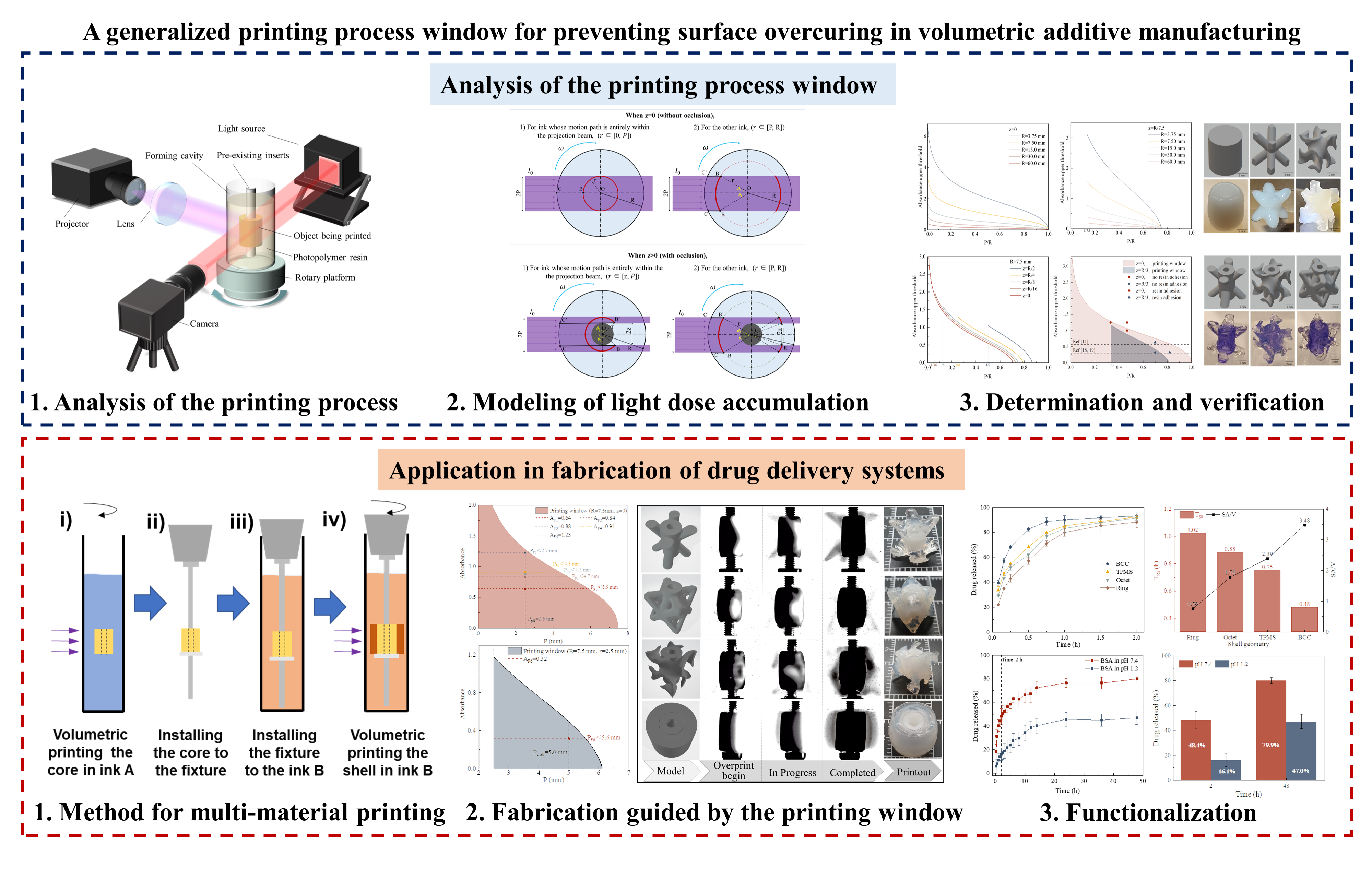
A generalized printing process window for preventing surface overcuring in volumetric additive manufacturing

Surface overcuring in volumetric additive manufacturing (VAM) occurs when material, process, and hardware parameters are not properly coordinated, leading to unintended polymerization near the vat boundary and impaired printability. Here, we develop a generalized theoretical model to predict the spatial light-dose distribution within rotating ink and to investigate the effects of key physical parameters, including projection beam size, vat dimensions, occlusion size, and material absorbance, on the onset of surface overcuring. The results show that this defect can be effectively suppressed through the synergistic regulation of these parameters. Specifically, lower material absorbance, smaller vat diameters, and narrower projection beams concentrate higher light energy in the central region of the vat while reducing energy deposition near the sidewalls, thereby promoting earlier solidification in the target region and preventing surface overcuring. Based on this model, a printing process window for suppressing surface overcuring is established as a quantitative guide for the design and fabrication of complex structures by VAM. The practical utility of this process window is further demonstrated through the successful fabrication of functional pH-responsive single- and multi-material drug delivery systems with controllable drug-release profiles. Overall, this study expands the printable design space of VAM for complex three-dimensional structures and provides a practical framework for more advanced applications.
- Whyte DJ, Doeven EH, Sutti A, Kouzani AZ, Adams SD. Volumetric additive manufacturing: A new frontier in layer-less 3D printing. Addit Manuf. 2024;84:104094. doi: 10.1016/j.addma.2024.104094
- Kollep M, Konstantinou G, Madrid-Wolff J, et al. Tomographic volumetric additive manufacturing of silicon oxycarbide ceramics. Adv Eng Mater. 2022;24(7):2101345. doi: 10.1002/adem.202101345
- Bernal PN, Bouwmeester M, Madrid-Wolff J, et al. Volumetric bioprinting of organoids and optically tuned hydrogels to build liver-like metabolic biofactories. Adv Mater. 2022;34(15):2110054. doi: 10.1002/adma.202110054
- Toombs JT, Luitz M, Cook CC, et al. Volumetric additive manufacturing of silica glass with microscale computed axial lithography. Science. 2022;376(6590):308-312. doi: 10.1126/science.abm6459
- Safari H, Hedayati SK, Islam A, Yang Y. Upscaling tomographic volumetric 3D printing via virtual stitching of coordinated projections. arXiv. Preprint posted 2025. doi: 10.48550/arXiv.2510.07981
- Zhu Y, Nipu SMA, Chen S, Li X. Linear volumetric additive manufacturing of polymer structures via light initiated direct growth. Light Adv Manuf. 2025;6(4):63. doi: 10.37188/lam.2025.063
- Behravesh AH, Tariq A, Buni J, Rizvi G. Computed tomography-based volumetric additive manufacturing: Development of a model based on resin properties and part size interrelationship—Part I. J Manuf Mater Process. 2025;9(6):178. doi: 10.3390/jmmp9060178
- Madrid-Wolff J, Boniface A, Loterie D, Delrot P, Moser C. Controlling light in scattering materials for volumetric additive manufacturing. Adv Sci. 2022;9(22):2105144. doi: 10.1002/advs.202105144
- Xie M, Lian L, Mu X, et al. Volumetric additive manufacturing of pristine silk-based (bio)inks. Nat Commun. 2023;14(1):210. doi: 10.1038/s41467-023-35807-7
- Kelly BE, Bhattacharya I, Heidari H, Shusteff M, Spadaccini CM, Taylor HK. Volumetric additive manufacturing via tomographic reconstruction. Science. 2019;363(6431):1075- 1079. doi: 10.1126/science.aau7114
- Thijssen Q, Toombs J, Li CC, Taylor H, Van Vlierberghe S. From pixels to voxels: A mechanistic perspective on volumetric 3D-printing. Prog Polym Sci. 2023;147:101755. doi: 10.1016/j.progpolymsci.2023.101755
- Bernal PN, Delrot P, Loterie D, et al. Volumetric bioprinting of complex living-tissue constructs within seconds. Adv Mater. 2019;31(42):1904209. doi: 10.1002/adma.201904209
- Chen T, You S, Xu L, et al. High-fidelity tomographic additive manufacturing for large-volume and high-attenuation situations using expectation maximization algorithm. Addit Manuf. 2024;80:103968. doi: 10.1016/j.addma.2024.103968
- Salajeghe R, Garmshausen Y, Arzhangnia Y, et al. A numerical framework for modeling the Xolography additive manufacturing method. Addit Manuf. 2025;113:105006. doi: 10.1016/j.addma.2025.105006
- Kelly B, Bhattacharya I, Shusteff M, Panas RM, Taylor HK, Spadaccini CM. Computed axial lithography (CAL): Toward single step 3D printing of arbitrary geometries. arXiv. Preprint published online 2017. doi: 10.48550/arXiv.1705.05893
- Regehly M, Garmshausen Y, Reuter M, et al. Xolography for linear volumetric 3D printing. Nature. 2020;588(7839):620- 624. doi: 10.1038/s41586-020-3029-7
- Loterie D, Delrot P, Moser C. High-resolution tomographic volumetric additive manufacturing. Nat Commun. 2020;11(1):852. doi: 10.1038/s41467-020-14630-4
- Zhang Y, Houlahan K, Webber D, et al. Advancing tomographic volumetric printing via oxygen inhibition control: Improved accuracy and large-volume capability. Adv Mater. 2025;37(47):e08729. doi: 10.1002/adma.202508729
- Zhang Y, De Haan H, Houlahan K, et al. Impact of oxygen inhibition on (meth)acrylate photopolymerization in tomographic volumetric printing. Addit Manuf. 2025;109:104844. doi: 10.1016/j.addma.2025.104844
- Pazhamannil RV, Govindan P, Edacherian A. Optimized projections and dose slices for the volumetric additive manufacturing of three dimensional objects. Mater Today Proc. 2021;44:922-925. doi: 10.1016/j.matpr.2020.10.807
- Webber D, Zhang Y, Picard M, Boisvert J, Paquet C, Orth A. Versatile volumetric additive manufacturing with 3D ray tracing. Opt Express. 2023;31(4):5531-5544. doi: 10.1364/OE.481318
- Wang F, Li L, Zhu X, Chen F, Han X. Development of pH-responsive polypills via semi-solid extrusion 3D printing. Bioengineering. 2023;10(4):402. doi: 10.3390/bioengineering10040402
- Lin P, Liu L, He G, et al. Preparation and properties of carboxymethyl chitosan/oxidized hydroxyethyl cellulose hydrogel. Int J Biol Macromol. 2020;162:1692-1698. doi: 10.1016/j.ijbiomac.2020.07.282
- Wu IY, Bala S, Škalko-Basnet N, Di Cagno MP. Interpreting non-linear drug diffusion data: Utilising Korsmeyer-Peppas model to study drug release from liposomes. Eur J Pharm Sci. 2019;138:105026. doi: 10.1016/j.ejps.2019.105026
- Lotfy VF, Basta AH. Optimizing the chitosan-cellulose based drug delivery system for controlling the ciprofloxacin release versus organic/inorganic crosslinker, characterization and kinetic study. Int J Biol Macromol. 2020;165:1496-1506. doi: 10.1016/j.ijbiomac.2020.10.047
- Darkes-Burkey C, Shepherd RF. Volumetric 3D printing of endoskeletal soft robots. Adv Mater. 2024;36(33):2402217. doi: 10.1002/adma.202402217
- Pellizzon N, Šeta B, Kruse CS, Salajeghe R, Spangenberg J. Investigating thermal strains and chemical shrinkage in tomographic volumetric additive manufacturing. Addit Manuf. 2025;105:104781. doi: 10.1016/j.addma.2025.104781
- Salajeghe R, Meile DH, Kruse CS, Marla D, Spangenberg J. Numerical modeling of part sedimentation during volumetric additive manufacturing. Addit Manuf. 2023;66:103459. doi: 10.1016/j.addma.2023.103459
- Ribezzi D, Gueye M, Florczak S, et al. Shaping synthetic multicellular and complex multi-material tissues via embedded extrusion-volumetric printing of microgels. Adv Mater. 2023;35(36):2301673. doi: 10.1002/adma.202301673
- Riffe MB, Davidson MD, Seymour G, et al. Multi-material volumetric additive manufacturing of hydrogels using gelatin as a sacrificial network and 3D suspension bath. Adv Mater. 2024;36(34):2309026. doi: 10.1002/adma.202309026
- Ji Y, Su E, Yee D. Volumetric additive manufacturing of composites via hydrogel infusion. ACS Mater Lett. 2025;7(8):1021-1030. doi: 10.1021/acsmaterialslett.5c00407
- Weisgraber TH, de Beer MP, Huang S, et al. Virtual Volumetric Additive Manufacturing (VirtualVAM). Adv Mater Technol. 2023;8(23):2301054. doi: 10.1002/admt.202301054
- Lü JQ, Sun JS, Jia RP, et al. Erosion-free penalty minimization optimization for high-fidelity computed axial lithography. Addit Manuf. 2025;111:104990. doi: 10.1016/j.addma.2025.104990
- Bami MS, Raeisi Estabragh MA, Khazaeli P, Ohadi M, Dehghannoudeh G. pH-responsive drug delivery systems as intelligent carriers for targeted drug therapy: Brief history, properties, synthesis, mechanism and application. J Drug Deliv Sci Technol. 2022;70:102987. doi: 10.1016/j.jddst.2021.102987
- Wang L, Gang X, Xiao Y, et al. Sodium alginate/carboxymethyl chitosan-CuO hydrogel beads as a pH-sensitive carrier for the controlled release of curcumin. Eur Polym J. 2023;192:112069. doi: 10.1016/j.eurpolymj.2023.112069
- Jing H, Huang X, Du X, Mo L, Ma C, Wang H. Facile synthesis of pH-responsive sodium alginate/carboxymethyl chitosan hydrogel beads promoted by hydrogen bond. Carbohydr Polym. 2022;278:118993. doi: 10.1016/j.carbpol.2021.118993
- Zhang Y, Zhao W, Lin Z, Tang Z, Lin B. Carboxymethyl chitosan/sodium alginate hydrogel films with good biocompatibility and reproducibility by in situ ultra-fast crosslinking for efficient preservation of strawberry. Carbohydr Polym. 2023;316:121073. doi: 10.1016/j.carbpol.2023.121073
- Matricardi P, Di Meo C, Coviello T, Hennink WE, Alhaique F. Interpenetrating polymer networks polysaccharide hydrogels for drug delivery and tissue engineering. Adv Drug Deliv Rev. 2013;65(9):1172-1187. doi: 10.1016/j.addr.2013.04.002
- Habib M, Berthalon S, Leclercq L, Tourrette A, Sharkawi T, Blanquer S. Dual cross-linked stimuli-responsive alginate-based hydrogels. Biomacromolecules. 2024;25(3):1660-1670. doi: 10.1021/acs.biomac.3c01201
- Hu Y, Luo Z, Bao Y. Trends in photopolymerization 3D printing for advanced drug delivery applications. Biomacromolecules. 2024;26(1):85-117. doi: 10.1021/acs.biomac.4c01004
- Lacerda L, Parize AL, Fávere V, Laranjeira MCM, Stulzer HK. Development and evaluation of pH-sensitive sodium alginate/chitosan microparticles containing the antituberculosis drug rifampicin. Mater Sci Eng C. 2014;39:161-167. doi: 10.1016/j.msec.2014.01.054
- Yuan X, Liu R, Zhang W, et al. Preparation of carboxylmethylchitosan and alginate blend membrane for diffusion-controlled release of diclofenac diethylamine. J Mater Sci Technol. 2021;63:210-215. doi: 10.1016/j.jmst.2020.05.008
- Gao C, Wang XL, An QD, Xiao ZY, Zhai SR. Synergistic preparation of modified alginate aerogel with melamine/ chitosan for efficiently selective adsorption of lead ions. Carbohydr Polym. 2021;256:117564. doi: 10.1016/j.carbpol.2020.117564
- Zhu C, Zhang X, Gan J, et al. A pH-sensitive hydrogel based on carboxymethylated konjac glucomannan crosslinked by sodium trimetaphosphate: Synthesis, characterization, swelling behavior and controlled drug release. Int J Biol Macromol. 2023;232:123392. doi: 10.1016/j.ijbiomac.2023.123392
- Adamov I, Stanojević G, Medarević D, et al. Formulation and characterization of immediate-release oral dosage forms with zolpidem tartrate fabricated by digital light processing (DLP) 3D printing technique. Int J Pharm. 2022;624:122046. doi: 10.1016/j.ijpharm.2022.122046
- Pereira BC, Isreb A, Forbes RT, et al. ‘Temporary Plasticiser’: A novel solution to fabricate 3D printed patient-centred cardiovascular ‘Polypill’ architectures. Eur J Pharm Biopharm. 2019;135:94-103. doi: 10.1016/j.ejpb.2018.12.009
- Salajeghe R, Šeta B, Marla D, Spangenberg J. Using viscoplastic fluid to suppress part sedimentation in volumetric additive manufacturing. Prog Addit Manuf. 2025;10(4):2411-2422. doi: 10.1007/s40964-024-00758-y
- Han X, Wang Y, Chen F, Zhu W, Li J, Wang F. A method and system for volumetric printing of multi-material components. China National Intellectual Property Administration, China Patent CN115107272B. 2023.
- Boniface A, Maître F, Madrid-Wolff J, Moser C. Volumetric helical additive manufacturing. Light Adv Manuf. 2023;4(2):12. doi: 10.37188/lam.2023.012
- Kyobula M, Adedeji A, Alexander MR, et al. 3D inkjet printing of tablets exploiting bespoke complex geometries for controlled and tunable drug release. J Control Release. 2017;261:207-215. doi: 10.1016/j.jconrel.2017.06.025