

Material–process integration and degradation engineering of biodegradable polymers in additive manufacturing

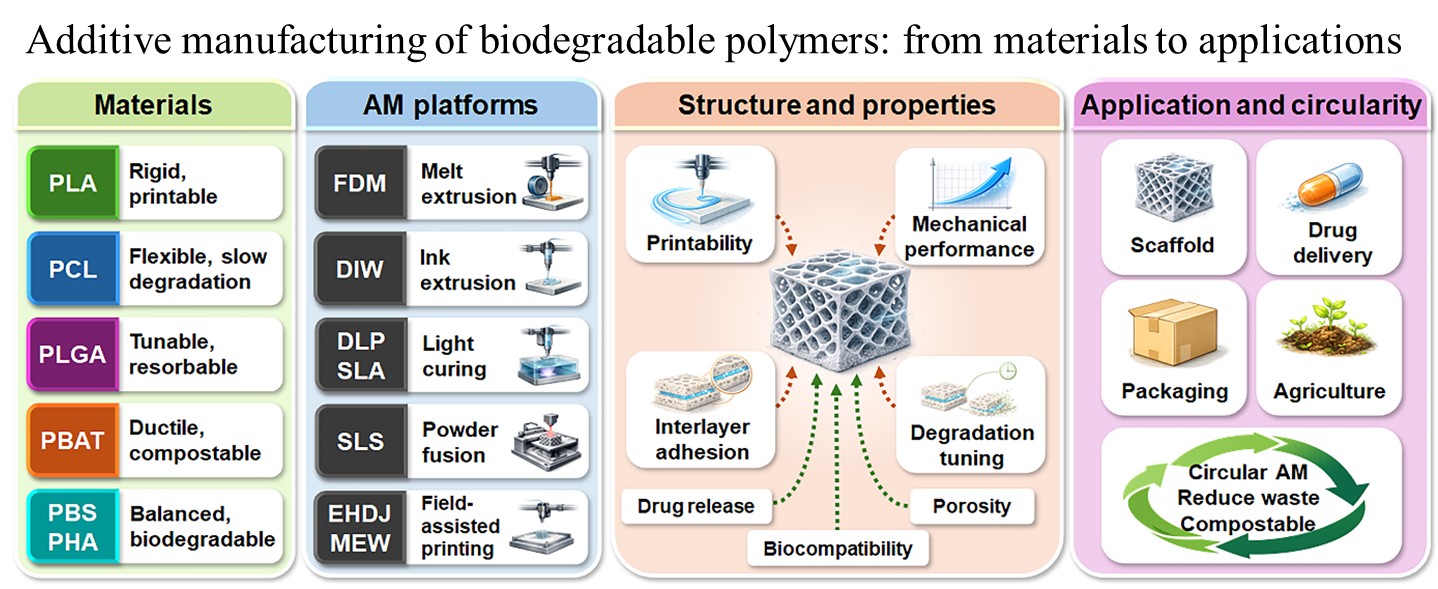
Biodegradable polymers are increasingly recognized as key enablers of sustainable additive manufacturing (AM), offering a unique combination of environmental degradability, tunable mechanical performance, and compatibility across diverse printing platforms. This review examines recent advances in the molecular design, composite formulation, and three-dimensional printing of biodegradable thermoplastics, including polylactic acid, polycaprolactone, poly(butylene adipate-co-terephthalate), and polybutylene succinate, across major AM platforms such as fused deposition modeling, direct ink writing, and digital light processing. Particular emphasis is placed on structure–property–function–degradation relationships that influence rheological behavior, interlayer adhesion, mechanical anisotropy, and life-cycle performance. Material engineering strategies, including polymer blending, reactive compatibilization, nanofiller reinforcement, and platform-specific parameter optimization, are critically examined for their capacity to enhance print fidelity and enable precise control over degradation kinetics. Representative applications in biomedical scaffolds, controlled drug delivery systems, agricultural devices, and compostable packaging demonstrate how deliberate material–process integration can achieve both functional performance and temporally programmed degradation. Furthermore, sustainable design paradigms, such as design for degradation, life-cycle synchronization, topology-driven material minimization, and circular manufacturing frameworks, are discussed as essential for transitioning AM from rapid prototyping to responsible large-scale production. Despite substantial progress, challenges remain in mechanical robustness, material standardization, and end-of-life infrastructure. Addressing these limitations will require coordinated advances in polymer chemistry, processing science, and life-cycle engineering to establish truly circular, high-performance biodegradable AM systems.
- Geyer R, Jambeck JR, Law KL. Production, use, and fate of all plastics ever made. Sci Adv. 2017;3(7):e1700782. doi: 10.1126/sciadv.1700782
- Huang S, Dong Q, Che S, Li R, Tang KHD. Bioplastics and biodegradable plastics: a review of recent advances, feasibility and cleaner production. Sci Total Environ. 2025;969:178911. doi: 10.1016/j.scitotenv.2025.178911
- Woodruff MA, Hutmacher DW. The return of a forgotten polymer-polycaprolactone in the 21st century. Prog Polym Sci. 2010;35(10):1217-1256. doi: 10.1016/j.progpolymsci.2010.04.002
- Jeong YG, Park JY, Lim MH, Yoo JJ, Lee SJ, Kim MS. Thermally tunable and biodegradable copolymer ink for 3D-printed implantable drug delivery depots. Int J Bioprint. 2025;11(5):350-370. doi: 10.36922/IJB025290294
- Nofar M, Sacligil D, Carreau PJ, Kamal MR, Heuzey MC. Poly(lactic acid) blends: processing, properties and applications. Int J Biol Macromol. 2019;125:307-360. doi: 10.1016/j.ijbiomac.2018.12.002
- Kim MS, Kim JH, Min BH, Chun HJ, Han DK, Lee HB. Polymeric scaffolds for regenerative medicine. Polym Rev. 2011;51(1):23-52. doi: 10.1080/15583724.2010.537800
- Jiao Z, Yang H, Zou H, et al. Effect of PCL/HA material characteristics on the degradation and mechanical properties of interbody fusion cages. Int J Bioprint. 2025;11(2):429-447. doi: 10.36922/ijb.7806
- Sauerwein M, Doubrovski E, Balkenende R, Bakker C. Exploring the potential of additive manufacturing for product design in a circular economy. J Clean Prod. 2019;226:1138-1149. doi: 10.1016/j.jclepro.2019.04.108
- Krobot Š, Menčík P, Chaloupková K, et al. Optimizing printability and mechanical properties of poly(3- hydroxybutyrate) biocomposite blends and their biological response to Saos-2 cells. Int J Bioprint. 2025;11(1):400-417. doi: 10.36922/ijb.5175
- Peng T, Kellens K, Tang R, Chen C, Chen G. Sustainability of additive manufacturing: an overview on its energy demand and environmental impact. Addit Manuf. 2018;21:694-704. doi: 10.1016/j.addma.2018.04.022
- Bishop EG, Leigh SJ. Using large-scale additive manufacturing as a bridge manufacturing process in response to shortages in personal protective equipment during the COVID-19 outbreak. Int J Bioprint. 2020;6(4):281. doi: 10.18063/ijb.v6i4.281
- Kyriakidis IF, Kladovasilakis N, Pechlivani EM, Tsongas K. Mechanical performance of recycled 3D-printed sustainable polymer-based composites: a literature review. J Compos Sci. 2024;8(6):215. doi: 10.3390/jcs8060215
- Sintim HY, Flury M. Is biodegradable plastic mulch the solution to agriculture’s plastic problem? Environ Sci Technol. 2017;51(3):1068-1069. doi: 10.1021/acs.est.6b06042
- Tymrak BM, Kreiger M, Pearce JM. Mechanical properties of components fabricated with open-source 3-D printers under realistic environmental conditions. Mater Des. 2014;58:242-246. doi: 10.1016/j.matdes.2014.02.038
- Ponis S, Aretoulaki E, Maroutas TN, Plakas G, Dimogiorgi K. A systematic literature review on additive manufacturing in the context of circular economy. Sustainability. 2021;13(11):6007. doi: 10.3390/su13116007
- Liu Y, Ma Y, Wang L, Liu C, Huang X, Zhang J. Three-dimensional bioprinting and infertility-related female reproductive system diseases: a review of current and future applications. Tissue Eng Regen Med. 2025;22(8):1067-1085. doi: 10.1007/s13770-025-00754-5
- Su J, Ng WL, An J, Yeong WY, Chua CK, Sing SL. Achieving sustainability by additive manufacturing: a state-of-the-art review and perspectives. Virtual Phys Prototyp. 2024;19(1):e2438899. doi: 10.1080/17452759.2024.2438899
- Nerurkar NL, Elliott DM, Mauck RL. Mechanical design criteria for intervertebral disc tissue engineering. J Biomech. 2010;43(6):1017-1030. doi: 10.1016/j.jbiomech.2009.12.001
- Zeng Z, Song P, Gui X, et al. 3D printed Nanohydroxyapatite/ Polyamide 66 scaffolds with balanced mechanical property and osteogenic ability for bone repair. Mater Des. 2024;241:112896. doi: 10.1016/j.matdes.2024.112896
- Gepek E, Fayyazbakhsh F, Suliandziga L, et al. PLA-based bone tissue engineering scaffolds incorporating hydroxyapatite and bioactive glass using digital light processing. Int J Bioprint. 2025;11(2):573-598. doi: 10.36922/IJB025040029
- Lombardi L, Scalzone A, Ausilio C, Gentile P, Tammaro D. Optimizing nozzle design in extrusion-based 3D bioprinting to minimize mechanical stress and enhance cell viability. Int J Bioprint. 2025;11(4):315-327. doi: 10.36922/IJB025190182
- Estévez M, Batoni E, Cicuéndez M, et al. Fabrication of 3D biofunctional magnetic scaffolds by combining fused deposition modelling and inkjet printing of superparamagnetic iron oxide nanoparticles. Tissue Eng Regen Med. 2025;22(5):627-646. doi: 10.1007/s13770-025-00711-2
- Laycock BG, Chan CM, Halley PJ. A review of computational approaches used in the modelling, design, and manufacturing of biodegradable and biobased polymers. Prog Polym Sci. 2024;157:101874. doi: 10.1016/j.progpolymsci.2024.101874
- Farah S, Anderson DG, Langer R. Physical and mechanical properties of PLA, and their functions in widespread applications-a comprehensive review. Adv Drug Deliv Rev. 2016;107:367-392. doi: 10.1016/j.addr.2016.06.012
- Shanmugam V, Babu K, Kannan G, Mensah RA, Samantaray SK, Das O. The thermal properties of FDM-printed polymeric materials: a review. Polym Degrad Stab. 2024;228:110902. doi: 10.1016/j.polymdegradstab.2024.110902
- Sanchez-Rexach E, Johnston TG, Jehanno C, Sardon H, Nelson A. Sustainable materials and chemical processes for additive manufacturing. Chem Mater. 2020;32(17):7105- 7119. doi: 10.1021/acs.chemmater.0c02008
- Nashed N, Greenland BW, Majumder M, Lam M, Ghafourian T, Nokhodchi A. The effect of manufacturing method: direct compression, hot-melt extrusion, and 3D printing on polymer stability and drug release from polyethylene oxide tablets. Int J Bioprint. 2024;10(2):4055. doi: 10.36922/ijb.4055
- Rejeski D, Zhao F, Huang Y. Research needs and recommendations on environmental implications of additive manufacturing. Addit Manuf. 2018;19:21-28. doi: 10.1016/j.addma.2017.10.019
- Lee JM, Sing SL, Zhou M, Yeong WY. 3D bioprinting processes: a perspective on classification and terminology. Int J Bioprint. 2018;4(2):151. doi: 10.18063/IJB.v4i2.151
- Chamas A, Moon H, Zheng J, et al. Degradation rates of plastics in the environment. ACS Sustain Chem Eng. 2020;8(9):3494-3511. doi: 10.1021/acssuschemeng.9b06635
- Xu J, Guo BH. Poly(butylene succinate) and its copolymers: research, development and industrialization. Biotechnol J. 2010;5(11):1149-1163. doi: 10.1002/biot.201000136
- Li N, Qiao D, Zhao S, Lin Q, Zhang B, Xie F. 3D printing to innovate biopolymer materials for demanding applications: a review. Mater Today Chem. 2021;20:100459. doi: 10.1016/j.mtchem.2021.100459
- Liu T, Lin Y, Sang L, et al. Biomimetic structural design and performance study of 3D-printed graded minimal surface bone scaffolds with enhanced bioactivity. Int J Bioprint. 2024;10(5):3416. doi: 10.36922/ijb.3416
- Zheng Y, Pan P. Crystallization of biodegradable and biobased polyesters: polymorphism, cocrystallization, and structure-property relationship. Prog Polym Sci. 2020;109:101291. doi: 10.1016/j.progpolymsci.2020.101291
- Fonseca A, Ramalho E, Gouveia A, Figueiredo F, Nunes J. Life cycle assessment of PLA products: a systematic literature review. Sustainability. 2023;15(16):12470. doi: 10.3390/su151612470
- Kim MS, Chang H, Zheng L, et al. A review of biodegradable plastics: chemistry, applications, properties, and future research needs. Chem Rev. 2023;123(16):9915-9939. doi: 10.1021/acs.chemrev.2c00876
- Rosenboom JG, Langer R, Traverso G. Bioplastics for a circular economy. Nat Rev Mater. 2022;7(2):117-137. doi: 10.1038/s41578-021-00407-8
- Bartnikowski M, Dargaville TR, Ivanovski S, Hutmacher DW. Degradation mechanisms of polycaprolactone in the context of chemistry, geometry and environment. Prog Polym Sci. 2019;96:1-20. doi: 10.1016/j.progpolymsci.2019.05.004
- Barletta M, Aversa C, Ayyoob M, et al. Poly(butylene succinate) (PBS): materials, processing, and industrial applications. Prog Polym Sci. 2022;132:101579. doi: 10.1016/j.progpolymsci.2022.101579
- Meys R, Kätelhön A, Bachmann M, et al. Achieving net-zero greenhouse gas emission plastics by a circular carbon economy. Science. 2021;374(6563):71-76. doi: 10.1126/science.abg9853
- Ngo TD, Kashani A, Imbalzano G, Nguyen KTQ, Hui D. Additive manufacturing (3D printing): a review of materials, methods, applications and challenges. Compos Part B Eng. 2018;143:172-196. doi: 10.1016/j.compositesb.2018.02.012
- Li X, Zheng F, Wang X, et al. Biomaterial inks for extrusion-based 3D bioprinting: property, classification, modification, and selection. Int J Bioprint. 2023;9(2):649. doi: 10.18063/ijb.v9i2.649
- Ford S, Despeisse M. Additive manufacturing and sustainability: an exploratory study of the advantages and challenges. J Clean Prod. 2016;137:1573-1587. doi: 10.1016/j.jclepro.2016.04.150
- Rajput S, Banerjee S. Valorization of biowaste for sustainable 3D printing in the pharmaceutical and biomedical fields: advances, challenges, and future perspectives. ACS Sustain Resour Manag. 2025;2(7):1156-1174. doi: 10.1021/acssusresmgt.5c00135
- Mani M, Lyons KW, Gupta SK. Sustainability characterization for additive manufacturing. J Res Natl Inst Stand Technol. 2014;119:419-428. doi: 10.6028/jres.119.016
- Islam MA, Mobarak MH, Rimon MIH, et al. Additive manufacturing in polymer research: advances, synthesis, and applications. Polym Test. 2024;132:108364. doi: 10.1016/j.polymertesting.2024.108364
- Penumakala PK, Santo J, Thomas A. A critical review on the fused deposition modeling of thermoplastic polymer composites. Compos Part B Eng. 2020;201:108336. doi: 10.1016/j.compositesb.2020.108336
- Tseng WC, Liao CY, Chassagne L, Cagneau B. An ink-insensitive deep learning model for improving the printing quality in extrusion-based bioprinting. Int J Bioprint. 2025;11(2):599-614. doi: 10.36922/ijb.6701
- Yu W, Sun L, Li M, Li M, Lei W, Wei C. FDM 3D printing and properties of PBS/PLA blends. Polymers. 2023;15(21):4305. doi: 10.3390/polym15214305
- Lewis JA. Direct ink writing of 3D functional materials. Adv Funct Mater. 2006;16(17):2193-2204. doi: 10.1002/adfm.200600434
- Baniasadi H, Abidnejad R, Fazeli M, et al. Innovations in hydrogel-based manufacturing: a comprehensive review of direct ink writing technique for biomedical applications. Adv Colloid Interface Sci. 2024;324:103095. doi: 10.1016/j.cis.2024.103095
- Kang J, Shirzad M, Ranganathan P, et al. Suspended 3D printing of polycaprolactone/hydroxyapatite composites for the fabrication of complex bone scaffolds. Int J Bioprint. 2025;11(6):205-219. doi: 10.36922/IJB025320319
- Schwab A, Levato R, D’Este M, Piluso S, Eglin D, Malda J. Printability and shape fidelity of bioinks in 3D bioprinting. Chem Rev. 2020;120(19):11028-11055. doi: 10.1021/acs.chemrev.0c00084
- Saadi MASR, Maguire A, Pottackal NT, et al. Direct ink writing: a 3D printing technology for diverse materials. Adv Mater. 2022;34(28):2108855. doi: 10.1002/adma.202108855
- Chen XB, Fazel Anvari-Yazdi A, Duan X, et al. Biomaterials / bioinks and extrusion bioprinting. Bioact Mater. 2023;28:511-536. doi: 10.1016/j.bioactmat.2023.06.006
- Lin Z, Qiu X, Cai Z, et al. High internal phase emulsions gel ink for direct-ink-writing 3D printing of liquid metal. Nat Commun. 2024;15(1):4806. doi: 10.1038/s41467-024-48906-w
- Pagac M, Hajnys J, Ma QP, et al. A review of vat photopolymerization technology: Materials, applications, challenges, and future trends of 3D printing. Polymers (Basel). 2021;13(4):598. doi: 10.3390/polym13040598
- Tumbleston JR, Shirvanyants D, Ermoshkin N, et al. Continuous liquid interface production of 3D objects. Science. 2015;347(6228):1349-1352. doi: 10.1126/science.aaa2397
- Zhang M, Yang F, Han D, et al. 3D bioprinting of corneal decellularized extracellular matrix: GelMA composite hydrogel for corneal stroma engineering. Int J Bioprint. 2023;9(5):774. doi: 10.18063/ijb.774
- Goodridge RD, Tuck CJ, Hague RJM. Laser sintering of polyamides and other polymers. Prog Mater Sci. 2012;57(2):229-267. doi: 10.1016/j.pmatsci.2011.04.001
- Onses MS, Sutanto E, Ferreira PM, Alleyne AG, Rogers JA. Mechanisms, capabilities, and applications of high-resolution electrohydrodynamic jet printing. Small. 2015;11(34):4237-4266. doi: 10.1002/smll.201500593
- Skylar-Scott MA, Mueller J, Visser CW, Lewis JA. Voxelated soft matter via multimaterial multinozzle 3D printing. Nature. 2019;575(7782):330-335. doi: 10.1038/s41586-019-1736-8
- Zhang Y, Zhao F, Qiao A, Liu Y, Chen M. Rational design and functionalization of melt electrowritten 4D scaffolds for biomedical applications. Nano-Micro Lett. 2026;18(1):144. doi: 10.1007/s40820-025-01986-9
- Phan DD, Swain ZR, Mackay ME. Rheological and heat transfer effects in fused filament fabrication. J Rheol. 2018;62(5):1097-1107. doi: 10.1122/1.5022982
- Dananjaya V, Chevali V, Dear J, Potluri P, Abeykoon C. 3D printing of biodegradable polymers and their composites-current state-of-the-art, properties, applications, and machine learning for potential future applications. Prog Mater Sci. 2024;146:101336. doi: 10.1016/j.pmatsci.2024.101336
- Jaouher L, Barkaoui A, Aouadi K, Sallem H. Biomimetic and personalized optimization of additively manufactured metallic bone implants: design, simulation, and clinical outcomes. Int J Bioprint. 2025;11(6):51-82. doi: 10.36922/IJB025270261
- Agrawal K, Bhat AR. Advances in 3D printing with eco-friendly materials: a sustainable approach to manufacturing. RSC Sustain. 2025;3(6):2582-2604. doi: 10.1039/d4su00718b
- Ozbolat IT, Hospodiuk M. Current advances and future perspectives in extrusion-based bioprinting. Biomaterials. 2016;76:321-343. doi: 10.1016/j.biomaterials.2015.10.076
- Kühl J, Krümpelmann SM, Hildebrandt L, et al. Nanomaterial-modified bioinks for DLP-based bioprinting of bone constructs: impact on mechanical properties and mesenchymal stem cell function. Int J Bioprint. 2024;10(6):4015. doi: 10.36922/ijb.4015
- Ligon SC, Liska R, Stampfl J, Gurr M, Mülhaupt R. Polymers for 3D printing and customized additive manufacturing. Chem Rev. 2017;117(15):10212-10290. doi: 10.1021/acs.chemrev.7b00074
- Dipta SD, Rahman MM, Ansari MJ, Uddin MN. A comprehensive review of sustainable and green additive manufacturing: technologies, practices, and future directions. J Manuf Mater Process. 2025;9(8):269. doi: 10.3390/jmmp9080269
- Hochleitner G, Jüngst T, Brown TD, et al. Additive manufacturing of scaffolds with sub-micron filaments via melt electrospinning writing. Biofabrication. 2015;7(3):035002. doi: 10.1088/1758-5090/7/3/035002
- Maskery I, Aboulkhair NT, Corfield MR, et al. Quantification and characterisation of porosity in selectively laser melted Al-Si10-Mg using X-ray computed tomography. Mater Charact. 2016;111:193-204. doi: 10.1016/j.matchar.2015.12.001
- Ren L, Wang Z, Ren L, Han Z, Liu Q, Song Z. Graded biological materials and additive manufacturing technologies for producing bioinspired graded materials: an overview. Compos Part B Eng. 2022;242:110086. doi: 10.1016/j.compositesb.2022.110086
- Zhang X, Gao X, Zhang X, Yao X, Kang X. Revolutionizing intervertebral disc regeneration: advances and future directions in three-dimensional bioprinting of hydrogel scaffolds. Int J Nanomedicine. 2024;19:10661-10684. doi: 10.2147/IJN.S469302
- Sun B, Lian M, Han Y, et al. A 3D-bioprinted dual growth factor-releasing intervertebral disc scaffold induces nucleus pulposus and annulus fibrosus reconstruction. Bioact Mater. 2021;6(1):179-190. doi: 10.1016/j.bioactmat.2020.06.022
- Rayhan MT, Islam MA, Khan M, et al. Advances in additive manufacturing of nanocomposite materials fabrications and applications. Eur Polym J. 2024;220:113406. doi: 10.1016/j.eurpolymj.2024.113406
- Silva M, Pinho IS, Covas JA, Alves NM, Paiva MC. 3D printing of graphene-based polymeric nanocomposites for biomedical applications. Funct Compos Mater. 2021;2(1):8. doi: 10.1186/s42252-021-00020-6
- Zhang G, Li J, Shangguan C, et al. Design and performance of 3D-printed cross-scale metamaterial porous structures for orthopedic implants. Int J Bioprint. 2025;11(6):515-530. doi: 10.36922/ijb025390401
- Chacón JM, Caminero MA, García-Plaza E, Núñez PJ. Additive manufacturing of PLA structures using FDM: effect of process parameters on mechanical properties and their optimal selection. Mater Des. 2017;124:143-157. doi: 10.1016/j.matdes.2017.03.065
- Gharraei R, Bergstrom DJ, Chen X. Extrusion bioprinting from a fluid mechanics perspective. Int J Bioprint. 2024;10(6):3973. doi: 10.36922/ijb.3973
- Olonisakin K, Mohanty AK, Thimmanagari M, Misra M. Recent advances in biodegradable polymer blends and their biocomposites: a comprehensive review. Green Chem. 2025;27(38):11656-11704. doi: 10.1039/d5gc01294e
- Meyer KV, Winkler S, Bahnemann J. 3D-printed microfluidic cell culture devices and hydrogel integration: trends, challenges, and solutions. Int J Bioprint. 2025;11(2):34-54. doi: 10.36922/ijb.4718
- Kale G, Auras R, Singh SP, Narayan R. Biodegradability of polylactide bottles in real and simulated composting conditions. Polym Test. 2007;26(8):1049-1061. doi: 10.1016/j.polymertesting.2007.07.006
- Kirillova A, Yeazel TR, Asheghali D, et al. Fabrication of biomedical scaffolds using biodegradable polymers. Chem Rev. 2021;121(18):11238-11304. doi: 10.1021/acs.chemrev.0c01200
- Wang C, Huang W, Zhou Y, et al. 3D printing of bone tissue engineering scaffolds. Bioact Mater. 2020;5(1):82-91. doi: 10.1016/j.bioactmat.2020.01.004
- Turnbull G, Clarke J, Picard F, et al. 3D bioactive composite scaffolds for bone tissue engineering. Bioact Mater. 2018;3(3):278-314. doi: 10.1016/j.bioactmat.2017.10.001
- Backes EH, Fernandes EM, Diogo GS, et al. Engineering 3D printed bioactive composite scaffolds based on the combination of aliphatic polyester and calcium phosphates for bone tissue regeneration. Mater Sci Eng C Mater Biol Appl. 2021;122:111928. doi: 10.1016/j.msec.2021.111928
- Yu YS, Kim DH, Park SH, Hwang Y, Lee JW, Kim SW. Characteristics of 3D-printed polycaprolactone tracheal scaffolds implanted in vivo. Tissue Eng Regen Med. 2025;22(7):941-950. doi: 10.1007/s13770-025-00745-6
- Park JH, Lee BK, Park SH, et al. Preparation of biodegradable and elastic poly(ε-caprolactone-co-lactide) copolymers and evaluation as a localized and sustained drug delivery carrier. Int J Mol Sci. 2017;18(3):671. doi: 10.3390/ijms18030671
- Itabana BE, Mohanty AK, Dick P, et al. Poly(butylene adipate-co-terephthalate) (PBAT)-based biocomposites: a comprehensive review. Macromol Mater Eng. 2024;309(12):2400179. doi: 10.1002/mame.202400179
- Fernandes M, Vicente AA, Salvador AF. Microorganisms and enzymes involved in polybutylene adipate terephthalate biodegradation. Appl Microbiol Biotechnol. 2025;109(1):214. doi: 10.1007/s00253-025-13565-4
- Ji YB, Park JY, Kang Y, et al. Scaffold printing using biodegradable poly(1,4-butylene carbonate) ink: printability, in vivo physicochemical properties, and biocompatibility. Mater Today Bio. 2021;12:100129. doi: 10.1016/j.mtbio.2021.100129
- Shah AA, Hasan F, Hameed A, Ahmed S. Biological degradation of plastics: a comprehensive review. Biotechnol Adv. 2008;26(3):246-265. doi: 10.1016/j.biotechadv.2007.12.005
- Kwon DY, Park JY, Lee BY, Kim MS. Comparison of scaffolds fabricated via 3D printing and salt leaching: in vivo imaging, biodegradation, and inflammation. Polymers. 2020;12(10):2210. doi: 10.3390/polym12102210
- Kwon DY, Park JH, Jang SH, et al. Bone regeneration by means of a three-dimensional printed scaffold in a rat cranial defect. J Tissue Eng Regen Med. 2018;12(2):516-528. doi: 10.1002/term.2532
- Jeong YG, Yoo JJ, Lee SJ, Kim MS. 3D digital light process bioprinting: cutting-edge platforms for resolution of organ fabrication. Mater Today Bio. 2024;29:101284. doi: 10.1016/j.mtbio.2024.101284
- Kim SH, Kwon JS, Cho JG, et al. Non-invasive in vivo monitoring of transplanted stem cells in 3D-bioprinted constructs using near-infrared fluorescent imaging. Bioeng Transl Med. 2021;6(2):e10216. doi: 10.1002/btm2.10216
- Kim SH, Park JH, Kwon JS, et al. NIR fluorescence for monitoring in vivo scaffold degradation along with stem cell tracking in bone tissue engineering. Biomaterials. 2020;258:120267. doi: 10.1016/j.biomaterials.2020.120267
- Ray SS, Okamoto M. Polymer/layered silicate nanocomposites: a review from preparation to processing. Prog Polym Sci. 2003;28(11):1539-1641. doi: 10.1016/j.progpolymsci.2003.08.002
- Pinto AM, Gonçalves IC, Magalhães FD. Graphene-based materials biocompatibility: a review. Colloids Surf B Biointerfaces. 2013;111:188-202. doi: 10.1016/j.colsurfb.2013.05.022
- Chen E, Qin X, Xiong Z, et al. 3D-printed poly(p-dioxanone)/graphene oxide composite bioresorbable stents for congenital heart disease treatment. Int J Bioprint. 2024;10(6):4530. doi: 10.36922/ijb.4530
- Noh JH, Lee Y, Kim MS. 3D-printed scaffolds: incorporating dexamethasone microspheres and BMP2 for enhanced osteogenic differentiation of human mesenchymal stem cells. Colloids Surf B Biointerfaces. 2025;253:114705. doi: 10.1016/j.colsurfb.2025.114705
- Chen L, Huang G, Yu M, et al. Recent progress on 3D-printed gelatin methacrylate-based biomaterials for articular cartilage repair. Int J Bioprint. 2023;9(6):0116. doi: 10.36922/ijb.0116
- Puppi D, Chiellini F. Biodegradable polymers for biomedical additive manufacturing. Appl Mater Today. 2020;20:100700. doi: 10.1016/j.apmt.2020.100700
- Kim JI, Kim DY, Kwon DY, et al. An injectable biodegradable temperature-responsive gel with an adjustable persistence window. Biomaterials. 2012;33(10):2823-2834. doi: 10.1016/j.biomaterials.2012.01.004
- Kim MS, Seo KS, Khang G, Cho SH, Lee HB. Preparation of methoxy poly(ethylene glycol)/polyester diblock copolymers and examination of the gel-to-sol transition. J Polym Sci A Polym Chem. 2004;42(22):5784-5793. doi: 10.1002/pola.20430
- Kim MS, Hyun H, Khang G, Lee HB. Preparation of thermosensitive diblock copolymers consisting of MPEG and polyesters. Macromolecules. 2006;39(9):3099-3102. doi: 10.1021/ma052713d
- Zhang F, King MW. Biodegradable polymers as the pivotal player in the design of tissue engineering scaffolds. Adv Healthc Mater. 2020;9(13):1901358. doi: 10.1002/adhm.201901358
- Zhu Y, Guo S, Ravichandran D, et al. 3D-printed polymeric biomaterials for health applications. Adv Healthc Mater. 2025;14(1):2402571. doi: 10.1002/adhm.202402571
- Cheng J, Gao R, Zhu Y, Lin Q. Applications of biodegradable materials in food packaging: a review. Alex Eng J. 2024;91:70- 83. doi: 10.1016/j.aej.2024.01.080
- Campanale C, Galafassi S, Di Pippo F, Pojar I, Massarelli C, Uricchio VF. A critical review of biodegradable plastic mulch films in agriculture: definitions, scientific background and potential impacts. TrAC Trends Anal Chem. 2024;170:117391. doi: 10.1016/j.trac.2023.117391
- Chien YC, Wu JH, Shu CH, Lo JT, Yang TC. Closed-loop recycling of 3D-printed wood-PLA composite parts: effects on mechanical and structural properties via fused filament fabrication. Polymers. 2024;16(21):3002. doi: 10.3390/polym16213002
- Aliotta L, Gigante V, Duniau A, et al. Optimization of 3D printing parameters for recycled polybutylene succinate (PBS) using a granule-based 3D printer. Polym Test. 2025;153:109038. doi: 10.1016/j.polymertesting.2025.109038
- International Organization for Standardization. ISO 14855-1:2012. Determination of the ultimate aerobic biodegradability of plastic materials under controlled composting conditions— Method by analysis of evolved carbon dioxide—Part 1: General method. Geneva, Switzerland: ISO; 2012.
- ASTM International. ASTM D6400-21. Standard Specification for Labeling of Plastics Designed to be Aerobically Composted in Municipal or Industrial Facilities. West Conshohocken, PA: ASTM International; 2021.