

Acoustic-assisted hydrogel fabrication, 3D printing, and 3D bioprinting

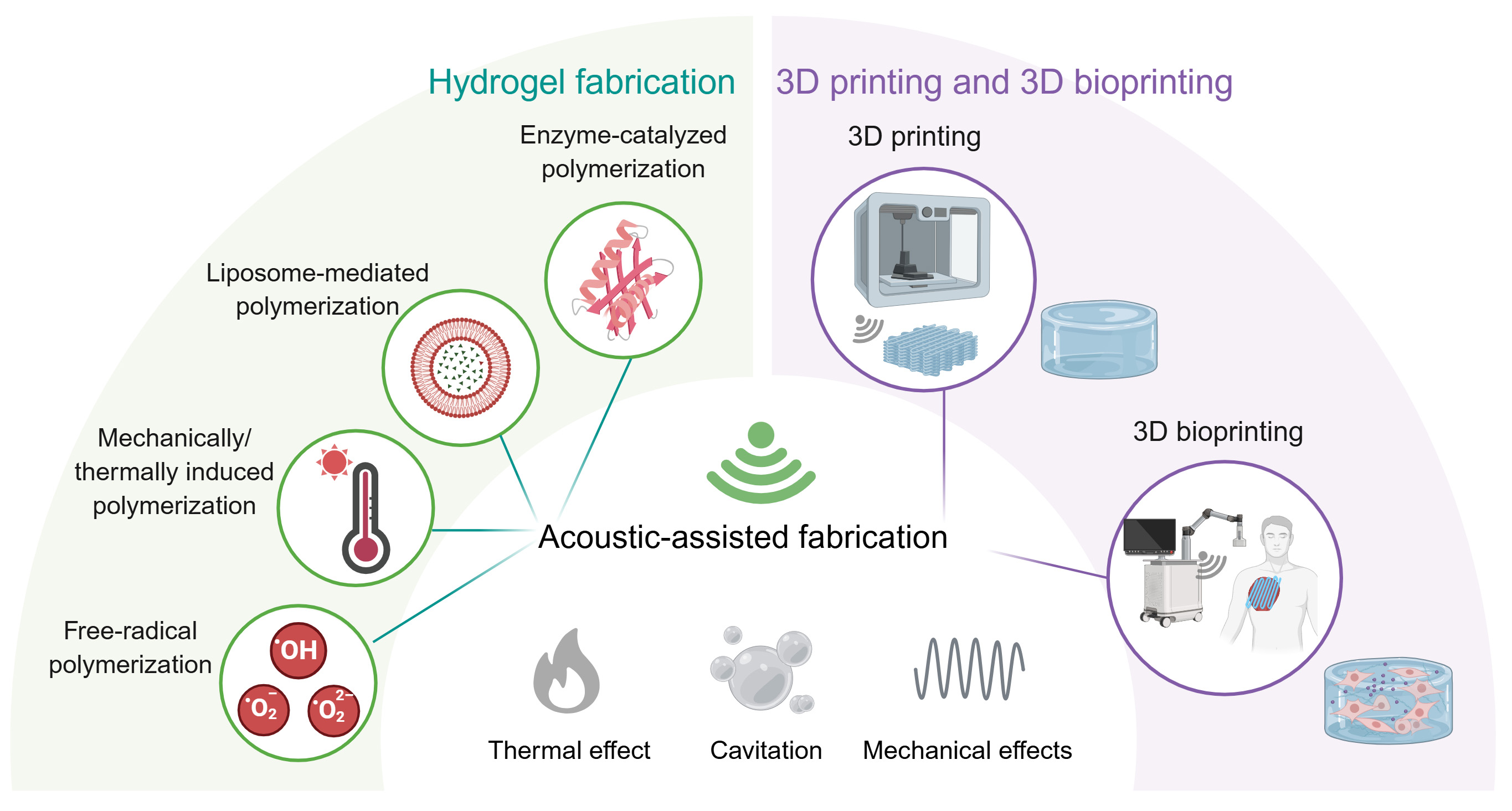
Hydrogels, three-dimensional (3D) printing, and 3D bioprinting hold considerable promise for biomedical applications. Compared to conventional hydrogel fabrication strategies triggered by light, heat, or crosslinking agents, acoustic-assisted hydrogel fabrication, 3D printing, and 3D bioprinting offer unique advantages, including superior tissue penetration, high spatiotemporal controllability, and enhanced biosafety. This review systematically elucidates the significant potential and innovative mechanisms of ultrasound as a unique physical stimulus in these fields. This review highlights the fundamental principles of acoustic effects—cavitation, mechanical effects, and thermal effects—and their roles in hydrogel preparation. We then comprehensively discuss the multiple pathways for acoustic-assisted hydrogel fabrication, including cavitation-triggered free-radical polymerization, mechanically/thermally induced polymerization, liposome-mediated and enzyme-catalyzed polymerization, self-assembly systems for polymerization, and homogenization effects in polymerization, highlighting their respective applications in biomedicine and other related fields. Subsequently, advances in the emerging field of acoustic-assisted 3D printing and 3D bioprinting are reviewed in detail, ranging from the acoustic triggering of 3D printing with thermally curable/free-radical polymerization inks to micrometer-scale 3D bioprinting using cell-laden bioinks. Finally, this review highlights current bottlenecks and future research directions in acoustic-assisted hydrogel fabrication, 3D printing, and 3D bioprinting.
- Dong S, An S, Saiding Q, et al. Therapeutic Hydrogels: Properties and Biomedical Applications. Chem Rev. 2025;125(18):8835-8920. doi: 10.1021/acs.chemrev.5c00182
- Chen L, Jin Z, Feng W, Sun L, Xu H, Wang C. A hyperelastic hydrogel with an ultralarge reversible biaxial strain. Science. 2024;383(6690):1455-1461. doi: 10.1126/science.adh3632
- Gao Y, Peng K, Mitragotri S. Covalently Crosslinked Hydrogels via Step-Growth Reactions: Crosslinking Chemistries, Polymers, and Clinical Impact. Adv Mater. 2021;33(25). doi: 10.1002/adma.202006362
- Goswami AK, Giduturi VK, Yerramilli SN, Chauhan VS, Yadav N. Tissue engineering: Hydrogel scaffolds and mechanical properties as key design parameters. Adv Colloid Interface Sci. 2026;347:103691. doi: 10.1016/j.cis.2025.103691
- Chen G, Yang Z, Pan H, et al. A Review of Hydrogel Fiber: Design, Synthesis, Applications, and Futures. Chem Rev. 2025;125(13):5991-6056. doi: 10.1021/acs.chemrev.5c00159
- Yin Y, Gu Q, Liu X, Liu F, McClements DJ. Double network hydrogels: Design, fabrication, and application in biomedicines and foods. Adv Colloid Interface Sci. 2023;320:102999. doi: 10.1016/j.cis.2023.102999
- Ding Z, Liang Z, Rong X, et al. Janus-Structured Microgel Barrier with Tissue Adhesive and Hemostatic Characteristics for Efficient Prevention of Postoperative Adhesion. Small. 2024;20(50). doi: 10.1002/smll.202403753
- Fan J, Ding Z, Cai Y, et al. Revolutionizing Bone Regeneration: Vascularized Bone Tissue Engineering with Advanced 3D Printing Technology. Aggregate. 2025;6(4). doi: 10.1002/agt2.731
- Wu X, Shi W, Liu X, Gu Z. Recent advances in 3D-printing-based organ-on-a-chip. EngMedicine. 2024;1(1):100003. doi: 10.1016/j.engmed.2024.100003
- Hu L, Chee PL, Sugiarto S, et al. Hydrogel-Based Flexible Electronics. Adv Mater. 2023;35(14). doi: 10.1002/adma.202205326
- Wang M, Li W, Hao J, et al. Biomaterial-minimalistic photoactivated bioprinting of cell-dense tissues. Cell. 2026;189(1):106-122.e26. doi: 10.1016/j.cell.2025.11.012
- Rong X, Xiao S, Geng W, et al. Sono-activable and biocatalytic 3D-printed scaffolds for intelligently sequential therapies in osteosarcoma eradication and defect regeneration. Nat Commun. 2025;16(1). doi: 10.1038/s41467-025-61377-x
- Yi HG, Kim H, Kwon J, Choi YJ, Jang J, Cho DW. Application of 3D bioprinting in the prevention and the therapy for human diseases. Signal Transduct Target Ther. 2021;6(1). doi: 10.1038/s41392-021-00566-8
- Lee SJ, Jeong W, Atala A. 3D Bioprinting for Engineered Tissue Constructs and Patient-Specific Models: Current Progress and Prospects in Clinical Applications. Adv Mater. 2024;36(49). doi: 10.1002/adma.202408032
- Luo Z, Tang G, Ravanbakhsh H, et al. Vertical Extrusion Cryo(bio)printing for Anisotropic Tissue Manufacturing. Adv Mater. 2022;34(12). doi: 10.1002/adma.202108931
- Chen Z, Zhang H, Huang J, et al. DNA-encoded dynamic hydrogels for 3D bioprinted cartilage organoids. Mater Today Bio. 2025;31:101509. doi: 10.1016/j.mtbio.2025.101509
- Burns N, Rajesh A, Manjula-Basavanna A, Duraj-Thatte A. 3D extrusion bioprinting of microbial inks for biomedical applications. Adv Drug Deliv Rev. 2025;217:115505. doi: 10.1016/j.addr.2024.115505
- Li S, Li J, Xu J, et al. Removal-Free and Multicellular Suspension Bath-Based 3D Bioprinting. Adv Mater. 2024;36(48). doi: 10.1002/adma.202406891
- Jeong YG, Yoo JJ, Lee SJ, Kim MS. 3D digital light process bioprinting: Cutting-edge platforms for resolution of organ fabrication. Mater Today Bio. 2024;29:101284. doi: 10.1016/j.mtbio.2024.101284
- Wang M, Li W, Hao J, et al. Molecularly cleavable bioinks facilitate high-performance digital light processing-based bioprinting of functional volumetric soft tissues. Nat Commun. 2022;13(1). doi: 10.1038/s41467-022-31002-2
- Chen Y, Zhang J, Liu X, et al. Noninvasive in vivo 3D bioprinting. Sci Adv. 2020;6(23). doi: 10.1126/sciadv.aba7406
- Murphy SV, De Coppi P, Atala A. Opportunities and challenges of translational 3D bioprinting. Nat Biomed Eng. 2020;4(4):370-380. doi: 10.1038/s41551-019-0471-7
- Wu J, Gao Y, Zhou H, et al. Ultrasound-enhanced gene transfection: vectors, methods, and biomedical applications. Ultrason Sonochem. 2025;122:107607. doi: 10.1016/j.ultsonch.2025.107607
- Zhao H, Du F, Xiang X, et al. Progress in application of nanomedicines for enhancing cancer sono-immunotherapy. Ultrason Sonochem. 2024;111:107105. doi: 10.1016/j.ultsonch.2024.107105
- Jiang H, Ye L, Yuan X, Luo Q, Zhou N, Hu B. Endoscopic ultrasound-based artificial intelligence for gastrointestinal subepithelial lesions. EngMedicine. 2025;2(2):100073. doi: 10.1016/j.engmed.2025.100073
- Athanassiadis AG, Ma Z, Moreno-Gomez N, et al. Ultrasound-Responsive Systems as Components for Smart Materials. Chem Rev. 2022;122(5):5165-5208. doi: 10.1021/acs.chemrev.1c00622
- Chen S, Ouyang Q, Miao X, et al. Wearable Ultrasound Devices for Therapeutic Applications. Nano-Micro Lett. 2025;18(1). doi: 10.1007/s40820-025-01890-2
- Cass P, Knower W, Pereeia E, Holmes NP, Hughes T. Preparation of hydrogels via ultrasonic polymerization. Ultrason Sonochem. 2010;17(2):326-332. doi: 10.1016/j.ultsonch.2009.08.008
- Heng BC, Li X, Guo Y, et al. Biophysical stimuli for promoting angiogenesis and vascularization in regenerative medicine and dentistry. EngMedicine. 2025;2(3):100078. doi: 10.1016/j.engmed.2025.100078
- Poolman RW, Agoritsas T, Siemieniuk RA, et al. Low intensity pulsed ultrasound (LIPUS) for bone healing: a clinical practice guideline. BMJ. 2017;356:j576. doi: 10.1136/bmj.j576
- Zheng H, Zuo B. Functional silk fibroin hydrogels: preparation, properties and applications. J Mater Chem B. 2021;9(5):1238-1258. doi: 10.1039/D0TB02099K
- Santha Kumar ARS, Padmakumar A, Kalita U, et al. Ultrasonics in polymer science: applications and challenges. Prog Mater Sci. 2023;136:101113. doi: 10.1016/j.pmatsci.2023.101113
- Garciamendez-Mijares CE, Ruiz DSR, Kuang X, et al. Acoustic Bioprinting: A Glimpse Into an Emerging Field. Small Methods. 2025;10(3). doi: 10.1002/smtd.202500733
- Mondal J, Lakkaraju R, Ghosh P, Ashokkumar M. Acoustic cavitation-induced shear: a mini-review. Biophys Rev. 2021;13(6):1229-1243. doi: 10.1007/s12551-021-00896-5
- Zhu X, Das RS, Bhavya ML, Garcia-Vaquero M, Tiwari BK. Acoustic cavitation for agri-food applications: Mechanism of action, design of new systems, challenges and strategies for scale-up. Ultrason Sonochem. 2024;105:106850. doi: 10.1016/j.ultsonch.2024.106850
- Yusof NS, Babgi B, Alghamdi Y, Aksu M, Madhavan J, Ashokkumar M. Physical and chemical effects of acoustic cavitation in selected ultrasonic cleaning applications. Ultrason Sonochem. 2016;29:568-576. doi: 10.1016/j.ultsonch.2015.06.013
- Abbott JG. Rationale and derivation of MI and TI--a review. Ultrasound Med Biol. 1999;25(3):431-441. doi: 10.1016/s0301-5629(98)00172-0
- Lenshof A, Magnusson C, Laurell T. Acoustofluidics 8: Applications of acoustophoresis in continuous flow microsystems. Lab Chip. 2012;12(7):1210-1223. doi: 10.1039/c2lc21256k
- Padilla F, Brenner J, Prada F, Klibanov AL. Theranostics in the vasculature: bioeffects of ultrasound and microbubbles to induce vascular shutdown. Theranostics. 2023;13(12):4079- 4101. doi: 10.7150/thno.70372
- Coussios CC, Roy RA. Applications of Acoustics and Cavitation to Noninvasive Therapy and Drug Delivery. Annu Rev Fluid Mech. 2008;40(1):395-420. doi: 10.1146/annurev.fluid.40.111406.102116
- Church CC, Carstensen EL. “Stable” inertial cavitation. Ultrasound Med Biol. 2001;27(10):1435-1437. doi: 10.1016/s0301-5629(01)00441-0
- Lighthill SJ. Acoustic streaming. J Sound Vib. 1978;61(3):391- 418. doi: 10.1016/0022-460X(78)90388-7
- Eckart C. Vortices and Streams Caused by Sound Waves. Phys Rev. 1948;73(1):68-76. doi: 10.1103/PhysRev.73.68
- Wiklund M, Green R, Ohlin M. Acoustofluidics 14: Applications of acoustic streaming in microfluidic devices. Lab Chip. 2012;12(14):2438-2451. doi: 10.1039/C2LC40203C
- Sirsi SR, Borden MA. State-of-the-art materials for ultrasound-triggered drug delivery. Adv Drug Deliv Rev. 2014;72:3-14. doi: 10.1016/j.addr.2013.12.010
- Liu Y, Yin Q, Luo Y, et al. Manipulation with sound and vibration: A review on the micromanipulation system based on sub-MHz acoustic waves. Ultrason Sonochem. 2023;96:106441. doi: 10.1016/j.ultsonch.2023.106441
- Li Y, Qiu C, Xu S, Ke M, Liu Z. Theoretical Study of Large- Angle Bending Transport of Microparticles by 2D Acoustic Half-Bessel Beams. Sci Rep. 2015;5(1). doi: 10.1038/srep13063
- Duan L, Yang L, Jin J, et al. Micro/nano-bubble-assisted ultrasound to enhance the EPR effect and potential theranostic applications. Theranostics. 2020;10(2):462-483. doi: 10.7150/thno.37593
- Gor’kov LP. On the forces acting on a small particle in an acoustical field in an ideal fluid. In: Selected Papers of Lev P Gor’kov. World Scientific Publishing Co.; 2014:307-317. doi: 10.1142/9789814366960_0008
- Kolesnik K, Xu M, Lee PVS, Rajagopal V, Collins DJ. Unconventional acoustic approaches for localized and designed micromanipulation. Lab Chip. 2021;21(15):2837- 2856. doi: 10.1039/D1LC00378J
- Zhu L, Altman MB, Laszlo A, et al. Ultrasound Hyperthermia Technology for Radiosensitization. Ultrasound Med Biol. 2019;45(5):1025-1043. doi: 10.1016/j.ultrasmedbio.2018.12.007
- O’Reilly MA. Exploiting the mechanical effects of ultrasound for noninvasive therapy. Science. 2024;385(6714). doi: 10.1126/science.adp7206
- Kok HP, Cressman ENK, Ceelen W, et al. Heating technology for malignant tumors: a review. Int J Hyperthermia. 2020;37(1):711-741. doi: 10.1080/02656736.2020.1779357
- Arthur RM, Straube WL, Trobaugh JW, Moros EG. Non-invasive estimation of hyperthermia temperatures with ultrasound. Int J Hyperthermia. 2005;21(6):589-600. doi: 10.1080/02656730500159103
- Ebrahimi R. Radiation initiated synthesis, characterization, and swelling behavior of poly (acrylic acid-co-acrylamide)/ starch grafted hydrogel. J Appl Polym Sci. 2021;138(37). doi: 10.1002/app.50931
- Xu PY, Kumar Kankala R, Wang SB, Chen AZ. Sonodynamic therapy-based nanoplatforms for combating bacterial infections. Ultrason Sonochem. 2023;100:106617. doi: 10.1016/j.ultsonch.2023.106617
- Liu YH, Li SB, Wang ZY, Wang L. Ultrasound in cellulose-based hydrogel for biomedical use: From extraction to preparation. Colloids Surf B Biointerfaces. 2022;212:112368. doi: 10.1016/j.colsurfb.2022.112368
- Velusamy M, Radhakrishnan M. Hydrogel fabrication using emerging technologies: Sources, mechanisms, and food applications. Innov Food Sci Emerg Technol. 2025;105:104226. doi: 10.1016/j.ifset.2025.104226
- Ebrahimi R, Niyaraki FS, Jirandeh AB. Ultrasonic Irradiated Synthesis of Acrylic Acid-co-Acrylamide as pH and Salt Sensitive Hydrogel. J Polym Mater. 2014;31(2):159-167. Available from: https://civilica.com/doc/244321/ [Last accessed on March 10, 2025].
- Ebrahimi R, Ebrahimi M. The stimuli-response characters of hydrogels prepared using ultrasound. J Polym Eng. 2014;34(7):625-632. doi: 10.1515/polyeng-2014-0028
- Yang SR, Wang RB, Yan CJ, et al. Ultrasonic interfacial crosslinking of TiO2-based nanocomposite hydrogels through thiol-norbornene reactions for sonodynamic antibacterial treatment. Biomater Sci. 2023;11(12):4184- 4199. doi: 10.1039/d2bm01950g
- Zhang L, Yao L, Zhao F, et al. Protein and Peptide-Based Nanotechnology for Enhancing Stability, Bioactivity, and Delivery of Anthocyanins. Adv Healthc Mater. 2023;12(25). doi: 10.1002/adhm.202300473
- Hilal A, Florowska A, Florowski T, et al. Effects of Sequential Induction Combining Thermal Treatment with Ultrasound or High Hydrostatic Pressure on the Physicochemical and Mechanical Properties of Pea Protein-Psyllium Hydrogels as Elderberry Extract Carriers. Int J Mol Sci. 2024;25(16):9033. doi: 10.3390/ijms25169033
- Ni Y, Wu JJ, Jiang YT, Li JW, Fan LP, Huang SQ. High-internal-phase pickering emulsions stabilized by ultrasound-induced nanocellulose hydrogels. Food Hydrocolloids. 2022;125:107395. doi: 10.1016/j.foodhyd.2021.107395
- Liu ZJ, Khurshid K, Saldaña MDA. Hydrogels and aerogels of cellulose nanofiber derived from barley straw with addition of chitosan using high-intensity ultrasound and supercritical CO2 drying. Ind Crops Prod. 2024;216:118755. doi: 10.1016/j.indcrop.2024.118755
- Rokita B, Rosiak JM, Ulanski P. Ultrasound-Induced Cross-Linking and Formation of Macroscopic Covalent Hydrogels in Aqueous Polymer and Monomer Solutions. Macromolecules. 2009;42(9):3269-3274. doi: 10.1021/ma802565p
- Rahmani N, Ebrahimi R. Removal Kinetics of Methylene Blue from Aquatic Medium using Hydrogel Nanocomposite Prepared by Ultrasound. Water Air Soil Pollut. 2024;235(9). doi: 10.1007/s11270-024-07383-z
- Ching TW, Haritos V, Tanksale A. Ultrasound-assisted conversion of cellulose into hydrogel and functional carbon material. Cellulose. 2018;25(4):2629-2645. doi: 10.1007/s10570-018-1746-y
- Cheng YX, Lee S, Xiao YH, et al. Ultrasound Cavitation Enables Rapid, Initiator-Free Fabrication of Tough Anti- Freezing Hydrogels. Adv Sci. 2025;12(22). doi: 10.1002/advs.202416844
- Jonnalagadda US, Nguyen TM, Li FF, et al. Sol-Gel Transitions of Comb-Like Polymethacrylate Copolymers by Mechano-Thermal Stimuli in Water. Macromol Chem Phys. 2020;221(13). doi: 10.1002/macp.202000088
- Norris EG, Dalecki D, Hocking DC. Acoustic Fabrication of Collagen-Fibronectin Composite Gels Accelerates Microtissue Formation. Appl Sci. 2020;10(8):2907. doi: 10.3390/app10082907
- Norris EG, Dalecki D, Hocking DC. Acoustic modification of collagen hydrogels facilitates cellular remodeling. Mater Today Bio. 2019;3:100018. doi: 10.1016/j.mtbio.2019.100018
- Karamikamkar S, Behzadfar E, Cheung KC. A novel approach to producing uniform 3-D tumor spheroid constructs using ultrasound treatment. Biomed Microdevices. 2018;20(2). doi: 10.1007/s10544-018-0260-1
- Su H, Zheng ZC, Li LM, et al. Strategy for regulating hydrogel pore size through ultrasound-assisted directional freezing for enhanced interfacial evaporation. Chem Eng J. 2025;518:164731. doi: 10.1016/j.cej.2025.164731
- Nele V, Schutt CE, Wojciechowski JP, et al. Ultrasound- Triggered Enzymatic Gelation. Adv Mater. 2020;32(7). doi: 10.1002/adma.201905914
- Zhao ZY, Zhang Y, Meng C, Xie XY, Cui WG, Zuo KQ. Tissue-Penetrating Ultrasound-Triggered Hydrogel for Promoting Microvascular Network Reconstruction. Adv Sci. 2024;11(23). doi: 10.1002/advs.202401368
- Nele V, Wojciechowski JP, Armstrong JPK, Stevens MM. Tailoring Gelation Mechanisms for Advanced Hydrogel Applications. Adv Funct Mater. 2020;30(42). doi: 10.1002/adfm.202002759
- Xiong WF, Wang YT, Zhang CL, et al. High intensity ultrasound modified ovalbumin: Structure, interface and gelation properties. Ultrason Sonochem. 2016;31:302-309. doi: 10.1016/j.ultsonch.2016.01.014
- Wang YH, Liu Q, Yang YY, Zhang RX, Jiao AQ, Jin ZY. Construction of transglutaminase covalently cross-linked hydrogel and high internal phase emulsion gel from pea protein modified by high-intensity ultrasound. J Sci Food Agric. 2022;103(4):1874-1884. doi: 10.1002/jsfa.12372
- Bashash M, Varidi M, Varshosaz J. Ultrasound-triggered transglutaminase-catalyzed egg white-bovine gelatin composite hydrogel: Physicochemical and rheological studies. Innov Food Sci Emerg Technol. 2022;76:102936. doi: 10.1016/j.ifset.2022.102936
- Huerta RR, Silva EK, Ekaette I, El-Bialy T, Saldaña MDA. High-intensity ultrasound-assisted formation of cellulose nanofiber scaffold with low and high lignin content and their cytocompatibility with gingival fibroblast cells. Ultrason Sonochem. 2020;64:104759. doi: 10.1016/j.ultsonch.2019.104759
- Shulman LP. Miscarriage risk from amniocentesis performed for abnormal maternal serum screening. Yearb Obstet Gynecol Womens Health. 2008;2008:36-38. doi: 10.1016/s1090-798x(08)79190-2
- Chen B, Fragal EH, Faudry E, Halila S. In Situ Growth of Silver Nanoparticles into Reducing-End Carbohydrate- Based Supramolecular Hydrogels for Antimicrobial Applications. ACS Appl Mater Interfaces. 2024;16(51):70818- 70827. doi: 10.1021/acsami.4c17526
- Streich C, Stein F, Jakobi J, et al. The Origin of the Intracellular Silver in Bacteria: A Comprehensive Study using Targeting Gold-Silver Alloy Nanoparticles. Adv Healthc Mater. 2023;12(30). doi: 10.1002/adhm.202302084
- Ling LY, Zhu L, Li YB, Liu CH, Cheng LX. Ultrasound- Induced Amino Acid-Based Hydrogels With Superior Mechanical Strength for Controllable Long-Term Release of Anti-Cercariae Drug. Front Bioeng Biotechnol. 2021;9. doi: 10.3389/fbioe.2021.703582
- Pan SF, Luo S, Li S, et al. Ultrasound accelerated gelation of novel L-lysine based hydrogelators. Chem Commun. 2013;49(73):8045. doi: 10.1039/c3cc44767g
- Xie ZG, Zhang AY, Ye L, Feng ZG. Organo- and hydrogels derived from cyclo(L-Tyr-L-Lys) and its ε-amino derivatives. Soft Matter. 2009;5(7):1474. doi: 10.1039/b816664a
- Ma ZC, Zhang P, Yu XD, et al. Sugar based nanotube assembly for the construction of sonication triggered hydrogel: an application of the entrapment of tetracycline hydrochloride. J Mater Chem B. 2015;3(37):7366-7371. doi: 10.1039/c5tb01191d
- Roy B, Bairi P, Nandi AK. Metastability in a bi-component hydrogel of thymine and 6-methyl-1,3,5-triazine-2,4- diamine: ultrasound induced vs. thermo gelation. Soft Matter. 2012;8(8):2366. doi: 10.1039/c2sm07225d
- Mallakpour S, Tabesh F. Tragacanth gum based hydrogel nanocomposites for the adsorption of methylene blue: Comparison of linear and non-linear forms of different adsorption isotherm and kinetics models. Int J Biol Macromol. 2019;133:754-766. doi: 10.1016/j.ijbiomac.2019.04.129
- Qu XY, Zhao Y, Chen ZA, et al. Thermoresponsive Lignin- Reinforced Poly(Ionic Liquid) Hydrogel Wireless Strain Sensor. Research. 2021;2021. doi: 10.34133/2021/9845482
- Khan SA, Siddiqui MF, Khan TA. Ultrasonic-assisted synthesis of polyacrylamide/bentonite hydrogel nanocomposite for the sequestration of lead and cadmium from aqueous phase: Equilibrium, kinetics and thermodynamic studies. Ultrason Sonochem. 2020;60:104761.doi: 10.1016/j.ultsonch.2019.104761
- Sun WX, Bu KX, Meng HM, Zhu CH. Hawthorn pectin/ soybean isolate protein hydrogel bead as a promising ferrous ion-embedded delivery system. Colloids Surf B Biointerfaces. 2024;237:113867. doi: 10.1016/j.colsurfb.2024.113867
- Taktak F, Gökçe S. Ultrasound-assisted synthesis of biodegradable graphene oxide-based hydrogel nanocomposites for highly efficient and cost-effective removal of methyl orange from aqueous media. J Water Process Eng. 2024;58:104837. doi: 10.1016/j.jwpe.2024.104837
- Mohammadinezhad A, Marandi GB, Farsadrooh M, Javadian H. Synthesis of poly(acrylamide-co-itaconic acid)/ MWCNTs superabsorbent hydrogel nanocomposite by ultrasound-assisted technique: Swelling behavior and Pb (II) adsorption capacity. Ultrason Sonochem. 2018;49:1-12. doi: 10.1016/j.ultsonch.2017.12.028
- Kang B, Shin J, Kang D, et al. Spatial regulation of hydrogel polymerization reaction using ultrasound-driven streaming vortex. Ultrason Sonochem. 2024;110:107053. doi: 10.1016/j.ultsonch.2024.107053
- Guo JB, Li YJ, Zhang YJ, Ren JJ, Yu XD, Cao XH. Switchable Supramolecular Configurations of Al3+/LysTPY Coordination Polymers in a Hydrogel Network Controlled by Ultrasound and Heat. ACS Appl Mater Interfaces. 2021;13(33):40079-40087. doi: 10.1021/acsami.1c10150
- Farrell E, Aliabouzar M, Quesada C, et al. Spatiotemporal control of myofibroblast activation in acoustically-responsive scaffolds via ultrasound-induced matrix stiffening. Acta Biomater. 2022;138:133-143. doi: 10.1016/j.actbio.2021.11.020
- Ebrahimi R. The study of factors affecting the swelling of ultrasound-prepared hydrogel. Polym Bull. 2019;76(2):1023- 1039. doi: 10.1007/s00289-018-2423-x
- Hooshvar M, Marandi GB, Nakhjiri MT. Collagen-Based Hydrogel Nanocomposite as Adsorbent for Methylene Blue and Crystal Violet Removal from Aqueous Solution: Isotherm, Kinetic, and Thermodynamic Studies. Water Air Soil Pollut. 2024;235(2). doi: 10.1007/s11270-024-06971-3
- Wang XH, Zhou ZL, Guo XW, He Q, Hao C, Ge CW. Ultrasonic-assisted synthesis of sodium lignosulfonate-grafted poly(acrylic acid-co-poly(vinyl pyrrolidone)) hydrogel for drug delivery. RSC Adv. 2016;6(42):35550- 35558. doi: 10.1039/c6ra03398a
- Buxaderas E, Moglie Y, Figueroa AB, et al. Ultrasound- Enhanced Gelation of Stimuli-Responsive and Biocompatible Phenylalanine-Derived Hydrogels. Gels. 2025;11(3):160. doi: 10.3390/gels11030160
- Zhu JW, Wang XR, Yang DL, et al. Ultrasound-Triggered In Situ Gelation to Overcome Tumor Hypoxia for Enhanced Photodynamic and Sustained Chemotherapy. Adv Ther. 2021;4(7). doi: 10.1002/adtp.202100052
- Li KY, Liu Y, Ge YQ, et al. An ultrasound-induced MXene doped PAM-SA super-tough hydrogel. J Mater Chem C. 2023;11(5):1908-1918. doi: 10.1039/d2tc04665b
- Zhang YS, Jiang RL, Fang A, et al. A highly transparent, elastic, injectable sericin hydrogel induced by ultrasound. Polym Test. 2019;77:105890. doi: 10.1016/j.polymertesting.2019.05.006
- Bardajee GR, Azimi S, Sharifi M. Ultrasonically accelerated synthesis of silver nanocomposite hydrogel based on salep biopolymer: application in Rhodamine dye adsorption. Iran Polym J. 2016;25(12):1047-1063. doi: 10.1007/s13726-016-0490-0
- Jiang CL, Wang XH, Wang GH, Hao C, Li X, Li TH. Adsorption performance of a polysaccharide composite hydrogel based on crosslinked glucan/chitosan for heavy metal ions. Compos Part B Eng. 2019;169:45-54. doi: 10.1016/j.compositesb.2019.03.082
- Mekala S, Silva EK, Saldaña MDA. Ultrasound-assisted production of emulsion-filled pectin hydrogels to encapsulate vitamin complex: Impact of the addition of xylooligosaccharides, ascorbic acid and supercritical CO2 drying. Innov Food Sci Emerg Technol. 2022;76:102907. doi: 10.1016/j.ifset.2021.102907
- Nakhjiri MT, Marandi GB, Kurdtabar M. Preparation of magnetic double network nanocomposite hydrogel for adsorption of phenol and p-nitrophenol from aqueous solution. J Environ Chem Eng. 2021;9(2):105039. doi: 10.1016/j.jece.2021.105039
- Bethi B, Manasa V, Srinija K, Sonawane SH. Intensification of Rhodamine-B dye removal using hydrodynamic cavitation coupled with hydrogel adsorption. Chem Eng Process Process Intensif. 2018;134:51-57. doi: 10.1016/j.cep.2018.10.017
- Shirsath SR, Hage AP, Zhou M, Sonawane SH, Ashokkumar M. Ultrasound assisted preparation of nanoclay Bentonite- FeCo nanocomposite hybrid hydrogel: A potential responsive sorbent for removal of organic pollutant from water. Desalination. 2011;281:429-437.doi: 10.1016/j.desal.2011.08.031
- Shirsath SR, Patil AP, Patil R, Naik JB, Gogate PR, Sonawane SH. Removal of Brilliant Green from wastewater using conventional and ultrasonically prepared poly(acrylic acid) hydrogel loaded with kaolin clay: A comparative study. Ultrason Sonochem. 2013;20(3):914-923. doi: 10.1016/j.ultsonch.2012.11.010
- Wang XH, Hou HQ, Li YJ, Wang YY, Hao C, Ge CW. A novel semi-IPN hydrogel: Preparation, swelling properties and adsorption studies of Co (II). J Ind Eng Chem. 2016;41:82- 90. doi: 10.1016/j.jiec.2016.07.012
- Wang XH, Wang YY, He SF, Hou HQ, Hao C. Ultrasonic-assisted synthesis of superabsorbent hydrogels based on sodium lignosulfonate and their adsorption properties for Ni2+. Ultrason Sonochem. 2018;40:221-229. doi: 10.1016/j.ultsonch.2017.07.011
- Matai I, Kaur G, Seyedsalehi A, McClinton A, Laurencin CT. Progress in 3D bioprinting technology for tissue/organ regenerative engineering. Biomaterials. 2020;226:119536. doi: 10.1016/j.biomaterials.2019.119536
- Ding Z, Cai Y, Sun H, et al. Janus hydrogel microrobots with bioactive ions for the regeneration of tendon-bone interface. Nat Commun. 2025;16(1). doi: 10.1038/s41467-025-57499-x
- Urciuolo A, Poli I, Brandolino L, et al. Intravital three-dimensional bioprinting. Nat Biomed Eng. 2020;4(9):901- 915. doi: 10.1038/s41551-020-0568-z
- Xie M, Lian L, Mu X, et al. Volumetric additive manufacturing of pristine silk-based (bio)inks. Nat Commun. 2023;14(1). doi: 10.1038/s41467-023-35807-7
- Debbi L, Machour M, Dahis D, et al. Ultrasound Mediated Polymerization for Cell Delivery, Drug Delivery, and 3D Printing. Small Methods. 2024;8(7). doi: 10.1002/smtd.202301197
- An X, Yu W, Liu J, Tang D, Yang L, Chen X. Oxidative cell death in cancer: mechanisms and therapeutic opportunities. Cell Death Dis. 2024;15(8). doi: 10.1038/s41419-024-06939-5
- Suslick KS, Eddingsaas NC, Flannigan DJ, Hopkins SD, Xu H. The Chemical History of a Bubble. Acc Chem Res. 2018;51(9):2169-2178. doi: 10.1021/acs.accounts.8b00088
- Pokhrel N, Vabbina PK, Pala N. Sonochemistry: Science and Engineering. Ultrason Sonochem. 2016;29:104-128. doi: 10.1016/j.ultsonch.2015.07.023
- Yusof NSM, Anandan S, Sivashanmugam P, Flores EMM, Ashokkumar M. A correlation between cavitation bubble temperature, sonoluminescence and interfacial chemistry - A minireview. Ultrason Sonochem. 2022;85:105988. doi: 10.1016/j.ultsonch.2022.105988
- Habibi M, Foroughi S, Karamzadeh V, Packirisamy M. Direct sound printing. Nat Commun. 2022;13(1). doi: 10.1038/s41467-022-29395-1
- Derayatifar M, Habibi M, Bhat R, Packirisamy M. Holographic direct sound printing. Nat Commun. 2024;15(1). doi: 10.1038/s41467-024-50923-8
- Yao G, Xiang H, Lucas M, et al. Sound Continuous Production of Thermosets. Adv Funct Mater. 2024;34(12). doi: 10.1002/adfm.202312736
- Lee CU, Cui J, Tewani HR, Prabhakar P, Boydston AJ. Creation of three-dimensional composite architectures via high-intensity focused ultrasound inside of foams. RSC Appl Polym. 2024;2(4):692-700. doi: 10.1039/d4lp00002a
- Kuang X, Rong Q, Belal S, et al. Self-enhancing sono-inks enable deep-penetration acoustic volumetric printing. Science. 2023;382(6675):1148-1155. doi: 10.1126/science.adi1563
- Papadakis CM, Niebuur BJ, Schulte A. Thermoresponsive Polymers under Pressure with a Focus on Poly(N-isopropylacrylamide) (PNIPAM). Langmuir. 2023;40(1):1- 20. doi: 10.1021/acs.langmuir.3c02398
- Kuang X, Rong Q, Belal S, et al. Sonicated inks and focused-ultrasound writing enable deep-penetration acoustic volumetric printing. Nat Protoc. Preprint posted online 2025. doi: 10.1038/s41596-025-01258-1
- Hakim Khalili M, Zhang R, Wilson S, Goel S, Impey SA, Aria AI. Additive Manufacturing and Physicomechanical Characteristics of PEGDA Hydrogels: Recent Advances and Perspective for Tissue Engineering. Polymers. 2023;15(10):2341. doi: 10.3390/polym15102341
- Zhou B, Jiang X, Zhou X, et al. GelMA-based bioactive hydrogel scaffolds with multiple bone defect repair functions: therapeutic strategies and recent advances. Biomater Res. 2023;27(1). doi: 10.1186/s40824-023-00422-6
- Davoodi E, Li J, Ma X, et al. Imaging-guided deep tissue in vivo sound printing. Science. 2025;388(6747):616-623. doi: 10.1126/science.adt0293
- Ta T, Porter TM. Thermosensitive liposomes for localized delivery and triggered release of chemotherapy. J Control Release. 2013;169(1-2):112-125. doi: 10.1016/j.jconrel.2013.03.036
- Needham D, Park J-Y, Wright AM, Tong J. Materials characterization of the low temperature sensitive liposome (LTSL): effects of the lipid composition (lysolipid and DSPE–PEG2000) on the thermal transition and release of doxorubicin. Faraday Discuss. 2013;161:515-534. doi: 10.1039/C2FD20111A
- Madhusudhan A, Suhagia TA, Sharma C, Jaganathan SK, Purohit SD. Carbon Based Polymeric Nanocomposite Hydrogel Bioink: A Review. Polymers. 2024;16(23):3318. doi: 10.3390/polym16233318
- Liu B, Chen J, Li Y, Ruan H, Cui W. Imaging-guided non-invasive in vivo acoustic printing: a new “surgery-as-printing” paradigm for precision medicine. Sci China Life Sci. 2025;69(4):1434-1437. doi: 10.1007/s11427-025-3027-0